France Erupts with Frexit Protests & Calls against NATO Warmongering! Geopolitical Trends
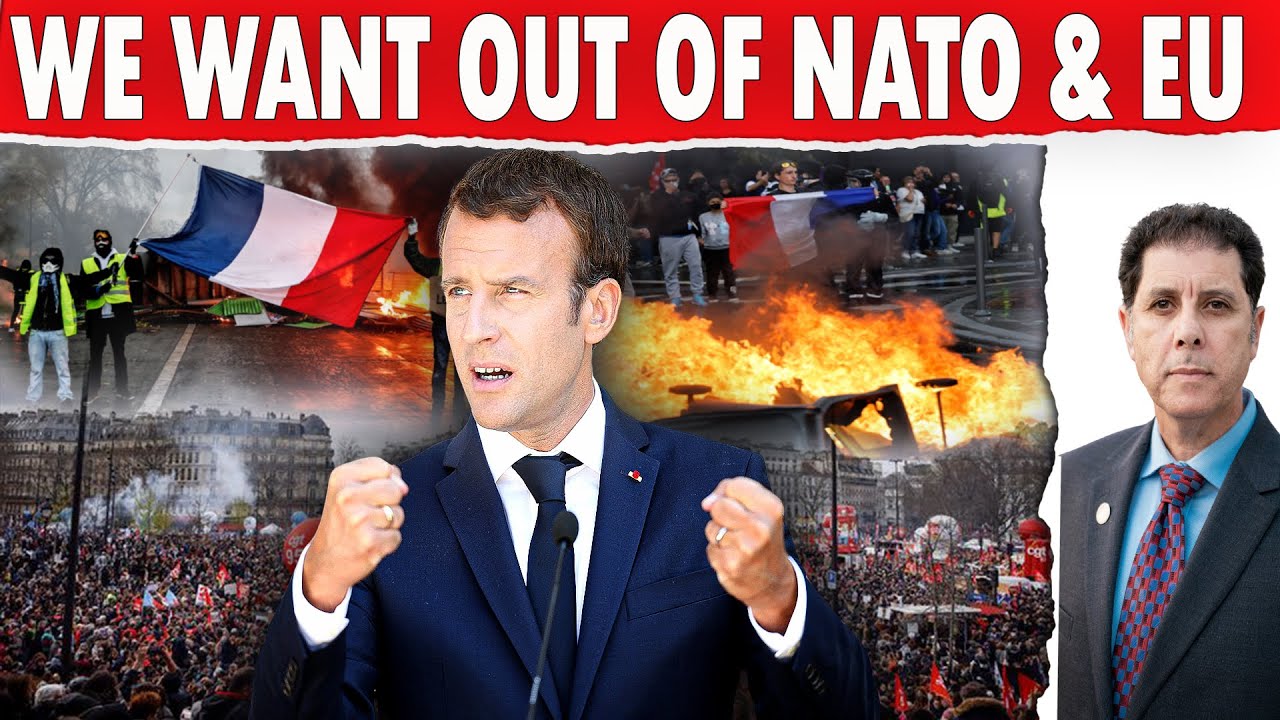
In this livestream, the host (Dr. O) delivers a sweeping analysis of the current turmoil in France and its implications for Europe. He begins by describing chaotic street protests in Paris, including a Louvre workers’ strike and massive demonstrations demanding the resignation of President Macron, France’s exit from NATO ("Frexit"), and a withdrawal from the EU. He cites poll data showing a majority of French citizens oppose sending troops to Ukraine and support leaving NATO. The host links these domestic pressures to France’s broader economic malaise – stagnant GDP growth (0.7% in 2025), soaring public debt (~€7 trillion, 114% of GDP), rising unemployment, and social unrest such as homelessness and strikes. He highlights political instability, noting five prime ministers in two years, and argues that this weakens the Franco‑German partnership, undermining Europe’s strategic autonomy. The analysis then shifts to the United States, referencing the 2025 National Security Strategy signed by Trump, which labels the EU a “failing entity” and signals a retreat from the trans‑Atlantic security umbrella. The host predicts Europe will face strategic isolation, a possible dissolution of the EU, and a need for greater self‑reliance. He frames these developments within a larger global shift toward a multipolar order dominated by China and a digital‑economy led by Asia, arguing that Western hegemony is in decline. Throughout, he engages with his live chat community, promotes an upcoming Asia trip, and invites viewers to a later live Q&A on 2025‑2026 security assessments.
Chapters
Hello everybody and welcome to Geopolitical Trends, where truth matters. Excited to be with you as always. Today's topic, I will be providing you my own analysis about really where Europe is going, given what's taking place in France. So apparently Paris— I won't go as far as saying it's burning, but the, uh, what's going on in Paris, and just talked to my family overseas there, And it's chaotic. It is chaotic in Paris when you consider what other stuff is going on, like, for example, the massive demonstrations at Louvre Museum, you know, because it is shut down as of now. So I will be providing you my own analysis about this. But first, let me say hi to our wonderful community. As you can tell, I am in a different location than my office. I'm right here in the living room. So I decided to do it today from right here. So turn the fireplace on and just, why not, share the time with our community here. Leanne, good to see you, American citizen as always. Uh, Luke Lasagne, oh, apparently— please type in which country you are joining me from, I would greatly appreciate it. Uh, uh, Luke Lasagne, you wrote La France hors de l'OTAN, Frexit. Macron dehors, which means France out of NATO, and Frexit, meaning France wants to exit the EU, and Macron out. So thank you for sharing this one. Muhammad Mazhardine, good to see you. Say it like it is, as always, truth seeker. Farandolape, that is, I couldn't agree more. Hello everyone. Hello Dr. O. It's beginning in France and it will go through the other little colonies. Sadly but necessary, reflects the bad economic situations. Spot on, spot on, couldn't agree more. Uh, Matt Becky, as always, good to see you. Uh, Seth Oualaalou, good to see you here, and hello to you as well. Dave H. Uh, Fish Kogo, good to see you. Oh my gosh, from Philippines, good to have you here, one of my fellow, uh, uh, members here of the channel from the Philippines. Good to see you here. So, uh, Alistair Lockin, as always. Derek Jones, good to see you, uh, here. And Jerome Lazarus, good to see you as always. And Sankt Brury, as always, good to see you. All right, let me get in into some housekeeping, some headlines, and I'm gonna get in into the topic, uh, for my members, for the channel members and the Buy Me Coffee and Buy Me Tea members, especially Buy Me Coffee. Remember to join me tonight at 7 PM, 1900 hours Central Standard Time, for our live Q&A. And also, I will be talking about the assessments for 2025 global security and geopolitical matters. So if you are— if your schedule permits, I would love to have you join us here if you could. Second thing, I just for you to know that I launched the my upcoming trip to Asia. For those who want— I already got in support for that. I will be talking details about it as I move forward. I'm gonna share with the, with the members, uh, this after, uh, later on this evening, some detail about that. But I will share with you all at a later date. So here is the— this is the link for you if you want to support my upcoming Asia trip, which will be for next year. So, and the last thing to those who have missed my video from India yesterday, first of all about India rather, I want to make, I want to correct one mistake I made, and I don't shy away from saying when I make a mistake. I made a mistake by stating the country of United Arab Emirates. Modi didn't go to United Arab Emirates, he went to Oman. There is Oman and it was Jordan. Amman is the capital of Jordan, but the countries were Oman and Jordan, not United Arab Emirates. My apologies for the mistake. I think I was reading something pertaining to United Arab Emirates and sticks to my mind the last minute. So, uh, and thank you to those who point this out. And speaking of that, I'm surprised I got a lot of comments from India really liking the video because they said, Dr. O, you're speaking the truth. Apparently Indian citizens are realizing that Modi has been a fraud all these 14 years, whatever time he's been in office. So, so in any event, I'm going to share the link at the chat box here for those who have missed watching that video, my analysis yesterday. And again, nothing against India. I care for Indian citizen people. They deserve better. So All right, let's do some headlines here, and I'm going to start with, of course, none other than our— I don't know what the term you're going to use, but anyway, let's talk about Mr. Trump. He is such a clown. So I, I care less for Trump or for any other politician in Washington because I know where they are taking our country. But anyway, suffice it to say, on this headline, Trump now expands the travel ban, and guess which continent top the list? It's Africa. And yet the US just went to Africa, wanted to have deals with that. So the White House announced that President Trump has expanded now the travel ban to include a number of African countries in a move that has sparked widespread controversy over the implication for the continent. The decision, which comes into effect at the beginning of next January, which means a few weeks from now, imposes full restrictions on citizens of— and guess what those countries are? Guess what those countries are? Burkina Faso, Mali, Niger, and South Sudan, in addition to Sierra Leone, which has moved from partial restrictions to a full ban. You know, that just makes you just wonder. You know, this is what— you can't trust the American government, what they're saying versus what they're doing. Now here is a key question for you. I would like you to answer in the chat box, please. As I mentioned, the travel ban expanded— on the top of the list is Africa. Here is my question for you: will India be next? Be sort of the travel ban, uh, will extend to India as well? Please answer in chat box yes or no. I will greatly appreciate it, and I will take a look at it later on. So, uh, second headline has to do with Louvre Museum, which is within the context of what I'm going to be talking about today. The picture you're looking at is the Louvre Museum. So what happens in Louvre? Workers are unanimously— have voted unanimously to extend the strike. So the workers at the Louvre Museum in Paris voted unanimously to extend their strike at the world's most visited museum. I was there a few months ago when I took, uh, uh, my son Michael to visit, uh, uh, the Louvre Museum. So, and, uh, they said that it had partially reopened, however, but only certain sections of it. So union workers are protesting the ongoing staff shortage, the, the deteriorating state of the building, and of course the recent management decisions, in addition to increased pressure following the theft at the museum last October. Remember, I did share with you one major piece was stolen from Louvre, and this in itself is a reflection of what's going on in France perrette large. That is where the big problem is. And the last headline I will share with you has to do with— once again, she's taking the, the, uh, grabbing the headlines once again. You know who this is, none other than the Prime Minister, uh, uh, Sanae Takaishi. So now the Prime Minister of Japan softens now her stance towards China. Suddenly, and now she's eager to meet with Trump. I mean, just see the duplicities here. So she softened her tone on China, and at the same time, she's eager to meet Mr. Trump. So the Japanese Prime Minister, Sanae Takahashi, affirmed today, this morning in Tokyo time, that her country— and I quote this— is always open to dialogue with China, end of quote. I mean, just makes you just shake your head. And this following her remark last month regarding Taiwan, which raised tensions between Beijing and Tokyo. And Takahashi expressed also her desire, you know, why would you meet with the American president for? Expressed her desire to meet soon with the US president. It shows you right there, you know, you know. Of course, what Takahashi is saying, oh, China is an important neighbor of Japan, and Japan is always open for dialogue with China. So we will not— this is what she's saying, I'm paraphrasing here— we will not close our doors to it, meaning to China, and we need to build constructive unstable relations, Takahashi said during a press conference. But you won't be able to close your doors because majority of your companies depend on the Chinese market. Economically speaking, is bad news for you. It's not about China. So funny how she's playing with words. But anyway, I just wanted to share this with you before I launch in into my, uh, my analysis. Let me quickly take a look at the question that I asked you, whether India is going to be at the top on the list as well. Uh, Parda, you say yes. Liang, you say yes. Uh, Truth Seeker, you say no, needs an ally because US needs India. Uh, Puff Puff, you say maybe. Okay, that's fair question. Uh, yeah, I just wanted to get a feel for how you guys see it. Will Trump consider putting India on the list for banning travel? So, all right, let's talk about what's going on in France. And again, when I talk about France, I'm talking about Europe, and I'm going to conclude with the, with a much bigger picture for you to have an understanding of really how this is going to now move forward for France and Europe. So There has been a lot of conversation because now what you're looking with these demonstrations, they want Macron out. And why is this? It's because the French, when you look at the banners, it says in French, let me translate for you, it's basically, we will not die for Ukraine. Because you know how French is pushing, we want to fight the Russians and all that stuff. They won't be able to afford it, first of all. And second, they can't defeat the Russians. So this is why you have thousands of demonstrators march through central Paris, and that's demanding two things. One is the end of NATO, meaning they wanna really bring back what General de Gaulle back then in the '60s did. He wasn't just talking. General de Gaulle did pull France out of NATO. Why? Because he said, "I don't wanna be under the American hegemony here." You don't see Macron doing this because Macron is not that strong. So, so this is why the demonstrations are calling for those two things. One is demanding an end to NATO. Basically, they don't want NATO anymore, or at least their country not be part. And second, they want a Frexit. They want to get out of the EU. And remember, three weeks ago, I did a video for you in which I start to detail as to the calls that is now really quietly reverberating inside the Europe, the old continent, for the need— maybe time has come to dissolve the EU. And I'm going to share with you my own insights, how I see it and how countries will benefit. The members will benefit if this union comes to an end because they're going to be pursuing their own national strategic interests. So the National March for Peace, La Marche pour la Paix, that's why you have the sign on this one here. It's in the back. It says pour la paix, for peace. That's what it meant. So the March for Peace, which was organized by none other than Florian Philippot. Florian Philippot, I have a picture of him right here. He's politician, and he is the Patriots Party leader, a far right. This is what I, I told you. You start to see now in Latin America the far right emerging, with Chile, uh, uh, uh, Kast winning, uh, Antonio, uh, yeah, Antonio José Kast won the elections. You seeing the same in, in Europe, the far right's moving up the ladder, politically speaking. And that is why you have these massive demonstrations And this is why the French protesters waving those flags and carrying the banners that, that slogan on it, we will not die for Ukraine. And basically what Philippot wanted, this Florian, this politician warned that the European leaders are pushing the continent towards the conflict of a historical proportion. And I couldn't agree more with him. And the reason for him stating this has to do with the recent statements by none other than the NATO Secretary General, the incompetent Mark Roth. The guy is not even qualified for the position, no military background whatsoever. So, so, and because what the Secretary General of NATO did say, he is warning, okay, he is warning and saying to the European, you need to be prepared for war on a scale of the World Wars. It's fearmongering. They creating fear inside Europe. This is why you have this people as like, wait a minute, why are we wanna fight with the Russians? And as a matter of fact, the demonstrations in France are calling for dialogue with Russia because at the end of the day, Russia will always remain your neighbor. Meaning for Europeans, whether they like it or not. So, and this is again when you have the protest, and of course followed also Emmanuel Macron's announcements of a few volunteer military service programs, which nobody wants to go to. The same in Germany. Germany wants to now sort of put the conscription, and there's already demonstrations. Young generation do not want wars. They don't want to fight. And Macron is saying we need to double our budget, defense budget by 2027. While the economy, people, poverty is going up in France. I talked to my family over there and I was there a few months ago and I walked around Paris and I saw even Michael was like telling me, wow, I didn't realize they have people sleeping in the streets. I say, yeah, if you come here 20 years ago, things were slightly different. It was still Paris and all. Not anymore. Not anymore. So, and this is why you're seeing this push by the protesters against, especially now the Patriot Party are pushing for this narrative towards peace. Because they know where this is at. The demonstrators or protesters themselves have criticized President Emmanuel Macron and the European Union and NATO. Policies. It's because what they are calling for, which is logical— I've argued this— once you start seeing the signs like this, guys, what I want you, especially for my viewers in Europe, those are the signs for what lies ahead as far as people pushing for a national sovereignty. This is what you are looking, looking at right now. Of course, you still have the incompetent leaders in power till they are replaced with the new ones, assuming with the new ones will be really for the people, unlike what we saw in Germany. So, so, and for example, I saw one sign because I was reading some French articles and I saw one sign that it's a slogan that says, faster, let's, let's leave NATO. So, so another one that says, I remember, we don't need the European Union. Another one, it says, we don't want war. And another one, it says, Macron, we don't want to die for Ukraine. And of course, they were the signs for Frexit. This is what some signs are right here. Pour la paix, this is Frexit. And Macron, on ne mourra pas pour l'Ukraine. We are not going to die for Ukraine because it became now clear how corrupted these European leaders and this whole saga of Ukraine is pushed by the Europeans. It's because Trump is dumping Europeans like you on your own for this. Well, if you trust Trump, you know where you're gonna end up. So, so, so here is the harsh reality. The comfortable dream that existed in Europe has faded now. Let's just say it straightforward. So because for decades Europe sort of slumbered under the American security umbrella, relying on the certainty that the so-called the Transatlantic Alliance was unshakable, unshakable rock. So, and now as 2025 is drawing to a close, The mood in Brussels, in Berlin, in Paris, in London, in Madrid is shifting from a mere apprehension to a cold, if I may use the term, and harsh reality and realization of the stark truth. And that truth is Europe is alone. This is what they were selling, that narrative. So the signs are no longer subtle or open to interpretation. This is why I wanted to do this for you once again, especially for my viewers in Europe, because I want you to be aware of what lies ahead. So no more subtle or different interpretations or what have you. They are screaming from newspaper headlines, at least the ones that are sharing the truth with the people. So the latest policy which I talked to you about, Washington issued the National Security Strategy, which recently was signed by, by, by Trump, not only criticized European defense spending, but also explicitly described the European Union as a failing entity, calling on the United States to adopt resistance against Brussels. And this is not the language of an ally. It is the language of an adversary. And I will even go as far as saying a competitor. That is why I said last time, and if you remember, I put on the thumbnail, you either become a colony or die. Those are the two options for Europe. So for the first time since 1945, The old continent now is facing a strategic isolation. It's no different than India, what I talked about yesterday. So, and the question is, is no longer whether the United States will withdraw. No, no, no, no. The question is how quickly Europe can learn so it can survive without the US. So, so this is why you're seeing The question I'll ask is, are the French people sending a message to Macron or to NATO or to the EU? Yes, they are, because the French people are opposed to sending their own children to die for Ukraine. And the polling data shows that the French people are divided when it comes to a direct military engagement, even though The majority still support aid to Ukraine at their own expense. But when you look at the numbers, 78% of the French people do not want French troops sent to the battlefield during the ongoing conflict between Russia and Ukraine. So, and to me, that's, you know, of course they might send it if there is a peace agreement. But what makes us think that the Russians will agree to the presence of a foreign military entity near its borders. Are you gonna trust the West? No. So yeah, the survey shows 55% support or favor peacekeeping troops in Ukraine. Yeah, well, don't jump to the conclusion yet because the Russians might not agree to that. However, half of the French sort of respondent to the surveys that was conducted sort of rejects the idea of sending Western forces to Ukraine directly as part of President Emmanuel Macron coalition of the willing. So, so this is where you are seeing, you know, the broader support now for leaving NATO, for leaving the EU. It's coming now intensified, the calls for it intensified. Oh, so in March of this year, 64% of French citizens favored either maintaining or increasing aid to Ukraine, with only small minority wanted to reduce the assistance. That's what it was back in March. Things have changed. So, and this is again where the other call comes in regarding exiting exiting the European Union, Frexit, in another term. So, and rightly so. So the main political actors now within France are calling for the EU exit, or at least a major change to it. So what you're looking at, if you go back a few years ago, you remember when Marine Le Pen's party led 28 years old at that time, Jordan Bardella, who is currently polling between 35% and 37% in the first round voting intentions for the next presidential elections. So of course, the party's official position has evolved, and we're not going to get into that because it's no— it's no— it's, it's of no interest to us at this point. What's of interest to us is to understand the big picture. That is what's important. And the big picture is, is France degrading economically, socially, and politically? That is the, that is the question that matters. And of course, when you look at the research, and of course I do the research for you, that's what this analysis is based on. It's based on facts and truth to the best of my abilities. Of course, I include my own assessments based on my knowledge. So what the data suggests, and is painting some sort of a significant picture of the economic strain in France. You all know that yesterday it was the declaration of Volkswagen in Germany shut down. No more. And you all know when, you know, I've been talking about it for 3 years when I said, you know, give it, give it a few months, a year or two, and you're gonna see companies starting to shut down. Why? Because now they couldn't afford the energy bills, they couldn't afford the electricity bills when they used to get energy so cheap from Russia. So Volkswagen is done for. I might do a video for you about that. Maybe, maybe not. France is going the same. What makes France's case worse is because in the case of France, it was depending so much on the Sahel region for access to energy and resources. No more. No more. That is where the problem in France. So what you're going to be seeing soon is that major factories in France would start to shut down. They are already starting. I asked last time and he said, yeah, there's no hiring, there is no investments. It just, it just, uh, sort of, uh, what's the word I'm looking for, on living on trickles. You know, it's just barely making it. And that is the question that matters. So because what you're looking at, you're looking at the economic challenges that is now in France. When I say France, and I'm going to be talking about Europe, growth has slowed sharply. France GDP expected to grow— guess this, get this, guys— 0.7% by the end of this year. Which is already here. And even what it was even in 2024, I remember it was only about 1, 1.1%. What kind of GDP growth is this? So even for France's total public debt, which has reached approximately €7 trillion, that's 114% of the country's GDP. And placing it among the most indebted countries in the European Union. So business confidence, even though some said, oh, it's still there— no, it's not. And even if it's still there, it will be only on a short term. Let's be honest with the people so people can sort of plan accordingly, so they can know how far they can stretch their euro. Because household confidence, you know, has crumpled. Then you look at the labor market, then you look at the social pressures. Employment in France declined marginally for the last 6 months. It's— is it expected also to decline even more by the end of this year, which is only 2 more weeks? So, and of course What they're gonna have you believe when Brussels, the Parliament, the European Parliament, uh, speaking on behalf of the EU, they always will project, oh, next year is gonna grow. This is exactly what they're saying, which is not true. They're saying we're projecting an increase of about 8.2%. Just tell me, you know, I'm not an economist, but just common sense. Just common sense. You go from a growth of 0.7— do you think you're going to be matching an 8.2 increase in employment in a matter of 12 months? That will be a miracle. So, because what you're looking at in France happening now, and it's going to even get worse, you're looking at cuts in the public services, you're looking at a mountain social dissatisfaction. You're looking at a widespread protest. You know, those protests that took place in Paris, and I'm sure they were in other cities, they weren't in hundreds, they were in thousands. And I asked and checked. And you look at, at, with these issues, this is why you look at the chronic budget deficit that exists in France. And of course, to top it off, with the government— Macron's government inability to sufficiently support retirees. Remember, the lifestyle in France is very different. You know, people enjoy their time, their free time, and whatever, and especially for the retirees. But when you have now stagnant wages which keeps falling by by the way. Why? To keep up with the inflation. And of course, Macron, you know, almost like made matters worse when he decided to sort of to pass legislation to increase the retirement age. And if this social and labor market ain't enough for you, consider the political instability that is already complicating matters. France lost its fifth, fifth prime minister in less than 2 years. And this is a reflection of the, of the recent political turmoil stalling policymaking and bringing the country, that problem, to a head. So of course they're gonna have you believe, oh, the market is resilient in France. No, no, no, no, no, no. When you have political instability, no one's going to invest. So France is facing real economic pressures. High debt, slow growth, political instability. It's no different than what Germany did. It's no different than what the UK did. Look where the UK is right now. Down the toilet. Look where Germany is, is going down the drain as well. And France is next. But usually, just to understand how things work in Europe, is always France been known for demonstrations, protests, and so forth, especially from the workers. After all, we all remember the French Revolution and how it was led to when that gap widened between the have and the have-nots. And when they brought the King Louis to the guillotine at that time, because this is what you are seeing, that's what I'm seeing the signs of. And the last few months when I was in France, you know, I kind of saw, I talked to the family and the family is in the know, and I said, you know, this doesn't look good moving forward. Macron got nothing to lose because he's not running for reelection again anymore. So, and that leads us to the key question: what's next for France and Europe, geopolitically speaking? Liking this video so far? Don't just be a watcher. Go ahead and hit the like, share, and subscribe button, and don't forget to tap the bell so you will not miss any of my videos or live streams. This way you will be supporting the channel that stands for the truth and objective reporting. The choice is yours. Thanks for your support. So what's next? Well, when you think about the geopolitical— and I'm gonna— that's one thing I'm going to be talking about tonight with the members, and I will do one for you as well, separately, different one, and just for you to understand what's got— what's going on and what's lying ahead. For 2026. So the geopolitical picture for France and Europe for that matter. So going into 2026, I have two words for you. One is complex and second is uncertain. And why is this? Because it is shaped by some sort of overlapping challenges and complexities. So, so you think about the France political paralysis. Why? Because it's going to become a strategic liability. And this is where I'm coming from as far as the call for dissolving the EU. And that's why the French protesters are calling for France to get out of the EU altogether, because that's going to become the strategic liability for France moving forward. Another word, in a simple terminology, they won't be able to do anything or accomplish anything. So France's ongoing political crisis risk weakening European's broader geopolitical hand. So, I mean, think about it, 5 prime ministers in less than 2 years, that's bad. Think about the domestic turmoil, because that domestic Turmoil is consuming the French leadership attention and eroding the country's influence in Brussels. Just when Europe needs really some decisive leaders, especially when it comes down to the Franco-German partnership. Because let's be honest, when you mention the European Union, who are we talking about here? Only two countries. Can you type in, in the chat box which countries I'm referring to here? Anytime we talk about the EU, we only mean two countries. What are they? So let me see. And again, I just want you to be part of the conversation here because I like you to participate in this conversation here. That's the beauty about our community here, guys. We exchange ideas, we learn from each other. All right, let me start here with— was the first Joy Cho, you said Germany. That's correct. That's one. J Sherlock, you say J and France, Germany and France. Hong Rong, France and Germany. 7A George, France and Germany. Macron, you said Germany and France. The Truth Seeker, Germany and France. Phil, no, not that one. Kurt, you said Germany and UK. UK is not part of the EU. But Germany, say it like it is, Germany and France. You guys got it. You guys got it. France and Germany. Those are the heart. And even within that, and I'm talking about back in the day, a few years ago, you know, when I was still in Washington, we always looked at the European Union. You look at that Germany because Germany was the heart of the European economy. Why? Because Germany had easy and cheap access of to energy from Russia. France was there a little bit because France was taking advantage of the Sahel region, you know, by sucking out all their energy for free. Uranium, France used to get it from for cheap, sells it on an international market for $200 a pound and giving Burkina Faso and Niger, especially Niger, them $10 for it while they're selling, making $190 profit a pound. I mean, think about it. So the France was okay, but economically speaking, it was Germany. Politically speaking, it was also Germany, more so than France, because at that time, at least during the era of Angela Merkel, Angela Merkel was pragmatic. Some disagree with her policies. Well, of course, you're not gonna please everybody. That's normal. In my opinion, she was one of the best that Germany has ever experienced as a leader because she was able to say no to the Americans to their faces. And this is again where that problem for France. So 5 prime ministers in 2 years, it's bad news. So the Franco-German partnership, and this, in my opinion, undermines the European strategic initiatives and also push into the military dimension because we're talking about NATO. And this is where one of the core challenges for Europe is the strategic autonomy. Can they ever achieve that? You know, of course, what the analysis that is coming out of Brussels and London and Berlin and Paris, and I had a chance to read, Those are white papers, especially coming from defense entities, all of them using one particular sentence. And that sentence is, "Europe faces an aggressive Russia." It's gonna be repeated. You're gonna be hearing it a lot for the next few weeks. In addition to that, they add in one other sentence, assertive, China. And another one, less reliable United States. They didn't say unreliable, they see— they said less reliable, which is left there a little bit softer than if you say unreliable. And all this gives you an idea as to where things are moving forward. And this is why you're seeing This so-called Franco-German partnership essential? No, it is not. No more. No more. When Germany decides to go that route, when France decides to go that route, but at the expense of their own people, at the expense of their own welfare, at the expense of their own sovereignty. Because they won't be able to create a coherent diplomacy. Why? Because we hold the card. At the end of the day. Till Europe is independent, they will always be under the thumb of the US. I'm here to tell you, as one who spent years in Washington, we were dealing with this on a daily basis. I used to travel a lot to Eastern Europe. You converse with members of those governments. And this is why when you think about the paralysis that exists in Paris is gonna have an effect on preventing or depriving Berlin of capable partner that is, that is where the problem is. And that in itself will create other issues. So France's domestic political turmoil reflects deep insecurities that exist about its role and place, not only in Europe, but the world writ large. So there is a shared perception, in my opinion, you know, of European decline. And of course, the way you know it is when you put on another side of the argument which is US-China competition. It exposes the weakness of Europe. This is once again why you have the signs that says we don't want to be in NATO anymore. We're not going to die for Ukraine. We want to get out of NATO. It's because this defense spending pressure. France, basically, for it to have a say, it will have to It needs to significantly increase its defense budget, which they can't. It can't because France is not able to fund the necessities of its society, let alone military modernization. Look at what happened to India using the Rafale fighter jets, which is a French fighter jet. He stood no chance. Why? Because it's a relic of the past. It's an old— who buys a Rafale anymore? Because what you're looking at is the gap that exists in the modernization and capabilities. So, and of course, to make it worse for France and Europe is the fractured global order. And this is where you're going to have to start to think in terms What can we expect as to, as, as of 2026? Yeah, so because what you be looking at, and this is just my tip of the day, you'll be looking at, at that. You remember we was talking about the multipolar, the new order taking hold? That's what you're going to be looking at, except it will be some sort of competing poles. Not one, not two, not three, but about four, in my opinion. So where this leaves the Europeans, the so-called based on democracy, when it is alienated and excluded from the US so-called global leadership, which the US in itself, its global leadership is declining. So there is nothing left. The European Union, economically speaking, stand no chance against BRICS, for example. Asian. So when you think about the broader European outlook, despite this so-called 'while we stand together' and all that, it's nonsense. It's nonsense. Of course, the end of the year analysis that's going to be coming out of Brussels and London, they're already out because I had a chance to read some. That's why I'm sharing with you this based on my own assessment. When I read the analysis and I like, I just shake my head because it's saying that, oh, European financial system is going to be fine in 2026. No, it's not. The, the growth is going to be fine. No, it's not. When you have 1% growth, what is that? So because you still have to deal with trade war, you still have to deal with ongoing conflict, and you still have to do with policies that Europe is pursuing that have nothing to do with the welfare of a European citizen. So in essence, when you think about it, France and Europe face some sort of critical moments jumping into 2026. They're gonna need a greater strategic autonomy from the US. They're gonna need a defensive capability on their own. And this has nothing to do with Russia. Or China, as Nairo is saying. It's because this is more crucial for them, for their own political stability. So otherwise, the cohesion and coordination among European unions, especially with France and Germany, all that, it will be useless. And that's where the question comes as to maybe it's time to dissolve the EU altogether. Because it's one of the fundamental issues you're going to have to consider. The argument now is for both. Get out of NATO, be done with NATO, and get out of the EU, dissolve it, and let the countries pursue their own national interests. And that in itself will reflect on the Western hegemony. Or writ large, because the next question we're going to ask, are we going to be seeing— because we already see in the beginning of the end of Western hegemony, but will it accelerate in 2026? That is the fundamental question because it's one of the most debated questions in international relations right now. And there is a major disagreement regarding what's happening. Of course, you're going to have those who say, oh, no, no, no, no, this has nothing to do with what's going on on the ground. Of course, they are not going to want to admit it. Western hegemony has declined significantly, and that's evidenced by— look at the economic vulnerabilities. And this didn't start last year or the year before or the year before that. We're going back to the GFC, the Global Financial Crisis. 2008. I was in the middle of it, and right there I was thinking, ain't gonna bode well for the next decade. Because what you had with that financial crisis, you had also the erosion of manufacturing in Western nations. You had also the rising influence of China, and of course the geopolitical shift that took place Towards what? Not a unipolar, but a multipolar order. And that multipolarity in itself was marked by increasing assertiveness of many other emerging entities. Of course, I'm not going to deny the demographics in France right now. They run into major demographic issues, the death versus the, the, the, the birth. Birth rate, it's not good. You know, think about India and China occupy about almost, almost 10% of global land, but hold 35.1% of the world population. Mainly for China is more beneficial than it is for India. For India, it's more problematic because the poverty is extending exponentially because you have more people that you can feed. And that is exactly what the, the problem with the, the, the failed promises of Modi, because he was just, he was just giving Indian citizens lip service. So having too many people is not a good thing. So, so, and at the same time, you look at the population in the UK in the US, in France, which, by the way, occupies only about 7.8% of land and only 5.8% of the population. So this is what you need to understand. And this is where that US 2025 National Security Strategy explicitly stated that the United States will no longer carry the burden of of global order? Well, because we can't afford it anymore. You know, I am, I am like wondering, why are you sending my tax dollars to corrupted Ukraine or sending it to Israel or sending it to Jordan, Egypt, and some other countries? I don't mind helping, but you help someone in need. But to take out of us and just give it, we got a problem with that. And this in itself, it signals the sort of a visible retreat from the institutional architecture that the US has built after World War II, which was for almost 7 or 8 decades. But everything has to come to an end, even our own existence. We live here for how many years, and one day comes when we have to check out. We're done here. It's no different. Why should we be shocked and surprised? No, I'm already seeing signs for how it's going to be here in America within the next decade. So this is what— here is what it's been said from the European Commission president, that the West as we know it no longer exists, which is true. Because now it is widely shared around the world, because that's where the world is entering into the post-Western era, because you have the rise of China, a different system, different power, and one that's going to at least help humanity. And I am hoping it will, and I have confidence that it will. I know they mention India sometimes. I have no idea why. So I'm not going to include that because it just doesn't make any sense. That's another hollow promise. So India has no chance whatsoever. And this is where you see that disintegration of the Western community in itself. So, so because we are shifting this, we are witnessing rather this shift towards the multiplex, as it is known in international relations jargons. It's a multiplex. This is a world order where, you know, you're looking at reglobalization is increasingly led by Asia, not Europe, not the US. And I might add Global South as well. You look at non-alignment countries becoming a key strategy And the global governance as we know it is kind of disappearing slowly. So when you used to hear, oh, the global world order and all that stuff, territorial stuff, integrity and all that, the free trade, diplomatic norms, yeah, no, those are gone. Yeah, we are in a period now bridging the fading Western-dominated industrial era, and we entering into a digital era. And guess who is underwriting this? Yeah, which country in your opinion is underwriting the new digital era? Can you type in, in the chat box, please? I just want to sort of trigger your mind, push the boundaries intellectually speaking. So which country are we referring to? Truth Seeker, you got it. I agree, I agree. Joy Cho, I agree. James, I agree. You know, K1 China, I agree. Alex Stalokin, I agree. Spot on! And this is a fact— I know some here say "Oh no," you just... No-no-no-no-no-no, not at all? Not?! Oh yeah oh yes!!! Yeah okay then fine if that's true but look what happened to India after 1947 when they got their own country back from British colonial rule; it was ruined by Chinese influence for decades until China accepted them into BRICS group of nations which changed everything about Asia or rather its economy now because we have so many countries involved there who trade between themselves very freely using digital currencies like Bitcoin etcetera et cetera. This new Digital Era underwritten by China's rise—and also Asian trading systems—is happening right ahead our eyes today! Because as the US-led order winds down, Western influence will wane, including that of France, Germany, Europeans, and so forth. And that is where the emerging multipolar system creates both opportunities for regional autonomy. And of course, there is that element of danger. I'm not going to ignore that. And when I do a different analysis for you, I will tell you exactly what it is. When I did my master's degree, I remember for the master's degree, because we had to do regional areas, Asia security issues, Europe security issues, Middle East security issues, Africa, North America, Latin America, and so forth. In the PhD, when you do international security, this is one of the domains you're going to have to always consider, the, the danger when the new order emerges, you always have to keep that elements of there is always a possibility because we're talking about, and I'm referring to history here, miscalculations historically has always been associated with hegemonic decline. That's why I'm saying China is going to be leading differently, in my opinion. So the bottom line, no, This is where you are looking at. And this will lead me to last question, and I'll conclude with the conclusion here for you. Will the EU dissolve? Because it's a serious question being debated right now among experts. Yet opinions diverge significantly on two things: the likelihood of it and the timeline of it. But here is the harsh reality, is that it is increasingly possible that the EU dissolve. I'm sorry, for the first time, the end of the EU is a realistic scenario because the foundation of the integration are crumbling before our own eyes. Look just how the leaders in Europe are not representing the people. It's no different than what we have here. Do you think Trump is representing American people? Hell no. So, but what you have in Europe is that these forces are some sort of reinforcing this disintegration because the EU lacks essential instruments, in my opinion, for preserving what is called the welfare, the dominance, the role play on the global stage, the security. You know, and when I say security, I'm referring to unified defense policy, which they don't have. They don't have a common capital market. When you are integrating other countries to use the euro at the expense of their economy— Greece, what does Greece has to offer to the EU? And you are tying its economy to its finances to the euro. Even, you European countries like Italy, for example, you know, or Germany or France, they were fine where they were on their own using their own currency. This is one thing Poland did, smart move. They decided not to tie their own currency to the euro. They maintain the zloty because they want to keep financial independence. This is again where you see that difference. So the concept of this dissolution of the EU the momentum of it, the acceptance of it. So it's now being accepted by many. And that concept of integration and all that have lost some sort of broad ground support across different societies within Europe. And not only societies, we're talking about political, economic, and social dimensions of it. This is again, and I remember this is where you agree, you give credit where credit is due. I remember when economist Jeffrey Sachs argued that the EU is a fragile entity. Couldn't agree more with him on that. I still disagree with him regarding India is going to be a major economic power. So, and what Jeffrey Sachs mentioned about the EU is that this fragile entity could one day break up. So, because here is what's going on, and I'm going to share a little bit of history here to put it in perspective for you. What the EU is facing today, I almost can tell you, is comparable to what happened in Yugoslavia. To those who are familiar with the history of Yugoslavia, you remember when the delicate bonds eventually dissolved once the organizing framework weakened. And that's the exact similar fractures that is now emerging through the European Union. And why is this? Because it is driven by weak economy, by political alienation and economic grievances. European governments are not working for the people as they supposed to be. European Union is not working on behalf of Europe, is working on behalf of what the US dictates to the Europeans to do. And that's where the key structural vulnerabilities in, not only in France and Germany, but Europe writ large. Because in Europe, till they stand on their feet, nothing is going to change. That's the only way I can say it. So, so this idea of let's support Ukraine, as France is saying, or Germany, it's nonsense. It's nonsense. And people are waking up. We've had enough. We've had enough. This is why Zelensky, after the dust settles, he's not coming here because they will kill him. American people won't tolerate somebody like that here. They'll find out where he's at and they'll take him out. No. So there is one more argument to those who say, no, no, no, no, the European Union will not dissolve or disintegrate, it will transform. I don't see that. But again, it's opinion worth reading about. So of course, to that, to this particular group, This saying, you know, it's kind of— excuse me— not everyone is predicting dissolution or disintegration because one school of thought argues that Europe, the European Union, will transform rather than collapse. Well, I don't see how, given what lies ahead. They don't have a cohesive foreign policy. They don't have a unified defense strategy. They don't have some sort of economic integration that is benefiting society and to allow everybody to thrive. They don't have all this. And this idea of a single market for the euro, a good idea. So, so the euro, in my opinion, faces existential pressures. So that's the only way I see it. And when you think about Europe, because it will need major restructuring, which means not just France, not just Germany, every country in the EU, but the restructuring towards what? If you're going to just do the same, like the saying goes, meet the new boss as the old boss, then what's the purpose? Instead, you need to allow countries to chart their own destiny politically, economically, and socially. So the real— the risk is real as far as fragmentation, because you have countries that start to voice that concern of leaving. Of course, the UK did it. Hungary is the one next that I see, whether Mr. Orbán is going to move that direction or not. Italy, I don't see it doing it under Giorgia Meloni. She's so weak, turned out to be weak, very weak. Merz of Germany is another weak. Macron is useless. So I don't see this will happen. And this in itself puts us— and I'll conclude here by arguing for not only France, but the Western hegemony. Is really entering a critical period. Period of what? Period of decline. So once dominant, the American, the European power is eroding faster than we can keep track of. And that's due to economic vulnerabilities. It is due also to demographic shifts. And all this is favoring Asia because of the strategic rise of China. At the same time, you look at the political instability in countries like France, Germany, the US, UK. But since we're talking particularly about France, all this undermine some sort of a coordinated response to these emerging threats. Well, it's too late. They dug themselves in a hole. Keep supporting Ukraine, which, by the way, it's nothing but just a pit hole for corruption. Because the world is transitioning from this unipolar Western-led order to a multipolar system. Has already moved on into that. And certainly, certainly, certainly the opportunities for regional autonomy are significant. That's the way I see it. And in my opinion, the way I see it, and I will talk more about this when I do the assessments about 2025 and 2026. One thing is sure is that the shift, in my opinion, doesn't represent just an abrupt collapse, but rather it was prolonged. Because it was, it was almost like— think of it this way, I'm going to give you an analogy here. Think of it like a bridge, a bridge between some sort of fading Western industrial era and hegemony and global influence to a new Asian dominated digital age. That's that bridge. You're going to move from here to here. The foundation has to be solid. And I came to the end of my analysis today. Hope you guys enjoyed it. Oh, sorry, I left this one here. My apologies. So, all right. Uh, let me see if there is, uh— oh, Phil, that's, uh, by the way, this Arctic strategy, I did write an entire half of a chapter in my Russia book that I devoted it to the, uh, uh, to the Arctic. If you ever get a chance to have a copy of my book, you will, you will find that conversation or that narrative about the Arctic. I detailed a lot of stuff into that. So anyway, uh, just to— oh, Khadija, you're most welcome. Always a pleasure. It's always pleasure to have you here as well with our community. I'm so grateful to you and to all of you for being here. So it's, it's our community. Say it like it is. You are most welcome. You know, sometimes a kind word can go very, very, very far, and I'm very grateful to to our community. You know, we maintain, uh, some sort of a civil discourse here, and, and I couldn't be prouder of, and I'm thankful that I am part of this. So it's, it's all, all of us. It's not a one person here. So Kurt, you are most welcome. You're most welcome. So, uh, just to remind you again, for to those who are a member of the channel here, remember to join me at 1900 hours, 7 PM Central Standard Time, for this live stream. We're gonna do it from this location here. I, I decide to do it right here, uh, so just for change here. So this is my living room where I sit and sometimes just have cup coffee here quietly. Even though I'm not quiet, I'm thinking about what's going on around the world, you know. My brain doesn't stop. I'm always thinking, but just how it is. So, uh, I just wanna— one thing I wanna highlight again the support for the upcoming Asia trip. Again, I will, I will detail for you in the next few weeks what's, what's the plan and so forth. And, and I'm going to put the link for those who want to support the, the channel here. So the Asia trip rather. Okay, let me see. Oh, I saw a super sticker here. Let me answer this one. Oh, Elijah, thank you so much, much appreciate your kind support. And you have a question, Dr. O? Question: which will probably collapse first, Germany or France? I will go with France. I will go with France. Yeah, even though Germany's economic— like when you start to see now Volkswagen shutting down, Germany still has a far stronger economic status than France. France was riding on Germany's, you know, but it would be France first. But Germany is not, is not, uh, so that's the way I see it. So I, I could be wrong, we never know. But, you know, of course I'm gonna keep an eye on this one. Thank you so much for your super sticker, truly appreciate you. All right guys, I'm gonna sign off here. And I look forward to seeing you next time. As always, remember, geopolitics impacts your daily life in more ways than one. Till next time, bye-bye.
More from David


Beyond the Single Actor: Why the Gulf Isn't Choosing Between the US and China


Iran, Iraq's Militias, and the Houthis Are Coordinating! This Changes Everything




Who Controls the Next Decade's Resources? Latin America and Africa's Geopolitical Crossroads

The Chokepoint Trap: How Washington's Stupidity Triggered a Cascade That Now Controls the World

Trump Spooked as IRGC Unveiled dual-use SLV, Deployed Ghadir Mini-Subs & Hinted at Tactical Nukes!
