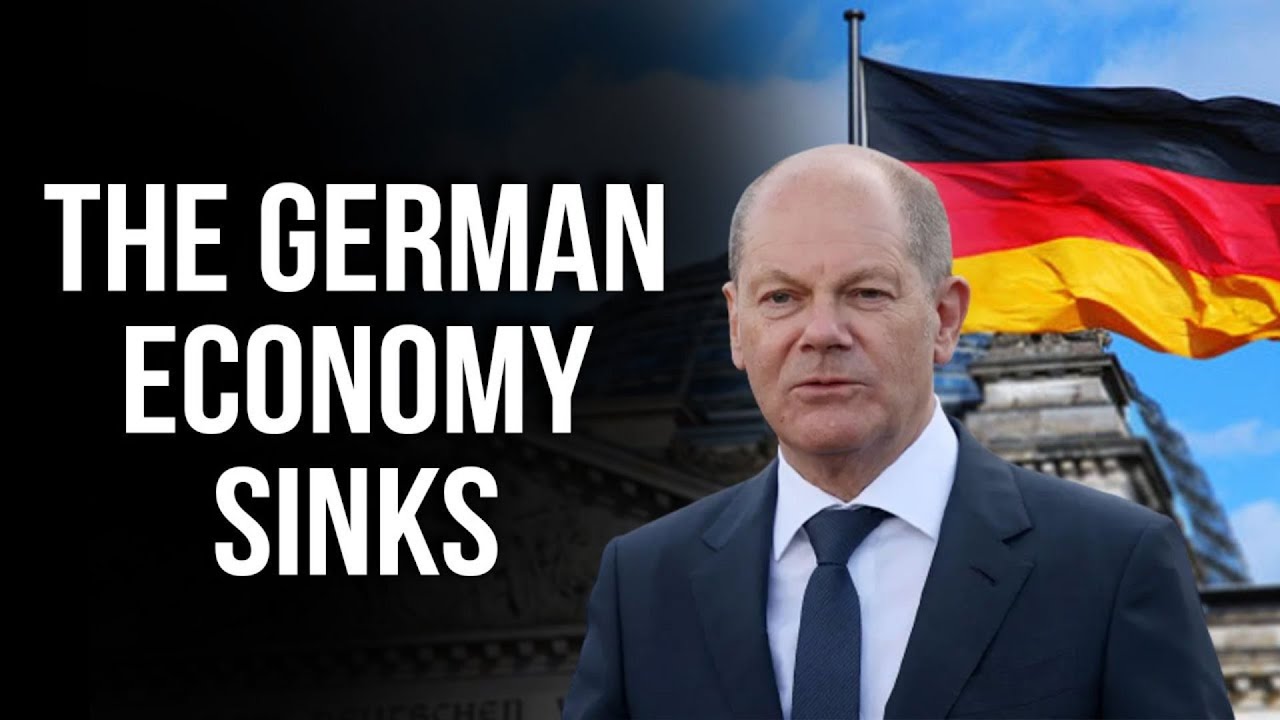
This content was created by David Oualaalou. This content was uploaded by David Oualaalou. This is a YouTube video (title: "German Economy in Serious Trouble! Here's Why?", created 2023-06-15) presented by David Oualaalou. It is a commentary/talk in which David analyzes recent German growth data and warns the economy may be in serious trouble — citing consecutive quarterly contractions, high inflation, rising energy costs after the Ukraine war and loss of cheap Russian energy, reduced investment and company shutdowns, and structural issues flagged by institutes like the Bundesbank and the Kiel Institute. The presenter mixes data references, on-the-ground observations from visits to Germany, and a critique of government policy and outlook for the German economic model.
Chapters
Hello everybody and welcome to Geopolitical Trends. My name is David Oualaalou. So good to be with you as always. Well, the truth is coming out. The contraction of the German economy, is this leading to its collapse? In this video, I'm going to provide you my insights based on the data that I just got my hands on and highlight to you the severity of the issue. Despite what the media is saying or what you are hearing about the German economy is surviving, that is not true. So, but before I do this, like always, I like to extend my sincere thanks to the channel's members and supporters. And for you, if this is your first time landing on this channel, please make sure to subscribe and smash that notification button so you'll be notified every time I upload a new video or conduct a live stream session. So let's dive in into this because there's a lot, a lot of information came out of this and it just came under my radar for about 4 days ago. So I had to look into the information, confirm it of course, and checked even the think tank where the information was also released from, which is in northern Germany. So, so every time, here's the thing, one thing I want you to know about Germany's economy and Germany as a whole. Every time the German Federal Statistical Office— this is the office that deals with economic data and outputs and so forth— announces the new growth figures, anytime this office does this, observers, both— you get the optimists and you get the pessimists— that they are evaluating the German economy. So both those on the team of optimists of Europe's largest economy, and of course those pessimistic about its ability to weather the crisis, the energy one. And what happened with these two teams? They end up began to debate the strength or the weakness of growth data and its impact on the performance of the economies of, in this case, Germany, of course the eurozone and even the, the rest of the world for that matter. But for this one, I'm just focusing on Germany. That's all I'm going to be talking about. I'm not going to be talking about the global growth and so forth. So, so when the, uh, you have the Competent, the Competent Office, this one that conducted, uh, uh, or released this information, recently announced that the German economy contracted in the first quarter of this year by about 1.3%. Okay, this year, 3%. This is after another contractions that it has of about 1.5% in the previous quarter. So what happened? The team of this Optimist per se began to provide some sort of convincing reasons, uh, that the strength of the economy is sort of tied to the strength of employment, the sobriety of labor markets, and a low wage rate, which we all know is not true because inflation pushes prices up. No, and they are saying that this technical— and I put this in quotes— technical contraction is nothing more than a transient situation that will be overcome in the coming months, end of quote. Ah, that's a lie. But haven't we heard the same saying by the US Secretary of Treasury, Janet Yellen, when she went on the record by saying, oh, the inflation is transitory? And it turns out to be a lie. It wasn't transitory. We're still dealing with it here in the United States. Now, this is from the optimist team, per se. The pessimists, on the other hand, began to warn of the decline of the largest economy in Europe and the third in the world— German economy, that is. That is what they are warning of, or warning about, rather. So this contraction in two consecutive quarters. Remember, the first one was the first quarter, uh, the quarter previous the recent one was 0.5%, and the recent quarter was 0.3%. So what this team is saying is that this contraction in two consecutive quarters are the consequences of the war in Ukraine, and mainly there is one main reason is lack of of cheap energy that Germany was getting from Russia. I recall about a year ago when the conflict started, I said right away, and it's on the record there, mark my word on it, Germany is going to be squeezed economically. And the only reason is because Germany depends on cheap Russian oil. As a matter of fact, the whole Europe is going to suffer the consequences. And here we are. So, so this outcome led and pushed companies now in Germany to reduce investments. This is why you're not seeing companies investing. As a matter of fact, some companies are shutting down. Media is not reporting this. You're also noticing that citizens are becoming reluctant to consume and spend money. I was in Frankfurt. I had a talk with people. I was also in other locations and I met Germans and I asked them the questions. They're all saying, we don't quite get it why the government is embarking on these failed policies, economics, and we are paying the price for it. So it's from the horse's mouth, as we say. So, and the idea of when citizens or consumers that has become reluctant to spend, it's contributed to reducing demand. And this is exactly what's going on in Germany. So, not to mention the high inflation rate, which by the way, only a year ago Germany was having about 10% inflation rate. You know, despite what you hear from the government saying, oh no, we had it under control, it's a lie. We do the same here. So it's a lie, basically. So despite this contraction, those who are confident, the optimist, that is the optimistic team, confident in the performance of Germany's economy and some economic players, such as you get one entity inside Germany, it's called the— let me get the right word in here for it— it's called the Bundesbank. The Bundesbank gives a good reason for for the economy to return to growth. Well, of course it's a bank, it has to give a positive forecast instead of telling the truth. So, so what this Bundesbank has said, that the economy will recover in the second quarter. Haven't Germans heard this advice before, that things will work out in the long run? We shouldn't worry too much about the problems in the here and now, but in economic crisis like high inflation, like high energy cost, things will be better in few, uh, sort of. How will it help German people now, and any Europeans for that matter? How will it help them when they are squeezed economically speaking? You know, this is where the, the, the, the question that looms large is the uncertainty about the German economy. Will it collapse? That is the question that matters, because step by step you are noticing German companies are shutting down because they couldn't afford the high energy cost. So, so there are Now the question about the uncertainty of it, it has to do with the reasons for those who doubt the readiness of the German economy to overcome the current crisis. They also seem to be convinced, as the latest report by the state bank— and the state bank is, is called the Bank of Credit for Redevelopment— this bank predicted that the economy will contract in the whole of 2023 by about 0.3%. So they were right on so far because only this quarter was, uh, the economy contracted by 0.3%. This bank, the Bank of Credit for the Redevelopment, is forecasting for the rest of the year. So this is why the media saying one thing and reality on the ground saying other thing. So beyond those two groups, because there is a rivalry between the two, finding an impartial and sort of objective assessment might be a challenge. There is, however, one institute that is located in, in the city of Kiel. It's K-I-E-L, and I've been there way back. It's up north in Hamburg, way north of Germany. It's called the Kiel Institute for World Economy, and this Kiel— or this institute rather— focuses on a growth department. Its department that deals with the growth here is headed by none other than Professor— his name is Stefan Kotz. So basically what this professor pointed to He pointed to the obstacles to the ambitions or ambitious growth of the German economy. He said, and I quote, let me get the quote, the ship— there's the quote here from the, the, the, from Professor Stefan Kurz. He said, and I quote, the ship of the German economy is sailing in shallow waters and that the most prominent obstacles to growth are the rise in energy prices, the security situation, the aging of society, the greatest shortage of qualified workers, the, the obsolescence of the educational system, and the brain drain, all of which threatens the end of the German economic model that prevailed in the past decades. End of quote. He is right on, he's spot on. And this is what the media is not disclosing for the average citizen in Germany or Europe or the rest of the world, for that matter, to understand the reality of where the economic conditions are as a result of the Ukraine conflict. So, by the way, guys, if you like the content of my videos so far, uh, hit that like button and subscribe if you have not done so. And I truly appreciate your support. So the question that also we need to ask is, is Germany now Europe's sick man? And the reason I'm saying this, because this situation, the current situation in Germany economically speaking, is reminiscent of, reminiscent of the headline that was published in 1999 in the magazine The Economist, and I read the article. And by the way, I have a link for you guys. I will post a link for you so you can read it if you want. And at that time, it says the title, The Sick Man of the Euro, or the European Zone, that is. So the recent, uh, growth figures are a warning. This 0.3 and 0.5 contraction in the economy are warning to Germany, which is at the bottom of the list of European Union countries regarding growth rate. Yeah, let that sink in. Germany is at the bottom of the list of the European Union countries regarding growth rate. And this is according to the report issued by the European Commission, which was released last October. So they warned that the contraction in the economy will harm not only Germany but all European economies. Once again, it leads me to what I said earlier, because most of Europe depends on cheap energy from Russia. They were getting abundance of energy from Russia at a cheaper price. Now they don't have that option anymore. So what you hear right now, the German government, the government of Olaf Scholz saying, is that we're gonna have to blame the previous governments. No, no, it's the failed policies that you have to blame, because Germany currently, the German Chancellor Olaf Scholz, is so weak politically speaking. Can't extend, couldn't say no to the US. So this is the outcome. Basically what it will be is that the German economic model of the past decade is over. This is the reality. That's many won't want to admit to it. So, and the time when Germany relied on cheap Russian energy and the opening of Chinese Americans and other markets to its goods, that era is over. You know, this is why I use the term, is the collapse of German economy on the horizon? So here's my conclusion for you, because like I always say, I like to keep these videos short and concise. You know, citizens, Germans that is, feel that a high inflation Okay, rates and energy prices are directly affecting their pockets and losing the prosperity of which they have been accustomed to in the past decades. And as I said, I asked Germans I met during my recent travels overseas, they are not happy where things are. So they are not completely, and especially now when you consider the measures provided by the German governments to citizens in, in form of subsidies, whatever, is about to end soon. And that begs the question once again, are we looking at the collapse of the German economy? What do you think? Leave me the answer in the comments if you feel like it, and I look forward to reading that. As always, guys, remember, geopolitics impacts your daily life in more ways than one. Till next time, guys, bye-bye.
More from David


Beyond the Single Actor: Why the Gulf Isn't Choosing Between the US and China


Iran, Iraq's Militias, and the Houthis Are Coordinating! This Changes Everything




Who Controls the Next Decade's Resources? Latin America and Africa's Geopolitical Crossroads

The Chokepoint Trap: How Washington's Stupidity Triggered a Cascade That Now Controls the World

Trump Spooked as IRGC Unveiled dual-use SLV, Deployed Ghadir Mini-Subs & Hinted at Tactical Nukes!
