Grey-Zone War: How China Is Quietly Winning the South China Sea
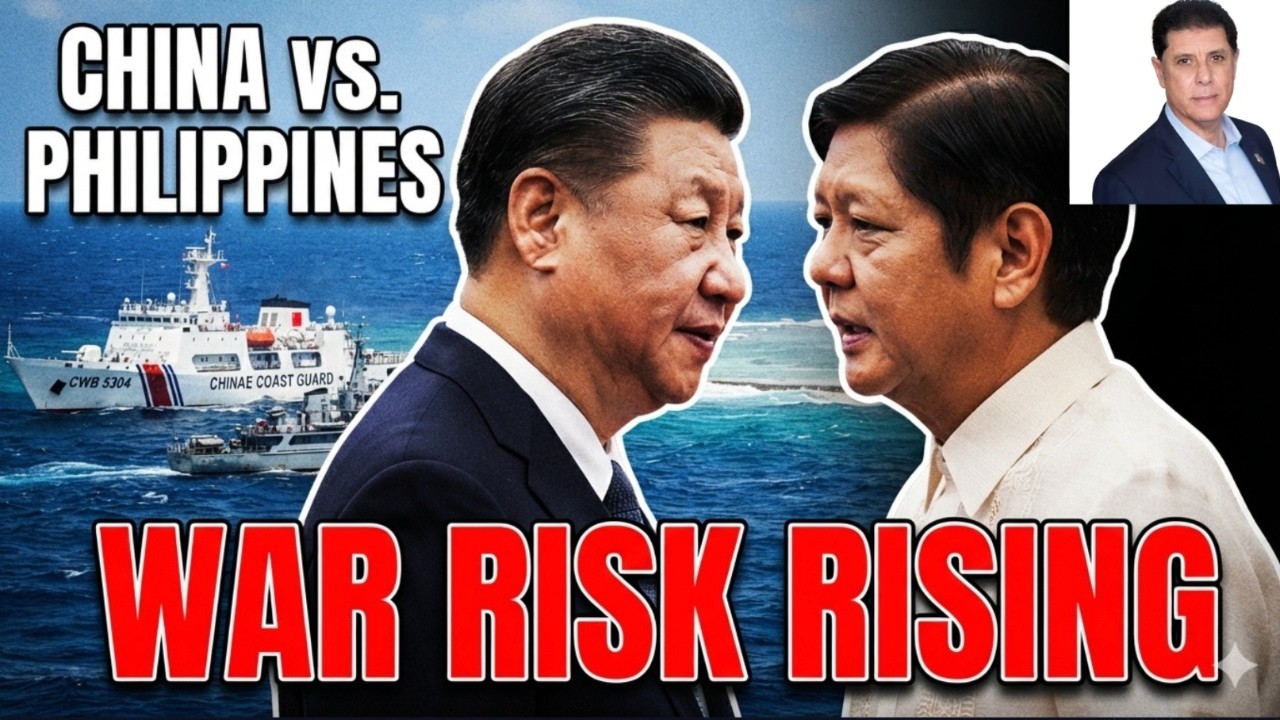
David Oualaalou analyzes China's strategy in the South China Sea, focusing on recent confrontations at Scarborough Shoal and Second Thomas Shoal. He traces Chinese claims back to the Yuan Dynasty and examines how the July 20 escalation between China and the Philippines threatens U.S. defense commitments and regional trade routes.
Chapters
Hello everyone and welcome to Geopolitical Trends, where truth matters. Right now we have the Chinese Coast Guard ships are indeed firing at the Filipinos. So, but they are firing water cannons at the Filipino sailors, not missiles. So, and the treaty that could pull the United States into a shooting war over it has been sitting in the books since 1951. That's what's interesting about it. So this week, what just happened in the South China Sea this week, that treaty signed between Philippines and the United States got a lot more relevant than anybody anticipated. And because here is the harsh reality of what's going on right now. Everyone is calling this a clash. It's not. This is not a clash. It's the fourth escalation just in one week. And if you connect the dots, the ASEAN chairmanship, because it's under Philippines right now, the stalled code of conduct, the US pivot, because the US is pivoting towards the— that part of the world, South, uh, South China Sea. So you will see exactly where this is heading. Doesn't take genius to figure out. And this is what I wanted to cover in this live stream. We'll take a break from Iran. Of course, I'll cover Iran next week, especially with the major developments that has to do with the tactical nukes. So, but for today, I wanted to address for you really what's going on in the South China Sea And at the same time, I would not sort of underestimate the possibility for, uh, the rise of tensions between Philippines and China. And we all know how the Philippines is being pushed into this. So I'll provide you my own analysis, but I'm gonna also— this is for you, for the community— I'm gonna share an excerpt with you from my upcoming, forthcoming book rather, about China. So stick with me till the end here. And, and, and we'll, uh, we'll, we'll cover all this. So, but first what I want to do is I want to play a clip for you, and I want you to take a listen here, and we just go from there. So there's a— it sound, uh, there's a sound. And that's the Chinese were warning the Filipinos to back down, to stay away. They were issuing warnings to that, but the Filipino sailors, I guess they didn't care. So that's where you saw this clash, uh, at Scarborough Shoal. Uh, and, and here is the interesting aspects of it. All this happened, and, and I found it not a coincidence. It's ironic that Philippines will behave this way because Philippines behaved just a day after Mr. Wani. It was, uh, with his counterpart. Here's a picture. Mr. Wani issuing a warning about the involvements of foreign players into all this. You all know what it means. So, and I'm going to provide you the link where you can read the full article, uh, for this. I don't want to go over that way because I have other stuff to, uh, cover for you. So now, before I'll detail and provide my own analysis, I found it convenient and important for you to know a little bit of history about the Scarborough Shawl. So I have some pictures, but I'm going to also share with you, uh, uh, certain aspects of the, uh, the history, uh, of why China made the claim to put it in perspective. And I disclose this in my forthcoming book, uh, about China. So now let us understand first of all, uh, that Scarborough Shoal is resource-rich, and that is where, uh, sort of a coral atoll in the South China Sea, uh, uh, uh, area. And I'm going to put the map again, a different one here. This is the South China Sea, so it's located about 124 nautical miles west of Luzon, and it falls squarely within the Philippines' Exclusive Economic Zone on one end. Now, the shoal is highly strategic. Why is it strategic? Because it is acting as a crucial traditional fishing ground and a focal point of ongoing geopolitical disputes. But here is the harsh reality that I think the US— I think the US knows about it. The Filipinos are trying to ignore it or pretend it doesn't exist. And what am I talking about here? We're going to be talking about the early history. First of all, you need to know the naming of this. It starts with the Spanish rule, which is known to the Philippines as Panatag Sho. Anatak Shoal. That's how it's known, uh, based at least on the tradition, uh, translation that I looked into. Or it is also known as Bojol de Masinoloc. To those locals, you will know what I mean by this. So the area was used by local fishermen for centuries and appeared on the 1734 map by the Spanish Jesuit Pedro Morillo, uh, uh, Velarde. I was the first one when it appears there, but the first one according to what the Westerners are saying. Then comes the British ship. The atoll gets its international name from the HMS Scarborough. And why is this? Because it was an East India Company ship that wrecked on the reef in 1748. That's the second one. And the third one is, of course, the Chinese claim to this. Now, here is where it gets very interesting, and I disclose this in my forthcoming book about— actually, I'm gonna show, show you the COVID for it right there. And I know they made a mistake on my last name spelling, but that's okay, we'll fix it later. So, uh, why China claim is important to understand? Because China claims ancestral right to the area, and I'm gonna tell you why. So why? Because what China's saying is that this area was utilized by Chinese navigators as early as 13th century. And what was during the 13th century? It was the Yuan Dynasty. So, and I have the record, I have everything here because I disclosed it in my forthcoming book. So what you need to understand, at least from a historical perspective, and then move on into the analysis, is that in 1279 The Yuan Dynasty conducted a survey. Believe it or not, it was a survey back then. And the claim refers to the modern assertion of historical sovereignty. We're not talking about historical just, uh, uh, claim— historical sovereignty and rights over the South China Sea. And back then was the name of Nanhai. So, and this How this came to be? Because this one was linked to 1279 astronomical and geodetic survey that the Yuan Dynasty astronomer, his name was Gu Xiaojing, uh, is S-H-O-U-J-I-N-G, so Joe or Joe Chongqing. It was under none other than Emperor Kublai Khan. Here's the picture of Emperor Kublai Khan. So, and this is again, you have to understand this history. 1279, Kublai Khan, the one you're looking at the picture there, the emperor commissioned an empire-wide geodetic project known as— it is known in the record as, in quote, measurements of the four seas. And I have a link for you that I, I use the same link for my, uh, for my upcoming, uh, forthcoming book. So, so I'm gonna put, share the link with you in the chat box just to have an understanding of it. Of course, I found out that it was a historian in Philippines, professor of sort. He claimed that, oh, this is just made up. I beg to differ with you, uh, professor. Because there's a historical record for it. And this is where the Chinese officials and official statements assert that the astronomer engineer, uh, Gou Qiaojing, he's the one who surveyed the South China Sea, identifying an observation point corresponding to modern-day Scarborough, the South China Sea. So, which is known, by the way, known in China as the, uh, uh, Huangjiang Island. This is why it's important to understand this history aspect, uh, is that the 13th century event is frequently cited in the Ministry of Foreign Affairs of the People's Republic of China, PRC, as the historical proof that the region was first discovered mapped and integrated into the Chinese administration purview during the Yuan Dynasty, 1271 all the way to 1368. And I have a different record that confirmed this particular statement. So, so I just want you to know at least the historical aspects of it. So now let's get back to this week's flares up that has sort of a fast escalation. Because this happens starting on July 20th, which is about 4 days ago. So here's what Manila, uh, is saying. Manila is saying, oh, one of its Navy personnel was struck on the head with a wooden baton. At the same time, Beijing accused the Philippines of ramming a Chinese patrol boat and attacking its officers with oar and sticks. And you saw the clip that the Chinese were issuing warning, do not get closer. So that's what China's Coast Guard said. He drove away two Philippines government vessels near Scarborough Shoal after the ship ignored repeated Chinese warning and deliberately entered the waters under China's jurisdiction. That is why the Chinese also fired cannon of water before. So both— so this is where you have now both countries, uh, summoned each other's ambassador, which is usually a step relatively rare, uh, given the how frequent these confrontations have become. And makes you just wonder, why the heck will Philippines get into all this? And I'm gonna share with you later on how some other claimants, like for example Vietnam, how they handled this with Chinese on a bilateral basis, away from the media, away from the spotlight. And this is why, uh, what Manila now is, is, is pushing for is the agenda by the United States. And also what the Philippines is doing this because it is the chairmanship of the ASEAN, so it wanted to use the platform for something that is not related to ASEAN agenda. You can see where this is going. So, and that is why it's important to understand the context of this sudden flare-up. So, because this flare-up, in my opinion, sits atop long-running structural disputes that exist, but it's pulling tight really of recently. Yeah, and the key event you have to understand is that Manila has been chairing, as I said earlier, ASEAN Summit this July. And that is why I find it convenient that Manila is using that platform to push— you know what they're pushing for? Something called code of conduct negotiations. Because what Manila wants to do, it wants to use the platform of ASEAN Okay, to deliver a text by that deadline, meaning by the end of where the communiqué comes up. And that is why you have Marcos Jr. separately signaling openness to restarting joint and gas talks with China. It's almost, I feel like, the double standard. He wants to enter into economic ventures with the Chinese, but at the same time he wants to stab China in the back. You know, what does it tell you? It's almost like Ukraine here, or what the US does with Iran negotiations, but at the same time we are bombing Iran. But at the same time, what the Philippines wanted to do this is because they feeling the pinch of the energy crunch. So, and that is why when you consider the closure of the Strait of Hormuz has pushed now Philippines into an energy emergency for the last few months. So Manila is playing both sides, has been pursuing diplomacy and friction management at the same time, which usually doesn't bode well. Ask India. And this is why this layered on Marcos' broad sort of Uh, this goes back to his project of, uh, if I recall, 2022. This is like, uh, and what is that? It's because when he came to power, he was pushed by the US to be more vocal contesting China's claim and deepening, by the way, his country's defense cooperation with Washington under what is called the Enhanced Defense Cooperation Agreement. You all remember when he was elected, meaning Marcos Jr., where was his first trip? It was to China, right? As soon as he came back to Manila, he signed the agreement with Lloyd Austin, at that time the former Secretary of Defense. But at the same time, Beijing is seeing this enhanced defense cooperation agreement as the main real driver in these tensions. So, because what the Chinese are arguing is that the Philippines is deliberately internationalizing the dispute by courting the US, courting Japan. And what do they want them to do? Philippines wants the US and Japan to build outside pressure against China. So, and that is where If Philippines is not careful, it's going to be pulled into the great power competition. We all know what it means. And that in itself, if that happens, or when that happens, forget about the sovereignty, the autonomy, uh, uh, uh, autonomy, the, the strategic autonomy of Philippines will be gone. Ask Ukraine right now, does Ukraine have any sovereignty? Or strategic autonomy? No, Philippines is running the risk also the same. And that is where, by the way, the immediate trigger to all this has to do with the resupply mission. And this has been negotiated back then, but on July 20th, Philippines run a resupply operation to the ground BRP Sierra Madre, which is located in the Second Thomas Shoal, which China called deliberately provocative and met with warnings. That's where they were issuing warnings, the Chinese Coast Guard. But the Philippines kind of didn't care. They were issuing warning, but they didn't care. And that's why you have now the Evasive maneuvers, you have the countermeasures and so forth, and that produced the physical clash in, in which Manila is saying the Chinese Coast Guard crew struck the Philippine sailor. No, it's not true because the Chinese have issued warning and the ship from the Filipino sailors were coming towards the Chinese. And here is the picture for it, and I played the clip for you. This, this, uh, sailor here, the Chinese one, was using the bullhorn to warn them not to get too close, but they didn't care. They— meaning the Filipino sailors didn't care. And that's again what you need to understand about this. Now, as a geopolitical analyst, the way I see this, I I see it as part of a broader than one-off, uh, incident. Because what you have now— and again, I've been keeping an eye on because I've been doing the research for the last year about my, uh, about my, uh, China, uh, forthcoming China book. And this is one of the areas, of course, I have to detail. And I will share an excerpt with you in a, in, in, in a second here when I keep towards the end here. So the way I see it, as I said, as a geopolitical analyst, rather than seeing this as brother one, one time off— no, no, no, no— the conflict between now China and Philippines has shifted from occasional, occasional direct confrontation into now a sustained hybrid pressure. You have to understand the meaning of this. Yes, we're only still using water cannons, we're still having dangerous maneuvers, we're still blocking resupply runs and so forth, even an intelligence breach exposing Philippines operations. And that tells you this— the control without tipping into an open conflict is a foregone conclusion. That is where my concern about this development. So now this leads us to ask the fundamental question: why should you and any other viewer from around the world care about this? Literally, you're going to ask yourself, what's in it for me? Why will I care about what's going on in South China Sea, far away from where I am? It's a lot. Think about it. The stakes here goes well beyond just China and the Philippines squabbling over reefs. When you think about and consider that one-third of global maritime trade transit through South China Sea, you think about the surrounding waters underpin energy security across East Asia. So any disruption to this so-called freedom of navigation there has a direct knock-on effect for shipping cost— costs, energy supplies, and manufacturing supply chain worldwide, not just for Manila, not just for Beijing. The same argument I can make about the Strait of Hormuz. And on the top of that, you think about the US and Philippines are now bound by the 1951 Mutual Defense Treaty. And also there is another one which was signed in 1998, and this one called the Visiting Forces Agreement. And this is where you get the hint that Washington has steadily been deepening its military cooperation with Manila under the so-called Enhanced Defense Cooperation Agreement. Which means what in a simple term? Which means a serious escalation carries real potential to pull the United States, and by extension the broader US-China rivalry or relations or competition, or whatever term you want to use, into a direct confrontation. And that is why I am convinced that Philippines has been pushed into this, because now we are— while we're still in West Asia or the Persian Gulf or Middle East, we are also shifting our sights to South China Sea. And that's why this keeps drawing in outside players well beyond the two claimants. Now you see why Mr. Wang Yi made that warning during his, uh, meeting with his counterpart for outside, outside, uh, uh, uh, players, that is. And we're not referring just to the US. Japan, yeah, Japan went ahead and deployed combat troops to Balikatan. Exercises for the first time since 1945. Let that sink in. The same thing Japan did with this statement that it will come to the defense of Taiwan. I mean, let those statements sink in and see the big picture of this. And this is where you see the dispute between Manila and Beijing is running agenda item as ASEAN. Especially from the Philippines part, because China's rivals and partners alike are watching now how firm the bloc, meaning ASEAN, backs Manila, which most likely they won't. And this is where, once again, putting my geopolitical analyst hat, I will note and observe or notice that the maritime incidents are now triggering near-instant diplomatic retaliation. And that in itself will make it very hard to manage and raise the odds that a future encounter escalates past the point of protests and summoned ambassadors, which is exactly the kind of slow-motion crisis that reshapes global trade routes and alliance politics and so forth long before it ever produces a headline, uh, area, uh, uh, title. And this is no different than what we are witnessing in the Persian Gulf or the Strait of Hormuz. If the truth matters to you, hit like, subscribe, and tap that bell. No spin, No agenda, just the stories they don't want you to know. Don't watch from the sideline, be part of the movement. Your support keeps the truth alive. Thank you. Now here is the next question, and, and again, for me as an analyst, I have to think of what-if scenarios, and, and no, I will not rule out any possibilities. And one of them now is how does this tension now, if not controlled, impact you and every other person around the world? Because if this spiral out of control, the most immediate hit will land on trade and prices everywhere in the world. And like I said earlier, roughly one-third of global maritime trade transit the South China Sea. So any blockade, any type, doesn't matter, blockade will be a serious— or a naval clash between the two, or even sustained harassment of shipping lanes would ripple into the higher cost of fuel, electronics, cars, food, and virtually everything or anything that moves through Asia ports, regardless of where you live or someone else lives. And did I mention also the insurance premium for shipping will spike, like what we're seeing now in the Strait of Hormuz and soon Bab-el-Mandeb in Red Sea? Factories will depend on just-in-time parts from the region will face delay by days, if not weeks, if not months. And energy-importing economies in East Asia will feel it first and hardest— Philippines at the top— with the effect passed down to supply chain and from there to consumers worldwide. This is once again what Philippines doesn't think the big picture. When you consider stuff like this, you have to understand the importance of— I'm looking at a different map here for you, just to put this one here. For example, the Strait of Malacca, the importance of it. And that is again where the Philippines, I feel, is being pressured into acting this way. So the deeper risk is escalation into a great power conflict. Yeah, of course the US is saying, oh, we are bound by mutual defense treaty with Philippines. Let's get real. Do you think the US is going to send its soldiers to the front line? I don't think so. It will be the Filipinos, it will be the Japanese, the South Koreans, and the Aussies. The US, the US is not going to be— look at Ukraine right now, or, or consider this, for example, how Israel is doing it with the Americans. Is Israel sending its soldiers to fight? No, it's the Americans. So, so when Washington saying, oh, we are deepening our military cooperation with Manila, it means that a little incident at sea could pull the world's two largest economies, meaning China and the US, into a direct confrontation. Because, I mean, let that sink in, and I disclose this in my forthcoming book, uh, uh, think about just the idea of the US-China military clash, even a limited one. The first, the first order of business, not even the amount of destruction, first of all all the bases of the US in the region. Let me put, uh, I don't think so. I have, I have a map here. Uh, no, I, I don't. Oh, we do, we do. Certain locations here, but for example, Japan, you don't see it here, but Japan, South Korea, Australia, and all that, all the US bases there are within range of Chinese missiles. Do you think China is going to wait? No, it won't. So, but the, the other major thing is that sort of even limited confrontation between the, the US and China will certainly rattle global markets. It will disrupt technology and manufacturing supply chain far beyond what we can imagine. And that in itself You know what it's gonna do to other nations, which is what the Philippines doesn't think of? It's just gonna force the other nations to pick sides in ways that will reshape trade, that will reshape security alliances for generations to come. This is almost the same argument I made before about the stupidity of the Saudis going ahead and targeting an Iranian plane that landed in Sana'a in Yemen. Whoever was advising the Saudi government sort of needs to examine his head. It's the same thing I will say about the Philippines. Whoever encouraged these clashes with the Chinese needs to rethink. So even you think about a short— we're talking about a short actual war, maybe a week, maybe two, we don't know, short— what is going to do, for example, to the gray zone patterns So, and that is where you're gonna have to think in terms of what this is going to set precedence moving forward. And this leads us to ask the other legitimate question: could the Philippines turn into another Ukraine? You know, I don't shy away from asking this. I know some have argued, oh, Dr. O, you can't compare this to that. Of course I can't because the setting is different, but the possibility is there. So I am not going to refrain from asking a question that ought to be asked because there are some real parallels between the two. Of course, the analogy breaks it down into important ways, but when you think about it, both involve a much larger power using military and paramilitary pressures. To assert some sort of the claim, territorial claim against, uh, the others. So, and both have a flashpoint where regional dispute gets entangled with great power rivalry— Russia versus NATO and the West in Ukraine case, and China versus the US alliance network in the Philippine case. Of course, unlike Ukraine Though the Philippines has this mutual defense treaty with the US dating back to 1951, plus a Visiting Forces Agreement, an enhanced defense cooperation agreement, this will give Washington some sort of a formal, long-standing obligation to Manila that Ukraine never had with NATO. But Mike, my word on this, that will be just on paper. The US is not gonna get involved, they know. And this is one of the reasons why when we signed— you remember when Lloyd Austin, the former Secretary of Defense, signed with Marcos upon his return from China? As soon as he returned, he signed the, uh, the agreement and the enhanced defense cooperation. You know what was that about? It was about the status of the 9 bases. What actually Philippines saying, only 5. They never disclosed about the other 4. The other 4, that's where you have the most sensitive information, sensitive US weaponry and so forth, that even the Philippine government might not know about. And knowing, knowing what China has with, for example, its Beidou systems and all that stuff, do you think it will be hard for them to pinpoint exactly where those locations? This is why Iran has succeeded now in targeting specific locations for, for example, the CIA, the locations for the special ops and so forth, with the precision. And this is one thing, uh, uh, uh, Marcos, it doesn't think in those terms. And that gives you an idea that he's been pressured into all this. So, and that is again where you think about, because this treaty that now is coming up to the surface Oh, the US signed this treaty with the Philippines, it will come to his defense. We will not. Mike my word on it. We will tell the Japanese, we will tell the South Koreans, we will tell the Philippines themselves, we will tell the Aussies, send in your troops to the front line, we will support you from behind. And this leads us to ask the last question in this, uh, brief analysis here. Is what lies ahead. How are we going to move forward now? Because in the nearest term, short term that is, what you're going to need to watch for in South China Sea, the one thing you're going to have to watch is the code of conduct. That's one. That's why Philippines is pushing to use ASEAN platform for this, but other countries going to look at it differently. And I'll tell you why in a second here. So, so you have even, for example, uh, you have some groups like Crisis Group says that Manila push for this new rule book is effectively, uh, sort of petering out as tensions rise. And with the Philippines increasing, shifting increasingly now, shifting towards the means of defending It's maritime. No, no, no, no, no, no. They're being pushed into it. Because again, I will caution against treating this so-called code as a finish line, even if it's eventually signed. Because one thing you need to understand is that China has already entered into talks with other claimants. And has resolved the issues. So, so the realistic path is a continued— this so-called gray zone friction, so punctuated once a while, from time to time, with periodic flashpoints, except if it gets out of control. But as far as clean resolution or a sudden war, no, don't, don't expect that. What you also can expect is more resupply missions to the Second Thomas Shoal. But what comes with it? More water cannon and ramming incidents at Scarborough Shoal. It's because if the Philippines enter into the Chinese water, of course the Chinese will issue a warning. And Chinese now are using restraint. I mean, think about it. They are using restraint. You and I know if China wants to sink all those boats there that belongs to Philippines, they will do it. But they won't, because that's not how China behaves. And that's why you're going to see more of these diplomatic summons, the protests, and so forth. All this is going to be moving forward into that directions. And that's, again, you have to think in terms Is Manila aware of the strategic consequences of it being pushed to go head-to-head against China? And again, I'm not saying that they should be scared or afraid of China. That's not what I'm saying. All they need to do if they want to resolve this issue is enter into bilateral talks.
Why?
Because Vietnam is a case in point. Vietnam entered into bilateral talks with Beijing and resolve the issues. And I believe also Indonesia, if I'm not mistaken. I do not know about Brunei. I do not know about that. Because when you consider Chinese Beidou systems is able to see every movement in that part of the world, every movement. So I'm gonna share an excerpt with you from my forthcoming book. Does the 21st Century Belong to China? A Geopolitical Investigation into Global Power, Economics, and Hegemony. So it is what I wrote. This competition plays out most visibly in the South China Sea, one of the most contested maritime spaces on Earth, where multiple countries hold overlapping claims China's possession rests on the Nine-Dash Line, a historical map asserting claim to vast stretches of the sea, tracing back to 13th-century Yuan Dynasty expedition credited with first mapping the area. What China has done with that claim in practice is ambiguous, building artificial islands militarizing them, installing anti-ship missiles and air defense system. That's to me not a legal argument anymore, that's a fact on the ground because the claim, they land the island, the, uh, China's claim stands. Other claimants like Vietnam, the Philippines, Malaysia— I'm sorry, not Indonesia, Malaysia. I'm sorry, I said earlier Indonesia. Malaysia and Brunei haven't gone away, but the picture is more nuanced than the standard China versus everyone framing suggests, because that's the framing coming out of Washington and other Western capitals, or even from Tokyo or Canberra. Oh, China is against everyone. Vietnam, for instance, has quietly negotiated and resolved its disputes with Beijing bilaterally rather than through confrontation. Meanwhile, it's the US, not any of the claimant states, that keeps running freedom of navigation operations through waters China claims as its own, framed as upholding international law. It's worth asking directly whose interest is actually being served by repeatedly sailing warships through those waters. And who's really doing the provoking here? What isn't in dispute is the risk this creates. Two navies operating in close proximity with overlapping claims and no shared trust is a structural setup for an accidental collision or an intentional confrontation to spiral into something much larger. That's what I argue. And again, I call it the way I see it. So, oh, let me share with you a, a picture of a map of the China Nine Dash Line right there. This is China's Nine Dash Line, just to put in perspective. Uh, I have another map here And the other map I forgot to share with you is an older one. This is a very old— when that mapping was done by the Yuan Dynasty between 1279 and 1368. Look at the parameters or the line where it going— where it's going. And I will have the link, uh, for this particular one that I'm going to put in the description.
Points.
Here is my conclusion for you, because I want to keep this short and to the point. South China Sea, when you think about this particular area of the world, isn't drifting towards a single dramatic war. No, no, no, no, no. It's just being reshaped. It's being reshaped one incident at a time. Treaty test one at a time while the rest of the world is quietly footing the bill in trade and energy costs. The real question isn't if we will ease, but whether Manila's alliance with Washington is enough to deter Beijing or eventually force a confrontation Neither side wants. This is the harsh reality that we need to consider. So I'm gonna leave you with one question, and I'd like to have your feedback before I'll play the clips for you like we always do. Do you think the Philippines can hold the line diplomatically, or is this headed toward a breaking point? Straightforward. Do you think the Philippines can hold the line diplomatically, or is this headed towards the breaking point? So, so just make sure to, uh, share your thoughts in the comment below— in the comment section, rather— and I will be, be happy to read. And I do read your comments, uh, uh, all of them, most of the time. So, all right, let's play some clips here, and we'll, uh, we'll, uh— oh, I want to share the screen with you, uh, about this particular one. And this one was a survey conducted by Pew Research Center. It's well known here in the US, and this was sent to me by my dear friend Ray. You all remember Ray, that I took a picture with him in China when I was there the first time. So, so take a look here, and that will give you an idea. Literally, I was, uh, I'm glad, uh, Ray shared this, uh, with, with, with, with me, and I'm gonna share it with you, of course. So, uh, here is the, here's the title. People in many countries now view China more positively than the United States. So, and I'll put the link for you in a second here, but here is what I want you to, to— here's what I want you to see is this, is this one here, right here. Look at this, how people in 36 countries view the United States and China. Look at the percentage on the— with the green on the US and the percentage on the blue uh, in blue color for China. Look at this number. Pakistan, 90% favoring China. Uh, as a matter of fact, in all of this— let me just make sure before I say something— uh, except in Colombia, which has a slightly, 60, uh, plus 3%, uh, favor for China, uh, also in Ghana, uh, beside this, the rest, uh, and, uh, Hungary, 58 versus 53, slight increase, but the rest is all— is a double-digit margins. So, so So I just wanted to share that with you, and I say thank you to my dear friend, uh, Ray. So next one I want to share with you is about the Chinese military, since we're talking about South China Sea. And not only that, I wanted, I wanted to share this with you as one who was in Beijing during the parade last September, and I saw the types of weapons the Chinese displayed. That wasn't a miss— that wasn't a sort of, uh, uh, it was a loud and clear message to the West, the US for that matter. So take a listen, please.
The military capability— China already possesses the military capability to strike the entire globe instantly. As everyone knows, on the 3rd of September, China held a military parade marking the 80th anniversary of the victory against fascism. On display was the DF-51, an intercontinental missile with global range. You heard that right, global range. Do you understand what global range means? It means that from Chinese territory, it can directly destroy New York, Washington, as well as London, Paris, and Berlin. In the past, geopolitics was constrained because it was too far to reach. There is an old Chinese saying, "Truth lies within the range of the cannon." The biggest difference between China and the United States is this: the US does not have missiles that can fly that far, which is why American troops are stationed all over the world. China, however, has no military bases in other countries, yet can strike global targets directly from home. Its speed reaches 35 Mach. What does 35 Mach mean? The air defense systems haven't even turned to aim at the warhead before being destroyed.
Yeah, let that sink in. And that is exactly my point. So Philippines needs to be thinking carefully before it embarks on whatever is being told to do. I want to share this clip with you, but before I'll, I'll put it up here, I want to tell you I intended to confirm this. There are two incidents from two units. One is American, one is Israeli, that have been captured. Those are part of the special units, uh, been captured, uh, trying to land in Iranian soil. But this one about the US, and I am gonna confirm it, uh, in the next few days, and, and I'll report back to you about this one here. Take a listen, please.
Joining us today as we follow the storm storm clouds that have suddenly gathered over the Persian Gulf. Just hours ago, a piece of news broke out of Tehran that's enough to shake the entire Middle East and global security to its core. Iran's military has pulled off a brilliantly executed counterintelligence operation, capturing an American made up of over 50 U.S. Marines and special operations personnel. These guys were dressed up as Omani fishermen and Arab traders, spread across multiple fishing boats that looked perfectly ordinary, trying to pull off a high-risk amphibious landing along Iran's southern coast, launching from secret staging points off the Omani shoreline. But here's the thing: their disguises and their entire approach route were under the watchful eye of Iranian military intelligence from the very start. This wasn't just some tactical victory. It was a complete humiliation of America's military arrogance in the Persian Gulf and its so-called Freedom of Navigation theater. It exposed exactly what Washington's war machine is really up to: trying to bypass international law, choke off Iran's oil lifeline, and seal off the Strait of Hormuz through reckless military adventurism. And Iran's response didn't stop at the coastline. Around the same time, Iran's military announced that its Aerospace Forces had launched a massive surprise ballistic missile strike on the strategic port of Duqm in Oman. According to Iranian state media, the strike directly hit the logistical support centers and refueling platforms that the US Navy uses for its carrier strike groups at Duqm. Since at least 2019, Duqm has been one of the most important logistical nodes for the US Navy in the Indian Ocean region, a place where American carrier groups and large warships regularly pull in for resupply, refueling, and rearming. Iran's military described this attack on Duqm as the third phase of its response to recent American strikes on Iranian targets. What this means is not just that America's carefully built logistical chain in Oman has been cut off at the knees, but that the more than 20 US warships currently lurking in the waters near Oman, ships that pose a direct threat to Iran's security, are now sitting ducks, well within range of Iran's shore-based missile batteries. With their supply lines completely severed. In the face of Iran's lightning double strike, the Pentagon's war gamblers are finally tasting the bitter fruit of their own making. Before we dive deeper into this high-stakes military chess match, if you stand with Iran's right to def—
I'm gonna stop it right there because it's a little bit too long, and we give the credit to Chronicles. Uh, that's their video from there. So the next one is about United Arab Emirates. I need you to see this one. Uh, sometimes I, uh, always, I always like to, uh, even though I'm aware of it, but I need also to, uh, uh, uh, double check and triple check the facts with imagery. So sometimes I might share something with you that passed, but to confirm, uh, uh, the, uh, authenticity and the accuracy of it. Take a listen, please.
For hosting America. Iran continues to—
oh, sorry—
Gulf states for hosting American military. The video shows oil infrastructure destruction in Dubai. Dubai is helping people leave the country on planes at a rate of 48 planes per hour. Iran's IRGC says it has completely destroyed Amazon's central data hub in Bahrain with several cruise missiles and warns more are coming, per Fars News. The attack marks a new phase. Iran is now targeting U.S. tech infrastructure. The IRGC has warned 18 American tech companies, including Microsoft, Intel, Cisco, and Google, that they are legitimate targets. AWS facilities in the UAE and Bahrain have already been hit before, disrupting banking and critical systems that rely on Amazon's cloud. Data centers are now strategic targets. Iran argues these companies support US military and intelligence operations. By striking Amazon, Tehran is signaling that American tech firms operating in the region are no longer off limits. The war has expanded into the digital domain. Iran continues to punish Gulf—
yeah, and we give credit to USA News Wave. That's their, their, their clip. And the last one I want to share with you is about KSA, the Kingdom of Saudi Arabia, Saudi Arabia. Uh, this one I found it very, very interesting. Uh, I wrote an article about 5 years ago, 6 years ago, uh, when it came to my attention regarding the request the Saudis have made behind closed doors, uh, to the US for access to nuclear technology. And I wrote an article, uh, a warning against such, uh, uh, venture with the Saudis. And, uh, this is what the clip is all about. So I want you to take a look and, and you decide for yourself. So Oh, I'm sorry, I'm not going to play the sound because there's just sound. You can read that one there. US President Donald Trump has approved a civil nuclear deal allowing Saudi Arabia to enrich uranium without key international safeguards. The move has raised concerns over nuclear weapons proliferation, given Saudi Arabia warning it would seek nuclear arms if Iran does. And with this, you find yourself asking the question, what makes it right for Saudi Arabia or any other country but not for Iran? You know, that's to me, I found where the, the, the hypocrisy, the double standard. But of course, in, in, in international relations or geopolitics, there is no such things as hypocrisy, whatever. Countries don't think in those terms. Countries think in terms of their strategic interest, long-term and so forth. But this— and again, I warned about it 6 or 7 years ago when I wrote the article. So it depends again what's going to transpire from this one. So anyway, uh, what I'm gonna be working— uh, by the way, uh, uh, be on the lookout tomorrow. I'm gonna release a video for you, a recorded analysis uh, about how Iran outsmarts the Navy. So be on the lookout for that. I will greatly appreciate, uh, if you can just share that video tomorrow. I will release it for, uh, around the 8:00 AM Central Standard Time. So, and I will share with you, uh, uh, I'm, I'm in a process of completing this book, uh, and, and I will let you know when it's done and all that. And I will share some other excerpts with you community. I had to send, uh, uh, an excerpt to the members. And I'll, uh, uh, just to let you know, I intend not to publish this with a publisher. I'm gonna self-publish in here because I, I— when they put them at those $100 prices or whatever, so I'm gonna decide on how much I'm gonna price this one. I spent almost a year and a half, I was quietly working on this and I'll share it with you, the community, the all the supporters. And I'm very, very grateful to all. So as I said, next week I will be talking about— I have a family visit, so I'm gonna spend the weekend, uh, with the family members. And, uh, next week I'm gonna be talking to you about the very interesting developments, which I will confirm, regarding Iran's tactical nuclear weapons. Is Iran in possession of it? So we'll talk about this one, uh, just quickly, an update regarding my upcoming trip, uh, to Asia. Here is the— we're still at that number here. I will greatly, greatly appreciate if you will, uh, support this upcoming trip so we can reach the, the goal, uh, for this trip here. So I'm, I'm very grateful to already the, the two major donors, uh, uh, Doug and the other person was to remain anonymous. So grateful, uh, for their, uh, support and generosity. So, uh, for the channel, to those who wants to support channel, you know the type of information you get in here, uh, will greatly appreciate it. And the last thing is my books. Soon I will add the— soon I will add— I will add this cover book, uh, cover, uh, image to the my next book here. So But for now, that's the ones I have, is this one here, the Saudis, the one about Russia, the one about American foreign policy in West Asia, and the one about Iran. And I intend to, by the way, I intend to do an update about the Iran book soon. It's not going to be lengthy like this one here, uh, and I'm going to do self-publishing it myself. So I'm going to— I'll work on it as well. So Anyway, I wish you a good weekend, safe one. Be safe wherever you go. And, uh, oh, I need to say thank you to a new member, uh, here, uh, David Lindsay, uh, becoming a YouTube member. Thank you so much for becoming a member. Appreciate you being here and look forward to, uh, uh, you, uh, contributing to the conversation here with our wonderful, wonderful community. And to the community, I say thank you for keeping the conversation civil in this chat box here. Truly, truly appreciate you for that, and I look forward to seeing you next week. As always, remember, geopolitics impacts your daily life in more ways than one. Till next time, bye-bye.
More from David


Beyond the Single Actor: Why the Gulf Isn't Choosing Between the US and China


Iran, Iraq's Militias, and the Houthis Are Coordinating! This Changes Everything




Who Controls the Next Decade's Resources? Latin America and Africa's Geopolitical Crossroads

The Chokepoint Trap: How Washington's Stupidity Triggered a Cascade That Now Controls the World

Trump Spooked as IRGC Unveiled dual-use SLV, Deployed Ghadir Mini-Subs & Hinted at Tactical Nukes!
