How Iran Cracked the F-35's Stealth — A Wake-Up Call for the Entire U.S. Military
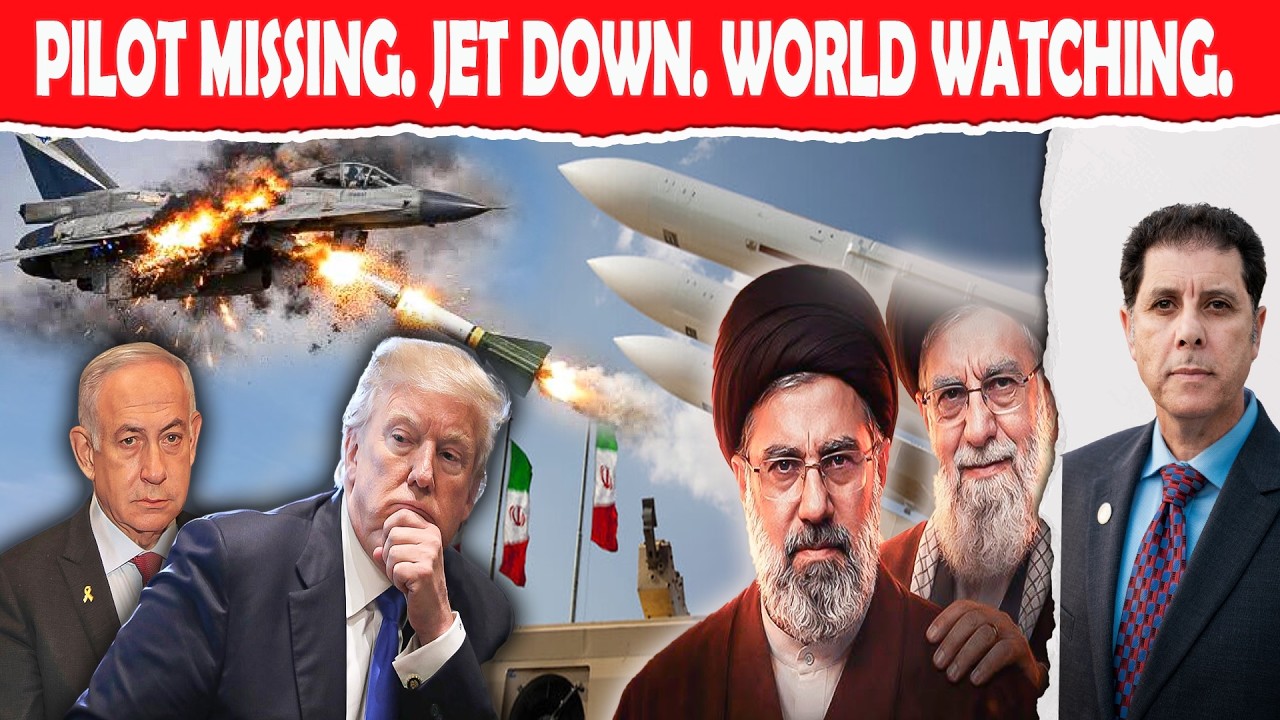
Iran claims it shot down a U.S. F-35 stealth jet and F-15 Eagle over central Iran using its Bavar-373 air-defense system, allegedly aided by Chinese technology. The Pentagon has offered only vague denials, while wreckage could provide critical intelligence to Russia, China, and North Korea.
Chapters
Hello everybody and welcome to Geopolitical Trends, where truth matters. For about 30 years, America, the United States, told the world its jets were untouchable. That's what it was for the last few decades. Iran just proved that it was a lie, and Iran just shot down an American fighter jets. And notice I said fighter jets. Captured the pilot, one of them. The other one was rescued, and the Pentagon is trying to hide it. And this is what I'm going to do in this live stream. I want to provide you a full picture with some documentation and some other clips to highlight to you where things are. Because when you look at a $100 million jet is now smoldering wreckage inside Iran somewhere in, in the center of the country. Of course, that's gonna beg the question, and question about what? Is about Russia and China. What have they learned from it? And that's exactly what's going to be hunting now the US for decades regarding the air power. So this is what I'm going to be addressing for you in this particular, uh, live stream. So make sure, like always, stay with me till the end, and I truly Truly appreciate your support. So here's the thing, there are now confirmed and unconfirmed reports, and I'm talking from my end right here in the US. The Pentagon finally came to admit a fighter jet was down or was struck or was targeted. You know how the language is going to be. What's interesting about the Pentagon, didn't disclose exactly the F-35. Oh, they say no, no, just fighter jet, and the fighter jets is the F-15s, which is true to a degree, but there are the stories that have not been told regarding more than just one fighter jet. And I'm gonna do— I'm gonna share a clip with you in Arabic. I'll do the translation for you to show you the detail of it. I'm not gonna play it in its entirety, just, uh, what you need to understand. And this is exactly where the IRGC Because when the rescue— why, US search and rescue was underway, the IRGC already claimed— and they did not claim, it was proved through documentation— that it has downed a US fighter jets over central Iran. And that is where this conflicting reports coming, especially is going to be on part of the Pentagon, because that's a big deal if now turns out to be that this high and mighty fighter jets are being down. Because what the conflicting reports will be about whether it was 30 F-35s or it was an F-15, there's two big, two different stories. If we're talking about F-35s, you know, that's a, that's a really major issue. Even if we are talking about the F-15 Eagle, it's still a major issue because those are considered— this is the fifth generation of the fighter jets. But if they are down, that changed the game altogether. And this is exactly— here is what happened. I'm going to take you back to March 19th. What happened on March 19th? An F-35 was previously damaged by an Iranian ground fire during a combat mission. The aircraft, even though it was damaged, made an emergency landing at a US base in the region. If I am to guess, it will be probably either Bahrain or Qatar, with the pilot suffering shrapnel wounds. And that was the first combat-related emergency landing for an F-35. That was just one. It was another incident of an F-35 which was not reported on, to my knowledge. And this is exactly where we're gonna do— I'm gonna do the first one the, the, the, the clip about the modern air defense systems in Iran. That's why the— that's what the IRGC shut down the F-35 fighter jets. So let's take a lesson at the first one here, then I'll do the, the, the translation for you, and we'll just go from there. And I give credit to, uh, Al Arabi News or Al Arabi Akbar. That's the— give them credit for that. All right, let's take a listen here and I'll do a translate. I'm not— it's, it's short anyway. Here is what I'm gonna do. I'm gonna just silence this and I'll do the translation as I play it because it's, it's— it makes more sense that way. Uh, we will now turn to the Iranian IRGC events announcements of the downing of an American F-35 fighter jets in central, uh, Iran. This is again what we are, uh, looking at here. Uh, Iranian media outlets have published images of what they claimed are parts of an aircraft wreckage, as we can see on the screen. The IRGC stated that the targeting was carried out using advanced air defense systems belonging to the Aerospace Force. This is the second time Iran has announced the downing of an advanced F-35 fighter jet in US Central Command airspace. They have not commented on the first incident but have not yet commented on the second. These are the images that Iranian media outlets reported and published. Claiming they show parts of the wreckage of this aircraft. I return to you again, Hazem, commenting on the IRGC announcements of downing of this F-35. Is not the first time, and there is still no information about the current situation. Let us get back to the details, Hazem. The announcements came this morning in two separate statements. The first statement was issued by a spokesperson from the, uh, Khatam al-Anbiya headquarters of the Iranian Armed Forces, and the second by the IRGC. Both statements are identical and indicating that the targeting took place in Markazi province in central Iran and that the explosion of or attack on the F-35 did not allow the pilot to eject. Thus determining his fate. It remains unknown, but according to two statements, it most likely did not survive. The images we see are pictures circulated by the IRGC and the Iranian Armed Forces who said they are— that they are of the wreckage of this aircraft, which also belonged to the British Royal Air Force base, according to some writing on the parts of the fighter's tail, according to the statements of the IRGC and the Iranian Armed Forces. This is the second time, uh, uh, Sonia point— as Sonia pointed, that the IRGC has announced the targeting of 35 jets within 12 hours. The first fighter yesterday was announced to have been shot down over Kashim or Kashm or Kashm Island. And the IRGC said in its statement that it's crashed in the waters of the Persian Gulf near Hingam Island. It plunged into the, the depth of the Gulf waters. Indeed, there are no further details available at this moment. However, throughout the 5 weeks, throughout the 5 weeks of the Israeli-American aggression against Iran. The IRGC and Armed Forces have announced on multiple occasions that they successfully targeted various types of fighter jets, including F-35, F-16s, and F-15s and others. The Armed Forces stated that these engagements resulted in damage to the aircraft in question. Yet this marks the first time that the armed forces have publicly released images of the wreckage of one of these fighter jets. We await a potential comment from the US Central Command, particularly given that it has issued statements regarding yesterday's incident asserting that these reports were untrue. I'm going to stop right here, uh, just to highlight to you the one sentence that I want you to pay attention to, and I'm going to show In another clip, the wreckage— because here is the thing, when the, the, uh, the individual for the, the channel, uh, or the news outlet was describing, he said, yet this marks the first time the Armed Forces of Iran, that is, have publicly released images of the wreckage of one of these fighter jets. It did not say the wreckage of the F-35 or the F-16 or the F-15. I just want you to be aware of this. And this is, again, by the way, let me just put this on the record: the incident, the targeting of this, which was done through the development of an indigenous systems in Iran— and I'll show you a clip for it— hi, it just coincided with what the Chinese engineers have shared with Iran. You know what they shared with Iran? They shared a trick on how to shoot down F-35 fighter jets just days before Iran strikes. So I'm gonna share the article with you in the chat box so this way you can read the information yourself later on. It's in Arabic, All you need to do is look for a way of how to translate it, and, and it should work for you. Okay, now let me share one particular, uh, clip here. And once again, I give credit to, uh, Al Arabi, uh, news outlet. So I thank them for that. The second, uh, clip that I share with you, and it's just a picture here It has to do with— pardon me— the, uh, the US commando forces infiltrate Iran following the downing of the F-15 Strike Eagle. Okay, let's, let's take a listen here. And again, I'm not playing the entire clip, I'm gonna play just the first, uh, literally 2 and a half minutes of it. So this way you'll have an idea of what is going on. Okay, let me move this one here so we keep things in perspective here. And again, let me make sure that you can at least, uh, so I'm gonna silence it here, but I'll do the translate. I don't know if you guys can hear me. Can you guys hear me right? Yeah, please give me a thumbs up if you can hear me. I want to make sure. Oh, thank you, thank you, Orel. Appreciate it. So here's the translation for these first 2 minutes. Peace be upon you. US Special Forces have penetrated Iranian airspace and territory following an incident in which Iran successfully shut down an American combat aircraft. Full details regarding this event began to emerge yesterday evening, specifically during the final hour of the night. The Tasnim News Agency reported that Iran has succeeded in downing a combat jet through— though Iranian military and official sources were initially uncertain as to the aircraft's true origin, whether it belonged to the US or Israel. However, the Iranian side subsequently released this video clip, which clearly depicts an aircraft that appears to have sustained a strike to its rear tail section. The aircraft is seen attempting to deploy flares, or decoy flares to be more precise, in an effort to evade and counter any defensive systems that might be targeting it. It is evident that the aircraft was engaged in a high-intensity evasive maneuver at that time. Tasnim News Agency initially stated that the incident took place near Qeshm Island. However, details later shifted, and debris, specifically shrapnels from an American combat aircraft, suddenly surfaced elsewhere. The sheer volume of debris recovered strongly suggests that a complete aircraft has indeed crashed. Authorities also showcased a large crater at the site, providing irrefutable evidence that a combat aircraft has crashed there, creating the impact crater and subsequently crashing or catching fire. Furthermore, upon closely examining the nature of this aircraft debris, specifically this particular fragment, we observe that it is an exact match for the tail structure of an F-15 Strike Eagle fighter jet. In other words, in other words, if one were to place this specific piece of debris against the corresponding section of the F-15's rear tail assembly, the fit, the fit will be perfect, leaving absolutely no doubt that the aircraft involved was in fact an F-15. Other fragments have confirmed their consistency with the nature of this tail section. Indeed, and this is a crucial point, when we refer to the tail, we note that in the video footage we viewed Moments ago, the impact occurred precisely at this specific location. This lends strong credence to the conclusion that this particular fragment is in fact linked to the aircraft currently under discussion. Focusing on the F-15 aircraft, specifically its insignia, we observe that it belongs to the US Air Forces in Europe. We are referring here to the F-15E Strike Eagle Panthers, a 5th generation aircraft primarily stationed with the 492nd Fighter Squadron at, uh, uh, uh, Lakenheath Air Force in the United Kingdom, which means basically United Kingdom is now part of it, specifically in eastern England. All these details have been independently confirmed by the war zone. Consequently, this marked the very first incident— instance in history where Iran has successfully struck and shut down a manned combat aircraft. While Iran has previously struck aircraft, it has never before succeeded in downing a fighter jet, excluding of course unmanned aerial vehicles. The critical issue for the United States in this situation is that the aircraft's two-person crew, the pilot and the copilot, have completely vanished. They successfully ejected from the aircraft. The pilot's ejection seat, clearly visible at the scene, indicated that he had landed at, at that specific spot before attempting to survive and flee through a particular sector of the desert where, as is evident, he subsequently collapsed. These circumstances and the details surrounding them prompted Iranian state TV to repeatedly broadcast an offer of a reward to anyone who could capture the pilots and co-pilots and hand them over to the Iranian authorities. These developments in turn immediately triggered a direct response from the US, specifically involving HC-130J Combat King II aircraft. This aircraft bears a striking resemblance to the MC-130J Commando, a specialized platform dedicated to special, to special operations that transport special forces personnel and execute critical missions such as those involving Delta Force. While visually similar to the Commando II and the HC-130J, is specifically tasked with conducting rescue operations, precisely the type of mission at hand— the recovery of downed air crew. I'm gonna stop right here, uh, just, uh, because I want to just do the first, uh, the reason I want once again is to highlight to you and show you, uh, let me put this back up because I need to give credit to this particular entity. And this one is Kanat Ataer, which is translated for a change channel. I just want to give them a credit, of course. Now again, what the US officials are actually confirming today is the downing of at least one or possibly two combat aircraft, but the aircraft type is disputed. Once again, From experience, I can tell you that the Pentagon will do whatever it can to push the narrative by not confirming it was an F-35 till it becomes evident. Or let's say the Chinese or the Russian satellites picks up the pictures of really that shows F-35, then in that case the US will have no other choice but to confirm that it was F-35. And this is exactly where, uh, because on April 3rd, which was yesterday, the US Air Force confirmed the loss of F-15 Eagle Strike from the, uh, the, the, the, the fighter squadron, uh, in, uh, that is belongs in, uh, the UK, which means automatically now put the UK as part of the war. Against Iran. And Axios, right here in the US, confirmed the loss and reported a combat search and rescue mission is underway because the ejection of the pilot. Uh, the, the other confirmation that I got from a US official— doesn't want to reveal the name— disclosed to NPR that a second combat plane with only one crew member was shut down near the Strait of Hormuz, and that crew member has been rescued, which I confirm, that pilot has been rescued. And this is again where this back and forth between is it F-35, is it F-15— no, no, no. What the Pentagon wants to do, it wants to, to, uh, give a cherry-pick the truth. In other words, to give only few pieces about the F-15 but not the F-35, when in reality the claim ought to be about two F-35s. That's what I want you to understand here. There are two different— this is significant, and I'll tell you in a second how Iran was able to do this. This is the F-15 Eagle, and this is the F F-35. One picture I want to show you is during the chase. Now, what I cannot confirm, whether this was a US fighter jet or an Israeli fighter jet. And if it is the US, could it be because it was coming from a UK air base, Air Force base? I don't know, and I can just, uh, say when I do not know for for sure. So here is the, the bottom to this before I'll do a brief, uh, analysis about this and move into the next clip. The US has confirmed now the loss of at least one, possibly two aircraft today, meaning yesterday. That's when this was, which is significant concession. And there where— this is where the US is going to be playing trick, is that the confirmed aircraft types appear to be an F-15 but not an F-35. And you don't know why, because many countries wants to buy the F-35. So damn expensive. And this is why the framing of this— now, whether Iran is playing with words, whatever, it's, it's war, what do you expect? But at the same time, if we are to say, well, Iran is playing with word— word with this, what about the Pentagon's lack of confirmation? How would you categorize that? No matter what, F-15 or F-35, this still an extraordinary serious development either way. Confirmed combat losses of manned US aircraft over Iran with a crew member unaccounted for. Let just that sink in. And this leads me to talk about the strategic significance of it as part of this analysis. Because now what you are looking at, the stealth penetration challenges— because we were thinking, oh, we can just take over the skies in Iran. Not anymore. Because if Iran— which is not if— Iran has successfully now targeted the F-35, this will be significant. And this is not just my opinion. We're talking about defense experts, people with knowledge that spent decades in this domain. And it's not necessarily because it means that the stealth has become an absolute— no, no, no, no, no. It's just because it shows and demonstrates that even an F-35 is not invulnerable in a dense adaptive air defense environment. That's what it means. Then you have the other risk, which is the pilot capture. I can't confirm for the second pilot whether he's been captured or not. They are looking for him and in, in, in central Iran, to the point that the government has issued the, uh, a reward for whomever turned him in. One word I got this morning, but I can't confirm it, I'll share it with you, is that some locals in certain villages got their hand on the pilot. But again, I repeat, just for the record, I cannot confirm it yet. It's what I read this morning and what are the info that I got this morning, and I will check it out for you as we move forward. Now let me play a second clip for you. It's very short. And why is this important? It is important to understand what Iran has That's some of it not been disclosed before. I just need you to see this one. Let me share the clip again and play, uh, I'm not gonna play it, I'll silence it, but I'll do the translation and I'll give credit to Al Arabi Television or Arabi TV station. Let's, uh, let me share it here. And again, it's written in Arabic and this is, uh, uh, I believe a major general Or Lieutenant General, my apologies, I couldn't remember. Liwa, uh, that's his, uh, his assessment here. Okay, let me just start it and I'll, I'll do the translation for you. Basically what he's saying, intelligence indicates, intelligence reports indicate that Iranian missiles are dispersed across 31 provinces. Consequently, the capabilities of the US and Israel are insufficient to neutralize these assets. Furthermore, many of the workshops manufacturing these missiles are situated deep beneath mountain ranges. While it is to be expected that some of these systems will inevitably be neutralized or destroyed, it is absolutely inconceivable that the United States could succeed in destroying this entire arsenal within mere 20 days of active operations. In addition, and echoing a point you previously raised regarding the use of launch platforms, we now observe that the pace of missile launches differs significantly from previous patterns, including those seen during the True Promise 1 and the True Promise 2 operations as well as the 12-day war. This new tempo involves launching missiles in small batches at frequent intervals, thereby subjecting the Israeli adversary to a high degree of attrition and disrupting the Israeli economy. Moreover, the process of replenishing these assets is likely ongoing during wartime. Nations typically mobilize their full potential to the absolute maximum to serve, uh, uh, the objectives of the conflict and the broader war effort. As a result, this is entirely natural. Replenishment is likely taking place while the rate of replacement may be lower than the rate of attrition. It remains sufficient to sustain a war of attrition over the long term. While numerous factors govern this Iranian capability. And while US strategy of gradual erosion may indeed prove effective in the future, the reality on the ground, as evidenced by the continued missile launches and operational dynamics, speaks for itself. It constructively demonstrates that the American narrative, along with the various statements and claims emanating from the United States is exaggerated, and that the portrayal of the successes and victories alleged achieved by the US forces is grossly inflated. That's exactly what he is saying. So I'm gonna stop it right there because I did the translation for you. And once again, I give credit to Al Arabiya TV, or Al Arabiya TV station. That is very interesting coming from, uh, and again, when you hear, uh, when you hear statements coming from, uh, a high-ranking general, it begs the question for us to listen. And this is again where this uncertainty about what's going on— F-35s, F-15s, F-16s, and so forth— for the last incidents that took place Yesterday is that the fate of the pilot remains unknown. Now, to my knowledge, one has been rescued, the other wasn't, because F-15— if we go with the F-15, F-15 is a two-man, uh, uh, two-person crew to fly it. Second thing is the US military has not officially confirmed the shutdown. Of course we will not. It's a big blow to the F-35s. F-15 will be okay, but F-35 is big blow. And that's why Central Command has previously dismissed multiple IRGC, uh, claims as of April 2nd, only to come later and confirm it. Yes, one plane was shot down. On the other hand, well, I read a report by, uh, a weapons analyst And this guy used to work as a contractor for the Department of Defense, and he notes that the debris appears consistent with an F-15 Eagle, not an F-35. Oh yeah, which is true, but to conclusively dismiss that F-35 has not been targeted is a lie. So the bottom line to this is that the significant development here confirmed the combat loss of the US manned aircraft over, over, over Iran. And this in itself is the first confirmed combat loss in decades, especially for plane like that. Because remember, uh, I'm going to take you back to 1999. US hasn't had a manned combat aircraft shut down over hostile territory in a really significant long time. The last time that happened, it was in Europe, in Kosovo, 1999, when an F-117 stealth jet was downed by Serbia. Think about the psychological and strategic weight of that alone— was enormous. Same arguments I can make about the F-35, uh, right now. And F-15 and F-16s for that matter. And because why? Because it shatters now this invulnerabilities of the US narrative about its, its supremacy in the fighter jets. The US air dominance doctrine rests partly on the assumption that the American jets, especially the stealth platforms, operates in a near impunity. He can be down, they can be whatever. Not anymore. And this is why defense experts— and again, this is not just my opinion, people with knowledge, experience, expertise rather, and long, long domain of understanding this technology— because now they are all confirming that F-35 is not invulnerable. Not anymore, not anymore, because Iran just demonstrated that it can track, it can target, and it can destroy this frontline US combat aircraft. Yeah, that, that, that notion is gone. Not anymore. And again, the opinion of defense experts with years, if not decades, of experience. And that is a capability, in my opinion, that most analysts concur, believe that Iran at that time, the beginning of the war, there is no way Iran can execute something like that. No, no, no, no, no, it can, especially once— and I'm going to mention a little bit about, as I move forward, about the Iran new defense system. This is not China, this is not Russia. Let's just put that aside. We're talking about indigenous, homemade. It's like the missiles technology. Yeah, there was cooperation with the Russians, the Chinese, and the North Koreans, but after all, Iran did the work. Where I see the big challenge to this now, what's going on with this F-35 and F-15s, is that the intelligence windfall that's going to be, you know, why do you think it's important for government to rush into, uh, uh, recovering the, the, the wreckage? Because that's where the technology is. So wreckage on Iranian soil right now is a massive intelligence prize. I can tell you just one real life story, what happened in Abbottabad when UBL was targeted. And what happened to that, uh, the helicopter that the, you know, we had to blow it up, but the wreckage of it was turned over from Pakistan to Chinese right away. And that's exactly what is going on here. We're talking about now an access by Russians, by the Chinese, by the North Korean, and of course Iranian, will almost— I guarantee you this certainly get access to the debris, those 3 countries— Russia, China, and North Korea. Why? We're looking at avionics, we're looking at radar-absorbing material, we're looking at electric, uh, electronic warfare systems, we're looking at the engine components. And this could accelerate now this country's air defenses and weapon developments by years. That's what it— the other worst scenario is going to be for the pilot. And the reason I want to mention the pilot, because I want to take you back to 1960, and I'll tell you why in a second here. And this is why so far, and again, I couldn't confirm for the second one, that Iranian government-linked source claimed that the US pilot may have been captured. That's exactly what I found out this morning. Before I came on air with you here, but I am yet to confirm it, with armed tribesmen in certain tribes, because that's how a part of Iran is, and villages actively searching the mountain areas. And a reward has been sort of offered for his capture. But I cannot confirm that he has been captured yet. Because why? He captured the American pilot will be an enormous geopolitical lever. For Iran. And that brings me back to 1960. Why 1960? It's because of this picture right here. This is the U-2 spy plane. And who was piloting this? None other than Captain Powers at that time. Okay, when you think about something like this, because 1960 U-2, uh, uh, incident, which by the way Uh, see that black plane? That's an SF-71. I have it over there. That came after this, uh, U-2. But that one was built on this technology that was on, uh, on, on U-2 spy plane. And here's what happened, the incident in 1960 when the USSR captured at that time Francis Powers. That's the guy on a picture. He was a captain at the time. For the CIA working and used it to humiliate the US globally. He was convicted and sentenced to 3 years of imprisonment and 7 years of hard labor. He would only serve— as a matter of fact, he only served— he died by now, of course, for those who do not know. He only served 1 year, to my knowledge, 1 year and 9 months, if you look at the records inside the government. Uh, before he was exchanged for the capture of a Soviet spy by the name of Rudolf Abel in February 1962. That's why they look— Iran looking for this pilot. There is a reason for that, and that's important, uh, that's— it's important to understand. And there's the last thing I want to mention about the strategic broader implication to this. Allied now, US allies are rattled, are rattled right now, especially when you consider the UK. The UK has always been wishy-washy anyway, despite what Starmer saying, oh well, that's America's war. You, you're a liar. It's not America's war. You're gonna do it against your will. You support America because America is the master of the UK. When it comes down to these matters. And I'm telling you from experience here, despite what you hear. So the UK, uh, uh, Lakehead, uh, uh, Air Base in particular, will face now enormous domestic political pressure. Because why? The Iranian ambassador in London said Tehran was considering whether to strike British bases in retaliation. What do you think? In your opinion, should Iran target UK bases from where these planes, especially the F-15 Eagle, took off? What do you think, yes or no, in the chat box? If you can, uh, uh, uh, leave a response there, I'm going to take a look at it later on. And that's again one of the, the most strategic implications. Of course, this one now complicates the, the, the, the escalation calculus for the US. It's because if— it's not if— the Pentagon, as, as we do in this live, they are now behind closed doors meeting inside the, the, the fourth floor or seventh floor of the Pentagon talking about exactly now the risks US pilots are facing if they are shot down or captured. And that in itself raises now not only the political cost but also the military one regarding these operations. And this will push the US now towards maybe we need to consider a ceasefire. Whether Iran is going to agree to that or not, uh, I, I don't know at this point. One thing that I know for a fact, setting aside F-35 or F-15, you know, if, if we buy, uh, uh, surpass— that arguments, was it F-35, was it F-15, beside the point. What Iran demonstrated now, as of yesterday, is that it can reach into active US air operations, doesn't matter where the location, and destroy the front line combat aircraft. And it can also, if it's possible, to capture the crew And of course broadcast it to the rest of the world. Remember, like I always say, in international relations context matters. That picture the rest of the world is seeing, it's exactly what happened with Powers, who died, by the way, I think in 1977, if I'm not mistaken. The image that the Russians displaying him captured in in uniform and so forth, the optics of it. And that in itself, what Iran in this situation— this, the what I just shared with you about the capturing of the crew, the, the, the destroy— the destruction of the frontline aircraft, combat, uh, combat aircraft and so forth— this fundamentally changes how every military planner— and we're talking about not just within the Iranian theater, we're talking from Beijing to Moscow, to Pyongyang, to Tehran, to whatever other locations that you can think of. They are now thinking about confronting American air power because now Iran demonstrated that is feasible. It is one of the most significant single military event involving US forces now, uh, uh, in the last 25 years. That's to me the important. Now, uh, let me share another clip here for you because I need you to see within the context of what we're talking about. And once again, there are certain information is not coming out by design, by design. And I do my best to bring you information from, uh, different— what you're going to be looking at, or you're already looking at it right there. That's the, uh, that's the Iranian drone, uh, are traversing now considerable distances to strike CH-47 helicopter right on the nose. Where was this? It was in Kuwait. Yeah, not been disclosed. And by the way, this was a post by, uh, Will Shriver. I just want to give credit where credit is due. I just wanted to share this with you as we move forward. If the truth matters to you, hit like, subscribe, and tap that bell. No spin, no agenda, just the stories they don't want you to know. So don't watch from the sideline, be part of the movement. Your support keeps the truth alive. Thank you very much. I'm gonna share one more clip. There are no translation, nothing, just for you to see, and, and you'll reach your own conclusions. Target destroyed. Why I wanted to share this with you, and the reason I wanted to share this with you, it's because, at least to my knowledge, for the F-15— F-15 wasn't hit, uh, uh, directly. F-15, what happened to, to it towards the end, the tail— it was the explosion of the missile behind. It's exactly the same setting. That's why I wanted to share this with you. So here's my conclusion for you. What happened over Iran yesterday isn't just some sort of a military story. Oh, no, no, no, no, no. It's a turning point because what you're going to be noticing now for decades to come And also for what happened for the past few decades, especially for the past few decades, we projected this image of absolute air dominance except against the Chinese and the Russians. And that's why the Russians went ahead and developed the Su-57, and the Chinese went ahead and developed, I believe, I think I still have the, yeah, the J-10C. But the Chinese have certain mechanism to defend against those, and Iran now has proved it, that it could. Because what this air dominance the US was projecting for the last few decades, uh, flying this most advanced fighter jets, the most expensive, the most sophisticated ever built, this image now has took a serious damage as of yesterday. A frontline American aircraft, whether it's an F-15 or an F-35, once again, that Iran was able to track, to destroy. And of course, all this happens during time when Washington is dismissing Iran as a second-tier military power. But at the same time, when you have your fighter jets being down Your pilots are missing. A wreckage is on the Iranian soil. Russia and China watching, and North Korea watching from, from a distance and taking notes. And the world right now is really quietly recalculating what American power actually means in 2026. So this is not just about just one jet or two. Or three. It is about the trillion-dollar defense budget that America spent building at the expense of the taxpayers, claiming this air superiority since the Cold War was over. But now the rules of modern warfare may have just changed now forever. Let me show just, uh, I think one picture, three pictures I want to show you here just to put this in perspective. Uh, no, we already saw the U-22. I want to show you the Bavar, the Bavar system. This is the, uh, this is the Bavar 373, which is an Iranian air— an Iranian, uh, long Uh, long-range surface-to-air missile system. Here it is. This is an Iranian. This is not a Chinese. This is not Russian. Iran is able to defend. As a matter of fact, once again, what we do not know is that there are Air Force bases underground for Iran. Maybe one day I'll do live about it. Here is what the IRGC just developed. It's called the IRGC Malta UI Fajr radar. Take a look. This is an Iranian-built. What's interesting about this, and by the way, this radar has a range of about 300 kilometers. You know what's interesting about this? That this radar was developed since the war started. Very interesting dynamics, and also gives me an idea. The Chinese have something similar to this, but much bigger, much bigger. And the last thing is that Iran is in possession of the Russian S-300 systems. Of course, the S-300 and the Russians is the most powerful defensive system, uh, that Iran has in its arsenal. And of course, it is, I think, in the process of acquiring the S-400, uh, the F— uh, I'm sorry, the, uh, S-400. But the S-500, I don't know any country has got it yet. Russia has developed what, which is very far advanced into that. And that is what I'm gonna do, uh, as I said, I will do a live for you next week I'll verify certain information about Iran's capabilities just to put it in perspective for you. I take this opportunity to say thank you to Tim for buying me cups of teas in support of my upcoming trip to Asia. I'm very, very, very grateful to you for that. And also want to say thank you to Ramzi Abdurrahman. Uh, yeah, yesterday, by the way, I had the conversation with the, with the members. We had a— so I hope next time for those members you will be able to join me if your schedule permits. So let me say also on the screen here, uh, uh, Hazan, uh, 2022-2203, thank you for becoming a channel member and also for, uh, Z, uh, Z Bliss 13, much appreciate you, uh, becoming a channel member. And I'll give my sincere thanks to Dr. Latina. Sadly, I have zero confidence in the reports from Trump or any of his cabinet, including the legacy media. Couldn't agree more with you, especially when you find out that the Department of Defense, the Secretary of Defense just fired 8 generals. 8 in the middle of a war. And by the way, one of the, the top generals who was fired, he is sort of— his background is the into the ground, ground operations, and they dismissing him right now. It shows you the story right there. So how can you— and that's what I do, what I do here, because I don't want the community to be misled by what the mainstream media is saying. I, I, I search for the info I spent hours collecting the information, verifying it, check it and double-check it before I'll come on the air, because that's my promise to you. So truly appreciate you for your Super Sticker, and I appreciate the entire community for being here. That's all. I wish you a good weekend. Enjoy it, and I look forward to seeing you next weekend. As always, remember, geopolitics impacts your daily life in more ways than one. Till next time, bye-bye.
More from David


Beyond the Single Actor: Why the Gulf Isn't Choosing Between the US and China


Iran, Iraq's Militias, and the Houthis Are Coordinating! This Changes Everything




Who Controls the Next Decade's Resources? Latin America and Africa's Geopolitical Crossroads

The Chokepoint Trap: How Washington's Stupidity Triggered a Cascade That Now Controls the World

Trump Spooked as IRGC Unveiled dual-use SLV, Deployed Ghadir Mini-Subs & Hinted at Tactical Nukes!
