Iran Attacks Bahrain Base! Inside the Dangerous U.S. Escalation! W/Larry Johnson
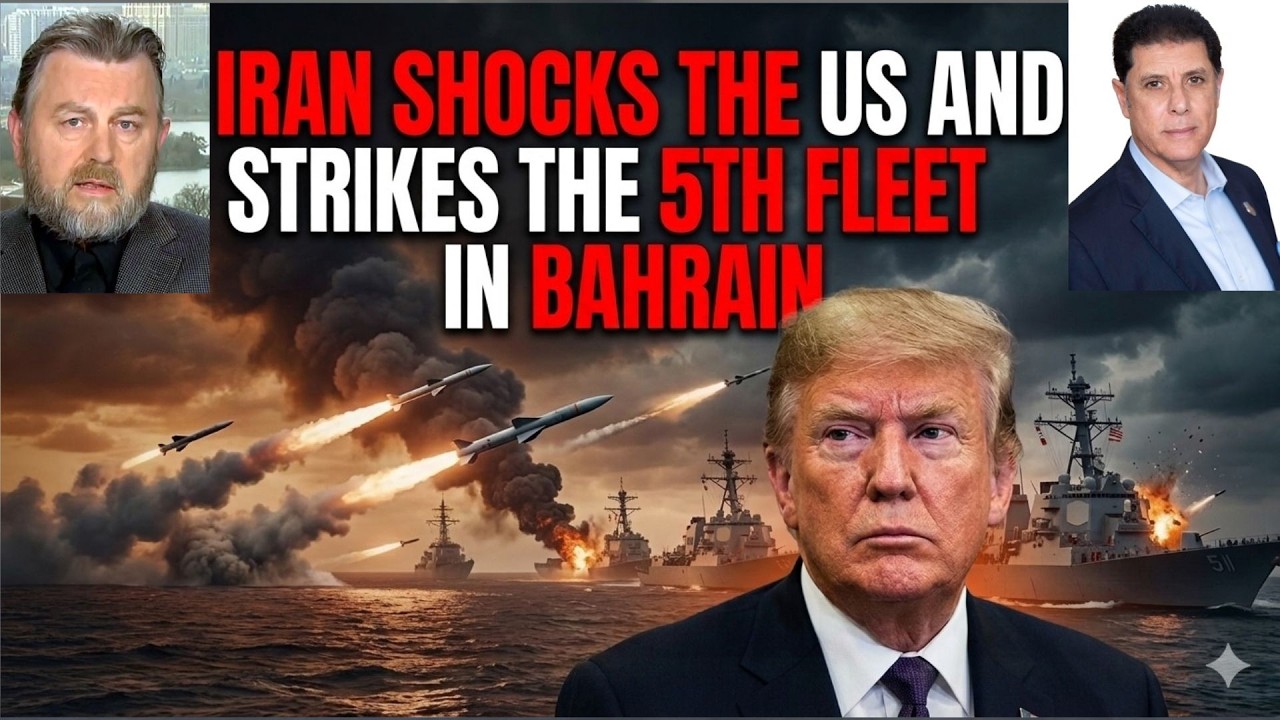
Larry Johnson argues that Iran's February-April 2024 attacks destroyed U.S. radar and communications at Al Udeid and Bahrain, forcing command relocation to Shaw AFB. Gulf states are reportedly demanding U.S. withdrawal and building a pan-Islamic security bloc with Pakistan, China, and Russia. Johnson warns the Strait of Hormuz is effectively closed and the U.S. Strategic Petroleum Reserve is near historic lows.
Chapters
Hello everybody and welcome to Geopolitical Trends, where truth matters. Excited to be with you as always. I'm even more excited today because I have my dear friend Larry Johnson here. Larry does not need an introduction. You all know Larry. Good to see you, Larry.
Hey man, good to be with you.
Well, truly appreciate you here. The community is so, so excited to have you here. We're gonna get into it right away, Larry, because I got a lot to cover with you. First, I would like to start with your assessments As to how do you see the conflict between US, Israel, Iran is moving forward since February 28th when the war started?
Well, so we had, depending on how you count it, 40— let's see, 31, 39 days or 46 days of war or 47 days of war. 40 or 47 days. Count that starting from February 28th through either April 8th or April 15th. By April 15th, at least a ceasefire had been signed. So during those 15 days, those, uh, you know, 40— let's call it 47 days of war, the United States suffered tremendous losses. Um, the, uh, we had these radar systems in both Al Udeid Air Force Base in Qatar and at the U.S. Fifth Fleet headquarters in Bahrain. Each of those radars reportedly cost more than a billion dollars apiece. They were destroyed. There were other sophisticated communications nodes. Some of them were space— were based with space-based assets that were destroyed. The 5th Fleet headquarters was rendered uninhabitable. They had to withdraw forces from there. Al Udeid Air Force Base, even though it had been a— it was a primary node for moving US troops into and out of conflict areas. But you know, I flew through there in May of 2006, going, you know, spent a night there, got up the next morning, then flew into Iraq to Baghdad, to Balad, where the JSOC headquarters was located at the time. So Al Udeid played that role, but its biggest role was with the Combined Air Operations Center, the CAOC. KAYAK was— gave— tied into those radars. It could see immediate launches of missiles out of Iran, could plot the trajectory, be able to warn who was going to get hit. The KAYAK was able to extend its vision to India to the east, Diego Garcia to the south, Russia to the north on the Black Sea coast. And out to Cyprus, covered an enormous area. Well, that's been blown to hell, and they've now relocated the CAOC to Shaw Air Force Base in South Carolina. So for all practical purposes, the United States has, has had to abandon its primary bases in the Persian Gulf. And it's not going to go back. They're not going to rebuild and restaff those bases. They're too damn vulnerable. That, you know, so that's lesson one of where we stand with this. Lesson two, they've exposed the limits or the myth of U.S. military supremacy. The United States not only failed to defeat the military forces of Iran, not only failed to stop and decimate their force of ballistic missiles, but the United States proved incapable of sustaining that operation. And so its air assets now are limited. In part because, uh, the, uh, the Tomahawk and JASM cruise missiles that are the primary arsenal for those, uh, airframes, no longer, uh, they're running out. And as those inventories are depleted, they can't replace them because they are dependent on— the Tomahawk missile, for example, is dependent upon 18 different rare earth minerals provided by China. Principally gallium is one of them, that China is not selling. They're saying, no, we're not, we're not providing that anymore to you. So that puts the United States in a real conundrum. Then on top of that, we get from the Secretary of the Air Force testimony to Congress 2 weeks ago that out of all of the F-35 jets that the United States has purchased, The only 25 to 30% are combat ready. So it means between 75— 70 and 75% of these $100 million planes, each one $100 million, are not able to fly, not ready to fly. And in the most recent delivery of 6 F-35s, they were delivered without the nose cone radar, which is a critical component. For it to be able to carry out its missions. And the reason for that is China is not selling us the magnets that are a critical element in those radars. So what did the Air Force do just so they could fly the plane? They went to Gold's Gym and purchased a bunch of weight plates, you know, that you put on a barbell. You put those into the nose cone to provide the weight so it thinks it's got a radar. Wow. So yeah, we're, we're in great shape.
Yeah, well, that's, that's very disturbing. And, and thank you, Larry, for bringing this up, because when I looked at after the retaliation of Iran on the, on the headquarters for the Fifth Fleet in Bahrain, uh, when I read, and I read in, in all the English, uh, versions here in Washington, none of them talked about the attack on the radar systems. You know, that's to me was like, wait a minute, why Washington is not reporting with accuracy what really transpired? Because to my knowledge was the, uh, Iran fired in addition to the drone, he fired some, uh, hypersonic missiles if I'm not mistaken. Yeah, there were some missiles used and that was the issue of what caused the destruction of this radar. So I'm Very glad, Larry, you clarified this because a lot of people had no idea of the massive damage that Iran has caused.
Well, in fact, in fact, one of the— excuse me— one of the systems hit. Yeah. And I don't know the full details. All I was told or learned is this is a highly classified system. Even the, the ground-based component of it was there in Bahrain, but it was tied into satellite systems. And because of the destruction of that ground-based component, those satellite systems now have no communication with the Earth. They're described as essentially space junk. Uh, apparently it caused great consternation among senior US military commanders who were fully read in on the program. I don't know what it was, but apparently it was significant. And that's what, you know, they— but they're not going to talk about it because I guess it's highly classified, whatever, whatever this was. It just, you know, it was one more system that was hit and struck, apparently with the help of either Chinese and/or Russian intelligence.
Yeah, you're absolutely correct, Larry. I mean, I got a word too about, uh, something highly classified was destroyed. I kind of, uh, didn't want to ask any further questions, right? My people would have talked about— you, you know how it is when they're classified stuff, we can't just talk about that. But I was informed about the classification of this. Now, with what just happened now in the, in, in the, uh, uh, Bahrain, in Fifth Fleet, how do you see the Gulf states now moving forward? Knowing that the US is not in possession to protect them anymore.
Well, there's a, there's a big effort underway by Pakistan with the backing of China and Russia to create, let's call it, a pan-Islamic version of NATO, a pan-Islamic military force that would combine Egypt, Turkey, Saudi Arabia, Iran, and Pakistan, that, uh, to secure the Gulf region. In lieu of the United States, and that particularly Qatar and Saudi Arabia reportedly have told the United States, you're going to need to vacate. You're no longer welcome to have bases here. We're not going to host you anymore. You need to go elsewhere. So to that extent, it's a major, major blow to the United States. It still remains to be seen if they're going to follow through on this, but I think they will, because what has been exposed is that although the United States provided, oh well, we got your back, you know, you need us in there, we'll protect you. Well, it turned out the US presence wasn't our protection. They made them a damn, you know, missile magnet. And so they said, you know, we don't need this anymore, we can live without this.
Yeah, because for sure Iran is not going to attack those Gulf states if there are no US military presence there.
Correct.
I've argued this, Larry, since the beginning of the war, if not even a few years back, that as long as the US maintains its military presence, those countries will remain a target. Simple as that.
Well, and they only become a target if the United States takes offensive action against Iran.
All right.
Because Iran has not been out doing preemptive strikes on US targets. They've always reacted. They've been in a reactive mode, not a proactive mode. Yeah.
Now with this development, I am sure you are aware of the recent statements by the Israelis regarding that the next Iran is Türkiye. What do you make out of that? Is this just bluffing? Is this Netanyahu's way of really dragging the region into a much more complicated conflict? Security situation, or is this like a way of saying to the Americans, you know what, we don't care what agreements you reach with Iran, we're still going to do what we want to do?
You know, privately, I hope it's true. I hope Israel tries to take out Türkiye because that will guarantee the full complete destruction of Israel and we'll be rid of that nasty little nation. I, I, you know, this kind of reckless talk full of hubris and arrogance, because why verbally attack Türkiye right now when Türkiye is the primary source of oil for Israel? What the hell are these knuckleheads thinking? So this is just, this is just one more indicator of how out of touch with reality the Israelis are, how full of themselves they are, and how self-destructive they are. And so again, that's why I think one of the other reasons Pakistan is busily promoting this broader military alliance. So if Israel is thinking about attacking Türkiye, they're going to be looking at attacking Egypt. And Saudi Arabia and Iran and Pakistan, which means this is, this is really, I think, designed to contain Israel, force Israel back in its box, and force Israel out of Lebanon. Wow.
Speaking of Lebanon, I am, uh, I'm sure the community is aware of what took place with Michel Aoun, the, the president of Lebanon, who now recognized Israel and has now the Lebanese furious, they send it to the streets. And is this one of the plans of Israel to really sort of create more division inside Lebanon before it moves into Syria as part of the bigger plan?
Yeah, well, it's also a US attempt to sort of further undermine the MOU with Iran. The MOU with Iran stipulated that both the United States and Iran were obligated to protect the territorial integrity of Lebanon and the sovereignty. What the United States did is go through the back door to get Aoun to sign on to a deal with Israel that effectively ignores the need to expel Israel. And so this former Army General Joseph Aoun, so, you know, what is he now? He is like 62 years old. He signed on to this. Well, he is a Christian, he is a Maronite Christian, but it turns out that the rest of the Lebanese government, particularly the head of the legislature, Nabi Berri, didn't get the memo, and Nabi Barry basically came out and said this deal is dead on arrival. So the sad fact about Lebanon is it's had this tradition that goes back 80 years where the Christians are nominally allowed to be the president, and then the head of the parliament and other offices are divvied up between the Sunnis and the Shias. But the Sunni and Shia are the overwhelming majority of the population of Lebanon, and they're not going to accept this kind of Israeli domination or influence. So this is going to remain— this is one of the issues that I expect Iran will be addressing in the coming week or weeks, because, you know, right now it is a clear violation Israel's continued presence in Lebanon is a violation, and I think Iran is dead serious about getting them out. And so that, that will set up a further confrontation with Israel. The reality is Israel is incapable— if they, if they have to go toe-to-toe with, with Iran, Iran will defeat Israel. Yeah, a lot, a lot, a lot of people have the same assessment, Larry.
And, and despite, uh, the only other option that They're saying that, uh, the only way, if Israel used the nukes, which will become a very serious problem— I don't anticipate that, but it'll become a serious problem. So, and speaking of, of, uh, of, uh, Iran, uh, uh, do you foresee that Iran, despite what happened since February 28th, still capable of engaging in a military conflict with the US?
Absolutely. You know, Ted Posta did an excellent presentation on Danny Davis's show on Monday, and which he showed with, you know, the actual videos of that. Only so, number one, of the Israeli air defense operations during that 47-day, 48-day period from February 28th to April 15th. The two-thirds of the munitions that were shot, in terms of air defense munitions, were U.S. munitions. So the U.S. played the overwhelming role in trying to, quote, protect Israel. Of those munitions, less than 10% hit their target. In other words, Israel was virtually unprotected does not have an effective air defense against Iranian ballistic missiles. So if Iran decided to reinitiate that campaign, Israel would be unable to stop it, and it would continue to such a point that Israel, as they had, as they did back in the 12-day war of June 2025, begged the United States to intervene to get it stopped. Because it couldn't sustain the pain. You know, I think the Iranians may come to the point of concluding that the only way to compel Israel out of Lebanon is to destroy their military bases completely, and they may be contemplating that.
So why is the US incapable of exerting its power on the Israelis to stop its excursions in southern Lebanon.
A matter of willpower. All you got to do is just say the word and write the orders. It is that simple. Up to this point, the United States has managed to rein them in somewhat, yeah, but not completely. And, you know, it is the point of the matter is that the United States has the power to enforce that. They absolutely do.
And the question is whether they're going to do it or not.
Correct. Correct. Yeah.
Okay. I need to get your assessment, Larry, about where things are in the Strait of Hormuz. Of course, what we're hearing from the Central Command, and I read some press releases recently after I came back from overseas, that all it says in a positive way that there is a freedom of navigation there, which I know It's a lie.
It is.
There is no freedom of navigation in the Strait of Hormuz. My question to you, Larry, is, is it a fait accompli that the IRGC now is in firm control of Hormuz Strait from this point forward?
Uh, generally speaking, what, you know, again, I've been checking regularly at marinetraffic.com to see what's going through. There have been a number of vessels that have gone through in sort of a convoy through the southern route around Oman. That was one that IRGC was blocking the other day. So I don't know if it's been that they're ignoring it or if they've worked out that these ships have done as required, submitted a request, and that is in accordance with the protocols that Iran has issued through the Persian Gulf Strait Authority protocols. But regardless, it's not anywhere near the volume of 120 ships per day that was the characteristic prior to the start of the war. And it looks like now, just in the last just in the last 24 hours that we may be getting the first ships headed towards Europe. There's one called the Rotterdam Energy. It's a ship. It says its destination is Fujairah, Fujairah, in United Arab Emirates, but it but it actually may be headed for Europe. But even if it's headed for Europe, it's 30 days before that oil gets there. And then once it gets there, how long does it take? It's going to be— it takes a day or two to get refined. So they're still— the Europeans are facing— they're facing an energy crunch right now. They're facing an energy shortage right now. And so there's, there's no relief in sight for at least another 30 days. And whatever relief comes, it's minimal. It is not going to match what they actually need to survive.
Yeah, because no matter what they say, Larry, even if the deal is reached, things are not coming back to normal quickly regarding the energy flow to the rest of the global market.
Yeah, no, that's correct, David. That's absolutely correct.
I just Now, where do you see the issue of the mines in the Persian Gulf? How this issue is going to be resolved? Will the European intervene? Will the American go ahead and clean this up, or will the Iranian leave it there and just as an insurance policy?
I don't know, because they claim that there are mines there, but the ships aren't acting like there are mines there. And we haven't seen any explosions take place that would make you think there are mines there. So, uh, uh, you know, I don't know. So it was the Pentagon in testimony for, uh, Congress that said take up to 6 months to clear the strait. Well, but, uh, still you've got ships operating right now that don't appear to be having any problems. So we just don't know. It's a— I don't know if it was a psyop by the Iranians claiming they did. And didn't, or if it was actually— they actually put some mines out there that are still floating around, can create a problem.
If the truth matters to you, hit like, subscribe, and tap that bell. No spin, no agenda, just the stories they don't want you to know. Don't watch from the sideline, be part of the movement. Your support keeps the truth alive. Thank you. Uh, I want to shift gears here, Larry, towards, uh, one, one specific question that many analysts now— and I'm seeing both sides of the argument regarding the role of Russia into this conflict. And some have said, you know what, Russia might be the winner of this US-Iran conflict. Others have said China is. I am leaning more towards the Russians being the winners. And why am I saying this? Before I'll, I'll get your assessment on, or your perspective rather. Uh, the reason why, the reason why I'm saying Russia is, is emerging or has emerged as one of the primary, uh, economic beneficiaries— it's not from a geopolitical perspective, from an economic aspect— because Russians have racked up billions of dollars since the conflict started because the oil prices went up. My question, Larry, could this windfall economically translate into some sort of geopolitical influence in the region?
Oh, well, yes, to an extent. Look, it's now 2 months ago, shortly after the agreement that was signed with the ceasefire was put in place around April 22nd. Foreign Minister Arachi traveled to Moscow, had an extensive meeting with Vladimir Putin. At the end of that meeting, Putin came out and announced that there needed to be a new security architecture in the Persian Gulf. One week later, Arachi was in Beijing, meeting primarily with Foreign Minister Wang Yi, but also had a meet and greet with Xi Jinping. And again, at that conclusion of that meeting, Wang Yi announced the need for a new security architecture in the Persian Gulf. In the ensuing weeks subsequent to those meetings, Pakistan emerged as a major mediator in the process and became a primary source of information about what was actually taking place behind the scenes, that Pakistan was acting, if you will, as the front man for China and for Russia. But, uh, this effort to secure the MOU was achieved as a consequence, I think, of two things. Number one, Donald Trump's realization of the imminent crisis the United States is facing with respect to supplies of diesel and aviation fuel. The shortages on those fronts that are going to do tremendous damage to the economy, and that is probably unrecoverable before the midterm elections. But he had to act when he acted in hopes that he might be able to forestall the damage, but I think it's increasingly unlikely. But the other element was that the full backing of Pakistan providing security guarantees to the Saudis and to the Iranians, backed up with as a nuclear power, came in and also had a major effect on the negotiations. So what we see is China is— Russia is watching, and you're correct, Russia is benefiting financially from this. Russia is supporting what is primarily the Chinese effort to sustain, to get this, because China needs the Persian Gulf open and functioning more so than Russia does by any stretch. The problem that China faces is that, you know, one of the major suppliers is Qatar, through their liquid natural gas terminal, and out of that liquid natural gas, as it's processed, they would process helium. Helium is, uh, from Qatar, accounted for about 40 to 44% of the global supply and is a critical ingredient in computer chips. Uh, right now there's zero helium coming out of Qatar, and that's why you've seen Apple have to announce the increase in its iPhones and MacBook Pros, because the computer chips are now more expensive. In some cases, like in the high-end iPhone, it's added $200 to the price, $300 for the MacBook Pro. So that shortage, getting, getting that whole system back up and running and running without incident is one of China's objectives. To that end, Iran has made it very clear it will allow— all the ships have to do is fill out the paperwork, identify the route that they're traveling, and they're good to go.
You're absolutely correct. And by the way, guys, just to let you know, if you can check out Larry's, uh, uh, uh, on Substack, uh, I, I had a chance to read, by the way, Larry, and I'll put it for you guys, for the community, in the video description. I read your article that was published on June 29th. You had, you had an excellent article there where you talked about the Strait of Hormuz remains open for those who adhere to PGSa protocols. So it's spot on, and I couldn't agree more with your, with your assertions in that particular article. It makes more, more sense moving forward, and that is the reason why I asked that question. So for the community, just make sure go to Larry's Substack, and I'll put all the link for you in the, in the video descriptions. And now this leads me to ask you, Larry, as to moving forward, how do we see the role now of the United States in this new architecture of the geopolitical landscape in West Asia or Middle East?
We're outside looking in, man. You know, the, um, up until the start of this war on the 28th of— well, it actually, it preceded that Let's go back to the start of the special military operation in February of 2022 by Russia. At that point, the United States was in a dominant position economically by virtue of the world having to rely upon the petrodollar to purchase oil, and that if you, if you didn't toe the line with the United States, by God, they'd punish you and you would suffer financial harm. They could— the United States would, you know, shut you out of SWIFT, which they did to Russia. So what did Russia do? So Russia began developing an alternative financial system and working in tandem with China to that end. And it turns out that the BRICS countries combined have— when you're looking at GDP in terms of purchasing power parity, are, are far bigger, wealthier than the G7. And, uh, this, this quest to create an alternative financial system instead of, you know, transferring money between banks internationally using SWIFT, which all it is, it's just, it's a, it's an analog email system. Chinese began developing CIPS, Cross-Border Interbank Payment System, which is a digital platform, one that, if you will, can be traced via— it's got blockchain security to it. Well, lo and behold, that's exactly now what's starting to take over in the world, that it is becoming used more prominently by a number of countries. And, you know, China's the biggest beneficiary. Plus, in the past, countries sort of, if you get into uncertain circumstances, you want to build, um, you go to safe havens, buy, buy U.S. Treasuries. That hasn't happened this time, just the opposite. Countries are flowing and buying Chinese bonds, bonds that are backed by gold. So you've now got gold-backed bonds in China that people are lining— countries are lining up to buy, and they're selling their treasuries, even countries like Japan, Saudi Arabia. And on top of it, the big seller is China. So the United States currency is actually in trouble. And so these economic problems are compounding.
So, and this is the reason why Uh, this is again, uh, uh, uh, and, and you mentioned this, Larry, in one of your other articles when you talked about the, uh, the, uh, the SPR being low in the quantity of oil here in the US.
Yeah.
Which prompted the Trump— I mean, this whole idea of this MOU has nothing to do with wanting peace, whatever. It's because we are getting closer to the red lines regarding the SPR, the Strategic Petroleum reserves?
Well, you know, I've quoted Ambrose Pierce. He was a Civil War soldier, and he was credited with saying that war is God's way of teaching Americans geography. Well, we can update that now to say war not only teaches geography, it teaches you about international trade, it teaches you about commodity markets, like the importance of oil, liquid natural gas, urea, sulfur, and helium, things I had no idea about. It teaches you about the Strategic Petroleum Reserve, which, you know, I had never thought about it until you started digging into it and you realize that even though we got, quote, the 750 million barrel capacity, uh, the, the reality is you got to keep at least 140 million barrels about 20% of that overall capacity in those salt caverns where the oil is stored. And it's not like there are 4 separate caverns. There are 4 sites, but multiple caverns at each of those sites. So, you know, they've got a— the amount of oil in each one varies because when they come time to pump it out, they pump water in that raises the oil, but that water going in starts mix them with the sand, you get salt water. So I, you know, I never knew this. And what we're now— and it was just reported in the press today— we're at the lowest level since 1983. And people go, so what, what does that mean? Well, what that means is 1983 was when we started filling the petroleum reserve. So we went from empty to something. Now we're back close to empty. We're close to empty.
You're right. It's very, very concerning, guys. I'm putting the link for you in the chat box for Larry's Substack because that's where I read his article there. So make sure to take a look at it and subscribe to that platform. It's a wealth of information. And thank you, Larry, for sharing those informations with the community here. So I want to shift to the Far East. Just to get your take on some developments that's taking place. The first one has to do with the tensions between the Philippines and China once again. But I want to just ask you about this, as to what prompted this all of a sudden, this tensions again between the Philippines and the Chinese, when considering what the United States did about 2 and a half months ago, to my knowledge, was the shipment of certain types of missiles They went to the bases in, in Philippines. What are we looking at here, Larry?
Yeah, I actually, I hadn't, I hadn't realized. I haven't had a chance to focus on that, so I'm taking you as being the news reporter on this. Uh, if, if, if the United States shipped missiles in there, it did, then, then the, the Chinese are, they're not going to sit back and ignore that at all. You know, that, that's a provocation. They're not going to sit back and let the United States build up weapons systems along its periphery. And so, you know, that, you know, I'm sure they're delivering a tough message to the Philippines, say, you know, you got to stop this. They're not going to wait until the missiles are in place and armed and ready to launch. I mean, in the same way that if China tried to do that in Mexico to us, we wouldn't put up with it for one minute. And this is what always puzzles me about the hypocrisy of the United States when it comes to these issues. But we, you know, the old golden rule, you know, treat others as you would like to be treated. No, hell no. We treat others as we don't want to be treated, and we expect them to like it and suck it up and live by it.
You're absolutely correct, Larry, because that happens in in the Gulf of Alaska a few years ago. Do you remember when the Chinese and the Russians' vessels got closer and the US went up in arms? It's like, what the hell? Now you know what it feels like when you go near other countries' borders and so forth. This is the same reaction.
Exactly right. Exactly right.
Now, before I let you— I want you to have the last word here, Larry, before I let you go. Go back to the Middle East, or West Asia, that is, because I personally seen some major developments. It's happening already, but the shift of the geopolitical landscape in the region ain't gonna go back to what it used to be. And the US seems to be under the illusion that, oh, once the war settles, we're gonna go back to business, right? So, so where do you see this moving?
Yeah, no, I think you're exactly right that we're witnessing the sun setting on the former US empire and control over the Middle East. A new order is coming into being, one that the United States is not going to be able to control. Previously, we could control it through the threat of military action. What, what, what— I don't know if people fully appreciate how dramatic the events of the last, uh, now 5 months have been, where the United States has been exposed as a weakling when it comes to projecting and using military force. It, it, it does not have unlimited capabilities. In fact, it's been shown to have very limited capabilities. And as a result of that, a lot of countries are, you know, the story of how an elephant was convinced that, you know, if you get a baby elephant, you put a chain around its leg, and as it grows up, it becomes accustomed to believing that if it's got something attached to its leg, it can't get free. And so it lives with that. And as it gets older, the, the, and, you know, the legs get bigger, the owners substitute just flimsy rope because they have convinced the elephant into believing a lie that they are trapped, that they have no way out. But then comes the day when the elephant actually accidentally pulls on it, it breaks, and realizes it's free and realizes, hey, we don't have to be chained to that anymore. That is what's happening right now in the Persian Gulf with the Saudis, with the Qataris, with the Kuwaitis, Bahrainis, and Emiratis, and Omanis. All of them in different ways are coming to grips with this new reality that previously they thought they were chained, that they had no option other than to be obligated to the United States. You know, and now it turns out they got some choices. And as a result of those choices, uh, it's no longer putting the United States in the driver's seat. In fact, the United States is no longer— they're not the only date in town. They have options.
You're absolutely correct, because Larry, I, I always believed since the beginning of this war that Iran is now the wild card that's going to change the trajectory of the Middle East moving forward.
Yeah.
And of course I get pushback against that statement, which, you know, people are entitled to their opinion. I'm not going to— this— well, no, Dr. Oualaalou, it can't be. And I said, just give it a time and you will see the changes. And it's what you just articulated, Larry, reflected exactly my thinking when I argue that point. I don't see the US going back to doing business the way it used to anymore. I don't see the presence of American forces in the region as it was, let's say, two decades ago. And what I see moving forward, and I would like to have your take on this quickly before I let you go, Larry.
Sure.
How will Iran now move forward with this new power they acquired? Because to me, they acquired a new power. That's now the main power in the region beside Turkey. There's no other, there's no other. Some say Israel, Israel stand no chance against Iran one-on-one, like you said at the beginning here. So how do you see Iran flexing now its military muscles, given that it proved that it can push against a major power like the United States?
Well, I, you know, it made a conscious decision back in 2003 following our invasion of Iraq that it's, hey, we gotta, we gotta move our capabilities underground and we have to harden them against, uh, potential nuclear strikes. And so they did both, and it's remarkable what they've accomplished in, you know, almost a quarter of a century, 23 years. So they, they now have this, you know, an extensive system not just for ballistic missiles but for marine craft, other weapons systems, as well as production facilities underground. And I, I maintain that I don't think the U.S. intelligence actually— community actually has a good grasp on the size, scope, and capability of these sites. And So from that standpoint, Iran has now established itself. It can clearly fight a defensive war. And look, in '46, '47, it's never been an expeditionary military force. It's never sought through either military means or intelligence means to go out and try to subvert other countries, to, if you will, proselytize the Shia Islam as superior to Sunni Islam. You know, they by and large maintain them, you know, maintain them, you know, kept to themselves. So, um, this is, uh, I think Iran's entering into a period where they're going to get some— they're going to get some additional backing from Pakistan, from China, from Russia, where they'll feel protected and won't have to face prospects of new attacks from the West. Indeed.
Well, Larry, I can't thank you enough, my friend, for your insights. Really, at least for me, and I speak for myself, confirmed some, some ideas I've articulated a few months ago as to where things are. And now you explaining that your own way made more sense to me. So I thank you so much, Larry, for being here. For sharing your knowledge with the community, and we are very, very grateful to have you here and look forward to next time.
Well, David, I, I really appreciate that and always enjoy a, a chance to chat with you. Thanks so much.
It's always a treat, Larry. Thank you so much.
Okay, bye-bye. Bye-bye.
Uh, to the community, remember, tomorrow I will be addressing, uh, sort of picking on what Larry mentioned earlier. I'll be addressing about this particular topic, whether Iran should acquire a nuclear bomb moving forward, because we don't know how things are going to go. So make sure to join me tomorrow at, uh, 12:15 Central Standard Time for this conversation. And quickly want to say thank you to Army with Harmony for the new, uh, membership here, uh, on the channel. Thank you very much for this one. And also want to show this one here. A great success in your ventures, Dr. Oualaalou. We are ready to receive your contributions. It is excellent to have the contributions of Mr. Larry Johnson. Fingers red, number one. I'm gonna send Larry— I, I communicate with him privately. I'll send him this comment by either. So thank you so much. So, uh, and to the rest of you, I look forward to seeing you tomorrow. As always, remember, geopolitics impacts your daily life in more ways than one. Till next time, bye-bye.
More from David


Beyond the Single Actor: Why the Gulf Isn't Choosing Between the US and China


Iran, Iraq's Militias, and the Houthis Are Coordinating! This Changes Everything




Who Controls the Next Decade's Resources? Latin America and Africa's Geopolitical Crossroads

The Chokepoint Trap: How Washington's Stupidity Triggered a Cascade That Now Controls the World

Trump Spooked as IRGC Unveiled dual-use SLV, Deployed Ghadir Mini-Subs & Hinted at Tactical Nukes!
