Iran Handed a Strategic Defeat to the U.S. & Redefined its Place in the World!
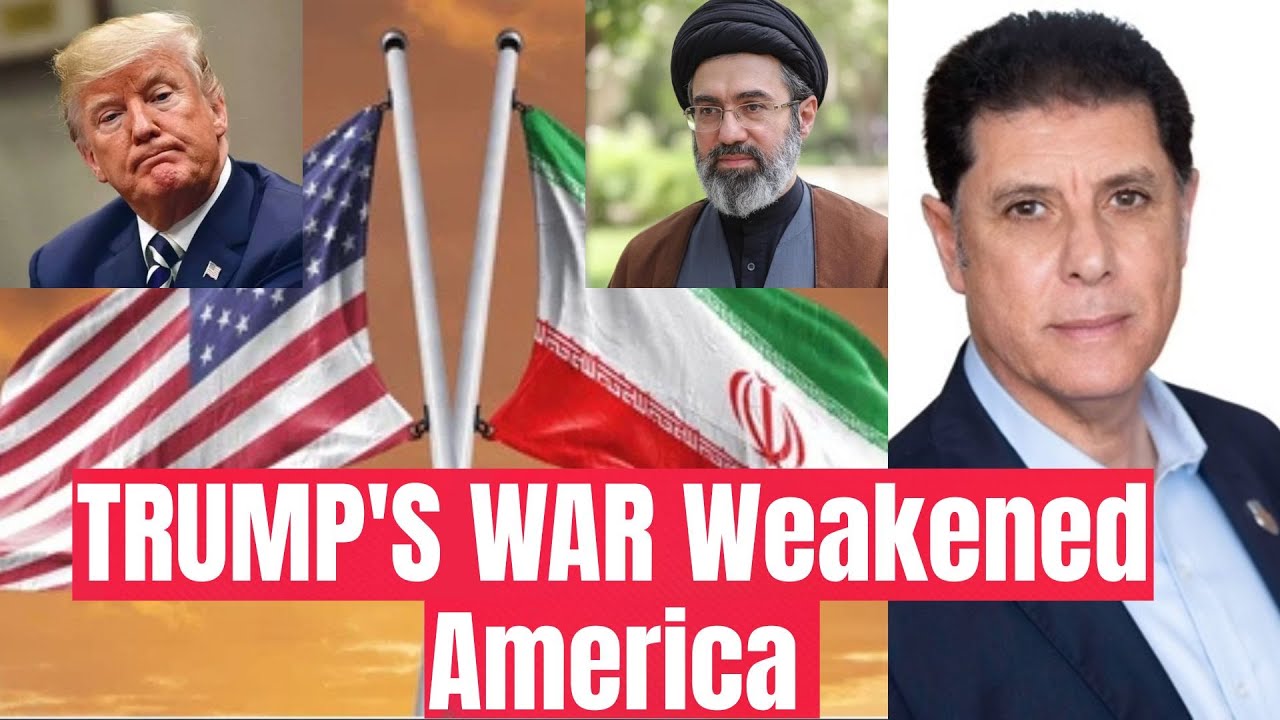
In this livestream, the presenter argues that the US‑Israel war against Iran—initiated by the Trump administration and continued under Biden—constitutes a strategic defeat for the United States. Over a six‑week period the conflict inflicted four major “wounds”: (1) a blow to the global economy by Iran’s weaponisation of the Strait of Hormuz, which threatened energy markets; (2) a rapid depletion of US conventional strike assets, notably more than a quarter of the Tomahawk missile stockpile, while cheap Iranian drones proved effective; (3) the erosion of traditional US alliances as NATO members, Japan, South Korea and others refused to join the fight, signalling a loss of trust in the US as an “indispensable partner”; (4) a legitimacy crisis for US foreign policy, portrayed as impulsive and lacking a coherent strategy. The host cites Pew survey data showing half of Americans believe US leadership is weakening, references statements by Chinese President Xi Jinping about a “new world order,” and includes clips from journalist Mehdi Hasan and leaked hacker material exposing Israeli‑Jordanian contacts. The analysis further claims Iran’s nuclear programme remains intact, the IRGC is resilient, and Iran is emerging as a fourth global power alongside the US, China and Russia. The presenter concludes that the war has accelerated a shift away from a US‑led international order toward a China‑mediated system, and urges viewers to reflect on America’s capacity to provide global leadership.
Chapters
Hello everybody and welcome to Geopolitical Trends, where truth matters. Think about it, in the US we called it a victory and we were wrong, because in just 6 weeks, one war did to America's— what, what sort of America's challengers, enemies, whatever term you want to use, spent decades trying to do. What is it? Is that it cracked— it really cracked the foundation of the world's most powerful nation so far, from inside out. This is exactly what happened in America, or to America. And the scariest part— here's the scariest part of them all— not all, of course, but most Americans still don't know that it happened. Only 6 weeks. And within the 6 weeks, you got about 3 or 4 wounds that have impacted the US. And he brought the so-called superpower to its knees. That's exactly what the Iran war is doing. So the US-Israel war on Iran, the illegal and unjust war on Iran didn't just shake the Middle East or West Asia for that matter. On the other hand, it handed China the key to a new world order. And I am going to share a clip with you by a statement by the Chinese president, President Xi Jinping. And this where he talks about the new world order, because what happened to America is it fractured literally, and I use the term carefully, it fractured the sort of the US oldest alliances, if you will, because nobody wants to join America in a fight that is not theirs. But also what he proved, he proved that the most challenger in this case, Iran, even though some in Washington called them enemies and all that stuff, beside the point, the challenge wasn't about just missiles. Firing this and that, but about the US own impulsiveness. That is where the demise of the United States is. So in this livestream, I'm going to be providing you— this will be more about an analysis more than anything else. I'm going to keep it brief for you, and I'm going to share some clips towards the end, and I'll share one excerpt from my first book that I wrote about 11 years ago, and I addressed this particular point. I'll let you be the judge of that once you listen to it. So, and that's exactly what I intend to address in this, uh, livestream here. So, because the war that Trump embarked on has really weakened the United States, and as I said earlier, 6 weeks, just 6 weeks were enough to lay bare the truth that most Americans still do not even come to understand. Because here is where it started, as you all know, and I've been covering this from day one. It started as a war that is sort of with some sort of excessive, excessive confidence on our part, but it's ended now. It's still— the war is on, but it's ended almost so far with some weighing-in questions. This war didn't strengthen America, rather it weakened it. And again, this is where I want to share with you 3 or 4 key points that I came to realize after doing a lot of reading from different sources that allows me to at least sort of construct this particular outlook. And I also wanted to share it with the community. So because what this war did, literally, because how, how we moved forward, this weakness, you know, as I said, on, on many, many levels, because the decision to go to a war made without authorization, first of all, from Congress, lacking congressional mandate as it is required by the law. Devoid of a genuine support from allies. As you know, most NATO— and I am in Europe right now— most NATO countries, you know, last time I stopped in London and it's like, heck with it, we ain't gonna join America in this. Oh yeah, it's our NATO ally, but no, no, no, no, it's not our war. So devoid of this genuine support from allies, and of course justified by the arguments A flimsy argument and contradictory. It's not even our war. And the big them of all, the biggest of them all is that there was no strategy, but rather an impulsive reaction to events. Why? Because Donald Trump was forced into it by Israel. Simple as that. So the global standing of the US and the alliance relationship, that is. Half of Americans right now, and I have the Pew Research Center results of the survey, I'm gonna share the link with you, let you read it yourself. Half of Americans are saying now Trump policies are indeed weakening the United States standing in the world. Of course, his predecessor Biden was no different. And Biden's predecessor was no different. The degradation of the US has been rolling on. I've been seeing it on the move since 2004, especially when we went to Iraq in 2003. And I said, this is the beginning of the end. And this is where you have this hypernationalistic approach to foreign policy, which, by the way, we don't even have a foreign policy. Has fundamentally, in my opinion, weakened the US role on the global stage from, from an international relations perspective. And all this comes at a time when partnership and alliances are seen as critical for the United States to meet the global challenges. So I'm going to share the 4 points with you. The first one, or the First wound, if I may use the term, the global economy. We'll start with that, you know, because here's the harsh truth: Iran was never defeated, and Iran will never be defeated. It did something shrewder. They were smart about it. What it did, it weaponized geography. That is the smart move on part of Iran. See, this Strait of Hormuz here, that's what Iran did. The Strait of Hormuz became a pressure lever, or lever rather, a low-cost threat with the power to rattle energy markets across the world. I would say that's a smart move. And the alternative, reopening the strait by force, which what Donald Trump was saying, will be a far greater and far more dangerous gamble. This is why Donald Trump today had to thank Iran, saying, "Thank you." I'm gonna share the clip with you and let you know why that is. The second wound is the American military. That is massive one. You know how many missiles we fired? The stockpile for the U.S. is draining. Of course, the Pentagon is staying hush-hush about it. More than a quarter of the entire Tomahawk inventory was consumed in a single conflict, and the conflict is not even over yet. And in return, what do you have? You have cheap drones managed to tie— and I use the term carefully— to tie in the world's powerful armed forces. Into knots. That's what Iran did. A very humbling equation. No Pentagon briefing was prepared for, nor did they ever prepare the public for, the American people. So that is the second wound for them. And for this, I'm going to share clip first, then we'll move— I'll continue with the conversation. All right, let's take a listen here, please. And it's in English, by the way. Trump's Iran naval blockade appears to be failing as 20 vessels, including ships linked to China and Iran, have passed through the Strait of Hormuz in just 24 hours. Tankers are still moving and oil is still flowing. Meanwhile, the United States Navy appears to be monitoring the situation without taking visible action. This raises serious questions about control over one of the world's most critical shipping routes. Trump. Okay, that is the important aspect for now. Here is the second, which just happened this morning, and I found out about it. Okay, let me share it with you here, and it's very short. There is no— I'm just going to read it to you. Or translate rather in English since it is written in Arabic. So what it says right there, let me, let me just make this bigger for you so you can see. Hope I can do that right there. Here is the thing. It says, "Mufajjah al-Trump," a surprise from Trump, is that he is thanking, saying thank you to Iran for opening the Strait of Hormuz. This is unexpected event and was unexpected that have ended the conflict. Now, here is the harsh truth. That is not the entire truth. Donald Trump has misplayed with the words. Iran opened the Strait of Hormuz, that's for sure, to all. Ships. But here is the condition for it. The condition is that as long as the ceasefire holds. So for Donald Trump to say, oh, we thank Iran for this, that's now the conflict is over. It is not because Iran is still saying we stand by if we need to resume the fighting. That is the important thing that I need you, and I wanted just to share that with you. So the third point or the third wound, if I may use the term, The allies, you're looking at Japan, you're looking at South Korea, and of course Europe. What are they doing? They are watching from the margins, from the sidelines, not because they were unable to act. No, no, no, no, no, no, no. But because they no longer felt that they could trust the United States, the so-called indispensable partner. Has be— now is becoming to look like their eyes like, oh, this is the unpredictable ally. We can't trust the Americans anymore. The fourth wound, or the fourth point, is the deepest, is the key, in my opinion. Because here's the thing: when a nation, in our case is the United States, openly threatened to erase a civilization, It doesn't just lost the battle, it lost itself because that's what we did. Global, global leadership has never rested on firepower alone. Go back in history, go back to the 14th, 15th, 16th, 17th, 18th, 19th century. Ask the Brits, ask the Portuguese, ask the Dutch, ask the Spaniards, ask the French. It's because whatever it is, it rests on legitimacy, and that is something Donald Trump doesn't understand. It rests also on principles, which we don't have anymore. It rests also on belief, which we don't have. But that belief is also held by others. That is one thing we missed. So the bottom line is to this one here is that weeks after a ceasefire that fell short of every stated goal, that's why I'm saying the war is not over, and from which Iran emerged with some sort of an influence beyond what we could even imagine. It had never— even Iran itself, not that they never imagined it, but it never crossed their mind that there will come a time where they're gonna— when they're gonna emerge this powerful. As a matter of fact, now major military analysts are saying now Iran is considered the 4th major power in the world. And I'm going to share a clip with you towards the end, so just make sure you stay with me till the end, please. So, so the lesson from all this is stark, really stark, is as clear as daylight. The unilateral path leads to isolation. That's where we are at. And in this case for the US, yes, we still can use the term, even though I don't believe it anymore, a superpower. What superpower? No, but if we are to go with that terminology, a superpower that acts on an impulse risks something beyond No missile can restore— no matter what we do now to Iran, we can't restore whatever because we have lost our standing in the world. That is where the challenge is. And with this, it leads us to ask the other fundamental question, and that fundamental question is: what are the geopolitical implications as a result of this particular war, or even as a result of once the war settles, assuming it does. So the fragile ceasefire, and what comes after it? It's a logical question to ask. So what I have learned throughout at least my professional life, my years in military, my years in the government, my years in dealing with consulting and so forth, what I have learned is that ceasefire. And of course, from history. History is always my biggest teacher, if I may use the term. A fragile ceasefire masks a far more dangerous reality. Because here's the harsh reality that we are pretending we don't hear or we don't know, is that Iran's nuclear ambitions still there, and they have the right to do so. Lebanon, as we speak, is destabilized, even though there is now ceasefire, but also because Israelis have suffered major setbacks against Hezbollah. And the shadow war, this is the shadow war between Iran and Israel, is poised to reignite at any moment. Israel will not stop till they push the US over the cliff. Vis-à-vis the fighting with Iran. So this fragile ceasefire brokered by Pakistan and China is only 2 weeks long. That's it. That's it. And since it's the time it was declared, it has already been violated, which Israel did, by the way. The other thing that comes out of this is that the rise of China as a global mediator. That's another which— where I see the statements by President Xi Jinping at this time, very crucial. That's the most consequential, in my opinion, as a geopolitical analyst. I look at it down the road. This is a long-term shift. That is why President Xi Jinping used the term the New World Order for a reason. Because here is the thing, what many do not know It was China that convinced Iran to accept the ceasefire proposal brokered by Pakistan. That's why I'm saying China is part of this deal and all that. But behind the scenes, what China end up doing is they end up chipping away at America's long-term status as this global mediator at first resort. Why? Because we are not honest and we can't be an honest broker in any— look at just the Arab-Israeli conflict, but also because China succeeded in brokering or mediating between Iran and Saudi Arabia in the past, which we've never tried because we never want them to resolve these issues. That is where the difference. So The big picture is that the Iran war adds weight to Beijing's worldview that the US-led international order is over. That is the lesson to all this. And this is, in my opinion, is a profound soft power transfer. Gently, quietly, stealthy, if I may use the term. The world's leading mediator is no longer Washington. Beijing. The other point you need to think of is the fracturing of Western alliances. That was as clear as daylight. Because without any prior consultation with Washington and allies, Trump showed a complete disregard for the strategic and economic concerns. As I said, I'm in Europe. I made a stop in London. And there's a conversation that NATO already raven by Trump's repeated threat to the alliance and design for Greenland. So if Trump wants to follow through, then he needs to pull out of NATO. See if he can do it. And if he does, then the Europeans needs to take matter into their own hands and and establish their own security instead of being under the thumb of the, of Washington. But they can't. Europeans are also weak. And this is again where you're seeing where things are headed vis-à-vis the new, this global order. It's because I will say both Beijing and Moscow, both of them are capitalizing on these cracks between the US and its allies. It's just how geopolitics is. You don't wait for the perfect moment. Doesn't work that way. Because when Trump requested support from NATO allies, you look at— he asked Chinese, even China, Japan, and South Korea to secure access through the Strait of Hormuz. These states declined to do so because they're like, wait a minute, that ain't our war. You deal with it. You deal with it. So there are some analysts in Washington, they're saying, oh, with all this happening, there is some sort of Iran's internal future. It's going to be a power vacuum, it's going to be hardened regime and all. No, there will be no power vacuum because of one fact. And that fact is, Iran structure of the government has built layers. Even if Israel or the US go ahead and take out the current leadership in Iran, next one is in line already, and the one after it, and the one after it, and the one after. So that's why I disagree with these assessments from some analysts in Washington. It's because when you see where it's coming from, it's coming from Brookings Institute. Institute, which we all know as the back door of the US government. And this is where you have these layers of officers inside Iran, across various armed branches of the military. They also have layers when it comes down to the economic assets of the country, in Iran, that is. That is why I'm saying if we take out this leader— no, there is a replacement already. Even if the US and Israel continue targeting these newly replaced leaders, the IRGC and various other armed forces will not melt away. No, they will not even fracture. Iran's government and Iran's system as a whole has managed so far to survive the economic devastation from the US sanctions that have been imposed for the last 38 or 39 or even 40 years. 40 years. So to put it simply, Iran's government is a hard target. There is no way. The other point that I see important, and I wanted to address it briefly here for you, is the nuclear question. Iran now has absolute justification to move forward with what it needs to do. Why? Because what the IAEA, the International Atomic Energy Agency, is saying, it is reporting— the IAEA, which I never trusted, is reporting that Iran has stored highly enriched uranium in underground facilities that was undamaged by the US bombing. I can see the reason why Iran will deny access to IAEA. As a matter of fact, some of the IAEA leaks of scientists, that's how Israel ended up targeting them. So what would you, why would you, if you are Iran, why would you even allow the IAEA to come back? Say forget about it. Even that, the, the NPT, the Non-Proliferation Treaty, why would you even bother with it? It's because what makes— and, and again, I found this very, very important point, and I'm going to share a clip with you here because it's worth really listening to when it comes down to this particular point. So let's take a listen, please. And this from Mehdi Hasan. I don't know if you know who he is. Uh, he's a journalist in England. Uh, uh, I listen to him sometimes, is spot on, logical arguments. So let's take a listen here. And you decide for yourself.
In the Middle East has nuclear weapons. It's not— which country in the Middle East has nuclear weapons? It's not Iran. It's Israel. Which country in the Middle East has not signed the NPT, the Non-Proliferation Treaty? It's not Iran. It's Israel. Which country in the Middle East is defying a UN Security Council resolution calling for that country to open up its nuclear facilities to IAEA inspectors? It's not Iran, it's Israel. Which country in the Middle East attacked 6 countries in the Middle East last year?
6.
It wasn't Iran, it was Israel. So the only country in the Middle East right now that can put its finger on a button and fire a nuke is Israel. The only country threatening to fire the nuke it has— Ben-Gvir smiled and nodded the other day when an Israeli journalist suggested nuking Iran— is Israel. Why is your country, Doron, you're a spokesman for the military, in violation of UN Resolution 487, which was unanimously passed, including by the Reagan administration in 1981, calling for Israel to open up its nuclear facilities to the IAEA. Why won't you allow IAEA inspectors to look at your illicit secret nuclear weapons program?
And that is a good point. And the answer to that last question is because Israel has a specific type of weapon. Unfortunately, I can't say the word. I'm sorry, but it's classified. That is the reason why they are not allowing the IAEA to get in. There's a reason for it. So, and the concern and fear is that if Israel will end up using that. I don't know. I don't know. But that's the point. I just want you to hear the other perspective to that. So then you have the other key point is the broader regional reordering, because now we are looking at the reshuffling of the global order in a different direction. So when the last year, remember, Iran was constrained, it's not out of fear, but we misinterpreted that as weakness. So we can just go and do whatever we wanted to do this time around, which, by the way, It's a fact. And I think the next video I'm going to do for you in a few days from now has to do with the types of weapons Iran now is exposing, including an entire airbase underground. So the reason Iran didn't do it back then, because constraint, not that they were afraid. This time around is different. Iran owns the skies over Israel. Because the Iron Dome, the David's Sling, and the Arrow 3, whatever, all helpless against Iran's missiles. And that is why Iran went ahead right away, targeted the US assets in the Gulf countries. Well, there is a reason for that, because those countries, Qatar, Bahrain, Kuwait, United Arab Emirates, Jordan, have allowed their territories to be used as a launching platform to attack Iran. What do you expect Iran will do? Aman itself. And this is where you see the geopolitical landscape. It is changing, at least insofar some of those countries are on the side of Israel. I'm gonna share a clip with you that was sort of came out of the hacker's access to a Jordanian general. Once you find out where the Jordanian general was, will make you just shake your head. But before I'll do this, I want to share the clip as I promised you from the book that I wrote back in 2000. Well, I forgot when I wrote it, '14 or '15. Anyway, It is what I wrote back then. If, for instance, I were to advise the Iranian government, all I have to say is that the US is paralyzed politically following years of hollow threats, weak leadership, and a disastrous foreign policy. More than ever, Iran and other countries are convinced that all they hear from Washington are empty threats. In their opinion, the United States lost its credibility as its leadership diminished. When an American president gives foreign policy statements to Iran and other countries, those countries hear only meaningless bravado, absurd prating about global leadership. Global leadership being a rare political commodity these days. America lacks resolve, and its greatness in standing for so-called freedom and democracy amounts to nothing but a consumption of ink. That's exactly what I argued back then, and I still stand by my statements. So the bottom line to all this, before I do conclusion— I told you I'm going to do this very, very brief for you— so sorting out, uh, if we are to say losers and winners— no, no, we're not going to think in those terms because there's one thing that is clear and that this conflict has created now a mighty geopolitical shocks. The shockwaves reverberating in Washington, in Tel Aviv, in Paris, in London, in Berlin, in Tokyo and so on, what have you. Because what the war has done so far is kind of dramatized the contour of a weaponized world economy. Iran didn't need to do much. Shut down the Strait of Hormuz. Roll in the old alliances, you know, and unveil the new one because you start to having countries now saying, how can we depend on America? Japan is watching. South Korea is watching. Philippines is watching. Australia is watching. Even Taiwan is watching. It's because what this war end up doing is pointing to a future in which global norms have eroded as some sort of a raw power realities take the fore, because that's what we're looking at. And the irony is so stark, you won't miss it if you read between the lines of the assessments, analyses coming out of think tanks, be it in Washington, London, or what have you. Because the war that was launched, it was launched in the name of the American strength. And that war in itself might have done more to accelerate the transition away from American-led global order than any single event in recent memory, to my knowledge. That's exactly what the Iran war has done and is doing. So let me share the clip with you, as I promised you before. Let me, let me get to it. But before I do this, I'm going to just play this clip.
Here.
If the truth matters to you, hit like, subscribe, and tap that bell. No spin, no agenda, just the stories they don't want you to know. So don't watch from the sideline, be part of the movement. Your support keeps the truth alive. Thank you very much. Indeed, truly, truly appreciate your support. All right, let me, let me show you this clip here. And, uh, and again, I'm gonna do the translation. Sorry, let me silence this one here. And here is what happened. The Handala group is hackers. Revealed thousands of photos and leaks from the Israeli general's phone. One of the photos shows a warm meeting between him, meaning the retired general, and Yusuf Ahmad al-Hunayti. He is the chairman of the Joint Chiefs of Staff of the Jordanian Armed Forces. The shocking photo was taken inside Hunayti's own office, where a picture of King Abdullah II is clearly visible behind him. The two men stand side by side smiling, and in their hands are commemorative gifts they exchange. According to leaks, the former chief of staff of the Israeli army presented Hunayti with a dagger belonging to a Jordanian soldier who was martyred in the Six-Day War of 1967. The dagger had been kept by the Israeli army for nearly six decades before being returned as a gift of friendship in a secret meeting. The photo also revealed another gift from the Jordanian Army to the former commander of the Israeli forces, or Israeli Army. Here is what it says: We will remain by your side with all our capability. This is what the Jordanian individual said. The Handala hacker group has become a nightmare for Israel's security agencies. It has intensified its attacks on Israel since the war in Gaza, carrying out dozens of cyber operations. It has succeeded in hacking the phones of generals, officials, and Mossad commanders, the latest being Herzi Helvi, who led the Gaza offensive until his resignation last year. This is the, the, the interesting— The group obtained more than 19,000 sensitive photos and videos from his phone and accounts, visual documents of secret meetings, strategic maps, and personal data from his home. The hackers revealed that the materials in their possession are not limited to ordinary documents but also include live documentation of the crisis room and highly secretive facilities. The leaks also included photo of Khalifi showing him in Qatar and United Arab Emirates touring the Sheikh Zayed Grand Mosque in Abu Dhabi. That tells you Arabs— not all, I shall not generalize— but you can trust hypocrisy is the key to all this. So now let me share one more clip before I do conclusion, and I will, uh, And I will conclude this live stream. And the one I want to share with you here, it's just the visual of it because it's in Arabic, and I'm going to translate it for you. It's very, very— just what it says right there. Let me, let me— it says, this is a breaking news. Xi Jinping, "Xi Jinping is warning the world." The global order is being destroyed towards chaos or is being led towards chaos. Will the world see fundamental changes in the structure of it? That's the question Xi Jinping was asking. Very, very, very important to ask. This question at this time. And as I mentioned earlier, there was a reason to why Xi Jinping said what he said back then. And the last one I want to share with you is the one pertaining to what I stated earlier. I just want you, as I promised, to show you in a clip. What you see in there, it says once again, it's a, it's a breaking Experts are saying now the emergence of Iran after the 40-day war, which consists of a strategic defeat for Washington and a political earthquake. And Iran, as it says at the top right there, It's the fourth power in addition or beside the United States, China, and Russia. It's really, like I said earlier, this war, the end of the dominance of US and Israel in the Middle East is going to be at the hand of Iran because this is it. That's all Iran needed to do. And remember yesterday, I want to talk to you about these specific types of ballistic underwater. It's called al-hout. Al-hout, it's a Persian for the whale, but it's also an Arabic term for fish. So, and that is exactly where the changes is going to be. So here we are, just to conclude this for you, weeks after the ceasefire that now It's almost satisfying no one. And in a world that looks very, very different from only a month and a half ago or 2 months or what have you. A war that was launched by the US was illegal, unjustified, and not even our war. It's on behalf of Israel, but also because we sort of in the name of our military strength, has left now fractured alliances, depleted arsenal, skyrocketing energy prices, and global order quietly shifting beneath our feet. And all this happening while China didn't fire a single missile. Can you imagine if China would have provided Iran with really long-range missiles and support? Yet It may have sort of emerged as the conflict's now biggest winner. That's how I see it. Of course, Iran lost its supreme leader, the late Ali Khamenei, but at the same time, its government is still standing today. Then you may ask, what about America? Well, if even we are to go with that assumption that the US has won every battle in the air, yet finds itself more isolated than ever, more questioned about its air capabilities, and more challenged than at any point in recent memory. I mean, just think about it. Yeah, it's my country, whatever, but at the same time, truth matters. 20 years ago, no country will sort of consider challenging that. Even though it happened in Afghanistan, happened in Iraq, happened in Yemen. So the lesson of this conflict isn't written in some sort of the massive amount of destruction, the rubble of Tehran, because we destroyed so much, or the silence of the Strait of Hormuz. Even with that, No, no, no, no, no. It is written in the faces of allies. How? Because allies said no to Washington. It is also written in the boardrooms in Beijing or what have you, where new trade routes are being drawn as we speak. And of course, in the quiet, quiet calculations of nations that once at some point 2 decades ago or so looked to Washington and now are looking eastward, eastward towards China. So history doesn't always announce it's some sort of a turning point with trumpets. No, no, no, no, no, it doesn't do that. Sometimes they arrive sort of disguised— this, this guy disguised as victories. That's how it happens. So I'm gonna leave you with this question. Will greatly— and by the way, before I forget, I want, I want to open up the survey that I did 2 days ago. And because I check, I always check the surveys because It's very, very important for me. It gives me an idea about how you think. You know, you might think I just do surveys for the sake of it. No, no, no, no. That's how I learn about your intellectual capabilities. Your, your, your, your critical thinking is through simple questions because that tells me about the depth of your thinking, how far you see. For the question that I asked you about if the US warship intercepts and boards the Chinese own tankers in the Strait of Hormuz, does China finally go to war? And if they do, who will win? 86% of you said China, 3% said the US, and 11% said, I don't know, which I truly appreciate those who said, I don't know, because it is not an easy task. We had about 2,000 participants in this. And at the same time, those who said the 86%, you understand, you understand the depth of really what a conflict like that between the US and China will do. Those who answer with 3% that the US will win, you understand this is not about the US, it's about the magnitude of the conflict in itself. That's what you give only 3% probability to the US. So I just want you to know that those surveys, it's my window into your intellectual level. So, so I appreciate you for that. So here is what I want to leave you with. If the most— we can use the term most, we just say if the, if the, if, if the US with a powerful military can win every battle and still lose the bigger War. What does that tell us about the kind of the leadership the world actually needs in the 21st century? Now you know why I am writing a book about China. I'll— you will be the first. I'll share an excerpt from the book before it's published, but I'll share it with you in due time. And here is the harder question that I would like you to just pound about, think about. Is America still capable of providing it, meaning this global leadership? To me, the answer is clear. So that's why I would like you to drop your thoughts in the comment section. I'd like to read your feedback. It's because the way I look at it, this conversation is too important to just leave it to politicians and so-called experts and pundits alone. You, me, us, community, we have a say into this because we can think. And I would greatly appreciate your insight into this. All right, let me say thank you to Noel as an avid supporter of the channel. Thank you so much, Noel, for your continued generosity. I just wanted to share with you guys Noel so far, most of the— if not all the time, whenever I do livestream, it will drop a Super Sticker in support of the channel. So I'm very, very grateful, and I want you to know, all of you, no exception, how much it means to me. And I will pay it forward, because in life is not about just take, you have to give also. So don't ever think that I'm just on the receiving end. I usually don't talk about what I do as far as you give whatever, but I am very, very grateful to all of you. So thank you so much, Noel, for your generosity. I would truly, truly appreciate all of you. And please, should you decide to support the channel, if you decide to, here's the link if you want to do that. I am also gonna post the link to the books. If you ever want to read the first book that I wrote, let me put up the picture here. And the way I title it, The Ambiguous Foreign Policy of the United States Towards the Muslim World: More Than a Handshake. Because that's what we do. We just go and shake hands and have tea. Foreign policy is not about that one. So here's the link should you ever decide to buy a copy of the book. I will be working on a next story for you, especially as I mentioned earlier about specific type of weapons. Sometimes I like to combine the, the, the, the analysis, not to focus just on the military aspect, but also on the, the international affairs aspects of it, the geopolitical outlook of how I see things moving forward. So I hope you guys enjoy this. And please, please hit that like button and share the video with others. And, uh, I'm very, very grateful to you for being here. I look forward to seeing you next time. As always, remember, geopolitics impact your daily life in more ways than one. Till next time, bye-bye.
More from David


Beyond the Single Actor: Why the Gulf Isn't Choosing Between the US and China


Iran, Iraq's Militias, and the Houthis Are Coordinating! This Changes Everything




Who Controls the Next Decade's Resources? Latin America and Africa's Geopolitical Crossroads

The Chokepoint Trap: How Washington's Stupidity Triggered a Cascade That Now Controls the World

Trump Spooked as IRGC Unveiled dual-use SLV, Deployed Ghadir Mini-Subs & Hinted at Tactical Nukes!
