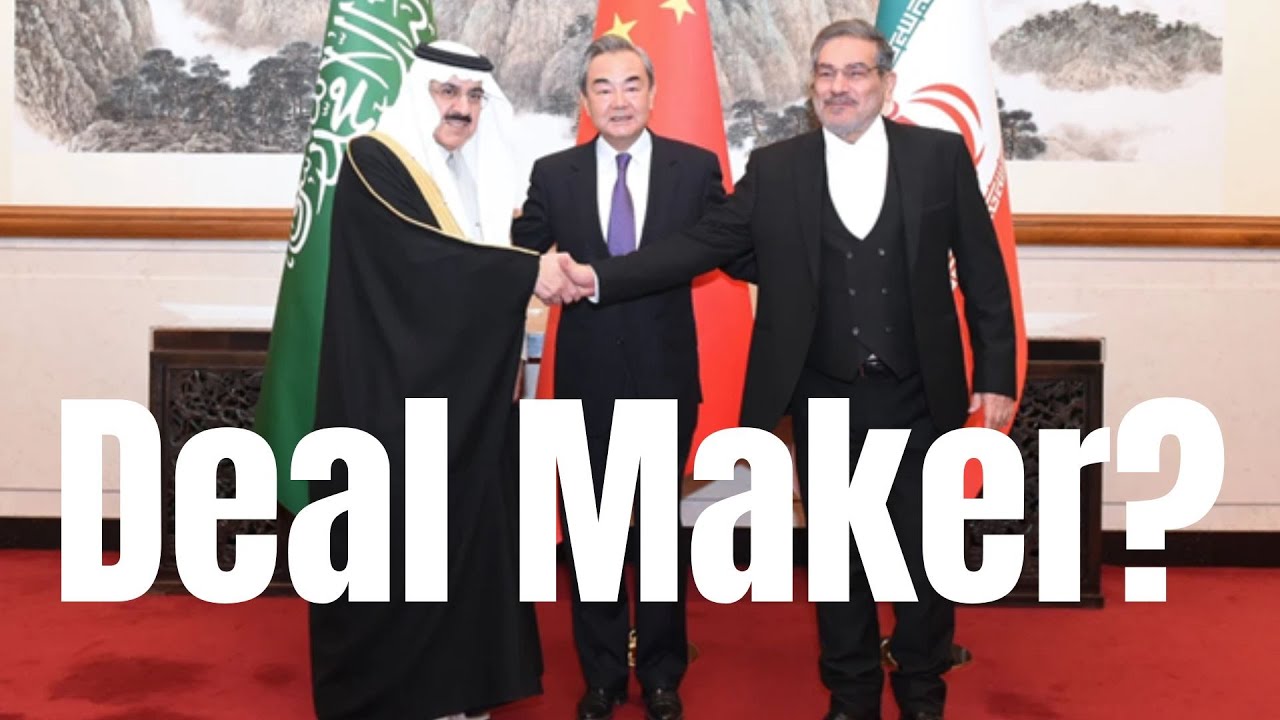
In this Geopolitical Trends video, host David Oualaalou analyses China’s role in brokering the historic Saudi‑Iran diplomatic reconciliation. Drawing on his on‑the‑ground experience and two books he authored about Saudi Arabia and Iran, he explains how China’s neutral, non‑imposing approach enabled the two regional rivals to agree to restore embassies, activate security cooperation, and respect sovereignty. Oualaalou contrasts this diplomatic success with the United States’ declining foreign‑policy credibility, citing a lack of strategic vision and “amateur” decision‑makers in Washington. He highlights the economic payoff for China—securing energy supplies from the world’s top oil producers—and warns that the deal’s impact will intensify once Saudi Arabia and Iran join BRICS, reshaping Middle‑East power dynamics and bolstering China and Russia’s influence. Throughout, he stresses the broader lesson that peaceful diplomacy, not confrontation, yields lasting outcomes, and he calls viewers to engage via livestreams and subscriptions.
Chapters
Hello everybody and welcome to Geopolitical Trends. My name is David Oualaalou. So good to be with you as always. Well, well, well, China brokered the deal between Saudi Arabia and Iran for the two countries to resume diplomatic ties. This is, this is, this is big. This is big, guys. It's a seismic change in the world of geopolitics. Let alone the Middle East for that matter. In this video, I am going to provide you my insights and brief analysis about this topic, given first of all my familiarity with it. I spent time on the ground in that part of the world, and also I wrote two books on each one of them, one on Saudi Arabia and one on Iran. So this is a big deal. Of course, I will tell you why China might end up being the winner of, of, of this endeavor, that is. So, so before I'll do all this, like always, I'd like to thank the channel members, uh, and, and subscribers, you, that is. And if this is your first time landing on this channel, please make sure to subscribe and smash that notification button so you will be notified every time I upload a new video. And by the way, don't forget to join me for for livestream this coming weekend. So let's dive in into this. So, so thanks to China, uh, yeah, Iran and Saudi Arabia now have agreed to resume diplomatic relations and reopen embassies and diplomatic representation within 2 months. As you may know, the relationship between the arch enemy, the arch enemy religiously There is a difference. A lot of people in the West cannot differentiate between Sunnis and Shiites. Saudi Arabia is Sunni, Iran is Shiite. So there's a lot of old history. This is one mistake we made when we went to Iraq. And I remember I argued against the war or the invasion because I said back then that we do not understand the old history of the Shia, of the tensions between Sunnis and Shiites. And that's exactly what happened. So anyway, the agreement that was reached following talks in China— it wasn't in the Middle East, it was in China— with President Xi Jinping overseeing that, you know, you can just see the optics of it from an international perspective. That's a big deal. Why? Because now you're seeing that China is brokering deals through peaceful negotiations, through diplomacy. Those are good initiatives, not through confrontation. So, and so the Saudi News Agency added that the talks came from the desire of both Saudi Arabia and Iran to resolve differences through dialogue and diplomacy. That's why diplomacy is important. Sadly for us in the US, we don't have diplomacy anymore. We don't even have qualified individuals to conduct foreign policy and to have a better understanding of what diplomacy is all about. This is not about just going and shaking hands with foreign leaders and so forth. It goes beyond that. It's because we have amateurs when it comes down to foreign policy establishment, let alone we don't have any foreign policy. We didn't have a foreign policy for the last 30 or 40 years. That's why we are reacting to events, whatever, on the whim of whatever. We create conflict here, then we move to another conflict here. And yet, when it comes down to strategy, we have none. I don't shy away from saying this. So here's the thing. The joint statements, or the trilateral statements by Saudi Arabia, China, and Iran, You know, this statement included that— stated rather that the foreign ministers of Saudi Arabia and Iran will meet to arrange an exchange of ambassadors and discuss ways to strengthen sort of the relationship and point it out, point that relationship towards sort of, uh, uh, a good, good approach for that will benefit everybody. So, so, and the thing is, with, with the intervention of Saudi Arabia— of China, rather— Saudi Arabia and Iran now agreed to activate the security cooperation agreements between them. In addition, of course, they agreed to respect the sovereignty of countries and non-interference in their internal affairs. That is very interesting, uh, the way I see it, you know, that, that's a win-win for everybody. It's a win-win for, uh, Saudi Arabia and Iran, but is also a win for China. And if I am to put my geopolitical analyst hat— and this is again where credentials comes in, this is where understanding what this is all about. And again, I lash out at those who are saying I am a geopolitical analyst and I can just talk about whatever. No, you can't, because it's nonsense if you don't have credentials for it. You can't move from some being a salesperson to becoming a geopolitical analyst overnight. That's kind of nonsense, you know. And again, I have nothing against anybody here, but at the same time, I will speak out when there is nonsense being spewed about what geopolitics is all about. So this is here. It's an example of this and how diplomacy can achieve far more than just conflicts. So, so, and, and, and this China's initiative, which by the way, this didn't happen last year or two years. This has been in the works for over a decade. Diplomacy takes time. Diplomacy is an art. You don't expect to just travel to a country, shake their hands, and have a tea or coffee or whatever that is, and assume that they will agree with you on everything you say. You can also go to a country and force your way on them. That doesn't work. So the question becomes, is why did China succeed? China succeeded because it approached it— it approached this initiative from neutrality. China wasn't dictating to Saudi Arabia what to do, wasn't dictating to Iran what to do. It provided an argument, lay out a strategy for how both countries can get— can work out their differences, and they did. But also, China didn't impose its will on them. That is the key. That is the reason why China succeeded into this, and I will elaborate more as I move forward here. So the agreement, now that they agreed, has received some sort of— was widely accepted around the world. Of course, some in the Western world will not agree to that or even congratulate China for achieving such a milestone, because it is a milestone. So commenting on this agreement, you know, you take for example Saudi Arabia's national security advisor, and he said, and I quote here, let me get the quote here for you, and I will upload the quote for you: Welcoming China's initiative comes from an approach of upholding the principles of good neighborliness and enhancing security. End of quote. On the other hand, Iranian Foreign Minister Mr. Hossein Amir-Abdollahian said, and I quote, let me get the quote here, the return of Iranian-Saudi relations offer great political— I'm sorry, offer great potential for the region and the Islamic world. End of quote. He added, and I quote, the policy of good neighborliness is pivotal and we continue to work towards more regional steps, end of quote. That is very, very interesting. So now it becomes the question, the optics of it, China's role on the world stage through this initiative. Yes, this part of what you all remember, what I always say In international relations, context matters. Here it is. This is an example of how, for example, you achieve a resolution to an issue or a conflict, whatever you want to call it, through peaceful means. Now the question becomes, why couldn't we do this for the Ukraine crisis? It's because we choose not to. Why did we reject China's initiative to resolve the Ukrainian conflict because we rejected it. We didn't want it. So it becomes now clear. It doesn't take a genius to figure it out. You don't have to be geopolitical analyst to see this, that it's a simple reality. You know, peace works, conflict doesn't. That's the bottom line to it. So the role of China on this— well, diplomacy in this case, diplomacy instead of confrontation works and achieves the objective. So by the way, guys, if you like this video so far, please hit that like button and subscribe if you have not done so, and I truly appreciate your support. So, so in the context of international possessions, China through China's top diplomat, Wang Yi, said that the talks and dialogue between Saudi Arabia and Iran in Beijing are a victory. For whom? Not for Iran, not for China, not for Saudi Arabia. A victory for peace. That is very, very, very poignant, and really it's hit the nail on the head. Because peace matters. You know, I'm a believer of that concept of live and let live. When you have peace achieved this way, everybody wins. So that's the way I look at it. So, so the US, on its— on the other hand, the United States stated that it was aware of this. Ah, I, I don't buy that argument. Yes, they were aware of it because we have an embassy in China, and of course any activities that goes, the United States will know about it. But the US doesn't want to come forward and said, hey, we failed, we failed to achieve this kind of outcome. Of course we're gonna say yes, we were aware of it. So what? Because if you couldn't solve the issue, what's the point? If you are aware of it, so what? How that helps those two countries to resolve their differences? Of course, you take into consideration the tensions between Saudi Arabia and the United States. And of course, the sanctions that we apply on Iran that still persist till today. And you can just see. So no matter what the US says now, it's like, whatever. The rest of the world just shrugs its shoulders. And the reason for it, and I'm going to say it, it's because we lost credibility. That's what's at the heart of it. You know, if people could not see, for example, why we are failing on foreign policy matters, it's because we don't have any more credibility left. That is what's at the heart of it. But how can you get credibility when you have amateurs in Washington conducting and making foreign policy decisions? That's the bottom line to it. So, and of course, the United States won't want to admit that It doesn't have a good relationship with Saudi Arabia because now the Crown Prince, MBS, who is by the way very aggressive, and I believe he's gonna go against the United States starting with one thing, is dumping the US dollar in bilateral trades with China. That's the first order of business, especially when he becomes a king, because he can't do any of that till he is officially a king, and he's not. His dad, by the way, is sick, and usually just a matter of maybe months, whatever. We wish him well, but it's just— that's the reality of it. Now, the other question you need to ask yourself is, what's in it for China? There is something in it for China. Let's just, uh, let's not pretend that China is doing it out of the goodness of its heart. Yes, it is a peaceful initiative. And I personally encourage and salute that. But there is something in China for it. And what's in it is that economic ventures, because China has a deal with both countries, especially when it comes down to energy. Now, the key question you need to ask yourself is how this picture will change once Iran and Saudi Arabia join BRICS. Yes. Mark my word on it, it will be a seismic change. And like I said earlier, I argued those. If you ever get a chance to read either book or both, I tackled this topic of the role of China in the Middle East. So, and this is how I'm going to conclude this for you, because like I always say, I like to keep my videos short, to the point, and concise. So here's my conclusion for you. So the Middle East, is undergoing major political transformation, like the rest of the world geopolitically speaking. So the transformation now, since we are talking about Middle East here, compels now regional and also major powers including China, Iran, Turkey, Saudi Arabia, Russia, and the United States to go back to the drawing board to determine what strategies they should pursue to secure their respective interests in the region. And we all know when you think of the Middle East, what comes to your mind? Energy, right? So having access to energy and securing access to energy. So China, by approaching this, by brokering a deal between those two top oil producers, securing access to energy. So, so for now, suffice it to say that China and Russia's interest in the Middle East will grow stronger, bolder, and more calculating, signaling a far more assertive foreign policy from both countries in the coming years. That's what I see, putting my geopolitical hat— geopolitical analyst hat That's what I see coming. So, so, and, and before I close this out, uh, make sure to join me on a live stream, uh, at the, on the weekend. I like to, uh, answer some of your questions, and I hope you find this very informative. As always, remember, geopolitics impacts your daily life in more ways than one. Till next time, guys. Bye-bye.