Iran Strikes the Eilat Border| Red Sea Blockade Triggers| Total War?
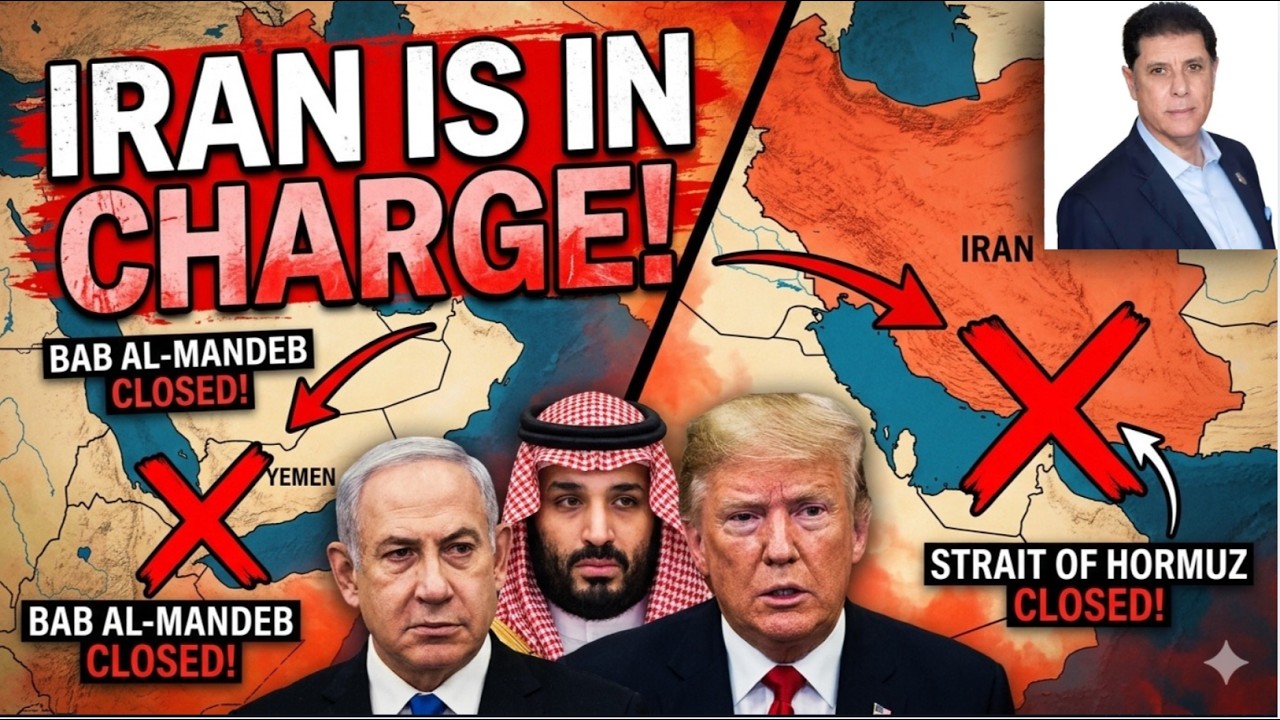
Iran launched ballistic missiles near Eilat and Aqaba as part of a coordinated blockade strategy with Houthi forces in the Red Sea, squeezing shipping and oil exports. The strikes aim to stretch US and Israeli military resources across two fronts while signaling a rejection of ceasefire proposals.
Chapters
Hello everybody and welcome to Geopolitical Trends, where truth matters. Right now you have the Strait of Hormuz that is closed, and you have the entire Red Sea that is completely cut off. At the same time, this is while the Houthis just choked off millions of barrels of the Saudi oil in the south. Iran's ballistic missiles just struck the northern gateway You see where this is going. But what Iran did, narrowly missing Israel by design. So the US is already moving almost 100 tanker planes into position, and of course global trade now is hours away from a total standstill. So what I want to share with you in this live stream, uh, and analysis is is the secret two-front plan Iran is using to trap the US. That's exactly where things are moving forward. So, so here's the thing. Iran's missile strikes, which was, uh, by the way, it was just kilometers, only kilometers from the port of Eilat, and that in itself has terrified Israel. Of course, Iran didn't miss. Iran wasn't intended to hit the port of Eilat. No, no, no, no, no, no, no, it wasn't. It was just, uh, the message that Iran is sending. And with this, you ask how significant this is. Well, of course, this development is a— it's, it's a major, given the escalation in the region, which is now expanding this US-Iran conflict. But it was not a direct strike on Israel, not yet. Iran is preparing something. So this is unlike what happened on July 19th, which was 2 days ago. Iran launched 4 ballistic missiles targeting neighboring Jordan port city of Aqaba. Let me, let me share the map with you to put things in perspective for you. So you see what everything is. And I give a credit to, uh, World Atlas for this. As you see on the map here— so let me make it bigger for you here. There we go. Of course, uh, yeah, when I point my cursor, guys, it's not going to show up on your end. It shows up on mine. But anyway, look what it says, Sinai Peninsula. Look to the far right, and that is where it says right there, Al-Aqaba. And right above it That's where Eilat Port is, the only port with access to the Red Sea. That's why it's important to understand why Iran went ahead and used those 4 ballistic missiles targeting, uh, the port, uh, uh, port city of Aqaba, because it's very, very important to understand the geography of Iran's decision to do so. Because Aqaba, like you saw on the map, sits directly across the waters from Eilat. Let me once again— let me put the map for you to see. See where Aqaba is and see where Eilat is.
Okay.
And the incident triggers now defensive actions in Israel and caused widespread panic due to the proximity of the explosions. Remember, Iran was just sending a message to Israel: not yet, not yet, sort of, we will deal with you in, in soon. And this is where you see the detail of this aspect. Why I wanted to address this? I wanted to address this because I need to highlight to you the strategic thinking of Iran moving forward this way. The target which the missiles, uh, targeted were the Aqaba in Jordan, with one reportedly damaging a hangar at the Aqaba Airport. So Iran was almost hitting two birds with one stone. The key to this is the spillover into Israel, and that is why when IDF, Israeli Defense Force, detected a potential threat from found debris of the missile that was launched, it went ahead and activated its Iron Dome interceptor over Eilat, and their argument is because they wanted to neutralize the incoming shrapnel. I mean, come on, common sense. You're gonna use a multi-million dollar missile to take down shrapnel? That just doesn't add up. So however, you have a large boom that rocked Eilat, and the missile trails were highly visible. Except that what happened inside Israel, no air, uh, air raid sirens, uh, were sounded. No, because it was not— the city was not targeted, not yet. So, so what we need to think about is we need to think about the strategic significance of this. So the reason for Iran doing this, this expansion of the conflicts now shifts to the front lines and carries heavy strategic implications for a reason. Iran is not doing this just out of the whim of whatever. No, there is a plan into this. This is why I was thinking in terms of the US losing control. Now we, we telling the American people here that we have the Strait of Hormuz open, uh, shipment is going and all. Which is a lie. The shipment is not going. No cargo ship can cross. As a matter of fact, Iran just targeted one of the cargo ships trying to defy Iran in this, and Iran went ahead and, and launched whatever it launched on it. So, but when we think about the strategic significance of what Iran is doing, you think about it from two aspects. One is the expansion of the regional warfare. Because now what Iran needs to do is involve everybody, and you're already seeing the repercussions in states like Kuwait, Bahrain, Qatar, United Arab Emirates, Saudi Arabia, Jordan. So, and that is why sort of, uh, uh, even the US went ahead and conducted more raids, or more strikes rather, in Iran. US has now asking for a 10-day ceasefire. I'm gonna confirm this later on with you. I just wanted to mention it, but already the US— it's not Iran, because the US, some media here saying is the other way around, is Iran that is requesting. It is not true. Is the US that wanted the 10-day ceasefire. And in my opinion You will think Iran has learned enough now about these tactics the US uses. So we will get into that because I have a specific clip that deals with this, uh, particular aspect. So what you need to think in terms of Iran's now retaliated by targeting US allies or US subservient states, you know, and, and the infrastructure across the Gulf including Kuwait, Bahrain, Qatar, and Jordan, as you know. But targeting Aqaba specifically— I thought I had another picture of— yeah, no, this is port of— this is Aqaba right here. This is another picture of the map. This is where you see Jordan, and this is Aqaba right here, and there is Eilat in southern part of Israel. So for Iran targeting Aqaba drags Jordan deeper into the kinetic theater, whether, uh, Jordan likes it or not. Jordan has no say. Jordan will have to do what the US tells it to do because we're the one funding the existence of Jordan. Let me just tell my American viewers where their tax dollars are going. In addition to Israel, they— we're the one funding the existence of Jordan. Let me just say this on the record. The second one, it has to do with the economic threat to maritime hub, which was Iran planning on, on doing by aiming at the Aqaba and Eilat bottleneck. Because when you look at the picture, you look at the map, Eilat and Aqaba are so close. Both of them need that strategic, uh, port or access to water. So by having Iran attacking that, Iran is demonstrating what? Its capability to disrupt critical and strategic maritime and of course regional hubs, with of course what's going on right now with the Houthis and the Saudis. And I will get into that in a second here. So what Iran was also demonstrating is that it can act outside— that's the keyword— outside the Persian Gulf, and that includes Red Sea shipping infrastructure, because Iran can threaten that if it wants to. And that is exactly where, when you think about what is Iran's objective behind moving towards the Gulf of Aqaba, it's not a coincidence, guys. This— we're talking about a strategic leverage here through economic strangulation, but also through the demonstration of Iran's missile outreach, where it can reach, and capabilities. So that is the— the importance of it. Iran is aiming at breaking US naval blockade in the Persian Gulf because Iran proves now it can paralyze international trade across the entire region. And when I see the entire region, I'm, I'm going to put the map for you to see, uh, clearly. You look at this one here, this the entire region here. Iran controls all this now. It's no longer, it's no longer the idea of, uh, oh, is the US that, uh, now have the blockade and, and all that. No, no, no, no, no, no, no, no, it's not. Is the US that is controlling all this, because that's the harsh reality that Washington is not willing to admit and accept. And that is why, when you think about who's really in charge, who's in charge? It's not the US. And by doing this, Iran— what Iran is doing, Iran is bypassing the Persian Gulf blockade. This is the smart move on part of Iran, because by doing this, Iran is countering the blockade leverage. As because we know the US now is imposing a blockade on Iran, uh, ports in the Strait of Hormuz. Yeah, okay, but Iran has other alternatives. That's one of them. Second one is the asymmetric, asymmetric threat that Iran is demonstrating. Because Iran understands it will not be in a position to match weapon for weapon or asset for asset, naval assets that is, match the US naval assets directly. So what it ends up using, Iran, is using long-range ballistic missiles to target alternative trade corridors. So that's going to just stretch the US thin. And that's the third element, because that's what Iran is demonstrating— is demonstrating its ability to reach. Striking near Aqaba proves that Iran can project power thousands of kilometers away. Why is this important? Is because this renders Western so-called containment efforts in the Persian Gulf, inefficient. That is the reason why Iran is doing what it's doing. By just launching those missiles far away, it's able to, uh, uh, uh, send its own message there. And of course, the major one from an economic perspective is the disruption of the global maritime supply. So choking the Red Sea. So you have the Gulf of Aqaba first is vital. Northern artery of the Red Sea. Without Aqaba, Jordan and Israel will not have any access to Red Sea. So because this feeding directly into the Suez Canal network, when you look at the map— let me, let me put it up for you there— look at the map where things are going. This is the Suez Canal, okay? This is the Gulf of Aqaba. Yeah, it's just, it's just smart move on part of Iran, what is doing strategically here. Because what you're looking at, you're looking at a dual port paralysis. You're not dealing just with one location, you're dealing with two, and Iran is in possession to paralyze both. A single strike in a narrow body of water simultaneously threatens the port of Aqaba in Jordan And at the same time, it threatens the port of Eilat in Israel. It's all Iran needs to do. Iran will get into Israel later on. So, and that's when now you have the global shipping panic that's now erupted this morning, because by turning the Gulf of Aqaba into a kinetic war zone, what is Iran doing? Iran is triggering a massive spike in global shipping insurance rates. And that in itself forces commercial vessels to avoid the Red Sea in its entirety. And of course, with what the Houthis just did, which I will get into, it just add to that. That is where the whole idea of how Iran is going about it. Iran is doing another thing also. It's punishing— and I'm using the term figuratively here— but it's punishing the, uh, and deterring US subservient allies in, in the Gulf— Kuwait, Bahrain, Qatar, United Arab Emirates, and Jordan, of course. So especially Jordan, because it turns out the, the one of the key secret bases we have, we had them in Jordan. Yeah, and we have some other ones in Bahrain. So that's the extent of what I can share. Because I'm still under the law, uh, uh, uh, obliged by law not to disclose, uh, sensitive info. But for the case of Jordan, which now I can say it's been exposed, and that is why Iran aims to pressure Jordan into making a decision. And what is that decision? Is regarding whether he wants to maintain US presence on its soil, the secretive aspect, or face the consequences. Also, Iran, of course, is aiming at creating wedge between the two, and it's already succeeding. There are now voices inside Jordan that is saying, you know what, we might have to rethink. The other aspects has to do with this psyop here, and psyop is aimed towards whom? From Iran is aimed towards Israel. This is the psychological warfare on Israel itself. Opening a, a fire vector near Eilat, the port of Eilat, forces Israel now to divert its air defense assets, like for example the Iron Dome, like the Arrow systems, all of them. He needs to divert them southward And that in itself will stretch Israel's military resources. And of course, the other objective is to fracture the coalition. So Iran is signaling to whom? The Arab states like Bahrain, Qatar, Kuwait, United Arab Emirates, Saudi Arabia that are aligning with the US blockade will result in regional economic devastation. And I bet you the Saudis now are feeling that this morning, because MBS is wondering. This leads me to ask the first question about, uh, uh, uh, whether Iran is preparing to target Israel. So I'll deal with this first, then I'll ask the second question regarding the Houthis and the Saudis and the Red Sea. So the answer is yes. And also yes for Israel being on a high alert because they are preparing. And those are not just my words, those are the words from senior officials inside Tel Aviv. They are now preparing defenses and expanding the military coordination because what Iran's most recent strikes primarily targeted US bases, which the devastation is now is more and more devastations coming up, and I will share some with you later on through a recorded clip. So, like, but what you saw already, and I talked about this yesterday, what you saw in Jordan, in Kuwait, and Bahrain, you have now intelligence indicators suggesting that a direct confrontation with Israel and Iran is imminent or is inevitable. So this is again where you have, uh, this idea of, uh, of— so I'm gonna play the clip for you here. I'll do the translation for you because I'm not gonna play it in its entirety. Uh, I'll just do, uh, screen— oh, share screen, sorry. All right, let me share with you here, Peter. And, and again, I just want you to signal that Israel, uh, uh, watch the, the imagery and I'll do the quickly here. So one potential Iranian objective behind moving towards the Gulf of Aqaba, specifically the Jordanian port of Aqaba, could be gradual advance or a signal that Israel is the next target. This is particularly relevant given that Israeli defense systems quickly intercepted 4 missiles, Iranian missiles. Yeah, of course Israel is going to say that one. So We are well aware that— we are aware that only a few kilometers separate the Jordanian port of Aqaba from Israel's sole Red Sea port. Operations at the latter and its surrounding facilities have already been disrupted since the Al-Aqsa flood— Al-Aqsa flood, I'm sorry— events in Palestine. Furthermore, the entry of Yemen forces into the confrontation, imposing a blockade and restrictions on Israeli shipping alongside Iran's direct involvement in two successive conflicts within a year and intensive targeting of Israeli infrastructure has raised the cost for the United States in its effort to rein in Bibi Netanyahu and his war cabinet. These developments have forced now a step back. From an Israeli perspective, the current situation is viewed with an ease Conversely, Iran views it with suspicion. Yet the core issue lies in the different strategic objectives held by the US and Israel regarding this war. Israel seeks to go as far as toppling the regime, a goal it failed to achieve in two consecutive wars. The US, however, has different aim: breaking Iranian power, bringing them, uh, bringing them down or bringing them back to the negotiating table, fully accepting terms proposed by US President Donald Trump, and perhaps first stripping Iran of the Strait of Hormuz leverage before addressing more complex issues. Good luck with that, son. But Iran, for its part, viewed as a continuous resiliency because it is demonstrated through military strategies and maneuvers as a key factor. So, and this is again where you need to understand regarding the targeting of al-Aqaba area in recent, uh, in recent, recently, a region of great importance to Jordan. The conflicting Jordanian and American accounts are interpreted in Iran as signaling a rift in their respective positions and perspectives. This could potentially foreshadow future disagreements between the two nations. The Iranian narrative regarding the targeting of US bases in the region is well known. There is no issue with bases operating within the framework of strategic or standard military cooperation with the US. However, if these bases are mobilized to target another state such as Iran, this is viewed as a violation of international law that warrants a response of some kind. We also recall that when a Tenaf area was targeted over the past two days, reports indicate that an advanced US radar system deployed in the rail lines to facilitate US operations against Iran during this escalation, which has now lasted over a week, was hit and damaged. The move towards Eilat and Al-Aqaba area may also serve as a warning to both the United States and Israel that future deployments— or developments, rather— will not unfold as Washington and Tel Aviv desire. This is the important aspects of it. I just want you to be aware of that. And this is why you have the US and Israel They are now preparing, they are doing preparations, they call them preemptive preparations, whatever. The one thing that is for sure is that the US, there is a massive US tankers now deployment. To my knowledge, it's about over between 90 to 100 aerial refueling aircraft. Why would you be using all this? Is this just posturing? Is it a show of force? Or is it really there is a plan somewhere? But at the same time, Iran is not backing down and will not back down. And that is why the US is asking for a 10-day, uh, ceasefire. No, no, no, no, no. Iran is not going to give the US that opportunity at all. So, and those aerial fueling tankers are going to military— Israeli military bases. And that is why I'm saying, uh, I know one for a fact is going to Ramon Airport in the south. And that is why I'm saying, is Iran preparing for Israel? And they know what to do. So because the significance of it is that this refueling planes are used almost exclusively to support long-range heavy bombing, and of course to support the fighter jets missions and so forth. And that, in my opinion, putting my geopolitical analyst hat on It tells me that the US and Israel, okay, are preparing for sustained long-range offensive strikes deep inside Iranian territory. Will they succeed? I doubt it. I have my doubt. That's the way I see it. And this is why, for, for, uh, for Iran is preparing and it's moving forward into that trajectory. If the truth matters to you, hit like, subscribe, and tap that bell. No spin, no agenda, just the stories they don't want you to know. Don't watch from the sideline, be part of the movement. Your support keeps the truth alive. Thank you. Now, when we think about Iran, uh, opening new fronts Remember last time we talked about the second front with the Houthis? We didn't talk about Hezbollah, but this is again where the strategic movements of groups like Hezbollah or proxy, whatever term you want to use, because while Iran is focusing its state-level ballistic missiles on US regional interests, it maintains also the capacity to strike Israel via its northern proxy, Hezbollah. Why? Because despite what you hear, I know there was some damage that occurred for Hezbollah. Despite what, what happened, you know, current, current intelligence report suggests an estimate and shows demonstrating that Hezbollah still possesses roughly 15,000 rockets, an unlimited number of missiles capable of being unleashed on central and northern Israel at Iran's command. But just think about it, and, and again, this is not nothing to— we talked about this 6 or 7 months ago. When 3 fronts are open, one from Iran, one from Hezbollah, and one from Houthis, the, the, the, the defense systems in Israel will be overwhelmed. Even the US will be overwhelmed. So this is why so far you're seeing Israel remaining at the periphery of the core US-Iran kinetic, uh, fighting. They're not involved yet. Will they get involved?
I don't know.
But as the US intensifies its blockade and continue to bomb because US now is moving to target a, a, a mountain in Iran because US is saying that's where the nuclear, uh, labs are and so forth. So, but Iran is also moving with the nuclear aspect, which I will address this in another separate live stream. So now let me move to the key aspect of it, and this has to do with the Houthis or Ansarullah. All these developments that I mentioned, okay, all this that I mentioned came against the background of the Houthis or Ansarullah blocking Saudi cargo ship from crossing the Red Sea. Yes, the Saudis now are saying to the, uh, let me, let me get you the map because I need you to see uh, where, where everything is right there. The, the, the Houthis are saying to the Saudis, your oil cargo ship ain't gonna cross. And what you need to understand is this location right here is called Yanbu. Yanbu, that is one of the major oil facilities where Saudi ship their major oil barrels and so forth to the world. You have the, the Jeddah also, main, main port, and the Houthis are saying, you know what, we're gonna block it. So, and you know the harsh reality is the Saudis can do nothing about it. You know, you're— what you're gonna be reading in the next 48 hours, oh, Saudi is gonna use everything at his disposal to defend its cargo ships and so forth. Good luck with that. If the— and I was in the middle of it— if the Saudis couldn't defeat the Houthis for almost 10 years with the support of the West, yeah, the support of the US, Britain, France, Canada, Germany, all of them were providing intelligence and weapons, and they couldn't defeat the Houthis. What makes us think that they're going to be defeating Houthis now? No force. I'm here to tell you No force outside Yemen can defeat the Houthis. What I mean by this, maybe the Yemeni army, because it's from the same culture, they understand, they might have that, that possibility, which I doubt it. But anyway, suffice it to say that the, uh, the, uh, the Houthis, uh, sort of now blocking the Saudi ships from crossing Bab el-Mandeb. So, so the question becomes, how will MBS respond? Because we all know when he ascended to power, he was thinking about, I'm going to invade Yemen and defeat the Houthis and all that stuff. It was clueless on his part. And this is exactly— this is what I need you to understand. This is exactly the strategy and the coordinated double pinch strategy of Iran and its coalition or proxies or supporters or groups. Because when you have the Ansarullah or Houthis declaration of an immediate— it's not next week, it's not next month— immediate maritime blockade against Saudi Arabia at the southern entrance of the Red Sea, that directly links to Iran's missile strikes near the northern Gulf of Aqaba. Once again, geography is important to understand. Look at this map here, okay? Here is the southern part. Here is Bab el-Mandeb at the bottom. I know I'm pointing my cursor on the screen, but you won't be able to see it, okay? Where it says, yeah, right there, Bab el-Mandeb. But go all the way up to the north through the Red Sea and and where you see Jordan and you see Israel right there, that's al-Aqaba. So Iran is firing there at the north and the Houthis is blocking the south. Smart move, smart move on part of this. And that's exactly, uh, uh, when you have to understand the sort of the broader regional architecture of what Iran is doing through this regional escalation. Iran is not now limited to just close to its periphery or its border or coast, what have you. No, no, no, no, no. They expanded it. They expanded it. When you put the events together, this is where you see that broader regional infrastructure of this escalation. It becomes clear. Literally, here is the thing, and I'm gonna explain this to you in a really just brief explanation here, because if I am to go more in detail, I will need about 2 hours to just break down all this. But I'm gonna just highlight to you the key aspect. The first one you need to understand is the closure of the Saudi escape route, or route, that is. Once again, when you look at this This is the Saudi escape route because since they're not going to be able to use the Persian Gulf, this is their escape route. The Houthi is going to block this, okay? That's the key aspect to this one here. And this is when the US and Iran began clashing in Persian Gulf. The Strait of Hormuz became some sort of an active combat zone. So to bypass it, what the Saudis did they end up diverting about 70%, 70% of their daily crude. This is not a weekly, not a monthly, that's daily, which means what? About 4 million barrels per day via overland pipeline in its western Red Sea port of Yanbu. That's the city that I showed to you earlier, Yanbu. It's very crucial, uh, to the economy of Saudi Arabia. Actually, the survival of the monarchy also depends on it to a degree, because that's where Saudi sells their oil. Because if Saudis didn't have oil, we won't be talking about Saudi Arabia. It will be some like nomads living in a desert. That's all it's going to be. So, which is true. So, and this is again, by shutting down Bab el-Mandeb, At the south, the Houthis have successfully now trapped Saudi Arabia's alternative maritime lifeline. That's one. Then you look at the northern and southern, uh, uh, bookends. So, and the timeline of all this, it demonstrates some sort of forward thinking. It demonstrates the high strategic coordination that exists. Because only on July 20th, which was yesterday, in the south, the Houthis enforced the, the what is known in the most of the Muslim countries, we know, an eye for an eye. You, you know that sort of an eye for an eye. That's what the Houthis did. Basically, they did an eye for an eye when it comes out to the naval embargo on all Saudi, vessels is the same what the US is doing to Iran in its ports. And the Houthis, they asserted that this is in retaliation for the Saudi airstrike that hit Sana'a Airport last week. Why? Because the Saudis wants to block an incoming Iranian— the Houthis didn't forget, and they will not forget. So that was on the 20th, yesterday. The day before, the 19th, what happened in the north? Iran fired ballistic missiles into Al-Aqaba and Eilat corridors. Let me show you the locations. This is the port of Eilat right there, which is on the right. That's Al-Aqaba, and I'm going to share it separately here. So that's what Iran did. Fired on those two corridors. So what is the result? The result is that the entire Red Sea is effectively bookend now by hostile fire from both ends. The Houthis hold the southern gateway while the Iranian ballistic missiles threaten the northern location. And that in itself becomes the maximum economic leverage. And wait for it when there is a full closure of Bab el-Mandeb soon, because once that happen, once Bab el-Mandeb is fully closed to Saudi— by the way, let me, let me put one on record because there are some— I, I saw some, uh, analysis mentioning No, no, no, no, no, no, it's not true. It is not true. It is not true that the Houthis blocked everything. They did not. They're allowing other ships, except of course the Israelis cannot get in there, uh, the US cannot get there anyway, but other countries— France, whatever— so except the Saudis. Let me just put that on the record. So the Houthis strictly sort of closing the Red Sea or Bab el-Mandeb to Saudi transit. And that in itself risks halting now Saudi oil exports to Asia and other locations, global, global oil supplies. Remember, an estimated 7 to 10%, between 4 and about 8 or 7.5 million barrels a day. So the Saudi-led coalition has vowed now to respond to maritime piracy with firmness. What the Saudis can do? Literally, what can they do? If it weren't for America, Saudis won't exist. Well, with all my respect to the Saudi citizens, the nationals, and so forth, but I am speaking facts. If it weren't for the US the oil deal for security, Saudis won't exist. We won't be talking about Saudi Arabia. And as a matter of fact, we won't even be calling it Saudi Arabia, we will be calling it Arabia. I know some might not like what I'm saying, but again, I'm just speaking facts here. So when the Saudis saying we're going to respond firmly, what can they do? They're going to ask the US to fly the fighter jets. They're going to ask the US for intelligence targeting. They're going to ask the US to fight on their behalf and pay for it. So how would you call yourself— you can fight on what have you? No, most of these Gulf states— and again, and I'm just— I hope people understand, I'm not bashing or talking negatively about— I'm speaking facts here. Most of these countries in the Gulf won't be able to fight. It's not in them. It's not in their culture because they've been always dependent on the US security. That's all it is. Same applies to the Saudis. That's why I said in few days you're going to be hearing the Saudi is going to do this, is going to do that. No, it's too late. When they embark on that stupid decision to target that Iranian plane, then it's over. And why would you do that? Why the heck would you do that to begin with? So whoever was advising them, they just had no, no, no, no idea. So, so, and that's exactly where the problem— so I'm gonna put one last time the map for— oh, I don't have it. Hold on, hold on a second. I can do it for you quickly here, uh, just to, to— because this one, it's much clearer. To give you an idea of— again, if this one right there at the Bab el-Mandeb is closed and the top of Eilat and Aqaba is targeted, Saudis have nowhere to go, and most of their oil is on this area near the water. Once again, that is the part of what you need to understand in all this. Now, I told you earlier, and I'm going to do it quickly here, I told you earlier I'm going to go back to mention some other aspects of the targeting of the US locations that happen in conjunction with, uh, uh, with what's going on with Ansarullah and Houthis. All right, let me— and I'm going to do the translation for you. I just want you to see some images, uh, in, in, in this clip here. And I give credit to Al Arabiya TV. That's, that's where Again, I was looking here in the US to see if I can find any info that highlights the truth and what's going on. Couldn't find any. Uh, the— I don't watch TV here in America. I don't watch TV at all in America, in here in the US. So, uh, so CNN, Fox, and all that stuff is irrelevant to me. So, so that's why I wanted to share this with you so you can see. All right, take a listen here, please. I'm sorry, not the listen, but I'm going to do the translation for you here. All right, let's go. Highly significant. Here's what it says. Highly significant leaks have emerged in New York Times from US officials speaking on condition of anonymity due to the situation sensitivity, particularly following yesterday's incident in which two US soldiers were killed and another one went missing at a US military base in Jordan. These officials state that Iranian missiles directly penetrated US defenses. The strikes demonstrated precise knowledge of the soldiers' locations and the base itself, indicating that Iran possesses highly sensitive intelligence. Furthermore, the officials note that Iran retained— retains a vast stockpile of precision guided missiles and knows exactly how to employ them. We are now on the 8th day— 9th day, that is today— of strikes, yet US forces continue to face failure for a simple, direct reason: the objective, opening the Strait of Hormuz, remained unachieved. Losses continue to mount, and the strait remains completely closed. While US strikes are targeting sensitive Iranian military sites, Iranian forces, including the IRGC, are simultaneously targeting the radar systems of US bases across the Middle East. These systems cost the US administration billions of dollars. Many analysts, as well as US officials speaking, uh, uh, to outlets, say— suggest that Iran has the capability to deliver painful blows to these bases, not necessarily destroying them in the conventional sense, but effectively disabling their operations. This is essentially what occurred in Jordan 2 days ago, resulting in the death of the US soldiers. Secretary of Defense Pete Hegseth has commented on the incident, stating that it will, uh, that it will— US forces are insisting in continuing the ongoing American, uh, uh, American offensive. Consequently, concerns among Democrats are mounting. So, so, y'all, you all know what it means because that's exactly what has been going on, and the US is not disclosing this. So the timing of what's going on with Iran in the north of Aqaba and Eilat and with the Houthis in blocking, uh, blocking the Saudis from, uh, transiting Bab el-Mandeb— they didn't close it, but blocking the Saudi ships. All the other ships can go except Israel, of course. I would not be surprised that in a matter of days they're going to shut it down completely, depending again how this is going to move forward. And that is why, uh, sort of it gives you the idea that the US losses— this what, what, what we have suffered, you know, from Iranian missiles, uh, still the objective to open the Strait of Hormuz, we couldn't, we couldn't do it. So Because this is why you have what you have with the US, uh, uh, uh, with what's going on. And of course, what I'm going to be doing in the next few days, I'm going to talk to you about some key developments. The first one, which I will confirm with some of my contacts in Washington, is that Iran rejected 10-day ceasefire proposal by the US. This is again, I've seen the one statements that is flipped the other way, and I know how these things work. You know, Iran is rejecting it, and who's rejecting it is because it was a meeting between this, the Iranian president, Raisi, and the Supreme Leader, Mousavi Khamenei. And it was Khamenei's direction where they saying, remember I said this yesterday, Khamenei is now saying, forget about that MOU, forget about even negotiating with the Americans. And that is why the US now is asking for 10 days. Iran has learned over time that this kind of ceasefire is for the US to regroup. Why? Because as at the time of, at the time of this live stream, there are planes fueling tankers flying to Israel. And the US and Israel are concerned because Iran knows what's going on. Iran's intelligence— I tell you this from experience, given the years that I spent in the region. I can tell you based on facts, when it comes down to the intelligence activities, and Iran is wired in the region. And we think we are on the top of it. No, we're not. We're not. So Iran knows every move, especially now with knowing exactly where the location of every soldier in the region. And that's not because of GPS. No, no, no, no, no, no, no. It's because of Beidou. So all these developments, all the satellite stuff It's giving Iran the upper hand in understanding where everything is. So, so, and this is what I'm going to be addressing for you soon. I'm going to be talking about, for example, uh, what's going on in Israel. Is Israel preparing for next retaliation from, uh, uh, uh, from Iran? So, and the other one is, which will be another topic for another day, is I'm thinking already about the scenarios. I always like to think ahead. What will happen if hypothetically, and this is hypothetical, if there is ground invasion by the US, how would Iran respond to this? And I want you just to be in the loop in understanding the possibilities. So, so we'll do this some other time, uh, when we talk about it. So the other thing is the one I want to do is I want to talk to you about how, how come Iran is in possession of precise intelligence information that enables it to target specific locations. Did you know that the estimates of the—
the—
I, I had the chance to read some, not classified of course, but some information not available to everybody. So let's, let's just put it that way. And the targeting that Iran is using is only like by few inches from the intended target. So when those who say, oh, the missiles that Iran launched near the Al-Aqaba or Eilat was few kilometers from the target— Iran was not intended on targeting Eilat port. That was the point, that was the message. If Iran wanted to target that, they would have done it directly. So, all right, here is my conclusion for you because I want to just share this with you, and I want to share some good news towards the end here. Please make sure to stay with me, uh, till the end here. So what we're looking at, we're looking at two locations. I call them the double pinch blockade. Let me put the map for you so we can see as I am explaining. So, so you have the Persian Gulf or the Shu'ayr al-Fawmuz And you have Bab-el-Mandeb. So this is what I call by the double pinch blockade of the Red Sea and the one in the Strait of Hormuz. But we'll talk about just the Red Sea because that one in the Red Sea has now shattered Western deterrence and sort of is pushing the region to the absolute brink of war, total war. Iran and the Houthis are ready for it. And soon Hezbollah will join. So, but when you look at the global trade hanging by a thread, yeah, it's hanging by thread. And the military escalation that is going on is reaching a point now of no return. This is why the US is asking for 10-day ceasefire.
Yeah.
And I know, uh, uh, Professor Mirandi is advising the Iranian government And I did hear— I haven't heard from him back yet because, as you know, I sent him an email extending him an invitation here, but he didn't respond. I'm sure he's busy. But he already advised the Iranian government to do not, do not give the Americans the 10-day ceasefire. And I can see why. So it's because Donald Trump now is facing this unprecedented crisis that he thought was laughing about. Oh, we're gonna just walk in and, and, and destroy whatever, whatever. No, couldn't. You couldn't. So, so here's my question for you: if the US and its allies fail to regain control, how much higher do you think oil and shipping prices will surge before a full-scale war breaks out? So just make sure, please, to leave me some comments the comment section. And by the way, I responded to those who, uh, answered the question from last session, so you can go and read my answers there. So now let me play some clips for you quickly here, then I'll share with you the good news that I said I would. So the first one I want to do is about— I have two about China, very crucial, very, very crucial, and I found the timing of it very important. Okay, it has a soundtrack here. I'm not gonna play it, uh, and I'm gonna just do the translation because it's written in, in Arabic. Let me share the screen for you. Those are short, I can just read them and, and translate them for you, uh, on the spot. So, okay, here is what you're looking at. You're looking at China has revealed the new developments regarding the KJ-600 a carrier-based early warning aircraft, dubbed the Chinese Navy flying eye. It is equipped with an active electronically scanned array radar capable of providing extensive air and maritime domain coverage while enhancing long-range detection and tracking capabilities for aerial targets. Very, very, very crucial. I find it very interesting. So, uh, the next one is also about China because I see something important that has, uh, this one is in English. I'm gonna play it for you. And all this, you, you have to put this within the broader context, okay? Because you need to understand what is the importance of something like this one here. Take a listen, please.
United States least wants to see— see those 6 golf balls? This is the ship the United States least wants to see. See those 6 golf balls mounted on top? That is where its real power lies. This is Liaowang-1, China's new generation large ocean-going tracking ship. Inside those golf balls are massive antennas. It can continuously track high-altitude and space targets from up. That means even while operating near China's coast, it could monitor aerospace activity across much of the Western Pacific. Whether it is a missile launch or a rocket lifting off, the ship can collect tracking data in real time. As for its accuracy, the exact specifications of Liaowang-1 remain classified. However, according to American experts, China's tracking ships can determine their own global position to within about 0.4 inches. More importantly, the ship is roughly 735 feet long, and is estimated to displace between 27,500 and 33,000 tons. Its enormous interior can carry large amounts of fuel, fresh water, food, and spare parts, allowing it to remain on long-range missions for up to 6 months. It has essentially become a mobile tracking and control center at sea. So do you think this is the limit of Chinese technology? This is the ship.
Yeah, it's almost like I feel like the question is, is this the limit or this is just the beginning? Uh, speaking of that, because I did write an article on Substack, uh, about the AI, uh, uh, I'm, I'm gonna get you the links, so bear with me here quickly. Uh, it's because, uh, I decided to write that particular article, and I knew about it for quite a while, just didn't get a chance to do it. Uh, I was aware of the behind closed doors hearing in Congress, uh, about the AI and the race with the Chinese and so forth.. So I went ahead and I wrote, uh, I wrote an article about it, uh, about the AI Battleground: Why China Is Poised to Dominate the Military AI Race. So let me put it up for you in the chat box and you can read it later on. And by the way, just if you don't mind subscribing to that Substack, it's for free anyway. So if you feel like it. Next, next one is quickly here. This is from, uh, Trump. Disturbing. And again, the reason I'm saying I'm sharing this, not that I care for the idiot one, but rather it's because of the incompetence that exists. Uh, and for American viewers, our American viewers here on the channel needs to be aware of something like Very, very disturbing. So let's take a listen here, please. Okay. Our country, of this country, we have to get the— sorry— people of our country, of this country, to love Israel more. I have to tell you that. We have to do it. We have to get them to love Israel more. Because you have people that are Jewish people that are great people. They don't love Israel enough.
You know that. You know that.
So you guys do know that he's like their guy, right? And I don't just mean on a political level. So this is what Joe Biden took, just to give you perspective. This is what Joe Biden took from these people, and this is what Donald Trump took from these people. And so when they say that he's really special in their eyes, like really special, like on a spiritual level, they're not kidding. Christians, listen up. This is an award they gave him, and he took this award no problem, called the Prince of Peace. Please, you go ahead. We love you, Mr. President. Thank you very much. All right, I'm gonna stop that one. You got the idea. That's what I'm saying. Both parties, two faces of the same coin. I wish my American fellow citizens wake up. Really, they need to wake up here because it's, it's, it's pathetic that they just— yeah, it, it, I don't know, it's, it's, it's crazy. So look, uh, look at just, uh, this one is in English, uh, there are subtitles here. I just want you to see You can read that quickly. It's a short— it's just a short clip here for you to see. Take a look here. This is about the Jordanian air base. I'm going to stop right there. So just to show you in imagery exactly what's going on, the destruction of the F-15 is confirmed, the destruction of Black Hawks is confirmed. So of course confirmed from sources outside here. The Pentagon is not going to do it right now. The Pentagon will most likely in 3 weeks, they're going to say, yeah, this is what happened and so forth. And the last one I want to play for you is from Tucker Carlson here. So very interesting one, as I always like the content that I want you to be aware of. So let's take a listen, please.
A direct and chilling threat to Israel. Any military aircraft using neighboring countries' airspace en route to Iran will be treated as hostile and shot down. In a strongly worded statement from Tehran, Iranian military commanders warned that they are closely monitoring airspace in Iraq, Jordan, Syria, and other regional nations. They declared that any Israeli fighter jets or bombers attempting to approach Iranian territory through these routes will face immediate interception by Iranian air defense systems. Officials emphasize that Iran will not tolerate violations of its red lines and is fully prepared to respond with overwhelming force. This dramatic warning comes amid heightened tensions following the collapse of recent peace efforts and reports of increased Israeli military activity near Iran's borders. The Trump administration has called an emergency meeting at the White House, while US Central Command has raised alert levels for American forces in the region. Israel has not yet issued an official response, but sources indicate Israeli Defense Forces are on high readiness. Analysts warn that this airspace threat significantly raises the risk of miscalculation and rapid escalation into open conflict.
Very interesting. And you know what he meant by near the border? Is because Iran just destroyed the group of Kurdistan that has received weapons from the US to go inside Iran. As a matter of fact, it target them on a specific location. I'm gonna disclose this because there is nothing wrong with it. I was in that location in northern part of Iraq overlooking Iranian territory, and that's exactly where that location is. So Iran was aware of this and went ahead and fired and destroyed, or that because we were sending weapons to these opposition groups to go ahead and create havoc inside, inside Iran. So anyway, what I wanted to share with you guys is regarding the upcoming trip to Asia. Why is this important? First of all, I want to show you a number here. To those who following this, you saw what the number was yesterday. So, but that's not about that. It is about a major donation from an individual who remain— wanted to stay anonymous. And as a matter of fact, is the same individual who provided a major donation last time is doing it again and saying, and I quote here, extending my support for your upcoming Asia trip. I will once again contribute dollar for dollar up to $1,000 should the community make further donations, end of quote. And these individuals put about almost $300 of T's just in support of this. So I just want you to be aware of this one. And, uh, and that said, I'm gonna put the number here, which means this number, the 6,614, once we reach 700, uh, $6,000, $7,500. I will let this individual know and they'll match dollar for dollar for up to $1,000, which will leave us short with $1,000 from the objective goal. And that's why I'm hoping to achieve this by the end of July so I can go ahead and book whatever the locations that I am going to be at. To— this is, again, I have a reason for why I want to go to these locations. And you will know why once I am there and reporting to you. It's not about the trips. It's not— if I want to travel, I'll travel on my own because that is the right thing to do. This one is about revealing the truth for you, for the community. So that's the only reason. I have another, uh, uh, uh, shout out to do is for Robbie. Uh, this one is from New Zealand. I bought many, many cups of teas in support of this. And here is what, what Robbie wrote: There are many here in New Zealand that see the West for what it is and that it needs to be defeated for the sake of humanity and return to a moral existence. Love your brilliant analysis and more importantly your integrity and dogged determination to say what is right. Excelios or end of quote. Thank you very much, Robbie, for your kind support. So there are people out there in our community that truly found this channel. I, I know YouTube is kind of limiting, uh, I don't care for the numbers. It doesn't matter as long as we reach many people around the world just for them to once hear the truth. That's it. That is the objective. So, so I can— I count on you. I count on your assistance. I count on your support. I count on you spreading the word about channel. I count on you forwarding this to the people you know and ask them to subscribe if that is what they will, uh, they feel like doing. So anyway, just back to the trip here quickly. Here is where we are right now. We are at 66%. This is the link if you want to donate in support of this channel. So we can meet that challenge by the anonymous donor that he or she will be willing to donate as part for the trip up to $1,000 if we reach the goal of $7,500 soon. The sooner we get to that, the sooner we will get that donation from that donor. And we are— I am, I am so thankful, grateful The word cannot describe what it means to me. And again, that still kind people out there. It's not about just the donation, it's not about— it's the kindness. Still kind people out there. And of course, for me, and I'll tell you this, I'll pay it forward one way or another, because in life you don't just take, you give also. For those who wants to support the channel, here is the link for it. And I already posted something yesterday for the members of the channel. Uh, there's something specific I put for, for the, the, the members there, which I will release for everyone towards the end of the week. Uh, so I will be, I will be doing that, releasing that one for the community. So anyway, I will, uh, I'll work on the other stories and I will report back to you, uh, soon. As always, remember, geopolitics impacts your daily life. In more ways than one. Till next time. Oh, before I go, oh, oh, oh, oh, my apologies, my apologies. Kevin, I am sorry, I didn't— I almost missed this one. Kevin, thank you so much for your continued support. Doc, given the damage to US bases, will this force it to place bases in Israel? This will be strategic folly for US and Israel. No, they won't, they won't, because they can't put everything in Israel. No. Because Israel found out its Iron Dome is not sustainable. They cannot— Iran didn't even use some highly advanced missiles, to my knowledge. And if all US assets— I mean, you look at it from another perspective, it might be. Why not? Because remember, in Congress, we're trying to merge US military with the Israeli military. There's a possibility to that, but I don't see it happening. Because now you're putting all your eggs in one basket. In other words, all US assets in one location, easy to target in case. So, so thank you so much, Kevin, for your unwavering support. I'm very grateful to you. Oh, another super sticker from you again. There you are. Your oppressor will not participate in your liberation. Wake up, my fellow Americans. Doc is right. I couldn't agree more. And I, I am perplexed as to Why, why an average American doesn't see it? You know, power to people, but they don't see it, they don't understand it. So when will they wake up? It might be too late by then. So let's hope. So once again, thank you very much, Kevin. Truly appreciate you. I look forward to seeing you next time, guys. As always, remember, geopolitics impacts your daily life in more ways than one. Till next time, bye-bye.
More from David


Beyond the Single Actor: Why the Gulf Isn't Choosing Between the US and China


Iran, Iraq's Militias, and the Houthis Are Coordinating! This Changes Everything




Who Controls the Next Decade's Resources? Latin America and Africa's Geopolitical Crossroads

The Chokepoint Trap: How Washington's Stupidity Triggered a Cascade That Now Controls the World

Trump Spooked as IRGC Unveiled dual-use SLV, Deployed Ghadir Mini-Subs & Hinted at Tactical Nukes!
