Iran's Underwater Super-Weapon: Faster Than a Bullet, Deadlier Than a Missile?
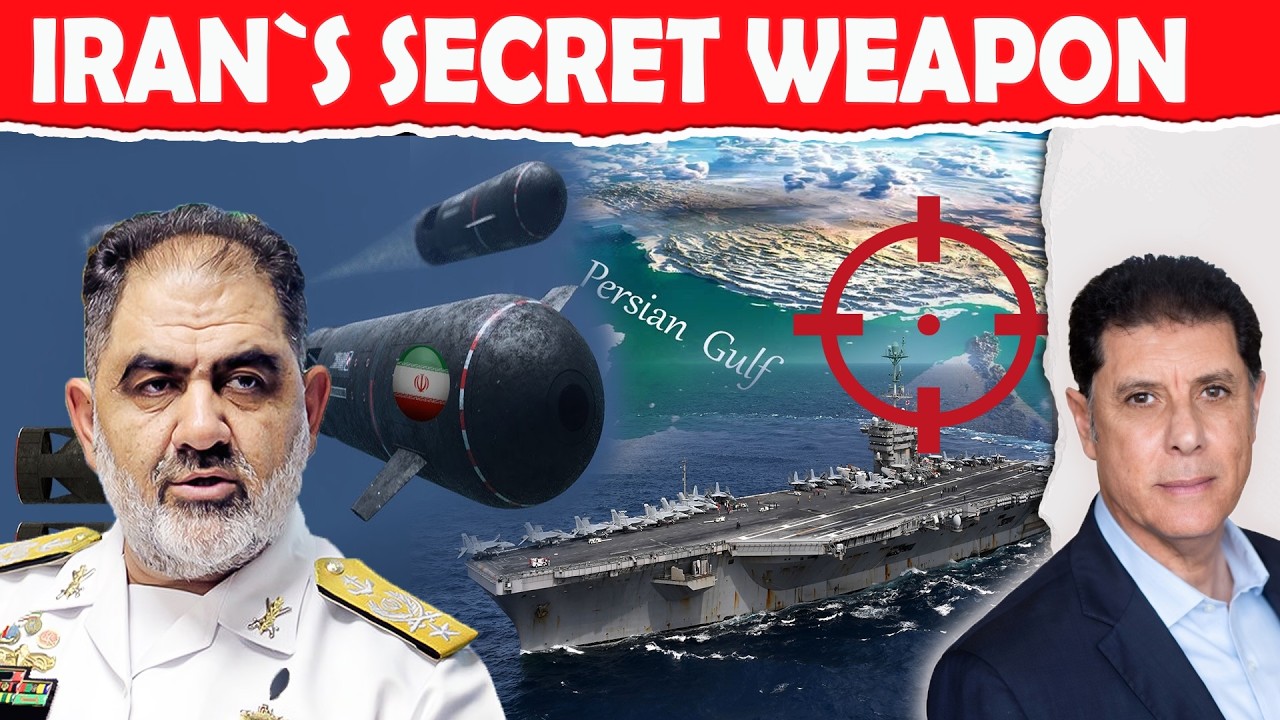
David Oualaalou analyzes Iran's supercavitating torpedoes and stealth drones, weapons faster than bullets that could challenge U.S. naval dominance. The video examines claims from Iranian Navy commander Rear Admiral Shahram Shamkhani and discusses how these systems might shift power in the Persian Gulf and beyond.
Chapters
Hello everybody and welcome to Geopolitical Trends, where truth matters. Today is May 1st. Wow, where time goes. So anyway, excited to be with you. A top Iranian military commander, he's the head of the Navy, uh, Alshamhani Irani, uh, looked, just looked at the United States dead in the eyes and said You know what? I hope they don't have a heart attack, in quote, jokingly. But at the same time, there's a message behind it. So what is really hiding in the waters of the Strait of Hormuz right now as we speak? Because whatever that is, that means it could sink a US ship. It could also collapse the oil markets. It could also drag the entire world into a war nobody's prepared for. And the scariest part, you know what it is? Is that American arsenal is already half empty. That is the harsh reality. While at the same time mainstream media is focusing on ceasefire negotiations and what have you, Iran is quietly repositioning its weapons so advanced that the United States military planners in the Pentagon are calling it near-term threat to every American ship in the Persian Gulf. I mean, just let that sink in for a moment. And the Pentagon knows what it is to a degree. They just not telling everyone else. And that's exactly what I found this, uh, in this episode here, why I wanted to do this live stream, uh, to highlight to you exactly the information that I came across. And, uh, and I want you to be in the know. So we're gonna be in for, uh, for a treat, if I'm gonna use the term here. And I'm gonna be sharing with you some clips as I move forward, like I've always been done here. So now Here's the thing. In the next few days, what we're going to be looking at, we're going to be looking at, at, uh, uh, taco Donald Trump. I usually don't like to, but anyway, we're going to be looking at Donald Trump sort of forced to make a decision. And this decision about, about what? Whether to strike Iran or not. But at the same time, knowing that something beneath the Strait of Hormuz Tehran has a weapon it has never used before. We already seen, for example, oil prices crossing $107 a barrel. By the way, it was someone from the community posted a comment. I remember seeing it. Gas in San Francisco is about $6, over $6 a gallon right here in Texas. Usually I called. And I found out that is about $4 almost. So you can tell the prices are going up. And above all this, I have at the same time something else happening in the Pacific. And what that thing is, is that China just doubled its naval forces around Taiwan. So one wrong move and this stops being the Middle East war. What a wrong move. Why? Because it will become a world war. That is the whole idea of why. Now, when we think about what the Iranian general is saying, or the admiral, I'm sorry, makes me pause. I am not jumping to conclusions right away by saying there must be something underwater. Maybe, maybe not. But what gives me more confidence to say that might be the case is coming from an Iranian naval officer. If it would have come from, let's say, an Air Force general in Iran, we'll be talking about something else. We don't know at this point yet. So I'm gonna go through the analysis with you, and of course, we'll tackle this at the end as to also solicit your feedback about what do you think. Well, so far, here is what we have. We have the Iranian Navy commander Rear Admiral Shahram Irani, that's his picture right here, which on 29th of this month, which was 2 days ago, stated, and I quote, Iran would very soon confront the enemy with a weapon it is deeply afraid of, adding that enigmatically that it is right next to their ear. Of course, we're not gonna understand. A lot of people in the West will not understand this kind of subtle language in the culture, in the Persian, for the Persians or in the Middle East in general term. So the Western audience might not understand what he meant by sort of it is right next to the ear. And jokingly, he adding that, 'I hope they won't have a heart attack.' So those are subtle messages. And the interesting thing about is that Irani, the Rear Admiral, did not name the weapon specifically. Of course, it won't make sense, but the statement was deliberately cryptic and designed to intimidate or make the Americans think. Because what we have right now, we have defense analysts in Pentagon and even the media here in the, in, in the US that is associated with, uh, with the government. All their reports, all their analyses are pointing to several leading types of weapons. We don't know. So I'm gonna share first clip with you, and again, if just for you to see. I'm not saying that's what it is, it's because I don't know. But once we— whatever I share with you as I move forward will make more sense to you. Let's take a listen here, please. And, uh, and actually there's nothing to listen to, it's just you, you see the— there we go. Now there is a conversation that I came across. When I say conversation, I'm referring about analysts talking to, to each other from different parts of the world regarding the type of new type of drones, which by the way, many are finding out now that the US have nothing against it. Could it be that weapon? Maybe, maybe not. We don't know yet. So, and I also found an article which I'm gonna post for you, uh, here in the chat box that you can read, uh, later on regarding this particular clip you just saw. It gives an idea of really what's going on. So here is what the experts believe. When I say experts, I'm referring to those in the military realm. We're looking at the first type of weapons, which is called Al-Hut. That's, uh, uh, uh, this is, uh, it's a Persian for whale. That's, uh, that's, that's how it's known. Why is this interesting? And this is called the supercav— uh, uh, cavitation torpedo. So You have defense experts now believe, they believe that the reference could be to this particular type of torpedoes.
Why?
Because it is a high-speed rocket torpedo, and it is believed to be among the fastest underwater weapons. Iran is thought to be only the second country after Russia to field this supercavitating torpedo similar to the Russian VA-111. And I have a picture of the Russian model. This is the Russian model right here.
The—
it's called the VA-111 Chagall. So unlike the conventional torpedoes that travel between 60 and 100 kilometers, The Hoot, or the Iranian version, this one can reach a speed of over 360 kilometers underwater, enabled by supercavitation technology that creates a gas bubble around the weapon, drastically reducing drag. That makes more sense to me, at least common sense, if the statement's coming from the Rear Admiral That means we're talking about a naval weapon here, something underwater, which will be catastrophic for the Americans. Because, uh, by the way, I made decision I'm gonna share the, the video with you, and I'm gonna do the translation for the one that I said part of it is AI, part of it— well, guess what? I reached out to someone that I know and asked, but I couldn't get the direct answer, and I can understand why, because it's sensitive info. I put the two and two together and figured, you know what, this might have happened. It's just the media in the US are keeping a lid on it. So I'm going to share the clip with you later on, but you reach your own conclusion. Now we talked about the Houthis first. Okay. The second option we could think of according to these military experts is that we're talking about naval mines. And this is again, the particular US concern that has over that. Why? Because Iran has already laid sea mines in the Strait of Hormuz, and it has done in past conflicts. As a matter of fact, I'm going to take you to 1988 with an event that took place. Take a look here. What happened back in 1988? That was the incident in which the USS Samuel Roberts, that was the one you're looking at right here, struck an Iranian mine, breaking the ship, Neil, and injuring more than 60 sailors. I found the picture, black and white, with the ship with a hole in the middle. I didn't want to post it. I wanted to post this for you. But again, the threat is keen, seriously. That's why now the Pentagon is is very concerned about this one. And the third one, option or type of weapons we might consider, is the underwater asymmetric drones. This is a different ballgame altogether. And this is, once again, the planners inside the Pentagon are kind of working around the clock to develop some sort of options to counter Iran's small, fast attack boats, 'cause we don't have anything. To deal with this, the mine-laying vessels and other asymmetric assets, because that has helped so far Tehran effectively, that's the key word, effectively shut down the key waterways. And one thing also that Iran has also previously deployed or developed, anti-submarine UAVs. I am gonna go even farther than this and bring one picture for you, and you can read between the lines. Take a look at this. What are you looking at? You're looking at the Chinese DF-21. Those are— those the anti-ship ballistics. I mean, think about it. A U.S. aircraft is not getting closer to the Strait of Hormuz. They're staying far away. They're staying in the Gulf of Aden from the other side, the Arabian Sea and the Indian Ocean. They're not getting closer. So the broader context for all this is that Irani, the Rear Admiral— let me put a picture here. His name is Shamhan Irani. Irani's comments coincided with the renewed focus on Iran's undersea warfare capabilities. Should I remind you about another statement Iran made, which is within its reach to go ahead and cut the cables? Internet. That's another option Iran has. Will they do it? I don't know. I don't know at this point. But suffice it to say that Iranian comments coincided with this renewed focus on Iran undersea warfare capabilities, with officials now in Iran hinting at this new weapon because tensions with Washington are escalating and the ongoing of the blockade of the Strait of Hormuz and so forth. So of course, Iran has not officially disclosed what the weapon is, and rightly so. So the vagueness of it is part of the psychological messaging also. And I believe as an analyst, I will say that this is a combination of deterrence, signaling, and a reference to existing asymmetrical naval capabilities. And with the supercavitating Hoot torpedo being the most widely cited candidate, that is again where I see the, the argument for the, for this So what I'm gonna play for you here, and I'll do the translation, uh, this is a reporting from Washington through— by a correspondent from Al Arabi TV. And I've been sharing some clips with you from that particular platform, and I verify their information is accurate. It's not some just whomever talking here. So what I'm gonna do is I'm gonna do the translation for you. And we'll play it for— it's not that long, it's not that long. So let's take a listen, please. So what he's saying— not listen, I'm sorry, because I'm going to do translation for you. Axios is reporting, citing sources it described as well-informed within the Central Command, that there are plans to launch swift and powerful strikes against Iran. This comes at a time when Donald Trump is speaking of ongoing contact with the Iranians regarding negotiations alongside the talks that Trump actually favors, a strategy of economic blockade. And given this conflicting report, is it at all clear what the US— what does the president actually intend to do? That's the question the broadcaster is asking. And the answer came in a form of, it is not entirely clear. However, the various sources, despite their diversity, tend to converge on a certain point that we can regard as the most plausible or probable scenarios. Yet there is a heightened state of American readiness. Yes, the possibility of a return to combat operations is indeed being raised, and this outcome has become increasingly likely, particularly following the report cited by Axios, which stated that the US military command has finalized all plans for strikes that, while potentially limited in scope, will be powerful in impact should combat and military operations resume. It stands to reason that the United States did not deploy aircraft carrier, or more specifically, a third aircraft carrier alongside additional naval assets and troops, merely to have them remain in a state of standby readiness, or simply to maintain control over the strait. Operationally speaking, the US naval assets already present present in the region prior to the outbreak of hostilities, before February, were sufficient to enforce a blockade on Iranian vessels and ports. Today, Donald Trump stated that he is continuing talks with the Iranian side. His reference likely alludes to the telephone conversation, the established line of communication between Steve Werichow and Abbas Arakchi, the Iranian Deputy Foreign Minister. Furthermore, his remark that all Iran needs to do is say they surrender may perhaps signal the possibility of a diplomatic breakthrough regarding the Strait of Hormuz, a waterway that has complicated calculations technically, operationally, and militarily, just as it has complicated the political landscape ahead of the upcoming round of negotiations. So, and this goes further to the point where he talks about the postponement of the discussions. And here is where the key that I need you to understand. Just moments, the— where the commander of U.S., uh, Central Command, Admiral Brad Cooper, indicated that U.S. forces continue to carry out their operations. The number of vessels that have been diverted has now reached 42. Representing the total count of announcements of the naval blockade imposed on the Iranian ports and vessels. So I just wanted to at least share this with you to let you know where things are. And I'm not gonna play the entire clip for that, so, because I need to move to my own analysis as to where we're going with this. And the way I'm looking at it, I'm gonna provide you two perspectives, one from an Iran perspective as part of this analysis, and the other one from the US. And the question that I'm gonna ask as part of this analysis is, is Iran bluffing? Okay, and it's worth asking, and I'm gonna break it down for you. Then we'll do the American side, and of course you decide for yourself. If we are to say, well, are the Iranians bluffing? Some will say partially, but not entirely. And here is the thing, on the secret weapon specifically, the vague of the theatrical language of it from Admiral Shamran Irani, from this individual here, has clear hallmarks of psychological sort of warfare. It's part of the game. Anyway, his comments that the weapon is right next to them fueled speculation that we're talking about an advanced underwater platform, but he offered no specifics, which is a classic, uh, sort of deterrence signaling tactic designed to create fear without revealing actual capabilities. And if we are to say, well, if Iran is bluffing, here is where the, the facts matter. However, Iran, previous incidents has backed up some of its threats. Another word, when they issue the threat, they follow through. They followed with action throughout this conflict. They've done it before. Look what happened to the Israelis when they attacked Iran and what Iran ended up saying. If you attack, we will attack you, and Iran followed it right away. So Irani, the, the Rear Admiral right here, Irani cited as many as 7 missiles, 7 operations against the aircraft carrier Abraham Lincoln, which prompts me personally to to now I kept that information and I reached out and called to find out. And when I get the answer that is not as clear as it can be, is because the classification is still sensitive. The individual I reached out to deal with this world of the government, and, and I kind of understand. And now you have this Rear Admiral saying that 7 missiles have attacked the aircraft carrier Abraham Lincoln. And he also stated that the retaliation prevented the US from launching aircraft or conducting air operations from the carrier for a period of time. That's why the aircraft had to leave the location, the area, and go to Cyprus for repair, even though they're saying because it was caught in fire inside. I am starting to have doubt about the report from the Pentagon. And that's not a bluff, by the way, on part of Iran. Iran has been willing to strike U.S. assets. And I am not— it's not me who's saying this, just me, basically. I read the analysis from a global security organization, and I'm going to provide you the link here for this particular— you can read it later on. Where Iran has shown real leverage is in the Strait of Hormuz. That is the key as part of— that's why I'm saying they are not— Iran is not bluffing when you think about it. Okay, let me see why this is not moving. Let me reload this here. There we go. I, I don't know what happened, uh, my screen froze for a second. It's almost like the norm now. Anyway, to go back to my point about Iran showing real leverage is in the Strait of Hormuz because it has discovered a new leverage in its control of the Strait of Hormuz. It's Iran that controls it, not the US. So, and again, this is where you think, there is no confirmed evidence of major damage to Iran's overall nuclear facilities. And that in itself suggests that Iran's nuclear deterrent may be more intact than the US claims, meaning that some Iranian threats still carry weight, including this one by the Rear Admiral Shamkhani. I'm trying to be convinced now. If we go to the other side, the American side, is Trump bluffing? Well, increasingly, Most analysts from both sides of the Atlantic, we all, if you ask them this question, they're gonna say yes. But some will say, oh no, no, no, he only bluffs on the deadlines. Now I don't buy that. I think Donald Trump just bluffs. He bluffs a lot. So the pattern is striking and well documented. Trump set a deadline, remember, When last time he said, "Oh, I'm gonna give you 48 hours." He set a deadline demanding Iran open the Strait of Hormuz and cut a deal. He then reamped the deadline saying, "Iran had 48 hours before the hell will rain down on them." Then he backed down. And despite Iran not cutting a deal or opening the Strait, Trump gave in another day when he stated during Easter, remember? And he said, I remember him saying, and I'm paraphrasing here, oh, it is not appropriate the day after Easter to strike, whatever, you know. I remember him saying, oh, I want to be a nice person. That's pathetic. That's pathetic language coming out of a president. But why Trump is bluffing? You think about it in these terms. Because if you look at his predecessor, not even his, uh, uh, the, the, the Biden, but before that, even before that, Obama back then. What did Obama do in Syria? Remember, he declined, he declined to enforce his Syria red line. And here is the irony, is that Donald Trump spent years criticizing Obama for it. Now what analysts are saying is you could certainly forgive Iran for concluding at this point that Donald Trump simply doesn't want to follow through with his threats. You have— yeah, I looked at different, different think tanks that deal with this kind of the global security aspects of it. And majority of them can confirm or concur or agree on the idea that overall US actions has not provided the display of strength the Donald Trump administration was hoping for. There is a reason for all that, because now you have the US depleted, depleted of the ammo stockpile in the Middle East. And also what this conflict showed, it showed the limit of existing American capabilities in terms of being able to intercept missiles and drones. That's exactly what is showing up right now. So both sides, Iran and the US, are engaging in a strategic ambiguity. That's the name of the game, is part of the strategic war. That's how you plan a mix. It will be a mix of real capabilities, a real willingness, and deliberate theater. So Iran's secret weapon statement is mostly signaling, in my opinion. But at the same time, they can back that up. I am now thinking of the two. I'm thinking about the DF, whether the Chinese have provided Iranians with the DF-20 21, the anti-ship ballistic missiles. And I'm also thinking about their own developments of the Hood, which based on the Russians' development of the VA-111 Shkval. So I'm starting to be more convinced because evidence shows me. So they are not just signaling, but they are backing that up. So, but Iran has proven It can and will use force if it needs to. Donald Trump deadlines have repeatedly slipped, come and go, come and go, come and go, to the point that now you have majority of analysts are beginning now to interpret it as a sign, you know what, that he prefers to— he prefers a deal instead, instead of resumption of war. I mean, make no mistake, the military option remains genuinely on the table because Iran's own parliament advisers have called Trump's ceasefire extension a ploy to buy time, and rightly so, for a surprise attack. And that in itself suggesting that Tehran is not sure how far he will go. And that mutual uncertainty is precisely the point and the danger at the same time. That is the way I see it playing out moving forward. If the truth matters to you, hit like, subscribe, and tap that bell. No spin, no agenda, just the stories they don't want you to know. Don't watch from the sideline. Be part of the movement. Your support keeps the truth alive. Thank you.
Indeed.
Now, for me, and again, I speak for myself, I'm thinking outside the box. I'm even going as far as saying, what if? What if? We don't know. What if? We're talking about the advanced types of Hadid 110, which is a really an upscale type of drones that the US has nothing against against it to deal with. All these are possibilities. And this compelled me to ask the significant, the most important question: how significant is Admiral Irani's announcements? Because you won't do things in a vacuum, has to be a reason for it. Highly significant and for several reasons. That go beyond just the weapon in itself, because the, the, the announcements matters less as a disclosure of a specific military hardware and more as a signal of Iran's strategic posture and resolve at a uniquely fragile moment. That is the importance and significance of it. And of course, this comes against the backdrop of the publicly announcements that this weapon are deeply sort of afraid of. That's what the enemy is going to be because he serves 3 key points. Number 1, he raises the psychological cost of renewed US strikes. Number 2, it signals to Iran domestic audience that the Navy has revealed reserves of power. And 3, it directly communicates to Washington that breaking the current ceasefire stalemate could trigger an unknown escalation. So the timing, coming as the ceasefire strained and the US military is actively drawing up a new strikes plan, makes it anything but a routine posturing. That is, to me, where the importance and significance of it. And of course, you have the geopolitical and the security ramification of renewed US strikes. Should the US attack Iran again, Iran's going to have to deploy this particular weapons, whatever this weapon turns out to be, and the consequences will ripple across every major dimension of global security. So let's start, and I'm gonna share 2 or 3 parts of it. The first one has to do with the energy and economic catastrophe that will deepen even further. The damage done so far has already been historic. When you consider about the head of the International Energy Agency describing what's going on right now as the greatest global energy security challenge in history. And so of course, following the closure of the Strait of Hormuz, Brent crude surged past $120 a barrel. And that in itself, just for example, some countries, it forced Qatar Energy to declare now force majeure. Force majeure, which is a legal term. Basically, it's a contract clause that is freeing parties from liability when unforeseeable events beyond their control, like natural disasters, war, pandemics, and what have you, make performance impossible or impractical. Qatar is being forced to do so on all exports, by the way, not just gas or oil production in countries, the Gulf, like Kuwait, Iraq, Saudi Arabia, United Arab Emirates, collectively have dropped at least 10 million barrels per day. So a renewed strike, in my opinion, that triggers Iran for naval response, including mines, swarm drones, and whatever this new weapon is. So we'll be looking at this. We'll be looking at this one here. And we'll be looking at a new type of weapon that Iran just developed, and that's called Azhdar. I have a picture of it right here. This is the Azhdar stealth underwater drone. Once again, I'm saying, I'm saying, and please share your feedback in the chat box with the community. Do you think Iran is bluffing? I don't. What do you think? And this again, where you think in terms of this renew— what Iran is doing, you know, because all what Iran is doing could push these numbers dramatically higher for what's going on from the energy perspective. And you have Iran Deputy Parliament Speaker warned when he said, and I quote, we realized if we place our foot on the throat of the Strait of Hormuz and Bab-el-Mandeb, 25% of the world economy will be affected. That's what he's referring to, the two locations, the Strait of Hormuz and Bab-el-Mandeb, right there, Bab-el-Mandeb. Very, very sort of poignant. Because gas prices in the US have already risen by about 27% since the start of the war. I mean, think about it, a second major disruption will be extraordinarily difficult for, for Trump to absorb politically. Number 2 is the military, or the US military, a position which is critically exposed. This is one of the key This may be, in my opinion, the single most alarming strategic reality underlying Iran's bold posturing. Why is this important? Because over the last few weeks since the war started, the US military expended at least 45% of its precision strike missiles. 45%. It spent at least half of its THAAD missiles inventory and nearly 50% of its Patriot air defense interceptors. And this is not my word. This is according to think tanks that deal with this, like for example, the Center for Strategic and International Studies. That's, that's their main focus is the Department of Defense. So the high munition expenditure have created now a window of increased vulnerabilities in the Western Pacific. And this, once again, not my word. This is the word of a retired Marine Colonel, Mark Cancian. I think I have a picture of him. Uh, let me see. No, I didn't. I thought I had it, but retired. Let me see if I can get it for— it's always nice to put a face, uh, to a name. Yeah, right here, I found it. And what he's saying, he's saying that it will take at least a minimum of 4 years to replenish these inventories and several years after that to expand them to where they need to be. Makes you just wonder. So, so Iran war, like I said at the beginning, The end of the U.S. and Israel dominance in the Middle East is coming at the hand of Iran. So I'm not surprised. Iran war has exposed now the U.S. and exposed one reality is that the United States is not ready for a major war. Iran has a clear advantage in drones like I showed you earlier, this type, Hadid-110, is something completely— we have no clue how to deal with it. And that's one, one that Iran has. So has the advantage in the drone warfare, both in the air and in the sea. And in the sea, you have this particular type right here. Those are drones, the stealth underwater drones. And the US is far from being competitive in the drone space, let alone being ready to create a hellscape for China. Think about it.
If Iran—
if US is facing this with Iran, how do you think US is going to face China? And again, I need to bring this up because it's on the table. So if Iran's secret weapon turned out to be an advanced underwater drone system or a supercavitating torpedo and it succeeds against the US Navy assets, think about the political and strategic fallout from this. It will be enormous. It will be enormous. And of course, to China, this will move it forward. Some analysts use the term China will be emboldened. China is not about that. I don't believe in that terminology. China will be emboldened about what? China has its own capability. And dare the US to ever threaten China. As we speak right now, they are circling Taiwan.— you know, nearly doubled their presence, around 50 vessels to more than 100 in early April. And that is why you have to think about it strategically. A second round of intense fighting in the Persian Gulf, especially one that results in the US naval losses, which are most likely, that in itself will send a message unmistakable signal to Beijing about the limits of the American power projection. And the number 4 will be the nuclear question becomes far darker. That is why I am not ruling out the possibility of something like this also, because it's worth considering. Iran does not yet have a nuclear weapon, at least to my knowledge. Maybe they do, maybe they don't. And I can't because I don't know. Simple as that. We'll leave it at that. But here is what I can tell you as an analyst. What I can tell you is that Iran has the knowledge and Iran has the infrastructure to produce at least one in a fairly short order should the leaders decide to go forward with it. If Mujtaba Khamenei gets the order, they're moving forward. And that is why I am leaving that possibility there. A resumption of intensified US campaign, especially one that will kill civilians or military leadership or what have you, could push now Iran and you leadership towards crossing this threshold by saying, let's do it, because they have the knowledge, they have the capability, they have the infrastructure. That's the way I see it. And I characterize this once again, this, this Iran strategy as a nuclear hedging. That's how I categorized it. So developing the technical infrastructure to assemble a weapon in such a short time while stopping short of actual production. Because if Iran is cornered with nothing left to lose, that will change the calculus completely. And that is, again, to put the perspective of the Admiral, the Iranian's statements. Within, within the proper context, is that the announcement is significant, not because the weapon is definitely a game changer. No, no, no, no, no. In a military sense, no. But because it arrives at the precise moment when the United States is most constrained. Depleted stockpiles, fragile ceasefire, distracted administration, Confused. And that's why this announcement is designed to raise the perceived cost of the resumed strikes to a level that makes the diplomatic track look more attractive. Whether it succeeds depends on whether Washington reads it as a deterrence or as a weakness. I don't know. I'm not part of that conversation in Washington. And I don't want to be anyway. So the ease with which Iran has used now the drones, the mines, the cheap missiles sort of to obstruct the Strait of Hormuz suggests that the United States can no longer guarantee freedom of navigation. Remember, the US will go to the South China Sea and say, hey, it's freedom of navigation. No, no, no, no. What Iran did, it proves that the US cannot guarantee that even against weaker adversaries. You know, you look at, you think about the sea lines, how they are, where geography now and the proliferation of the inexpensive weapon put even powerful navies at a disadvantage like the United States. So the strategic reality, more than any single new weapon, is what makes the current moment so dangerous. That is again the key factor. And I'm gonna play the clip for you and do the translation of the one that I've been holding on because I wanted to confirm a few things. And when I get the word— when I get the word that the individual I asked and said I can't answer, and I can understand that it convinced me that something major has happened. So what I'm gonna do is I'm gonna share the clip with you, uh, and once again I give credit to, uh, Al Arab, uh, to Newstime. That's the one I get this, but I'll let you decide for yourself. So because that's how we do it in this community here. So all right, let me share it and I'll do the translation for you. Okay, and what it says right on, uh, it says, uh, breaking. So let me do this one here, and we're going to start it, and I'll let you just watch at least, but I'll do the translation for you. It was clear tactic designed to overwhelm air defense systems and saturate them with advanced barrage of missile threats. These missiles, believed to be precision-guided munition, struck their target directly, penetrating protective layers and triggering a series of consecutive explosions deep within the vessel. The blasts following the initial strikes were, and were, were of unprecedented violence. Their concussive force, heard from great distances, Field sources confirmed that massive quantities of ammunition stored inside the ship has ignited, resulting in the incineration of thousands of tons of ordnance, effectively transforming the vessel into a colossal explosive device that compounded the catastrophe with every passing moment. The scene unfolding now is by any standard catastrophe. Flames are devouring vast sections of the ship's superstructure, while the sounds of secondary explosions ring out ceaselessly. Meanwhile, rescue teams are struggling to bring the situation under control amidst extremely perilous conditions. As of this moment, precise figures regarding human casualties remain unavailable. However, preliminary indications suggest significant injuries and losses among the crew. This attack, described by analysts as a calculated preemptive strike, raises grave questions. Are we witnessing the onset of a direct confrontation between Iran and the United States? Was this attack a message of deterrence, or was it in reality a declaration marking the entry into a new phase of open conflict? Conversely, US forces in the region are currently on a state of maximum alert Readiness levels have been raised to their highest tiers, accompanied by urgent movements of naval and air assets converging towards the sites of the incidents. Furthermore, reports indicate that regional defense systems have been activated in anticipation of any additional attacks. On the Iranian side, no detailed official statements have been issued thus far. However, sources close to Tehran have hinted that the operation was conducted in response to imminent threats and was aimed at preempting a US strike that was reportedly in the works. In the works. Scenes of a hell are unfolding across the waters of the Arabian Gulf and the Sea of Oman. In a daring and devastating Iranian assault, the Iranian Guard launched a single unprecedented wave of over 120 advanced ballistic and cruise missiles aimed directly at the largest and most powerful US military vessels in the region. I can see thick black smoke billowing into the sky like infernal pillars while flames rage across the massive vessels. A ship once regarded as the very symbol of US naval might. Hundreds of tons of heavy ordnance, missiles, and shells are now burning within their magazines, and millions of tons of explosives are being reduced to ash and flame, consuming everything in their path. Secondary explosions are erupting in rapid succession, much like a raging volcano, with tongues of flame soaring dozens of meters high, illuminating the sea as if it were broad daylight in the dead of the night. This preemptive Iranian strike descended like a thunderbolt amidst the skies of escalating tensions, serving as a direct response to what Tehran has characterized as acts of US maritime piracy. And Washington's violation of the temporary ceasefire agreement. Right before my eyes, I am witnessing swarms of missiles launching from the Iranian mainland and from mobile maritime platforms are breaching US air defenses with astonishing speed. Some have successfully penetrated the missile shield of a colossal vessel, triggering massive fires and inflicting severe damage upon its production system, its propulsion systems, radar arrays, and primary munition magazines. The American ship, representing the pinnacle of Washington's naval arsenal with its immense sea size and its dual nuclear and conventional capabilities, now lists precariously under the weight of these strikes. I see plumes of smoke billowing from the deck, and the wailing of sirens rises above the screams, screams of the crew members struggling desperately to contain the unfolding catastrophe. Billions of tons of advanced munition ranging from Tomahawk missiles to air defense interceptors are erupting in a single missile fireball. The chain of explosion shakes the very waters beneath sending out shockwaves that cause neighboring vessels to shudder. This scene is no mere conventional military assault. It marks qualitative shift in the regional balance of naval power. Today, Iran has proven its capability to strike at the very heart of the US Fifth Fleet utilizing precision missile arsenal. It has painstakingly developed over the years despite the burden of international sanctions. The missiles were launched in a successive wave, the first designed to overwhelm radar systems, the second to achieve penetration, and the third to deliver the final decisive blow. Some of these projectiles bypassed the sophisticated Aegis defense systems, striking vital targets and igniting vast stockpiles of ammunition, quantities sufficient to sustain entire wars. The past few hours have witnessed one of the most ferocious naval attacks in recent history. So that is what I want you— and it's almost the end here, so— that is what I want you to see. And again, I'll let you decide for yourself. Of course, I was sitting on this for 3 days because I needed to get a confirmation. And when I asked the person that I trust— and because the person that I trust is in the know— and the answer I get was, I can, I can confirm definitely. I get the idea because that just is the right answer from his or her part. But I kept that. Then I said, no, I'm going to share it with the community and let you decide for yourself. So, so what I'm going to do now is I'm going to play 4 clips for you. Those are short, very, very clip, like I always do, and do conclusion and sign off with this. So the first one I want to start with, it's in, I believe, in English. Let me see. Because I want you also to know— oh yeah, this is traveling. And again, to highlight to you where things are back home, let me share it. And this during a hearing in Congress. Take a listen here. It's in English, guys. Said you're a war criminal! You should be arrested! What you're doing is despicable! The American people do not want to go into this war! We don't wanna fight— I didn't do anything yet! I didn't do any— Pete Hegseth said you're a war criminal! You should be arrested! Hey, what you're doing is despicable! The American people do not want to go into this war! We don't wanna fight a war against Russia! It's disturbing, and it happens in in Congress, stuff like that sometimes. Second clip is a very, very interesting one. I want you to listen to— I know of this individual, I don't know him personally, but he speaks the truth. That's why I'm saying there are good people out there that really mean well for the sake of humanity. So take a listen, please.
If they start talking to you about fighting a war with Iran, you treat them like an enemy that they are. Benjamin Netanyahu came and testified before Congress in 2002, and he said with certainty that if we overthrew Saddam Hussein, democracy would sweep the region. If you take out Saddam, Saddam's regime, I guarantee that it will have enormous positive reverberations on the region. By the way, he also advocated that we had regime change in Libya, Syria, and Iran, and he's still advocating that to this day. You must recognize that anyone advocating that America go fight another stupid catastrophic war in the Middle East is your enemy. They are our enemies.
Yeah, yeah, Dave Smith was right. He's right. There's no other way of looking at it. The next one I want to share with you, it's— I'll do the translation for you because it's just few words— is from Vladimir, President Vladimir Putin. And again, I can't play because it has a soundtrack. But I will translate the writing for you. So let me share it on the screen. What it says there, it's breaking news. Putin, yada o khatan ahmar, sokotahran memnu bi amar min al-Kremlin, which means basically it's urgent. Putin has put a draw red line. That the fall of, uh, uh, the, the fall of, uh, of, of Iran, uh, the fall of Tehran is prohibited. That means who will not— he will not allow it. And that's by order of the Kremlin. And that's what the, the Russian president, uh, wrote right there in Arabic. It says We will support Iran with all our power. Did— are we entering the great conflict? That just, uh, I wanted to highlight to you where— how the Russians are seeing this. And speaking of the Russians, the last one I want to share with you is the surprising, uh, that now Iran has a specific, specific weapon here. Take a look. And again, it's— I think in— let me see. Yeah, there is nothing. You can just see the, the, the— here, let me, let me— instead of me talking, I just show the, the clip here and you can take a look. All right, what are you looking at? You're looking at the Yeah, yeah, makes you wonder now, you know, is the US have to think twice about this? And once again, just to tie it back to our original conversation about this secret weapon, the Iran secret weapons. Are we talking about the torpedoes? Are we talking about Hadid-110? Or are we talking about the Chinese DF-26? And now, are we talking about even the Su-35? Very, very interesting dynamic. So, so here's my conclusion for you. The admiral, the Iranian Admiral Irani, The secret weapon announcements, maybe, maybe psychological warfare, maybe. Yeah, it may be a bluff if we go down. But here is what it's not a bluff: a fragile ceasefire hanging by thread, okay, and oil prices of a barrel that crosses $107, and you have China that is doubling its naval presence around Taiwan, but also the possibility of sending the DF-21 and two heavily armed adversaries who have both repeatedly shown they are willing to pull the trigger. The Strait of Hormuz is no longer just a waterway. It is a pressure valve of the entire global economy. And right now, both hands on that valve belong to Iran, not the United States. So the real question before us wasn't— is never about whether Iran has a secret weapon. Of course it does. The real question is whether the world has a plan for what happens if this ceasefire fails. Because based on everything that we've seen, I shared with you, Nobody knows and nobody does. That is the, that is the important aspects of it. And here is what I want, I want to know, I want you to know as I— so what I want to know from you, as a matter of fact, as I read every single comment, do you believe, in your opinion, Iran's secret weapon is real or Is this just the most dangerous bluff in modern history, military history, that is? And if the US strikes against Iran once again, will Iran deploy it? And if it does, which country do you think ultimately will back down first, Iran or the US? So make sure to drop me your answer in the, in the, in the chat box. I will greatly— not the chat box, rather, but the comment section. I will greatly appreciate it. Tomorrow I will be talking to you about India once again, you know. And I'm gonna share one, one, uh, one post with you. Somebody put a post that I talked about 3 years ago. He just posted, and I have it. I'll share it with you tomorrow. And he said, you know what, Dr. O was right 3 years ago when he said India will backstab BRICS if it gets the opportunity. And here we are. So, so I'll be talking about that tomorrow. So, so make sure to join me tomorrow. You don't want to miss this, truly, because of the information that I have. And I intend to share it with you because it's very, very important to understand, you know, as India backstabbing BRICS in the back. Well, maybe it is time to kick India out. I've always believed India's presence in BRICS is doing nothing but the bidding for the United States. That is the only explanation for it, because they are subservient to us no matter what they say on the world stage. We dictate the term to New Delhi. So tomorrow I will be talking about that, so make sure you join me if your schedule permits. I'll take this opportunity to say thank you so much to Rari M64. Much appreciate your generosity and support for the channel. I'm very, very grateful to you for that. So, and I also wanted to, uh say thank you to— I got some, a few, a few, few supporters, uh, went ahead and bought me cups of teas in support of my upcoming trip to Asia. First, I want to give a shout out once again to Paul Green in the UK. Much appreciate your PayPal donation, a generous one. Thank you so much for that. And of course, I will, uh, utilize that donation in support of the the Asia trip. The next person I want to give shout out to is JTD78. Thank you for buying me cups of teas in support of the trip to Asia. And the next person is Takarta. Thank you so much for buying me couple cups of teas in support of my upcoming Asia trip. And the last person I want to give shout out to is Merith. Merith, M-E-R-I-T-Y-H. Thank you so much for your support for my upcoming trip to Asia. And to those who want to support the upcoming Asia trip, which I will show you, by the way, I'll show you where we are in the fundraising. Here we are. We— oh, as a matter of fact, no, my apologies. That is not the right one. Let me upload the update as of this morning. Because I have it, I have it on standby here and I just forget to upload it. Here we go. This is where we are right now. So we are at a 30% threshold. And as I said, by July or even the end of June and so forth, if we reach at least 50%, then that gives me sort of more motivation to move forward. With the plan and travel. If we don't, then I postpone the trip till we reach the target funding goal because of where I plan to go. And that is, uh, once again, should you decide to support that, I would greatly appreciate it. Uh, to those who have been supporting the channel, you know the type of information that I provide you, the analysis that I do, the research that I conduct for you. Here is the link for the channel. This is in support of the channel. If you decide to support the channel, I would greatly appreciate it. And the last link, it has to do with the— if you want to purchase some of my books, uh, you, you go and buy them there. They are really— I kind of, uh, that's one way for you to support the channel if you decide to do that. So here's the last book about Iran. So So I look forward to seeing you tomorrow. Hope you enjoy the rest of your day, evening, whatever part of the world you're in. And as always, remember, geopolitics impacts your daily life in more ways than one. Till next time, bye-bye.
More from David


Beyond the Single Actor: Why the Gulf Isn't Choosing Between the US and China


Iran, Iraq's Militias, and the Houthis Are Coordinating! This Changes Everything




Who Controls the Next Decade's Resources? Latin America and Africa's Geopolitical Crossroads

The Chokepoint Trap: How Washington's Stupidity Triggered a Cascade That Now Controls the World

Trump Spooked as IRGC Unveiled dual-use SLV, Deployed Ghadir Mini-Subs & Hinted at Tactical Nukes!
