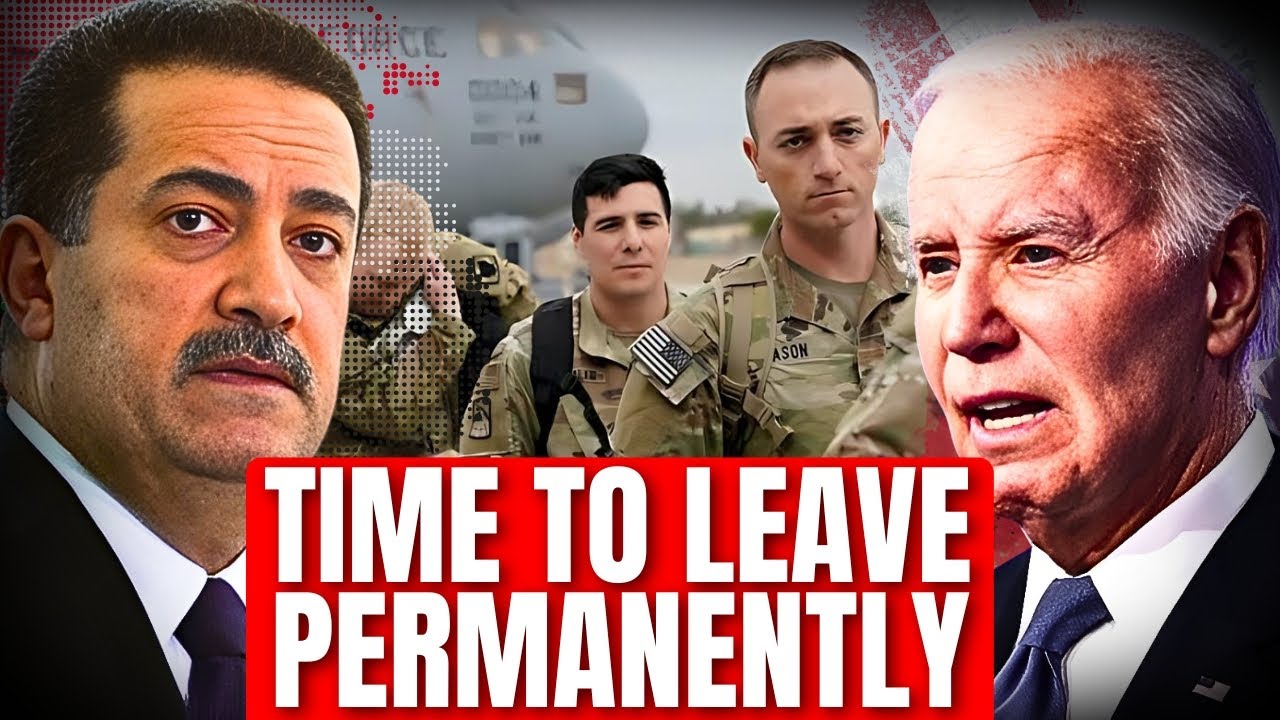
This content was created by David Oualaalou. This content was uploaded by David Oualaalou. This is a YouTube video titled "Iraq Wants the US/Western Forces Out!!" (uploaded July 24, 2024). Based on the title, the content likely discusses calls for US and other Western military forces to leave Iraq or related political developments. No transcript or speaker information is present in the excerpt/metadata, so participants, language, and format (monologue, news clip, interview, etc.) are not identifiable from the provided data.
Chapters
All right, hello everybody and welcome to Geopolitical Trends. Excited to be with you as always, and I mean it when I say that, guys. Uh, I got an interesting topic for you today, something that happened about, uh, not happened in the past, it just happened recently, but it traces back its root to about a year, almost a year, and I did a video on it back then, and now I'm putting the pieces together, makes perfect sense. So this is why when I came across this yesterday, I was reading overseas, uh, uh, information and so forth, and I said, no, no, no, no, no, no, this doesn't happen in a vacuum. So I'm gonna make a video for my community here and just to shed lights on some stuff for you that you need to understand, like we did yesterday with the topic about, uh, Russia's, uh, uh, announcement regarding the armament of the age group. This one has also a different dimension to it, and it is part of that. So here is how I'm gonna do this one this time. I'm gonna provide you the background, but I'm gonna address it from 3 angles: one geopolitical, one economic, and one financial, because that is what the big picture is. Then of course you draw your own conclusions at the end. All I'm going to do is lay out the analysis for you Uh, you can accept it, reject it, whatever you want. So we, we, we are free here to express our opinion. So, and by the way, guys, before I'll do this, of course I gotta say hi to some of you, or not all of you. Uh, Termy, good to see you. Timeline Dunkley, as always. Mustafa Al Husainat, good to see you. Uh, first time I see your name here. Ahmed Sidi. Willie Homan, as always. Uh, Army with Harmony, good to see you. And I read your comment, by the way, about the weekend. The community conversation. Yes, I will have some pictures, uh, for all of you there. Uh, Joel M, good to see you. It's, uh, 5 more minutes. Uh, okay, I, I guess you need— you are in a different time, time zone there. Truth Seeker, Jane Wong, Masian Dorier, Farhad Razavi, Wong KC, The Wacky Monkey, good to see you as well. Uh, Gayatri Adarsh, good to see you from Francis Tango, Abby Ongoy, good to see you. John Smith, and who else here? Alice Tarkin and Sam Stone, good to see you all. Hong Ruan, good to see you. KL, as always. All right guys, let's get into this, but before I need to share for you some housekeeping stuff with you, for you, with you rather, uh, remember to join me on Saturday at 1900 hours, uh, for my conversation with Carl Zha and Jerry Gray together. We're gonna have a panel conversation, just just a discussion there. On Sunday— yes, no, I'm sorry, I'm sorry, I'm sorry, I'm sorry. On Saturday at noon, I will be doing the community conversation. Not on Sunday, on Saturday. Just please check the community post, that's where I post everything for you over there. Then on, I think Sunday, I'm gonna be on Twitter with SL, uh, uh, content. He invites me over to his platform there on YouTube— on, on Twitter, rather. So, uh, I want to share one thing, by the way, guys. Uh, one of our viewers, uh, Azaka848, put a comment. It says, sir, point of correction, it was a Russian Iskander-M mobile that was used to kill the 50 foreign mercenaries in Ukraine, not a Kinzhal mobile. He is right. I made the mistake. I, I somehow I was talking and thinking of— it wasn't the Kinzo, it was Iskander. So it's my mistake, and thank you very much for correcting this one here. So all right, let's get into our topic here. What we're going to be talking about today is the Iraqi government and the US. Sort of the Iraqis asking the US and its coalition, time to pack and leave. I think, in my opinion, as one who spent time there I think we overextended our stay. So we destroyed the country, we damaged it. So why are we staying there for? We shouldn't even be going there to begin with, you know. And I, I wrote my own report— pardon me— report back in 2003, uh, advocating against the invasion because the history of that part of the world. And even back then I argued that If you go in, you are not coming out in less than about 18, 20 years. And second thing, you're gonna turn things upside down. And that's exactly what happened. So, but in any event, we're gonna be talking about what just transpired regarding the call by the Iraqi government. Now, will the Iraqi government push harder for this? I don't see that happening because here is the thing. If they really want the US out, they should have done the same thing Niger did when they asked the US, hey, you need to pack and leave, it's a sovereign state. So that's, to me, this in and out and all that, it's nothing but waste of time, but it's a tactic. But beside all this, there are some hidden agenda behind the scenes that I am gonna share with you in this analysis that I'm gonna provide you. So But let, let us ask the, the key question like we always do, because those questions help you to at least put things in perspective. Here are the questions here, guys. First question: why is the US overextending its stay? We're not staying there because we want— we're staying for some other objectives. Second thing: why does Iraq want the US coalition forces out now? Why they didn't push for it a year before, 2 years before? Because remember This goes back all the way to 2011. I remember my last trip to Iraq was in 2010, if I'm not mistaken. Third question, which is the key— this is why I decided to divide this into three key elements: one geopolitical, one financial, and one economics— to provide you the big picture. And of course, you reach your own conclusion. Third question is, is something brewing geopolitically in the region? And most likely you know the answer. Just go back to what I talked about yesterday. So, and the last question which you should not ignore: what does Iran— what do Iran, Russia, China have to do with all this? There is some links there. So this is why we're going to be addressing in general term. I provide you some pictures, maps, and I'm gonna do a little bit of history of Iraq because you need to understand this one here. So, so let's talk about just the background first, then, then I'll get into the geography and so forth. So, well, now the question that is, uh, and I came across an article, by the way, from Shafaq News. Shafaq News is overseas, not here in the US, and that's what I give credit to, uh, in this picture here. This is an Arabic term for Shafak News, uh, uh, uh, that's, that's written in Arabic language there. So Iraq, now the Iraqi government basically wants the US-led, uh, coalition— when I say US-led, remember, there are more than just the US present there, and I'm going to share with you the countries and the one that been lying about saying, oh, we are not in Iraq, we have never been in Iraq. They were lying. Including our neighbor to the north, Canada, which by the way, guys, Canada is collapsing economically. You don't hear much about it. It is collapsing economically. It's going the same direction as the UK, and I will even extend it to Australia. What they all share in common? They all follow the monarchy in England. So, but that's beside the point. So Iraq aims sort of now asking for the US-led coalition to withdraw its forces by September. Why wait till September? Of course you need the time frame. You can't just pack overnight. That just doesn't make sense and doesn't happen that way. You got equipment, you got— unless we do it in one condition or one way. And you know what that way is? Is the same way we did in which country we just packed and left. I want you guys to type in the name of that country. You should know this one here. It was very embarrassing, and we left everything behind. Behind. So let me just see which country. And, and I— oh, you got it, Jammy Dodger! Jammy Dodger, you got it, you got it! And Muhammad Mazhar, you got it, you guys got it! That's, that's, that's the country we just packed and left almost a billion dollars worth of weapons. I was in Bagram Air Base. I sort of— it's not a small place with all the massive equipment. We just left the stuff behind. Almost a billion. It was $800+ million worth of equipment. Almost a billion. It's the same thing here in Iraq, because if we wanted to leave, we just leave. On the other hand, what are we doing since 2011? And this is where you have to understand. Now the US is saying, well, sure, we can enter into some agreements and we will leave by 2025. No, no. But now it's up to the Iraqi government to push, you know. It's a sovereign state. Of course, we were the one to install the previous prime minister, Nuri al-Maliki, and I was there. Never liked the guy because he was wishy-washy, you know. Ayad Allawi was also wishy-washy. Were all of them corrupted and having their own assets in England? Shame. Iraq is a rich country in oil, and yet they live in poverty. And I couldn't understand that. But at the same time, what makes Iraq different than Niger, for example, as far as political decisions? When Niger made the decision, said to the US, you need to pack and leave, you know, you have a week to pack your stuff and get out. Simple as that. But there are some other aspects to all this that is very, very intricate. And this is the reason why I wanted to, uh, stress, uh, or, or provide you the analysis about. But first, let us get into, uh, just, uh, I want to show you the, the, the map. I'm not going to get into the whole geography of it, but you need to see, uh, certain— oh, let me remove this one here. Okay, let me share the screen with you. And, and by the way, guys, uh, I need you to keep an eye open on the chat box if you notice any bot just give me a heads up here so I will remove that. I, I watched the video yesterday and I pinned one exactly, and I removed it from the whole channel altogether, and I reported it, by the way. So the— because those entities have no place here in our— on our channel. So, all right, let me share the screen with you here just for you to see the map. Then I'm gonna detail the history aspects of it because it's very, very important for you to understand these dynamics, and it will make more sense to you, uh, once you put it together as far as, oh, this is why the US wanted to stay. Okay, it's taking time here for us to expand the full screen. Uh, let me see here. Sorry for all this. Junk stuff here. So this is Baghdad, the capital. So, so the idea of thinking about the importance of, of why we have to have, uh, uh, uh, an understanding of the history of the country. So, and I have a specific link that I'm going to share with you later. For now, I'm just going to provide some, uh, some snippets of what that history is all about. So of course, when we think about the history of Iraq A lot of people would not know much that anything is start in the 20th century. That's usually where the sort of the reference for the contemporary time. However, the earliest time of Iraq goes back some 4 millennia. Yeah, that's how far it goes back. So from about 4500 BC, there are settlement or there were settlements on the edges of the marshes where the Tigris River and the Euphrates River reached the Persian Gulf. That's how far back you go. So back then, the Greek named Mesopotamia. That's where the name is coming from. And I think I have another picture here. Let me just, uh, close this one and open— if I can find it. Maybe, maybe not. No. No, I don't. And life goes on. So anyway, then the Mesopotamias, which means between the rivers, that's what the name means. So, so civilization at that time, the existence of town and cities and so forth, was established a little earlier than 3100 BC. This is why a lot of people do not know the center of civilization, especially for the Arab world, the Arab, the Arab world, yeah. One thing that I learned throughout the history is that the grammar, the Arabic grammar, was established in Iraq, not in Egypt, in Iraq. So, so from that time, meaning 3100 BC, until the end of the Ottoman Empire, the development of Iraq is part of the history of Mesopotamia. That's how. So anytime you hear Mesopotamia, you have to think in terms of Iraq. So So for almost 4 centuries, yeah, 4 centuries from the arrival of the Sultan— Sultan was like the equivalency of king in the Ottoman, for the Ottoman Empire— and his army, which they arrived into Iraq in 1534 according to historical record. So when I say Iraq, the whole region is that matter, was under the rule of the Ottoman dynasty in Istanbul. That's how it was. So what happened at that time? The head of the Ottoman Empire wanted to have provinces, and one of the governorates was based in Baghdad, which is the capital of today's Iraq. So on two brief occasions, the neighboring Safavids dynasty, which I talked about in my Iran book, which was in Iran, intrudes, because that's— remember the Persian Empire at that time, during that time. And for much of the 18th century, the region was under the control of the Mamluks, officially subordinate to the Sultan but in effect independent. So then you're moving to World War I, and that is very important. Why is this? Because when Turkey sided with— which country did Turkey sided with? During World War I? I want to test your knowledge on this, guys. Can you please type in the country? Just the country. Which country did Turkey sided with during World War I? Oh, Muslim Revert, you got it! It was Germany. Yeah, whoever thought, right? And that changes the region out of recognition, ending the Ottoman century. That's what— so I think it was a mistake for— by them, but for them, who cares? But then what comes after this? The British Mandate from 1920 all the way to 1958. And I'm not going to go through the details of it, I'll provide you the link, but I'll share a few things with you here. So, so when the Germans back in 1918, uh, sought armistice at the time in early November of that year, uh, and why? To end the war, of course. So delegates to the peace conference gathered in none other than Paris for 2 months later, uh, Paris 2 months later after that. So, and their task was for one specific, uh, uh, reason is working out the precise terms that will impose if treaty is to be signed. Why am I highlighting this? Is the same conditions we see in today. And you compare this one to the Ukraine conflict, and that's like what I'm saying. So the US hold the cards on side of Ukraine, which means we not allow Ukraine to move an inch, even if Ukraine now is decimated. You know, they actually— it was a poll inside Ukraine that they wanted to surrender, but we're not going to let it because of the terms. Same in history here. So, and this treaty, before it was signed with the defeated nations at that time, so the treaty with the Ottoman Empire is the last to be agreed upon. But however, it was not signed till 1920 at, uh, there is a place in France called Sèvres. It's, it's a city there. So now the terms of the treaty, by the way, were very harsh. So the empire— and listen carefully, this is where the Western power thinks in terms of divide and conquer, which what we're seeing here now. I see it happening right now in Europe, but of course it's going to be happening even more in Asia. Divide and conquer. So, so the empire at that time is to be entirely dismantled, you know, with all Middle Eastern provinces previously under Turkish control now made the responsibility of— you guys got it— which two countries became the responsibility of that played a major role after World War I? Can you guys guess which those two countries are? To those who are familiar with history here, I'm, I'm just trying to see. So which two countries that were given the responsibility after the Turkish Empire was dismantled, and those are shaped the history of the Middle East or West Asia? France and England. You're absolutely correct. Let me see who answered this one here. Uh, France, uh, uh, bro, Eswar, you got it right. Uh, France, you can— Hafir, you got it right. Uh, France and Britain. John Smith, you guys got it. You got— Hamid Sidi, you got it also. France and England. Why? Because they get the mandate, which means now we decide. Well, who the heck gave you the right? Yeah, you defeated the Ottoman Empire, but now you're gonna carve out all the proceeds or the, the spoils of the war without even understanding the historical, cultural, religious, and ethnic divisions that exist within the region. That was the problem. All we see in what we're seeing today in West Asia. So, and the division between those two European nations has already been agreed upon prior, and this is why it was foreseen as to, uh, the idea that Turkey is going to be defeated. It just matter now of how we're going to proceed. This is exactly what we are— once again, I'm going to bring you back to today, contemporary time— the same scenario we're seeing in Ukraine. It was preconceived notion on our part, well, Ukraine is going to be defeated anyway. So, but what becomes is for our, our entities. Europeans won't get much. We do because we're using the Europeans. You got the, the likes of, uh, JP Morgan, you got the likes of Blackwater, BlackRock, not Blackwater, BlackRock, now given the mandate to reconstruct Ukraine. It's all tactics, and this is part of what the geopolitical dynamics are all about. So, and this of course leads us to 1916 with the Sykes-Picot Agreement. I'm not going to get into— that was the foreign ministers for France and the UK at the time, and they made the agreement secretly and signed it. So, and that is where, you know, you fast forward to between 1930 and 1958 also, what happened It was the emergence of the Kingdom of Iraq. Yes, it was a kingdom there. So in 1930, British signed an Anglo-Iraqi treaty with none other than Faisal. Faisal was the king of Iraq back then. It gives his kingdom full independence but with major military concessions to Britain. Britain, uh, the government here— I'm not talking about people, the government have not done well for the history of the world. They really, really, really destroyed humanity. And the same way we are doing it right now, we've been doing it for a while. It saddens me to say this about my country, but I will not shy away from saying it. When my country does wrong, I am gonna express it. I don't give a damn what others think. Yeah, you hear that terms of where you don't like America, it's nonsense. It's the destruction of a human race. Why are we doing this for? Greed. It's exactly what Britain did. So these are important to Britain for two reasons, why Britain decided to do this with King Faisal at the time. One, can you guess? The first one is oil. You got it. Iraq is rich in oil. And second one has to do with, uh, uh, importance of defense of India. Because UK, when it got involved in around the world, it has to find the resources. So you control other countries to use the proceeds from that country to support your naval assets. Same thing we've been seeing. This is why I'm saying, to go back to the beginning of this conversation here, the Iraqi government shouldn't be waiting till September or 2025. All they need to do, put it on paper and tell the Americans, you know what, we need you to pack your stuff and get out. Simple as that. Niger did it, and Niger is not the same capacity as Iraq. So what's preventing Iraq from doing this unless the heads of the governments are in the pockets of the US? And I am aware of some because I was aware of the asset that some of them were having in England. So Now fast forward to, uh, uh, 1930 when Faisal died and he succeeded by his only son, Razi. That was his name, who himself dies 6 years later. So, and his son, by now only 3, became a king as Faisal II because he was just a kid, but they had to give him the throne because it goes hereditary, which I don't believe in that nonsense stuff anyway. Uh, because I don't believe in, in kingdom anyway. So Faisal II's reign is brought in violence in 1958, and this where the anti-monarch coup took place. But also, what happened during this time in the '50s? And again, I'm gonna ask you here, what happened in the Arab world? Not just in that part of the world, it was something going on, major movement. I'm giving you a heads up here. What was it? What was it? You should know this because it took place in many countries in West Asia. It was one noun, starts with an N. Uh, the Suez Canal? No, no, no, no, no, no. This is a movement, a movement that took, uh, uh, I'll give you a hint, guys. Arab nationalism. David King, you got it. Arab nationalism started with, of course, Jamal Abdel Nasser, you know. And this is where Saddam Hussein came in. This is where the Ba'ath Party of Assad in Syria came in. That is what— yeah, Brotherhood shows up later on, and I will touch on this one, uh, as, as I move forward here. So, so, and this is why you have to understand this. And I'm gonna take you fast to 2003. You all know what happened in 2003, so the invasion. And of course, and I wrote in my book, as a matter of fact, I'm gonna share it with you now before I'll get into the, uh, before I'll get into the analysis of the topic. But let me share a picture with you as to where, which book I wrote this in. This one, I wrote it in my first book which by the way I do have, uh, if you guys want to, want to buy this book here, just go to Buy Me a Coffee platform and enter Extra and you'll find it there. So even back then I argued that, uh, because when we think 2003, what comes to mind right away? Bush's foreign policy. Because he perplex— it is perplexing because in that its position, as I argued back then, towards the, the greater Middle East. At that time, I used the term Middle East because that's the term familiar here in the Western world. I know, guys, it's West Asia. I am aware of that. I use the term interchangeably. Western audience will never understand— not all, of course, I shall not generalize— they will never understand when you mention West Asia. But West Asia is the Middle East. So, and here is the thing. American foreign policy during that time under Bush was perplexing, was inconsistent in its dealing with countries in the region. You know, the political double standard undermined US credibility back then, which still, by the way, till today, and has led the populace in the Muslim world to lose faith in American principles. We never were honest about it. Let's, let's say it straightforward. So the military coup in Egypt that saw the removal of the democratically elected president Mohamed Morsi is a case in point. We say we stand for democracy. When they had elections, they elected someone else that Washington didn't want. All of a sudden we turn on them by allowing a coup. And by the way, guys, did you know who also gave the green light to the coup? Can you guess which country? Beside the US. It's not classified, uh, even though I was in a government at that time, but it wasn't classified. So what I'm sharing with you, it's not classified. And I need to know your input, which country you think gave the green light also. And this country will have a reason to allow this. And this one, for religious purposes. No, not Israel. No, Ahmed, you got it, it was Saudi Arabia. Saudi Arabia got the funding and got the green light with the United States, uh, for, for this one. And this is exactly what I argued back then in my book, uh, uh, when I discussed this part of the history, uh, of Egypt. So another example of the US foreign policy double standard was evident when Bush promoted democracy in Iraq and Afghanistan but continued to support other repressive and democratic regimes in West Asia and North Africa. So of course, you all know the story that God has told him to spread democracy in the region, which is nonsense anyway. So, and here is the key to all this, because I had to highlight it. Historians also note that under President Bush, the United States became, uh, sort of the victim of its own success and aspiration. Stated differently, Mr. Bush wanted to assert America's power by pushing for democracy, and when his call, when his call was put to test, he disliked the outcome. And I'm going to give you a specific example: the election of Hamas and the rise through the ballot of the group in Lebanon, Hezbollah that is, and the Muslim Brothers in Egypt. Challenged his efforts. So that is the, that is the key that I want you to understand in this aspect as I talked about history. So, uh, let me finish this history here and I move on to, uh, uh, talking about, uh, uh, well, actually part of this history is what we're talking about today, and it has to do with the, the, the process of, or, uh, the presence rather of the US forces and coalition. Now you all remember 2003, that's when Paul Bremer, he was the US administrator of Iraq. What was his first act? And I was shaking my head when he did that. You know what was his first act? Is to dismantle the Iraqi military, which was a mistake. Fast forward to 2011, between 2009 and 2011 Many in Iraq viewed the presence of Western troops on their soil as a foreign occupation. Do you think the same thing happening now in Japan, South Korea, Philippines, Australia, Germany, Italy, soon Finland? What do you guys think? So, and this is why in, in 2008, a bilateral agreement between Iraq and, uh and US was made about, uh, none other than Nouri Maliki, the former prime minister, uh, that will allow, uh, uh, uh, the US presence there, but they will need to withdraw from the cities in 2009 and from the country by the end of 2011. All this changed few years later. You all know why, because all of a sudden terrorism appears in Iraq. So, and we all know who introduced that. So I'm not gonna get into all this, uh, right now. I will provide you guys the link. It is worth reading if you get a chance to do so. So, so let me get into my own analysis and conversations here. So, so what happened? Three sources inside the US now saying that the US ambassador to Iraq And I have a picture of her, and, uh, I'm very familiar with her, whose dad is Polish, from Poland. He was a, a nuclear physicist. He used to teach nuclear physics. And her mom is from Canada. So anyway, uh, uh, uh, Elena, Elena Romanovski, uh, she's the one that gives the message to the Iraqi prime minister, uh, Sistani as far as the arrangements, uh, uh, that the US— and listen carefully to what she said, so funny, but again, it's the manipulation. Here is what the letter says. It says that the US has dropped precondition that attacked by— that attacks by Iran-backed Iraqi militant groups must first stop. So it was a condition for the US to leave. Now the, the US is dropping this. All this doesn't make any sense if you are a sovereign state. Well, you are attacked because you are not welcome. It's common sense. So you either have to pack and leave, or you're gonna, uh, experience the same fate like what the 50, uh, foreigner instructors in, in, in Kharkov have just experienced recently with the, with the bomb, with the bombing from Russia. Simple as that. So, but it tells you right there the how the wording of certain aspects will make more way for manipulation as far as really what's going on. Well, of course we know the US has about 2,500 troops sort of advising the local governments. No, no, no, no. And this is to deal with the terrorism and so forth. No, that's nonsense. That's nonsense. Because here is what happened, or is what, what's happened and what is happening. US troops, be they in Iraq or Syria, have been attacked more than 150 times. Of course we don't hear much about this one. 150 times. What does it tell you? This to me, it's clear and loud message that we want you out. And this of course has led to retaliatory, uh, uh, strikes by the US. Well, you're deploying your forces in a foreign soil, we got a problem with that. I mean, for the like of Germany or Japan or South Korea or Australia or Philippines, those are voiceless, those are useless anyway. When you have 30,000+ troops, for example, in Japan, South Korea, Germany, that's problematic. So, and this is why now, because the retaliation, and also the retaliation from the militias inside Iraq, is leading the Prime Minister, uh, Sudani, to sort of call for a swift exit of the US and its coalition all of them out of Iraq. But still didn't make any sense for them to make the arrangements till 2025. I just personally have a, a hard time digesting this information coming out of Washington, not Iraq, because remember, it was just a meeting a week and a half ago in Washington between the Iraq between Iraq and US regarding this particular, uh, issue. And this is why, uh, it says the, the, the article, by the way, uh, from the Shafaq stated, and I quote, the US and Iraq are close to agreement on starting the Higher Military Commission dialogue that was announced back in August. This commission will allow for a joint evaluation of Iraqi security forces capacity to fight terrorism and so forth? Uh, no, no, no, no, no, no, you need to be out! You need to get out— simple as that. And here is where the shocking part for me when I, uh, when I digged into the record only to find out that the countries that have been involved inside the coalition, so And I'm going to state them quickly for you guys. I'm not going to go into more details here. And this started from 2003. Just pay attention to the countries, you reach your own conclusion. Afghanistan, Albania, Australia, Azerbaijan, Bulgaria, Colombia, Czech Republic, Denmark, Salvador, Eritrea, Estonia, Ethiopia, Georgia, Hungary, Iceland, Italy, Japan, South Korea, Latvia, Lithuania, Macedonia, the Netherlands, Nicaragua, the Philippines, Poland, Romania, Slovakia, Spain, Turkey, the United Kingdom, and Uzbekistan. And of course, a year later— I mean, a year later following this— uh, Costa Rica, the Dominican Republic, Honduras, Kuwait, Marshall Islands, Micronesia, Mongolia, Palau, Portugal, Rwanda, Singapore, Solomon Islands and Uganda joined. Then in April 2003, Panama, Angola, and Tonga joined for that. Now here is where the disturbing news that I found has to do with none other than Canada, our neighbor to the north, which by the way, it's collapsing economically. I'm gonna do a video for you down the road about the real conditions in Canada which they don't get disclosed. You know, you all know the, uh, the legislation or the law that the Canadian, the dictator, Trudeau's government has passed as far as having control over media. Everything has to be sort of vetted by the government. That's why a lot of people do not know how bad it is getting in Canada. Very bad. So, so here is what happened back then. So Canada conducted clandestine deployments to Iraq. So according to the US State Department, this one, this one through a cable that was disclosed— yeah, it wasn't supposed to, but it got disclosed— there were 15 countries, 15 participated covertly. And this according to the leaked US diplomatic cables. So including that, the Canadian government, uh, possession that they would not participate in the invasion, that's what they said. However, Canadian officials allegedly promised to clandestinely support it. In addition to naval vessels and personal personnel already in the region, Canadian officers Major General Walter Natanski and Peter Dilvin and Nicholas Manor served as deputy commanding generals of a multinational corps in Iraq. And Canadian pilots flew their Boeing C-17, which is a military transport, into Iraq to season the flight crew. In 2003, Prime Minister at that time Chrétien, Jean Chrétien, admitted that some Canadian troops could be serving alongside US and British troops in Iraq? It's possible, he said. Liar, you know. But they are not in combat role, which it's a lie. Canadian Defense Minister John McCollum at that time refused to give Parliament detail. So you reach your own conclusion. The same argument was made about their presence in Afghanistan. I was there, I was there. As a matter of fact, I'm going to share a personal story with you if you allow me. It was one day in Iraq, in Afghanistan. Went to the PX, need to get something. I was dressed in civilian. I hardly ever would put in a military back then. So went in, some of my colleagues went inside. I didn't want to go in, so I stood out, just standing up. And on my right side, there were two Canadians, because I could tell by their insignia, their uniform, and they're Canadian. And one of them told the other, of course in English, he said, hey, check out this guy on your left. Which was about me. He looks like an Iranian. So, and I just laughed. I was able to hear because I was so close. So, and the assumption on their part that I was, I wasn't an American, so because my dark hair, my dark blue eyes and all that. So I'm not blonde and blue eyes and all that. So I looked at him and I just smiled and I said, well, you need to be careful what you say, man. You know, I happen to be your neighbor in the south, someone who's watching your back. And he was like, oops. And I said, yeah, oops. That just shows you the ignorance. Just because somebody looks different, we assume. And I didn't take it personally. I was like, you know, you guys need to learn a lot about what's going on. So anyway, this is what I wanted to highlight to you about Canada. Now let me get into my own analysis. As I said, I'm going to divide it into three: geopolitical, financial, and economic. From the geopolitical aspects, and I'm going to keep this very, very brief to you, uh, in the, in, in the aspect that, like I mentioned yesterday, we know what Russia is going to do. This is why I mentioned earlier, is something brewing in that region geopolitically? And the answer is yes, because what Russia planning to do, what Russia decide to do with Iran as far as the military cooperation, and in addition to what China is doing in Iraq And that's from an economic perspective, which I will tackle, uh, shortly here. But the idea that the dynamics changing in the region, especially when you get the three groups, the Lebanon, the one in Lebanon, the one in Yemen, and the ones in Iraq, all of them attacking especially Israel in that part. But the Red Sea is, is controlled by the H group, so there is no worries there, except now that they're going to advance with the weaponry. So Iraq wanted to make sure because if the US forces are there, they're gonna become a target. If they become a target, sometimes when you launch something, you might not able to control where it lands. And Iraq wanted to make sure that it would not be perceived geopolitically as hosting US forces, because now if you host US forces, it's a liability politically speaking. This is why Niger made the decision it made. But this is also why Japan couldn't, why North Korea couldn't, Philippines, Australia, Germany, Italy, and now Finland. You know, they couldn't. They're too weak, politically speaking. But the fact that Iraq was thinking in terms of the optics of it, let alone where Iran is regarding its nuclear program, that's another dimension to all this. Because even back then I argued, if we are to consider, for example, if hypothetically back then when I argued that I don't see Israel attacking Iran, it can't because it will be showered with missiles from all directions. And now it's become clear. This is why the Houthi group in Yemen mentioned, we have a bank of targets. In other words, we have a list of targets inside Israel. And back then I argued that any military act against Iran will put the US in a political limbo and drag it into yet another conflict in the region. The later— the last agreement, or the late agreement at that time, was between P5, the 5 permanent members of the UN Security Council, and Germany They made agreements with Iran regarding the nuclear deal. So, and back then I argued that the late agreement between the West and Iran may compel Israel to shelve any attack plan until further notice. However, here is what I wrote back then, and it applies today. I wrote, should conditions vis-à-vis this agreement change, which it did, Israel may reconsider an attack on Iran's nuclear facilities with the possibility of US support. One should recall how the war between Iran and Iraq in the 1980s unified the Iranians. A similar galvanization of Iran would happen if Israel attacks. An attack on Iran will lead to an overwhelming response and unification of all stripes in that society, meaning Iran. Against the United States and Israel. That is exactly where I argued this one here. And, uh, let me just put a copy link. This is a link for— I'm gonna put the link for those who might want to be interested in reading, uh, about the book. I have it on Buy Me a Coffee if you want to Here, I put it in chat box for you guys if you want ever to do that. So now the geopolitical dynamics, this is what I'm saying. You have to think in terms of why Iraq now is pushing for it, why they shouldn't wait till 2025. The dynamics will be different by then. If they don't take care of it now, you don't wait till September. You tell them, you tell the Americans and all the coalition, you need to prepare now, start packing because we want you out. And here is the deadline. You put a deadline by the end of August, no ifs and buts. But you have to have a political will to do that. From a financial perspective, this is a major one. Why is this? And again, I am going to share with you— I did a video about this in 2023 in which I titled— and that video got about, uh, I think over 130,000 views, whatever. Because I titled it Iraq Ditches the US Dollar. Uh, I don't know, those, uh, if you guys didn't see it, uh, here is the link. I'm copying the link and put it in chat box for you. Just check it out later on because the issue here has to trace back its root to when that decision was made by the Iraqi government. The central bank in Iraq banned the US dollar transactions, and this was back in 2023, in May. That's when I did the video. Because here is the thing, at that time Iraq is an OPEC member. You need to remember this, okay? So what happened back then, the conversation started about some, some other oil some other OPEC members will be selling oil not in the dollar currency. So that's why Iraq went ahead with that decision. And which, these countries at that time, it was Saudi Arabia and United Arab Emirates. Why? They planned at that time to sell oil without the dollar. And this is why the whole idea of the new currency that is going on with the financial market enters into the play here. This is what my own analysis is leading me towards. Iraq wants to ensure— he better get on it now before it's too late, as it's seeing other OPEC members moving into that direction by trading, selling oil in other currency beside the dollar. Where the issue Iraq has You know where the issue is? Is that its oil revenues are held in, in, uh, in, uh, the, the Federal Reserve in New York in a special account. Makes you wonder, why are we holding money for a country here in the US? It's their oil, it's their money. And that's why Iraq is kind of watching what it says to the US, because the US could freeze that thing or take over. That's one. And of course, the US— uh, I'm sorry, Iraq is also seeing what is happening in Ukraine. That is why at that time when the decision was made, they started to consider, because back then anyone who wants to sort of buy a house or a car, whatever, uh you will use the dollar because the, the dinar, which is the currency of Iraq, was losing value. So, so when Iraqis will buy some big items, uh, uh, they use the dollar. They don't use the dinar for that one. So, but the financial aspect, you're gonna have to look at it from the perspective of what is taking place right now. So this is why Iraq has to move— had to move into that direction. Like I mentioned, Saudi Arabia already said that the country is open to selling oil in, uh, uh, uh, different currencies including the euro and the Chinese yuan. Iraqis are seeing that where this is headed. Also, the Iraqis understand that The world is changing. The financial landscape on the global stage is changing. The financial global system is changing. It's going to take time, of course. The dollar is not going to die tomorrow. That's just common sense. But it is happening. And this is exactly why Iraq— the only thing that Iraq needs to, uh, think about is how far they want to drag this. Niger did it because Niger doesn't have any assets here. That's, that's, that's one major element that they needed to think about. And the last part, or last element, that I want to talk to you about is the economic aspects. And this is where China comes in. It was an article, and I'm gonna share it with you later on. It was written by Moayed Kinani. Those are Iraqi names. Adam Makari and Timur Azhari, those three authors. Uh, and, and this article was written in just, uh, a month, two months ago this year. So, and here is what it says, and I quote: Chinese companies won five bids to explore Iraqi oil and gas fields, Iraq oil minister said on Sunday, as Middle Eastern country hydrocarbon exploration Licensing round continues into its second day. So Chinese companies have been the only— listen this carefully, guys— Chinese companies have been the only foreign player to win the bid so far, taking licenses covering 10 oil and gas fields, while Iraqi Kurdish company Kar Group took 2. I was aware when I was in Iraq back in 2008 that a decision was made about RBO, that Iraq central government decided to give the contract to China, not the US, and asked Exxon to leave. We didn't like it. We got pissed at, at that time, uh, uh, uh, Nori Maliki, when he was still in order, or I think the one after him. My point in all this: China is coming in for economic ventures, rebuilding Iraq. And I'm going to share some pictures with you. Here's a picture of the Chinese and Iraqi delegations signing 15 economic agreements. 15. That includes building 1,000 school inside Iraq. This is the al-Kadhimi, the previous prime minister, here in the center, watching over the signature between China and, uh, uh, Iraq regarding those agreements. So because China is rebuilding Iraq, and when you think about— and I'm going to share, uh, in the map with you because here's the thing, listen carefully to this. Actually, let me show you the map because you need to see where those locations are for Iraq. Uh, there are some, uh, central provinces, and that's where China and Iraq agreed to rebuild. And here's the map of this. This is the provinces of Iraq. So what you're looking at right in the center, among those contracts that the Chinese and the Iraqis signed, one of them was with the Chinese company called CNOOC, which won the bid to develop for oil exploration in Iraq Block 7. Block 7 extends across the country's central and southern provinces. Including Diwaniyah, Babil, Najaf, Wasid, Mutanna. Uh, those are the main ones, uh, and that's what the oil minister said. If you look at the map, you, you see Babil right here below Baghdad. That's Babil. You see Diwaniyah right here at the bottom. Uh, Samarra, it's not there. They're not doing it. They're doing it just in those particular locations. In Diwaniyah, Babil, Najaf, Wasait, and Mutanna. Those are the main locations where the, uh, uh, Chinese going to develop, uh, the oil field. Then you have the, the Chinese school that they are building. The Chinese project is that China and Iraq built— signed an agreement by which China will build 1,000 schools in Iraq, a long-stalled construction project as part of a move to help reconstruct the war-torn Middle Eastern country. Now, I looked at into one site. Some of the schools have already been ahead of schedule, but when I tried to open the site, I couldn't. It just doesn't exist, even though In the search engine, it shows right there building school ahead of schedule, but when I clicked on it, it says doesn't exist. So, and I'm going to be looking at other ones. Uh, the only one I found is from the East, uh, some of the, uh, uh, now you need to think about also why is China doing this? It's a strategy. This is what I'm saying. We play checkers. China, Russia, and others, main leaders too, they play chess. And chess, you have to be very strategic thinker when you do movements. That's exactly what China is doing, and rightly so, because when it comes out to geopolitics, it's all about national interest. Of course, you do it the right way. Not, uh, not causing havoc into countries like what we did in Iraq. So, so here is what happened. The re— this, this building of schools, this exploration of oils that the Chinese signed, the 15 agreements, all this falls within particular aspects of the projects of BRI, the Belt and Road Initiative. It's because that's the future, economically speaking. Iraq wants to prosper economically. And rightly so, it's a rich country in oil, and yet they live in poverty. That doesn't add up. And this is where, just to sum— to summarize all these guys, and I'll, I'll open it to some of your questions, this is where this all comes in as to why Iraq now needs to push hard in asking the US to leave immediately, not till 2025 for the final withdrawal. No, no, no, no, no. A lot of stuff can happen between now and then. You ask them to leave now. Niger did it. I understand about the assets and all that stuff, but again, because our credibility is, is been shattered, we can't be trusted. So, and if we are to say we honor a sovereign state, well, here is a sovereign state that doesn't want the presence of US forces there. So what are we doing there? So, and here is a picture here, uh, this one I give the, the, uh, credit to Tahir As-Sudani. That's the, that's his picture here. So this is where the difference is, guys. And, uh, and I wanted to address this to you. This is not about just military withdrawal. You have to think in terms, when you think geopolitics You think about the other moving parts, part of the equation. And for here, you look at about the financial, the geopolitical, and the economic aspects of it. So, and that's why I want you to get this picture here, the big picture that is. And of course, you reach your own conclusions. I'm going to provide you the links and everything else down in the description later on. And, uh, and that's all I have to share with you guys, uh, for So now I'm going to turn it over. I'll take over to— I'll take you over to say, of course, thank you to the supporters, uh, to those who bought me coffee. TC Quan just bought me coffee. Uh, there is a, a notification from PayPal. Uh, Liz, uh, Liz, L-E-I-Z-H, thank you very much for your, uh, support of the channel. Uh, uh, there are others that donated to the channel as well. Uh, and for those who bought me coffee, uh, bought me tea rather, please, please just remember, if you want to support the Asia trip, just do that on the platform 4. Uh, here's the link, it's, it's the second link here that says Truth Matters, that one is specifically for Asia trip. Uh, the first one is for the channel. So should you decide to, uh, uh, by the way, by the way, by the way, please just listen carefully. Do not, do not, if you ever receive email or solicitation, solicitation saying that, uh, on behalf of Dr. O, we collecting money for him, whatever, that's nonsense. I'm aware of the scammers already. And I am talking to some, believe it or not. I'm sure they're smart enough to know, you know, I'm aware of the scammers. So, but don't you worry, I know how to handle that. Uh, just for you guys to know, I will never ever ask you through a third party. If I need to ask you, I'll ask you directly like we've been doing here, and I am very thankful that you responded to the call. I'm very, very grateful to you for that. So, and I will update you by the weekend or the beginning of next week where we are. And I am moving forward with the trip. This is the planning stage now because there will be multiple locations. I'm not going to— for example, when you fly to Bali, you stay in Bali. That's not what I'm doing, you know. I'm going to different locations. Unfortunately, I cannot disclose this, and you, you all know You don't know why, so it's just the way it works. Uh, but I am aware of the scammers. So scammers, go do something better with your life. That's my advice to you. So, all right guys, let me answer some questions from you, and, uh, before I sign out here, and then we just go from there. And remember, by the way guys, remember to join me on Saturday at noon, 12:15, for our community conversation, No Geopolitics, and for, uh, at 1900 hours for my conversation with Carl Zapp and, uh, Jerry Gray. I am working on a panel for probably next month. I'm gonna have a panel here, discussion, very, very interesting one, and I don't want you to miss that, and I will, uh, I will let you know. Okay, let me, uh, uh, oh yeah, yeah, Karakolak, that was very— there is a massive demonstration in Washington, DC about that. What a shame on Congress. You know, our Congress is corrupted, and you all know how I deal with that punishment, right? I don't need to say it here. Somebody went ahead and put it on Twitter. On X. He said, if you guys want to find out what Dr. Oz's punishment for corruption, go check it out. That's what I will do. You know, shame on American politicians, all of them, no exceptions, no exceptions. But there are massive demonstrations in DC. You won't hear much about it. So, uh, okay, let me see a question from you guys. Just put Q so I know it's, it's a question. And I will go directly to it. Uh, Hamad Sidi, I want to say thank you for your Super Sticker first. And, uh, and you wrote, geopolitics is interestingly related to banking, currency, and finance. For sure, for sure. You know, it became— of course, I didn't know this when I was a kid. You know, that's how you know. But for the last 30 years, because that's all I've been doing, and this is why sometimes I get on edgy per se if somebody claimed to be an analyst when they are not. And that kind of, uh, I kind of get concerned about the, the, the veracity of the content. That's what I get concerned. And for me, for my community here, I'll make sure to protect that from any intrusion, intellectually speaking. I have no problem with anyone who wants to call him or herself geopolitical analyst. I got no issues with that. What I have an issue with is the credentials. Simple as that. So thank you very much, Hamad Sidi. I truly appreciate your support. And by the way, you mentioned last time you're taking some online courses. If there is anything you think I can assist with academically, I'll be happy to do it. Just reach out. You know how to reach out to me. And I'll be happy to assist with that one. So thank you very much for your, uh, super sticker. Uh, okay, Francis Tango, how are these still demonstrations in DC and what is the new president like? Well, we don't have— we don't have— it's a laughing matter. It's sadness. It's sadness that in a country like ours you don't have the people who can do the right thing anymore. Politicians? No. Average people? There are great Americans out there, trust me, trust me on this. There are great American people out there. No, like any other, other society, is the damn politicians, the corrupted politicians. This is why my punishment for corruption, there is no ifs and buts. That's it. Once proven guilty, you give a fair trial. Once proven, we don't have this, uh, uh, uh, uh, just now let's, let's put in prison. No, no, no, no, no, no, no. You go to the square on a Sunday afternoon and you take care of business. End of story. So, so demonstrations is because everybody's pissed as to why all of a sudden Congress is giving the priority to a foreign country instead of what's going on here in America as the country is crumbling. Our country, you know, the Pentagon now is saying they're gonna add hazard pay of sort of $20 to service members, which is an insult. And yet billions going to corrupt Ukraine. So, and the new president, he won't be different. He will be no different than the old president, than the one before it, than the one before it. If you are to think about a real good president in America, you have to go back to Eisenhower. That's it. With Eisenhower, his last— when he ended his presidency, that was it. It was a decent man. Right after that, none. Now it's getting even worse. Let alone Eisenhower was at least a former military guy, a 4-star general who I knew. So, so yeah, it's all about diversion here in the US. Keep the masses occupied here and do something here. Uh, John Smith, you wrote, Dr., have you read Aldous Huxley's Strategy for Israel? No, I did not. I did not. I, I tend not to read too much. I do read stuff, but I read the stuff pertaining to my, uh, like, I don't have all my books and all that. It's majority of them deals with global affairs. That's just, uh, no, no, I didn't. I mean, I'll check it out. I'll take a look at it. But thank you for pointing that out. I'll, I'll check it out. Uh, Uh, Ivana, question: does Britain own Malta? That's an interesting question. I don't have an answer to that. I know Malta is very, very small and all that, but I do know that there are some, uh, uh, Western influence behind the scenes over the government there, given the tensions between Malta, Cyprus, and Turkey and all that stuff. But no, I don't know. I can't— I can't speculate on this one. So, but it's an interesting question, interesting question. Okay, let me see one more question here. Uh, Z Yan, I hope I pronounced it correctly. Question: how many US troops have been— have the Iraqi militia killed? It didn't disclose the numbers. There were some some US troops killed, but it didn't disclose that. Usually the numbers, uh, uh, we don't do this in two things. We don't disclose the numbers accurately in the military or in the intelligence community. That's just the norm, you know. And this is why, for example, in some parts of the intelligence community, you just put a star on a wall and that's it. Uh, for the military is the same thing. We won't disclose the— and I don't know. If I know the numbers, I will disclose them because I might look into it. I know where to look for that information. I may look into it, but it's not easy to get. Uh, supposed to pay for— uh, Rumples 01, question: isn't the US supposed to pay for the reconstruction of Iraq for destroying the country, for, for or for a lie about WMD and that never existed, and the US recognized it to be so. No, we never had intentions to be. What we say is we're gonna now embark on nation-building. That's just a slogan to use it to justify the funding from Congress, because remember, in our system, Congress holds the power of the purse, as we call it. In other words, money.. So if Congress doesn't approve that, then what you end up having, you're having some block ops that Congress is not made aware of. Uh, and, and, and, uh, there were some things that I'm not gonna deny it that I did in the past, the Congress wasn't aware of it. So you think about, for example, Panama, the invasion of Panama, it was done, uh, a block up. You think about even both Afghanistan and Iraq, What wars were never declared? So, and there are some other, uh, North Stream 2, for example, uh, you know, that, that's all that stuff. It's under Black Ops, and Black Ops has its own, uh, budget, doesn't fall under, uh— so no, the US will not build. And this is why I believe the economic aspects of what I talked about regarding China rebuilding there, the US wanted to extend this till '25. So Iraq It behooves Iraq to say to the US, no, we want you out because we want to rebuild our country and move on. But, uh, this prime minister now doesn't strike me as strong. So, so I don't see anything happening. I might be wrong, but we shall see. I'm going to keep an eye open on this. And that's exactly what I talked about back last year when I did that video, uh, about the, uh the, uh, the financial aspects. Copy. Let me, let me repost it again for you guys just in case. Uh, I did about that one, how Iraq is ditching the US dollar. So, all right, let me see, last question, and I'm going to sign off here. And I look forward to seeing you on Saturday. That's for the community conversation. So we're gonna just— actually, I'm gonna share some pictures with you. Army with Harmony asked me to take some pictures of the chickens, so I will do that. I'll, I'll share that with you. Okay, I'm scrolling down just through the chat box to see if there is one last one here before I sign off and, uh, Uh, let me see here if there is one here. Oh, Zell, you say thank you. You're most welcome, you're most welcome. Uh, Uh, Sabal, good to see you. That means good morning. That's the screen name. Uh, the question is, does Iran need the dollar? If so, for what? No, Iran doesn't need the dollar. Iran needed the dollar back then when I was in Iraq. You know, when I was in Iraq, I was aware of a transfer from the Iraqi Central Bank of the US currency to Iran back then. But now things are changing. As a matter of fact, I might do a video for you guys if you want me. Just, uh, if you want it, just say yes and I'll put the survey for you. Do you guys know that we are now pressuring Iran, Iran from behind the scenes not to go full extent with BRICS? Yeah, we are pressuring Iran. Isn't that crazy? So, so now I feel comfortable saying that Iran doesn't need that because it's moving now a different direction. And this is part of why we are pressuring, uh, uh, Iran regarding this aspect. Oh, oh, Vedder question: what happened with our geopolitical leaders? Nobody knows. Sansu: and hold your allies close and your enemy even closer. Yeah, no, no, we are— let me just say this, and when I say we, uh, I am not generalizing. There are some people who like to read, but in general term, we Americans, some of us are poor readers of history. I will extend this all the way to the West. The Western world is poor at reading history. You know, you will think we will learn, for example, why China— and I give you just quick example— why China succeeded in brokering a deal just yesterday between all the factions in Palestine, the Palestinian factions. If you only know the complexity of those, and yet China was able to succeed that. Why is that? But if we read the history of China, we will have a better understanding why China is able to achieve that. And this is, by the way, the second success regarding a complex issue that China was able to resolve, to succeed in, where we failed miserably. So, so, so that, yeah, Sansu, yeah, they do have— I can tell you this, in the, uh, in West Point, the military academy, they do mention it. I had someone who approached me once, few years ago, if I will consider teaching at West Point, and, uh, I didn't feel comfortable enough It's because I, I, I, I didn't feel comfortable enough. And if sometimes I get this negative vibes, I stay away. I don't— I do listen to my inside intuition. That's how I've been operating all these years. But I did find out that they do mention at West Point the Sun Tzu philosophy. Do they go in detail? I don't know. I don't know about that. So, uh, all right guys, I'm gonna sign out here and I wish you a good morning, good afternoon, good evening, whatever part of the world you are in. And I look forward to seeing you on Saturday. I might do a live stream on Friday, not sure yet. We shall see how it goes. Uh, till then, I hope you find this video informative. As always, remember, geopolitics impacts your daily life in more ways than one. Till next time, guys, bye-bye.
More from David


Beyond the Single Actor: Why the Gulf Isn't Choosing Between the US and China


Iran, Iraq's Militias, and the Houthis Are Coordinating! This Changes Everything




Who Controls the Next Decade's Resources? Latin America and Africa's Geopolitical Crossroads

The Chokepoint Trap: How Washington's Stupidity Triggered a Cascade That Now Controls the World

Trump Spooked as IRGC Unveiled dual-use SLV, Deployed Ghadir Mini-Subs & Hinted at Tactical Nukes!
