Is China Prepared for Another Trump Presidency? W/Dr. Warwick Powell
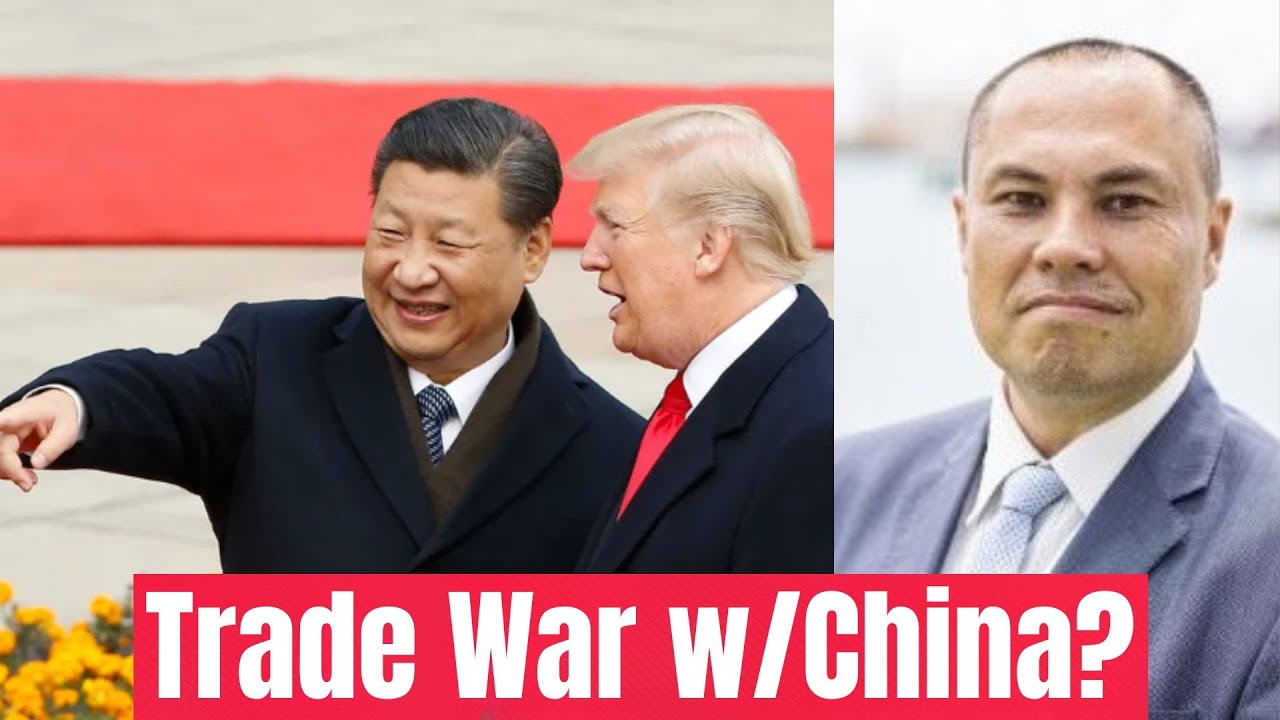
In this Geopolitical Trends livestream, host David (Speaker A) interviews Dr. Warwick Powell, a scholar of Chinese and European history and author of The Trust of China: Trust and Digital Supply Chain. The conversation examines the likely trajectory of U.S. economic policy under a second Trump administration, focusing on renewed protectionism, tariffs, and a push to decouple from China. Powell argues that while the U.S. may intensify barriers, China is better positioned than in 2016 due to stronger domestic demand, robust manufacturing, and a rapidly expanding export base in Southeast Asia, the Global South, and BRICS markets. The dialogue moves to Europe’s own tariff considerations, the EU’s industrial challenges, and the strategic use of Chinese investment as a carrot‑and‑stick tool. They discuss the growing relevance of BRICS and the New Development Bank as an alternative financial architecture, the potential for European countries to align with BRICS, and the broader geopolitical implications of Saudi Arabia’s last‑minute withdrawal from BRICS membership. The interview also covers Indonesia’s state visit to China as a signal of political‑economic alignment in ASEAN, and the strategic significance of China’s Chancay megaport in Peru for shortening Latin‑America‑Asia trade routes. Finally, Powell shares recent Chinese macro data showing 5% GDP growth, strong manufacturing and EV output (10 million EVs produced, 1 million exported), rising household incomes, and stable unemployment, countering narratives of a collapsing Chinese economy.
Chapters
All right, hello everybody and welcome to Geopolitical Trends, where truth matters. Excited to be with you as always for second time in a day. You know, we did the live stream earlier, so, uh, my excitement here now, guys, is because of who I have as a guest. Now we are waiting on Mr. Einar Tengen to show up, but nonetheless I'm gonna go ahead and start the show out of respect for my guest, uh, uh, Warwick Powell, but also for you. So we're gonna go ahead, I'm gonna bring in, uh, Warwick right in. Hi, Warwick.
Hey, David, how are you?
Good, good, good to have you as always. Very, very excited to have you here. And, uh, and guys, I'm gonna get into it right away because we don't have a lot of time to waste. In addition to, uh, uh, uh, Warwick is busy and kind of him to allocate time for us here. So I'm going to get in, into the conversation. Let me introduce briefly to those who do not know who Warwick is. Well, Warwick Bao, he started his career in academia, by the way, teaching Chinese history and European cultural history at Griffith University, graduated with the first honors. Yeah. And is the recipient of the prestigious University Medal for Academic Excellence. So I'm I'm gonna put a full bio for you guys. I just want to give you this. By the way, he is also an author. He writes books. He's the author of the latest book of— on China. It's called The Trust, uh, of China: Trust and Digital Supply Chain, which was published by very reputable publication called the Routledge. So I'm very, very familiar with it. So anyway, let's start with our conversation here, Warwick. Uh, yeah, you know, Donald Trump won the elections. In other words, he's going to be the president right now. What is your take as to what do you foresee regarding Mr. Trump's policy from an economic perspective towards China?
Look, I think the Trump administration going forward is likely to pick up on where it left off, and in some respects it's likely to pick up from where the Biden administration left off, because the Biden administration really didn't change much of what the Trump administration version 1 had bequeathed it. And what that's going to mean is an American posture that is increasingly focused on building protective barriers in terms of limiting or restricting the ability for producers from other parts of the world to export into the American market. And also on the other hand build greater barriers to the export of American goods, particularly those deemed to be of some technological significance or some, you know, potential dual-use capabilities. And there'll be restrictions on the export of those goods, particularly into China. So we're going to, I think, enter into a period where America becomes increasingly, um, removed from the patterns and structures of global commercial intercourse that have been dominant over the last 30 to 40 years. And ironically, uh, was actually the patterns, uh, and the institutions that America itself was so central to creating.
Very interesting. Now, I— there is a lot of conversation here in Washington, and I have still have my contacts and I talk, uh, the kind of like like, uh, all of them converge on that notion that China should be now scared. China now should be concerned. I go with the opposite of that. China ain't worrying about, uh, what Trump's gonna do because China's economy today is different from what it was in 2016. Will I be wrong, Warwick? Will I be wrong in this assessment?
Look, I think the way to think about this is that national leaders and their policy advisers are constantly doing a couple of things. Firstly, they're looking at the capabilities and resources that they have available to themselves, and they're looking at ways of mobilizing those resources to achieve the goals that they've set themselves. In China's case, the principal objective is to achieve what they themselves describe as becoming a moderately prosperous society by 2035. So that's the principal underlying driver. The second thing that policy advisors and leaders will be working on is to understand the risk environment, which is to say, if we are aiming to achieve a particular set of outcomes and these are the resources that we have available to work with, what are the headwinds that we need to be thinking about to be prepared for, to build ways of either reducing risks, mitigating risks, or have Plan Bs in place that will enable us to respond appropriately in the event of risks. And I think that the, the approach to the United States, whether it was a Trump administration or the Biden administration or the incoming Trump administration, is largely shaped by that kind of an outlook. So Chinese political leaders policymakers and industry leaders will have developed, I guess, many thoughts about what they can and can't do, what they should and shouldn't do in light of various possibilities. What does that mean? Well, I think what that will mean is that China is better prepared today than 8 years ago to adapt to the challenges that will be thrown up by virtue of what could well be a significant intensification of American decoupling from not only China, but actually from the patterns of global trade.
Yeah, well, is this the reason why they already— like the Trump, the president-elect, uh, Trump already, uh, not hinting, but suggesting that 60% of tariffs are going to be on China and between 10% and 20% will be on Europe. Now, is this a way— once again, Warwick, will I be wrong if I am to think outside the box by saying, could it be that Mr. Trump is trying to create a wedge between the Europeans and the Chinese?
Look, that's one dimension of it, David, I think. And the other dimension is The Trump policy is set against, I guess, a 5-decade-long backdrop, which is a progressive hollowing out of American industrial employment in particular. And the retreat to a tariff-based policy aims to turn that on its head, to try to rejuvenate manufacturing employment. And to, quote, bring the jobs back. The reality is, is that tariffs are highly unlikely to bring the jobs back anyway. We have evidence of the last 5 years, from the 2018 trade wars onwards, which is quite clear. The jobs didn't come back to the heartland, though there was of course a political dividend. And there's lots of reasons why the jobs won't come back because of tariffs. One of those is that the kinds of jobs that actually modern manufacturing creates requires a highly skilled, highly numerate, and highly literate population. And recent data on American literacy would suggest that in fact American literacy is quite low and is a tremendous concern if you're in the business of rejuvenating modern manufacturing. So the the, the challenges that Trump wants to tackle, which is the hollowing out of industry, the loss of jobs for traditional working-class people, the decline in living standards in working-class communities, etc., etc. They're all very understandable concerns, but I doubt that the tariff-based policy approach is likely to deliver for the United States. From China's point of view Of course, it will create some cost barriers to export volumes, and that will no doubt give rise to a need for enterprises to adapt. Now, adapting to new market conditions always involves some costs, transaction costs, changing what you're doing, creating new markets, building some new systems. It always involves some cost, whether it's time, effort, or financial costs. But I would expect that Chinese enterprises would be able to respond within— definitely within a couple of years of, of a full-scale tariff war, uh, to in effect fully replace the American market, or what they lose in terms of sales to the United States by growing sales elsewhere in the world.
And that's basically will be reflected through the growth of BRICS and the Global South, because that market in itself will be big enough to— for China to say, you know what, forget about the American market, we can, we can look elsewhere. So is this now—
well, they're the patterns, right? So if you think about this as part of the last 15 years, The last 15 years has seen, from China's point of view, consistent growth in, in output, which has been largely absorbed domestically, but it's also, of course, delivered to global markets low-cost, high-quality products. And those markets, particularly in Southeast Asia through the Belt and Road Initiative and, of course, through BRICS, has— those markets have grown. And those markets have grown to such an extent that ASEAN, the Association of Southeast Asian Nations combined market, so that's 10 nations of Southeast Asia, is now a greater export destination for Chinese enterprises than the European Union was. And the European Union before that, before 2020, was actually the largest combined market destination for Chinese manufactured outputs. So the patterns of trade have already been evolving over the course of the last 15 years, and I would expect that these patterns to continue unfolding along similar lines. We've got ongoing growth in Southeast Asia, in Central Asia, West Asia, in the— in North and East Coast Africa, that is taking place at rates greater than global growth on average. And that means that those markets will become relatively more important as time goes by, but also in absolute terms more important as well than the EU markets and the North American market.
And there are those who suggested, for example, in the case of BRICS, that its expansion, it's now sort of, uh, might push— and this is just a big if— might push the European to think in terms of maybe pushing back against Trump by aligning to a degree with BRICS nations? Is there any possibility of that?
You— the European Union as a whole, I think, is confronting some very big policy problems, in part because the, the overall competitiveness issues and the landscape that Europe as a whole confronts reflects some policy decisions that were made by Eurozone leadership 2 or 3 years ago, and in some respects even before then, that they will find difficult to walk back on. The, the problems around accessing low-cost energy, of course, are now well understood. And in the short term, it's highly unlikely that Europe as a whole has any ability to tackle that problem. Politically, of course, walking back on the decision to sanction Russian oil and gas is a very difficult one for the incumbent leadership in Brussels to walk back on, which means they're going to need to find alternative pathways, and those alternative pathways won't materialize overnight. The second challenge as a result of all of this, David, is countries across Europe within the eurozone itself are beginning to experience economic and social problems that Brussels is going to struggle to solve. The unemployment and deindustrialization problems that are manifest in places like Germany and to some extent in France is creating an environment where the bottoms-up political dynamics in these countries is beginning to place pressures on the national political settlement to find answers that so far Brussels has failed to find. Hungary, of course, has been a— perhaps you would say a standout voice, but also a lone voice over the last couple of years advocating for a policy approach and framework that is firstly, less hostile to Russia and more focused on finding a peaceful resolution to that conflict, number one. But number two, and this really is the big kicker, that, that Hungary is saying, look, we need to adopt a policy of connectivity. And what that means is to be part of an ever-expanding Eurasian economic sphere, and Hungary has benefited from that by way of receiving investments in its own industrial development, but also it has access to markets. So it cuts both ways. The question is, is, you know, when people say Europe as a whole, um, who in Europe, right? The EU in Brussels, I think, is going to confront forces that are pulling the union apart to start with. So that's a difficulty that they're going to need to face. But of course, they're hemmed in by their own policy decisions and political positioning over the course of the last 2 years, which makes the kind of policy choices they need to make almost impossible to make without significant political cost.
And it became evident through where the— I looked at the stats, the economic stats, that is, for like, for example, manufacturing in Germany, or just with the recent— and I had the— I'm going to share this on the screen here, Eric. For example, in Germany, all the manufacturing for Volkswagen, where they're going to be shutting down those plants and the loss of jobs. So you look at Wolfsburg, for example, with 60,000 jobs will be lost. Hanover, 13,000, and so forth. So to me, was this an indication for, yes, their ill-conceived policies that they embarked on? Where I see the challenge for Europe moving forward is the idea of them imposing tariffs on China. What for? Why will they do that?
It, um, my own view, I guess, is that it makes very little sense from a European point of view. Uh, if you look at the motor vehicles industry, interestingly, the challenges for the European motor vehicles industry is really not coming from Chinese EVs, um, certainly not over the last few years or anticipated into the near future. The problems are stemming from the fact that as, as global enterprises, they're struggling now in the Chinese domestic market where they had historically had such dominant market share positions. Chinese manufactured EVs into Europe, into the Eurozone, has relatively low market share today and is unlikely to reach levels that would substantially cause problems for European domicile manufacturers. If that's the only thing you're looking at. The problem is, is that the financial position of these European manufacturers is hemorrhaging badly because they're losing market share in China itself. And that's where the problems arise. They've taken the Chinese market in many regards for granted over the last say, 10 years. It's been widely known, David, that the investments that were being made by Chinese enterprises and government into this EV space has been taking place ever since, say, 2010, 2010, 2011.
And, and in many regards, I think a lot of the historical industrial leaders and industrial giants Yeah, well, it's, uh, it was evident, for example, for the latest, uh, uh, yep, yeah, go ahead.
Sorry, I was just going to say, so, so, so that's the one part. So tariffs really isn't going to help the European vehicle manufacturers. Tariffs aren't really going to help in terms of solving their energy problems either because The one of the fastest ways of tackling this energy problem is to develop greater energy autonomy or greater energy sovereignty. And a part of the answer is the speed at which European nations can roll out new energy generating and distribution capabilities. Now, a part of that answer is going to be coming from renewable technologies, whether it's in wind turbines or in solar and certainly in batteries. And there's very little point, very little to be gained for European economies as a whole by putting up barriers to slow down the processes by which European enterprises can bring those kinds of technologies on board. They're just really slowing their own ability to adapt. No, no.
So in your opinion, Warwick, if this is the case, why are European leaders from— you look at even now the recent trip of the foreign minister of Germany, Baerbock, to, to, to China. What are they going to China for? Yeah, we looked at before with, uh, uh, Giorgia Meloni. You look at Pedro Sánchez of Spain. You look at Emmanuel Macron. You know, what are they going to China for if they are gonna embark on imposing these tariffs?
Look, I think one of the things that they're hoping to achieve is to get more Chinese capital to establish facilities in Europe itself. And there are great examples of how that has delivered benefits both for the enterprises and for the countries in which they go. Hungary is a good example where BYD has established a significant manufacturing presence and Spain has also seen Chinese enterprise Chery create a joint venture and take over a defunct Nissan car manufacturing facility to develop a new hybrid and EV manufacturing capability in Spain. Giorgia Meloni, of course, had reached out to BYD earlier this year, seeking BYD's willingness and interest to establish assembly and manufacturing capabilities in Italy as well. So I think that at a certain level there is a sort of a sticks and carrots framework that is trying to be played out here, which is that if you don't invest in Europe, we'll impose tariffs, but if you invest in Europe, well, you know, you'll benefit from being on, on, on the, on the, on the inside of the tariff regime. So that, that I think is what the the sort of broad objective is. The irony is that by voting for the tariffs, which went to a vote a few weeks ago, has led to, of course, a pushback from the China side. Put aside the, the stuff on brandy, the French brandy stuff, I think that's pretty small scale as a response. The real issue has been reports that Chinese enterprises have been It's been strongly suggested to them that they suspend any of the work that they were doing to look at investing in those countries that voted in favor of the tariffs. And, you know, so perhaps actually moving forward with the tariffs, not just the threat of tariffs, but actually voting to implement them, has backfired a little bit so far.
We will be seeing the same approach regarding the microchip.
Of course, you know, that's the mentality. It's the mentality at the moment, and it's a very defensive mentality. It's a mentality that is largely about prohibitions and punishment. You might have seen some remarks from the, from the new European Commission's foreign affairs spokesperson, um, uh, Kalis, who talked about China having to, to pay a big price for being a supporter of Russia. Um, and, you know, so there's still this sense, uh, that, uh, that European policy needs to focus on how you, how you punish others and how you— and, and through punishment, you, you make an example of others, and you use that punishment approach to twist arms to get what you want. Now, it's unlikely to work, but it also says something about the mentality, which is that the leaders at the moment inside the European Commission, I think, still have a very colonial attitude towards the rest of the world, which is that if the rest of the world doesn't do what we want them to do, we're going to punish them. Well, you know, I think the world's moved on from those days. Europe is in no position to threaten anybody with anything, and I don't think it's looked upon very well by other countries in the world, generally speaking, but certainly by countries that had historically been on the receiving end of European colonialism.
Very, very interesting. Uh, I want to shift gear towards the, uh, the recent visit, the state visit of the Indonesian, uh, President, uh, Prabowo, who was in China. What do you make out of that, that trip? Because I really personally, I was like, okay, is this a political mission or is it an economic approach to the trip. What do you make out of that?
A little bit of both, of course. Indonesia is the largest economy in ASEAN. Where Indonesia goes, it has a very big impact on where ASEAN and Southeast Asia goes. And the ability for Indonesia and China to have stable and productive relationships is actually two critical anchor points for economic stability and prosperity within Asia as a whole. If you think about this in a geographical sense, China occupies that very significant part of the northern aspect of Asia, and Indonesia, of course, occupies the southern end. So you've got the sort of two bookends, the northern and southern bookends, that need to be able to be coordinated and be aligned in ways that will support predictable and dependable dynamics within a region that currently, of course, is being subjected to quite a lot of destabilisation efforts from particularly the Americans. So I think that that had an important political point. Which was to emphasize the commitment of the Indonesian government, the new Indonesian administration, to ensuring stability in these relationships for the region as a whole. Economically, of course, the two countries are very significant players within the region, and the ability for them to deepen their economic collaborations through trade, investments, and the exchange of people is also going to be critical to the ways in which the Asian region can continue to be the focal point of global economic development.
So both of those fronts, I think, are quite important, which is very, very the opposite end of what the Philippines is doing, which, by the way, guys, Tomorrow I will be talking to Anna Mandeló about this particular aspect. She's from Philippines, so, and, and she knows quite a lot about what's going on inside Philippines. So, uh, make sure to join me tomorrow for that conversation. So, and, uh, the idea, uh, also, Owarik, about, uh, I want to, I want to go back to BRICS for one particular point to get your insights into this. Uh, because I was as surprised as anybody else when the Saudis pulled out of the full membership of BRICS to the last minute. Because during the same day, on that 24th— well, 25th, that was— when the meeting was taking place in Kazan, the Secretary of State Tony Blinken was in, in, in Jeddah. And I think he pressured the Saudis to pull back. So why is that?
Um, well, the— in part, I think there are concerns around this question of the, of the petrodollar dynamic and, okay, the, the risk of, um, of oil being traded for something other than the US dollar. So I think that there's— that's part of the story. The other part of of course, is related specifically to the role that Saudi Arabia plays within the Middle East itself, or West Asia, and how it has been in some parts a balancing force against Iran. So from America's perspective, that's been quite an important piece of regional ballast. The— but again, I think that, you know, if we took half a step back or elevated ourselves a little bit more, rather than necessarily seeing these dynamics as, you know, people joining one team or another, and understand them really as ways in which a global system is evolving and how the players are interacting with each other, whether they're formal members of a network or not. And there's no doubt that the Saudis have deep economic relationships with, with China, of course, as well as with Russia. Their membership of OPEC and the role that they play with Russia in coordinating the, the global production quotas of oil remain incredibly important. China remains an important customer for Saudi oil. And will continue to be the case going forward. China is an important investor in Central and West Asia, and there are a whole raft of financial and institutional agreements that have been put into place between Saudi Arabia and China, for example, that address issues of cross-border financial interoperability the coordination and alignment of the, of the capital markets in Saudi Arabia and China, particularly through arrangements on, on financial products that will be listed on both the Saudi exchange and the Shanghai and Shenzhen stock exchanges. So these relationships are continually developing, they are fluid, and they ultimately lead to an evolution in the global system. I think a lot of people, of course, see these moments in very black and white terms, you know, they've joined something. And it is important, of course, that, you know, when parties become members of organizations, because then they have a say in how those institutions work. But at the same time, the fact that Saudi Arabia is not part of that decision-making structure within BRICS doesn't necessarily diminish its economic significance as far as being an important piece, an important node, I guess, in the evolving multipolar economic network.
So, and, and where do you see the future of BRICS, uh, Warwick? It's because there are those— I know I had some conversations with some people that are saying, well, BRICS doesn't have doesn't make a dent on the global state. It has been around for whatever. And I said, well, you can't look at it that way. It doesn't work that way. You know, the system has to— an infrastructure has to be put in place, and that's what they are working on. Where do you see it moving forward?
Look, I think that group of countries sees BRICS as a pathway whereby an alternative can be rolled out. Not because there was necessarily any deep desire for there to be an alternative. I think in times past, the preference would have been to be able to persuade the dominant powers in the, in, in the global economic and institutional setup to participate in reforming many of those institutions, whether they're reforms in the WTO or reforms to the World Bank and the IMF, or some of the other multilateral financial or banking bodies. Unfortunately, despite best efforts to advocate for reforms in these global institutions, very few reforms have been successful, and the voices of the global majority have never really been properly reflected in these institutions. Hence BRICS. And BRICS is doing that in ways that don't seek to overturn the existing global order, but to create a set of institutions that enable member countries and others to pursue their objectives in the event that the dominant institutions are unhelpful, or at— or even worse, prohibitive. The New Development Bank, I think, is an important feature of the BRICS architecture. And because if you think about BRICS, one of the criticisms made of BRICS, David, is that it doesn't have any permanent presence. There's no secretariat or anything like that. Well, it actually does have a very important permanent presence. It's the New Development Bank. The New Development Bank was created by BRICS countries to be a multilateral financier for member states. It is the only permanent piece of architecture that is in place that is, that, that is a BRICS piece of architecture. And the New Development Bank will play a central role in the development and implementation of new payment systems, the associated insurance products or platforms that will come with that, And the New Development Bank will also play an important role in expanding the capacity of member nations to finance their development activities in national currencies rather than in a foreign currency, whether it's the USD or something else.
So, so does that mean that even from the financial perspective, we will be seeing a change to the global financial structure or system, if I may use the term. Yeah, is there a possibility that BRICS could play that role?
Yeah, absolutely. It will do that largely through firstly a reform of, or the introduction of, a new, better coordinated, consolidated national currency-based payment system for cross-border trade settlements. It will do that through expanding the role of the new New Development Bank, for the purposes of supporting that settlements process, but also to enable national currency-based financing to be provided for development purposes. Now again, none of that was conceptualized as an attempt to overturn the existing system. The aim was to firstly deal with the fact that the existing system was either letting down the aspirations of developing countries, or at times worse than that, actually hampering the ability of developing countries to develop. And that was particularly the case with a lot of the conditional IMF lending structures. So this was to create an alternative pathway so that countries could pursue their economic development ambitions in the event that the other system wasn't particularly supportive. But the aim wasn't to overturn the other system because the effort continued and continues even today to argue for the need to reform the IMF and the World Bank, and even ongoing discussions around reforming the United Nations. So I think these activities are being taken in parallel, they're being taken in a holistic sense, it's not an either-or. But the message is very clear, and that is that if the dominant Western powers that largely control the way these post-World War II institutions work are not willing to constructively come to the table and be part of the change that the others in the world are seeking and advocating, then the others do have alternatives now.
Very, very interesting. Yeah, I was just wondering about where this is gonna be going from a financial perspective moving forward, given what the IMF, the World Bank, and so forth are trying, and given also the statement by the, this president, president-elect, that is, that he's gonna sort of punish countries that shun away from using the US dollar. So That's to me was kind of like, okay, what's the message here?
Yeah, look, the— it wasn't— it's kind of odd, right, you know, to— it was threatened to punish people for contemplating not using the US dollars. But of course, the act of punishing them dissuades them from doing business with the US, which reduces the demand for US dollars anyway. So there's something a little bit incoherent about that as a reaction. And, and, and perhaps in, in the fullness of time, cooler heads will prevail as to how the US firstly calibrates its own monetary policies for its own purposes, but then perhaps thinks about how its own monetary policy requirements are not necessarily consistent with the monetary policy requirements of the globe more broadly speaking. Let's see how that unfolds.
Yeah, fingers crossed. So, uh, I want to touch on a last thing before I let you go, Eric, because I'm, I'm aware of your time here. Uh, recently the Chinese president, President Xi, uh, was warmly welcomed in the Peruvian, uh, by the Peruvian rather Prime Minister Gustavo Adrianzén. So I want to share a clip here with, with all of you guys, if you allow me. Uh, let me just share the screen if you allow me here, uh, briefly to show you this one here. That's the arrival of, uh, President Xi. So just bear with me. Very, very interesting. Now, as you all know, guys, there is the APEC Summit that is taking place right now. Road. APEC is the Asia-Pacific Economic Cooperation, which is basically an intergovernmental forum of about, uh, I think, what, 20, 21 countries, something like that. Here's what I found very interesting now, Warrick, is that the US president is attending. So why the heck is Biden going there for that? But that's not the point for all this. Uh, the idea that Chinese are inaugurating the ports, you know, how significant is this when it comes down to the movement of commodities that now is going to shorten the trip from Brazil to China by about 2 weeks. How is that going to impact the, the economy moving forward?
It's hugely significant. So this is the megaport project in Chancay in Peru. This project has been 5 years in the making to build and construct it. Now there is an interesting background to this, and that is that The Peruvian government had invited others, including the Americans, to, to come on board with the development of this port vision some years ago, but it wasn't taken up. The Chinese took it up, and this port development is, is going to achieve a number of things. Firstly, it's going to reduce the transit time between the Latin American continent and the markets of Asia. So in terms of Peru or the, or the, or the west coast of Latin America to, to Asia, we're looking at between 10 and 12 days of reduction in transit times. From Brazil, it's about 15 days. Now, a rail line connection is going to be developed also between the west coast and the port and the countries on the other side of the of the continent, and that will ultimately enable the, the countries on the east of the, of the Latin American continent to reach the Pacific through this port in particular. The savings that are expected will be in the order of about 20% on logistics costs. So that's the first part. The second part is that it will mean that there will be reduced transshipment demand for cargo between Asia and Latin America to go via either Mexico or North America itself. So that's the second change in, in the, in the configuration of trading relationships. The opening up of these trade routes will, I think, add another dimension of economic growth and resilience for Latin American markets in particular. As this 20% savings in logistics costs really puts them on an incredibly competitive footing in terms of many of the things that they have, you know, strong advantages in already from a, you know, a natural capabilities point of view, whether it's in minerals or whether it's in agricultural products, you know, other commodities as well as meat and other proteins. So this is an important development for economic development overall. The other interesting feature about this is that it is seen by Washington to be an imposition into Washington's own so-called backyard. Now many countries in Latin America will be quite offended by, by that frame of reference because frankly this is 6,000 kilometers away from North America. And, but this is clearly the legacy of the Monroe Doctrine mentality being replayed, where anything that happens in the Western Pacific hemisphere is seen through security lenses from Washington. So that's something that will create some nervousness, I think, in Washington. And we've seen remarks about this already Yeah, now the third thing, which could be quite an interesting, uh, eventuality, is that as trade grows directly from this port into the Pacific and then across to Asia, it's likely that in the interest of ensuring commercial safety for, for the, these vessels, that the Chinese Navy and other navies, possibly even the Russian Navy, will begin to play a more active role in patrolling the oceans of the Eastern Pacific. And that in some ways again is illustrative of a changing balance of power in the world and the extent to which the, the Monroe Doctrine is now no longer effective.
Well, apparently that's what they always say, and look for the economic prosperities, not more tensions and so forth. So apparently when the US was given the opportunity to get involved in this, they turned it down. Now the Chinese took it and developed it. So that's how it's supposed to be. So, well, Warwick, I can't thank you enough for really carving out time for us here to just pick your brain on certain issues here. Unfortunately, Einar Tangen couldn't join us this time around, so I'll reach out to him and I'll have him on the show next week by himself if he can make it. So he's busy man as well. So I thank you so much, Warwick, and I—
it's an absolute pleasure, David. I hope that your community didn't mind me having to fill in for honour a little bit. I, um, I hope that I managed to step into some very big shoes. Um, I might just add one more thing, if I may, David. I've got a couple of minutes if you and your community has. Um, and that's the fact that China's economic data for October was released yesterday.
Oh yeah.
And, um, and there's some very interesting outcomes from that. And so just very, very high level really points to the fact that there is continued energy in the Chinese economic system, that the, that the target of around 5% economic GDP growth for 2024 will be, will be achieved. It's not really in doubt, and personally I've never really thought it was in doubt anyway. But, but I think the data really shows a few things. One is, is that investment growth and output growth in, in particularly manufacturers remains strong. It shows also that consumption demand, retail demand for both services and physical things, has also been growing strongly as well. Now, this is an important point to note, and your viewers, I think, would be well advised to just always have this in the back of their mind. Household incomes have been rising, which of course is necessary for there to be consumption growth. And there has been consumption growth. There are many people— there's a dominant trope running around a lot of the Western mainstream commentary about China that China has weak domestic demand. Well, the data consistently shows demand growth in real terms. The other thing that came out in the last few days from a data point of view for people in the community who love their data relates to the new energy vehicles, the EV world. The data shows that China has— Chinese enterprises has achieved a new threshold of EV production. They've hit 10 million EVs this year already, and with about 6 more weeks to go before the end of the year The factories are working overtime to actually try to hit about 12 million vehicles produced. Now, the interesting thing about the 10 million vehicles produced to date is that about 1.058 million of those have been exported. In other words, about 90% of this output is actually consumed domestically. This is not evidence of a weak Chinese consumption economy. In fact, quite the reverse. Um, so I think that there's some very interesting things in the way that the data, um, well, the way that the data tells us about what's going on in China at the moment. Yeah, the households are earning money, their incomes are growing. And the other thing is, is that, as I'm sure many of your viewers know, Over the last 5 or 6 years, the Chinese economic structure has been working its way through a very significant restructuring process with an active policy-driven constraint on the property market to try to bring that, slow that down because it was getting too hot, way too leveraged, and also to transfer resources increasingly towards high-tech manufacturing. Now that process has been quite successful. One of the pieces of evidence of that, other than the expansion in output such as the new, new, new energy vehicles, is the fact that Chinese unemployment rate has consistently hovered around 5%. Now when you're essentially slowing down one big industry and then boosting another industry, you usually expect there to be some adjustment challenges. And of course there are in practical terms because people need to develop new skills and be retrained and sometimes move locations. But the evidence shows that in an environment of rising real wages, that unemployment remains stable, which means that those people who are losing their jobs in those industries that are being pulled back are finding new employment opportunities elsewhere. And that process of redeploying national labor resources in an environment of significant structural change is also a testament, I think, to the investments that have been made over 20 years or so in developing the human capacity of the working force in China. So that's something that, that you and your audience might be interested in taking a little bit more of a look at. With the release of that data.
Wow, I'm so glad you, you had a chance to share this with us because a lot of people do not, will not know. And to me, this, uh, puts to rest that notion of those who've been saying what the Chinese economy is collapsing. I mean, I heard some analysts in Washington that I know of their background saying this, and when they said that, I was just shaking my head and I was like, you know, I just got back from China, uh, I would have seen the signs for a collapsing economy, which I didn't see any. So, so I'm glad you shared this data with us here. So because it's very important, I'm gonna look for the link for this data here once it becomes public to share it with, with the community here. So once again, Warwick, thank you so much for carving out time for us here, and I greatly appreciate you for, for just sharing your knowledge with us.
So great. Good to be here.
Wish you a good weekend as always. Thanks, Warrick.
See you.
Bye-bye.
Bye-bye. Bye.
Ah, guys, as you have it, you know, Warrick is, is one of those you truly have to sit and listen to what he has to say. Unfortunately, Einar didn't join us this time. He'll be here for next time, and they are very busy people. And, you know, I consider them friends. It's not a term I use loosely. And when I reached out to Eric and I reached out to Aynur, they both agreed to, to show up here to share the knowledge, because you guys know this channel is about learning, about broadening your intellectual horizon here. You know, I don't talk about kitty cats playing here, so I don't have time for that. So this is why I appreciate you. I thank you for being kind to my guest here, and I look forward to seeing you tomorrow at 8 o'clock for my interview with Anna. As always, guys, remember, geopolitics impacts your daily life in more ways than one. Till next time, bye-bye.
More from David


Beyond the Single Actor: Why the Gulf Isn't Choosing Between the US and China


Iran, Iraq's Militias, and the Houthis Are Coordinating! This Changes Everything




Who Controls the Next Decade's Resources? Latin America and Africa's Geopolitical Crossroads

The Chokepoint Trap: How Washington's Stupidity Triggered a Cascade That Now Controls the World

Trump Spooked as IRGC Unveiled dual-use SLV, Deployed Ghadir Mini-Subs & Hinted at Tactical Nukes!
