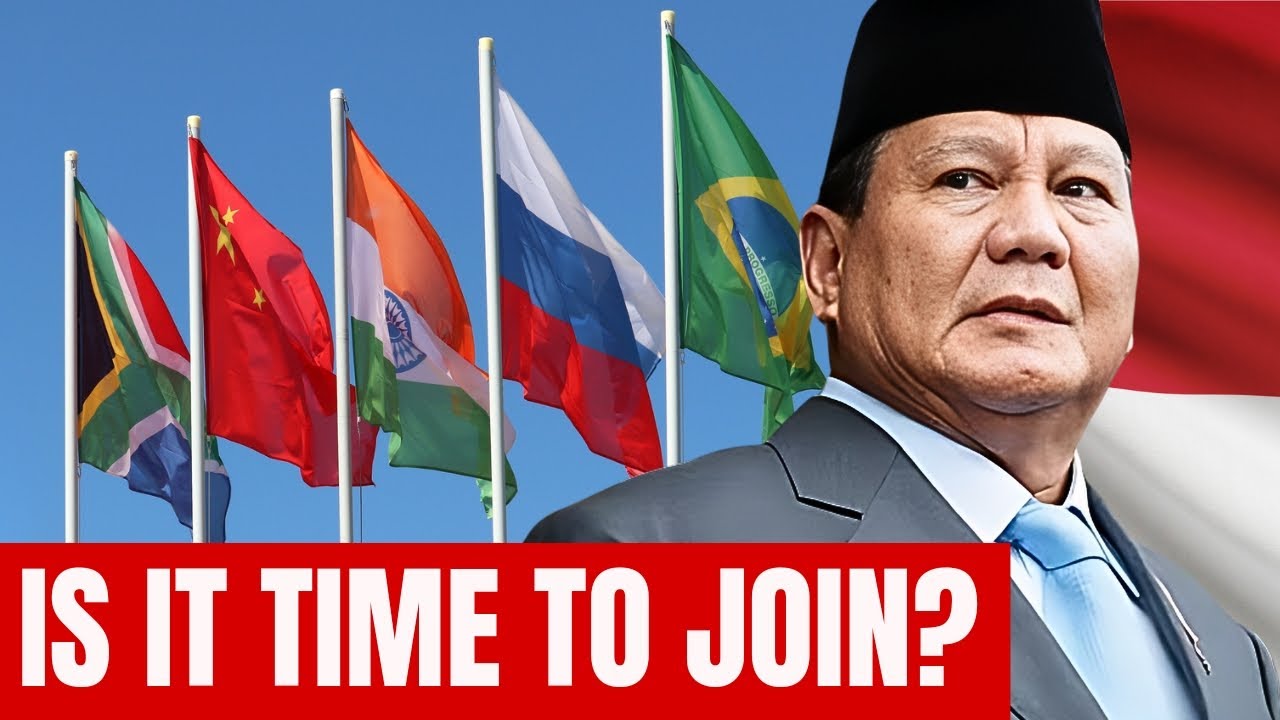
In this live-stream video, the host (Dr. O) examines whether Indonesia should join the BRICS bloc. He begins by greeting his community and outlining the three core questions: (1) Will BRICS admit Indonesia? (2) Will BRICS be better off with Indonesia? and (3) How might Indonesia shape the future of BRICS. He provides a geographic and historical overview of Indonesia, detailing its archipelagic location, demographic composition, linguistic diversity, and religious makeup, as well as a concise history from early kingdoms through colonial rule to modern independence. The host then shifts to economic analysis, highlighting Indonesia’s status as Southeast Asia’s economic powerhouse, its G20 membership, and its trade relationship with China (US$184 billion). He cites recent statements from former President Jokowi (no current interest in BRICS) and Foreign Minister Retno Marsudi (studying possible membership), and discusses the broader global shift toward de‑dollarisation, the expanding BRICS roster, and the strategic implications of Indonesia’s potential entry compared with India and other aspirants (e.g., Saudi Arabia, Egypt, UAE, Iran, Ethiopia, Thailand, Vietnam). Throughout, he engages with his live chat, polling opinions on EU and Australia joining BRICS, and reflects on the geopolitical dynamics of the Indo‑Pacific, including the China‑Vietnam‑Laos corridor, the Malacca Strait, and the North‑Korea‑Russia relationship. The host adopts a cautious, critical stance, arguing that rapid BRICS expansion could be detrimental and that Indonesia must carefully weigh economic benefits against geopolitical risks. He concludes by reiterating the need for thoughtful study, thanking supporters, promoting his book, and signing off.
Chapters
All right, hello everybody and welcome to Geopolitical Trends, where truth matters. Excited to be with you on this Friday, June 21st. So, uh, I got an interesting topic for you. I read up on it a little bit, I wanted to sort of familiarize myself, even though I did some other, uh, sort of, uh, sources stated the issue differently than what it is. So, so I'll be talking to you today about Indonesia. Indonesia, the consideration for Indonesia to go into BRICS, it's a major deal if you only know the other details involved with it. And this is what I am going to be talking to you about today. Before I'll do that, let me say hi to all of you because that's how we always do it. In this community. Good to see you. Uh, it's, it's not whether Indonesia is a good fit for BRICS, it's BRICS the Cinderella shoe that fits all. Okay, I see your point there. Uh, Noel, good to see you as always. And Noel, thank you so much for your support, uh, on, on, on Buy Me Coffee. I'm very grateful to you. So, Citi Rohana, good to see you. Johannes Christian, good to see you. Uh, who else is here? Truth Seeker Freedom, good to see you. Uh, and Info, good to see you. You, TU, the Super, good to see you as always. And hello to you. Uh, latest— oh yes, about the, the H group in Lebanon. Yes, I am considering doing a video for you next week about that one, so I'm following down on what's going on. With this development there. So, uh, Speaking the Truth, good to see you. YT and Coach Ahoy, Willie Homan, as always. St. John Smith from New Zealand, good to see you. And Tennis, good to see you. Timeline Dunkley, good to see you. And Cyborg Ninja, good to see you as always. Speaking the Truth, good to see you. And Francis Tango, CJ, so good to see you all, guys. All right, let's talk about what I'm going to be talking about today. So Indonesia. So why is this important? Well, for a lot of reasons. So especially when you consider the geostrategic aspects of it. Economy is involved, geostrategic, uh, or geopolitics is involved, but also security is part of that as well. So Indonesia now Here is where the key is. Indonesia now is studying the possibility of joining. This is what I differ with some others who saying, oh, Indonesia already is going to join BRICS. Hold on a second, they are studying it because they wanted to see what's in it for them as far as this membership, and rightly so. Are you gonna buy something without ensuring that there is some benefit for you? Ain't it? So that it's the same thing. So what Indonesia is doing now is weighing in the, the benefits, uh, uh, sort of what will it derive from this membership, and rightly so. So if I am to say, it's, it's foregone conclusion, yeah, why not let Indonesia replace another player inside BRICS? Let's say India. Straightforward. There is no ifs and buts. We don't shy away from the truth here. So I, I, I'd rather see that Indonesia will replace, uh, India. Straightforward. Why? Because India has a lot of issues domestically that needs to deal with. That doesn't mean Indonesia doesn't, but the economic conditions in Indonesia are far better than those of India. And this is what I'm gonna get into today, and I'm gonna ask the questions pertaining to this one. And here's— let me share this with you on the screen. Will BRICS admit Indonesia? Yeah, I know, I know, to some of you this might sound like, well, that's silly question, Dr. O. No, don't assume, because here is the thing. You all remember when the meeting took place in Johannesburg, right? What was the deal back then? That Malaysia was not voted for. Yeah, meaning BRICS didn't vote for Malaysia at that time. What the same argument I'm making here. Because I don't assume, I don't assume that all the members of BRICS are on the same sheet of music. In other words, they all would agree. You all remember what happened when BRICS mentioned about the common currency. What did India do? Could we see the same? What happened when Algeria reached out, even though Algeria now is, is going to be asking again to join BRICS? India opposed to that. It was for a reason, because France asked India to do so. That's why I'm asking the question. Will BRICS admit Indonesia? Worth asking. Second question: will BRICS be better off with Indonesia? You have to think of what are you bringing to the table. Like, let me think, if you guys been involved in, in general life, like when you deal with meetings or teams or whatever, are you gonna bring in a deadweight? Heck no. Same question I'm asking, you know, will BRICS be better off with Indonesia? In other words, what will Indonesia add to BRICS for it to move forward? Okay. And third question, how may Indonesia shape the future of BRICS? Because you're not gonna ignore Indonesia's economy in that part of the world. As a matter of fact, I'm even find out— I found out that Australia, behind closed doors, behind the scenes, it's not reported openly per se. Indonesia has more concern about Indonesia right now because of the economy. So those are worth— those are questions that are worth asking. And, and we can't assume that, oh no, they're gonna admit them right away. No, they won't. Not right away. This is why Indonesia also is studying the possibility. So, uh, and, and, and here's the thing, because you need to remember, and I'm gonna take you back— actually, let, let me, before I'll jump into all this, how about if we do a little geography and a little history? Because it's important to understand this, will put things in perspective for you as far as My question that I ask: will BRICS be better off with Indonesia in it? So, so let's start with geography, and I'll give credit to, uh, World Atlas, of course, as always. That's the one I've been using so far, even though sometimes maps might have different, uh, uh, uh, sort of, uh, uh, expressions as far as the wording of it. But nonetheless, I would say about 90% is, is, is good, is accurate. So, all right, here's the screen. Let me make it bigger for you here, guys. Here, Indonesia, very, very interesting country. Let me close this stuff here. Wow, there's so many ads on this stuff. All right, Indonesia, you know, the archipelagic nation of Indonesia is located just to the north of Australia. Here's why I'm mentioning what I'm mentioning, uh, and of the Southeast Asian mainland between the Pacific and Indian Ocean. Thanks, think geography, think strategic location. Okay, it is situated or placed across the equator and hence is geographically positioned both in the northern and southern hemispheres of the Earth as well as eastern hemisphere. It is bordered by Malaysia, Papua New Guinea, PNG, and Timor-Leste. It is surrounded by, or surrounded rather, by the Indian Ocean in the south, by the Pacific Ocean, which means South China Sea, in the north, and over a dozen regional areas. Indonesia shares its maritime borders with India, Australia, Palau, Singapore, Philippines, Vietnam, and Thailand. This is why it's important to understand the geography. It will put things in perspective for you. So let's move into history a little bit here. And again, I'm gonna, uh, put the link for you in the description, uh, and it was an article written by— as I told you guys, most of the time I'm As a matter of fact, 98% I do not depend on Wikipedia and all that stuff. So because I know what happened with Wikipedia a few years ago here in the US, in Washington, when the government got involved and trying to manipulate the, the information on Wikipedia. So that's why I don't, I don't trust it 100%. So I read an article by, by Kelly, or Kelly, uh, Sipransky, and I will post it for you regarding this one here. So Indonesia. Okay, of course it became to emerge in as an economic power in Southeast Asia, as well as sort of fair nation, if I may use the term. I don't like to use the term this democratic nation loosely, you know. I will say fair nation, we leave it at that. So, and of course you have to understand what shaped Indonesia. Well, you get, uh, for example, one thing that I am very familiar with has to do with its multiethnic and religious diverse nation that we see today. Because what are— what is the background? What is the, the, the ancestors of Malaysians? Where did they came from? Does anybody know? I like you guys to type in, in the chat box who, who can they be associated with, or who are they associated with, like, like ancestors of Malaysians. —of Indonesians. I'm sorry, I'm sorry, not Malaysians, Indonesians. Yeah, and, and interesting, when I read this, I was like, very wow, that's fascinating to learn about this one, that the, uh, Indonesian, uh, uh, not India, not necessarily, not necessarily. There is some Arabs to a degree You know, and the question is, you know, who are the original ancestors of Indonesians? The original ancestors? Melanesia. That is correct. But some of them traces back to China, believe it or not. This is what fascinated me when I found out how they go back, and I'm going to share with you all this. I'm not gonna get in into the structure of the government and all that. Uh, suffice it to say, we're gonna talk about the population of India. It's worth your time to understand this. And as one who is considering, uh, probably teaching in that country— I haven't decided anything yet— it behooves me to understand the makeup of the society, whatever society I might end up in. So Indonesia is home to over 258 million people. It is the fourth most populous nation on Earth after China, India, or India, China, and the US, of course. Indonesians belong to more than 300 ethno-linguistic groups, most of which are Austronesian in origin. The largest ethnic group is Javanese, at almost 42% of the population, followed by the, the Sundanese with just over 15%. Others with more than 2 million members include Chinese, 3.7%, Malay, 3.4%, Madurese, 3.3%, Batak, 3%, Mingabo, 2.7%, Bitawe, 2.5%, Buginese, 2.5%, Bentinese, 2.1%, and Banjaris, 1.7%, And Balinese, 1.5%. And the last group is Sasak, 1.3%. Very, very interesting. But here is also what I found fascinating about Indonesia, has to do with its languages. Many of us here in the West have no clue that there are more than 700 other languages in active use throughout the archipelago area. So, so across Indonesia People speak the official national language, of course, of Indonesians, which was created after the independence as a lingua franca from Malay roots. I remember one day back in 2007 when I was still in the government, I was dealing with someone from that part of the world and he was speaking Malay And I asked the question, I said, you know, where is the root of this? He said, yeah, that's the Malay root, uh, part of the lingua franca language. So however, as I mentioned, there are about 700 other languages in active use throughout the archipelago, and few Indonesians speak the national language as their mother tongue. Uh, now one of the most popular one is the Javanese. Is the most popular first language, which is about, uh, based on a record that I found, 84 million people speaks it. So it is followed by Sundanese and Madurese with 34 and 14 million speakers respectively. As to religion, which is worth knowing for you guys, uh, Indonesia is the world's largest Muslim country. Now you understand why they took a stand against Israel. So with 86% of the population professing, uh, professing Islam, in addition, almost 9% of the population is Christian, 2% are Hindu, and 3% are Buddhist. Uh, that, that's the, the calculate— the percentages that I found. So now there is one thing, uh, as far as the economy is worth mentioning Indonesia is the economic powerhouse of Southeast Asia. Would you agree to that statement, guys? Is Indonesia, in your opinion, yes or no, in your opinion, is considered an economic powerhouse in Southeast Asia? I am specifically giving you the geographical location, Southeast Asia. We're not talking about Asia, of course. So, and of course, just please, uh, put yes or no in the chat box and I'll take a look at it. And also, we need— we shouldn't forget that Indonesia is a member of G20, uh, groups. So that's what it is. But let's go back to the history of it, because this is where I'm focusing on, uh, mainly. Human history in Indonesia goes back at least between 1.5 and 1.8 million years, as known by the fossil Java Man that were found. Archaeologists found those, which was, by the way, the, uh, was discovered in 1891. So archaeological evidence suggests that Homo sapiens had walked across Pleistocene land bridges from the mainland by about 45,000 years ago. So it's an ancient, uh, location that, if I may say, they may have encountered another human species called the Hobbits. So you have the first one, the Homo erectus, then you have the Hobbits of the island of Flores, and that extract taxonomic placement of the diminutive Homo Floresians. This is where part of where the ancestors go back. Flores— the, the inhabitants of Flores seems to have become extinct. Yeah, they become extinct by about 10,000 years ago. So, so the ancestors— and here is what I need you to get out of all this— the ancestors of most modern Indonesian reached the archipelago around 4,000 years ago, arriving from— guess what do they have in this record? They said it's arriving from Taiwan, which means it's arriving from China according to DNA studies. This is what I was, uh, getting into. Melanesian people already inhabited Indonesia but they were displaced by the arrival of Austronesians across much of the archipelago. Then you move into the 300 BCE, which is Before Common Era. What was known about this early era of Indonesia? Hindu kingdoms sprang up on Java and Sumatra as early as 300 BCE, and this was under the influence of traders from India. But that doesn't mean that the first settlers of Indonesia were of Indian descent. No, at least what I'm finding out in a record. By early centuries, Buddhist rulers controlled areas of those same islands as well. Not much is known about these early kingdoms due to the difficulty of access for international archaeological teams. So fast forward to the 7th century, which the powerful Buddhist kingdom of Srivijnana arose on Sumatra. That's what happened back then. And what, what did it do? It controlled much of Indonesia until 12 90 when it was conquered by the Hindu Majapahit Empire from Java. This is why Java and Sumatra, they have a lot, a lot of history. And it was— excuse me, I need a sip of water. Majapahit, between 19— I'm sorry, between 1290 and 1527, the kingdom was able to unite most of modern-day Indonesia and Malaysia. I did not know this. I did not know that they were able to do— to, uh, to unite Malaysia into the fold of this. Although large in size, uh, Majapahit or yeah, Mahabharata was more interested in controlling trade routes than in territorial gains. So fast forward to when Islam slowly spread through Java and Sumatra, although Bali remained majority Hindu. In Malacca, a Muslim sultanate ruled from 1414 until it was conquered by the Portuguese in 1511. And this will lead us into the colonial era, uh, of when Indonesia was colonized. Well, of course, the Portuguese took control of part of Indonesia in the 16th century, but they did not have enough power to hang on to their colonies, uh, there when the much wealthier Dutch decided to muscle in on the spices trade beginning in 1602. Because here is another thing that I need you to know: it wasn't just India when known for the spices, Indonesia was as well. Yeah, some record, historical record doesn't emphasize this, so I want you to keep that in mind. And this is why back then After the Portuguese couldn't control the entire location, they were confined to East Timor. That's where the Portuguese settled at that time. So throughout the day, early, uh, fast forward to today, like sort of independence time, uh, throughout the early 20th century, nationalism grew in the Dutch East Indies. And in March 1942, What happened in March 1942? What happened to Indonesia? Does anybody know? Let me just, uh, check the chat box. Do you guys know what happened in 1942? Just think history. Think history. What happened in that part of the world? Netherlands. Dutch. Yes, that is 1942. War. UTU. You got it, but which one? Oh, Oh, tennis, tennis, you got it. David King, you got it. Truth Seeker, it was Japan. Japanese occupied Indonesia, and with that, they expelled the Dutch, which is modern-day Netherlands. It goes for both. Uh, initially welcomed, and here is where I think, I think the Indonesian made a mistake. They welcomed Japan as liberators. A big mistake because the Japanese were brutal and oppressive, catalyzing nationalist sentiments in Indonesia. And we all know what happened with, for example, China, what happened, uh, with other locations in that part of the world. So after Japan's defeat in 1945, the Dutch, or Netherlands, tried to return to their most valuable colony. But the people of Indonesia launched a 4-year independence war, uh, gaining full independence. What year did Indonesia gain its independence? Which, by the way, with assistance from the UN. What year was it? Does anybody know? Uh, 1960. No, before that, before that, Alice, still looking. Before that, uh, 1948. You're short one year, one year. It was 1949, 1949. That's when the— with the UN help, Indonesia gained its independence. So the first two presidents of Indonesia, Sukarno, which he ruled from 1945 to 1967, Then after him came Suharto, who ruled from 1967 to 1998, which by the way was very, very, very, very corrupted, you know, where autocrat who relied upon the military to stay in power. Since 2000, however, Indonesia presidents have been selected through reasonably free and fair elections. That, that's just the same. Now let me ask you these questions. Do you think the elections were fair or are fair in Indonesia? Yes or no? I mean, I can speak for my country here that we don't. We're not talking about US now, we're talking about Indonesia. In your opinion, do you think elections are free and fair? Yes or no, please. UTU, you say no. Muslim Revert, no. Tennis, no. Prabowo may be hesitant to join BRICS out of fear from the US. Yeah, if you only know the history of Prabowo with the military. So, and Info, you said yes. Okay, all right, okay, that's, that's, that's fair assessments on your part. So, all right guys, let's get into the analysis. Now what I'm going to start with because I'm going to want to shock you first, intellectually speaking. Of course, I want to start with a, a major statement by none other than the former president, okay, Jokowi. Why is this important? It's— and again, not pointing fingers here, whatever. The importance of this is to highlight to you that when the dynamics on the global stage change and they change at a faster rate, any country will have to adjust, adjust its policies. Indonesia is no exception, especially with this particular topic we are talking about. Well, well, here is what happened during BRICS summit in Johannesburg back in 2023 in South Africa. President— former President Jokowi at that time said, I quote, Indonesia has no interest in applying for membership, and that, that his presence at the meeting was a boost solidarity among the world developing nations, end of quote. I find it very interesting, fascinating what was said back then and where the country stand today. That's just how, uh, uh when you adjust to what's going on on a global stage, you're going to have to adjust your position, you have to adjust your policies, and so forth. So, because fast forward from that time, 2023, to today, the foreign minister of Indonesia, Retno, I believe, Marsudi, if I'm not mistaken, stated, and I quote, Indonesia continue to study the possibility of joining the trade alliance BRICS. No, that to me it's fair. That's why I am not— I, I can't say, oh, Indonesia is joining BRICS. I can't, in clear conscience I can't. It's because they are just studying. What if they conducted their final analysis and found out that, hey, this is not for us, if there are some dead weights inside that organization? Or if this organization, economic, uh, block BRICS, that is, that is expanding with some countries that have no— Hello, what's up? How you doing, man? Come on in. You want to say hi to the community? Yeah. Okay, here, let me share a picture with you guys. This is Michael. My son wants to say hi to you guys. So cool. I've never been live in front of so many people. You've never been live? Well, now you are. Let me share screen with them so they see your picture here. Here, I want to share this with you guys quickly. Here, there's Michael, man. That picture, that's a long time. Yeah, he's taller than me. Anyway, just want to say hi to you. Yeah, I hope y'all are having fun on the live stream. Well, they, they are, they are. They always kind of enjoy, and they are very smart people. Yeah, because they ask the key questions. So, all right, smarter than me. Well, you, you will learn. You're only 17, you will learn. You know, they are— they've been around long enough and they've been with me for 2 years. Yeah, straight. So I'll let you get back to it. All right, thank you, Michael. I got— sorry for that, I just wanna— why he don't say hi to— he always hear about you guys, so can I one day say hi to the community? Sure, come on in. So, uh, you know, what was I saying? Now I draw a blank. Uh, yeah, the idea of— now the foreign minister is saying, uh, uh, we are studying this, and rightly so, because the economic conditions, global one that is, not just in Indonesia, are changing. We all know about the de-dollarization. We all know about some countries, uh, get— getting so much gold. We all know about infrastructure investments. We all know about be GDP, for example, of economic blocs like BRICS, ASEAN, SCO, and so forth, or the EU for that matter. Even though I am starting to think— by the way, you guys saw the video that I released this morning— we're gonna be sanctioning Europe for that matter. I'm done start to think now, will EU one day reach out to BRICS and say, hey, can we join you? What do you guys think? Should BRICS allow or grant admission or welcome or agree to having the EU joining BRICS? What do you guys think? Please, yes or no. What do you think? Should BRICS allow them? Uh, Abu Hanifa, no, is already a bloc. Uh, no. Uh, Lima, you say no. Uh, Muhammad, Muhammad Mazaruddin, you say no. And Jumdeep, never. Yeah, Truth Seeker, you're saying yes. Why is that? Why are you saying yes, Truth Seeker? I really would like to learn about those, you know, your opinion matters. Hiri Lokal, you're saying no, only some countries. Like who? Because it's worth to— what's it to understand is because the EU will be thinking in terms— will be thinking in terms of, well, we are already losing our, our sort of percentage of the global GDP. Remember, I just looked at the stats about a week ago. I wish I would have put it. And the numbers that I saw, BRICS is at 31.6 %. The EU is at 30.9%. BRICS has an advantage over the EU with the population that is reaching about 40% of the world population, about 3 billion plus. So which makes more sense to think in terms— could one day they— you be asking BRICS to join? You know, for me personally, and this is my opinion, I, I don't think emotionally, of course. With this, you have to think in terms of the economy, as far as allowing the EU on what, on what level. Because if they start to undermine the policies, then, then it's a lost cause. And this is where Indonesia comes in. Why will Indonesia be a good sort of for BRICS. And, and, and I'm not advocating for it, guys, just FYI. I am not advocating for it. All I'm saying, all I'm saying here is the idea of, uh, let me see, uh, the idea of, uh, uh, Malay, in this case of Indonesia No, where things are moving. Why will that be important? It will be important because Malaysia is having— is considering a plan now of new ports in Malacca. You have to think in terms of economics. Which one, you know, a new port with access to Malacca Strait What is that going to do to your economy? This is Malaysia. Indonesia, on the other hand, being part of BRICS, what is that going to do to its economy, given that both countries, Indonesia and Malaysia in that case, and as part of being of the ASEAN and so forth, is considered the, the largest trading— their largest trading partners is China, a member of BRICS. You can just see the dynamics here. So, and this is what I'm saying when you consider that BRICS is already where it is as far as the members, okay, with all those countries there, and, and it's growing, of course, uh, Saudi Arabia, Egypt, United Arab Emirates, Iran, and Ethiopia, which already joined the bloc. And you got about, uh, uh, sort of— there's different numbers. I saw some numbers with 28, I saw some numbers with 38, uh, countries that are wanting to join uh, they're gonna provide their, their, uh, what's, what's the word, request for joining BRICS during the upcoming summit in Kazan in Russia, uh, on October 2024 of this year. So, so, and this is where the, the idea of when Indonesia is saying, okay, we're gonna have to study this carefully, rightly so, is because you're talking about now foreign policy Yeah, even though it's on an economic trajectory, but you're gonna have to keep in mind the changes that's going on on the global stage, where, where the global, uh, economic order is going. I've already said, and I never shy away from this, that the shift is already happening, has already happened. It is happening before our own eyes, shifts of the global economic order. No more, no longer the US will be the sole dominant of the global economy. It's done. That era is done. We need to come to grip with that reality. We in the United States, we in the West, it's a reality. Back in 2017, I remember writing one article in, uh, on Huffington Post back then when I used to write for them. I said the center of gravity, economically speaking, now is moving east. The wealth is shifting. Back then I said it's shifting from the West to the East. It's affaire accomplie. You can't be pretending that ain't happening, which what we are trying to do here. We pretend like, oh, we still this dominant power. No, we're not. Just having, uh, 11 or 12 or 13 aircraft carriers doesn't make you the, the most powerful. Powerful in what? So, and this is what Indonesia had to think in terms of what now Prabowo is going to be deciding moving forward, because again, the foreign policy of Indonesia will have to be carefully considered if they don't win this. This is why they have to study this possibility. So this is why they still studying it. And I am not convinced as of now for me to say Indonesia is joining BRICS. I, I can't, and I would not. I would not because it's different dynamics. It behooves us to see how things move forward. So when you think about, uh, uh, think— just think about it this way, guys. When you think about the stats, economic stats, that is, just for Indonesia itself the total value of trade between Indonesia and China, a BRICS member— this is just with one country, you know— reached about $184 billion. And I will provide you the link for all this. And this is worth considering because you have to think in terms of what Prabowo is going to be deciding moving forward. Well, will Indonesia play a role in BRICS? Better than, let's say, India? Yes, it will. No, it's, it's no-brainer. And again, nothing against India here, because we, uh, as a matter of fact, uh, one of the viewers, uh, sent me a comment here, and, and I decided to keep it and share it with you. And I appreciate, you know, you don't have to agree with me, and, and I appreciate this individual to come forward. And then, you know what, no, no, that's why we are here. This is what this community is all about— exchange of ideas, of course respectfully. And, and that's exactly what he did. So let— or she, I don't know who the person is here. Uh, uh, oh, oh no, Ono Snow 6500, he wrote, and I quote— this is after the interview I did with Jayant Bhandari— he wrote, and I quote, this is seriously the most interesting interview, like yourself. Giant doesn't shy away from telling the truth. When I first watched your video, I was angry at you, Dr. O. How could you say something bad about our country? Slowly, I understand the truth matters. You are truly one of the heroes in this world. You will be remembered as a person who isn't afraid, uh, who isn't afraid of speaking out the truth even though you will be hated by your own people. Good on you, Dr. O. God bless you. And the— so makes sense. And this is what I'm saying. I, I know, I do know, guys, that some think I am just being this negative guy about India. No, it's because I feel sad for the Indian people, not the government, the people. Because I know some India people, smart, well-educated, but no opportunities. So where is the damn government if he can't provide this? What happened to this? You know, we are now the third largest economy in the world when it can translate to the, uh, to the welfare of the average citizens. That's why I'm pointing this out. That's why the likes of Jayant Bhandari put the truth out there. It's not out of hatred, it's not out of negativity, it's not out of— because that stuff is nonsense— is out of care and concern. Simple as that. So, and this is where I see things moving forward with Indonesia, should they decide to move into this direction. Now, you have to also understand other dynamics. This is why I use the term geostrategic. Earlier at the beginning of, of, of this, uh, live stream here for a reason. You think about what just happened between North Korea and Russia. You think about what happened between Russia and Vietnam. Vietnam is a member of the ASEAN, right? You think about the infrastructure between, uh, China, uh, Vietnam and China, Laos. You think about Thailand, the consideration to join BRICS as well. All those dynamics will push India— uh, I'm sorry, we push Indonesia to really carefully study this particular aspect before joining BRICS. Because remember, for me personally, the fear that I see, literally always the fear that I see, is that BRICS will grow so fast, so big, so quick, and that's not good. It is not good. Yes, I know the Global South wants— the entire Global South wants to move away from, uh, the dollar, wants to bypass the SWIFT. BRICS will provide that mechanism to do so. But again, you can't do it— you can't do it hastily. It will not be a good idea to do. And this is where I am thinking as to what Proboho might end up deciding on. Now, I'll, I'll let you decide for yourself. I can't speak for you. Uh, for me, I've never, uh, uh, saw Prabowo in, in, in the— at the level of someone who will really, really, really kind of understand the dynamics of geopolitics, you know, as a former military himself, former special ops, whatever. But his background coming from well-to-do families, whatever. It was always that status associated with, and that to me, it's not enough sort of yard measure by which I will measure your qualifications to rule a nation. This is what we're seeing, for example, the incompetency of European leaders. In Australia, for example, in Japan, in South Korea, in Philippines. You got the idea. So, and, and it behooves Indonesia to really, really think it through because this club or block is going to grow bigger and they're going to have to understand who they are bringing in. Uh, the last list that I looked at, like, like 14 countries, so forth. Uh, they already have a plan of, of, uh, applying, uh, this year during the summit. So let me see, uh, one of that question that I asked you earlier, see what the answer is, because, uh, yeah, you're right, uh, and info, there is no other choice like, uh, Biden and Trump. Yeah, yeah, there's, there's the leadership deficiency. That's what it is. That's what it is. So, so the idea for BRICS is, uh, for BRICS and Indonesia for that matter, yeah, it makes perfect sense given the economy of Indonesia. And this is why Australia— and I will not rule out this possibility also— will, well, will we be surprised that if Australia said, hey, BRICS, can I join you? Well, I don't know. What do you guys think? Australia joining BRICS, what do you guys think? Uh, yes, Francis Tango, I was aware of the war between Indonesia and Malaysia in during the '60s. Yes, early '60s. But thank you for sharing that. Uh, so Australia, for me, no. And again, it's a collective decision, by the way. So most of you saying China decide, you don't see. Yeah, they could, they could agree. Maybe, maybe, I don't know. It will be bad idea, as Pendulum said. Yeah, it's because you have to bring in countries that's going to contribute both politically and economically. You know, if you're going to bring in a member that— especially for BRICS, there is no one country that can make decision. So what if one country, its sole job is to prevent any policy from moving forward? I mean, we see it in our own incompetent, uh, uh, Congress. There's always somebody is going to vote against whatever for the welfare of people. Because he's being hired, or she's being hired by the lobbyist. Same argument. I mean, look no further now when you think about the, uh, what's her name, Pelosi, in India meeting with Modi and going Tibet, about Tibet, whatever that is. Yeah, unless there is some— and that's my point— BRICS will have to be aware of those dynamics. This is what I'm saying. Uh, I won't be surprised. I won't be surprised if Australia one day, same like EU, but you can't trust them. The West in general term, and I don't shy away from the West credibility, is zero. There is no credibility left. Of course not the people. There's still good people out there in the collective West, always. Always. It's just you have to separate the government from the people. So, all right guys, that's all I have to share with you. I am going to answer a few questions. And by the way, I want to say thank you to all your support. Uh, I want to say thanks to those who purchased the book already. I got a note that some of, uh, uh, you guys purchased the book, some members in the Buy Me a Coffee. Uh, show you this side, and, and I want to give a shout out to, uh, one of, one of the individuals for, uh, PayPal. So, Yamin Zhang, thank you so much for your support of the channel. It, it means a lot, and I'm very grateful to you. So So should you decide to support the channel, here is a link. Uh, I also appreciate you, uh, watching the video I released this morning. Very interesting. Yeah, we stand with our allies, that is. So, and, uh, uh, that's what— and here is the link to the books, guys, should you ever decide to do— yeah, it's academic stuff. This is not— it's my own analysis that I spent years and years Uh, the last book that I just posted there, which is this one here— let me show you the picture here. I just post that one. Uh, this one, the publisher selling it for about almost $50, the, uh, the e-copy. $50, it's ridiculous. So I'm putting it for about literally $15 or $10, uh, for the members with you. Uh, it's pure academic. It's, uh, But it will— what I talked about back then still apply today. It was just specific for the location of West Asia at that time. Uh, next book I'm gonna upload, it will be not this one because the legal, uh, contract. This is the next one I'm gonna upload. So if you guys want to support the channel, you can go ahead and upload, uh, purchase a copy of it. Uh, to, to me, books are better than t-shirts. And all that. T-shirts are good and all that. This book will, will, will stay with you forever. T-shirts also, but they get old after a while. So, so anyway, this is what should you decide to support the channel. When you go to Buy Me a Coffee, uh, usually you just click on the extra one and you see where the books are. All right, let's take a question or two. Uh, by the way, I'm gonna be preparing some, uh, a guest for next week. Uh, there is, uh, one individual I'm gonna meet with. Uh, he lives around here in, in my town, and I bring him in. It's worth listening, uh, to him, what he has to say. And I'm— I already sent— some of you also again asked me to reach out to some. I do send emails, I don't hear back, I move on. You all know how it is for me. It's kind of I, I don't like to chase after people. I don't like it, and I usually don't do— if I don't like doing something, I won't do it no matter what. So I'm not being whatever, it's just that's my personality. I reach out to you once, twice, then that's it, move on. The way it is. So all right, let me answer some questions from you guys. I appreciate you being here. Oh, by the way, some other comments about, uh, uh, which, which country to consider for teaching. Uh, some of you said Singapore, uh, some mentioned about, uh, Indonesia. However, when we did the survey, the outcome of the survey shows about 60% of you suggesting China. So Yeah, it's just, uh, it's just the way it is. Just the way. Oh, Future Vision 769, thank you so much for your super sticker. Truly appreciate you. It means a lot, man. Means a lot. Yeah, I have to consider for the teaching. You can't just jump because there is a lot of moving parts to into all this, and I have to consider the country where I will make the most impact. Because to me, what would be the point? It's like for us here with the community, guys. If I am not making an impact on you intellectually, then, then it's time for me to leave. Straightforward. Uh, the moment I start to sense or, or see that you guys have no interest whatsoever, it's time for me to leave. You know, I don't drag my feet. I don't do things just for the sake of doing them. If I don't put in 110% effort in whatever I do, then I won't do it because it has to come from the heart. Otherwise it becomes fake, and that, that kind of, uh, hypocrisy— no, I will not stand for that no matter what. So, uh, Diana Kiblis, thank you so much for your super sticker. Yeah, you've been an avid supporter throughout this, this time, and I'm very grateful. So thank you so much. And all others, all of you guys. So, uh, let me see, uh, a question here. I don't see one yet, but, uh, uh, Master Man, Dr. O, you should consider teaching in Hong Kong. I do know someone in Hong Kong, someone I trust. I'm gonna reach out to and ask and, and, and get some some feedback. You know, those people are willing to help. It's because, again, if Hong Kong will be the place where I will make the most kind impact, I'll do it. This is to me not about the status of the location or whatever. I care less for that stuff. I care about whether the students that's gonna walk into my classroom, after the session is over, that they're gonna leave the classroom with some knowledge. That's to me the key. So whether it's in Hong Kong or, or some other location, but again, of course, I have to consider all the— I will, I will look into that and, and, and, and check it out. Oh, Kara Kulak, no worries, we will have another live stream next week. So yeah, I wonder, I didn't see your name at the beginning, so I was— but it's, it's okay, no worries. It will be there, it will be there. So, all right, let me see a question if there is one. Uh, uh, All Star X: Dr. O, your child looks handsome, and he would look even more handsome with a short haircut. He looks like a good kid. I'm sure you raised him well. Yeah, he, he is good. He is. But also he knows I don't sugarcoat things with him. You screw up, you're on your own. Straightforward. Because I am here today, okay? Tomorrow I'm not going to be here. So, and not everybody's going to be giving him advice. So that is when, uh, uh, let me share a picture with you guys here. And that's— I do my best as far as ensuring you know, learn, get the knowledge while I'm around. I'm not going to be here forever. So, so that— but, but overall, he is, is— all right, let me see. Uh, uh, uh, Harry Lucal: Dr. O, the biggest group of voters in US are the double hitter of Trump, Biden. That's true. It's the division that exists in our society, and that's usually a sign for the end of an era. We come into that. And because, I mean, you look at it, you look at it, to all of you guys, you know, think about it, think about it. A country like ours and only have two individuals to choose from. That's it. You know why is that? It's because the system has been set up that way. Both parties control the political process. They will not let a third party get in. That tells you right there. American citizens are not well informed to understand those dynamics. They don't understand that both parties agree behind closed doors as to who's gonna go this round and who's gonna go next round. Like I always give the analogy of football, American football, because that's what most Americans understand. When I get a chance to talk to them about this, I always give them this analogy of football. Think about both parties. A quarterback from one party throws the ball to the other quarterback of the other party. He either threw the ball every 4 years or threw the ball every 8 years. No other alternative. And that's why, you know, voting now, let alone— most Americans do not know that it's not American people that pick the president, it's the Electoral College that decides who the president is. Well, if we are to do this, so where is this so-called democracy? What happened to one man, one vote? Yeah, the system is corrupted to its core. And that's usually a sign for the end is near. This is why I've been talking to you about when I did the survey for the countries where I, uh, you guys— because I wanted to have your feedback. It's not that you're going to decide for me, you will not. It's just your feedback matters to me. That's how I look at the community. Speaking the truth, Pine Gap, Australia, off limits to Australians and belongs to Americans. Yeah, it is certain sections of it, and the sections, that's where the most sensitive stuff that even Aussies themselves will not have access to or be aware of. So that's what I can share about Pine Gap stuff. So, all right guys, I'm gonna sign off here because I gotta go with, uh, Michael to go— I think we're gonna go shooting, so range, shooting range. So you gotta have to keep that skill, hold on. All right, I hope you guys— wish you a good weekend, and I look forward to seeing you, next week. As always, remember, geopolitics impacts your daily life in more ways than one. Till next time, guys, bye-bye.
More from David


Beyond the Single Actor: Why the Gulf Isn't Choosing Between the US and China


Iran, Iraq's Militias, and the Houthis Are Coordinating! This Changes Everything




Who Controls the Next Decade's Resources? Latin America and Africa's Geopolitical Crossroads

The Chokepoint Trap: How Washington's Stupidity Triggered a Cascade That Now Controls the World

Trump Spooked as IRGC Unveiled dual-use SLV, Deployed Ghadir Mini-Subs & Hinted at Tactical Nukes!
