Is the Demise of NATO & EU Being Near as Protests in France Continue?
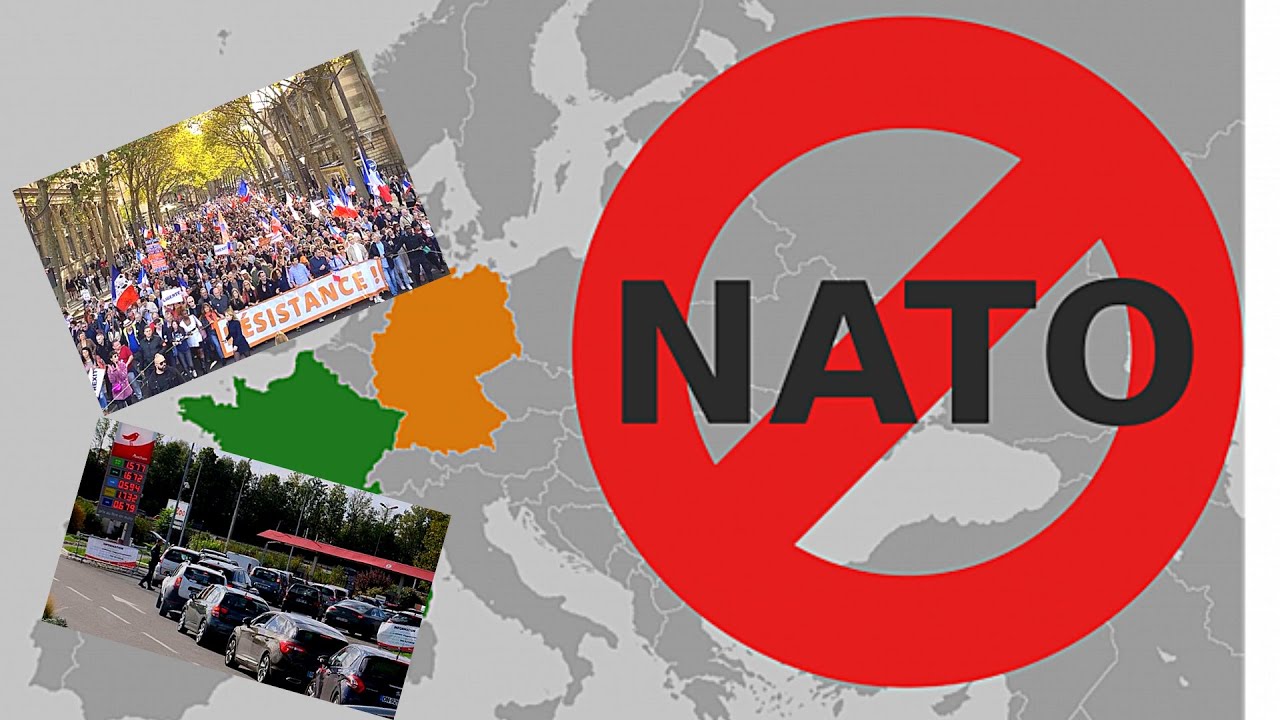
This content was created by David Oualaalou. This content was uploaded by David Oualaalou. This is a YouTube video titled "Is the Demise of NATO & EU Being Near as Protests in France Continue?" (published 2022-10-11) featuring David Oualaalou as the sole presenter. It is a geopolitical analysis / commentary in which Oualaalou reviews ongoing protests in France (calls for Frexit, withdrawal from NATO, strikes at refineries, fuel shortages and rising cost of living), places them in a broader European context (comparisons to protests in the Czech Republic, Italy, rise of far-right politics, energy dependence on Russia), and argues these trends signal growing cracks in the EU and NATO. The content_type is YOUTUBE and the excerpt is a single-speaker monologue aimed at informing viewers and soliciting comments.
Chapters
Hello everyone and welcome to Geopolitical Trends. My name is David Oualaalou. In today's video, I am going to provide you an analysis about the meaning of the current protests taking place in France, which basically hints to the upcoming demise of the EU. Like I always say, you need to see where the trends are headed and put things within the global perspective. You know, you take it, for example, with the protest in the Czech Republic, you take it with the elections in Italy, protests in Italy, the protests in the UK, in Bulgaria, and all this should prevent you— should provide you, rather, a hint as to where things are headed. And this is why today I am going to provide you this analysis about where this is headed when it comes down to the French protest. But before I delve deeper into this, make sure to hit the subscribe button and hit the likes and notification so you will be notified every time I upload a new video. So friends, why is this important? And I'm a little bit familiar with France because I have family lives in France. It is now a massive crowd of protests that have marched through the center of Paris, which was only a day or two, excuse me, which we don't hear much about here in the West. And what's interesting about that is the chanting, what the protesters were saying. And basically, they are asking for a change in stance on NATO and the EU. They want France to get out of NATO and to get out of the EU. This is fairly major given France, the role it played with the Allies after World War II. And it's a role, it's not minor, it's significant when it comes down to EU. The march, by the way, or the protest rather, by the way, was organized by the right-wing party called Les Patriotes. Les Patriotes is a French word for the patriot. And this party or the party is led by a gentleman by the name of Florian Philippot. Now, Florian Philippot was the former deputy head of Marine Le Pen National Rally. And Marine Le Pen is one of the opposition in French politics. As a matter of fact, she lost the last election by a small margin. So, but this is interesting. Why? Because in neighboring country to France, Italy just saw the election of Georgina Meloni. She's a far right. So you can just see where things are headed. And this is why I want you to put this in perspective because we are not hearing about it here in the West, you know, whether by design or by default, that's for another, that's a conversation for another day. But the fact is this, is that the rally downtown Paris has attracted thousands and thousands of people. And I will provide you a link and some pictures to all this, you know, according to Philippot, who was there, of course. And he was also— interesting about Philippot. Philippot was a member of the European Parliament between 2014 and 2019. So he's somebody that, uh, It understands how the system works. But here's the interesting aspect about it, is that the demonstrators were holding banners, a very large one that reads the following, and I quote, let me get it the right wording for it. It says, "Résistance," which means resistance. That's a French word for it. And in addition to that, they were also holding small placard that reads "Frexit." Does the term ring a bell? Frexit, Brexit? You know, Frexit is a reference to a demand that France leave the EU. You know, it's like what they did in the UK. So many protesters in France were also waving national flags. Now you might think, okay, what does it mean? A lot. They are not waving the EU, the European flag. They waving the national flag. That tells you how much they don't want to be part of the EU. This is why I mentioned at the beginning, are we seeing the cracks inside the EU? Are we seeing the upcoming demise of the EU? And personally, And based on my understanding how the geopolitical trends are going on, it's just a matter of time. It's not going to happen tomorrow, it's not going to happen next year, but it's just a matter of time. And this is also what the demonstrators have, or protesters, that is what they have demanded also, is that France withdrew from the US-led NATO alliance. They were chanting, and I quote, let me get the quote for you here, "Let's get out of NATO," end of quote, because they're all noticing where NATO is heading. I'm sorry, where NATO is leading the European countries. We're leading the world security into a confrontation with Russia. And I'm not saying we should be scared of Russia. That is not what I'm saying. It's what's pragmatic. Are you going to go against a major nuclear power? No, because NATO, what was NATO established for to begin with? It was to challenge the Soviet Union, right? Soviet Union ceased to exist since 1991. The question becomes is what is the purpose of NATO? Why does NATO need to expand all the way to Russia's doorsteps? I'm talking pragmatics, pragmatism here, because this is part of what foreign policy is all about. If NATO keeps going in these actions, it's leading us all into some, over the cliff basically. That would not be a good outcome coming out of it. Interesting thing also about the protesters or demonstrators, they also chanted, against the high cost of living because things are costing up. I'm sure whatever part of the world you are watching this video from, I'm sure you noticed the cost of goods and food and energy and everything has went up. You know, in France they were chanting for that. No, they asked— as a matter of fact, I was even surprised with this one, I didn't see this coming— they asked that the current president Emmanuel Macron resign from the office. That is a big blow to Macron who just won the second term. And that they also ask that Macron's administration cease all military sales to Ukraine. It's because France, like Germany, like the UK, like the US, they're all sending weapons to Ukraine. At the expense of the domestic agenda anymore. Marine Le Pen, which is France's far-right leader, said just a few days ago that if she won the presidency, she would leave the military leadership of the US-led alliance, which means what in a simple term? France will not be a member of NATO anymore. And mark my word, If that ever happens, that will be the beginning of the end for NATO. So maybe one day I'll do a video about just NATO itself and give you some background as to what it used to be, what was the purpose for its establishment and where it is today. So since the beginning of the Ukrainian conflict, as a matter of fact, which has caused catastrophic energy— a crisis across Europe. This is not just France. This is not Italy, not just Italy. This is not just Germany. It's across Europe. So which means what? That anti-NATO sentiments have grown among Europeans. Because Europe, as I always said, and I don't shy away from saying this, Europe is like the child that never grows up. And is always in constant need of discipline and direction. Because let's face it, Europe has no foreign policy. Europe has no security. If Europe has to follow what the United States says or requests Europe to do. So Europe, to me, it's like, you know, just, this is why you're seeing European leaders making this kind of very odd decisions that are harming their citizens. That makes you just wonder. But let me at least provide you a picture about where things are in France inside domestically, because again, we don't hear much about this one in the West. Well, and I have family lives in France, so I can always call and find out. Gas stations in France have been running empty As a strike, it is a strike going on in the refineries of the main French oil firms continues, and the strike called by France's hard left CGT union at ExxonMobil and at TotalEnergies. Those are two companies, ExxonMobil and TotalEnergies, or Total, we call it Total.— but in French, in French you pronounce it Total— TotalEnergies. Those are refineries, okay? This was supposed to last only 3 days, the strikes, and guess how long now it has been? 13 days. Let that sink in. 13 days. We haven't even heard about it here in the United States that they were French demonstrators, or demonstrations, that is. And this is why I wanted to come on the air and share this with you. So, so it's continuing everywhere. The CGT spokesperson said, and adding that there have been no communication whatsoever from TotalEnergies since the union request for the company to sit down and start negotiations never took place. So you can just see where this is going. I am reminded And I've seen, by the way, and I talked to my family, what I was told is that there are long lines of cars waiting to fill up. I am reminded of the 1973 crisis in the United States when there was no gas, when there was an embargo on gas being sold to the United States. So what you are seeing right now in France, and I wish Western media show the images to people so we know what's going on is that hundreds of meters long lineup of all of them crawled out of the gas stations around France. This is not just in Paris, by the way, or Lyon or Nice or Strasbourg. This is across the country. And with this, they are generating anger. And long delays for commuters. As a matter of fact, I read something and I found out that a newspaper asked one motorist who doesn't want to disclose his name, whose car was already running on empty, and he said, I quote here, "We've been waiting for an hour to just get gas." So The queue hasn't moved at all. I don't know what we are supposed to do. End of quote. Folks, here is where the importance of understanding the geopolitical trends. Why is it important? Because trends gives you an idea. It gives you insight as to where things are headed. Nothing happens in a vacuum. We always— you heard the saying, history tends to repeat itself. We are now witnessing what took place, like for example, in the 1970s of the last century with the long line at the gas stations here in the US because there was no gas. France is expecting or experiencing rather the same. The demonstrations in Paris are no different than what took place in the Czech Republic months ago. And few months ago, as a matter of fact, only about a month ago, it was, and I remember this vividly, it was in September, around towards the end of September, 26th or 28th, there were massive demonstrations in Prague. Why? Because people were fed up with the cost of living going up. And demonstrator were asking Prime Minister of Czech Republic, Petr Fiala administration to resign. Why? In the wake of the rising energy cost. But here is the interesting thing that I see, the comparison between the demonstrations that took place in Czech Republic and the current demonstrations that's taking place in Paris, is that both of them have called their nations, okay, to review their relationship with the EU, and get out of NATO, the UN, and the World Health Organization altogether. That is very, very, very interesting sort of demands. You can just see the EU is not going to be around forever. And now we're starting to see the signs, the cracks into the alliance. And by the way, the demonstrations in the Czech Republic, they came in reaction to the energy prices and the soaring of living costs because it's across Europe. You know, we don't hear much about it here in the West, you know, because there's almost like a media blackout and this kind of stuff. You know, you have a corporate media, what do you expect? And because the media is not advocating for the truth, This is what prompts me to establish this channel here, because I want you to get the facts to the best of my ability, to the best of my knowledge. I want you to get the truth, but I want you to reach your own conclusion. So the demonstrations that took place in the Czech Republic were a reaction to the soaring cost of the— of the soaring of living cost, you know. And also because Czech people, Czech Republic, they were fed up with what NATO is asking them, what the EU are asking them for. Remember, Czech Republic joined the NATO back in 2004, and they are seeing now the change happening on the old continent. Some demonstrators, like for example And I found an article about this, and I will provide you with the link. Her name is Mikheila Marikova. Marikova was asked, you know, why are you here? And she said, and I quote, we are here because the situation in the last 2 or 3 years has started to be very difficult. She's referring to both economic conditions and political conditions. And the reporter from the Euro Active channel was the one who was asking her that question, and she even added, and I quote, "We would like to have a good relationship with Russia for the gas," end of quote. So it's specific. You can just tell why these people are starting now to get a little bit upset. And not just starting, they have been for the last 6 months. And she explained that Czech Republic does not support the war in Ukraine. She supports the maintenance of business with Russia. Why? Because Czech Republic also depend on Russia's gas. And winter is coming. It's gonna be a cold winter in Europe. And this is what surprised me about the leadership in Europe. It's almost like they couldn't see far to see the impact of sanctions, what it's going to do to their citizens. And that leaves me with two options or two responses, if I may. One is either they are incompetent, okay? Or they have been ordered to embark on those policies. There is no third option. As one who works in Washington, and I've been around long enough to know how things work when it comes down to foreign affairs, those leaders in Europe, in Germany, in France, the UK, certain Eastern European countries have been pressured. This is why you are noticing right now in Italy, they got the far right now leader that is going to challenge the EU. As a matter of fact, and once again, it's not reported here in the West, Italy now is amending relations with Russia because Russia is going to be sending gas to Italy. You can just see where things are headed. And for that individual, Michala, who was from the Czech, that disclosed why she was protesting, she also added that she feels that the European Union disregards 'the priority of little countries like the Czech Republic.' End of quote. And she's right. This is why Ursula von der Leyen, she's the EU president, threatened, like for example Italy, threatened some Eastern European countries if they don't toe the line. Well, they don't have to toe the line because the interest of their country doesn't align with what the EU wants. And those leaders usually are supposed to be there for the benefit of the people, not for their welfare. We have the same problem here in the United States, big time. Members of Congress are not looking for the welfare of the American people. But also, part of it is our fault. Because we don't understand that concept of the government is for the people, by the people. So what we end up doing is we end up giving the government the go-ahead to do whatever he wants. What was interesting about the rallies in, in the Czech Republic is that they called it the Czech Republic first. That I found it very, very interesting. And they only have two demands. The main demands is to secure gas contracts with Russia and to achieve military neutrality. They don't want to be part of the conflict. They know where this is headed. This is why you're seeing now demonstrations in France asking for France to withdraw from NATO. They don't want to be part of NATO anymore. Because NATO with its action is leading Europe into disaster. Europe is close proximity to Russia. Most of the nuclear missiles will devastate Europe. It will flatten Europe. And when I wrote my Russia book, I detailed all this about the importance of understanding where things are heading. What's interesting about the demonstrations in the Czech is that it came in the wake of another demonstration that took place earlier in the month in which about 70,000 people descended to the streets in Prague because they all see where this is headed. And that's why I wanted to come on the air here. To, to this analysis that I want to provide you is for you to put the pieces together and understand where this, where these things are headed. So in the case of France, and let me go back to France again because that's what the main topic is all about. In France now, with what's going on with demonstrations, you have about 20.7% of service stations, gas stations that is, experiencing difficulties which means they don't have enough gas in comparison to only 19 the day before. And this has happened only about 2 days ago. And I'll provide you a link, uh, for, for this one so you know. And this, by the way, was issued— the statement was issued by the French Energy Ministry. So if something like that was issued by, issued by a department, or cabinet, whatever you want, whatever the name of it is, is how serious that is. So if the French ministry, is the French energy ministry disclosing these numbers, that means there's serious concerns. Out of the French, in France, there are about 6 refineries. Out of the total 6 refineries, only 3 are currently operating. Which means what? Cutting production by about 60%, which is equals to about almost a million barrel a day. That is affecting nearly every, almost one-third of the gas stations in France. That is major. And yet we don't hear much about it here in the West. This is exactly the type of trends you need to pay attention to because this is how it starts. And I've always said this, I always said this, you're going to see massive protests in Europe first before we see them in Australia, in Canada, in the US. Europe is always leading into in these aspects of And France is known, you know, look no further than the French Revolution. Even though they use the term revolution, it wasn't a revolution. It was a civil war. Historians have to correct that term because they gave it the term of revolution to soften the blow. It was a civil war. And Europe is known for that, especially France. So now you have the workers at the refineries staging also strikes and demanding for pay increase against the backdrop of the cost of living that has soared beyond their abilities. And it's a major concern because people have to start to think, we have it here, right here in the US, It's just we don't hear much about it. You got now a family that is wondering, do I put gas in my car or do I buy dinner? I can't do both. For us, at least in the United States, rich countries considered, an American family shouldn't be put in that position. And I am not talking about a handout here because I don't believe in handout. And here's the thing, friends, in the second quarter, of 2022, TotalEnergies recorded a profit of $5.7 billion. Listen carefully, $5.7 billion in comparison to $2.2 million during the same period in 2021. And I'm gonna provide you a link for this. You can just see why people are fed up. So here's my conclusion for you, you know, and again, I, I do remember saying this in one of my videos. I am a student of history because I— you, you learn from how history repeats itself, the events, and people don't pay attention. The French Revolution, so-called revolution, even though I call it civil war Why did it start? It started because the gap start to widen between the poor and the rich beyond. It's something we are witnessing right here in the United States. We are witnessing it in Europe or around the world for that matter. The gap is widening too big, too much. And usually when people start to deal with their survival, they will have to do whatever it takes to survive. So this is why I use history, and again, I am going to use history here in my conclusion, and you will understand why. Back in July, about July 12th, July 11th, July 12th, in 1918, yes, 1918, a memo at that time was circulating. It was brief, just about a few hundred words. The memo was polite, believe it or not. But later on, for President Lyndon Johnson, later on, and his NATO allies, it read like a slap in the face. Basically what it was, France, and I put this in quote from former President of France, Charles de Gaulle. And he said, and I quote, or he wrote at the time, "France is determined to regain on her whole territory the full exercise of her sovereignty." End of quote. And that's what the former President Charles de Gaulle wrote at that time. Basically, the country, France, intended to stop putting its military forces at NATO's disposal and intended to kick NATO military forces and those of NATO members off its land. In short, basically what de Gaulle, Charles de Gaulle, that is what he wanted to do. He did the unthinkable. Literally the unthinkable. And you know what the unthinkable is? Is he pulled the plug on a crucial part of NATO. Because de Gaulle's, in 1966, decision to withdraw France from NATO integrated military command sent shockwaves through NATO member states. And at that time, they were only about was 7. It was a reminder because the way I look at it, I am to put my geopolitical analyst hat, the way I look at it, it was that this action by the former French president, what suggest to me or remind me of that the tensions that exist within the North Atlantic Treaty Organization or NATO, that is. And it was also a challenge to its very existence, which is exactly what is happening now. So the thing is that the winds of the De Gaulle blow again in France. Leave NATO. That is why the protesters were calling. Let me leave you with today's question. And here is the question: will France leave NATO? Let me repeat: Will France leave NATO? Let me know what you think and leave me some comments. Comments, I would like to read them. As always, remember, geopolitics impacts your daily life in more ways than one. Till next time, bye-bye.
More from David


Beyond the Single Actor: Why the Gulf Isn't Choosing Between the US and China


Iran, Iraq's Militias, and the Houthis Are Coordinating! This Changes Everything




Who Controls the Next Decade's Resources? Latin America and Africa's Geopolitical Crossroads

The Chokepoint Trap: How Washington's Stupidity Triggered a Cascade That Now Controls the World

Trump Spooked as IRGC Unveiled dual-use SLV, Deployed Ghadir Mini-Subs & Hinted at Tactical Nukes!
