Is the US Turning the Philippines into Another Ukraine? W/Anna Malindog-Uy!
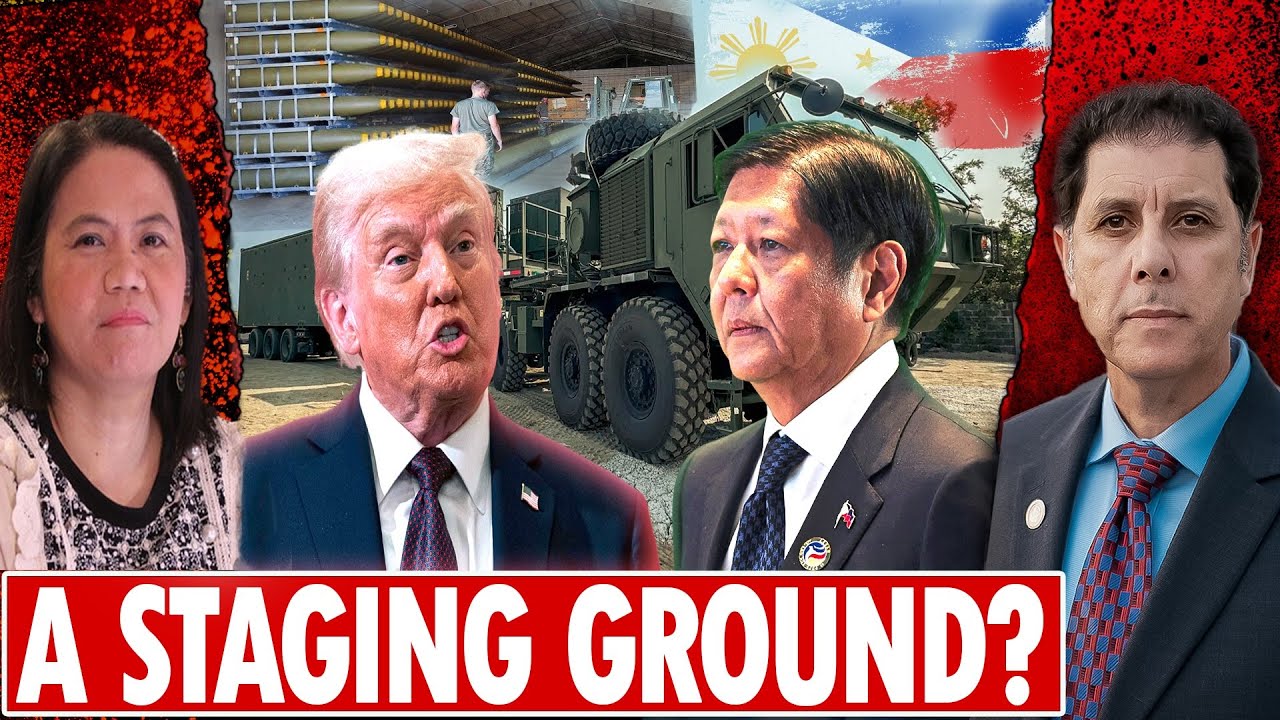
Professor Anna Malindog-Uy argues the U.S. is building nine military bases in the Philippines and pre-positioning missiles, risking the country's sovereignty and isolating it within ASEAN. The Philippines faces 17 trillion pesos in debt, a 20% U.S. tariff on exports, and a domestic power struggle between Duterte and Marcos Jr. factions.
Chapters
Hello everybody and welcome to Geopolitical Trends. You can tell I'm excited being here because I got up early, but second, because of my, my friend Professor Anna Melendoc is here, so we're gonna be hearing from her a lot. So anyway, very excited. Just quickly, guys, uh, uh, remember to join me on Monday. I have a major topic and this pertains to China, so I'm not gonna get into the details of it, but Monday I'll be addressing this particular topic. And on Tuesday, Larry Johnson will be here. There is also another developments regarding the Russia front you want to know about that pertains to NATO, Ukraine, and so forth. So anyway, that one just to give you a heads up on this. So, so what I'm gonna do, guys, I'm gonna bring in my guest and we're gonna get into it right away because we have a lot to cover. So let me bring in Professor Anna. Hi, Anna.
Hi, David. Thank you so much for inviting me. It's nice back in your program. Thank you so much.
Always a pleasure. The community gets so excited, even my Filipino followers, which by the way, guys, if you are from Philippines watching this, please make sure to subscribe to the channel. I will greatly, greatly appreciate it. So to those who do not know who Professor Anna Malindog, she is a PhD candidate at the Institute of South-South Cooperation and Development at Peking University, a major institution in Beijing. China. In addition to that, she is also an economist, writer for the Manila Times, and if that's not enough, she's also the Deputy Secretary General for the Association for the Philippines-China Understanding. So, and I just found out that Professor Anna is also the Vice President of the Asian Century Philippines Strategic Studies Institute. This is a think tank Very, very— and it's located in Manila. So, so we are very, very excited to have you here, Professor Anna. And I'm gonna get right away into it because as I said, we got a lot to cover. What is the state of, uh, what is the current state of the Philippines as we stand right now since last time?
Yeah, since the last time we talked, I think there's not much, um, difference in terms of the issues that is, um, the different issues that are surrounding the Philippines at the moment in terms of the political landscape of the country. I I think it's still the same in a way that there's still this continuous feud, political feud between the faction of the Dutertes and also of the Marcos Jr. So again, still there is this impending impeachment trial against the vice president and Sara Duterte. And I think if in any case it will push through since they already convened before in the 19th Congress the impeachment court. I think, um, if in any case it will proceed, it will happen in around July 28th. And also, again, still, um, as you can see in the post, um, there's still this, um, clamor at the moment for the former president Rodrigo Duterte to be brought back to the Philippines, especially now that there are certain developments again about him. It seems that the former president is getting thinner and thinner. And I think, um, though he is healthy generally speaking, but he's getting thinner, I think, precisely because I think it, it has an issue with food. I think he likes really traditional and really Filipino food, but in the detention, I think it's not being served, or they don't know how to cook this kind of food. So he's getting thinner. And at the same time, the last time that I, I saw the interview with the vice president, it seems like he already made mention that if in any case he dies, well, let us say in the ICC detention, probably there should be, you know, he talks about how what will happen to him and how they're gonna, you know, do something about his body. Like he, he said you should cremate me, all of these things. So it's really a sad story and a sad reality at the moment. But of course, majority of Filipinos, if not all Filipinos, would want him to be back in the country. Um, it's not, it's not necessarily because to evade trial. It's more about, you know, clamoring for house arrest where he can really stay and, you know, wait for the trial if it really happens. So that is another major political issue. And of course, the economy of the Philippines is still not so good with our, um, how do you call that, we have, um, a rising sovereign debt at amounting to around 17 trillion pesos already. So we're doing some debt servicing. There are a lot of challenges as well in the economy, given that our GDP that's supposed to be projected at around 6 to 8% has been downgraded now to around 5.5 to 6%. This is just a projection. We really don't know, um, if— yeah, if we really can achieve that this year. So And of course, the living standard of the people are, you know, Filipinos are still struggling. We have inflation and all of these things. And I think there is also higher pressure or more pressure now on the Marcos government because of this trade war. And recently, just 2 to 3 days ago, I think President Trump of the United States imposed 20% tariffs on our export. And I think this is not good news for the Philippines. And it's really not okay because we're supposed to be a friend of the United States and a treaty ally.
That will be— that will— hey, Anna, that will be fatal, being a friend of the Americans.
Yeah, that's what Henry Kissinger said. If you're an enemy of the United States, it's dangerous, but if it's a friend— if you're a friend, it's fatal. So I think it's more true now, and, you know, people are seeing it.
Yeah, yeah. Well, great. I'm glad you provide at least this, uh, this, uh, just an update as to where things are. And we're gonna touch on the economy economy later on in the conversation pertaining to what we're going to be talking exactly about. But I want to just go back quickly to one point about, uh, the former president Duterte, uh, uh, in, uh, in, in, in The Hague. Because here is the thing, guys, for you just to know, uh, in addition to what's going on right now with his health condition, whatever, we all know, we all know that the arrest was illegal. Yes, this is one thing that I need you guys to understand. We know now the double standards of— I was in The Hague. I have a— I even did a live stream for you from behind, from close in front of the ICJ. I went there physically, not that I wanted to go inside. And of course I asked, but they told me, sorry sir, the court is in session, you can't get in. Say, okay, no, no worries. My point, guys, it's just, uh, since Anna, uh, Professor Anna brought this up, I want you just to remember the illegality of that arrest. So anyway, we hope, we hope, uh, they'll, they'll come to their senses and send him back to the Philippines, then deal with the issue on the Philippine soil, not in the Hague.
So yeah, yeah, I agree.
Now, Professor Anna, I want to get into one particular really, really why we're going to be talking about here. And, and as I put a question, is, is the US dragging the Philippines to become a staging ground for what we are— I mean, in the US, that is— what it is planning on doing.
Yes, my reference—
yeah, my reference here is to what's going on in the, uh, Subic base. So because there is now a conversation about some strategic resurgence by the United States footprints in the region And this, I couldn't think of anyone better to really tackle this issue. And because you wrote an article, I'm gonna put the link for you guys, uh, in the chat box. This is, uh, Professor Anna's, uh, article in the Manila Times. So when you get a chance, take a look and read it. It's very, very, very interesting. So you mentioned about the Manila possible move to allow and host the United States ammo factory.
Yes.
How— where is the— what do you see the problem with this?
Yeah, um, this is actually before a year ago, David. I already read a letter, I already read a news report on this actually a year ago, and I was not really pay— I, I did not pay attention to it. And also another colleague of mine who is an old friend and also an academic, and he is a Filipino— she is a Filipino— already told me that there is such a thing and a plan that's being discussed even last year, I think, about this staging or creating or establishing an ammunition hub or an ammunition factory in the Philippines around the area in Subic. And my friend told me that it might happen, and I was like telling him like maybe this is not possible because at the moment, at that time, I was thinking that's too much. I think so. I, I am not sure if they— I mean, you know, if people, the Filipinos, will react. So I did not really think too much about that. Then suddenly another good friend just 2 weeks ago forwarded to me a news report. It's actually published in the United States, like that, you know, there is a plan at the moment and it's like under study. It's like a feasibility study that the Philippines will be the next factory hub of ammunition in the Asia-Pacific region. And it's, I mean, it's the plan of the United States to a greater extent. So that is a plan right now. I think there's a study, it's as far as the United States is concerned. And our Secretary of Defense, um, Chedoro Gibo, said that, you know, um, there was not yet a a formal proposal for it. However, it, it seems like as far as he's concerned that he is open to it and the Philippines is open to it. Though the President Marcos Jr., to be fair, did not make comment on, on this issue at the— not yet. But on my side, it's already there. It's already a plan. It's like before, you know, before I also heard about the additional EDCA sites of 4 Before, we did not take it seriously because we thought that, you know, Marcos Jr. will not allow it, but it happened. So it seems like this is another move on the part of the United States. And, you know, making and creating and establishing a factory of ammunition in the Philippines in Subic Bay is not anymore— it's too much already for us Filipinos. Why? It's precisely because it's already trying to, you know, paint a picture that we are really an extension, that the Philippines is already an extension of the deep state. Of the United States. Because it's not, you know, if you really look at the Philippines right now, David, first and foremost, we have EDCA sites, EDCA sites, 9 all across the Philippines, and very strategically located, um, in areas like near Taiwan Strait and near the South China Sea. And some areas are being used also for military exercises every now and then, and even prepositioning of high-level military assets of the United States in my country. That's already a very, um, you know, that's already putting my country in a precarious situation given the very volatile and a very, um, tension-driven relationship between China and the United States in that even in this Indo-Pacific we're already becoming a battleground of this kind of strategic rivalry between the two superpowers. Now that's only the EDCA sites plus the rotation of troops. There is a rotation of boots on the ground by the United States and U.S. forces. The third one, it's not And it's not even in theory, David, because one of my friends just yesterday, one of my friends told me— he is in the Philippines at the moment— then he told me that he saw a lot of American soldiers and a lot of Americans in our, in our military camps, like, you know, the big military camps in Manila. So I mean, like, this is not anymore like a, a discussion, it's really happening. So And so you have this rotational forces that is in the Philippines, and I don't even think it's rotational. Many of them are staying in the Philippines, I mean the US soldiers. The other one is the high-level prepositioning of missile system in the country and even assets, military assets. And now all of these are happening all at the same time, and now you will have this factory or ammunition hub on a factory in, in this, in Subic. So what, what becomes of the Philippines if this will push through? This is not anymore about, you know, a partnership or mutual defense treaty. It's really a picture that we are entrenched in the security and defense orbit of the United States in the Indo-Pacific, that we really is a forward base for the United States in the Indo-Pacific for any kind of confrontation or contingency that might happen. And another thing that the one that I cannot accept even at the moment is we are like an extension of the deep state, of the industrial military complex of the United States. We lose our strategic economy, uh, strategic autonomy completely, and we lose our sovereignty, even a little of it at the moment, you know. And there's no pretension anymore that we are a partner. We're not. We become really a pawn if this will happen again and this factory will be put up in Subic Bay. And I am even not sure if only in Subic. If it happens in Subic, probably in other areas it might happen in the same way that happens with, with Edgar Sait. So I don't think this is good for the country. I don't think this is good for the region. In any case, I really hope that Marcos Jr. will not allow this. And also, this will in many ways put also other countries in ASEAN some kind of in anxious position. And also, in a way, if this kind of moves on the part of the Philippines, you know, set aside ASEAN centrality in many ways. And when you talk about ASEAN centrality, it means that, you know, when you talk about security issues or military defense issues in ASEAN or in Southeast Asia, it should be ASEAN member states, and ASEAN as a bloc should be consulted. But it seems that the Philippines does not even talk with its counterparts in ASEAN and discussing this matter, because whatever we do in our country, we— it will affect definitely the countries in ASEAN and of course the wider Asia-Pacific region. So these are critical issues that I don't— you know, if people like me will not even speak about it, if I did not write something in my column in Manila Times about it, I don't think the whole Philippines will know anything. About these things because this is hidden. The media, the mainstream media, they don't report on these things, you know. But Filipinos have the right to know what is going on in the country and what will happen to the country if in any case some kind of confrontation happened between major powers in the Asia-Pacific region. We will be the first one to be bombed if that's the case, you know. But this is not good.
Yeah, and that was the reason why I wanted to— when this topic came to my attention and I read some other stuff also in Washington, uh, given a really— what's—
which—
this is something I'm not gonna detail much, guys, for Monday, but this one is part of that. That's why I wanted to have the conversation first with Professor Anna, uh, regarding the Philippines. But I'll deal with the China stuff on Monday because I'm waiting to confirm some information. Uh, what was gonna— I was gonna say, uh, excuse me, Professor Anna, is that this, uh, to me, this entanglement by the Philippines is very dangerous the way I look at it. And I used to work in Washington, we kind of know the steps that's going to be taken. And that's to the point of, at some point— and I'm not, I'm not scaring the Filipino people here, all I'm saying is they're gonna wake up and it will be no sovereignty for Philippines whatsoever. This is where my big concern. And the second thing, this doesn't happen in a vacuum. When you consider what the Pentagon has been doing recently. It's not coming up. It's— there is drips of information coming up, and this one has to do with two countries, Australia and Japan.
Yes, and Japan.
Pentagon is pressing those two countries to sort of clarify what role they're going to play in case there is a tension with China, because this is where we are moving into. And that's exactly why I wanted to address this with you, Professor Anna. Now, you mentioned the sovereignty and you mentioned ASEAN. Now, the question that I have is, will Philippines be isolated should it move forward with this decision to allow the establishment of an ammo factory on the Philippine soil?
I think the Philippines is already little by little isolated. In many ways, in relative terms, it is isolated. It's just that I think leaders of ASEAN, they— I mean, it's not really a thing of ASEAN to confront, you know, each other publicly. But even in private conversation, when I attend conferences being participated by ASEAN counterparts, they're not happy with the Philippines. They're saying that, you know, Why is it that the Philippines are not consulting ASEAN member states when it moves, especially when it comes to this kind of very critical issues? Like, for example, even military intensify balikatan or military exercises that, you know, deploys high-level military assets like missile system in the Philippines and then conduct this kind of military exercises near very sensitive area like South China Sea and Taiwan. Even that, I mean, countries in ASEAN are very anxious and, and very— it's not so happy, you know. They're like questioning why you don't consult us, because we are supposed to be a one block, and we agreed that there's such a thing as ASEAN centrality, and we adhere to that. So it means resolving conflict, managing this kind of issues related to security, we need to, you know, to be to one as a bloc, and we agreed on certain things. But it seems that the Philippines don't consult at all. So this is not good for us, and in a matter of time, we will really be isolated from ASEAN, even though we are part of ASEAN. And you can already see the statements of leaders in ASEAN, like for example Anwar Ibrahim. It's very clear he is emphasizing in many of his statement in different gatherings of leaders like BRICS, or even visiting China, or even visiting other countries. He always emphasized that ASEAN centrality is important, that ASEAN should maintain its neutrality and non-aligned stand, especially when you talk about geopolitical issues. And, you know, we should try to be cohesive on these things. So So this is the stand of many countries and almost majority of countries in ASEAN except the Philippines. So if you ask me in a matter of time if we'll be isolated, there is that potential and a possibility to be isolated. And also, David, earlier you mentioned that, you know, the United States is trying to pressure Japan and Australia and, you know, to tell them exactly if you're with us, if in any case a war breaks out between China and the United States. Over Taiwan Strait or South China Sea. They're putting pressure in these two allies of the United States. However, you have to remember, the Philippines is also being inserted and being pushed by the United States to be part of a squad. What is a squad? The squad is actually, it's a, it's a, it's a minilateral, some kind of security architecture that comprises Japan, Australia, United States, and the Philippines. And our Secretary of Defense Gibo saying that, you know, they are discussing this one theater operational strategy for East and Southeast Asia. See, so I mean, like, are you— in my mind is like, are you trying to recreate what happened in the Second World War? Because this is precisely the case. So, you know, there's this kind of move. This is like, um, I, I don't agree with this because as far as I'm concerned, Asia at the moment, Southeast Asia is more particularly, um, are more focused and oriented in trying to make, um, to focus more on economic development and prosperity, but not so much on this military and defense, um, you know, alignments or some kind of blocking. But it, but it seems like my country, the Philippines, is being dragged into this kind of thing. And of course, you don't— we expect Japan and Australia, because they're allies of the United States, you know, But even then, I think Japan is under pressure, and even I think Australia also. Because, you know, David, when I was in Singapore attending a conference on security, I had a discussion with one good Japanese friend, and he was telling me actually that, you know, Japan feels the pressure from the United States, especially when you talk about this, you know, war games and all that. And they're trying to look towards ASEAN Precisely because one thing that they like about ASEAN is ASEAN is non-aligned. In most countries, except the Philippines, is non-aligned, neutral, and has— and most of the countries, or majority of countries, they have this independent foreign policy. So that's why it becomes attractive to major power like Japan when you talk about realignment and recalibration of their alignment with the United States. So On my side, even if Japan is— Japan is— while talking to him, I was thinking like, if Japan is doing this already and thinking through it, the Philippines must think, yeah, you know, you know, that it should go back and try to forge more relation with its counterparts in ASEAN and diversify its relationship. Don't depend too much on the United States, especially when you talk about military and deterrent— military and Precisely because this is not about our interest. This is really about the strategic interest of the United States in the Asia-Pacific, or what you call Indo-Pacific region. And we're— but we're like, we're just a pawn. We're really like a pawn. And we will end up like Ukraine in the long run, like the Ukraine of Asia in the long run, if we are not careful and if we will just bow down and accept whatever the dictates of the United States, especially this new development that they want to have a factory, an ammunition factory in Subic. I don't think this would lead to something else. I'm not kidding.
Yeah, well, that was the reason why I put the in the title, and I know some will disagree with this, but of course I respect their opinion and so forth. But again, I'm looking over the horizon, you know. I, I know how the, the government in Washington proceed with issues like this, so this is why You kind of want the Filipino people to be aware that if nothing changed, they're gonna turn out— their country will turn out to become another Ukraine. And that's where the issue— and this is one of the things, guys, by the way, I will be addressing with Larry Johnson on Tuesday. You need to hear this. Liking this video so far? Don't just be a watcher. Go ahead and hit the like, share, and subscribe button. And don't forget to tap the bell so you will not miss any of my videos or live streams. This way you will be supporting a channel that stands for the truth and objective reporting. The choice is yours. Thanks for your support. And once again, I do appreciate my Filipino followers. If this is your first time here, please, please make sure to subscribe to the channel. I want to go back to Professor Anna. I want to go back to the ASEAN because I have one, one aspects on this, then we'll move on with our topic. It was just recent summit for the foreign ministers of ASEAN countries. Now, first of all, what was the United States doing there? That's one. Second, the two key things that I wanted to highlight, and I have a dear friend of mine, Dr. Dashan Feng, sent me a text. He and I would communicate and mentioned to me about How come the media— which is true because I looked it up and I couldn't see— how come the handshake between Marco Rubio and Sergei Lavrov took place, but the handshake between Marco Rubio and Mr. Wang Yi did not? So yeah, what is the angle for this in your opinion?
Um, for me, I think, um, um, the United— the United— the media, the mainstream media in the United States, they don't want— for the American people to see it, that there's a possibility that actually the United States and China could have a positive, pragmatic, and constructive diplomacy and relationship under a Trump 2.0 administration and under Rubio being the State Department Secretary. So I don't think they would want to see it. So that's why they don't want to have the picture flashed during reporting. Because I— one of my good friends who is actually working for, uh, American mainstream media, um, also messaged me about this and he told me, Anna, why don't you mention this in your post, in your social media platforms? Because this did not came out. I did— it did not came out, um, in, in mainstream, um, U.S. media. And I was like, what? I said, okay. I said, I will try to post it in my social media. But I said, but you are a producer of, of mainstream media in, in United States. Why is it that you cannot push it? But it seems like, you know, the bosses maybe, or the owners, it's a private entity, don't want to, you know, to— for the American people to see that, you know, there is a possibility that, or there is this potential that the United States and China could have a constructive relationship, may it be in the economic field or may it be in, in defense, or, you know or security, and they can talk actually. But yeah, that is really strange and weird for Russia. Russia, you know, they, they put it out in the media, but for the, the Chinese side—
that's true. Yeah, I was wondering about that one too because I looked into that. I saw the image. I wish I could have kept it for you guys to see the handshake between Marco Rubio and Sergey Lavrov. That I saw, and I'll dig it out for you guys for next week. So, so that is one of— I just wanted to bring this to your attention. And speaking of ASEAN, and we'll, we'll address one last final point on this and move back to our topic here. Speaking of ASEAN, uh, do you, do you foresee any possibility of ASEAN making a decision to ask Philippines, hey, you either get your act together or leave? Is there any possibility of that? Because I am seeing similar pattern in BRICS with India. So India does not need to be in BRICS, in my opinion. I'm starting to feel the same about the Philippines. When I say feel, I am referring to thinking, you know. It's not an emotional thing, it's a thinking process, because I'm starting to see the Philippines undermining that independence of ASEAN, who wants to go a different direction altogether?
Yeah, on my side, I think in the long run, if the Philippines will continue to do unilateral moves that affects especially the, you know, the peace and stability of the region, of the sub-region of Southeast Asia in that sense, and it will not in any ways try to consider also the feelings or even the stands of other member states of ASEAN, ASEAN. I think that possibility is not impossible, you know, it might happen. And one thing though that you have to also take note of, David, in the Philippines, there are segments or individuals, or let us say a more pro-United States faction in the Philippines, are also saying that, you know, we should leave ASEAN. There is this some ideas being projected to the government that the Philippines should leave ASEAN, should not anymore be part of ASEAN, precisely because ASEAN is not supportive of the claims and of the plight of the Philippines when you talk about the South China Sea dispute with China. So it seems like they cannot get what they want. From the ASEAN region of ostracizing or trying to call for ASEAN member states to quarrel with China over the South China Sea, because that is not happening. So there is this idea being floated in some cases that Philippines should not anymore be part of ASEAN. But actually, to be frank with you, if in any case the Philippines will not anymore be part of ASEAN, it will be a very big loss on our side. First and foremost, we lose, um, what you call, um, strategic leverage when you talk about political stand in the region. So we don't have any more a buffer or some kind of an anchor, because we all— a country would always need an anchor and at least a membership in a regional organization for you to have, you know, you for you to have this kind of backing, especially when you talk about regional issues. So that one, we will lose that. Second is the benefits that we have when you talk about trade and economics, because in ASEAN we have also our, what you call, trade agreements that benefits each member, especially when you talk about trade between and different among countries in ASEAN. So that one we lose if we are not part of— we will not be part of ASEAN. So there are a lot of things that we will lose as a country, and we will be isolated in every sense, and we will be alone in the region fighting for our whatever kind of issues. And even in the South China Sea, we will lose that leverage of having an ASEAN, like, you know, being part of a multilateral organization that actually also helps in resolving the dispute in the South China Sea. So in a way, if in any case it happens, that would not be good for the Philippines in every possible sense. But I think on the part of ASEAN member states at the moment, It is still patient, it's really patient. And as you can see, you cannot really hear ASEAN leaders speaking against the Philippines publicly because that is not the attitude of ASEAN member states. And even in ASEAN, it's not part of our culture. But you can, if you listen to the comments and if you attend regional conferences, you will hear the sentiments of ASEAN counterparts that it's not It's not really happy, and sometimes they, they just don't understand the Philippines, why they are doing this, and it's not aligned, and it's not within what you call ASEAN practice and ASEAN values. So if the Philippines will continue push and push and make a unilateral move, putting the whole region in a, in a compromising situation, especially when you talk about peace and stability, probably, probably, potentially um, leaders of ASEAN will think like, you know, you're— this country is undermining us and our security, probably it should be out and we should accept right away East Timor anyway, you know, to complete the 10 block, because East Timor is the 11th but it's not yet an official member of ASEAN. You know, that's a possibility, but I hope it will never happen. You know why? Because of course it's my country. As much as possible, I want my country to be part of a regional organization that it can draw some kind of backing, regionally speaking. And if you look at the Philippines, David, the only organization that it is a part of is ASEAN as a regional and intergovernmental bloc. It's not part of the Belt and Road Initiative, it's not part of BRICS, it's not part of SCO. You know, these are things that we actually should be part of, but we are not part of.
Yeah.
So It's a sad story if the Philippines will be out of ASEAN. I think it will be to our disadvantage in every possible way.
Yeah, well, I did, uh, you mentioned BRICS, Professor Anna. I did hear the possibility that there are some, uh, whispers out there, and again, I can't confirm that, guys. For now, I'm just saying that's the word I got, but not a confirmation. That Philippines wants to join BRICS because they are seeing now Vietnam, you know, attended the Brazil as an observer. Indonesia is in already, and, and the, uh, they wanted to— I personally, and again, I, I'd like to have your insights on this, but I personally do not see Philippines joining BRICS. What do you think? Professor Anna, is there any possibility?
I think, um, when you talk about the Philippines joining BRICS, personally speaking, I really would want my country to be part of BRICS because we will benefit from the expanded BRICS in terms of market, in terms of political backing, especially when you talk about issues that has something to do with defense and security, even economics. And even, um, we will even benefit from the fact that BRICS are using now local currency when it comes to trade, and it prioritizes issues that are, you know, shared by many developing countries in the Global South, like the Philippines, like climate change and, you know, climate resilience, poverty, all of this kind of issues that are focused and being, you know, prioritized by BRICS. So I think being part of BRICS, it would be a big advantage for the country, but The question is if in any case BRICS will accept the Philippines. It's not— I, I, I— that one thing, I, I think in many ways BRICS countries, especially the, the, the, especially China, Russia, Brazil, South Africa, and even India, will have hesitation, or maybe will have a double— would, would not necessarily um, oh, it will not open their arms to the Philippines, welcoming it even as an observer, in an observer status. One thing though, one reason for that is first and foremost because right now, really, the Philippines, when you talk about its foreign policy, is very much leaning under a Marcos Jr. presidency, it's leaning to the United States. So the Philippines does not, in that sense, the Philippines does not embody what you call the essence or the stance of favoring or leading towards a multipolar world, or, you know, advocating multipolarity. I don't think the Philippines is in that case. So, but this is very important for BRICS and the expanded BRICS. So in, in that sense, I, I don't think, um, countries or, or the, or BRICS will accept the Philippines even if it applies now. I think the future— but I would hope that if in any case there's a change in leadership and the next leadership of, uh, well, the next administration of the Philippines would be more, um, would have less dependency on the United States, will reshape its foreign policy from being too much dependent and too heavily influenced by the United States and leaning to the United States into a more non-aligned, neutral, and independent way. It will embrace what you call strategic autonomy. It will be more a sovereign state. I think BRICS will not hesitate to accept it. But at this time, to be frank with you, David, and to our audience, The Philippines, even if it wants to at this time, it will have difficulty applying for BRICS. And I don't think BRICS country Russia, China will accept or will sponsor its membership because I think a regional member country of BRICS needs to sponsor a country application to the BRICS.
That's true.
Any one of them. So I don't think any one of them will sponsor us. If we want to apply now. I don't think so.
Well, what's your sense about the public mood in the Philippines regarding the next administration? I mean, are we gonna see another Marcos term, or the Filipino people will want a new direction for the country with a new leadership? What's your sense of that based on your knowledge?
Yeah, based on what I can sense in the Philippines at the moment, I think The Filipino people, even as early as now, really want to have a change. A change in policy, may it be foreign policy, a change in the dynamics of the politics in the country, and even certain changes in how— let us say, a very important issue in the country right now is budget, the national budget, how it's being crafted, how it's being discussed. Last, you know, these are things that, you know, Filipinos want to change. So it directly has an impact, or it's related to leadership, the presidency. So you can really sense that there is this clamor for change. And even I think that clamor extends to a change in leadership. However, in the Philippines, we need to wait for another 3 years for us to have the national election, which is in 2028, around May. So that would be will be a very important political event that will happen in the next 3 years. But if you ask me, if we— if only if you ask Filipinos like me if you want to have a change of leadership, a change of direction, especially when you talk about foreign policy and how we're gonna conduct our business domestically and internationally speaking in relation to the world, I think we want that. We really want that. The country is facing a lot of problems at the moment: corruption, economic challenges, poverty issues. We have this, you know, problem with our foreign policy that anytime soon, where we don't know if the United States will make some kind of confrontation with major powers and we will be dragged into it. There's a lot of, there's a lot of what you call, um, um, anxieties and uncertainties that we're facing as a country. So if you ask Filipinos if they want to change, yes, definitely. However, we need to be patient because the only The only way for us to have the change is through an election, and that will happen in 2028. But if you ask me, if during this time, if let us say 2028 comes, if we will really have a change in leadership, that really depends on the Filipino people, how they're gonna vote. And at the same time, it really depends also on the integrity of the ballot. And of the political and of the voting system, mechanism, system. Because the electoral system in the Philippines is very— is— it's facing a lot of, um, criticism at the moment. There's a lot of issue against electoral fraud. It means election is not clean. So that is our challenge as well, because that, that is connected to the issue of changing leadership in the country.
Yeah. Great. Well, let's go back to one last point here before I let you go. I know you— yeah, it's late for you there and you've been traveling and busy, so I want to keep you too long here. So I just want to go back to this Subic base or Subic Bay and this possibility of the US ammo factory being established there. So is this tied, in your opinion, to their It's not recent. It happened a few weeks ago, if not a month or so. I was aware of it and has to do with the US unfreezing certain military aid to the Philippines. Could it be that the US put a condition to unfreeze this aid to the Philippines if Philippines, Manila, will agree to allow the establishment of an ammo factory in Subic Bay?
I am not— I don't have the information at the moment on this particular issue, but I would presume that, you know, the United States always is like this. It always has its concession and it always have its deals, you know. And I think in any case, there is a deal that has something to do with this plan to establish some kind of ammunition factory in the Philippines. This is not an isolated plan. It is a part of a grand plan that I can see. And when you talk about exchanges, definitely there is an exchange and there is a deal. Now, I don't At the moment, I still don't have the information on it, but I would believe the way the United States, you know, does its job and does its dirty work, it's always— there's a deal, there's a, there's a catch, and you know that, David. So for me, I think there is. And also, as I have told you earlier, I have known about this plan as, you know, one of my really good friends told me about this that, you know, beware of the possibility that the Philippines will be the next, um, ammunition hub of the, of, of, you know, of the United States in the Asia-Pacific region. That was a year ago, and, and there was a certain politician that was named by my friend who have dealings on this, initially speaking. So this— there is some Things going on in there, and I think some politicians in my country are involved in these things, but it's not— it's hard to name names at the moment. But of course, you know, I, I believe in— I believe in the saying that you cannot hide anything in this world. If you have done something wrong or there's something that needs to be unraveled, it will be unraveled in a matter of time. So I believe so.
Yeah, well, that's why— that's why, you know, now why I always say Truth matters.
Yes, it always comes up. So it will always come up.
Yeah, it does. So I really hope, I hope the Filipino people will really realize what's going on. And this is why I truly appreciate you, Professor Anna, when you come along, when you come on here, the channel, to share your knowledge with not only the Filipino people but the whole community, because there are issues that we don't hear much about here. So there's no coverage here in the US about what's going on in Subic. None. I looked into that, I didn't see any. So, and that is why I wanted to address this issue with you, uh, uh, and, and get your insights into this. Before I let you go, what— something to share with the community and the Filipino people for that matter. So I'll give you the floor.
Thank you so much, David, and thank you so much to the community and to our audience. And I think my, my last message to our audience, and even especially to my Filipino kababayans. Kabayan means fellow men, and you know, we need to be aware of what's going on in the country. And I think what is happening and how, and the relationship, it's really important for the Filipinos to understand the functional and the unequal relationship between the United States and the Philippines. May it be in when you talk about security and military, and now especially when you talk about economic because of the current imposition of 20% tariff of Trump. And oh, this is so crazy. So I think the Philippines need to wake up. You need to really to wake up. What we need for our country is not to depend on any, on any country for that matter, especially for a superpower like the United States. What we need is to diversify our relationship with all countries possible, especially major powers aside from the United States. That's the only way, that's the only way for the Philippines to survive. And, and, you know, and I think we need to focus more on economics and economic development rather than all of this military and mini-lateral security architecture that is just dragging us into something that we don't want, and that is being a pawn of the United States. I don't think that's the way forward for the Philippines. I think the Filipinos must be aware of these things, and I really hope that you, you know, Filipinos will try to dig deeper Just not believe what the mainstream media is saying because many of it are also propaganda for, you know, serving as the interest of some politicians and even of the United States to a greater extent. So try to learn and try to watch program like Dr. David Oualaalou's, and, you know, program on global geopolitical trends, which, you know, it tells the truth and it gives you an idea and more explanation and in-depth analysis about certain issues that's happening not only in the Philippines but in the world because Whatever happens in the Philippines, it happens, it will, it will impact the world. And whatever is happening in the world, definitely it will impact the Philippines. So I thank you so much, David, and thank you to everyone, and, and God bless. And I will be back here again in a matter of time. Thank you so much.
Well, you are so, so welcome. So, uh, first of all, I wanna, uh, just before I, I, I sign off here, I want to say thank you and welcome to Xian Liu, good to have you here as a member on the YouTube channel, and I also— on our channel here. And I also wanted to share this with you, Professor Anna, from some members of our community here. For example, Hong Wong, an avid supporter of the channel, here is what he wrote. So, well, here is, here's another one here: bring back the turtles. I agree, because it wasn't legal. And the last one I'm gonna share is with, uh, Georginia Jones. She's an avid supporter of the channel. It is what she wrote for you.
Thank you so much.
Well, on behalf of the entire community, Professor Anna, we say thank you so much for carving out time for us, and we look forward to seeing you next time. Thank you.
Take care.
My pleasure, my pleasure. Hi guys, hope you enjoyed listening to Professor Anna Mandak. She is a wealth of of, of, of information. And that's why I wanted to, uh, have you listen to this particular development. Once again, remember to join me on Monday. There will be an interesting topic I'm going to be addressing about China. And on Tuesday, Larry Johnson will be here again, a major development that is taking place vis-à-vis Russia-Ukraine, and you need to know about it. So wishing you a good weekend, safe weekend. Be safe wherever you are. And look forward to seeing you next time. As always, remember, geopolitics impact your daily life in more ways than one. Till next time, guys. Bye-bye.
More from David


Beyond the Single Actor: Why the Gulf Isn't Choosing Between the US and China


Iran, Iraq's Militias, and the Houthis Are Coordinating! This Changes Everything




Who Controls the Next Decade's Resources? Latin America and Africa's Geopolitical Crossroads

The Chokepoint Trap: How Washington's Stupidity Triggered a Cascade That Now Controls the World

Trump Spooked as IRGC Unveiled dual-use SLV, Deployed Ghadir Mini-Subs & Hinted at Tactical Nukes!
