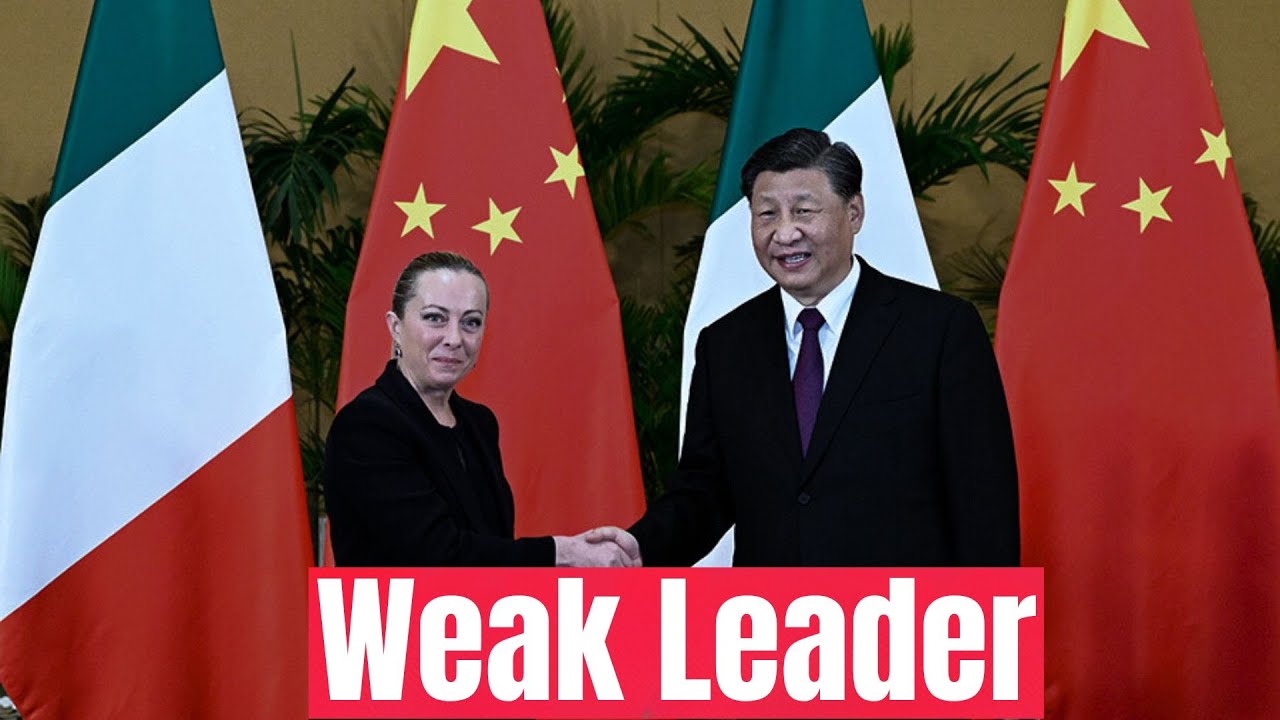
In this Geopolitical Trends video, the host argues that Italy is unlikely to renew its Belt and Road Initiative (BRI) agreement with China, which expires next year, and examines the political, economic, and strategic factors behind this potential withdrawal. He begins by citing an anonymous senior Italian official who says the decision will be discussed before the G7 summit, highlighting the oddity of Italy seeking external approval for its own foreign policy. The presenter then traces Italy’s long‑standing economic relationship with China, from Romano Prodi’s 1990s industrial outreach and Giovanni Tria’s 2018 diplomatic push to the 2019 Memorandum of Understanding that made Italy the first major European economy to join the BRI. He references two University of Bologna scholars, Enrico Fardella and Giorgio Prodi, who warned that China’s control of the Greek port of Piraeus has already shifted 13 % of Chinese‑European trade through the Mediterranean, and that Italy could lose significant port and rail traffic if it exits the BRI. The video outlines the perceived risks of staying in the BRI—potential debt exposure and alignment with the United States—and the risks of leaving—economic isolation and loss of trade flows. The host critiques Italian Prime Minister Giorgia Meloni’s leadership, contrasts it with former Prime Minister Silvio Berlusconi’s anti‑China stance, and accuses Western allies of hypocrisy for condemning China while signing their own deals. He concludes that Italy’s sovereignty is constrained by broader Western pressure, making the BRI the only viable infrastructure link between Europe and Asia, and laments Italy’s “economic suicide” in abandoning it.
Chapters
Hello everyone and welcome to Geopolitical Trends. I'm so excited to be here with you as always. Italy is unlikely to renew its BRI, the Belt and Road Initiative, deal with China. Why all of a sudden Italy is changing its mind, or was it pressured to do so? In this video, I'm going to provide you my insights while highlighting how Not only Italy, but a whole Europe for that matter, is shooting itself in the foot, economically speaking. But before I delve deeper into this, I'd like to always— I like to extend, as always, my sincere thanks and appreciation to the channel's supporters and members. And for you, if this is your first time landing here, make sure to subscribe so you can join the thousands of subscribers in this channel and smash that notification button so you will be notified every time I upload a new video. And thank you all for your continued support. Let's dive in into this. How likely is Italy to leave China's BRI? Well, Italy is highly unlikely to renew its BRI, the Belt and Road Initiative, uh, deal with China, which by the way expires next year. This is where it's going to happen, but Italy needs to discuss this with Beijing. This is according to a senior Italian official who has a knowledge of, uh, of this internal dynamics. And what he said, by the way, this individual is anonymous, wants to remain anonymous within the government. He said that the formal decision about this would not be made ahead of G7 meeting in Japan. Well, guess what? The meeting took place, right? And the reason why this was stated is because Italy wants to consult with the members of the G7. Well, wait a minute, isn't Italy a sovereign state? Why do— why does Italy need to have permission from other members whether to conduct business with China or not? And that shows you, or it tells you, the story right there. So His argument that it's a sensitive topic, that's what they are saying. So, which doesn't make any sense. Even the Prime Minister's Office of Giorgia Meloni declined to make a comment on this topic. That's how sensitive they are. But there's something beyond that, and I'll tell you as I move forward into my discussion here. But I need to provide you the historical and political background to understand where Italy comes into this picture, how Italy ends up, uh, signing up for BRI. Well, believe it or not, Italy was the first big European economy to join China's BRI. And why did Rome sign up for this, you may ask? It's legitimate questions. So it goes back to March 2019. When Italy signed the Memorandum of Understanding, an MOU, with China on the BRI. You know, this culminated a long-standing economic relationship spanning decades that was punctuated by sort of the finance minister— his name was, or is, Giovanni Tria. Tria made a trip to China in 2018 And he is the one who kind of expedited the process, or quickened the process, that is, for Italy to join the BRI. Even, believe it or not, in 2018, back then, from that point forward till recently, the political elites in Italy, you know, sort of were in support of this agreement about the merit of deepening the relationship, economic relationship, that is, between Italy and China. And the interesting aspect is that industrial relations between China and Italy dates back to the mid-1980s when Romano Prodi, at that time, who was— who would later, as you— if you know a little bit about the history of Italy's political government, Romano Prodi became the prime minister and served 2 terms. So at that time, Romano Prodi was the president of Italy's Institute for Industrial Reconstruction. So what happened with Mr. Prodi back then? He asked China to build him a factory in Tianjin. Yeah, that was what Prodi asked China for. In return, his Chinese counterpart helped him build a factory in what was then the Soviet Union. So once Mr. Prodi became a prime minister in 1997, Prodi led a massive trade mission to China, believe it or not, bringing with him on the trip over 100 companies to promote joint ventures, uh, sort of, uh, in engineering Pharmaceutical, foodstuff, textile, fashion, and finance, among others. Why am I highlighting all this? To highlight to you the deep, deep economic ties between Italy and China. Then you put this within the context of this sudden decision that the possibility that Italy might withdraw from the BRI. And again, as an analyst, I will ask the common question: was Italy pressured? It's no different than what Germany, no different than France, and so forth. So, but here is the thing: most Italian prime ministers, believe it or not, if you look at the history of Italian governments, most, uh, history of the Italian prime ministers over time they all have shared pro-this warm, or warmth, that is, relations with China, including— and I'm gonna spell out some names for you, those they served as prime minister— Massimo D'Alema, okay, Matteo Renzi, and Paolo Giovantioli, the only major— get this, guys— the only major dissenting voice has been none other than the previous Prime Minister, Silvio Berlusconi. You know, and why? Because Mr. Berlusconi, after he sold his Milan soccer team to Chinese investors, okay, here is what he did. He sold the team to the Chinese investors, then he presented his candidacy for the 2019 European Parliament election. And guess what did he run on? He ran on as a counterweight to Chinese hegemony. That's what he ran on. He asserted, and this is what Berlusconi said back then, he asserted that Italy, and I quote here, should side with the United States in its antagonism toward China, end of quote. So Berlusconi, which we all know, serves his own interest. That is what the statement was all about. But here is the problem that Italy, it's not foreseen. And I'm saying this based on the research that I conducted after I read the analysis of two professors at the University of Bologna. And I'm gonna detail with you, uh, why. This is why I like this geopolitical dynamics, is because The media will only present, or present rather, the arguments that Italy is fed up with China, doesn't want to do it. But they don't tell you the truth. They don't tell you the details of as to how that decision is gonna impact them economically in the long run. Look no further than what's going on in Germany right now. You know, it's no secret, and I'm gonna do a video for you about the upcoming collapse of German economy. Yeah, you heard me. And I'm not sort of exaggerating here. You will know why, and I'm gonna detail that. So here's the thing about the competition for this lucrative Chinese business in the Mediterranean. Why? Because Italy is on the Mediterranean, uh, sort of proximity, and you will know why here. So Italy has a good reason to nurture its friendship with China. Despite what you hear, and as I said earlier, I did the research on it and I found out that there are two professors. One is by the name of Enrico Fardella, and the second professor is Giorgio Prodi. And by the way, this Prodi guy, professor, has no link to Romano Prodi, the former prime minister. So both of those scholars are from the University of Bologna.. And when they did their analysis about the BRI impacts on Europe, particularly Italy, what they found was that since Chinese— get this, guys— since Chinese shipping company bought a controlling stake in the Greek port of Piraeus in 2016, the Mediterranean has become a more important trade hub for China because the volume of trade went up. And I'm going to share the numbers with you. Maritime transport is an important part of the BRI, as you may know, because of the vast majority of China-Europe trade travels on ships. This is what's important. And for some odd reason You wonder what's wrong with the Prime Minister Giorgia Meloni for wanting to embark on this economic suicide, because that's what it is. So according to Prodi and Fratella, the Belt and Road Initiative impacts on Europe. They wrote an article in 2016 about it, and after China acquired the port of Piraeus, guess this, get this guys, 13% of Chinese trade passed through Greece compared to just 2% 7 years prior. Just let that sink in, sink in. 13% of Chinese trade passed through Greece compared to just 2% 7 years prior. So what, uh, these two professors Fardella and Prodi warned that should Italy remain outside the BRI, it could miss trade sort of opportunities, massive ones. Specifically, Italian ports on the Adriatic Sea could lose business should the port— in this case, should the port of, uh, of, uh, uh, uh, Piraeus become linked to Central Europe via rail, because that's how they are. Most of the ports in Italy are linked to Europe, Central Europe, that is, via rail. Because this would mean what? It would mean that trade will bypass Italy altogether. If Italy withdraw from this BRI, there will be no more trade passing through Italy, and Italy will suffer economically. It will be a big loss for Italy. And the reason also because most of the commodities, you know, landing in Italian ports and being transported by Italian railways. So Italian ports are already connected by rail to Central and Eastern Europe. So this could— which is making perfect sense, but you wonder why politicians don't see the logic in their decisions, you know, because in this case Italy, which serves as a hub for trade coming from China via the Suez Canal, could see all that evaporating. This is where I see it. Going, economically speaking. So by the way, guys, if you like the content of my videos so far, or this video that is, you know, just hit that like button. I will truly appreciate it. And subscribe if you have not done so. Thank you so much for your support. So now comes the big question: is Italy boxed in, or is Italy pressured to make this decision. Granted, signing up for the BRI does not come without risk. This is what some are saying. Of course, before you sign up into something, you have to know what's in it for you. You know, China is not pressuring Italy or any other country for that matter to sign up for the BRI. No. So, but also there is a risk not signing up. You are missing out on other opportunities that other countries will benefit from. So the argument that has always been is that there is a risk that BRI financing could leave Italy further in debt, given that Italy, along with Greece, is already one of the two most indebted countries in the eurozone. Well, wait a minute, you know, how did they acquire this debt? Of course, this goes back to 2008. It was no conversation about the BRI at the time. So how come all of a sudden they, politicians in Europe, or Italy for that matter, are linking Italian debt into the BRI? That just doesn't make sense. It's a lie, basically. So the second risk is that Italy will be perceived— here is where I see why Italy decided now to think about withdrawing from the BRI. Italia, or Italy, that is, will be perceived as drifting away from its traditional allies or partners over, uh, like other EU members and the United States. Yet, as Italy still suffers from the 2008 global financial crisis, or GFC known as that time, and also Italy feels betrayed by the United States because of the Libya disaster Italy can, you know, conduct— contend rather with being abandoned by Europe over the immigration and economic crisis. So it begs the question once again, what are Italy's priorities? You know, that's what I, I, I see. I remember when Georgina, uh, Meloni came to power, said, oh, we're gonna spur the Italian economy And everybody was cheering up for her because they were thinking that she's gonna be a strong leader standing up on her— standing up her ground and in support of what's good for Italy. Turns out to be another weak leader. She caved in. Now she is reversing all those policies that she, she sort of ran on. And it shows you how weak European leaders across the board You take few, like for example the Hungarian Prime Minister Orbán, you know, the guy stands his ground. Yes, he is a member of the EU. Yes, he is a member of NATO, but he's saying no to the EU and to NATO and to the US because the welfare of his country comes first. I don't see Italian doing that one. So now here is the very important— if you understand the dynamics of how geopolitics works, even among allies. You have other countries, especially France, have expressed concern about Italy's engagement with China. But guess what? France in itself quickly was quick to sign their own deals with China. This is hypocrisy of the highest order. And what would you expect from Western leaders? They just lie. You know, they can't take stand. Where is the courage of standing up to what you believe in? This hypocrisy, that's what it is. And who ends up paying the price is the average citizens. Average Joe, Average Jane. It's not in Europe. We have it right here in the US. Shame on them all. And I say it Proudly. I'm not shy away of saying this. So here's my conclusion for you. In some respect, Italy's Western partners have limited its choice. That tells you what? Italy might not be that sovereign as you may think. It has to follow orders, sort of, uh, uh, what's the word, what's the expression we use, uh, uh, to the line, like Australia is doing, like Germany, like Canada, like the UK. You got the idea, guys. You know, you know that this is exactly what I see. As for Washington, it was the Trump administration back then, the dismissal of both the Trans-Pacific Partnership, the TPP, and the Transatlantic Trade and Investment Partnership deals that made the BRI so attractive to Italy in the first place. But at the end, turns out to be that Italy was so weak to stand its ground. So the BRI is now, believe it or not, the only major sort of global initiative designed to link Europe with Asia in terms of infrastructure, trade, and finance. It is only natural, in my opinion, that Italy wants a piece of the pie, but apparently it's too weak to stand or take a stand on this issue. This is where I see it. So, so guys, by the way, if you like this, hit that like button to support this channel because we— I want to grow it even bigger. And without your support, I can't do this. So I appreciate you and thank you for all that. I hope you find this, uh, uh, content informative. And as always, remember, geopolitics impact your daily life in more ways than one. Till next time, guys. Bye-bye.