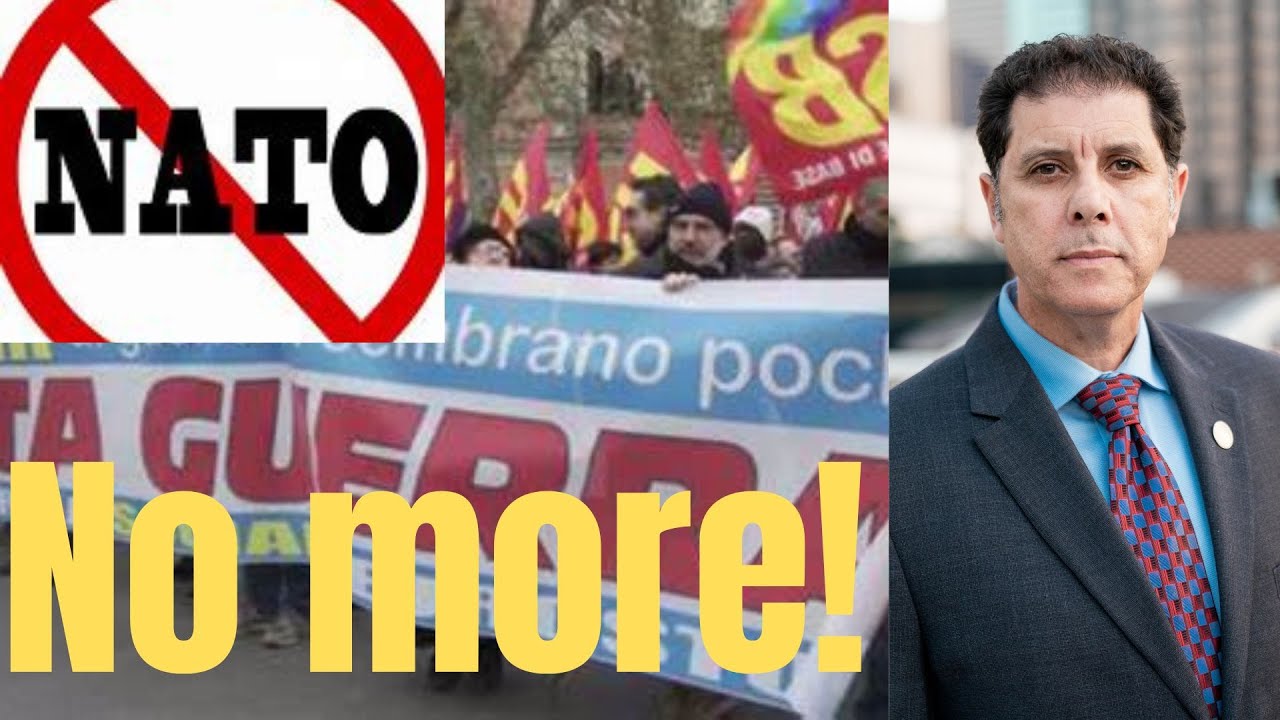
In this monologue, David Oualaalou examines the recent mass protests in Italy against the government’s continued arms shipments to Ukraine. He argues that the demonstrations reflect widespread public fatigue over rising inflation, energy costs, and a perceived misallocation of tax money to a distant conflict. Oualaalou highlights the broad coalition behind the protests—students, trade unions, cultural groups—and points to internal political fractures, noting Prime Minister Giorgia Meloni’s public commitment to send more weapons versus former Prime Minister Giuseppe Conte’s demand for parliamentary approval and a cease‑fire push. He situates the Italian unrest within a wider European wave of anti‑war demonstrations in Spain, the Czech Republic, and elsewhere, linking them to broader economic pressures across the EU. Oualaalou then shifts to other European foreign‑policy signals: German Chancellor Olaf Scholz’s China trip accompanied by CEOs of major corporations, and French President Emmanuel Macron’s unexpected handshake with Venezuelan leader Nicolás Maduro at COP27, which he interprets as evidence of growing cracks in EU‑US alignment. Throughout, he criticises Western media for downplaying or omitting these developments, urging viewers to consult native‑language sources. The video concludes with a question to the audience about whether Europe is finally “waking up” to its economic and political realities.
Chapters
Hello everyone and welcome to Geopolitical Trends. My name is David Oualaalou. As always, so great to be with you guys here. What I'm going to be talking about today is Italy. There are protests going on in Italy. In this video, I'm going to provide you some insights that, by the way, it's not been reported here in the West yet. Maybe they will, maybe they won't. And I will put this within the context of global affairs as to what's going on with other countries like France and Germany. But before I'll delve deeper, please make sure to subscribe if you have not done so and smash that notification button so you will be notified every time I upload a new video. And I can't thank you enough for your support. It means a lot. So we want to grow this channel bigger quickly here. So anyway, let's dive in. You know, Italian protest against one specific aspect, and you know what it is? It's the arms shipments to Ukraine. Apparently Italians have had it with the government spending. As I always said, Europeans are now waking up. So there were some protests 2 days ago by which Italians were holding banners, placards, and rainbow flags, believe it or not. Here is what they are demanding, and their demands are straightforward. They are demanding diplomatic efforts to solve the crisis in Ukraine because it's going nowhere. Like I said last time, Ukraine, Ukraine has no sovereignty. We all know this reality because Ukraine is under the order of the United States. So, so on Sunday, which is what, 2 days ago, the Italian media, you know, cast the future, and they were able to write about it. You know, the Italian government couldn't prevent that from, from, uh, being published. They cast the future of Italy's military support for Ukraine in its conflict with Russia in doubt. That is the key word right there, in doubt, which means what? It suggests that there is a fragmentation within the government, Italian government that is, as to those who are in favor of continuing to support Ukraine versus those who said enough is enough, let's think about our country. So anytime you see a report or something that has the term in doubt, keep that in mind. Become— and all this happened— this particular publication or, or article was only a day after tens of thousands of Italians took to the streets in both Rome and Milan. To protest against the country's arms shipment to Ukraine. Yeah, they've had enough, you know. And because— here is the reason why Italians now are coming to grip with the reality, economic reality, that is, that Italian economy is facing downgrades aimed at inflation worries. And it shouldn't be just not in Italy. I'm sure whatever part of the world you are watching this video from I'm sure you're noticing the prices of items went up and gas and so forth. Italians are expressing that on the streets. So, so protesters held banners, as I said, placards and rainbows, flags, at the events even the day before the demonstrations. And they are demanding those negotiations and diplomatic efforts to solve the crisis in Ukraine. I looked through some media publications in Italy, and I came across one particular one that they said, and I'm going to quote it to you in Italian language. So it said, "Più braccia per riaperirci, non più guerre," which translates to "More arms for hugs, no more wars." End of quote. So it's basically— this is what was written on a banner carried by a man who was holding that weapon, water rainbow scarves in Rome. But here's the thing also you need to understand. Italy is also a founding member of the North Atlantic Treaty Organization, known as NATO, of course, and the European Union, the EU, both of which— both organizations, both of which broadly, meaning NATO and the EU, broadly support financially and military aid for Ukraine. But at some point, citizens of this country is going to say enough is enough. It's almost like, uh, I'm wondering here in the US, how come we're not saying a word about it when we know the government spending billions of dollars at our expense? You know, it's kind of like, hey, I have no problem with helping someone, but wait a minute, not when you have issues right here at home with Why would I be sending our tax money to some far land that have nothing to do with my welfare? You know, once again, it's because once you speak the truth, you are not— or you are against America. It's nonsense. It is nonsense. So this is what Italians are doing. And of course, you don't look at it just from this perspective. You look at it also economically speaking. Italians are dealing with the high prices, the inflation, that is, which, by the way, The European Union have been lying, or has been lying about it. Remember when I mentioned last time in one of those videos when the Central European Bank said that, oh, inflation is only about 10%, which was a lie? You look at some of Eastern countries in Eastern Europe, they are about over 33% of inflation, you know. So Italians are saying that, are seeing this aimed skyrocketing energy prices and an economic slowdown, of course, sparked by the crisis. A growing number of Italians now argue that current policies, the one that the current government is embarking on, are risking prolonging the war in Ukraine while diverting resources the government should be spending, uh, sort of domestically on Italian people. And rightly so. You know, those people that protest, you know, they have common sense. You know, you kind of— wait a minute, what are you using my tax money in some issues that have nothing to do with my welfare? That's to me, it's logical arguments. So demonstrators included— and here's the thing, those are not just average people. You know, they are, of course, the majority, but it included also representatives of trade unions. Okay, student groups and cultural associations, which tells you what? It tells you that those protests are not just from one segment of society. It includes the entire society. It was, uh, and I looked at also one tweet that read, and I quote here, there are protests in Spain capital, about 50,000 people took to the streets demanding higher wages due to inflation, you know. And of course, did you hear about this from Western media? I don't think so, you know. And this is why I look out for the information in their own native language, you know. I happen to speak a few languages, so I kind of like, wait a minute, I'm not seeing this published by the Washington Post or the New York Times or The Economist or whatever. So it's kind of They are cherry-picking the information. Why? It's because they want to keep you in the dark. That is the reason why. So when you have an ill-informed society, it's easy to control it. That's the bottom line to it. So, so here's the thing. In Italy, the unions have threatened now that the protests will not stop until the goal is reached. Is reached, or rather. So, and this one, of course, like I always say, you have to look up for the trend when you look at— when you evaluate a problem, okay? Don't ever evaluate the problem independently from other happenings around the world. This is, of course, when it comes down to global affairs. And this is why you look at this protest within the global context. What am I talking about here? This protest comes on the heels of foreign ministers. Okay, get this, foreign ministers of the G7 that just met on Friday, which is 3 or 4 days ago. They met in Europe, which echoed the G7 foreign ministers, they echoed their support, they vowed to continue supporting Ukraine. And a new Italian Prime Minister, Giorgia Meloni, said— of course she had to say that, because remember, when you are a prime minister, you have, as I always say, context matters. So Giorgia Meloni said that Italy's support for Ukraine will not waver and that more weapons will be sent soon. But this is what she said in public. In private discussions is a different affairs, and I tell you this from experience because that's what happened. So, and here is the thing, the protests also have shined a new light on the differences among Italian political leadership. You know, despite what you hear from Giorgia Meloni, the new prime minister, uh-uh, you know what's going on inside the government always differ from what's going on from on, on, on the public sphere. So what am I referring to here? I'm referring to the former Italian Prime Minister, Gaspi Conti. Gaspi Conti, now he is a member of a government opposition, and he stated on Sunday, yesterday or the day before, that no more arms will be sent without— get this, guys— without parliamentary approval. That tells you right there the right hand of the government is not in coordination with the left hand within the government. So, and this is why you are looking at protest. And of course, Western media doesn't want you to know this. European Union will not report on this because this highlights the fragmentation of the European Union, you know. Conti said, and I quote, let me get the quote here. He said, we need a breakthrough towards the ceasefire and peace negotiations, end of quote. You know, and of course he was quoted by the— quoted rather by the media, adding that the current strategy, and I put this in quote, is only leading towards escalation, end of quote. You know, you know, he's— Conte's been in the government, and I've been aware of his tenure when he was inside the government as a prime minister. Of course, those are very measured words. These are not just spewing for the media consumption or domestic. No, no, no, no, no, those are very measured. So the guy is a diplomat, he understands, and politicians, he understands how things work. So, so the debate now in Italy over his support for Ukraine Of course, it comes as the new government, which was just sworn in on October 22nd, you know, because here's the thing: the new government, the new one that is now, it's already in trouble, shall we say, because he tried to hammer out details for the 2023 national budget. And wanted to lay out the strategies for sparking economic growth and curbing record-high inflation. Once again, what a prime minister— just FYI, guys— what a prime minister states on the public stage is different than when he or she states behind closed doors. So now the Italian government is faced with this. I told you last time that, uh, Giorgia Meloni is going against the EU because she wanted to pursue the policies that benefit Italians, and rightly so. That's why they voted for her, for that. So, and like I said before, you always have to remember, uh, to take into consideration other trends. Well, I want you to keep in mind Olaf Scholz's trip to Germany— to China, rather. You know, he's back, of course, from that. But why is that important? Okay, why is that important in light of the demonstrations in Paris, in light of demonstrations in Milan and Rome, in light of demonstrations in Spain, which we don't hear much about, in light of demonstrations in Prague? Which we don't hear about, you know, you put all this into a context of all of a sudden Olaf Scholz went out to China, you know. Well, here is the thing, because it was concerning to European leaders that Scholz was accompanied in his trip by about 12 CEOs of German blue-chip firms. Because remember what I told you last time? He's not going alone because it's been always a tradition when anytime a Chancellor of Germany goes to China, there is an entire delegation that goes with him. So 12 CEOs of German blue chip, blue chip firms, including the bosses of— and I kind of dig into this to find out so I can bring you the accurate information. The bosses of Merck, which is, uh, you know, Merck is a drug company, of Siemens, which is an engineering company, is well known in the world, and also Volkswagen, which is Europe's biggest carmaker. So that's why it's very, very important. So, and that alone suggested what? A return to the business first. Approach that was, uh, uh, followed by Olaf Scholz's predecessor, Angela Merkel. So, and this is why you always have to look at the context for all this. So, so, uh, before I continue here, if this is your first time watching this video or visiting this channel, please remember to hit the subscription button and hit the notifications so you will be notified every time I upload a new video. And thank you for your support. As I said earlier, you take everything within the context. Here is another event that just took place yesterday, and you have to put it within this context. What am I referring to here? I'm referring to the French president Emmanuel Macron. He just faced accusation now, actually today. By the time you watch this video, he It will be 2 or 3 days, but he faced accusation today of making a major foreign policy reversal after an apparently cordial encounter with his Venezuelan counterpart, Nicolás Maduro, on the sideline of the COP27 climate summit in Egypt. And what is the COP, by the way, just for you to know what it is? COP stands for Conference of the Parties. It has been always held since 1995. This is a sort of under the leadership of the UN, United Nations, by which world leaders and their delegates have always convened annually to discuss the critical issues of global warming, carbon emission, and how to tackle climate change, change, which you and I know it's nothing but a farce, no more no less, because you got the millionaires And billionaires flying, jetting up from one continent to the next. They don't care about emission, and yet they tell you, you need to cut down on eating meat, you need to cut down on driving. Hey, y'all know it's, it's a lie. Let's just say it straightforward. Let's not waste time on this, okay? Because that's not, uh, make— I just wanted to let you know what it is. So, well, here is the thing. What happened is it was 1.5-minute handshake between the French President Emmanuel Macron and Nicolas Maduro on the sideline of the summit in Sharm el-Sheikh, which is in Egypt, and just happened yesterday. You know, it was brief, but even though a minute and a half, it can tell you a lot within the context of global affairs. That's why I always say in international relations, context matters. So that handshake for 1.5 minutes, it sends a message around the world, and I'm going to tell you why. You know, so even though, as I said, 1.5 minutes, but they were a stark contrast to previous comments made by Macron, you know, because we all remember in 2019, and I usually keep track of this stuff because it's part of my academic background. Macron at that time said or described Maduro as, and I put this in quotes, as an illegitimate president. You all remember when what's his name, Juan Guaidó, Juan Guaidó, whatever, the West trying to put him as a president, and it was a farce anyway. So all of a sudden, Macron now is reversing, you know, And the way I found this, by the way, I found it through a recording. I had to dig into this and make some phone calls. You know, it was a recording of the encounter of that 1 minute and a half, and I'm gonna tell you exactly what was said, what Macron told Maduro, and I'm gonna say it to you in its original language, which was French. He said, and I quote, and I will translate it for you, «Je serais heureux si nous pouvions nous parler plus longtemps pour nous engager dans un travail bilatéral utile pour la région.» The translation is this: «I would be happy if we could talk to each other for longer to engage in useful bilateral work for the region.» End of quote. This is very heavy. Listen, listen to me, guys. Macron didn't say for the regional work. He said for bilateral work, which means he's looking after his own interest, and specifically for energy. Now you see why Olaf Scholz, when he went to China, he didn't want Emmanuel Macron to go with him. So that tells you also another sign of how European Union, there's cracks now expanding. So that's what it means. So you're— and by the way, French President Emmanuel Macron addressed Maduro as president. And he said, and I quote here, he said, I will call you, I will give him a call. So again, put this within the context. In an international relations context, matters. So the fact that here is one of the hallmark of the European Union, a staunch ally of the United States, saying to Maduro, you are the president of Venezuela and we like to have bilateral talks so we can improve relations. You all see where this is going. So this is why I wanted to come on the air right away and let you know about this. So here is my question for you for today. Is Europe finally waking up to the economic and policy or political realities? Let me repeat this. Is Europe finally waking up to the economic and political realities? Let me know what you think, and I will be happy to answer your questions and feedback on that. As always, guys, remember, geopolitics impacts your daily life in more ways than one. Till next time, bye-bye.
More from David


Beyond the Single Actor: Why the Gulf Isn't Choosing Between the US and China


Iran, Iraq's Militias, and the Houthis Are Coordinating! This Changes Everything




Who Controls the Next Decade's Resources? Latin America and Africa's Geopolitical Crossroads

The Chokepoint Trap: How Washington's Stupidity Triggered a Cascade That Now Controls the World

Trump Spooked as IRGC Unveiled dual-use SLV, Deployed Ghadir Mini-Subs & Hinted at Tactical Nukes!
