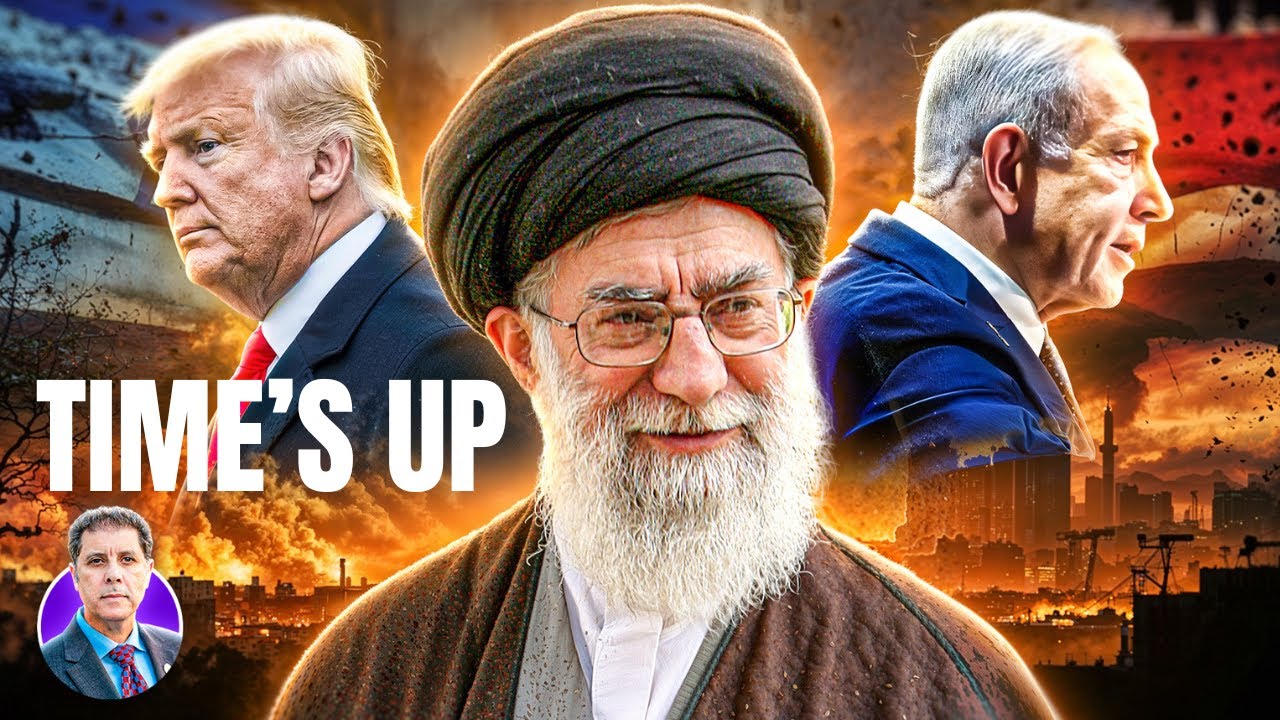
This content was created by David Oualaalou. This content was uploaded by David Oualaalou. This is a YouTube video titled "It's Done: Israel Bombed Iran (Now What?!)" (published June 16, 2025) consisting of a hosted geopolitical commentary/podcast segment. Two hosts (labeled SPEAKER A and SPEAKER B) discuss escalating U.S.–Israel–Iran tensions, stalled nuclear diplomacy in Muscat, possible Israeli strikes on Iranian nuclear sites, likely regional retaliation, and broader geopolitical and economic fallout (energy markets, safe-haven flows into gold). The episode also includes a lengthy sponsored read for GoldMining Inc. (ticker GLDG) that promotes the company’s project portfolio, financials, shareholders, and leadership — noting co-chairman David Oualaalou is named as an executive associated with the firm. Content type: spoken YouTube commentary with an integrated advertisement.
Chapters
Hello everyone and welcome to Geopolitical Trends, where truth matters.
Something shifted in the global order.
As U.S. and Iranian diplomats wrap up their sixth round of nuclear negotiations in Muscat, Oman, news broke that multiple American military installations in the Middle East or West Asia had been placed on high alert. Simultaneously, President Trump publicly confirmed what had long been whispered in intelligence circles: Israel may be preparing for a direct military strike on Iran's nuclear sites. And if that happens, the United States will not stand in its way. Iran, for its part, has responded with chilling clarity. Not only has it expanded its uranium enrichment efforts, but it has also declared that it now possesses intelligence on Israel's own nuclear facilities. Tehran warned that if it is attacked, it will retaliate forcefully, and not only against Israel. American bases across the region have already begun evacuation, a clear sign that Washington believes Iran is not bluffing. The Diplomacy Breakdown. Despite months of negotiations, the United States-Iran nuclear talks have stalled.
Each round seems to end not in the breakthrough, but in a deeper suspension.
As diplomatic efforts wear thin, both sides have begun preparing for the worst. What makes this moment especially dangerous is that diplomacy has not failed in silence; it has unraveled under the open threat of force. President Trump's public statements that an Israeli airstrike 'could very well happen' doesn't just reflect military assessments. It also signals a growing frustration with the slow pace of talks and willingness to escalate if talks don't lead to results. This diplomatic breakdown is unfolding alongside rising coordination between the United States and Israel. Behind the scenes, intelligence sharing has reportedly intensified. Washington and Tel Aviv are aligned on one critical point: they will not tolerate a nuclear-armed Iran. What about Iran postures? Is it defensive or is it defiant? Iran's response has been both strategic and incendiary. The regime has activated a third nuclear enrichment site and continues to increase the purity of its uranium. While Western leaders frame this as a provocation, Iran sees it as leverage, something to force Washington and its allies to negotiate on more equal footing. And it's rightly so. Meanwhile, the Iranian Intelligence Ministry claims it now has access to detailed information on Israel's nuclear facilities, hinting at a capacity for asymmetric retaliation that could shift deterrence in its favor. From Tehran's perspective, military action by Israel or the United States wouldn't just be an attack; it would be a declaration of war. And war would not remain confined to Iranian soil. In multiple statements, Iranian leaders have threatened to strike U.S. military targets across Iraq, Syria, and the Persian Gulf if they are attacked. This is no longer a theoretical threat; it's a stated policy. Tehran has drawn its red lines clearly. If war comes, what will it look like? Well, should Israel move forward with airstrikes, the first wave would likely target Iran's deeply buried enrichment facilities near Natanz and Fordow. But Iran's retaliation wouldn't come from a single direction. It would likely use its regional allies—Hezbollah in Lebanon, militias in Iraq and Syria, and even the Houthi rebels in Yemen—to open multiple fronts. American bases in the Middle East would become immediate targets. Oil infrastructure in the Gulf would be hit, leading to a massive spike in energy prices and disruption to global shipping lanes. The fallout wouldn't stop there. Iran's military response could provoke a broader conflict, drawing in actors like Russia and China. Russia has already deepened its ties with Iran over the past 2 years, and while it may not send troops, it could provide weapons, intelligence, and diplomatic cover in the UN Security Council. China, too, has energy and strategic interests in Iran. If war erupts, Beijing could respond economically. Perhaps accelerating de-dollarization efforts or stepping in to broker peace on its terms. A Changed Geopolitical Landscape. What emerges from such a conflict wouldn't just be a battered Middle East; it could trigger a fundamental shift in the global order. The United States might find itself overextended, militarily speaking, while attempting to contain simultaneous tensions with Russia in Europe and China in the Pacific. Gulf monarchies could draw closer to China for protection or stability. Russia, emboldened by US destruction, might escalate in Ukraine or Central Asia., and oil prices, already volatile, would likely soar, with gold and other hard assets following suit. Financial markets would not be immune. Investors would flee equities for safe-haven assets. Supply chains, especially in energy and defense technology, could be severely disrupted. The resulting economic shock could rival or exceed the impact of the 2008 financial crisis, but this time triggered not by banking failures but by geopolitics. Then we ask the question: Is war inevitable? It doesn't have to be.. But the margin for error is razor-thin. For peace to hold, diplomacy must be revitalized immediately and with teeth. That means back-channel negotiations involving neutral intermediaries, not just formal statements in the press. The United States and Israel must also clarify their intentions. Is military action truly imminent, or is it a tactic to force Iran back to the table? At the same time, Washington must engage both Russia and China, not just as adversaries, but rather as stakeholders who could help contain the fallout. If Moscow and Beijing believe that a US-Iran-Israel war threatens their interests, they may apply pressure on Tehran to show restraint. But these are fragile hopes in a time of escalating tensions. What happens next will depend less on public speeches and more on covert negotiations A red line's management and whether cooler heads prevail behind closed doors. Here is my final reflection on this. We are entering a moment of remarkable risk. A coordinated strike on Iran by Israel, with or without United States backing, could change the balance of power across three continents. It would set off not just missiles but a global realignment in energy, finance, and diplomacy. What's at stake here isn't just one country's nuclear program; it's the architecture of global security itself. And unless something changes fast, that architecture could be shaken to its core. As the threat of war grows, one thing becomes crystal clear: when diplomacy breaks down and missiles are being moved into position, money moves too. In times of conflict, especially in the Middle East, gold doesn't just rise, it surges. We are already seeing this. In the last 48 hours, as tensions escalate between Israel, Iran, and the United States, gold prices have spiked past $3,380 per ounce, hitting a new all-time high. Investors are pouring into gold as the ultimate geopolitical hedge because, unlike fiat currencies, gold doesn't need peace to hold its value. And beneath the surface, something even more telling is happening. Central banks around the world, especially in China, Russia, and Turkey, are hoarding gold at historic levels. Do you understand what this moment means? If war erupts, If global trade is disrupted, if trust in institutions falters, gold becomes the fallback.
This leads me to talk about today's sponsor, GoldMining Inc., a company that is helping investors not only ride the wave of gold's resurgence but actually own a piece of the ground where this new gold story is being written. Once again, today's sponsor, GoldMining Inc., stock ticker is GLDG, which is, by the way, traded on the New York Stock Exchange. This isn't just another junior miner. GoldMining owns one of the largest gold and gold-copper resource-stage mineral portfolios in the Americas. We are talking some dozen projects across 5 countries located in pro-mining jurisdictions in Canada, the United States, Brazil, Colombia, and Peru, with an estimated 12.4 million ounces of gold equivalent in the measured and AMO indicated category, and an additional 9.1 million ounces of gold equivalent in the inferred category. But wait a minute, the company doesn't just own resource-stage mineral properties. It also has a portfolio of publicly traded equities and cash. GoldMining has grown its portfolio of publicly traded securities to over $150 million based on the market closing price of those securities on June 12, 2025. This now surpasses the current market cap of the entire company. The marketable securities comprise entities from spinouts and an option agreement including: 13% of Gold Royalty Corp., GROI, 79% U.S. Gold Mining Inc., USGO, and 22% of NavGold, Nauv, forming a solid financial foundation. An additional $6.8 million of cash and equivalent as of last recorded quarter and financials on February 28th, 2025, which include, by the way, 9.9 million shares of USGO are quoted at $95.2 million. 21.5 million shares of GROY are quoted at $49.1 million. 25.9 million shares of NAV are quoted at $6.4 million. The total equities holding valued at $150.7 million. Once again, GoldMining, stock ticker GLDG, and it is traded on the New York Stock Exchange. GoldMining is focused on advancing key projects such as its São Jorge project in Para state in Brazil. The company has just initiated the largest exploration program in the history of the company. And this one was at San Jorge, as we see in this picture on the graph, which is an open-pit resource with regional growth potential in about 46,000-acre land package. Gold mining is on trend from Tucani-Tinzinho G Mining, which has the same style of mineralization but has been much more extensively drilled, about 400+ meters depth, with 30 million ounces of reported production over 40 years in an area of approximately 90,000 square kilometers. While GoldMining has much less drilling, most only about 200 meters depth. The information on Tucanitizinho is important to understand the region, obviously. Each project is different, and proximity is not indicative that San Jorge will have the same result. The San Jorge project is also ideally situated within 2 to 3 kilometers of paved highway, and power available from G-Mining, Tocani, Zinho, and Serbia's nearby Paleto mine. There are 4 key points I need you to understand: 1. Record gold prices. The stock market gold prices have been on a historic run recently, crossing the $3,300 per ounce mark. Setting a new all-time high. Yet, despite this surge in the price of metal, many gold mining stocks have not followed suit. For some investors, this disconnect could represent an opportunity. As you can see in the graph, gold stocks have a tremendous gap to close, and this one compared with the gold spot price, which has soared in the opposite direction. Companies with strong project portfolios and solid financial structures, like GLDG, may be well-positioned if investors' sentiments begin to shift back towards the sector. 2. Gold reserves must be replenished. Size, quality, and location matter. One of the biggest challenges facing the gold industry today is reserve replacements. Large mining companies need new discoveries to replace the ounces they are producing, but exploration spending has lagged, and new major discoveries are becoming increasingly rare. And that's where companies like GoldMining Inc. may come into focus. Size, quality, and location matters. The GoldMining portfolio includes increasingly scarce large-scale gold and gold-copper projects in mining-friendly jurisdictions, just what the major operators we need to replenish reserves mined through production. Back in 2010 to 2012, the combined peak market cap of the companies that previously owned the assets in the gold mining portfolio was approximately $850 million Canadian, and that's back when the Canadian dollar was much closer to par with the US dollar. Fast forward to 2025, and gold mining's entire market cap is around $150 million. So despite gold prices climbing from $1,925 in 2011 to $3,300 recently. So why does this gap matter? These are large-scale projects in safe jurisdictions with infrastructure advantages and, of course, a management team with deep experience in building value over time. Gold mining may be in a strong position to benefit from this trend. For example, Yellowknife Gold Project, which is in Canada. La Mina Gold copper project, which is in Colombia. Number 3: Experienced leadership team. GoldMining has a strong leadership team led by industry experts with decades of experience successfully growing and operating mining companies. Led by co-chairman David Oualaalou, who was the ex-Goldcorp CEO, in addition to Amir Adnani, a serious success story, and ex-Newmont executives. This team has proven records of success. Insiders own over 5% of the company. They have real skin in the game. Number 4: Lastly, look at the key shareholders of the gold mining Inc. You have Ruffer, BlackRock, Sprott, Morgan Stanley, GDXJ ETF, UBS, and Goldman Sachs. Managements and insiders have a real skin in the game, collectively owning over 10 million shares, or approximately 5.15% of the company as of May 12, 2025. Check out GoldMining Inc. on New York Stock Exchange under stock ticker GLDG. Now, if you are looking at companies with leverage to gold prices and a long-term development strategy, GLDG may be worth a closer look. As always, Make sure to review GoldMining public filings for important information regarding it and its projects, including its most recent annual information form and technical reports, which was referenced in them. So check out GoldMining stock ticker GLDG and visit their website goldmining.com and do your own research. As always, remember, there are always risks with investments and there are no guarantees. Thank you.
More from David


Beyond the Single Actor: Why the Gulf Isn't Choosing Between the US and China


Iran, Iraq's Militias, and the Houthis Are Coordinating! This Changes Everything




Who Controls the Next Decade's Resources? Latin America and Africa's Geopolitical Crossroads

The Chokepoint Trap: How Washington's Stupidity Triggered a Cascade That Now Controls the World

Trump Spooked as IRGC Unveiled dual-use SLV, Deployed Ghadir Mini-Subs & Hinted at Tactical Nukes!
