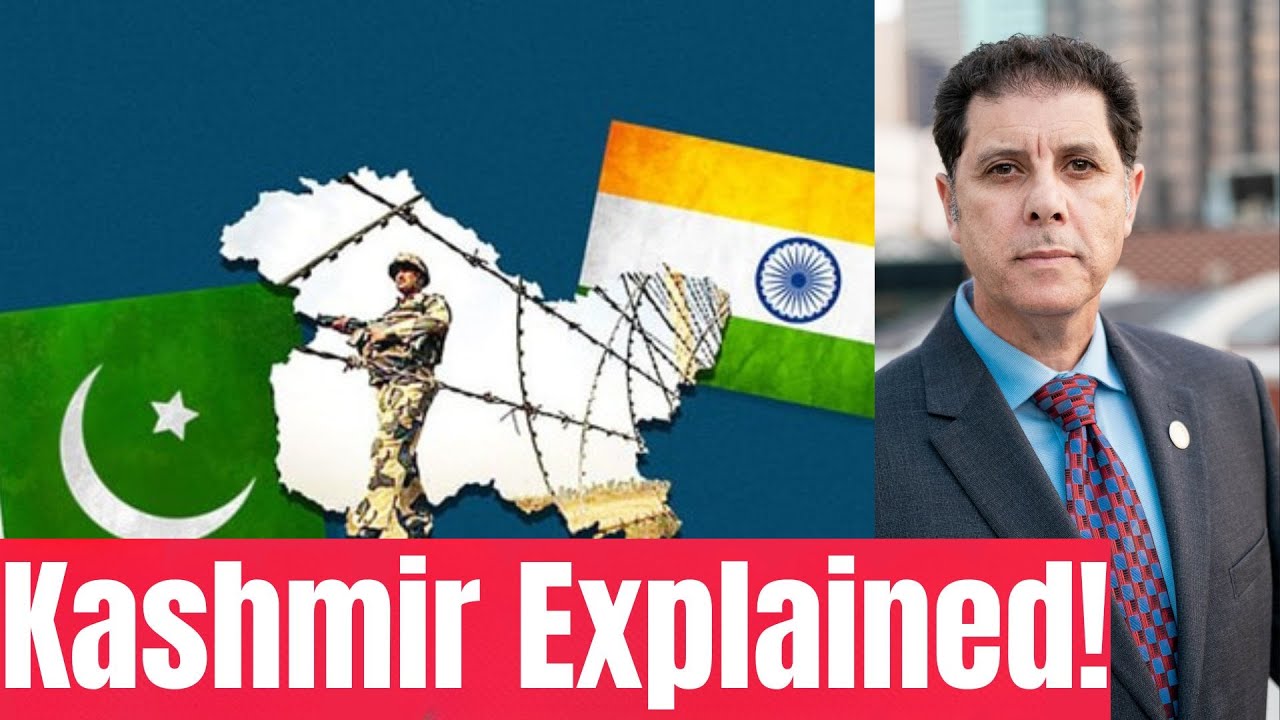
In this hour‑long livestream, the host (Speaker A) of the Geopolitical Trends channel presents a deep‑dive into the Kashmir dispute, blending historical overview, recent developments, on‑the‑ground reports, and geopolitical speculation. After a brief channel introduction and audience shout‑outs, the discussion is organized around three core questions: (1) can the Kashmir issue be resolved, (2) would the parties benefit from keeping it unresolved, and (3) why has a referendum never been held. The host outlines Kashmir’s geography, showing how the region is split among India (two‑thirds), Pakistan (one‑third, including Azad Jammu & Kashmir), and China (Aksai Chin/Trans‑Karakoram). A historical narrative traces the area from Mughal and Sikh rule through British colonial arrangements, the 1947 partition, the 1949 UN cease‑fire and plebiscite resolution, and the 2019 revocation of Jammu & Kashmir’s special status by India, which triggered an eight‑to‑ten‑month internet blackout – one of the longest worldwide shutdowns. The host cites personal contacts and “ground sources” to claim that internet has now been restored, that Kashmiri sentiment overwhelmingly favors independence (an 80 % poll result), and that Indian security forces suppress dissent while Pakistani‑administered areas enjoy self‑governance. The livestream also examines broader strategic motives: the United States, China, and other powers allegedly keep the dispute alive to maintain leverage over India, Pakistan, and China; references are made to US‑Canada diplomatic pressure, the role of the UN, and parallels with other geopolitical flashpoints (Afghanistan, Taiwan, Haiti). Throughout, the host stresses an “objective” stance, invites viewer comments, and warns against judgment, while also acknowledging personal bias and the sensitivity of the topic. The session ends with a call for subscriptions, a preview of future content, and a reminder that geopolitics affect daily life.
Chapters
Hey everybody and welcome to Geopolitical Trends. So excited to be with you on this Saturday. I got a, an interesting, controversial, sensitive topic, has to do with Kashmir. At the same time, we can't shy away from addressing hard topics that do matter. Yes, I understand the complexities of it, I understand the historical aspects of it to a degree based on my own knowledge, my research, and my contacts on the ground, which I'm going to be sharing with you some information that I get directly from Kashmir. I have my own sources, and that is the reason why it took me a few days before I decided to, to do this. So anyway, this is what I'm going to be talking about this today. So I'm so excited that you're here. Spending this hour with me here. Your time means a lot to me, and I appreciate you for that. So before I'll do anything, like I always do, I like to extend my sincere thanks to all channels' members, supporters, and for you, if this is your first time, I will greatly appreciate if you could subscribe to this channel, so to move it up forward. So, uh, I also like to give a shout out to two new members One, one is not a new member, he's a member on this channel, but he's been an avid supporter. I've been always reading his comments. His name is, and I'm gonna pronounce it, uh, uh, Zho Jian. Thank you so much for becoming a supporter. And the second person is Jeffrey, or Jeff Lee. Thank you very much for becoming a channel supporters. I'm short about 14 members, so if any 14 of you can become a member of the channel, supporters, so I— we can reach 100, so I can do the exclusive Q&A for the members. Because I promised, I promised you once we reach 100 members. So 14 short. So if you feel like becoming, uh, supporters on the channel, I would greatly appreciate it. So, and once again, if this is your first time here, please make sure to subscribe. I will greatly appreciate it. Just few housekeeping stuff here, uh, remember to join me on Monday, uh, for my conversation with Dr. Stewart, and I'm gonna share the link with you here. This is for the health channel. I'll have all this for you guys on the description, so don't worry about if you can get it right now, but I will, I will do it soon. I also want to share with you, uh, this is, uh, about the government course. If any of you are still interested, I usually give the— I teach the course on Tuesdays at 1900 hours, my local time here. So, and the other one is if you want a free copy of my Saudi book, here is a link to it. All you need to do is sign up for this, uh, uh, to sign up for it. And, and remember, I don't give your email anywhere else, whatever. That's just strictly for the book. So, uh, your privacy means a lot to me. So, and to those who might be interested in my, uh, in my, my writings, my article, whatever, I have everything here on Amazon or whatever. You can check it out if you are interested, and I will put all these links for you guys. So I don't want you to worry about all this. So, all right, let's, uh, let me first of all see who's here. Oh, Hong Twa, right away, that's the first one that came up here. So, so all of you, good to see you here. Eternal, good to see you again. Uh, there are some names here. Cam 35, good to see you. Uh, uh, Coach Ohoi, good to see you. Boon, good to see you. Phil, good to see you. Robert Gibson, good to see you. Uh, who else I do have? Uh, Nikhil Kiwat, good to see you here. And, uh, Shriram Prasanna, good to see you here. And Taiwan Steel, good to see you. So excited to be here with you guys as well. So let's, let's get into this topic because I got a lot to cover. And one thing, before we launch into anything, please, please, please refrain from any judgment because here's one thing, and I promised you, you know, What this channel is all about is about objectivity. Yeah, do we make mistakes? Yes, we do. That's what makes us human. Do I make mistakes? Yes, I do. That's what makes me human. However, when something like this— that's why I take my time, because I have to verify the information. I have to do my own research. I got about a page and a half of references. I'm not going to give you all of it, of course. I'm gonna just, uh, put few information— I mean, few links for you rather, so this way you have at least access. But because of the sensitivities of certain topics, we have to check on, on, on, on the— first of all, the historical record, but also for me, I have, uh, sort of my own resources how I can get the info from the ground, on the ground. There are people in the ground that I just got the info about.. And this is what I intend to share with you without, you know, being objective. That's what matters. So, so we'll start with the 3 questions, or 2, that is. Could the issue of Kashmir be resolved? You know, that's just question for us all to think about. Some say yes, some say no, and I'll tell you why some say no. Second thing, is it better for all parties involved if this issue is not resolved? Yeah, it's because there is a lot behind the scenes. I know one of the viewers put a comment, uh, at some point, as far as I didn't see the big picture and all that. I respect that, and, and he or she got valid point, and I am gonna share with you some. But I did, I did, except that you cannot cover this in a short video and even for a live stream because the complexities of it because the many players involved, because the governments themselves are navigating policies to justify one action over another. And this is not about just India, by the way. Other governments are playing a role into this, including ours, because for us in the United States, we know Kashmir is a hot button. We can pressure many countries, including the main three: India, Pakistan, and China. I understand all that. So sometimes I might not say it, but, but I respect the, the person's, uh, uh, opinion who shared this, which was very spot on. I am so glad he or she, uh, shared that, and I'm going to share it with you. The third question we need to ask is, if this is all in place, how come there is no referendum? And this is why I put the survey question for you guys in the, uh I posted for the community. I don't know, some of you saw it, uh, or might not. But anyway, the answer was— and the question was, should Kashmir be independent from both Pakistan and India? So, uh, as I put the question, pick 1 for yes, no, 2 for no. And, uh, the poll shows here, yes, 80% meaning should be independent from both Pakistan and India. And the nos had about 20%. So it's overwhelming. But also, that depends. Again, there is a lot of— we can't just jump to conclusions. But I wanted just to put that out there. So the question becomes as this: why not referendum? You know, and by the way, we're not just putting this on the the India or Pakistan or people in Kashmir, whatever. We have the problem right here at home. I bet you if we are to do a referendum here in the United States, for example, the state of Texas being independent from the rest of the United States, majority will agree. I'll be the first one to vote for it, you know. As a matter of fact, and I'm gonna share it with you, it's not classified, it was a research that was conducted some 35 or almost 40 years, way back here in the United States, and it was conducted by the Pentagon. Okay, what they wanted to see or find out or learn about is that what would happen if the idea of being separated from the rest of the United States— and this was specifically for the southwest part of the United States, southern part of California, New Mexico, Arizona and certain areas, uh, uh, yeah, from Mexico, that is. And you know what was the result? Majority wanted to be independent from the rest of the United States. That sends red flags inside the, the halls of the Pentagon, and they kept hush-hush on the, on the, on, on the research. This is why I use the term referendum to resolve this issue. So here is basically, because here is what happened, we're gonna have to And I'm going to start backward, so go back to August 5th, 2019. What happened in 2019? It was when India revoked the special status of its portion. This is the key word. It didn't say of all Kashmir, of its portion of Kashmir. Well, India's portion is two-thirds, Pakistan portion is one-third. So what India end up doing is revoked the special status of its portion in Kashmir known as Jammu and Kashmir. Okay, and why is this? This was in a bid to fully integrate its only Muslim-majority region with the rest of the country. This is why I'm saying, why, why do we— that we want you to have a referendum and let people vote for whatever they want? They want to be part of India, they want to be part of, uh, Pakistan, or they want to be independent. So, and this is where the, the, uh, the, uh, the massive arrest and, and, uh, where the authorities in India imposed communication blackout, which I will get into that because I had to dig into some information, okay, from my own sources on the ground as to how long it took for the blackout, which took about 8 months, no internet. And, and by the way, why not just blaming India? Yeah, let's not jump to this. There were about 100— I did find out, and I'm gonna put all the links— there were about 187 internet shutdowns around the world. Okay, this is according to a report that was just published last year. Okay, out of the 187 84% by India alone. That begs the question, if you are to say democracy, how come you embark on this? And once again, guys, we're trying to be objective here, no pointing fingers, no whatever. So, okay, because that's what makes sense for us to learn. So this is where the authorities back in 2019 cut off communication. It was, uh, established or imposed communication blackout, cutting off phone and internet connections. All right, before I move further, let's jump to geography and let's jump to history, then I'll go into my own brief analysis about this one. So, so I'm gonna be showing you some pictures here. I got a lot of pictures, some of them new— not new, contemporary rather— and some of them from old history. So let's start with, uh, geography here. And I'm gonna— and by the way, here is what we're talking about today, just, uh, try to put an idea for those who might be just joining us here. So we'll be talking about Kashmir today. So, so by the way, as to the maps, well, what I found very interesting, depending again what part of the world you are looking at that map from, For example, in certain maps you will see that certain part, for example, when it comes down to China, it says occupied. Okay, in other maps it says part of. So, and I am not gonna— I'm gonna show all three. I'll let you reach your own conclusions. But suffice it for now to say all I'm gonna be talking about is this area right here. I'm pointing at it. You can't see my cursor. I'm pointing at Kashmir and Jammu. This is why I'm going to leave this here while I go over geography briefly. And the geography, uh, uh, there, there's a source for me that I go to. Her name is Amanda Brainy, and I did put one of her links in my previous because she's qualified. She has a degree in, uh, in, uh, in, in geography, and she is certified geographer. So, so basically, uh, what are we looking at? We're looking at Kashmir, about 68,000 square miles area, okay? And it is bordered to the north and the east by China. You look, this is when you look at the Xinjiang and Tibet, that's on the north and the east. To the northwest, it is bordered— meaning Kashmir, it is bordered by Afghanistan. This is where you— for those, I've been in Afghanistan, so I was familiar with Wakhan Corridor. That's part of where it is bordered by in the northwest. To the west, it is bordered by Pakistan, and this is where Khyber, Pakhtunakawa, and Banjar. And to the south is by India, Himachal Pradesh, and Banjar. So, so Kashmir, when you look at it, is a region located in the northwestern part of Indian subcontinent. I don't say part of India, I say Indian subcontinent. So, and this why it includes the states of, uh, uh, uh, Jammu Kashmir and, and so forth, as I mentioned. So now here is what's interesting about this geography. Is that when you look at that Indian state of Jammu and Kashmir, as it is known there, it is as well also as the Pakistani states of Gilgit-Baltistan and Azad Kashmir. This is where you have the Azad population there. So then you add the third one, which what you look at, at the map here, is the Aksai Chin and Trans-Karokham are also included in Kashmir. This is why I say depending on what type of map you're looking at. What's interesting is that the United Nations, which by the way, it's toothless and has contributed to this problem of Kashmir. Let's say it straightforward. Yes, we know Britain created the whole mess like always. Look what they did in the Middle East and now they did the same. And I'll get into that in history here. But the problem with the UN is that it refers to this region as Jammu and Kashmir. So, so it was until 19th century when Kashmir geographically included all the valley region from the Himalayas to the Pir Banjal mountains range. And today, by the way, it has been extended to the aforementioned areas I mentioned. So it is very interesting to study, uh, Kashmir geographically per se to understand why its status is disputed and why it often causes conflict to develop in the region. We already saw the two or three wars between Pakistan and India, but now you look at three main players, not two, three: India, Pakistan, and China. So another thing to look at it, and the geography has to do with ethnic groups of Kashmir. You know, most Kashmiri population— here is the thing— are Muslim. Hindus also live in the region, and the main language is Kashmiri. This is what's interesting about this one. Let me show you another map here, guys, because it's important to understand what are we looking at. You look at this one here, this map I'm pointing at it, if you see the Akshekin. It says occupied. In other maps it says part of. So, and again, we're not here to talk about— we here to talk about Kashmir itself. Let me show you another map here because maps are very, very interesting, you know. Uh, this one, it shows right here the section that is— I'm pointing at it, you guys can see here, but You see the area that is controlled by Pakistan, you see the area that is controlled by India, and you see the area that is controlled by China. This is why those three main players are very, very, very crucial in understanding what's, uh, about this part of the world. So I have another map here, and again, you see the Durand Line and You see the line of control. So because when one, it says Kashmir dominated by Pakistan, of course there's the city of Kargil, which was the, uh, 1999 war, and the Abbottabad, which was on the border. So let me go back to this one here, this map here, and I'm going to share with you a little bit about a history because you need to understand the history part. And especially when it comes down to, uh, uh, uh, here's the thing. It was throughout history that Kashmir has been called an earthly paradise. It's because of its very beautiful— and the people that I know from that part of the world, they swear by it. I've never been in Kashmir. I've been in Afghanistan close by, but I talked enough to people who used to travel back and forth between Kashmir and Afghanistan. Uh, they are saying that it is like a paradise on the ground, so on Earth rather, or earthly paradise, that is. Uh, and the reason I'm sharing these pictures here with you, because I'm gonna get into the history aspects of it, and you need to understand, uh, uh, this part of, of, of, of, uh, Kashmir's history. So let's start with this part here, which is the 17th century, which, uh, this is where, uh, the Mughal emperors into the 16th century and 17th century considered Kashmir as an earthly paradise, you know. But here is the thing, violence has always existed in, in, in Kashmir before, before the disputes between India and Pakistan. Basically before their partition in 1947 by the British. And this is where it was created, because when the partition happened in 1947, it created Pakistan as a Muslim counterpart to a Hindu-majority India. But also, we can't forget about Sri Lanka, we can't forget about Bhutan, you know, you can't ignore Bangladesh. You know, and we can just see the influence of India in certain parts. But, but let's get into the history of Kashmir. So after centuries of Buddhist rule, Muslim Mughal Emperor took control of Kashmir in the 15th century. And what happened when they took control? They converted the majority of the population to Islam and incorporated it into the Mughal Empire. So Islamic Mughal rule should not be confused with modern form of authoritarian Islamic regimes. Yeah, let's not confuse that. The Mughal Empire, characterized by the likes of Akbar the Great, who ruled between 1542 and 1605, and he embodied Enlightenment ideas of tolerance and pluralism a century before the rise of the European Enlightenment. So yeah, which sometimes in the history references, Europeans would never mention that it existed the way back. So the Mughals left their mark on the subsequent Sufi-inspired form of Islam. This is why you see in Sufism in Turkey. Sufism in certain parts of Southeast Asia, mainly there. There is some part also in North Africa, mainly between Libya, Tunisia, Algeria to a degree, Morocco to a degree. Egypt, you don't see much there. So, and that's why this form dominated the subcontinent in India and Pakistan before the rise of, of course, jihadists and so forth. Uh, which is another conversation for another day. So then what comes after that? Afghan invaders way back, which followed the Mughals into the 18th century, who were themselves driven by the Sikh from Punjab. Of course, right after this, Britain invaded in the 19th century and sold the entire Kashmir Valley for half a million rupees, which means basically 3 rupees per Kashmiri, to brutal repressive ruler of Jammu at that time. It was the Hindu Gulab Singh, and it was under Singh that the Kashmir Valley became part of the state of Jammu and Kashmir. This is what's important to understand. And let me show you a map here to highlight to you. That's way back in the 15th, 16th century. So, because this is very important to understand, I always going to refer to this map here because it's contemporary, but at least it shows you certain aspects of it. Now let's talk about brief historical facts about Kashmir itself. Well, historical documents based on what I found, and I am going to post all the— as I told you, I have about page and a half of references So historical documents state that the region of present-day Kashmir was formerly a lake. Thus, or as a result, its name is derived from several translations that deal with water. So Kashmir in itself, a term used in the religious text of Nila Mata, Purana. Which means for— which means, and I put this in quotes because that's how it was referred to in a historical record, a land desecrated from water, end of quote. So, so Kashmir's old capital, Srinagar, was first founded by Buddhist Emperor Ashoka, and the region served as the center of Buddhism in the 9th century, Hinduism was introduced to the area, and both— yeah, this is the key word, guys— both religions, meaning Hinduism and Islam, thrived. Fast forward 14th century, the Mughal ruler Daulat Khan invaded the Kashmir region, and this ended the Hindu and Buddhist rule in the area in 1339. After that, in which, uh, Shah Mir Swati became the first Muslim ruler of Kashmir. Throughout the 14th century and into subsequent time, Muslim dynasties and empires successfully controlled the Kashmir region. And by the 19th century, we don't know what happened, the Kashmir was passed to the Sikh armies that were conquering the area. Fast forward, I'm going to take you now to 1947. And this map, I think— not, not this one, this one here might reflect that one. Fast forward to 1947, at the end of the England rule in India, the Kashmir region was given the choice. Here is the thing: Kashmir was given the choice to become part of the new Union of India the Dominion of Pakistan or to remain independent. That's, by the way, I looked at other records, I didn't see this there. Remember, even certain records can be very cherry-picking. Mainly it depends on where that record is being compiled. So, so around the same time, however, Both Pakistan and India attempted to gain control of the area, and the Indo-Pakistani War of 1947 began, which lasted until 1948 when the region was partitioned. Two more wars over Kashmir took place in 1965 and 1999. And by the way, this is where I have my own sources, and I put a separate narrative for this, and I'm going to share it with you as I move forward. So, and this is where the— it is important to understand the historical reference of 1947, the partition of, uh, partition of, uh, uh, India and Pakistan, of course, and of course of Kashmir. So, and as I said, they were partitioned in 1947 And Kashmir was split with two-thirds— this is the key— two-thirds going to India and a third going to Pakistan, even though India's share was predominantly Muslim. This is where the problem— like Pakistan, Muslims rebelled and India repressed them. War broke out and it was settled in 1949. That's when the ceasefire by the UN and a resolution called for referendum or plebiscite, allowing Kashmiris to decide their future for themselves. However, here is the key: India has never implemented the resolution, and the UN was toothless to push for that. And by the way, for those who might wonder what the word, uh, uh, uh, what's the word, plebiscite, is, the meaning of plebiscite is a vote by which the people of an entire country or district express an opinion for or against a proposal, especially on a choice of a government or ruler. So this is why it's important to understand. And at the same time, where all this happening, instead India has maintained what amounts to an occupying army in Kashmir. It's still to today. There is not— and, and again, this is a reality on, on on, on the ground, and I'm going to share, uh, what I get from my own sources directly. So, and this has cultivated more resentment from the locals because majority were Muslims in Kashmir. So then you get the modern India's founders like, uh, Nehru and Mahatma Gandhi, both had Kashmiri roots. Which a lot of people do not know, which partially explains India's attachments to the region. So to India, Kashmir, for the Kashmiris, means nothing. Indian leader stands the, uh, standard line is that Kashmir is an integral part of India. Well, not if the Kashmiris don't want to belong to India. How can you enforce your will on them? Because don't get me wrong, even Kashmiris do not— some of them do not want to be part of Pakistan. This is what I'm saying, referendum to belong to neither, or they want to belong to either. Let give them a choice, let them decide. So, and this is why, uh, the 19, for example, even with the accordance to the UN resolution, we which has never been, uh, uh, enforced because India never implemented that one. So, so Pakistan renewed its call for referendum by Kashmir's mostly Muslim population of 5 million to decide the region's future, and this once again according to the 1949 UN resolution. But India continued to resist conducting such vote or referendum. So, and this is what paved the way for the 1965 war, because it settled nothing basically and merely put off the future conflicts. And of course, I am not gonna get into what took place between 1977 and 1988 with the rise to power of none other than Muhammad Zia-ul-Haq of Pakistan. That was the reason why, among others, why his plane was shut down. A lot of people think that it was an accident. It wasn't an accident. So, so if we are to talk about Kashmir today, so I'm going to share with you what is out there on the mainstream research platforms and so forth. Then I will share with you my own resources. Okay, so according to Congressional Research Service report, relations between Pakistan and India remain deadlock on the issue of Kashmir sovereignty, and a separatist rebellion has been underway in the region since 1989. Tensions were extremely high in the wake of Kargil conflict, as I mentioned earlier, in 1999, when an incursion by Pakistani soldiers led to a bloody 6-week-long battle. So of course, when Musharraf, former Pakistani leader, uh, took over, pledge as always proved empty because he was pledging so much but nothing was delivered. So So, and violence in Kashmir continued right after till May 2002 when an attack on an Indian Army base killed about 34. So to me, I look at it like the Arab-Israeli conflict. So the conflict over Kashmir remains unresolved and I think it will remain unresolved as long as there is no referendum. Unlike the Arab-Israeli conflict, it is the source and perhaps the key to peace in a region far greater than the territory in dispute. There are those who might disagree with this, and this is what I'm going to get into by sharing with you what I have found through my own sources from the ground in Kashmir. So once again, let me just show some very beautiful pictures of Kashmir. It's, it's, it's a nice area, is what I was told, and the people that I know in that part of the world. So here's the key, you know, and the way I did this, and I'll share it with you, of course I can't disclose the source no matter what the cost is, and I don't waver on that. Uh, I had to send some questions, and those key questions. And the question that I asked was, I would like to know the state of the, the current state of affairs. Is India, for example, still restricting access to internet? Do Kashmiris want to identify with Pakistan or India? And where is the Prime Minister of India Modi's current policy towards Kashmir? One that is not reported by the mainstream media. So, and here's what I— the information I received from my source, and I will trust my source. That's why we call them source. So, and I said it just happened. Let's think about it. Kashmir internet is restored as of today after 8 to 10 months of cutoff. But Indian authority, the government, mainly the BJP, this thing. Now when I say this, remember, there are those who say, well, Modi has nothing to do with it. And there is a possibility to that. Scenario. Yeah, it might not be in control because there are rogue elements inside the governments within the PGP in Modi's government. Yeah, that's like almost like our president here in the United States. President has no control. You know, how the heck would he know what's going on? They're just telling him, feeding him stories, let alone his mental capabilities are not there. So for the Prime Minister of India, he could be in the same boat. So what happened with— and I'm going to put it in general term, you interpret that whether it's Prime Minister Modi directly or the government. So for me, I say Modi's government, and we leave it at that. They restrict social media and take the right to freedom of speech. So there is no rule of law in Indian-occupied Kashmir, known as IOK. So this is again according to my source on the ground. So Kashmiri people definitely do not want to be part of India. Some of them, they want to merge with Pakistan. Kashmiri people wants their own state. That's why I said some, not all. Don't misinterpret this, guys, that what they don't want to be part of India, they want to be part of Pakistan. Not necessarily, because some are wanting to be independent. They have their own. But when you look at the map, because it's very crucial to— when you look at the map, the location, it's very, very, very important to understand the geography of it and how it will impact the geopolitical landscape. That's why it's important. So when some Kashmiri people don't want to be part of India, they also want to merge with Pakistan, but some others, they want their own state. But as of now, and this is according to my source, Azad Jammu Kashmir, what you saw on the map there on the left side, known as AJK, is a self-governing administrative region in Pakistan. It's not under Islamabad. It is sort of, uh, uh, not administratively. They have their own because they have separate prime minister, okay? And they have separate Supreme Courts. So which means what? Why am I highlighting this? Once again, let me point this out on the map. And I know you guys can see my cursor here. See on the left side in green, Azad Kashmir. That's what I'm referring to here because that's one-third of the territory of Kashmir. So basically that territory, according to my source on the ground, they have their own prime minister and they have their own separate Supreme Court, which means what? Since they aren't part of Pakistan, Pakistan is giving them all the rights as Kashmiri people. So what's interesting is that Modi didn't recognize the current boundaries of the Kashmir, and there is too much tension on the border. That is what's going on. And this is why once in a while there are images out there, and there are even videos out there, and I think I did have one, and I will share it with you soon. Indian Army usually attack the villages firing from borders. My source is there on the ground. So when you fire from the border, you will not know where it's coming from. This is almost similar to what's taking place in, in, uh, uh, uh, what's the name of Manup?
Yeah.
Oh, Manipur. I'm sorry, Manipur. So, and according to my source, yeah, Kashmir people don't want to be part of, of Pakistan either. This region will remain disputed among, between both Pakistan and India. So because India is not, is not allowing the referendum to move forward, and the people on the one-third part in Pakistan, they are self-governed But they are on the Pakistani side, so Islamabad is giving them all the laws they needed. So, and here's the thing, and I even asked another question in, in, on, on Kashmir as far as certain, uh, uh, uh, fundamentalist or terrorist activities in that part of the world. So, and the source inside, uh, Kashmir said there are no terrorist activities on the Pakistani side. That's the key of Kashmir. Remember, one-third Pakistan, two-thirds on India side. The two-thirds called Jammu and Kashmir, the other one called Kashmir. So however, my source said, but this is from the Indian-occupied Kashmir where the activities are, not on the side of where Pakistan is. So I asked my source another question because I needed to know, should we? Well, I said, should we consider Kashmir as an independent, uh, governorate and is not under the authority of both Pakistan and India? So the answer I got was, and again, the source on the ground, yes, you can consider that on the Pakistani side. So only Pakistani side. So Kashmir, Azad Jammu Kashmir, which is known as, or I'm sorry, Azad Jammu Kashmir, AJK, which is on Pakistan because Pakistan is giving them all the rights. As an independent state. But you cannot apply this to the Indian-occupied Kashmir, or IOK, because there is no fundamental right there. And we all saw when the internet was cut off for between 8 to 10 months, the longest, by the way. And this is what I— when I found an article, and I'm going to share it with you here because you need to see Oh no, not the— I'm sorry, I thought it was a video, but not. I have the link and I will send you the link to all this. This is where I found an article and it says, and I quote— well, actually you need to see it so you know it's not my word here. Let me open it for you. It's fascinating when you go throughout history and decipher the facts and so forth. So, all right, let me share this with you guys so you see it with your own eyes. Share screen, and I will send you— I will put the link, not send you, I'll put the link for you so you can see. This is written very small, I'm going to read for you. And I, uh, and I quote, in occupied Kashmir, the people have been warned to be, uh, to be aware of Indian collaborators who are trying to approach their Indian masters to bring the members of extremist Hindu organizations like Rashtriya, Rashtriya Swayamsevak Sangh— it's known as RSS— and other Hindutva forces to the territory to make the Kashmiris slaves and snatch their everything, including religious identity. Okay, that's what the article mentioned, and I will share it with you. Let me see if I can share this video here. Yeah, I'm gonna share this video with you— clip, not a video, I'm sorry.
Ordered the government to restore the internet in Kashmir, ruling that the communication shutdown was unconstitutional. Prime Minister Narendra Modi's government had shut down mobile and internet networks back in August to try to quell unrest after it stripped the region of its autonomy.
Kashmir has been under a security lockdown for more than 5 months. The High Court says internet access is a constitutionally protected fundamental right.
It now wants the government to explain the need for all the restrictions it has imposed on Kashmir. More now from our correspondent Nihal Punia. Nihal, the ruling is a rebuke on Mr. Modi and the government.
Okay, I'm gonna stop right here because I don't want to— it's too long. But I will, I will send you the link to all this. So now let me share with you one of the viewers. I'm not disclosing the name. I didn't get the permission to disclose even the screen name. I don't do that till I get the Okay, so when the individuals wrote that it is, uh, crucial to consider broader perspective, which unfortunately you are missing the big picture. So I appreciate your opinion even though I disagree with you, but that's okay, you know, we are here to learn from each other. So if you disagree with me also, I, I respect that. But in due fairness, you know, I'm, I'm a fair guy, I like, I like being fair. So, uh, he or she pointed out some key points when you look at, rightly so, the big picture. And what are we referring to here? We're looking— if you look at the map, this is why it's important, and depending again which map you're looking at. So, but if you look at this, it will behooves the— and here is, as an analyst, thinking from outside the box, which I never disclosed in short videos. I, I can't do that because there's not enough time. You know, these things, it's, it's an hour-long discussions to highlight. I can tell you that nobody will want— nobody, when I say nobody, interested parties outside this region won't want this issue to be resolved. Why? Because you can target three birds with one stone. You can target Pakistan, India, and China. This is if you want to create internal dynamics disturbances. But if there is peace in the region, how else would you create that? It's in chaos where we ferment more tensions. So I understand this person's argument as to maybe this is meant to be, to stay that way so you can destabilize China from within. I see the possibility of that. I see the logic, arguments for that. Is the same arguments can be made about Pakistan, the same arguments can be made about India. And this is why when Kargil War happened, at that time the Secretary of State Colin Powell had to fly over there to settle the— because we didn't want to go out of control. Remember, both India and Pakistan are nuclear powers, but the aim was always to maintain that line of division so we can manage both. Now we manage three— China, India, and Pakistan. So I understand your point, and it's valid arguments, and China will not be You, to a degree, that depends again what part of China you're talking about. As far as could be destabilized from within, I just don't see that. But I could see it from far elements outside. So, because to these individuals, the argument was an independent Kashmir could provide such an opportunity. Yeah, to a degree, but also the same reason why we didn't see it with, uh, with the Khalistan. That's why it won't happen. And if the UN was— had some tooth, they would have proceeded forward when India refused to move forward and send in international troops, conduct the referendum, and declare them as an independent, independent country of Kashmir, or whatever they want to call themselves. So I see the argument on that. So this idea of Kashmir, like I said earlier, it serves our regional interests in that part of the world. And I've always knew this, you know, not today, I know it for last 35 years or so, that Kashmir will always be a pressure point for us. Even when we were in Afghanistan, it was always the talk about Kashmir. And that's why we never wanted at that time, or even after. Now we are very concerned, and India itself is very concerned about the rapprochement between the government in Afghanistan and Kashmiris. This is part of, uh, now there's a third element which I really find very interesting from, uh, uh, this individual, uh, and, and, and yes, I agree, we did something similar to it in Cuba, you know, for example, the Bay of Pigs. Why did it fail? Because we were the one funding groups to overthrow at that time Fidel Castro. It didn't succeed. So we can say the same thing that's going on in that part of the world. You know, we look at it also for us on, on the border, like, well, we never resolved the border issue, but it was for a reason, political reasons. Yeah, this is the reason why we never did, you know. And this is why we are fermenting those tensions in pockets. So, you know, you look at Bhutan, you don't hear much about it, right? Well, there are certain parts of Bhutan closer to India that been dominated by India. But on the other hand, you look at certain areas that we try to ferment tension in them, like in Tibet, or try to ferment, not fermentation, but rather circulate the information about Xinjiang, you know, which wasn't true, by the way. Even now you get candidates here in the US running for office, that's all they talking about. Vivek Ramaswamy, you know, the guy clueless about, you know, another member of the establishment, you know, that, that they just ferment intentions.
Why?
Because we wanted to maintain those pressure points. So I can see the logic and the arguments of this. And one key point that this individual made, which I encourage you guys to read his post if you get to it— so, uh, his or her, because I don't know— uh, what I found very interesting about the comment was about the current tensions between India and Canada. So, and said, and I quote, Now connect the recent conflict between Canada and Modi-led Indian government. A calculated and thoughtful approach taken by the Canadian government. This action aimed to achieve multiple objectives simultaneously. Multiple objectives simultaneously. The first objective is to exert pressure on Modi to comply with the demand of the West, particularly the Five Eyes.. And these demands will include number 1, severing, severing ties with Russia. Number 2, undermining BRICS and SCO alliances. Number 3, adopting a stronger stance against China. And number 4, recognize Jammu and Kashmir and Ladakh as autonomous regions under the Indian administration. I don't see that happening, you know. So, and if this is not enough, according to this individual, the second objective is to escalate the matter to international forums such as the International Court of Justice, the— or the ICC, the International Criminal Court, which both lack credibility and legitimacy. First, if this is only if an unsparing agree with the individual. If Modi fails to comply with the collective demands of the West, makes sense. Because why? Because Modi will find— will be found guilty and imposed sanctions or restrictions on his international travel, which means it will be a big blow to his image and the whole, uh, uh, government of India. So, and this is why I said earlier about the BJP, sometimes it might not be Modi himself, but rather certain rogue elements inside. This is exactly what's taking place in Manipur. And some say, where they put the blame on Modi, because Modi didn't step forward and kind of like say, enough is enough, let's figure out what's going on. He's staying mum, silent. When, when you stay silent like that, what does it say? That means you are aware of what's going on and you endure sort of activity, whatever. So, and the interesting about all this, it has to do with the upcoming elections in India. So, so could we see a different prime minister, especially if now with this issue of Kashmir? This is why I said Uh, let's not point fingers here, guys. Let's be objective in our assessments, to be, uh, uh, uh, sort of resolute in our thinking by arguing this logically. There are political calculations to be made whether the issue is solved or not, and this is where you tie it back to the two-thirds that India occupy in, in Kashmir, because that falls back to, uh, Hindutva. Remember when I mentioned that during the history? That goes way back. And to Prime Minister Modi, it will be some sort of fulfillment of that aspiration, if I may use the term. So, so this is how I see. Also, this is why I agree with the individuals who specifically shared this particular point. But to look at it, it's very complicated. We wouldn't want it to resolve to begin with. And yes, if we are to, which by the way, we are not the one calling for referendum. We will never do that. You know why? Because that would be hypocrisy. How can you call other countries to do referendum and you are not allowing it in your own? As I said, if we are to do referendum today about which state wants to leave the union, Texas will be first. I don't know about California. California is gone. California has lost. But Texas for sure. And we do have the economy to sustain and support that. So I can see the same arguments be made in, uh, when it comes down to Kashmir. But one thing I need you to understand, looking at the map again, the complexity of it geographically and how no country will want to be entangled. Remember the two countries, India and Pakistan, two wars already, and they were on the verge of the third one. They are nuclear powers. So, and, and this might be interesting now that, uh, uh, the Russian president just announced that he might consider withdrawing from the nuclear, uh, test, uh, the Ban Test Treaty was signed 1996, if I'm not mistaken. Ah, it's a big problem, but Russia has to do what it has to do. So this is where I see the challenges when it comes to Kashmir. Now, where the problem— part of it has to do with, uh, it has to do with how India exercising its, uh, authority over Kashmiris who do not want to be identified with India. And again, I'm not saying they're gonna allow referendum. I don't see India doing that. Remember, shut down internet for 8 to 10 months. And the article that I, that I found, uh, suggested that the whole idea of it was, uh Let me just see something here because it was a map that I, uh, it shows the percentages. So, uh, yeah, uh, don't get me wrong, other countries did the same but not to the extent of what, uh, India did. Uh, some countries mentioned, like Ukraine— and I'm going to mention them all here— Ukraine, Iran, Myanmar, Bangladesh, Turkmenistan, Sudan, Libya, Jordan, and others. So, uh, for us, we never had it here, but that doesn't mean there are other means by which the governments— I mean, we all know You can't trust, uh, I, I don't trust the government, period. You know, I don't care what they say. So, and here's the what I found very troubling at that time was that the BJP government have justified the internet censorship on a law and order basis, with Home Minister Amit Shah alleging that in cases such as Kashmir, it had, and I put this in quotes, prevented bloodshed and in quote, save the children. Uh, that's a farce. That's what it is. So, and I'm gonna let you read the article yourself so you guys can decide. Anyway, uh, let me see if there's any question from you guys. And this is what I wanted to do, uh, uh, to share. I know it's sensitive topic. I know I'm gonna get a lot of, a lot of nasty feedback, but be it. And I don't care because I don't care when the truth matters, you know. I don't— I've been around long enough and I've seen worse in my life. So a bad comment or nasty one ain't gonna do a thing for me. So I just wish those individuals that put those kind of nasty comments take a step back and one time just try to listen to a different argument. Yeah, you might disagree with it. Nothing is wrong with that, but just listen just once, or maybe meditate more. So anyway, let me see if there is a question from you guys, and I'll take one or two. And, uh, be on the lookout, by the way, for a video coming up about what the Iraqi government decide to do. So, and once again, guys, if this is your first time here, please make sure to hit the like button and subscribe. I would greatly appreciate it. So, and one thing I want to again emphasize, guys, let's not jump to conclusions here. We always think objectively. This is what's different about our community here than others. No offense to others, but we think rationally, you know. I've seen some elements here, and I don't like to point fingers here, but I've seen some comments here already, and I'm not going to comment on that. It was no need for stuff like that, uh, uh, but you are entitled to express your opinion as long as it's done respectfully, because I will not tolerate that. You know, you cross the line as far as respect. It's not about me, it's about my audience here, you know. Yeah, don't do it. So, all right, let me see if there is any question here, and if I don't, I'm gonna sign it off after this. And thank you all for being here. Uh, as again, your time means a lot to me, and I will never waste your time. So, and I'm always open to your suggestions as far as next topic or next, uh, conflict area. If you want, just send me a com— put a comment and let me know. Oh, KL, thank you so much, sir, for your super sticker. Truly appreciate it and hope all is well. I haven't seen you for a while, but hope all is well. Thank you so much for your super sticker. Truly appreciate it. Uh, yeah, Kashmir topic is very, very, very complicated, but on the other hand, if we are to be fair And again, oh yeah, Hong Kong, free Texas. You're right, you're right, because, you know, a lot of people in Texas do not— you know, we don't care what the government says. You know, of course we respect the law. There is something in our system called federalism, when the super— when the federal law supersedes that of the state. That's just how our constitution is set up. But deep down, some of us don't want to be identified with— yeah, we could have our own country. So, so you're right, you know, except that I do know for fact what will happen if the state of Texas declare independence. All right, let me see here. Uh, the challenge for India is, is problematic in one sense. It's optics on the global stage. If you are to say, uh, you are a democratic society, well, how come you are treating a minority differently? I mean, you look at it, even don't get me wrong, there are issues in Pakistan, but at least when it comes down to the Kashmiri side in Pakistan, it's independent. Islamabad is not dictating the term for them. So they are leaving them be. Yes, they are one-third versus two-thirds, but that's just how So that's, uh, that's how it is. All right, I'm looking, guys, to see if there's a question here, but I, I don't see any. So, uh, I'm just scrolling down all the way to the bottom, and if not, I'm going to sign off. So, and once again, if you want me cover specific topic, just let me know in the comment section or Uh, sometimes when we do, because I want you to be part of the conversation here, not just me talking. Uh, this is why I open for questions for you guys to be part of this, uh, because that's usually how we learn. Yeah, you're absolutely correct. Uh, yeah, Carmel, you're absolutely very complicated contradictions. They could resolve this peacefully in an amicable settlement, uh, but, you know, certain interested parties from outside wouldn't want that to happen, you know. And yeah, you're correct, Phil, consideration for BRI also, that's part of all this, this. And this is why, uh, we are looking at it differently, uh, the tensions in Pakistan that's been created, uh, It was created, uh, when the former Prime Minister Imran Khan refused to allow the United States to establish a drone base on Pakistani, uh, soil. And we saw what the outcome is. But what we didn't count on is that you threw that country into more chaos, uh, you will not be able to control it afterward because who will have access to the nukes? And it won't be pretty outcome. You know, that's, that's always my fear. Uh, uh, uh, yeah. And Jupdeep, thank you for your question. Any thoughts on Israel today? You guys all know what happened in Israel, right? Yeah, they, they, they were taken by surprise, uh, by the, uh, by the, uh, Hamas fighters. You know, they kind of killed civilians on roads and attacked some Yeah, it was unexpected. They didn't see this because today Saturday, Sabbath in, uh, in, uh, in Israel and all that stuff. Uh, it's gonna now increase tensions, you know. Uh, Arab-Israeli conflict is, uh, uh, Arabs are— they are more than just the, the Jewish state. So if, if they really could have fight the Israelis, they would have done it way back. And this is, by the way, the question I asked you yesterday, guys, and some of you forgot The— I looked at, uh, the comments. What was yesterday? October 6th. And nobody answered that one. What did— what happened on October 6th, 1973? So, so it's, it's very, uh, uh, uh, complicated. So, uh, yeah, it's gonna— now Israel is gonna go full force, but it's only gonna increase tensions in the region, and it could spill over. It would be bad. It would be very, very bad, especially if Iran and Hezbollah gets involved. They're already involved. And here's the thing, the weapons that was used by Hamas, those are American weapons, FYI, just to let you know. Uh, another question here by Hong Rong. Yeah, UN Security Council approved US military action in Haiti. Yeah. Basically an invasion. So we intend to invade Haiti. Yeah, it's not a laughing matter, but it shows you, right there it shows you, you know, the UN could have support in the case of Kashmir. They could have at least bring both parties, bring India, bring Pakistan, the leaders, and sit them down and have a conversation. This issue has to be resolved if the population wants to be independent. You know, I'm not saying you just any, any region in the world wants to do that, you grant that one. But, but if this has been the, the, the, the exact aspects of it, knowing that it was never agreed upon. So India took the two-thirds, Pakistan took one-third. You know, this is different. By the way, there are those whom I argue within, in that case Taiwan could do the same. No, no, no, no, you're confusing stuff. In the case of Taiwan, it was already under a part of China, so you can't change horses in the middle of the, of the, of the race. So that is the case. So the Han Wan, this question here, yeah, basically that's what we wanted to do. We want to go there, send in the troops, and take over. Yeah, so who gives us the right to just do that? Yeah, leave them alone, leave them alone. I mean, there are enough complications there, they can figure out how to resolve their own, own issues and so forth. So, uh, why invade Haiti? Yeah, I, I have not looked into this yet. I do know one thing, that there are some resources in Haiti, believe it or not. But also the big concern about Haiti is location, especially if you consider China's presence, because the US is considering Haiti or any part of the Southern Hemisphere as its own territory, Monroe Doctrine. And when you consider now that, for example, the deals between China and Honduras, the deals between China, Argentina, Argentina being part of BRI, Brazil, Mexico, even certain countries in the Caribbean, uh, like, uh, I forgot the name of it, which ditched England altogether. No more under the Commonwealth, you know. The US seeing this as, uh, very concerning that what if, uh, uh, oh yeah, I remember, because China wants to build infrastructure for Cuba. So this is where we are concerned. So what the US wants to do is invade Haiti under the banner of the UN, which means, whoa, just peacekeeping stuff. No, it's not. That is it. Uh, you are correct right here. You are correct. Uh, yeah, and Judi— yeah, 1967 Arab-Israeli, uh, war. That's when they surprised Israel for it. So it was yesterday. So that's what it was. So, all right guys, I hope you find this informative. And once again, please, if this is your first time please make sure to subscribe. I would greatly appreciate your support, and I look forward to seeing you next time. Be safe and, and stay well. As always, remember, geopolitics impact your daily life in more ways than one. Till next time, bye-bye.
More from David


Beyond the Single Actor: Why the Gulf Isn't Choosing Between the US and China


Iran, Iraq's Militias, and the Houthis Are Coordinating! This Changes Everything




Who Controls the Next Decade's Resources? Latin America and Africa's Geopolitical Crossroads

The Chokepoint Trap: How Washington's Stupidity Triggered a Cascade That Now Controls the World

Trump Spooked as IRGC Unveiled dual-use SLV, Deployed Ghadir Mini-Subs & Hinted at Tactical Nukes!
