Major Escalation Between India & US: Can India Afford it? Geopolitical Trends
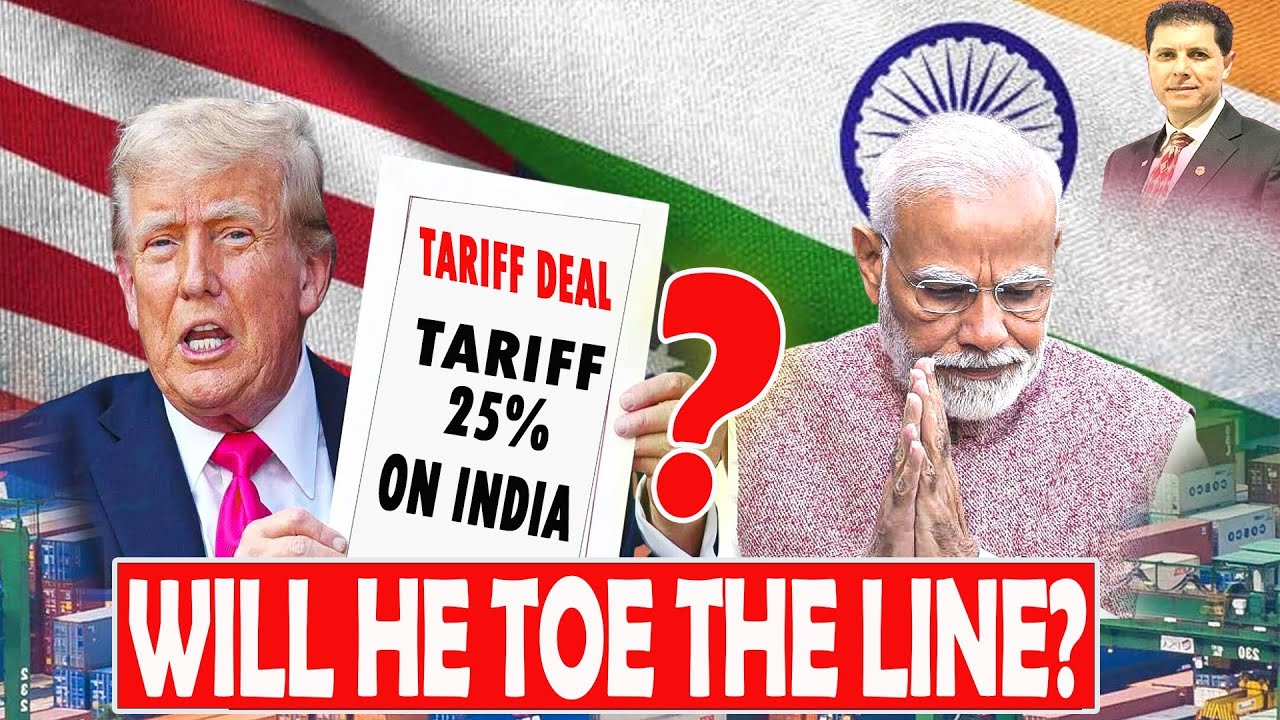
David Oualaalou analyzes a US-India trade escalation over Trump's 25% tariff threat and India's possible retaliation. He examines how the dispute could ripple through South Asia, affecting Bhutan, Nepal, and Bangladesh, and explores India's economic and political capacity to absorb the fallout.
Chapters
Hello everybody and welcome to Geopolitical Trends, where truth matters. Excited to be with you. Hope you had a, a relaxing weekend and you are geared up for the new week. So I have an interesting topic I'm going to be talking to you about today. Has to do with India, not just about the tariffs. There are other issues surrounding the neighborhood, uh, the likes on Bhutan Nepal, Bangladesh, and Sri Lanka. But I am going to be focusing mainly on one particular country for a reason, and I'll share that with you later on as to what that reason is. But first, let me say hi to our wonderful community. As always, let me get a sip of drink first. Sorry guys. All right, let me see who is here. As always, Willie Holman, good to see you. Truth Seeker, as always. SD, good to see you. Uh, Timeline Unseen, I know it's good to see you. It changed from, uh, the previous name. Matt Becky, as always. Muhammad Mazhar Dean. Wong Casey, good to see you. Adam Ruko, good to see you. Sam Karina. Uh, Yan Hakor, good to see you. Ateen Wu. Army with Harmony, KR66, Uncle Sam, good to see you. You to you, Z Super, good to see you guys. Myra Page, good to see you here. So, uh, guys, uh, as I said, there are a lot of stuff that I'm going to be covering regarding this on two fronts. One has to do with India itself, and the other part of the conversation has to do with the neighborhood Why? Because these tariff issues with India, it's going to be impacting the neighborhood as well, which means that the neighbors, the countries nearby like Bhutan, like Nepal, like Bangladesh, they going to sort of feel, feel rather, the impact of, uh, the, uh, these tensions if they continue to escalate. And we're going to find out whether India is going to toe the line or is going to antagonize Trump?
That will be—
excuse me— an interesting take to address here. So, but first, let me do some housekeeping items for you. First of all, remember to join me tomorrow for my conversation with Dr. Ted Postol. Very, very interesting dynamics given the background Dr. Postoliz, who, who is a professor emeritus at MIT in missile defense technology, in addition to being or was a former Pentagon advisor. So I look forward to that conversation tomorrow. And on the 6th, remember to join me for my conversation with Larry Johnson, as always a friend of the show here, and it's always great to see Larry. We're going to be talking about the irresponsible irresponsible decision recently of Trump moving the two nuclear subs near Russian border. So we're going to be addressing those topics. And the third guest, which I am still working on the details, it will be Melissa, uh, Park. Uh, I am coordinating with her office there to set a time, uh, for when she can make it to the channel here for, uh, an, an interesting and fascinating, uh, uh, interview and conversation uh, since Melissa deals with nuclear disarmament. So it will be very interesting for you guys to hear the other perspective. So I look forward to that. So, all right, let's get into our analysis, or our conversation rather. We're going to be talking about this escalation, and I use the term major because I'm seeing it going the other direction, another world, the— in other word, rather The US and India are now embroiled in this trade dispute over tariffs, which is to me is going to lead to some serious consequences, especially for India. And that is why it leads us to ask the fundamental question: can India afford it? I know, you know, because Trump sort of put now 25% on India's goods, of course New Delhi is saying forget about it, we're going to stand firm, uh, vowing now to protect the interest of, of India. Rightly so, nobody's denying that. The question is, is India in a position that it can afford that? Does it have the means to do that, or will it bow to Trump's pressure? So, and the other question is, how will the neighborhood react to this. So, so like I said earlier, uh, India has issued, uh, some sort of, uh, uh, its, its position regarding the tariff, uh, sort of that it's saying that we gonna retaliate against the US. So following what Donald Trump did with the increase of 25% tariffs on Indian goods, where this is gonna lead to It's, it's— I, I, I can see it's only going one direction. It's not going to bode well for India. And that becomes the question: can India sustain this kind of tensions with the US? India has one advantage to its part, which will hurt American farmers right here, but also the Indian farmers will be very, very pissed with the Modi administration. So what I'm gonna do, I'm gonna provide you a breakdown of these developments of what took place. So of course, Donald Trump, the incompetent president, has announced a 25% tariffs on a wide range of goods imported from India, and that's starting within 3 days, you know, on August 7th. 7th, that's when it's going to start. And here is Trump's rationale for this. Trump is saying that for sort of, uh, India, far too high tariffs on US goods, and that's what led him to impose the 25%, because India puts a high tariff on US goods that's going into India. Well, first of all, not every person in India can afford that kind of stuff, given where the economic conditions in India. India is not your average rich country. Poverty is massive in that country, poor infrastructure, crumbling infrastructure. So there are other domestic issues that, first of all, Indian government would have been better to address before you get into a spat with the United States on that. So then With all this, the— which, by the way, this is now— it's gonna be on part of the US. We're looking at it like, uh, this is obnoxious non-monetary trade barriers, uh, that they are, uh, being put. And that's how the US is seeing it when India raises the tariffs on US goods inside India. So the additional penalty to this, uh, because it's gonna add to more tensions So gone the era of the honeymoon between Modi and Trump, you know, two, two sort of, uh, uh, individuals who kind of, uh, fit each other at the mindset, you know, populists, you know, nationalists, if I may use the terms. So Trump also imposed an additional yet unspecified penalty on India for its purchase on Russian oil and military equipment. Well, this is where it gets a little bit too really off the cuff regarding what we deciding or dictating. You know, you can't dictate to other countries who do you want to purchase, whom they want to purchase weapons from, and whom they want to buy oil from. So all of a sudden you're seeing the US is— doesn't understand the dynamics of global affairs. When I say US, I'm referring to Donald Trump, you know. India, of course, has its own reason why it's buying oil from Russia, because it turns around and sells it to Europe for twice or three times the price, you know. Would you blame India for that? I won't. Let's be fair and honest about it. Most countries will do the same. I was aware of some country in, in North Africa, either Algeria or Morocco, I couldn't remember exactly, and don't quote me on this, either Morocco or Algeria was selling gas to Europe for profit. So what India is doing is not sort of the norm of what other countries doing. But for Donald Trump to put a penalty because India is buying oil from Russia, that becomes ludicrous. So, but also it gives you an idea how much we can pressure India. Well, we always done that because India has no power whatsoever. India will bow to the global powers when it's pressured, mainly from the US, Russia to a degree. India doesn't deal with China, which is a big mistake on India's part. So, and, uh, this is what the argument Donald Trump is saying, is that, well, because India is buying oil from Russia, Russia's getting that money and sort of, uh, supporting indirectly the war in Ukraine. Well, hold on a second, Mr. Donald or Mr. Trump. You have no idea or understanding. First of all, the Indian rupees, they are worthless. So I'm still wondering, I'm really still wondering, and please guys correct me if I'm wrong, why is Russia is accepting the rupees instead of, let's say, ask India way you rather pay with gold or some other commodities. So because what are the rupees on the international basket or international market? They're not worthless, they are, they are not worth much. So, and this is where India comes up with this response that Indian businesses now are very concerned, and rightly so, because of the impacts of these tariffs. It was It will be different. Uh, we, we can't compare it to China. Let me just make that clear, because I never like to put India and China on the same sentence because there is no comparison there. But the idea of what I wanted to address here is the same argument at the beginning when Donald Trump said, I'm gonna, uh, put more tariffs on Chinese and all that stuff. And businesses were like, whatever, in China. And India cannot do that. They can't do that. They can't afford it because India's economy is no comparison to that of China. China can afford to push back. And as a matter of fact, China pushed back. This is why now Trump is even pissed more that the Chinese have said, you know what, Donald, we are not going to stop buying the Russian oil. And now Trump is is threatening China by putting 100% tariffs. They're like, you get to be so damn stupid to even be thinking about antagonizing the largest economy in the world. Gone the era where you say the Chinese is second. It's not second, is at the top, is in par with the US, whether Washington wants to accept that reality or not. But India is in no position. And this is again what keeps me going back to my original, uh, uh, argument or question is what will India do? Will it bow to US pressure, or, or, or can it afford it? Can it afford— can India afford antagonizing the Americans? Because remember We threatened sanctions on India if it doesn't stop buying oil from Iran back then. And guess what India did? Stopped. That just shows you how quickly we can dictate the terms to New Delhi. Now with this, I don't know, is Modi just trying to chest thump in, I'm going to stand up to the Americans, just because the upcoming elections? Or what? Because we all know Mr. Modi was never qualified to be in office to begin with, because Modi— excuse me— does not possess the depth of understanding the complexities of the global geopolitical landscape. So, which is a reality that I personally do not shy away from saying. Now, the, the issue in the— with the business entities in India is that fearing that now it's going to be an order cancellations. Of course, that will impact the competitiveness within India itself. And what it's going to end up having to do, meaning those businesses, they're going to have to depend on subsidies from India. Does India government has enough funding to do this? I don't know. Now, where does India stand on this? Well, so far India is expressing its commitment to trade negotiations with the Americans. Yet India has hardened its position on providing concessions in areas like, for example, agriculture, dairy product, and genetically modified food, which is problematic to begin with. Thanks to— who do we have to thank here? Evil Bill. Because he's the one, Bill Gates, who's the one involved in the GMO. Most Americans have no idea what they're eating, how food has been modified. This is why you're seeing the obesity here in America is reaching highs. So, and so the Indian arguments, they're saying, well, we have to protect the livelihood of the farmers here in India. Well, we shall see how this is going to be. So the question becomes is what kind of potential retaliatory measures India can embark on. And can they? So, so one of them that's based on some analysts' position on this is that India could consider, for example, imposing reciprocal tariffs on US imports. For example, it could reimpose digital tax on US tech companies. Well, first of all, What kind of companies going to India for? You know, I'm sure there are some, I'm not denying, starting with Microsoft. You know, it's just because that's how they using India for that. Uh, but this, if, if they put the digital tax, it's going to become a problem for US firms. So, and this leads us to the question of what are the impacts on this relationship between India and the US. Remember, only a few years ago Modi hugging Trump and all that nonsense stuff. And now all of a sudden, because both of them, both Donald Trump and Modi, are, are like match to each other— in other words, their intellectual level is the same level. Of course, they don't have none. Uh, sorry for this, I'm not putting them down, I'm just stating the facts. Uh, their understanding of the world is so minimal You know, and their grasp of the realities is, is, is, it's beyond belief because they can't comprehend what's going on. And this is going to now impact this relationship both economically and politically moving forward. Diplomatically, we don't know how this is going to end up going because even if it goes bad, I don't see China— I don't see India pivoting towards China. So, which is one of the mistakes India is making in its foreign policies. That is why they are not advancing faster in comparison to the rest of the world. Liking this video so far? Don't just be a watcher. Go ahead and hit the like, share, and subscribe button. And don't forget to tap the bell so you will not miss any of my videos or live streams. This way you will be supporting a channel that stands for the truth and objective reporting. The choice is yours. Thanks for your support. Yeah, please, if this is your first time here, please make sure to subscribe. I would greatly appreciate it. So, and once again, if we are to take a step back, we're going to be asking ourselves how these two countries going to now move forward. Of course, the political establishments in both countries, in New Delhi and Washington, are saying, you know what, we are committed to resolve these issues and, and whatever. However, India made it clear that it seems unwilling to concede on key agricultural and dairy demands. And that is where the problem is going to be. It's going to be for both farmers in the US and farmers in India. Excuse me. And this one was, was, uh, sort of, uh, reflected by the statements of Indian Commerce Secretary. His name is, uh, Pichu Koyal. I hope I pronounce it correctly. I'm sorry. Um, who said over the weekend, just, uh, on Saturday, I believe, that trade negotiations are guided by the country's national interest. And I quote here, and the government wouldn't would not be tied to any deadline. New Delhi, as a matter of fact, threatened new retaliatory duties on US goods, end of quote. So, and it makes me just wonder, is India, uh, learning from China? Because China pushed back against the, uh, the Russ— you know, remember what, uh, Donald Trump said he's gonna give 12 days to Russia to end the war, and Russia was just laughing. You know, could India be learning the lesson from that? The possibility is there. And this is why, uh, it becomes now more of a problematic on a much larger scale. And this is the second part of my conversation that I want to get in into with you guys to provide you those insights. This now is not limited just to, uh, sort of the bilateral relations between the US and India.— or just the trade or just diplomatic aspects. It pertains now to the geopolitical landscape in the region. And my reference is when you look at the neighbors of India, especially 3 countries: Bhutan, Nepal, and Bangladesh. I will not count Sri Lanka much given where it is now, but for those 3 countries, and even those 3, I want to only focus on 2: Nepal and Bhutan. Because Bangladesh, you remember what, what happened with Sheikh Hasina, who was, by the way, as corrupted as it can get. And where did she fled after the demonstrations? She fled and found sanctuary in India because she was protected by India. Now, the two other countries, Nepal and Bhutan, are some sort of in a dilemma given the tensions. If those tensions rise between the— between India and the United States. And you all remember, guys, when I asked you a question, uh, last time. Let me pull it up because I want to put the right numbers when I asked you this particular question. So bear with me here, I'm gonna just go through quickly, uh, for the Oh, I think I did the survey. Uh, yes, I have it right here. When I did the— when I asked you guys the question about, uh, given the current state of affairs, both economically, domestically, and all that in India, should it be partisan? 62% of you said yes, 24% of you said no. And 13% said I don't know. So my point, this is what I'm getting at with this, because this question now is coming up to the surface. So the question whether India should be partitioned, of course, is a complex, uh, uh, uh, undertaking, and it involves strong, strong opinions. You know, majority inside India is going to say no, but on the other hand, when you think about how this could now sort of put the entire region on a different trajectory, more peaceful, if I may use the term, if India is partitioned. Of course, when you consider the original partition that took place— what time, what year did the original partition of India took place from, uh, Britain? Does anybody know the year? See if you guys can put it in the, in the chat box if you happen to remember or not. What year, uh, did the, the original partition of Britain, of British India, took place? Uh, Muhammad Mazhar Din, you got it, 1947. Indeed. Taiwan still, you got it. Uh, John Dutchman, '46. It was '47. So, so you guys got it, '47 that took place. So, and this, because here is the reality, and I know I'm gonna be addressing this because the reason for this, because I am gonna be having a guest, uh, a former government official in one, one of those countries. I'm not gonna disclose at this point yet from which country. Suffice it to say that you need to understand that from 1947, following this partition, it led to immense violence and displacements. Yeah, so because it continued to be debated today, and this is why this question of partition, uh, is, is coming back to the surface. You all remember Kaliningrad, uh, Kaliningrad wanted to be partitioned from them. Kashmir wanted to be partitioned from there because it will be much more, much better from a security perspective. It will provide stability in the region. Because of course at that time the partition was necessary because a solution to religious and political tensions. Now is different. The partition of India, if it takes place in modern day, it will not be because of just religion. It will be also for economic stability. You have some regions inside India that can prosper on their own without depending on New Delhi. And you got neighbors like, for example, Nepal, like Bhutan. So I'd like to just briefly, uh, share with you the map of, uh, Bhutan because I'm going to be talking about, uh, Bhutan, uh, in, in detail as we move forward. And let me first of all, to those who do not know even where Bhutan is, it behoves you to understand the importance of this particular country. So, so Bhutan is a small landlocked country which is situated in the southern part of Asia on the southern slope of the eastern Himalayas. It is located both in the northern and the eastern hemispheres of the Earth. Bhutan is bordered by two main nations. By China to the north, of course, and India to the west. So of course, in certain geographical, uh, record, you're gonna be, uh, hearing or reading, uh, or you're gonna be reading that is mentioned as a Tibet Autonomous Region, which is part of China, you know, to the north. Or you take, for example, the Chambe Valley of Tibet and the Indian state of Sikkim. And West Bengal in the west. And all this along with the Indian states of West Bengal and Assam in the south, the, uh, the, the Arunachal Pradesh in the east. And this is why, to me, I look at it straightforward that India— I'm sorry, I'm sorry, Bhutan, uh, borders only two main countries: India and China. And why is this important for you to understand is because when you consider Uh, uh, I'm going to stop sharing this here. When you consider, for example, uh, not only just the history of Bhutan but also the possibilities for this country to free itself from the shackles of India, is the same way that Nepal is now able to do. You guys, I don't know whether you know or not, when I went to Kathmandu in 2008 or 2009, I remember And I had conversations with some members of the government there. So, and the word that I got is that we are really tired and sick of Indian influence inside our systems here in Nepal. So, but things have changed for Nepal now. Nepal is on its own, moving as an independent from India's influence. Bhutan is not. And what I see, the possibilities, is that Bhutan has more abilities to do so and become more independent and free from the shackles of influence of India. But also you have to understand its history, which I'm gonna get into here if you allow me here. So when you look at about the— I don't know if I have pictures, uh, for you guys about Bhutan. Uh, no, I'm gonna save this for my conversation with, with a guest at some point. So, but when you consider the record of the archaeological evidence, uh, it seems that the people have settled in the land of Bhutan around about 4,000 years ago. The only difference here is that there was no record of exactly the Bhutanese people. Whether they settled in that— during that era or not. So the historic— the historical period, uh, in, in which historical events can be verified through historical record, books, and oral traditions can be roughly divided into 3 periods according to historical record. You have the first period, which is before the founding of the country the country by Zabz Drung. It's D-R-U-N-G, which was between the 7th to early 17th century. That's how far back goes. The second period was the Druk lineage. This Druk lineage era, which goes back first half of the 17th century all the way to 1907. And you have the third period, and the third period was what's called the Wangchuck dynasty, which was from 1907 forward. To those who might not know, Bhutan is a kingdom. It's considered the Kingdom of Bhutan. So, and like I said, when you think about its history And again, there is reason why I'm talking about this one in conjunction or within the context of India-US tensions, because this country is going to be suffering if they don't embark on a policy that can sort of provide them some sort of an independence from an influence of India, because India is influencing Bhutan beyond what you can imagine. We're talking about— and I dig enough to find out— it is India that is training the military in Bhutan. Are you gonna count on India's training? You know, Bhutan should reconsider. But also, there are issues with this. You all remember I did a video for you guys, uh, uh, let me see if I can pull it up, uh, for you. I did video way back, few months ago, when it was a meeting between the foreign minister of Bhutan and the foreign minister of China, Mr. Wang Yi. And back then I argued, uh, why will, why will India be upset about this meeting? What it has its reasons for. I am looking through the, uh, the videos here just to pull up the— if I, if I get to it, because it's been a while since I did this one here. Uh, but I remember, and, and, and you guys truly, uh, uh, because I remember reading all your comments about this particular, uh, event, uh, some of you were surprised, but all, all your comments converged on the idea, why will India be upset about what a sovereign state like Bhutan wants to do with its own foreign policy? And, uh, I'm still looking here if I could get it for you guys. Uh, bear with me here, because if not, I'm going to move on and I'll look for it later on, because that was way back when I did this one for you. And this is where I'm seeing the trajectory is going, because it behooves Bhutan to really embark now on some sort of a policy that will free it from India's influence, because India is influencing on both on a military front and on the intelligence aspects. And you all know why, because India does not want to see a rapprochement or economic prosperity of Bhutan, because if it does, you know, Bhutan will not need India anymore, and rightly so, because Bhutan is a sovereign state and it can decide for its own what it wants. So, uh, unlike Bangladesh— and you all know the conditions of Bangladesh where they are, uh, because of the influence of India, uh— but for Nepal, Nepal end up embarking on its own trajectory And finally, they were able to free themselves from, uh, from the shackles of India's influence. So, uh, I don't think so I can find it, guys. I, I don't think so I can find it right now. So I'm gonna just move on here, uh, because I have still, uh, a few other things I need to cover for you. I'll do one last check here. And my apologies, my apologies, I should have considered this one earlier, but in any event, I will dig for it later on. So when you consider once again for the history of Bhutan in itself, which is when you think about it, because what is the first thing that comes to Bhutan? You know, Buddhism, religious influence, of course, and of course methodology or mythology, rather. So this is one thing about, uh, Bhutan is known for. And because back then they used to be just small kingdoms, and the external contact was very, very limited, it was like closed in. It's not that they choose to, it's just the part of the culture. And this is why Buddhism is so important within Bhutan, and it was introduced in the 9th century, because it became a dominant force, particularly the Drakpa Kagyu school. It's well known for Buddhism, and it was till the 17th century, that's where it was unified and all that. I'm gonna play a short clip for you guys, just a short clip for you to put this in perspective, then I'll continue with my conversation. Let me find it for you. Okay.
In the land of the Thunder Dragon lies a special place where wisdom and compassion have forged a unique way of life. Rooted in the timeless principles of Vajrayana Buddhism, Bhutan seamlessly intertwines spiritual and cultural values with a profound respect for nature. A green sanctuary where national parks and forests absorb more CO2 than the country emits, Bhutan harnesses the power of its rivers, making it one of the cleanest nations in the world. Guided by Buddhist principles and the philosophy of Gross National Happiness, Bhutan has nurtured a society built on trust and well-being, a safe place governed by a stable political system dedicated to the country's long-term vision. Today, Bhutan is focused on building its future, ready to emerge as the gateway between between South Asia and the world. Rooted in Bhutanese identity and open to international partners, a new city will serve as a hub for global exchange and sustainable development. With a confined footprint of just 4% of the nation, this special administrative region will lay the foundation for future generations, becoming a new model for a lasting legacy. Welcome to Gelefu Mindfulness City. Descending from the Himalayas to the lush tropical plains, a cascade of urban terraces is shaped by the uninterrupted flow of water, plants, and animals. A land where bridges become cultural landmarks connecting one neighborhood to another. A human-scale environment designed to inspire and nurture global talent, fostering a culture of collaboration, experimentation, and innovation. In Gilefen, green and clean surroundings will drive businesses towards sustainability, striking a balance between economic success and environmental prosperity. Built with locally sourced river stones, timber, and bamboo, the Mindfulness City blends tradition with modernity, preserving heritage while advancing progress and cultivating resilient, self-sustaining communities. Here nature is enhanced rather than displaced, with every path drawing you deeper into the wild. This sanctuary for spiritual and physical rejuvenation evolves with its ever-changing landscape, integrating infrastructure with social activities and nature-based solutions. A constellation of public spaces will gather residents of the mindfulness city to share a life of learning and happiness. In the Vajrayana Buddhist capital of the world, people of all cultures will unite and practice compassion, kindness, and inner peace, revealing Bhutan's greatest teachings. Together we begin a new era of mindful prosperity.
All right, I'm gonna stop right there, um, and I give credit to Careful City for this video here, guys. The idea is, by the way, Bhutan is on a process now of building a major international airport. And I am even— I'll share this with you— I'm even considering next year heading out to Bhutan to see with my own eyes what the possibilities are for this particular, this particular country. So when you think about its history moving forward, the idea of what he went through, you know. And I'm not going to get into the details of it because that would be a live stream on its own, and I'll be happy to do it for you in some other time. So suffice it to say, then, when you go back to the 17th century, that's when the unification of the Shabdrang began. 17th century marks some sort of— if you know anything about Bhutan, you need to know that 17th century marked a turning point with the arrival of the Shabdrang Nagwang, sort of a Tibetan lama at the time who unified Bhutan. So suffice it to say, one thing to tie it to India. So what you need to understand is that after the idea of this, the tensions between now India and the US could escalate. How will it impact regional countries like Nepal, like Bhutan, Bangladesh 2 degrees, Sri Lanka 2 degrees, and so forth. So, and this is when you consider once again for the case of Bhutan, I happen to know a little bit about the idea of the hydropower. There is one thing that India purchased from Bhutan is the hydropower. And this was some sort of a key component that is really marking this relationship between India and Bhutan. But is marking the relationship not on an equal footing. It's benefiting India more so than it's benefiting Bhutan. And this is why, in my opinion, it will make more sense for Bhutan to reconsider this kind of treaty with India and consider expanding it with other, let's say, Southeast Asian nations, let's say countries in ASEAN. Why not? It's a sovereign state. India should not be dictating the terms. What do you guys think? Should Bhutan consider establishing economic, uh, ties with ASEAN? Yes or no? If you can just answer in the chat box, I will greatly appreciate it because it's very important, at least from what I'm seeing coming over the horizon regarding this part of the world. Because what we're looking at is the possibility if Bhutan free itself from the shackles of India. It could become the equivalency, and we can go as far as stretch it to this level by calling it the Switzerland of Asia. You know, you think about the example of Singapore, you know, think about Singapore, what comes to your mind right away? You will think of investments, major economic progress inside Singapore, clean country, prosperous country. Yes, a little bit expensive, of course it has to be, but at the same time consider, uh, of course it's no comparison, India and Singapore, there will be no way. I'm just providing you an example here. The same thing could apply to Bhutan if they would have considered renegotiating this treaty with India first of all, and second, deciding for themselves to expand their economic ties with other entities. So why will India be concerned about Bhutan, for example, having a meeting with the Chinese, or having a meeting with Malaysia, or Indonesia, or, or Vietnam, or Cambodia? So it's because India wanted to maintain that firm control. It's like what we are doing with the Philippines, what we are doing with South Korea, what we are doing with Europe, what we are doing with Japan. And we are— what we are doing with Ukraine, of course. But can you imagine if these countries will decide to stand on their own, tell the Americans, we'll be happy to have a relationship with you, but you do not interfere in our affairs, you do not speak on our behalf, you do not dictate the term to us? Because Bhutan could be that particular country that can move forward. And all this goes back to why India is taking advantage of that, because Bhutan is selling its surplus of energy to India, of course, at a fraction of the cost. Bhutan's not making money out of it, India's benefiting from it. So why should you? So, and this again takes us back to the other question of should India be partitioned, because every region will work for its own development, for its own economic prosperity? Because India as a whole, it's not working. I mean, look where they are today. Will it make more sense? But again, the people inside there, they have to decide. So, uh, India has been a major partner in developing Bhutan hydropower sector, but are you gonna really compare that that infrastructure provided by India to the one provided by, let's say, South Korea, let's say China, let's say Singapore, Indonesia, there is no comparison. Because here is the thing why India went ahead and sort of developed this hydropower, because all the electricity generated in Bhutan is exported to India. So in other words, you're just using Bhutan basically. You know, Bhutan is not benefiting from it. And all this goes back to when they signed an MOU, Memorandum of Understanding, with none other than Adani. You all remember the corrupted Adani in India and why Prime Minister Modi is protecting him. It was his company that signed the 5, uh, gigawatt with, with the Bhutan for a new hydropower. Why will— and I'm questioning, I don't know who's advising the Bhutanese government, but why would you— I know they might not want tensions, whatever, but sometimes you have to push back. Why would you pick India instead of China? Of course, for political reasons, India is not going to like it, but who gives a damn about what India likes or doesn't like? Butan is a sovereign state. They can decide what they want. They can enter into bilateral trade with whomever they want. And this is why the, the Adani Group, uh, signed this memorandum of understanding with the Dragreen Power Corporation. It's a Bhutan state-owned company, a hydropower plant. So, and this one, sort of, uh, they jointly, they're going to develop about 5,000 megawatt of hydropower capacity in the Kingdom of Bhutan. Of course it's going to benefit India, not the Bhutanese. And that is why when you think about the relationship between India and Bhutan, India and Nepal— because India was doing the same tactic with Nepal, but Nepal pushed back, and now Nepal is almost on its own disregarding India and pivoting elsewhere. This is where I see the need for Bhutan to embark on this particular aspects of its economic development. So, and like I said, I'm really starting to think about going there next year because I don't know whether that airport is going to be finished or not, but it won't matter. There are ways of how to get over there. So, uh, and when you think about, like, again, when you think the relationship India had an influence on those three countries— Bangladesh, Nepal, and Bhutan. So suffice it to say that Bhutan's relations with India is also characterized to a degree, uh, or to some greater degree of dependence and a more formal alliance. Dependence on whom? Because Bhutan finds itself depending on, on, on India because it puts itself into that. Maybe the circumstances, economic, warn where they are today. But today Bhutan has the possibility of changing the trajectory and moving in a different direction. And this is why I'm going to be bringing a guest uh, someone who is well informed and, uh, part of the government, so well informed about this. He's gonna be sharing the insights with us here for the community. Like I always say, uh, I— this channel is informative one. I want you to be informed of what's going on, you know. I, I don't follow the trends of others just because they're talking about topic A or topic B. Uh, that's nice, but I also think in terms of what can you benefit from. So, and to me, I look at it because I see what lies ahead moving forward in that part of the world and how, uh, and, and you will mark my word on it, within a decade, 15 years or so, you will see where Bhutan's going to be if they embark on a right path here as far as the decision of becoming independent from depending on India's influence is because India is influencing Bhutan on the military aspects and on a foreign policy aspect. So, and I know Bhutanese, their nature and the culture, it's not one of confrontation, whatever. That, that strategy will not work with Indians. With India, you have to push back. You have to push back very hard. That's how Indians operate. You have to push back hard. And but of course, Bhutan has to make sure its steps are calculated, are strategic of nature to ensure its independency. That, that is how, uh, because there is one thing that is common sense here. When you think about the geographical proximity between India and Bhutan, Yeah, just on the border. So, so, but when you compare Nepal and Bhutan, both of them are in the same situation as far as being geographically landlocked countries, and both of them with proximity to India. But that doesn't mean India will have to control what's going on inside those countries. They are sovereign states, they can decide for themselves. And that's why, should ever India be partitioned you're going to see more developments in that part of the world that you can't even expect. And, and I, I have no doubt about it. I have no doubt. Of course it will be a struggle at the beginning, but you will see they will develop even more. So this is what I wanted to share with you, uh, on, on this aspect here, to put it in perspective for you as far as the tensions between the US and India and how that could spill out to other regional countries, the likes of Bhutan and Nepal. For Bangladesh and Sri Lanka, it's— even in the case of Sri Lanka, which I was aware of, you all remember they used to say that it was the Chinese debt trap that crippled the financial economy of Sri Lanka. Turns out to be a lie. It was the IMF policies of sort of privatizations and— what's the word that I'm looking for? Austerity. That's what the IMF imposed on Sri Lanka. That's why its financial situation collapsed. So I am seeing the possibilities for Bhutan to really free itself from the influence India. Because where India is going, it's not up, it's going down. You know, forget about those articles that says India will be the next, uh, great superpower in 5 years. That's nonsense. There is non— that's nonsense. So, and to those— I've read some statements from some media in India, even on YouTube I saw some That just makes me just shake my head because has no, no, no shred of truth, uh, in, in them whatsoever. And I don't know why they're saying those kind of things too. It's not right. So, and I even extend an invitation to some of those anchors if they are willing to come over here and we'll have a civil conversation and I'll challenge them on those assertions that India will be the next superpower and, and all. It's nonsense. You know, Indian people needs to realize what their government is doing. And again, I am not about criticism here. I am about exposing the truth because Indian people deserve a functioning government like every other nation. Even for us, do you think we have a functioning government? We don't. We have a corrupted government and we have corrupted establishments. You know, you look at what my government is doing. I don't consider it my government. They don't represent me. So I, I refuse to use the term my government. It's not my government. They don't represent me. Look at what they're doing and contributing to what's going on in Gaza. Look at what they're doing to the Philippines. Look at what they're doing to Ukraine. Look at what they're doing to Europe. And then you got the idea. So American people deserve a functioning government. So the Indian people, they deserve also to live in prosperity like every other country. And again, I look at the case of India, I look at some other countries that have entered into economic bilateral trades and so forth with China, and where they are today. I'm not saying they need to do the same. That is not what I'm saying. They can do whatever they want. All I'm saying is pragmatism here. When you look at the reality and you see where the economies of those countries— once they allow foreign direct investments coming in, the infrastructure being built, the, the, uh, the, uh, uh, the management of certain assets within the country— the country is sort of prosper. So I don't quite get it why India is having this hard time accepting this fact for the sake of its own people, no more, no less. No. And again, to those— and I know I have some viewers from India— sometimes they think I am being too harsh on India. I am not. On Indian government, I am not. I am just putting the facts on the table. I criticize my own government. And I do criticize them because they are corrupted. We have a corrupted and dysfunctional Congress. We have a fractured Supreme Court, and we have an incompetent president. So simple as that. And I'm, you know, I just like to, uh, make sure people do hear different perspective. This is why I bring in guests here, guys, uh, individuals for you to learn from, to hear a different perspective. It's very important, very important. I'm not saying, you know, you have to listen to other perspectives, you have to listen to different opinions, and you form your own conclusion. If I am to advise you with one thing, never allow anyone— I don't care who is— anyone to reach a conclusion for you. You have your intellectual independence. You have your own critical thinking. You can reach your own conclusion. Simple as that. So, all right guys, that's all I have to share with you today. Let me just remind you once again, tomorrow remember to join me for my conversation with Dr. Ted Postol, very, very interesting fella. Has been around long enough. I'm, I'm aware of him. I'm aware of his work did before because we used to do, uh, we used to sort of involved in the same entities except in his time he was before me. Uh, uh, but, uh, I'm, I'm aware of all this. You are in for a treat because he's someone that now I wish the government will reach out to him for advice, but they won't because our government is corrupted. Our government does not want to hear the truth. This is why Trump end up appointing that just people with no credentials, with no, uh, ability to really formulate the strategies or even, or even break down or explain the complexities of the geopolitical issues that we are facing today. So, so Ted will be— Dr. Postel rather— will be an interesting tomorrow because I'm going to be addressing from the Iron Dome to the US missile defense to the, the, the Chinese ICBMs to the Russians hypersonic to the Iran, uh, Khurram, Khurram, Khurram 5, uh, the ICBM. And because Ted's background is in missile technology, so he's somebody you want to listen to. And also, of course, you, Larry is no stranger to the channel. He He will be here on the 6th, and as I said earlier, I will coordinate with the office of Melissa Park, uh, to have her here, uh, for us to share her knowledge regarding the nuclear disarmament. Um, I want to share, uh, quickly, guys, just to give you an update, uh, where we are as far as the, uh, uh, my upcoming trip to Asia. And I have a picture of updated Uh, here we are, we're at 41%. I wish we can cross the 50%, so please, if you are in possession to support this trip, I will greatly appreciate you doing so. I only have 3 weeks left before I leave, so I'm hoping, uh, uh, we'll reach this, uh, this, this target goal here. And, uh, if, if, if you can, I will greatly appreciate it. Let me share the link on the, uh, uh, chat box, uh, for those who will be willing to support this upcoming, uh, Egypt trip. I also want to share the link with you to the channel for those who've been supporting the channel as far as its content. Uh, if you are interested in purchasing some of my books, this This is the link for, uh, to purchase some of my, uh, uh, books that I wrote. And in addition to my media speaking aspects, so I don't know if you— to some of you who know that I'm, I am embarking now on, or I am on a speaking, uh, uh, path, if I may use the term. So if you are interested or know someone who might be interested in having a speaker that addressed, uh, that address geopolitical, uh, aspects, risks, assessment strategies, and so forth. I'd be happy to do that. And thank you all for your support. I look forward to seeing you tomorrow. As always, remember, geopolitics impact your daily life in more ways than one. Till next time, guys. Bye-bye.
More from David


Beyond the Single Actor: Why the Gulf Isn't Choosing Between the US and China


Iran, Iraq's Militias, and the Houthis Are Coordinating! This Changes Everything




Who Controls the Next Decade's Resources? Latin America and Africa's Geopolitical Crossroads

The Chokepoint Trap: How Washington's Stupidity Triggered a Cascade That Now Controls the World

Trump Spooked as IRGC Unveiled dual-use SLV, Deployed Ghadir Mini-Subs & Hinted at Tactical Nukes!
