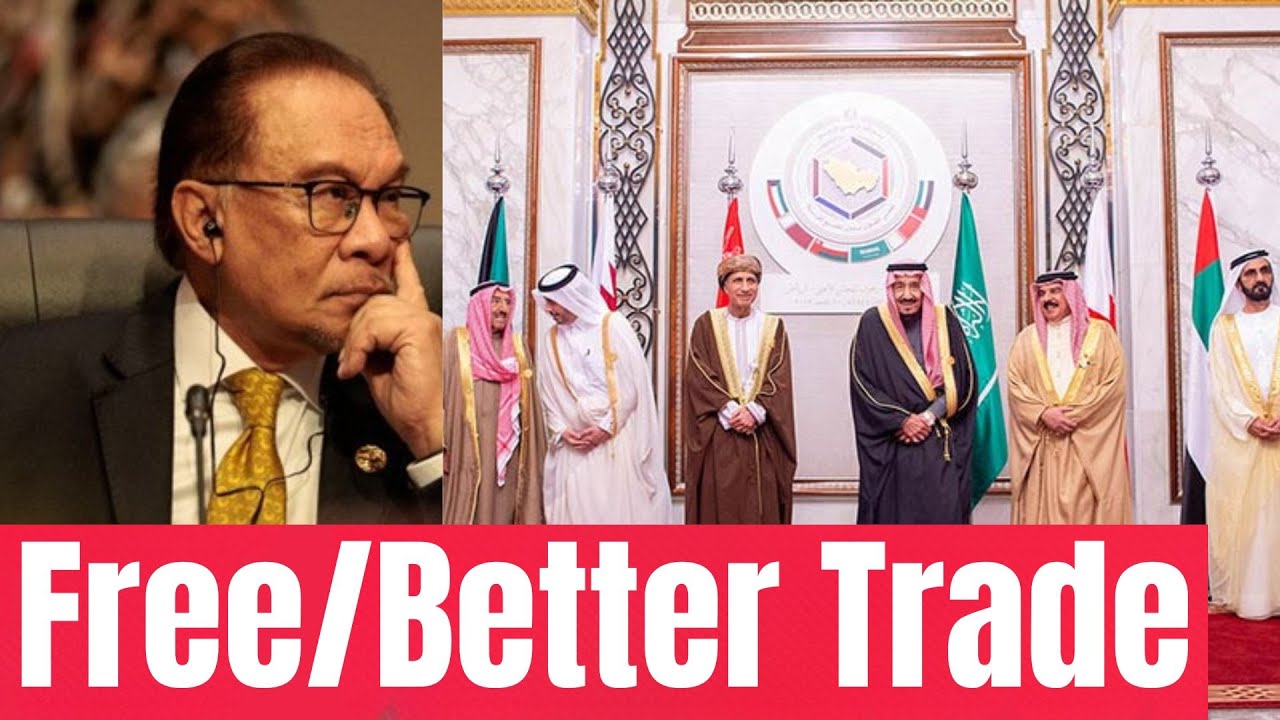
In a live‑stream titled “Malaysia: Ditching the West for GCC!”, the host examines Malaysia’s recent proposal for an ASEAN‑wide free‑trade agreement (FTA) with the Gulf Cooperation Council (GCC). He frames the move as a strategic pivot away from traditional Western partners (EU, US, G20) toward the oil‑rich Gulf states, arguing that it serves both economic and geopolitical goals. The discussion covers the internal cohesion of ASEAN—highlighting the Philippines as the perceived weak link—and parallels this with India’s role in BRICS. The host contrasts the GCC’s unified, debt‑free, energy‑rich profile with the EU’s sovereignty‑sharing model and the fragmented G20. He links the proposal to broader trends: the shift of wealth and energy demand toward the East, China’s Belt‑and‑Road Initiative (BRI) and related infrastructure (Indonesia’s high‑speed rail, Saudi‑China refinery), and the rise of non‑dollar financing exemplified by Egypt’s yuan‑denominated panda bonds. The stream also critiques US domestic politics, lobbying, and infrastructure neglect, using these observations to argue that ASEAN’s integration with the GCC could reshape regional trade, energy security, and geopolitical alignment. Audience interaction, channel membership goals, and occasional Q&A are interspersed throughout but do not alter the core analysis.
Chapters
All right, hello everybody and welcome to Geopolitical Trends. So excited to be with you on this Saturday, uh, weekend. So you kind of just chill out and do whatever you feel like doing. Uh, for me, I wanted to do the live streams on weekends sometimes just because I need to make sure that the information you guys getting, uh, it's first of all, is up to date, of course, and second, to keep you abreast of what's going on around the world. And we all know how media works. Nothing's going to be detailed if it doesn't push for the narrative of what the media wants you or wants to influence you with. So anyway, what am I— what am I going to talk— what am I going to talk about today? Today I'm gonna be talking about the proposal of, uh, uh, Malaysia as far as entering into free trade agreement with GCC, the Gulf Cooperation Council. Not the EU, not the US, not G20. No, GCC. And there is reason for that, strategic one of importance, economic of course, but also there is a strategic interest. And that's what I intend to detail in this, uh, uh, live stream session here. But, but first I want to say, uh, like I always do, that's my way of showing respect for all of you and appreciation. So I want to say thank you all for your continued support. And if this is your first time here, please make sure to subscribe to the channel and hit the notification button. I know what some of you guys sent me some comments that they weren't notified, that they didn't know the live stream was going on. And so I don't know whether you have, uh, uh, when you subscribed, whether you hit the bell button, the notification, or not. So, but that's all it is. So just make sure to hit the notification button so you will be notified every time I do, uh, a live stream. I want to give a shout out to two new channel members and supporters. Uh, the first, uh, uh, channel member is Tamputra. Thank you so much for becoming a channel member. Tom Potra is not new to today. He's, he's been always with us on the other channel, the big channel, but he's now also showing his support for this. Thank you so much, Tom Potra. Really means a lot to me. So, and as a supporter, I want to give a shout out to Tom X. Thank you so much for becoming a channel supporters. We are now at about 95. We have 5 to go, 5 members. Either members or supporters, whatever. So if you will be kind and any of you wants to take this on, just become a channel supporters or a channel member. And once we reach that 100, I'm going to do the exclusive Q&A, uh, for the members and supporters alike. But I intend to do something separate for the members. So, and I will talk about this later on once that time comes closer. So Uh, once again, if this is your first time here, please make sure to, uh, subscribe, uh, to the channel and, uh, you show your support for that. So, all right, well, let me say good morning to you all. Good morning to you, Cam35. Good morning, Losio from Canada, Montreal. Good morning to you, uh, Albany, Oregon. Army, Army Weather Army, Weatherman Money. Good to see you. Uh, uh, Alan Roy, bonjour de Montreal. Bonjour à toi aussi. That's hello to you in, in, in English. So, good evening from the UK. Uh, Hamad, good, good to see you. Phil Ottawa, good to see you as always. And Phil always, uh, shows up on the Health Channel. I always have a conversation with Phil when I do the Health Channel. Speaking of Health Channel, I always do on Mondays at, at, uh, 19:30, uh, conversation with Dr. Stewart. So if you feel like to join me there, uh, feel free, and I will, uh, post the link for you in the description. So, all right, uh, hi Jack Robert, good to see you as well. So, all right, let's, let's get into our topic today. Well, as I mentioned, uh, uh, Malaysia proposed this free trade agreement. You know, it was interesting that it will be between, of course, ASEAN. This is not unilateral, it's not Malaysia by itself. Soroff is advocating for ASEAN. Now, you all remember what I said about ASEAN. Who's the weak link in ASEAN? Can you type that in, in the chat box? Who do you believe, in your opinion, the weak link in ASEAN? This is similar arguments can be made about BRICS. Who is the weak link in BRICS? So now we're talking about ASEAN here. Who do you think, in your opinion, is the weak link in, in, in ASEAN? So, so Malaysia, Anwar Ibrahim, the PM, sort of proposed this. What the pro— the, the proposition in itself, for me personally, it has a lot of sending a lot of messages. Uh, the obvious one is that— could Malaysia— it's not good. Is Malaysia thinking about dumping the US dollar altogether and moving into the transactions in some other currency, whatever that might be? Because that's how I see it from an economic perspective. From a geopolitical aspect of it and strategic is that Malaysia is seeing the trend where it's going. Well, and I'm gonna get into the GCC and you will get the full picture, and I will ask you some questions because All this is not happening in a vacuum. There is no way I'll argue whomever that tells me, oh, just because they feel like it. No, there is, there is, there is an underlying strategic goal that Malaysia and ASEAN, for that matter— this is with the assumption that all ASEAN are on board. This is why I ask the question, who is the weak link in ASEAN? Because he could hinder the progress like we're seeing in BRICS. Who, who's hindering the, uh, the progress in, in BRICS? So now with all this, the timing of the announcements, once again you have to think in terms of other developments around the area, around the vicinity over there. So what are we talking about? Talking about the presidential elections in Maldives, okay? We're talking about Even for Indonesia's, the speed train that is entered into operation now, that's going to link, uh, I think Jakarta with, uh, I couldn't remember the— I have the link and I'll, I'll talk about this as I move forward. So could this also, uh, uh, uh, suggest the position of ASEAN as an economic entity? In other words, regarding what's going on between the US and China when it comes down to trade. And the third question we need to consider is why GCC but not the EU, the European Union, or even G20 for that matter. But G20, we all know what— there is, uh, Russia there, there is China there. So ASEAN is not going to want to do that because ASEAN could have those bilateral trade with those entities ASEAN is not going to trade with India openly because India has nothing to offer ASEAN. No offense to India, I am not talking negatively about India here. I am presenting the facts, and I'm really getting tired of those— you know, I could see the comments, and come on, man, take it like a man. The truth matters. This is why, you know, some have been launching at, uh, Jasant when, well, he was speaking pragmatic, the truth. That's what it is. So same arguments. So why GCC but not the EU? And this is what I'm going to get into the detail about all this one here. So what is interesting about all this one is that, as I mentioned, uh, uh, Prime Minister of, of Malaysia, Anwar Ibrahim, you know, and this is what he proposed on Friday, which was yesterday. That the, uh, the free trade agreement between ASEAN and the GCC— again, is this specifically for, for Malaysia using ASEAN, which I don't see that? What, what's in it? And this is what's at the heart of the detail of this one. And this, by the way, was during a speech that, uh, uh, Ibrahim— Anwar Ibrahim, the Prime Minister, give him proper respect as well— uh, the Prime Minister Ibrahim, uh, added or mentioned it during a speech during the ASEAN-Gulf Cooperation Summit. And where was the summit held? It was held in Saudi Arabia. Yeah, so it makes you really wonder about the, the, uh, because here's the thing you have to understand And I'm going to use his own word. Let me get the quote here. So he said, and I quote, this agreement is essential to promote gradual, inclusive, and sustainable growth, especially as we recover from the COVID pandemic, which we all know it was nothing but a hoax. It's coming up more and more, and face geopolitical uncertainty, end of quote. So spot on. That's why I'm saying two key points: economic and geopolitical. That is the reason why he's pushing for this on behalf of ASEAN. Once again, and I can't stress this enough, with the assumption that all ASEAN countries are on board with this one. Well, first let me, uh, define first of all, uh, what is GCC, what is ASEAN. I know some of you know, uh, what, what this is. But, uh, it doesn't— I, I don't assume. I have the info, I may as well just share it with you while I'm having it right here. So, so this is a picture of the Prime Minister Anwar Ibrahim. This is during the initiation of, uh, of the, uh, proposal for why he was mentioned. So So let's talk about GCC because I'm going to share some pictures with you, uh, and, and put things in perspective as we move forward here. Let me— here is another image. So GCC, known— there are about 2 or 3 terms in English we— they go by. Known, uh, of course, for their Arabic term. For those of you who speak Arabic, they know they— it's named Majlis al-Tawoun al-Khaliji al-Arabiyah, so, or Majlis al-Tawoun al-Khaliji. It goes also by two pronunciations in the Arabic language. In French, it's known as le Conseil de Coopération du Golfe. That's how it's known. So, so for us, in the terms of English, we look at it as the GCC, the Gulf Cooperation Council. That's been the term, even though You can see it in some literature mentioned as the Cooperation Council for Arab States of the Gulf. They don't use that a lot. The, the common one is the GCC, Gulf Cooperation Council. So, so basically what it is, is a regional, uh, regional intergovernmental political and economic union which includes the countries of Bahrain, Kuwait, as you see on the map there. But yeah, Kuwait, Bahrain, Qatar, United Arab Emirates, Oman, and Saudi Arabia. Those are the Gulf States, known as the Gulf States. So, so now here is the key question for you to understand why the proposal came that way. What do, what do those countries, the 6 countries, what do they have in common? Can anybody type in And besides, they speak Arabic, of course, and they are Muslim countries. What do they have in common? If you can type in, in the chat box, please, and I'm, I'm going to take a look at it while I continue the conversation here. So, because it's very important to understand this dynamics. Oh, let me say thank you first, because that's my rule. I, when I'm by myself, I can interrupt myself and say thank you to Super Sticker Hong Wong. Hong Tua, thank you so much for your Super Sticker. Truly, truly appreciate it. So it means a lot. And I can— once again, guys, I don't take your support for granted. I want you to know that. So it means a lot to me. Thank you so much, Hong Tua. And by the way, guys, remember to have some questions towards the end because I will answer a few questions for you. So this is what's important. And let me see what you typed in. Into the chat box. What do they have in common? You guys absolutely correct as far as Philippines being the weak link. Hamad Sethi, you're absolutely correct. And, and, uh, uh, who else? Yeah, there is another, uh, Great Fulton, you're absolutely correct. Uh, you are absolutely correct. Philippines, it's, it's becoming evidence, and we can't shy away from disclosing the truth. You know, I, I, I don't do emotions. Oh, I gotta— maybe they feel bad about— no, no, there's no such thing. It's because when you provide an objective assessment, especially when it comes down to geopolitical matters, emotions are aside. This is exactly what we're saying about India. We can't be sugarcoating it because, well, we don't want India to feel bad. Who gives a damn about that, whether they feel bad or not? This is not about that. It's about the facts on the ground. It's about the welfare of the citizens. That's always been the case. It's the same case. You are absolutely correct, uh, uh, Young Dixon. Philippines is the weak link. Lynn, you're absolutely correct also. Lynn Ong, you're absolutely correct. Uh, that's just the reality of it. And we all know why. We all know why. Because of the recent policies that are now sort of fermenting this division. It's, it's to me, the way I picture it, guys, it's like there is a tiny, tiny crack and you are trying to expand that cracks. This is what Philippines foreign policies mean to me. It's widening that gap or the crack inside ASEAN. Because if division exists within ASEAN, it's easy for us, at least the United States, to push forward with the agenda. So Philippines, that's why it's the weak link. The same arguments could be made as far as BRICS. There is no, there is no, there is no way about it. It's the fact, is the truth on the ground. India is the weak link into that. So Um, let me first say thank you to Jennifer Lee. Thank you so much for your Super Sticker, truly appreciate it. I also want to say thank you to KL, as always, truly appreciate it. It means a lot. I truly appreciate it. And the next one, which is a new member, SC Lee, thank you for becoming YouTube members. We are now 96, we got 4 to go. If we can close this in, in this live stream by having 4 more members or supporters. So just think about it, guys. So thank you so much for becoming a member, truly appreciate it. So to go back to my point, uh, well, for the BRICS, uh, India in BRICS and Philippines in ASEAN, this is where I see that challenge ASEAN could be faced, uh, with this agreement, even though here is the kicker even though Philippines will be benefiting from it. So in this case, is Philippines playing both sides? I'll let you reach that conclusion yourself. All right, let's move on to, uh, ASEAN. What is ASEAN? Once again, I don't assume, guys. I want just to, uh, again, I have the info, I have everything, and I'm going to share it with you for those who might not be familiar. The Association of Southeast Asia, known as ASEAN. This, uh, entity, economic entity that is, was formed in 1987. Yeah, it goes way back, but back then there were only few members. As a matter of fact, there were only about 5 members, if I'm not mistaken, with the signing, uh, of the Bangkok Declaration in Thailand, because that's where it start. Uh, it was by Indonesia, Malaysia, Singapore, Philippines, and Thailand. So here it is, Philippines is a founding members, and you will think it will embark on policies that will push ASEAN in the right direction as far as prosperity, economic prosperity. I can't speak for the Philippines, that's— we all see the policies of Marcos Jr. To me, it's derailing really impacting Filipino citizens, the average citizens, not the elites, the citizens. Then the association was later joined by Brunei Darussalam, Laos PDR, Myanmar, Cambodia, and Vietnam, makes it 10 members, as you see on the map over there. I have another map for the same Oh, I'm sorry, not this one. Uh, I think this one here. Yeah, so these are the members here. So, and if you look at the map as you see in here, the interesting aspects of all this, they, they all closer, you know. Economic block like that will really have sort of a, a punch on the global economy in a good way, per se, because it creates more economic opportunities and prosperity for the locals first. Then you go into the global trade for whomever wants to enter into a trade. You know, we all know what we did with the Chinese back in 2018 when President, uh, Trump was there about TPP. That's how we end up where we end up. So, and, and Americans, we are sort of dealing with it. It just You won't hear our government talking much. Look at it just on prices. You know, I live here, I go and see and evaluate prices and see where things were 5 years ago versus 3 years ago versus today. Inflation still exists. The government is mum about it. So, and our government is corrupted. I don't shy away from it. So you all saw the post that I did on the community for, for, uh, uh, the incompetent President Biden. Yeah, I say it, he's incompetent. You know, why, why, why sugarcoat it? Because he's embarking on foreign policies that have nothing to do with our welfare. So same thing I would say about Philippines. They have to think in, in terms of, uh, where this is going. Well, for the ASEAN Charter, as you may know here, that the, uh, they had one particular, uh, clause in their charter which has to— I'm not putting in quote here because that's the word from the group. It's one vision. Just listen carefully, guys. One vision, one identity, one community. So if you are like we say here, if we are a community, are we going to allow anybody to sort of try to divide all of us here as a community? No, we're going to give the option to the individual, either get your act together or get out. Straightforward. Same thing could apply to Philippines in this case. Well, if it is a party to the same charter, one vision, one identity, one community, how come you embarking on policies that are in the opposite direction of the welfare for, uh, for ASEAN countries? So, and all this is because the ASEAN as an entity emphasizes the value of economics. That's the key— economics, political, and social cultural harmony. That's how, uh, but I feel comfortable saying not all of them are on the same sheet of music. It's the reality of it. It is, however, if you compare ASEAN to G20, not about the, the, uh, the, the volume of, uh, the money trade on— no, no, if you compare it as an entity. ASEAN is sort of a close-knit membership. G20, it got— we all saw the recent one in India. What was it all about? Where is that cohesiveness in, in, in, in a membership, in an entity that works collaboratively together? No, you know, of course India in this case was just used for the G20 like always, because that's what India allow itself to be used that way. In other words, India couldn't take stand on something, but like, that's the reality of it. We leave it at that. So, so, and this is the thing about the uniqueness of ASEAN, you know, the, the two strategic issues that concern their stability, and the most of course has to do with, uh, the, uh, uh, they were about two issues at some point. That they had to contend with, you know. Are they going to maintain neutrality when it comes down to regional issues? Here's my keyword— I didn't say global issues, I said regional issues— because ASEAN didn't go and start to getting involved in the Ukraine-Russia conflict. It's their problem over there. Now, if they are asked they will voice their concern or their position, whatever, but they wanted to remain neutral. This is why it was that push by the United States to push countries to take stand in support of the United States position. ASEAN saying no, except for the Philippines, in a sense of entering into more military agreements with, with the US. And this is where I see the big difference. And even if we are to think about, uh, uh, the G20— let's hypothetically extend the conversation to G20, you know— well, the members include G20. You remember, we're looking Argentina, Australia, Brazil, Canada, China, France, Germany, India, Indonesia, Italy, Japan, Republic of Korea, Mexico, Russia, Saudi Arabia, South Africa, Turkey, United Kingdom, and the United States and the European Union. But you can just see the division right there, you know, because for us being a member of there, we're gonna put our thumb on the countries that they're gonna have to do what we tell them to do. You know, there is half of them are US, under US pressure. So where is the, the independence of an entity? This is why I'm And I'm glad I brought this up because I wanted to bring the comparison ASEAN and G20. That's why I didn't want to bring G20 into the conversation altogether. This is why the proposal by Ibrahim wasn't about G20 or the EU for that matter. It was GCC. That is the importance of all this. So then you think about the global significance of, of, of ASEAN in this case. Well, it's because it's not a small entity that you could disregard. You know, ASEAN is, is, is, uh, I will use the term, is powerhouse, regionally that is. So, and also because, uh, well, ASEAN has about 600 million, almost 700 million people as consumers. That, that's quite a lot. I had a chance to read an article, and the article was by, uh, what's her name? Because I like to give credit where credit is due. Her name is, uh, Akansha Badu. Akansha Badu. She's, uh, she's a writer. She writes about, uh, sociocultural importance, uh, and, and of course politics and so forth. It It was very interesting, uh, take on, on, on her understanding of how this— of course, for her article was the comparison between ASEAN and G20, and I am not about to talk about G20 because to me is G20 is irrelevant. Yes, it has presence on the global stage, I'm not denying that, nobody's denying that, but it's irrelevant to this particular conversation. And the reason being because, uh, uh Yes, it has the high percentage of 85% of global GDP and 75% of global trade. No, but it's fragmented. This is the problem with it. It's very fragmented. So, so the reason I mentioned about this author, uh, why I, I took interest in this article, it's the conclusion of it. And the conclusion was, and I'm gonna share it with you, Uh, uh, she wrote, and I quote, one must assert that in a developing narrative of geopolitical relations in today's world, uh, concentric circles of regional alliances within broader circle of economic cooperation can help the world achieve global developed vision in a more cohesive and integrated manner while realizing the vision of Vashodiva Kutumbakam. That's the keyword that I found very interesting. So I want to look it up. What is Vashodiva Kutumbakam? Well, it is an interesting— it is a Sanskrit phrase that was found in the Hindu text. And some of the examples of this Hindu text that I found where this is was like the— you know, you all heard about the Mahabharata, that's one, but this one was found in the Mahayupanishad. And all it means basically, the world is one family. Yeah, that's the quote of it. The world is one family. So the idea of the phrase, this phrase, Vasudhiva Kutumbakam— I'm sorry if I'm mispronouncing it here, so The idea of the phrase remains relevant today as it emphasizes the global perspective, prioritizing the collective well-being over individual or family interests. In other words, family— country in this case. It encourages us to think about the welfare of others, fostering global solidarity and responsibility. Especially addressing crucial issues like, you know, sustainable development, peace, tolerance, difference, and so forth. What I also found interesting is the translation of the term itself, Vasudhiva Kutumbakam. So it consists of several words. The first word is Vasudha, which translates to Earth. Second one is Iva, which translates to is thus. And the third one, kutumbakam, which translates to family. That's what I found very, very interesting about this. So let me go back to the GCC and put this in perspective for you. Why I do see— and by the way, it will only be fair, because otherwise I will be not providing a balanced argument— it will be fair to even mention the EU in this context. So what is the EU for those who might not, uh, might not be too familiar with it? Uh, uh, it's an entity of economic— well, political and economic entity of 27 country members that are partly to the EU founding treaties and thereby subject to the privileges and obligation of membership. They have agreed by the treaties to share their own sovereignty This is where the concern for me, for me, to share their own sovereignty through the institutions of the European Union in a certain aspects of government. State governments must agree unanimously. I have a serious concern about that, especially with the word sovereignty. They have to share their sovereignty. That is very problematic. That is very problematic, some. But that is not the reason why Malaysia proposed the idea of entering into, uh, free trade with GCC. And once again, let me go back, see what your response about what GCC have in common. Oh, I did see one here. I did see it from Poyin too. Oil, energy. Black gold. That's another word for oil. Uh, mobile— yeah, mobile fiber. You're absolutely correct. You don't hear that term anymore, black gold, but that's correctly true. Uh, yes, it is true. BSFSF, it's Muslim relations. All of them, they share, uh, that. So, so you, you guys got it. You guys got it. Yes, it is in a desert also, but, but you get the idea. So, but here is the thinking that I see personally. Malaysia also wanted to get on board before it's too late, but it wants also the whole ASEAN entity to move. So could it be that Malaysia— Malaysia, rather, is thinking in terms of collective welfare, not just itself? Which will be refreshing to see that a country thinking about the welfare of others inside the community, you know. That's to me refreshing. So now, knowing what I know about Anwar Ibrahim and his back history with the CIA and so forth, I can't judge him for that. That's not the point. It just to me was the idea what prompt him all of a sudden to propose something like this, because it didn't come from Thailand, didn't come from, uh, uh, some other members. It didn't come from Indonesia in that matter. It came from, uh, Malaysia. Well, here is the way I see it. The wealth is already shifting from the West to the East, okay? Energy consumption is moving faster as far as demand in the East than it is in the West. As a matter of fact, for us in the US, which we still depend on oil from the Middle East, believe it or not, Despite what you hear, our SPR, the Strategic Petroleum Reserves, are getting low to the point that now our president, incompetent president, is reaching out to some, uh, some, uh, uh, leaders like, for, for example, uh, of Venezuela. What's his name? I draw a blank on his name. Uh, Maduro is reaching out and said, hey, we're gonna lift some sanctions, but we want you to send us some oil. It shows you the double standard and hypocrisy. So, so what Malaysia is seeing is that with the demand of China for energy, you know, India to a degree, because India still gets some oil, uh, from the Middle East, except that in 2016, I think '16 or '17, we threatened India with sanctions if it did not stop buying oil from Iran. And guess what India did? It stopped. So to me, that's, you know, if you are to think about the strategic welfare of your country, why would you agree with what the US saying? You say no, because that's for my people. But apparently Modi was not, uh, that's why I came to evaluate his 7-year, 10 years so far. Oh, 7, not 9. 7— I can't even think— 7, 7 years, all of failed policies, straightforward. What the GCC is noticing is that the demand of energy, especially from China, the market in China is already growing. When you consider the BRI, you all remember— I still, I think I still have the picture, I didn't delete it, uh Darn it, I deleted that picture of the BRI. You all remember that picture where it's going through close to the Middle East, Red Sea. And, uh, so that is one of the key to all this. And Malaysia is thinking ahead and saying, hey, it will be to our benefit to reconsider this aspect of it. Now there is another element, and that falls under the BRI. And I found it very, very interesting that it's worth mentioning. It was a comment by, uh, Rocky Chan who sent me this comment. It says, and I quote, Indonesia high-speed rail from Jakarta to Bandung just became operational. And indeed, because I did check this, I read the articles on it, and that's exactly what is happening. So what's interesting about all this is that Malaysia is seeing Now it makes more sense. Now the free trade with the GCC is gonna allow for access to more energy, of course, open up the market, but also you consider the infrastructure under the BRI. This is why I believe the presidency's keynote speech— I, I will use the term BRI 2.0. In other words, we move into the next phase now in the BRI. So that's how I read the decision of Malaysia in trying to convince— remember guys, it's only a proposal at this stage. I won't be surprised it's gonna move forward. I will also will not be surprised that we're gonna try to hinder that progress one way or another because we are not willing to accept the changes in the global order, that they are not— those changes are not to our favor, and we don't know how to react to all this. To put all this in perspective, and in follow-up of what I mentioned yesterday about China and Egypt, you know what, China and Egypt— what did Egypt just do recently? And I'll put the link for you guys in the description. Don't worry about it, you'll find all this. What did Egypt just, uh, uh, do? Well, Egypt sold— I'm sorry, sold about 3.5 billion yuan in panda bonds. It didn't, it didn't use the euros, didn't use the dollar, didn't even use its own currency. No, in 3.5 billion yuan, the equivalency of about $479 million US dollars. And what is it is that, uh, Egypt issued this 3-year panda— panda, I'm sorry, panda bond, you know, that are worth, uh, uh, 3.5 billion yuan. And interesting about all this is that the, the bonds Egypt first issued were priced at about 3.5% annually for 3 years. Why am I mentioning this? Is the percentage that is the key to all this. So, so, and interesting that now this Panda bond are denominated non-negotiable, they are denominated in Chinese yuan. But here is another key it was issued by foreign borrowers. So in a simple terminology, the way I understood it from a financial perspective is that the investors are interested, but they are okay also with buying or investing in this in the Chinese currency, not the US dollar. That's what I found very interesting. And of course, Egypt has been looking at other sources, following less conventional, if I may use the term. And conventional sources means here IMF and World Bank, since Egyptian foreign borrowing spree caused its repayment schedule to balloon and sent many traditional investors out of the door because they're saying forget about it. As a matter of fact, as a matter of fact, here is, here's one news you might not— you might hear about it soon. The, uh, the rating of Egypt just been downgraded. Moody's just downgraded Egypt because Egypt made this decision. What I found very interesting, Moody's didn't downgrade Israeli stock markets after he was— I mean, after he went down so bad, even after the Israelis ditched the US dollar. That's what I found very hypocritical of even a Moody's institution that tends to— supposed to be, uh, uh, independence and all that stuff. They all are, uh, like I always say, they are cut from the same cloth, all of them. So this is what I found very, very interesting. So, uh, and, and, and this is just— I wanted to highlight this to you while I'm thinking about it. But to go back to our conversation about Malaysia and also with the, uh, the, this bullet train between Indonesia, uh, within Indonesia, between, uh, what was the city, uh, Jakarta and Bandung. Is sending a message, right? Even one of you guys put a comment about the high-speed train between Laos and China, and, and the stations in between. The local farmers is gonna be also benefiting from that because their products can be also sold elsewhere. A win-win the way I look at it. This is what— but I'm still having a big question mark whether this is going to move forward, knowing that Philippines, it's not 100% committed, if I may use the term, because most of the other countries within ASEAN remain neutral. Most of the other countries within ASEAN are not extending any military agreements with the United States. So to me, that's, that's become a, a, a clear message as to why. The second thing, like I mentioned earlier, is the idea of, uh, Malaysia or ASEAN as a whole seeing where the trends are headed. The wealth shifting from the West to the East. The next hub is going to be in Asia, not in the West. The EU, we all know it's going down. G20, it's irrelevant. Yes, it's big and it has members in it, China and so forth, but here is the thing you need to think about. I'm going to take you back few months ago when the summit of the G20 in Indonesia— not Indonesia, I'm sorry, not G20, it was about ASEAN. President Biden didn't attend that, okay? But President Biden attended G20. It shows you right there, subtle message. Yeah, could the same be said about President Xi not attending G20? Possibly. Makes perfect sense. Russia not attending, uh, Vladimir Putin didn't attend, I think, but Lavrov did. But, but President Xi didn't attend. So, but China sent a delegation, of course. So the messages, yeah. And now this is what I'm saying. Could we, the US administration, the Biden administration— I shouldn't say we, I say the Biden administration, because American people have no, no say into all this. No, you look at just right now, this incompetent president wants to allocate $106 billion aid to Israel. Well, hold on a second, man. Hold on, what's in it for us here in the US? What is our beef over in, in the Middle East altogether? You know, unless we're creating tensions. And by the way, Malaysia, Indonesia, and Pakistan all came forward and condemned Israel, uh, uh, uh, operations in Gaza and the bombing of the hospitals and so forth. So because Indonesia and Malaysia, of course, yeah, and Pakistan, they all have Muslim communities and Muslim countries and so forth. So, but, but, but to go back to our, uh, President wants to request from Congress. No. As a matter of fact, a poll was conducted here in the US. Majority of Americans saying no. But, but at the same time, you can only talk so much. Sometimes you're going to have to act in peace. You all know what I'm referring to here. Otherwise, you're going to have to make the government understand that you mean business. Heck, even if we have to put the whole country on hold, you do it. Government for us, government for the people, by the people. But we got a massive population that is so distracted, so consumed by trivial stuff. To them, this is not going to it's not going to ring a bell. It's not going to ring a bell. So, so anyway, the way I see it is that now that this proposal hasn't entered into, uh, application or effect— what, it was just proposal— it's going to have to take some time to hash out the details of the free trade zones and so forth. Even though, uh, Ibrahim, Anwar Ibrahim, Prime Minister Anwar Ibrahim, did detail certain aspects of it. So, because here's the thing, and, and we need to put this into consideration. When you consider that ASEAN for years— yes, including the Philippines— start to integrate its economies, all of them, you know. But here's the thing, if you combine all of them, you're looking at about $2.3 trillion, and that will be sort of the, uh, the— this, uh, what's the word I'm looking for— integrations can be done through trade, can be done through investments, can be done through compatible standard when it comes down to tariffs. This is why we end up having a beef with China regarding TPP, the tariffs. ASEAN at least doesn't have that, but now if they are to enter into a free trade agreement with GCC. Well, GCC have money, GCC have energy, GCC have the political will to really build infrastructure in Asia. As a matter of fact, I am aware of a project that the Saudis entered into with China, building a refinery in China, worth about a $10 billion project. No, when we asked the Saudis to come back to the United States and upgrade the oil refineries in Texas, Saudi said no, uh, they, they are fine. But they went ahead and built brand new one in China, which tells me what? It tells me that's where the Saudi is seeing the next market is. It already is. So this is what I— and I even thinking in terms of the research that I conducted was that ASEAN economy as a whole, as an entity, is this— by this year, by this year, it is expected to reach 4.7%, and next year, 2024, will be about 5%, which to me, it's, it's not bad at all. If it is growth that is sustained that way, I would say it's, it's worth considering the idea of the proposal free trade arrangements with GCC. And once again, you think about those GCC countries, they are very, very, uh, sort of, uh, uh, uh, financial— financially sound countries. There's no debt because they don't need— they don't borrow money. They have enough oil that they can supply the world. So, and FYI, for those who might not know, that ASEAN is a part of the Regional Cooperation Economic Partnership known as RCEP, which includes, of course, along with China, Japan, South Korea, Australia, and New Zealand. Well, you know what I'm about to say, right? Which countries you don't need to have there? Can anybody tell me? Once again, ASEAN is part of a Regional Cooperation Economic Partnership known as RCEP, along with China, Japan, South Korea, Australia, and New Zealand. So the question for you is, which country, which country or countries do you believe shouldn't be included in this? Let me see what you put on the, uh, chat box there. I know it takes a while to— oh, Coach Ohoye! I want to say thank you so much for your Super Sticker. Truly appreciate it. Coach Ohoye has been a member of the channel for both the big channel and this one, has been with us since the beginning. I remember the name from way back when we started, so I had a hard time pronouncing it first, but So I learned how to pronounce it and I asked. And so thank you so much for your support, I really appreciate it. So let me see what you guys wrote down as far as which countries do you believe should be not included into that. Oh, another super sticker! I want to say thank you to Born Fame, much appreciate you, really appreciate your support, it means a lot to me. Thank you so much. For your Super Sticker. Oh, Ariel, where is Ariel? Here you are, member, become a member. Hi Ariel, good to see you as always. Ariel, another one's been with me for a long, long, long time. Thank you so much, Ariel. Let me see what you guys put as far as which countries do you believe the ones that I mentioned to you shouldn't be included into that RCEP. It's because it's worth saying. Okay, I don't know what you mean by this. Dr. David has no idea what is about— you know, I, I can't read that. You know, if you can write clearly and sort of, uh, uh, concisely, then I won't be able to answer something like that. Anyway, so let me see. Oh yeah, I'm seeing here. Okay, I, I think you hit the nail. You— US is not part, Australia is. Uh, Hamad City, Australia is. Yeah, you're absolutely correct. You're absolutely— oh, oh, this one, China too. No, uh, yeah, it could if you think that won't fit in, but how can you ignore a large market like that, you know? Uh, Muhammad, uh, you're saying Japan? There are many conversations about this one, knowing what Japan just did. You all know, right? I did post this for you in the community. By the way, guys, when I post things in the community, that's how I, I share with you certain information that is not covered openly. Uh, what Japan just did is just— is supported, uh, supported the United States in vetoing proposal by Russia to allow humanitarian aid into Gaza. Yeah, Japan. You will think a country like Japan that experienced the hardship of what took place after we dropped the bomb will be more understanding about it. Apparently not. So yeah, you're absolutely correct. Maybe Japan shouldn't be there at all. So, uh, New Zealand, to a degree, I can see your point, uh, Athenu, uh, and I'm still waiting to see the outcome of their, uh, elections, uh, which by the end of this month, I believe. So I'm, I'm keeping an eye on that to see. By the time the elections are done in New Zealand and the decision whether they're going to be part of the, uh, AUKUS or not, that's going to put, uh, sort of a nail in the coffin on, on New Zealand. We shall see. But Australia, definitely, definitely. So you guys get the point on into this. So this is why I'm saying, just to go back to wrap up my topic here, uh, this is why I'm saying the proposal, it's gonna be now well received in the Middle East, in the Gulf States, will be received or well received within ASEAN countries, because I'm sure they're gonna convert, uh, converse rather among themselves. But what we going to do to hinder any progress for that? Because mark my word, we will. That's just how our administration operates. So, uh, and don't get me wrong, this is not about just the Democrats. It's both, two faces of the same coin. This is why most Americans do not understand the system is set up certain way that they have no other options but among between two. That's about it. When in reality, in a democracy, you're supposed to have choices. So that is the reason this system has been set up for the last 150 years. And that's exactly what I talk about in the government course that we are offering here. So I detail all those details about how the system is set up By design, this is no coincidence. 150 years has been controlled that way. So this is where I see the idea of, uh, uh, where the, the, the, uh, economic impact this proposal, if it moves forward, it's going to have on ASEAN countries. And when I say ASEAN countries, I'm referring also to the population that's going to benefit from coming. This is what I'm saying. You look at right now for this, uh, for this, uh, uh, bullet train in Indonesia, the distance, I think it's only about 45 minutes. So, so that means a lot. It means a lot for you that you could live in that city and travel to, uh, uh, to Jakarta and come back. 45 minutes, what is that? In a high-speed train. What, what always fascinates me, always fascinates me, like in a bad way, not in a good way, here in the US, you know, I'm not criticizing my country, I am exposing the failure. What's fascinating me always in a bad way here is that with all the wealth we say we have, with the land we have, the land we have, whatever, we couldn't build a speed train that can connect New York to LA, meaning the east to the west. Usually if you drive by car, you're looking at about 4 or 5 days to get there. Uh, speed train will take you in about, what, 10 hours, maybe 8 hours, I don't know. But you'll have a speed train at 360 miles an hour, you'll get there in less than 24 hours, that's for sure. And yet we don't have any. Why? Because the lobbyists for the aviation industry pushed on any, any legislation that will advocate for the building of speed train that can connect the east to the west, and they killed it. That just shows you how corrupted our system is. I mean, won't you think that people will benefit from that? The aviation lobby is seeing it differently. That means less money for the, for, for the, uh, airline industries. I look at it with 9/11. After 9/11, what did the airline industry say? Well, we want to impose some sort of fees on the luggage. It was about $25, and we're going to do it only for one year. It's still till today because the lobbyists were pushing Congress not to remove that. It, it, it's, it's sad. It's really sad that most of my fellow citizens are not aware. They just not aware of what is going on. Not aware. But again, as, as the saying goes, you can lead a horse to a lake but you can't make him drink. The, the— if they are willing to learn, they will look for— but what they like instead go to YouTube and watch the silly stuff, animals playing and stuff and all that. That's— but again, it's their choice, their life, they'll decide. So at least for me with you guys, this is why I always say your time is very important to me. I don't want to waste yours, and I don't want to certainly waste mine. So, but I enjoy this, I enjoy conversing with you and having this interaction. So, and as I said earlier, I intend to do, uh, uh, I'm gonna add another perks for the members of the channel. So, and I'll, I'll figure all this out, uh, and I'll announce it for whomever is interested in becoming channel members. And that's going to be, uh, whatever I'm going to decide on. I'll see how it is and we'll work it out. So far, I thank you so much for your continued support, and we are only about 5 or 4 members from reaching 100. The moment we reach 100, The first weekend after that, I'm gonna set up the live exclusive Q&A for the channel members and supporters. So, all right, this— I'm done talking, and let me see if you have any question and I will answer it for you. I know some of you guys been asking me to bring back, uh, uh, Jasant Bhandari. Yeah, and I will. I intend to anyway. And we will be addressing the shortcomings of the Indian economy as to why it's not supposed— and, and why is it— and why India should not be calling itself a major power. Because it's not there yet. All right, let me see, uh, any questions here. If you will be kind, please put Q so I know it's question, uh, this way, because the statements and questions, I, I can differentiate between the two here. There's so many, uh And once again, I'm very, very, very enjoy my time with you guys here on this live stream. And of course, you are free to express your opinions. I'm not against, uh, whatever, as long as there is civility and there is respect. Otherwise, I just won't allow. I won't. I won't. So it's just because that's, you know, we have to move beyond that kind of, uh— oh, thank you, Francis, for confirming that. Yeah, David, Indonesia is the major Muslim country in the world, 89% Muslims, 11% Catholic and Hindu. Thank you so much for sharing that. Okay, I'm watching. All right, all right, all right, all right. And I truly enjoy that you guys get engaged with each other in the conversation. And, and that, that should help us all learn, because we're all here to learn, no more, no less. No more, no less. And no one knows it all. No one. I'll challenge whomever. This is why I never like those people that, you know, brag about, you know, I'm a PhD, I'm a doctor. So, so what? So what? If you can't be humble, then what's the point? What is the point? Because just because you reach a PhD doesn't mean you stop learning. Learning doesn't end till you are done, till you check out. So that's the way I look at it, you know. I'm still learning. I'm learning from, from, from you guys. When you— what do you think I read the comments for? And it takes me time to spend reading all those comments because it's, it's important, and that's how I learn about certain things. Here's a question from YT. Question: Why is India silent on Gaza? Uh, silent because they switch to supporting Israel, so of course they're not going to say anything. Uh, India, like my guest Jayant said, goes where the wind is. So, but there is one thing a lot of people do not know behind the scenes is that Israel shares certain military technology with India. As a matter of fact, sometimes Israel has shared certain technology that was supposed to be only for Israel, and we found out about it. So this is the reason why, why India has to switch, or switched. Uh, it's their— I was never convinced, and again, this is my own opinion, I was never convinced that Modi is qualified for the position of You can't govern a country based on nationalism and this kind of rhetoric and mindset. That's not going to cut it on the global stage. Why? Because you will be exposed sooner or later. People can see through. Some politicians been around for a long time to learn, like some of us. We can, you know, you learn what to look for if somebody is bullshitting or somebody talking seriously. You can tell that from the first 2 minutes or so in a conversation, and you make a decision. Do I want to maintain a conversation with this nonsense, or do I really want to engage with somebody that I can learn from and exchange ideas with? So, so in this case of India, India just does whatever, you know. And, and I am not surprised, and I would not be surprised that we were behind the scenes telling India, hey, you need to go public with the support for Israel. I won't be surprised. So that's the reason why it's silent on Gaza. I mean, you look at what even certain ethnic tensions in, in, in, uh, uh, certain, uh, uh, regions in including Manipur, the, the Muslims have been targeted there. That's the way I see it. That is the way I see it. So, uh, next question here quickly that comes across: what is the next predictable conflict other than Taiwan? Oh, that's an interesting one. I can think of one location actually beside Taiwan. I'll think of the Korean Peninsula, that's one. But I also can think about the Black Sea. Why the Black Sea? Because the president of Lithuania threatened to close the access to Russian ships that goes through the Black Sea. And if he does that, that is bad news for Lithuania or the region for that matter. Uh, Russians not gonna— and that could only escalate things far beyond. But Russia is ready for that. And here is why, uh, I, I am convinced to say Russia is ready. Yesterday, the Russian president ordered— now Air Force, Russian Air Force, to patrol permanently— there's the keyword there— permanently the Black Sea with the aircraft carrying Kinzhal missile. And if you only— you, you can go and search what a Kinzhal is and what's its, uh, its capabilities. So that tells me again where that problem is, where the next conflict is. Taiwan, of course, we can rule that out. You don't rule that out. You don't rule that option. Otherwise, why will China will think about building a certain infrastructure to bypass the Malacca Strait? Because that will be one of the first thing we will do, tactically speaking, if a military conflict erupts, which I don't foresee a military. You'll see pockets of conflict here and there. Uh, that would be the first one, is the choke point. So, and this is where the Philippines will be used. Their bases, which at the same time will render itself as a target. Same thing for Australia. So that's the way I see, I see that one. All right, I'm scrolling all the way down to see one last question here before I sign off. I have to go do some other stuff. All right, I don't have any question here. So guys, well, I truly appreciate you being here. I always enjoy my time with you. As I said, your time mean a lot to me. I hope you guys learn something from this, uh, because, you know, I'm putting my time in it, I'm putting my efforts into it, I'm doing the research. I gave up a full-time teaching position to do just this because it means a lot to me, and I hope you get something out of it. Thank you all for your support, and please don't forget to hit the like button. Because that's how the algorithm is going to push this stuff forward. I appreciate your support. I look forward to seeing you next week. All right guys, you take care. As always, remember, geopolitics impacts your life— I drew a blank— impacts your life in more ways than one. Till next time, bye-bye.
More from David


Beyond the Single Actor: Why the Gulf Isn't Choosing Between the US and China


Iran, Iraq's Militias, and the Houthis Are Coordinating! This Changes Everything




Who Controls the Next Decade's Resources? Latin America and Africa's Geopolitical Crossroads

The Chokepoint Trap: How Washington's Stupidity Triggered a Cascade That Now Controls the World

Trump Spooked as IRGC Unveiled dual-use SLV, Deployed Ghadir Mini-Subs & Hinted at Tactical Nukes!
