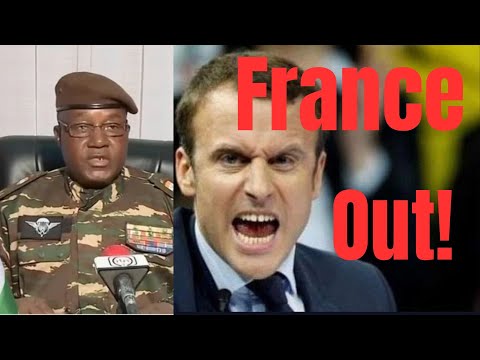
This content was created by David Oualaalou. This content was uploaded by David Oualaalou. This is a YouTube video titled "Niger Tells France it's Over! Go Home!!!" (uploaded Aug 2, 2023). Based on the title and available metadata, the content appears to be political commentary or reportage expressing anti‑French sentiment concerning Niger–France relations. No transcript or speakers are included in the excerpt, and no creator/host is specified in the metadata provided.
Chapters
Everybody, and welcome to Geopolitical Trends. My name is David Oualaalou. So good to be with you as always. Very, very excited to be here to talk to you about what's really going on in Niger and put this within the, the big picture. There are more than what meets the eye. Of course, Western media is sort of spinning certain things for certain reasons, and I will disclose all this to you in this live stream here. So, but first, I'd like to say thank you as always to the channel's members and supporters, and I want to give a shout out to new members. Is— all right, there's one here. That's, uh, In My View CCM. Thank you very much for becoming a channel supporter. Uh, I also want to give a shout out to D. Lam. He's another supporter, just subscribed to the channel. So we are now about 65 members. So if you want to really show your support for this channel, become a supporter or a member for the channel here. And by the way, I kept my promise to you that once we reach 100 members— we are 35 short— The moment we reach 100, I'm gonna do an exclusive Q&A for the members, and I will share a surprise. So I have just a quick two announcements to make. Actually, mainly one is that I set the, uh, uh, the time for next week to have my guest from Australia, and my guest is Robbie Barwick. So I'm gonna post all this for you guys. I just was finalizing some stuff with him yesterday. He's flying back from Canberra to Melbourne, and, uh, uh, Ravi is someone you want to listen to what he has to say. So I look forward to that conversation. And also, I'm sure you guys saw the video that I released this morning about New Zealand. Some of you have put a comment about doing a, uh, a live stream. So if you guys want a live stream, just, just put yes on, on the chat box so I know that you guys want it. This way I won't waste my time and I wouldn't waste yours either. So, all right, let's get into addressing what, uh, this, uh, Niger coup, uh, now, uh, by the way, there are those who use the term coup and there are those who are not, including the US. Believe it or not, Washington has not confirmed that it is a coup. So it's wishy-washy about it, and I'm gonna explain to you why, why that is. So, but just a brief, brief background about the, uh, the, uh, for now we're gonna have to call it as is, which is a military coup. Uh, the 3 questions you're gonna ask yourself are, you know, why did this happen? You know, even knowing the history of Niger, as a matter of fact, this is the 5th coup that took place, you know, in its history so far. Second is, why are Western countries, mainly France and the United States, are very concerned? Is it really about democracy as they claim, or is it about economics? So, and we're gonna detail all this. And the third major key question we need to ask is the role the ECOWAS, which I will explain explain, uh, uh, to you what that means. Basically, for ECOWAS, it's the, uh, the Economic Community of Western African States. That's what ECOWAS stands for. And I will, I'll, I'll detail as I move forward. So this is— those are the basic questions we need to ask, because anytime, uh, an event like this happens, of course this spinning of the information from the machinery, uh, uh, in, in, in different parts of the world. It's because there are interests. Now, Africa has always been, you know, I still, till today, to a degree, has always been the center where Westerns, uh, you can use the term colonialism, you can use imperialism, whatever term you want to use, What I wanted to say is they've always exploited Africa, and they still, till today, and still doing it. So, so what, what surprises me personally as, as a human being— this is not as an analyst, not as a— just as an observer— is with Africa's massive richness, natural resources, and they stay poor. Certain reasons. That, that's what's mind-boggling to me. So, and we're going to explain, or I'm going to detail a few things for you, but first need to put this within the context of what happened. So the general who led the coup in Niger, uh, his name is Abdourahmane Tchiani. Let me get you guys a picture so you'll, you'll see, uh, what he looks like. I'm sure some of you have already seen that. Uh, this is General Tiani here. So, uh, there's another image of him here. So this is the military, uh, he's, he's the head of the presidential security guard. So, well, the, uh, when he took over, you know, on, on Friday and asked believe it or not, he went to the state television and asked for support from the nation and international partners, you know. And his argument was that because the growing concern inside Niger that the living standards of Nigerian people are not moving, poverty all over, and yet the country is so rich in natural resources. So that's what prompted one of the reasons why, uh, uh, for the, for the, for the removal of the, uh, the president of Niger. So, so what happened is that there are various factions in Niger's military, you know, that have so far reportedly wrangled for control since members of the Presidential Guard when they detained, uh, the president, uh, Mohamed Bazoum. Let me get you guys pictures so you see. There's a picture of him with none other than our Secretary of State, you know. And, and I'll let, I'll let you read between the lines. So, so Mohamed Bazoum, that's— he's the first elected actually, believe it or not, since, uh, he's been in power I think since 20 or 2021, somewhere around that time. So yeah, 2 years ago, he's been elected, uh, 2 years ago in Niger. To some have categorized his election as the first peaceful democratic transfer of power since independence of Niger from France. Yeah, that's how, uh, so when the general, General, uh, Tiani spoke on, on the TV stations, he sort of identified himself as the leader of the group of soldiers who are— who those the one who staged the coup. And his appearance seems to be an effort to show he was in charge. So Abdourahmane Tchiani, the head of Niger presidential guards, by the way, uh, you have to know a little bit about his background. Has named himself as the head, as I said, of the so-called transitional government in the West African country after he took over. So he made the announcement on Friday, so, uh, on, on the state-run TV. He's about 62 or 62 years of age, and, uh, The intervention, in his opinion, he sort of believes that it was necessary. Why it was necessary in his argument, and I put this in quotes because I had to read his statements and I— it caught my eyes, so I decided to keep it for you guys so you hear it. The quote, he said, because of the gradual and inevitable demise, end of quote, of the country. So his argument is that while Bazoum, which is the, the president of Niger, has sought to convince people that all is going well in the country, the harsh reality is a pile of dead, displaced, humiliation, and frustration, end of quote. That's very, very powerful statements. And why is this powerful? It's because the question will become, is he really after power, this general, or was he really to make change so the people in Niger can benefit from the wealth under their ground and improve their living standards? I am reminded historically here of, uh, I used to have a colleague— I'll share this with you guys— I used to have a colleague that I worked with in Washington, DC back in the day, and he was originally from Sudan. And he told me the story when a general in Sudan way back conducted the coup, yeah, and took over power, you know. And you know what, once the, once the dust settled, that general back then in Sudan turned over power. Back to the civilians. So his objective was, is to calm the nerve of many in the country, in Sudan back then. So his objective wasn't about controlling power. So I'm like wondering, is this new, is this general in Niger might be doing the same because he is concerned where his country is headed, and he didn't see any changes from the pro-Western president, uh, uh, Bazoum, because Bazoum is pro-Western. And I'm gonna share some stuff with you to know. And again, we're not passing judgments here, guys. We just putting the facts on the table. So the security approach today has not— this is according to General, uh, Tiani— the secure— and I quote this— the security approach today has not brought security to the country despite heavy sacrifices, end of quote. So of course General Tziani didn't mention the timeline when he will return power to civilians, and that makes you think and wonder, no, is he really general? Is he thinking about the welfare of this country? Yes, he's going to have to rattle some feathers here and take over control of the country. Because so far inside Niger, the army is not against it. This is what the— not been disclosed in the West. The army is not against it, army in Niger. The population is divided. There are those for, there are those against. So, and this is why we're saying we're presenting the facts And we'll see what transpires. Um, and by the way, just a brief background on, on, uh, about this general. Uh, Tiani was drafted to lead the elite unit, presidential that is, back in 2011. And he is from the western side of Niger. Uh, let me see if I can get a map here so for you guys to see. Uh, No, I don't have the exact one, but just— he's from this part here, from— this is Niamey, the capital of Niger, and, uh, Genociani is from this part of the western part of Niger here, uh, from a, from a tribe that is called the Tillabéri, or region, I'm sorry, western region of Tillabéri, which is close to the borders with Mali. Why is this important for you to know? Because Mali and Burkina Faso just stated that they will come to the support of the new leadership in Niger if France intervenes. Because what happened in Mali recently? Mali kicked France out with the support of none other than the Russian Wagner. So you can just see how, like, it's like a web of really, really major interests playing against each other. And I will try to decipher it for you here in this live stream so you at least have a perspective of what's going on. So, so General Tiani, uh, General Tiani remains a close ally of a former president of Niger Mahamadou Issoufou. That was way back. So, and now we need to think in terms— okay, if this is all taking place, what's in it for France? Why all of a sudden France is saying we're gonna intervene militarily? Well, now you can't intervene militarily because Niger is a sovereign state. So who the heck are you to just dictate the terms and say, I'm going to send my special ops and take over? You can't do that. And this is why Mali and Burkina Faso both stepped forward and said, we will support. As a matter of fact, there are other countries in Africa that they have expressed their support for the new leadership in, uh, in Niger. So, so the question becomes is why France is interested in this. Well, of course it's because economics. I'm going to share a link with you because I had to look for it and confirm it. First, I want to tell you that when you go to France right now— so I, I have family lives in France— so when you go to France, every light bulb— see those light bulbs that are in places in France and the whole country Where is that coming from? As far as the nuclear power plant that generate electricity, that uranium, where it's coming from? It's coming from Niger. When France allowed— somebody's calling me here— when France allowed, for example, uh, I'm, I'm going to show you, uh, one Uh, I got it on my Twitter, uh, follow-up, uh, that France is— has like, for example, it's considered now the fourth. Richard, yeah, yeah, let me share this with you guys and take a look, and I'm gonna read it for you if you couldn't see it here. Let me share this screen with you so this way you'll understand Why is France all of a sudden saying, oh no, we're gonna go and, and intervene militarily? You know, so here's what happened. France now is, uh, has, is considered the fourth, yeah, the fourth, uh, largest gold reserves in the world with 2,436. No. Well, the question becomes, is does France have any gold mines in France? No. As one who's familiar with France, it doesn't. So where is that gold is coming from? Well, it's coming from Mali and the region, so, which France has occupied, by the way. And here is the sad part, is that, you know, here's the image, guys. Look at this amount of gold here. You know, really, that doesn't belong to France, it belongs to, uh, Mali, the rightful owners. So what's interesting about all this, uh, uh, uh, what's interesting about all this is that the reason why France wanted to intervene is because they wanted to protect their access. And the access, by the way, Wasn't that in an— wasn't sort of conducted or made in an— on an equal footing that the locals will benefit? No, because France will take the, the, the, the, the goods and Africans will just do the labor. Well, I don't think so it's fair. I also find out that, believe it or not, and I'm gonna send you the— I'm gonna post the link for you— that as of today Okay, France still getting about $500 billion in colonial taxes from African countries. And let me send you the link so you can read it for yourself. So, so it is mind-boggling. That's to me what was the copy. And here, I'm going to send it to you guys, and you can read it yourself later on if you want, or read it now, whatever you like. Here is the link. All right, I posted for you. Yeah, $500 billion in colonial tax. So this is why you are noticing now France wants to intervene. The United States, on the other hand, which by the way we got— we get uranium also. For the case of the United States, uh, which is very, very interesting dynamics because I'll show you this picture of Secretary of State and the president. He's still president officially because he's not been— he's removed yet, but he's still a president. But where the challenge for this is that the idea that we are now— we, the United States, are in trap. We're, we're, we're trapped. Trapped between what? Trapped between choosing either the economic interests or the so-called promotion of democracy. This is what the Biden administration now why it is hesitating to call this a coup, because that's the only explanation to it. So the administration— I mean, US, that is— is kind of like playing, playing it safe. So the administration position on, on the characterization of a military coup in Niger is dominated by hesitation, as doing so could lead to the cessation and termination of US security assistance to a country key to fighting so-called terrorism and all that, but also limiting the Russian influence on the African continent. That's why I said, guys, few weeks ago Africa is also gonna emerge and is already emerging as the new geopolitical ground, battleground among major powers. So if you look at this map, if you look at this map right here, this is Niger, where it is, and all these countries around here rich in natural resources. Even those two here, right here up North Africa, Algeria and Libya, oil. You know, look what's going on in Libya because NATO went ahead and did what it did. So this is why for us, the US administration, or the Biden administration that is, was hesitating because they are thinking in terms of, well, we're gonna have to limit the Russians, the No, it's about access to those natural resources. And yet Africans, citizens from whatever part of the country, uh, from whatever part of the continent they are, they're not even benefiting from all this. This is what, what, what's surprising about this. So you also have another dimensions. So the reluctance now of the US to call it a coup is an example of President Biden's lack of foreign policy, because poor president doesn't even know what he's saying. Uh, you forgive him for that because, uh, we're all gonna get old one day. Some of us might be experiencing that decline in cognitive abilities. You know, it's not a laughing matter. So, and, and we don't do that. You know, you don't, you don't make fun of someone else's illness or health issues, whatever. It's not appropriate. It's not appropriate. But the decline is there. The cognitive decline for President Biden is there. So he's not aware. He's not able to make those decisions. So, so this reluctance in this— because this is considered a foreign policy— this reluctance in this foreign policy is an attempt to balance so-called democratic principles with— when we know There is no such thing. We're just using that word loosely, very loosely, to justify whatever, uh, this. And on one hand, and also the harsh reality of a strategic reality of it, because the strategic reality is access to natural resources including rare earth minerals, which is going to be defining how the new global political order or the geopolitical order is going to be. Mind you that AI is going to be part— it is part of our existence, and whoever or whomever has access to rare earth minerals and dominate that will have a say into which direction things are going. We're already witnessing what's going on between the United States and China regarding the chip industry. You're looking right now what's going on in South Korea with Samsung. Yeah, you're looking right now what the head, the CEO of TSMC in Taiwan is saying about the US sort of putting the plants in Arizona. He's not in favor of that. But Africa, Africa is rich in these natural resources, and this is where the hard reality that left the Biden administration confused as to what to call it. You call it a coup or not? So they're gonna be playing wishy-washy. This is exactly the approach we were trying to do with, uh, uh, New Zealand. That's why I released that video this morning, guys, for New Zealand. And New Zealand took stand. You admire— I admire Nayana. I admire her. She's, by the way, uh, uh, uh, uh, indigenous. That's why you see the mark on her chin. That's the tribes, the indigenous, you know. She took stand. She has the courage to look at Secretary, uh, Blinken in his eyes and said, no, we're not going to sacrifice the welfare of our nation because New Zealand also has a good economic trade with China, and they are seeing what's going on in Australia, and they're like, nope. So Africa has the potentials for really, really turning things around economically. But it's— you look at countries like France, you know, and this is nothing new. I'm not pointing fingers at France, you know. No, historically, you have to go back to the Portuguese, the Dutch, the Germans, the Belgium the British and the Americans and the French and the Spaniards, of course. So this is what's at the heart of it. It's a strategic reality, especially when it comes down to access to, uh, rare earth minerals and, and, and so forth. Then you got another— a pro— not a problem, I will call it But another, uh, what's, what's the word I'm looking for? Another avenue, if I may use the term. Now you have the role of the ECOWAS. Well, ECOWAS is, as I mentioned earlier, is the economic community of Western African states known as ECOWAS. Let me show you guys a map so you know, uh, where ECOWAS is. This is Western Africa. That's where most of those countries are part of the ECOWAS. So ECOWAS, uh, it's, it's an African organization established by the Treaty of Lagos in May 1975. That's how far back it goes. And it has one objective and one objective only. It's to promote economic trade cooperation and self-reliance, which makes perfect sense. Can you imagine? And this is what I still wonder, why African countries couldn't join together, combine their resources, combine their manpower, combine their abilities, and produce for everyone. But because the Western collective West tried to prevent that from happening. It's because access to natural resources. You look at France, most of the uranium used in France's nuclear power plants is coming from Niger. That's why France is far ahead in comparison to European countries when it comes down to nuclear power technology. So that's what it is. So the organization, the, uh, ECOWAS, that is seeks to harmonize agricultural policies and to facilitate the free movements of people, services, and capital between members. So originally there were about 15 nations: Benin, Côte d'Ivoire, or Ivory Coast, Gambia, Ghana, Guinea, Guinea-Bissau, Liberia, Mali, Mauritania, Niger, Nigeria, Senegal, Sierra Leone, Togo, Burkina Faso, Cape Verde, which joined in 1977. So once again, let me show you the map here, guys. Most of those countries are right here. Now here is where the problem— ECOWAS has just sent a delegation now to, uh, to Niger, Niamey, and they wanted to sort of talk or figure out a solution. Why? Because they already threatened— yeah, believe it or not, they threatened to use force against Niger. Well, hold on a second, who are you to go to a sovereign state and declare a military, uh, uh, intervention? It's almost saying like, well, Niger is not a sovereign state. When it is. And even if we are to go with the arguments that the coup, it's not a good idea, whatever, whatever, it's an internal matter. So this is why Mali and Burkina Faso stepped forward already and said they will support militarily, they will support Niger army inside Niger is not opposing to the coup so far. This is why we in the United States were wishy-washy about how to word it. France saying no, we're gonna intervene. It's because they feel that because Niger cut off the shipments of uranium, export of uranium, they stopped it for now. And maybe it's a good idea. They need to sort out their problems first and reorient everything. As a matter of fact, the, uh, General Tiani, uh, I, I read somewhere yesterday that he got 48 hours to the finance minister from the previous cabinet, 48 hours to provide the books about all the finances or be executed. I know it might sound harsh, but hey, sort of things needs to be done. Even I look at it now for us, the corruption that's going on. No, no lawmaker go to jail. No, there is, there is one set of laws for average citizens and there is another set of laws for the upper class. Well, isn't that the law for us? When you see the symbol in the Supreme Court of the United States, what do you see at the top? Is the blindfolded lady with equal— the, the, uh, what you call it, the balance, the, uh, the scale, evenly, you know, even, which means what basically? Even just— or equal justice. You know, yet for us here, no politicians end up in prison. Yes, he was one guy I remember from Ohio, his name was a congressman or senator, one I couldn't remember. His name was Traficant. He went to jail, brief period, you know. But the massive corruption that's going on right now, you don't know, including our president's son or even the president himself, you know. How come we don't have any investigation regarding the president's wrongdoing? If he did wrong, the investigation will prove that. If he didn't, life goes on. So nobody should be above the law. And this is where that argument comes in as to why ECOWAS all of a sudden saying, well, we want to intervene. No, you can't, because Niger is a sovereign state. There is another element that I need you to be aware of here, and it has to do with economics. You know, when you look at the Iranian production, Niger by itself, which has Africa's highest grade uranium ore— I will be doing, uh, I will be doing an analysis for, uh, uh, someone who reached out, uh, to me to do an analysis about this, uh, for uranium investments. I can just see where things are headed. It'll make more sense to now, because this is why France is so scared of or nervous about— even for us in the United States, most Americans have no clue that we import about $1 billion worth of uranium from Russia. Yeah, you heard me. I, I don't want to say much because I'm keeping this for my analysis that I'm gonna record for down the road soon, so in a few days. Yeah, surprising, right? So, so in, uh, in Niger, uh, it produces about 2,000 metric tons of uranium as of last year, you know, which is about 5% of the world mining output. And this, by the way, I checked and fact-checked this info from two separate sources. This is from the World Nuclear Association, known as WNA. So, and I'll be happy to provide you— let me provide you the link so you know where this information is coming from. Link, and I'm gonna share it with you guys. And this is what some— I feel that the media, you know, cherry-picking about the information that justifies certain narrative but, uh, refrain from disclosing the full picture. So the listener or the viewers end up getting half of the story. As a matter of fact, he was a A survey was conducted by Gallup, and Gallup tends to have a good reputation. Uh, when I was doing my, uh, my, uh, PhD dissertations and so forth, and I had to look at a variety of sources because you have to— that's part of what PhD is all about, it's about research. So, and their recent research find out that when it comes down to here in the United States, the media MSNBC is the only one that is about 50% accurate. Fox News is about 28%. CNN, I don't remember the number, but they're all bad. MSNBC came up with 50, which means what, guys? If you are an American watching TV or listening to the news, that means half of it, it's not accurate. So I, I take this example and apply it to this regarding an international matter. And the reason being, because this is why I said what I said a few weeks ago, that Africa will become the new geopolitical ring by which competition will become fierce among major powers, because access to resources. So, and this is why understanding also on the economic front, it makes perfect sense. So the other aspect of the economic is gold. You have to think about it this way also. The global sales— excuse me— the global sales of, uh, uh, uh, for gold exported by all countries totaled about $436 billion last year. You know, that dollar amount resulted from a 45.2% gain in value since 2018. So why is this important? It's important to understand where the gold's coming from. Also, this is why France declared itself as the fourth, uh, reserve of gold in the world. After Russia, China, and I don't remember the third one. So, so, and again, you ask yourself where that gold is coming from for France. Africa, that's where it's coming from. So, so this is now the idea of understanding these dynamics within the bigger picture. So, and it behooves now the ECOWAS, the, the association, the, uh uh, what you call it, the Economic Community of Western African States, to think twice about just spewing this kind of nonsense, because it's nonsense. And it begs the question, are they being told what to say? Because that's how I look at it, you know. Why would you want to intervene militarily in another sovereign state? Yeah, and France already— they already— you got 4 countries, I think, uh, uh, uh, that Western evacuated their citizens. Now the US will be— I mean, we do have what we call the— there is a term, and I think when I put the, uh, the description for the video I, I had to change it just to make change, to make, uh, to make it clear. I didn't want to use certain terminology that will confuse people. Uh, some said, well, we already have the troops in Niger. Yeah, it's more presence there to begin with, but the troops are not there. They are what we called retrograded. Retrograded means when you just bring in back the already established force, 1,000 troops. That's what we had in, uh, in Niger. So, so it begs the question, are we gonna get involved militarily? Is it really about democracy, or is about being concerned that now Wagner Group might be going now back to Mali and he might even get involved in Niger? They're highly trained, highly skilled, and this is why Mali was able to kick out France, because with the help of Wagner. Let's not deny this one. There is also another aspect that I need to bring forth. You know, I can confirm this one because I looked from different, uh, sources and I couldn't get a confirm— confirmation about it. So But I will state it, that doesn't mean it's 100%, is that there are some analyses that have been released suggesting that the coup was orchestrated by Russia. I, I, here's the thing. The entities inside Niger, and I think I had one, uh, I had one particular aspect that I'm aware of, that some of, uh, some of them were trained by the United States, uh, uh, Special Forces. So, so we were having, uh, sort of— we spend a lot of time training, uh, those elements. Uh, how far is it? That, that depends. So, and here's the thing, uh, some regarding our presence there, because as I said earlier, you're looking at about 1,000 troops, so, uh, that we have service personnel in the country, in Niger. No, some military leaders who appears to be involved in, in this coup, by the way, have worked closely with the US for years. I can name one because I do remember General Moussa Salao Barmo. He was the head of the Niger Special Forces, so has especially strong relationship with the US. And other Western military alliances. So, so this is why if you are to read or hear the narrative, oh, was Russia behind the coup, you have to take step back till you evaluate the information. That's why I wanted to share it with you, but I couldn't. For the record, I couldn't confirm that one. So, so, and like I said earlier, guys, Niger is known for Some countries in Africa, this is the norm there. So this is Niger's fifth coup that marks the fall of one of the last democratically collected— elected, rather, not collected, elected government in the Sahel region. But mind you, if you are democratically elected and you couldn't benefit the welfare of your people, what good that democracy is going to do to the people who are living in poverty? So that's just common sense question. So, and this is what prompts this military to kind of remove the guy, uh, Bazoum, Mohamed Bazoum, remove him from power, uh, uh, and, and figure out— till they figure out, uh, whether General Tchiani will stay in power. I, I, I don't see that. I don't see that. If he has good intentions, he'll, he'll set the country on a good path and turn power over to the civilians, you know, if that is what people want, you know. Because like we always say, guys, it's human nature. Power corrupts. And if you don't pay close attention to it, to within yourself, then you don't, you know, you, you can get sidetracked. So So this is where I see the challenges lying ahead for Niger. But Niger, like other countries in, in the region, they are rich in natural resources, and their people needs to have a better life. They deserve better. That's just the way I see it. So All right, let me, uh, see first of all if I shared everything with you. I think I did. Yeah, this is the— yeah, that's all those countries around. They're very rich in natural resources. And this again because France has a massive presence in Africa. It's colonial power. Uh, if they're still getting $500 billion in colonial tax, that's problematic. Very problematic, I would say. And, and, uh, this is why I don't think so— it's over for France. It's over in Africa. And it's frankly so. It's about time. Any, any colonial powers. And this is again where I see the trends. I, I pay close attention to that stuff. Still, this will not dissuade me from saying that, oh, now the attention about the geopolitical is going to shift to Africa from Asia. No, it won't. Asia will still remain. And this is why I'm thinking of doing— what do you guys think? You want me to do a live stream on New Zealand as to really why he made that decision? Just leave me an answer on the chat box and I will be happy to take a look at it. So, because I just see the dynamics of, of what's going on in Asia and, and what lies ahead for that country. So, so yeah, it's, it's mind-boggling that African countries still paying the, the tax, uh, colonial tax. No, and, and as I always say, you know, if those Western countries are guided by moral ethics, you know, by principles, then return the stolen gold to the rightful owner. Britain, you know, during the Queen when she was alive— if you all guys only know the atrocities United Kingdom committed in Africa, you know, or, or in, in Southeast Asia, but we're talking about Africa right now. So if, if, if, uh, UK wants to do the right thing, then return the stolen gold to the rightful owners in Africa, in India, and in, in Venezuela. So France, we need to do the same. Belgium needs to do the same. The Dutch needs to do the same. Portuguese needs to do the same. So even for us, you know, it's kind of— or you trade with these countries in a fair manner, justly, fairly, and squarely, that is. So, you know, you don't exploit the, the, the, the labor market there. You're paying them a dollar a day for 12 hours. That, that's to me an abuse. It's fascinating what people can do for money. Greed, because it blinds the— sort of, it blinds your heart. You don't think sensibly anymore because you're blinded. You can't see anymore, you know. To, to me, that's the right thing to do if those countries are claiming this principles of, uh, uh, rule of law and democracy and so forth. It's— we all know it's nothing but a bravado. That's the sad part. So, so, all right guys, let me see if you guys answer that one, uh, quickly. I know it takes a while before to show up here, uh, Yeah, and I'll, I'll see how the weekend goes, and if it is, I will do, uh, uh, the, the about New Zealand, uh, because yeah, yeah, you're absolutely correct, TNT, you're absolutely correct. New Zealand has such a small country, is a small country, but had some balls to take the— you admire them, it takes courage. It takes courage and determination when it matters. You know, this is why I believe, you know, we use the term leader so loosely, but when a leader is tested, they back down. Look at the Europeans. Look at Olaf Scholz, German, the Chancellor of Germany. When it matters, he couldn't take stand. You look at the Prime Minister Dictator Trudeau. You look at the Prime Minister, incompetent Albo of Australia. You look at the incompetent, uh, uh, Fumio Kishida of Japan. You look at the President of South Korea. You look at even the, uh, Marcos Jr., incompetent, weak leader. You know, New Zealand showed— Nana showed courage. She showed courage. You admire someone Yes, she knew what she's getting into. There will be some— that's why I left the— I ended the video with the question: will the United States respect the wishes of New Zealand, or will it foment tensions through its proxies? It's a reality. So, well, at least I wanted to put this in a, in a bigger context for you guys. To have an understanding, because you're gonna be reading more and more. And yes, when you take the whole continent of Africa, of 54 countries, you know, uh, you look at just the recent meeting or the summit between Russia and Africa, you know, 49 out of 54 attended. That speaks volume. And this is why I said Africa is going to turn into the geopolitical ring where the competition is going to get fierce. Among the major powers. And which major powers are we talking about? France? No, we're talking about United States, we're talking about Russia, and we're talking about China. That's about it. So, all right guys, uh, let me see if there is one question. I'll take one question. And by the way, if this is your— oh, there's one question. I saw it right here. Where is— I just saw Q, it says question. Uh, and by the way, guys, if this is your first time here, please make sure to subscribe. I would really appreciate it, uh, your support. Without your support— oh, TNT, thank you so much, man. I appreciate it. Thank you, Dr. Dave, for highlighting my comment. You always provide great content that is up to date. You are most welcome, and I can't thank you enough, TNT, for your continued support. TNT has been with me here for a while, you know, I, I can't thank you enough, man, for your support. It means a lot. So yeah, guys, if this is your first time landing here, please make sure to subscribe because that's the only way I can grow this channel. And, and if you really want to show your support to the channel, become a member, uh, of, of the channel here. So I'm by myself here, by the way. I don't have some funding for all this, and it takes me time It really takes me time to do the research, as I told you last time, and I don't shy away from it. I gave up a full-time teaching position just to do this. Why? Because I believe in it. And if sometimes you believe and your heart is in something, go for it. This is what my instinct is telling me. So I believe in this, I believe in you guys, and I count on your support. That's the bottom line to it. So Once again, thank you so much, TNT. Truly appreciate it. Let me see if there is a quick question from you guys here. I'll take one and I'll move on because I have to go, uh, uh, prepare, uh, one video for you that is very— oh, uh, David K, thank you very much. Dr. Oualaalou is spoiling us with— spoiling us with all this content. Thank you, Dr. You are most welcome. I, I, I know it's a, it's a, it's a special content, if I may. I'm not bragging, uh, it's my background, and, and I want you guys to get the best information. You arm yourself with knowledge. That is what's important. You arm yourself with knowledge. This way you won't be swayed or persuaded by misinformation just because it sounds good, or it looks good in the images, whatever. No, you will be aiming at the content. Why? Because you've developed critical thinking by which you can analyze and see the information. So you're most welcome, David K. Truly appreciate it. Uh, and yeah, I do spend a lot of time here. Oh, here is another— I want to say thank you to Darren M. Thank you so much, Dr. David. Your coverage, uh, are amazing. Please do an analyst on Southeast Asia. I heard the US, Ned, are rounding up their puppets. Uh, yeah, I will second that. There are some stuff going on, and I will do one about Southeast Asia because I'm already starting to see the signs, and that my first signs was with India. That's why I had to do those videos. I know some in India misinterpreted that, that I am picking on their country. I am not. As a matter of fact, I did reach out to an analyst inside India, well known, without disclosing the name, well known, a PhD guy, and he knows what he's talking about. And I haven't heard back because I like to invite him over because he's from there And he is objective. I know of him. I'm aware of his work. Usually in the field of, of, uh, geopolitical analysts, you know who the real analysts are. Like, for example, you take an example of Dr. Connie Bakri in Indonesia. She knows what she's talking about. So, so analysts know who the— who their colleagues are, per se, even though we might not know each other personally, but we know of each other. So, so thank you so much, and I will do that one. You have my word on that. So, uh, let me see else. W— Athene Wu, good to see you, Athene Wu, as always, you know. Uh, Harry, good to have you here again. The Netherlands is the best lap dog. You are absolutely correct, because look now what happened When Netherlands decided to stop selling equipment, the ASML, the equipment for the chips, to China, look now what's happening to them. You know, you don't hear much about it. The government had to collapse. Their Prime Minister Rook Mark had to resign, even though he resigned because he has another agenda in mind. He's aiming at Ursula von der Leyen position because she's gonna move and aim for the NATO position. It's all about them, power. That's why they are corrupted. That's why they are corrupted. And to me, I have to provide you the information so you'll be well armed to know what's going on. So, so, and thank you again Heidi, for your continued support, so truly appreciate it. Jack, I'll take question from Jack Robert here. Question: Russia and China next going to help Burkina Faso, Zimbabwe, Mali, Somalia, the Central African Republic, and Eritrea, the same nations Russia gave free wheat to? You're absolutely correct, they are going. Let alone that Russia also forgave $20 billion of African debt. Yeah, so that tells me what? It tells me that the sanctions imposed by the West are not working. If Russia is giving free wheat, you know, and as a matter of fact, now I even read— where did I read that? One country now, uh, stopped exporting rice. I think India, if I'm not mistaken. So, so yeah, yeah. And this is why, this is why Burkina Faso and Mali moved forward and stated that they will be willing to support Niger militarily if France, uh, launched an attack or the ECOWAS intervened militarily. And it could become a wider one Wagner is on its way, based on my resources— or my sources, rather. It's on its way. So this is why— this— that's why for us, the United States, we had to be very careful how to word it. A military coup or not? That's what's interesting about it. Uh, Tony, good to see you, Tony. How about inviting David P. Goldman on your program to talk to the tech side? I have someone in mind already, and I'm gonna reach out to him. He knows about this, the world of the tech, the fintech, and all the stuff. And as a matter of fact, his headquarters is, uh, his, uh, he resides in Shanghai. So, so I will, I will do that. Just I have to coordinate the timing. Uh, oh, David Lee, please collaborate with Connie Bakri. I did send her an email, so I'm waiting for her response. So till she gets back to me, I don't chase after people, I don't do that. So, oh, Shiro, let me say thank you back to the previous Super Chat. Please have more content about the Asia and Pacific. Hope can invite Dr. Connie and bring more viewers from Indonesia. We need to learn the geopolitics affecting our country. I will do that, Shira. I will do that. And I— this is why I'm leaning more towards— and I will do it for a live stream on New Zealand, what it did. Then I'll, I'll kind of, uh, put an analysis together for you about Southeast Asia with the focus on Indonesia and Malaysia. I will do that. Thank you so much for your kind support. All right guys, I'm gonna have to go because I have, uh, I have an interview in Washington, DC that I have to attend to. So as always guys, I hope you find this content very useful and informative. And please, once again, please subscribe to this channel if you have not done so. I would really appreciate it. As always, remember geopolitics impact your daily life in more ways than one. Till next time, guys. Bye-bye.
More from David


Beyond the Single Actor: Why the Gulf Isn't Choosing Between the US and China


Iran, Iraq's Militias, and the Houthis Are Coordinating! This Changes Everything




Who Controls the Next Decade's Resources? Latin America and Africa's Geopolitical Crossroads

The Chokepoint Trap: How Washington's Stupidity Triggered a Cascade That Now Controls the World

Trump Spooked as IRGC Unveiled dual-use SLV, Deployed Ghadir Mini-Subs & Hinted at Tactical Nukes!
