No Deals, High Tension: The Takeaways From Trump’s Beijing State Visit! W/Dr. Warwick Powell
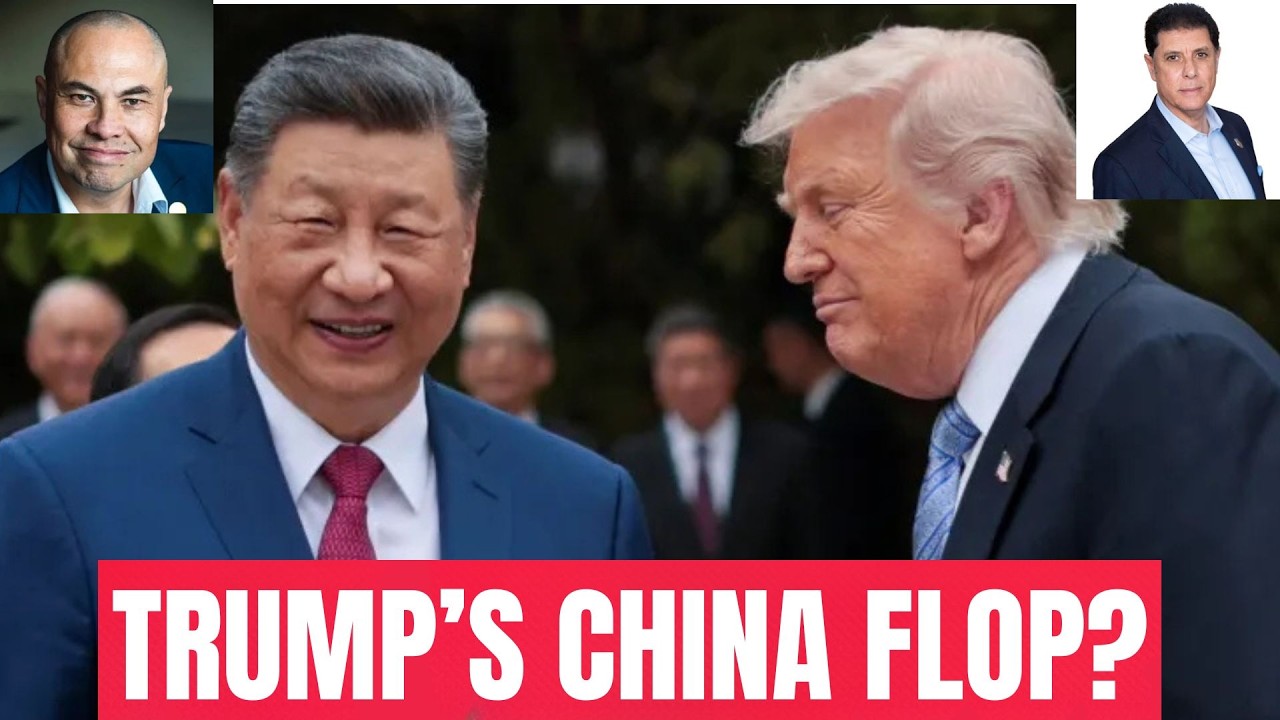
In this hour‑long Geopolitical Trend interview, host David Oualaalou and guest Dr. Warwick Powell dissect President Trump’s recent state visit to Beijing. They evaluate the summit’s limited concrete outcomes, noting that China secured its primary objectives—recognition of parity, Taiwan ambiguity, and no substantive economic concessions—while the United States walked away with modest market‑access promises (soybeans, beef, limited aerospace sales) and vague tech‑policy discussions. The conversation moves through five thematic blocks: (1) corporate delegation and the political leverage of tech CEOs (Elon Musk, Tim Cook, Jensen Huang) amid unresolved trade and export controls; (2) the geopolitical dimension, focusing on strategic ambiguity over Taiwan, the erosion of U.S. deterrence in Asia, and the shifting balance of military assets; (3) Middle‑East dynamics, especially the Iran‑Strait of Hormuz issue and China’s pragmatic role in regional security architecture; (4) domestic U.S. political fallout, including how Democrats may weaponize the summit’s “empty‑handed” return against Trump ahead of the 2026 midterms, and the broader economic headwinds (diesel shortages, K‑shaped growth, Ukraine war). (5) ancillary topics such as the scrapped Trump‑branded tower in Australia and the broader invitation to a multipolar world. Throughout, Powell stresses that single‑summit outcomes are less decisive than the institutional mechanisms (Trade Board, Investment Board) and the longer‑term strategic posture of both powers. The interview ends with a cautious optimism that the summit could lay groundwork for a U.S. adaptation to a multipolar order, but warns that entrenched U.S. institutional inertia may revert to “business‑as‑usual.”
Chapters
Hello everybody and welcome to Geopolitical Trend, where truth matters. Excited to be with you once again, but I'm even more excited because I have my dear friend, uh, Warwick Powell. He's here. Of course, last time you all were excited for Warwick, just something came up to his schedule and so forth, so we decided, and it was kind of him to allocate time for us to be here. So let me bring in Warwick right away. Hi, Warwick.
A good evening, I think it is. Good morning to anybody in my part of the world.
It is indeed my evening here. So for those who might be here for the first time, if you do not know who Dr. Warwick Pao, uh, Warwick is an adjunct professor at Queensland University of Technology. He's also a senior fellow at the Tahir Institute in Beijing. He writes frequently, and I follow his, uh, what I read rather, his articles and books. His latest book And I have a, a copy of the book right here. Uh, it's called Thermo-Economics in a Time of Monsters: Rethinking Theory, China, and International Geopolitical Economy. And by the way, guys, just for you, you might want to go and I'll post the link for you to the interview I did with Warwick when the book was launched. It was kind enough for him to carve out time for us here, so He's also the host of the TIO Talk Show. Uh, I'm gonna put the link for you in the chat box. You guys can check it out. Very interesting guests that come in on the show. I watch it on a regular basis. Very, very interesting. And thank you for doing that work. It's, uh, it's, uh, your knowledge. It's, uh, I'm, I'm, I'm appreciative of that. Let's put it at that. So, so Let me start, Warwick, right away. We're gonna— by the way, for the community, we're gonna tackle about 4 or 5 key themes. We're gonna talk about the corporates, we're gonna talk about geopolitical dimension, we're gonna talk about Middle East, and we're gonna talk about the security. And the last one is gonna be talking about the domestic political question that is worth asking. So, so what I want to start with, Warwick, is the idea that, uh Many, many objective analysts are saying that China achieved its primary objective, and its primary objective sort of not just one specific thing. For example, equal footing recognition, Taiwan ambiguity, no structural economic concession on part of China, unfriendly summit aesthetic, if I may use the term. On the other hand, the United States achieved pageantry, claimed unverifiable Chinese commitments on Iran and nuclear weapons, and left— the US left without the concrete breakthroughs the White House has hoped for. How accurate is this assessment in your opinion, Warwick?
Look, I think it's largely true, though I tend not to view these single summits in necessarily win-lose terms per se, because a lot will depend on what happens afterwards. A lot of things are discussed, some of them are agreed to, but ultimately the proof of the pudding will be in the eating. And we're going to have to wait and see how the United States, for instance, responds to what is in effect an invitation offered by China for the United States to join the multipolar train. And to collaborate with China in a way that would support the rejuvenation of the United States and the fulfillment of the broad vision of making America great again. Whether or not the United States is able to grab this opportunity, or whether the institutional muscle memory that has driven politics and economic policy for generations reasserts themselves is going to be the interesting question. So, uh, you know, what, what the US accomplished out of this, I think, is, uh, um, some— well, what you'd call agreements around market access, uh, selling some more soybeans, some beef, some, uh, airplanes, perhaps if they ever get built on time. And, um, the rest of it seems to be a little bit vague, um, and I don't think that the United States would get much joy on those other issues anyway.
I, uh, I had a chance to, to write an article on Substack, uh, uh, Warwick, in which I argued, uh, back then prior to the summit, that is unlikely to alter the character of— and the course, for that matter, of the US-China relations in the long term. Would I be wrong in this assessment?
Look, the character, as you say, of the relationship is something that's been in place for many decades, which means that they're difficult to change. A lot of institutional inertia gets built up over that period of time around what is by and large a status quo, you know, which is a United States policy institutional environment that increasingly frames China in adversarial terms, a general disposition towards global affairs which positions the United States as a victim, you know, it's being exploited by others, and I guess a turn towards reassertion of American power, particularly against smaller nations and also the nations of its own immediate region. So in many regards, changing the sort of deep tenor of, or the structural dynamics of a relationship, are difficult and certainly not things that single events like summits can actually do. I think the other point to remember, David, is that the United States came into this particular summit relatively underprepared. It's been distracted by many other problems and challenges, many of which are of its own doing. Yeah. And it has not been able to commit the bandwidth necessary to address the issues of substance, which ultimately will define not just the bilateral relationship, but how the bilateral relationship reverberates into the rest of the world. You know, issues around artificial intelligence, which clearly are very significant but complex, remain undercooked at this stage. A substantial number of the delegation that accompanied President Trump were from the tech sector, and so far as we can see, very little concerning technology questions has been resolved, or even a framework has been arrived at. What we did have was the ability to create an institutional architecture to address trade and potentially investment questions going forward. The United States describes these as the Trade Board and the Investment Board, but, you know, call them whatever you want. They are a mechanism by which the issues can be aired, and should there be differences of opinion hopefully can be resolved through negotiation. In some respects, it's a formalization of the working groups that have been operating since the trade wars began, and in that sense, you know, you could see this as a way of containing and managing potential areas of conflict. But many other big issues, I don't think were, you know, were successfully addressed or resolved. Obviously, the question around Iran, no doubt, was raised, but it wasn't resolved. Even the question of Taiwan, I think, in many ways remains up in the air, in large part for the reasons that we've just discussed, which is that presidents come and go, but the machinery of state and the institutional memories that drive it the inertia that exists around the agencies or the apparatuses of state, the entire ecosystem that's emerged around this question of Taiwan over the course of the last 75 to 80 years, you know, think tanks and, I mean, the military-industrial complex that thrives from disputes. None of that is going to bend just because President Trump you know, uttered some words on the airplane flight back or indicated that he personally as president did not see merit in the United States diving into a war, um, you know, in some part of the world that's 9,500 kilometers away from the American mainland. So, um, again, this is going to be one of those cases where the test will come from the actions that the Americans take not so much the utterances of the president.
Yeah, but with it still, I'm still gonna sort of follow on this before we dive in into the corporate question that I can't wait to hear your input about it. What I wanted to ask again, Warwick, as far as your assessment, and again, please correct me if I am wrong in this assessment, because the way I looked at this summit, we're not going to use the term it was a failure or whatever. We're not going to do that. What I'm going to say, however, is that it was about managing stability rather than sort of solving the outstanding issues and concerns that plague the US-China relations. Will that be fair?
Yeah, look, I think that that's a fair assessment that these kinds of talks, in many regards are orchestrated so as to create a mood that enables a bit of calm afterwards. Clearly, the mood that was created during the course of the 2.5 days was positive in the sense that there was plenty of bonhomie between the two leaders. The And so that, I guess, opens a space for the kind of constructive engagement that one might hope will take place thereafter. Had the leaders had a poor experience where there was, you know, a lot of cantankerousness one way or the other or both ways, then that would set a very bad mood, and moods can matter when you're negotiating around issues because if there's a bad mood, the likelihood of people digging their heels in increases, whereas if there's a good mood and there's goodwill being brought to the table, there is a willingness to find some common ground and to engage in some give and take. How much give and take there will be, of course, will again, you know, be the test. And I think it's fair to say that the United States, over the course of many years, has demonstrated that it tends not to be very good at the give and take. The United States has, for the best part of, you know, 30 years at the very least, you know, during the period of unipolar dominance, largely viewed the world through a zero-sum lens. And it does not have the experience anymore, bureaucratically and I think culturally, to understand what negotiation and compromise means, which makes the United States a party that many describe as agreement incapable. It just finds it very, very difficult to arrive and then stick to agreements that have been arrived at. And I think we've seen this not just in the term of this presidency, but across the terms of a number of, you know, recent presidencies as well, where the United States engages in so-called negotiations but really is trying to force the other side to concede or to yield to American demands. And it does that through the application of military force typically, and, and sometimes it can get what it wants through that method. But when it comes to dealing with places like China or Russia, or as we've seen now, Iran, holding a gun to their heads and threatening the other side with, you know, you know, economic sanctions or military interventions simply has not yielded the results that the United States is looking for. Now, can the United States rediscover its, its capacity to engage in sophisticated proper statecraft where the interests of others is actually recognized as legitimate and taken on board in the discussions, or will it continue down the path of nodding its head, pretending to take note, and then going back to its recent habits of, you know, single-minded, zero-sum— well, negotiations isn't even really the right word. It's really laying out some demands and, um, and getting angry when the other side resists.
Well, you're absolutely correct, and, and you brought up an interesting question about can the United States— and we're gonna get back to this later on because I want to get your perspective, especially when it comes down about the Taiwan issue. We'll, we'll get into that later on. So now, uh, since you wrote your book I remember when you were here on the channel and you detailed exactly the, the, the theme of, of the book and the interest about how, what we need to understand about the energy and so forth, and the key about the technology aspects of it. Uh, what I wanted to ask you is, how does the complete lack of concrete trade deals impacted now the political leverage of the high-profile tech CEOs, the likes of Elon Musk, Tim Cook, Jensen Huang, that, uh, who accompanied Donald Trump on this recent trip to China?
Look, I think that there's a few issues to unpack there. Probably the first one to note is that of the companies and the CEOs that, um, accompanied President Trump on the trip to China, there are, from a technology point of view, there are in broad terms two types. One type of companies that are already deeply invested in and dependent upon the Chinese supply chain and the Chinese market, whether that's Apple or Tesla, both of those companies, uh, and that— and the success of those companies is heavily contingent upon the stability of their relationships with Chinese supply chains and their ongoing access to the Chinese marketplace. That's the first point. The second group of companies are companies that would dearly love to have access to the Chinese marketplace and have struggled to have access to that marketplace, either because they haven't been able to meet the expectations of the Chinese market and the regulators, or because the American side has forbidden them from exporting their products to China. And I'm thinking, of course, of NVIDIA, which has suffered at the hands of American restrictions in terms of its export capabilities. You know, the NVIDIA H200 chip, which has been approved for exports, has gained zero traction to date. And I think that's partly because of the ongoing developments in China itself as far as alternatives, particularly the Huawei alternative. As well as broader concerns that the United States is a, is a body politic that has tended to view China through the lens, an adversarial lens, and therefore is prone to capricious policy changes that could disadvantage the long run of Chinese companies. And so companies, unsurprisingly, are wary of making commitments to a particular technology stack when you've got this much political uncertainty around what the policy regime is going to look like in 12 months' time or 24 months' time or even in 12 weeks' time. I think that that is to the significant disadvantage of companies like NVIDIA. Because it literally means that their ability to persuade the Chinese market that they can make long-term commitments to the NVIDIA product range is impaired. And, you know, so until the United States— and I don't just mean, you know, a single president— but until the United States as a political actor, broadly speaking, through the instruments of the Congress can demonstrate to the world that it will design policies and positions, it will agree to them and then abide by them. Until that happens, you know, these, these big decisions are really very, very hard to enter into. So I think part of the test— just quickly— part of the test of this summit is actually on the Americans, which is there's a bunch of relatively small things have been agreed to And the question is whether the Americans will be able to stick to their promises.
Well, just to piggyback on that, then what was the purpose of having those billionaires, 30 of them, going to China for? What was the sort of— what would be the purpose now that they realized that? Because the assumption was it that the Chinese are going to give concessions?
Well, perhaps, but I think, you know, the other purpose— and again, look beyond the summit— the other purpose is to at least open up a level of communications at that senior level that may— well, that is necessary if they want to make progress on anything. You know, when there have been these sorts of difficulties in the past that has created an environment of risk and uncertainty, you have to work at it to try to bring that back to earth and to reduce the sense of uncertainty and the risks associated with that from the other side. And there is no better way to do that than to have the CEOs of companies actually be involved. It's not going to deliver quick results. That's the other— that's the point to remember. And I think we know that. Whether it delivers any results at all remains an open question, but if I was to give some benefit of the doubt to the delegation that accompanied President Trump, then this would be the principal reason. Obviously, on some of these other issues, you know, whether it was Boeing, for example, the— this president in particular has, over the course of this term in office, been one of the most vocal champions for Boeing as he has, as he has pursued diplomatic and commercial leverage through the trade war and other things. You'll recall last year that on the back of the tariffs that were implemented, many of which have now been knocked down by the Supreme Court, that President Trump twisted the arms of other countries and their leaders to make commitments to purchase Boeing aircraft. Now, you know, it's one thing to get those sorts of commitments at that level, it's another thing to convert them into executed purchase orders. And what we know about the situation with Boeing is that Boeing as a corporation is many years behind in terms of its backlog of forward orders and the so-called, you know, approvals to purchase all of these aeroplanes isn't even booked onto Boeing's balance sheets because they're not firm— firmed up orders yet. So, you know, they're really something a little bit better than an expression of interest, but not much more. Again, you know, those who make these commitments understand the reality that Boeing is many years behind and have, you know, no expectations that airplanes, new airplanes, will suddenly arrive tomorrow. So, you know, it's an easy thing to make a commitment to. The hard part really is for Boeing to deliver, and I mean, we're going to have to wait and see as to how well it can execute that. The other groups that went, there were some folk from the food industry. I think the aim there was simply to get market access, and I think that that will happen, particularly around beef, for example, and I thought the most interesting part though was the very large, um, phalanx of financial industry executives who accompanied the president on this trip, no doubt seeking greater access to the Chinese financial services market and the Chinese capital markets, which are continuing to go through processes of reform and opening up. Whether or not The American companies will participate in the China market, given the kinds of regulations and rules that I think we can expect from China, will again be an open question. But, you know, as China's capital markets grow and become more mature, whether it's in the equities market directly or whether it's in this growing array of, I guess, what you, you might call wealth management services, You know, all of these firms, you know, want a piece of that action, and, um, uh, but, you know, they're not going to get carte blanche access to this market, and that's, you know, that's one thing we can be certain of.
Yeah, well, I did read this morning about the, uh, the agricultural agreement. I believe that the Chinese were willing to purchase about $17 billion of the soy stuff from But that's, again, it's a drop in the bucket given the, the, between that and the purchase of the 150 Boeing, it's not in comparison to, I think, and again, like you, you articulated very well, Warwick, the idea of what's going to happen later is what's remaining important for us to understand.
So yeah, and these are tests, right? These are actually tests, and you could argue from the American side It's also they're testing the sincerity of the Chinese buy side because there has been the argument run that commitments made, you know, after the first trade war in Trump version 1.0 weren't fulfilled from the China side. You know, the China side, you know, will talk about the fact that COVID really was the big disruptor in all of that. So the pandemic really transformed, you know, the ability, I guess, of the Chinese consumer market to, to, you know, come good. But, um, but so, you know, I mean, these are, these are relatively small amounts of things. Um, $17-odd billion soybeans and, um, and beef. Beef is, um, an interesting one because the American beef producers, um, have previously had access to the China market, then they lost access to the China market, and now they're going to get access back. And, um, and, and from China's point of view, the timing arguably couldn't be better because early this year China introduced new tariff quotas again, um, on Australian and Brazilian and Argentinian— and probably beef from other places too, but they're the three main ones— where each country had a certain annual quota that would fall underneath the, um, the, the tariff regime. So anything up until the quota would be treated as tariff-free, and everything above that quota will become tariffed. And from Australia's point of view, for example, which is one of China's biggest exporters of beef, um, the tariff is 50%. Now Australia has, as of May, already achieved 80% of its annual quota for 2026. So sometime in the next month or so, Australian beef exports to China will hit that quota mark. And every kilogram thereafter, or every pound thereafter, will be tariffed. That's a 50% rate. Now, as that happens, that's likely to affect the price competitiveness of Australian export products, but it also opens the door to American beef coming in. Now, during '21, '22, '23, a similar dynamic took place when Australia was prohibited actually from access to the China market, and American beef producers actually filled some of that void. So, um, uh, you know, this, this is a, an interesting dynamic for those who are impacted by the sector. I understand though, and this is going to become an interesting problem, is that beef prices in the United States in the last 6 months or a little bit more have been rising incredibly quickly. And, um, and, uh, which means that if beef producers are exporting into the China market, they will be exporting at reasonably high prices. So whether or not the Chinese importers will accept that will be an interesting one, but either way, it's likely to, um, add to the price pressures that are already evident in the North American red meat industry.
Very, very interesting. Uh, let's move on to talk about the geopolitical dimension of this summit. There is a geopolitical, uh, the way I, I, I read some white paper analysis about this, the deterrent question or deterrence question for that. Uh, in your opinion, uh, Warwick, did Donald Trump's public refusal, especially when he was asked to clarify whether the US would militarily defend Taiwan weaken the arguments that the American deterrence still stands? Or, in your opinion again, did it successfully maintain the traditional postures of strategic ambiguity?
Well, you can read it both ways, right? So, um, President Trump, uh, at times has his own way of describing things, which is not necessarily consistent with traditional scripts, it does offer, of course, a lot of wriggle room for how his utterances are interpreted. And this really goes to a question of intent. I think there are probably two issues here. One is that, well, perhaps there is some ambiguity, but the effectiveness of ambiguity in 2026 is very different from the way that ambiguity plays out in 1996. In 1996, for example, when President Clinton, um, authorized an American naval group and an aircraft carrier to sail through the Taiwan Straits, the idea of ambiguity, um, really was a way in which the Americans could hold a big stick without saying that they're committed to using it. And clearly at that time Mainland China was really in no position to do much about any of that. The issue now with so-called ambiguity is that the material context and the material balances of power have fundamentally changed, and so you can be as ambiguous as you want as far as intentions are concerned. The real issue now is whether or not you could even walk the walk, and I think that that's actually where the real issues are. So If I was somebody sitting in Taipei, I would be concerned on two fronts. One is that there is continued ambiguity, which means, um, there's no guarantees that you can rely on the Americans, um, in terms of intentionality in any case. But secondly, um, the real issue is going to be whether or not in fact the Americans have the wherewithal to provide the kind of deterrence that they once did historically. And I would suggest that in fact they don't, that, um, that America's entire architecture of Asian deterrence has now collapsed. And the evidence of that is actually what's happened in West Asia, the severe damage and destruction of American bases throughout the Persian Gulf during the course of the 40 days of, you you know, that round of the war with Iran shows that the United States really does not have the ability to, um, to protect its bases in the way that many had assumed that it would, that its air defense capacity in the face of contemporary airborne attacks, whether it's drones or what have you, is severely limited. And in fact, to a point now where the United States is rapidly depleting its air defense, um, uh, inventory. There have been many articles over the course of really the last year, but particularly in the last 4 to 6 weeks, that go to the heart of this problem, which is that the United States has been draining its arsenal, and the rate at which its arsenal has been drained is far greater than the rate at which it can replenish it. This has significant implications for the ability of the United States and its allies in Asia now to, um, to give effect to a deterrence framework that's underpinned by a bunch of forward bases. If these forward bases are really at high risk and are largely indefensible, then I think it's fair to say that the deterrence architecture is over. There has been some very interesting modeling done on the extent to which the United States forward-based defense could survive, um, a, uh, an air attack from China, um, by, um, a, a research analyst by the name of Anasar Faruqi, better known on social media as Policy Tensile. And his modeling indicates that even on best-case from an American point of view, assumptions, which is including, uh, the inability of, um, of China to overcome American electronic warfare, which affects accuracy, that there is significant hard shells being developed to protect American aeroplanes, etc., etc., that the Americans will lose somewhere in the order of 200 airframes out of about 400 across the region within the space of a week. In a worst-case scenario, you're looking at well over 300 airframes destroyed, together with the destruction of those bases. Now, without those bases, the ability to sustain any kind of deterrence within the Asia region is, is dramatically curtailed. So, you know, if, you know, President Trump, you know, in his own way may be trying to be vague ambiguous. He may be trying to signal to, uh, you know, folk in Taipei that really, you know, don't bank on us, um, get your own show in order. Let's not forget that, you know, whilst he may be, um, indicating that he hasn't made up his mind as to whether or not he'll approve the additional arms sales, the likelihood is that they will be approved. Because, because it's, it's, it's revenue, it's money for jam for the United States. And, um, uh, but it's doubtful that any of the, um, uh, the, the things being purchased, um, well, a lot of them have from the last, from the last procurement haven't arrived yet. Um, so, you know, that there's the issue of delivery. Yeah. But, uh, but in the end it's, it's unlikely to, to be meaningful. And serious analysts actually understand this now, that, that, that the entire framework by which the Americans were able to, through strategic ambiguity, through its network of forward bases, essentially function in a deterrence capacity format— well, that's all over now. Yeah, if, if the, if the United States has ambitions around some kind of an Asian deterrence function, it's going to have to find other ways. Now, this has created big vacuums in the region. I mean, the evidence that there are concerns across the region that the United States isn't capable of fulfilling that role— and it's not just the United States, it's the fact that China's, you know, defense modernization has tilted the environment. But if you look at what's happening in Japan, um, you know, arguably it's, it's walking two sides of the street. One is indicating to Washington that it will behave like a good, good ally/bassle/client state would, but it's also doing it because it sees an opportunity to push its own, you know, military ambitions. The Koreans themselves, of course, have a high-tech military industrial capability, and there have been many doubts that the Americans will, you know, put Washington or Detroit or LA or any other American city at risk, um, in the event of an attack from the DPRK. And unsurprisingly, the Korean public— South Korean public, that is— um, have been for quite a number of years now of the view that the United States nuclear umbrella is not dependable. The only folk who seem to be well, other than the Japanese leadership, and there's, you know, Japanese public aren't fully on board, though she does have strong support still, is, you know, what's happening in the Philippines. So there is, and of course what's happening here in Australia, but, but, but there is a, a big shake-up going on in Asia at the moment. And, and this recalibration from America's traditional allies is really evidence of of their concerns that the systems that provided them the certainties of security that they essentially enjoyed over the course of the last 70 to 80 years are simply no longer there. And, um, so, you know, so that's actually the reality, right? So whatever President Trump says or doesn't say, yeah, um, uh, in some ways needs to always be understood in the context of what's going on in terms of the actual military dimensions as well.
You mentioned something. I still want to talk briefly here about Taiwan, and I'm going to play a clip for the community, and I want to get your take on it, Warwick. For Taiwan, you mentioned that if there are the politicians in Taipei, consider the two things you mentioned. There is another element that I'm thinking of, and this one has to do with the visit of Chiang Li-yu when she came to Beijing. She is the opposition of the KMT party. How do you see that visit specifically? And is this a signal, in your opinion, as to what some voices inside Taipei are willing to reach out to Beijing and figure out a way of resolving this standoff?
Well, yes, basically. I mean, there are clearly emerging political forces that believe that the pathway that has been forged over the last 10 years or so is a dangerous one and should be avoided. And so, um, Zheng Liwan is seeking to forge a different path. The path that she's seeking to forge draws from history, both pre-1949 history, which is the common point of Sun Yat-sen as the founder of modern China, so to speak, which is a common point for both the KMT and for the Communist Party of China. But she also seeks to rejuvenate and give material voice to what's known as the 1992 Consensus, which was a set of verbal agreements related to the, again, the common understandings across the Straits, principally that there is only one China. Now this issue of one China is one that I think confuses a lot of people, because there is a tendency to use the word China to simply mean what is actually the People's Republic of China, and Taiwan, because it's a detached island, as something separate. What people need to, in a sense, get in their minds to understand the historical context and the state of play is that there's a series of layers at work here. The foundational layer is that there is something called China, and China exists, including Taiwan, um, uh, irrespective of which particular political setup claims to be the government of China. Then we have a contest, if you will, between two political setups that claim to be the government and the sole government of this thing called China. The political setups are the Republic of China and the People's Republic of China. Both of them agree that there is one China, What they haven't agreed on is who is the legitimate government. Until 1979, for example, the Americans recognized the Republic of China as the sole legitimate government of China, and then they changed that recognition to the People's Republic of China. Both of these political setups view Taiwan as part of this One China and that Taiwan is a province to be administered accordingly. There are some minor differences, uh, one major difference between the geographical claims between the People's Republic of China and the Republic of China, and that is that the Republic of China continues to have a geographical claim over what is now modern-day Mongolia. The People's Republic of China does not. Okay, so we've got those two layers at work. Taiwan, in every instance of that, remains a province of China. The fact that there is these two political setups that have been competing for the right to be the sole and legitimate government of China stems back to the Civil War, and the Civil War is incomplete. And again, this is just the reality of what history has dealt. Plenty of people in the West in particular, and even to some extent some folk on the island itself, would like there to be a blank sheet of paper. On the basis that there is a discrete body of territory, an island, that has been physically separated from the governance, the active governance of the governance on the mainland, and therefore claim that somehow that delivers autonomy and possibly even independence. Now, on a legal basis and on a civil war basis, in terms of history, that claim is not sustainable. Now, the Republic of China Constitution, incidentally, and the subsequent amendments and, and the, um, legislation that extends from it speaks of the mainland as the mainland area and the Taiwan area, that cross-strait relations are actually engaged not via the Ministry of Foreign Affairs but via the mainland office or the Taiwan office, right? So both sides of the Straits actually, from an administrative and governance point of view, treat the other side as being part of one China, um, and that there literally is a political divide as to who the legitimate government is. You've got to bear all of that in mind when we try to understand what's going on in the island. And so what Zheng Liyuan is trying to do is to reaffirm the fact that there is one China, um, and that, uh, and that there is no attempt to do anything about that layer. What she is trying to open up a space for is a peaceful coexistence at the administrative layer.. And whether that can lead to other things is an open question. Yeah, don't forget that constitutionally the People's Republic of China sees reunification as a necessity. It's a constitutional necessity. It's not a policy whim. It's, it's a baked-in requirement that this is the purpose of this constitution and the purpose of the People's Republic of China. So But they're the issues that people need to understand. So this idea of national defense is really a continuation of the legacy of the unfinished civil war.
Well, I'm glad you clarified this, especially from a historical perspective, because there's a lot of misunderstanding on part of some Westerners here. That was one of the reasons why last time, I think, the last time, before last, I went to China. I decided to go to Taiwan physically because I wanted to be on the ground and see with my own eyes as to where things are. And, and yeah, because it was this perception. So I'm, I'm glad you clarified this one, and, and thank you for that. While we're still talking about the geopolitical, I want to just play one clip, uh, here with, for the community. I want to have your take on it, Oleg, if you allow me, please. Let's take a listen, please. It's in Chinese. All right, uh, I, I don't speak Chinese, but I read the Arabic version and I'm just share quickly with the community the gist of it. Basically what President Xi Jinping stated that, and I quote here based on the translation, we must be partners, not adversaries. That's what Chinese President Xi Jinping stated during his meeting with Donald Trump that cooperation benefits both sides while conflict harms them both. How do you assess this statement by President Xi Jinping, Warwick?
Well, I think from his point of view, um, it's a statement of fact that, uh, conflict between these two major countries in the world serves nobody, including the peoples of each of the countries. But he also talked about how, um, resolving or, or stability between these two major countries is actually in the interest of the world at large. The idea of being partners as opposed to adversaries really stems back to, I think, a deep-seated sense in China's own geopolitical ontology that, uh, that countries' interests and the interests of different peoples in those countries are deeply intertwined with each other from the get-go. It's not something that happens afterwards. That countries are— they share a world and they are connected to each other in many direct and indirect ways. And understanding that is really the foundations of understanding how major countries need to interact with each other. So he talked about this pathway of being partners as opposed to being adversaries as a new pathway for the— or a new model for great power or great country interactions. And he was trying to set a scene, I believe, that— and this is the invitation that I talked about earlier. Which is the invitation to the United States to step out of its historical mindset, which views the world as in adversarial terms, and view the world in intertwined terms, that you can't detach yourself from each other, but you need to recognize that you are connected to each other and act accordingly. President Xi, last year or the year before, when he hosted a group of American business and academics in the Great Hall of the People, actually talked exactly about this idea of the United States and China being partners and not adversaries. And he used the Chinese phrase to set the scene, which is which is, 'I am in you and you are in me.' And that is a very vivid way of describing the intertwinedness of countries and people, that you can't separate them thinking that you can go off on your own doing whatever it is that you're pursuing without somehow having not only an impact on others but more importantly than that, that it has impacts on you as well. So, and you'll recall, you know, there's been a lot of chatter about the Thucydides trap comments that he made at the outset when he opened up the summit, and he raised that because what he was doing was transcending it. And transcending it was really— is actually probably a nice way of saying that he repudiated the fundamental premises of Graham Allison's Thucydides trap thesis. And in fact, he argued for what was in effect a very different reading of Thucydides' Histories of the Peloponnesian Wars. And Xi Jinping's argument in effect is that the lesson of the Histories is that conflicts happen when vanity, ego, and hubris overrun the capacity of states to conduct sensible and rational statecraft. And that statecraft presupposes a recognition that the interests of states are intertwined with each other, not separate from each other. So that was basically what I, I is how I would read or interpret those remarks that you played in the short clip before.
Well, I believe, Warwick, the words were very measured, in my opinion, very, very specific. And that's, to me, highlighted the point of the equal footing between the US and China, which some still here in Washington are kind of pushing back against that. They didn't like the fact that something like that was stated or articulated in that manner, that's reflecting that we are now in a new, a different world order, and you better sort of get on with it if for the sake of the whole world. For that, that's, that's how I read it, and that's how I see it.
Yeah, look, there are those in Washington— I think you're right, David, you know, obviously the inbuilt habits, you know, habits of finds it very difficult to cope with the idea that the United States is on par with somebody else. So that's the first, I think, challenge that the United States needs to cope with. The other one, I think, is actually an unfortunate interpretation of Xi's "this city's a trap" remarks, because people view that as an implied threat to America or a backhander, which is to say you're a declining power. In fact, I don't think that that was the case at all. And the reason why I say that is because the remark was made as part of a rhetorical question, which is, are we going to fall into this so-called trap, or are we going to, you know, be able to transcend it to create a new model of great state relations? And so this wasn't about saying to the Americans, we're rising, you're falling, because if that was the case, he would have, you know, would have been probably arguably— well, he wouldn't have used that analogy. The point of the analogy was actually to raise something that I think the view was, was it was that many in Washington would understand that analogy, number one, and number two, by saying that we don't ascribe to it we don't subscribe to it, and we're inviting you to join us in moving on from it as a way of thinking about the world. It was actually a very diplomatic way of repudiating a very mainstream framing of great state relationships which dominates a lot of Western discourse and particularly American political science.
Well, yeah, because there is a, you know, the next argument was right there after that statement was issued, at least based on what I read, is that the idea of, well, the fall of America has nothing to do with the rise of China, because that's how they were trying to frame, in a sense, like, no, no, you guys are reading this wrong, you are reading this wrong. There is a reason why President Xi Jinping stated that argument That way, read a little bit of history and you will understand. But again, that's, that's the way it is here in the US. And this leads me to my next, uh, uh, part, uh, as part of these themes we're talking about, which is the Middle East diplomacy question. Because now the question that is coming right here in Washington saying, why was Washington unwilling to leverage its position as a primary buyer Iranian oil to help mediate the US-Israeli war or conflict with Iran during the summit? Well, how do you see that question to begin with, uh, Warwick?
Well, it's an interesting, um, expectation, uh, because in some ways, of course, it implies that the United States needs the help of another power anyway. Which runs counter to the other view that Washington has of itself and of America, which is that it, it straddles the world. It is greater and more powerful than, than all else. It is, of course, an admission that the United States does not have the means to resolve the Strait of Hormuz question certainly not by conventional military means, and it has an unwillingness to resolve it diplomatically because to do so would involve an admission that the United States has been strategically defeated. So the United States is in a very difficult position as a result of a war that it initiated assuming that it would topple the Iranian government quickly and would be able to assert control over Iran post-war, and of course, um, the Iranian, uh, economic resources. Uh, the, uh, the— if a request was made of China, um, and I suspect there wasn't one, though there might have been, um, feelers made in the lead-up to, to the summit. It— if, if any request indirectly or directly was made, it clearly did not gain much joy. You'll notice that from the readouts that Washington said that the Chinese agreed that Iran should not have nuclear weapons. Well, you know, I haven't yet come across a nuclear state that thinks someone else should have nuclear weapons, so that, that wasn't really news. And that the Chinese also agreed with Washington that the Strait of Hormuz should be open to traffic and that no toll should be placed on it. Well, no doubt. I mean, who, who would agree to paying a fee or a toll if you didn't have to? So it's actually a very simple thing to agree to.
Yeah.
The real issue though isn't whether you agree with that as a principle or not. The real issue is how you deal with reality. And you'll notice that whilst China would prefer there to be no fees at all, yeah, nonetheless is willing to go with reality. And it has been coordinating the traffic of oil tankers from the Strait of Hormuz ultimately to China with the Iranian military, as, as has been required by the Iranians themselves. So China has a very pragmatic approach to all of this stuff as well because it understands that you've just got to deal with reality as it is. And reality as it is right now sees Iran as having control over the Strait of Hormuz, that the Americans have no means of resolving that problem by conventional military means, and that the situation in the Persian Gulf is highly fluid but ultimately cannot be resolved without Iranian interests being taken seriously and featuring prominently in what the final architecture is. And you'll recall, no doubt, that when Iran's foreign minister visited Beijing at Beijing's invitation 10 days or so ago now, the comments made afterwards by both the Iranian Foreign Minister Araghchi and the Chinese side through the Ministry of Foreign Affairs is that China supports the resolution of a new security architecture or order in the region that is developed by the countries or states of the region under the framework of good neighborliness. Now, what can we make of this? I think the first thing we can make of this is that China is of the view that a future security architecture for the region, um, does not involve American bases. So it didn't talk about, um, an architecture that involved great powers having a military presence there. It talked about the countries of the region resolving this issue and establishing an architecture as good neighbors. Now, this goes back to the frameworks that China has discussed and has partly put into place with the countries of the region over the course of the last 4 or 5 years. Its negotiations to facilitate a rapprochement, for instance, between Saudi Arabia and Iran, the agreements around economic infrastructure development through the Belt and Road Initiative, etc., etc. So China's view seems to be that the future of the security architecture in the region is not going to look like what it did in the past. And what that really means is that the Americans simply will not have the same kind of role in that region as it once did. Point number one. Point number two is that it must— the security arrangements must be underpinned by agreements amongst impacted countries. Number two. Number three, and clearly this is China's strong suit, it is willing to and able to— it's also in China's interest to promote and implement and enable the development of significant economic infrastructure interconnectivity across the region that facilitates economic development and welfare. So, you know, that's, that's where China's at. So Washington can, in a sense, say that China agrees that there should be no tolls, that the Straits of Hormuz should be open to traffic. But from China's point of view, it is quite clear that as much as it may believe those things, it nonetheless is working within the parameters of reality as opposed to fantasy.
Yeah, that's, that's the, uh, that, that is, that is perfectly accurate, uh, Warwick. So, uh, we are almost at the top of the hour here, uh, but I still want to ask you one specific question, actually two. If you allow me, I want to just get your, your, uh, your assessment about the domestic political angle to all this, and especially from looking from outside in, from your part, looking into our country here, seeing how will the congressional now Democrats, in your opinion, weaponize this sort of empty-handed return, of Trump, uh, to counter the narrative of being, uh, some sort of the master of a deal maker and so forth. How do you think this is going to translate into the voting midterm comes November?
Look, there's clearly, you know, what are we, about, um, 6 months off from the midterms, maybe 5, 5 and a half months, right? Um, so politicking is going to become even more intense. Uh, positions will become more polarized. That's the nature of elections. And, uh, and whilst these global issues, I think, may feature to some extent, the real dynamic is going to be how the domestic economic situation is, is performing. Now, obviously, these global issues are affecting the American domestic economy, and I think that we've got a series of converging events which will intensify the political headwinds for President Trump and the House Republicans. The— if this war in, in the Persian Gulf against Iran doesn't get resolved soon, and that the flow of petroleum oil petrochemicals, et cetera, et cetera, um, uh, continues to be nothing more than a trickle.
Yeah.
The risks to the United States economic foundations and social foundations intensify. Uh, people who talk about the United States as being a net exporter of energy confuse many things. Uh, they, basically work at a level of abstraction that is meaningless in practical terms. So what happens is when people say that the United States is a net exporter of energy is that they take all the different types of energies that the United States imports and exports, then converts them all into a standard unit such as, um, calorific value or joules, and then say that the United States exports more joules than it imports. The problem with this is that different types of forms of energy are useful for different kinds of things, and the United States is an economic system that is heavily dependent upon diesel. And for American refineries to be able to produce the necessary volumes of diesel that the American economy needs, They need to import crude oil. Okay. American crude oil is being exported because it's basically surplus to requirement, right? So this is a chemistry problem. And, and people need to, in a sense, really understand this. The United States is actually at risk of experiencing diesel shortages, particularly come August, September this year., and, and that's going to play into the politics of the, of the election cycles. It also has global ramifications too, because whatever the ambitions may or may not be about the United States being a global energy superpower dominating world energy, etc., etc., none of that commentary understands the chemistry of hydrocarbons and their different types and forms. And once you actually begin to understand these issues, in other words, step down from that extremely high level of abstraction, you realize that the United States is actually incredibly constrained. It's constrained in other ways too, with diminishing energy efficiency in a shale oil industry, for example. And so it's highly unlikely that whatever the ambitions are, the United States will ever be a globally dominant energy player. It's not an unimportant player, but it's certainly not going to be able to dominate in any hegemonic sense. So that's the first thing. I think we've got some real challenges, headwinds coming up in terms of oil, in terms of diesel, etc. And that obviously is tied to how the Iran war question is resolved. The issue of the summit and, you know, empty-handedness— well, President Trump's response to that will be the ability to cut ribbons for soybean exports and beef exports. Now, that will be the political response, is to say that these are concrete outcomes, etc., etc. Whether, you know, people will believe that, I guess, you know, time will tell. But House Democrats will clearly be seeking to paint President Trump as having failed with the war. The question of the war is a delicate one because the Democrats want to point to Republican failure or presidential failure whilst at the same time not necessarily putting themselves in a position where they can be accused of not being supportive of the greater Israel project, right? Right. So there is some deft maneuvering from the House Democrats, but look, so you've got an unfinished war in, in the Middle East, a difficult one to finish, and it's actually one of the drivers for why the war may not intensify greatly, though it may, or escalate, but it's certainly one that won't get resolved quickly because the resolution of it requires a concession, and a concession would leave the presidency vulnerable to being attacked very, very significantly. I think the third thing you've got then on top of all of this is what's going on in Ukraine. I've done quite a bit of modeling around attritional warfare, which would suggest that the window July to September becomes quite a pivotal window in terms of the sort of the grunt, if you will, of the attritional warfare that's been unfolding now for a long time. And whether you like it or not, you know, people will have obviously their own views about this. All I'm describing is a, a window of probability, I guess, for a tipping point to be reached as far as Ukraine's ability to sustain the defenses that they have over the course of the last 4 years. And that's starting to come to an end. So anytime between September and January is going to be a quite a critical period where, um, uh, the the probability or the risk of accelerated Russian gains and an inability of Ukraine to hold them back rises. Now, when that happens, of course, there will be plenty of blame to go around, and in an intensified political electoral environment, there'll be plenty of blame being sheeted home to President Trump. So there are some very serious headwinds domestic economic headwinds, problems in resolving the Iran war, which I think is going to be difficult to resolve quickly, and an increasing probability that the war in Ukraine becomes visibly adverse from an American or, you know, transatlantic point of view. None of that bodes well for the Republicans. And, you know, President Trump's would need to, you know, pull some very serious rabbits out of the hat. Now he's got some events coming up which may give him new platforms. Let's not forget that there is a reciprocal state visit from Xi Jinping to Washington towards the end of September, and, uh, and that leaves, um, what, 2 and a half months or 3 months for, um, parties on both sides to take the fragile space that has been created out of the summit just completed to perhaps create some things which are a little bit more durable and which may deliver more meaningful and tangible strategic outcomes. That's an important event, but if that's still— if that takes place against an environment where these wars are going badly, you know, they could easily overshadow anything that— so there are some real difficulties coming up. That's, you know, that's my view from the outside. I mean, my own sense is that the economy is not doing as well as the administration would want people to believe. Clearly, with the economy and the distributional dynamics— and what people call it the, the K-shaped economy, right? You know, that there is a group of people who are doing perfectly fine, but there's a large proportion of Americans who aren't, and they're not doing any better at all. So, um, so that they're— to my mind, they're some of the dynamics to be keeping an eye out for.
Very interesting. Uh, I just want to comment or add to what you stated about Ukraine. Just had a chance to read this morning statement by President Putin, which was released by the Kremlin, really reflecting exactly what you mentioned, Warwick, as to how they expecting this— Putin saying, I'm paraphrasing here, they expecting the gains that they're gonna acquire in a few months soon to be so. And the other thing I want to just share with the community, and based again what Warwick mentioned earlier regarding energy, make sure you take a look or get a copy of his book because That is exactly one of the themes that is addressed in this book very in a different way. This is not a— it's an academic, academic book. So be ready to really delve deeper into understanding the concept of energy and how this works. So before I let you go, Warwick, I want to ask you one question since you are down under. There is an event that took place in Australia, and this has to do with the scrapping of a project, a billion-dollar project for the Trump Tower. What can you share with the community about it? That is, now that project is scrapped.
Well, it's a project, a high-rise project on Australia's Gold Coast, which is in some ways analogous to Miami, if you will. Oh. There are many high-rise towers on the beachfront on the Gold Coast, and it's very well known for that particular feature. It's a holiday and a retirement destination, and there have been many, you know, big tall projects being developed on the Gold Coast. The approval for this Trump-branded tower was issued by the local Government Authority not so long ago. Now for that to have happened, it would have meant that this particular project would have been in the application pipeline for anywhere between 18 months and 2 years, right? So approvals for multi-story high-rise buildings takes a long, long time. They have to consider a lot of issues, you know, environmental impact issues, engineering issues, impact on local services, social and economic impacts and those sorts of things. So it takes a long time for major projects like this to be approved. Now the announcement of the project was only, from memory, you know, inside the last 3 months, right? But in the last 2 weeks, the project proponent has announced that they're scrapping the project. Now the indications are is that the project was scrapped because there are concerns that the branding would be poorly received at this current point in time by the Australian market and probably also the wider Asian market to which a project like this would seek to appeal. And, you know, recent public opinion surveys in Australia, for instance, point very strongly to an Australian public that does not hold President Trump in high regard at all, and in fact sees President Trump as the source of significant instability and negative conditions in the world impacting Australia. So there is, I think, genuine concern that there is brand damage. So, so from that point of view, the project as it's been conceived has been withdrawn. Now the project itself could still proceed It just won't be branded this way anymore. Whether it does proceed or not without the branding remains unknown because, look, these are substantial projects that require financing, successful pre-sales, and these aren't easy things to get done, particularly in a global environment that is very volatile, right? So, um, but yeah, it's, uh, it, it certainly, I think, took a lot of people by surprise when it was first announced a couple of months ago. Um, the fact that it's not proceeding is probably less surprising.
Well, we're glad you, you're able to explain this to our community. By the way, community, I put the link in the chat box for the article that I read from The Independent, uh, should you read it. Duareq, I want to give you a last word, my friend, for how— if you are to, let's say, summarize all the summit with the ins and outs of it, I give you the last word.
I think the summit has potential to lay the groundwork for the United States to adapt to the unfolding multipolar world. Now, the multipolar world is a messy place, right? There are many forces at work, both in favor of the institutions of multipolarity, but just as there are many forces at work that seek to push against it and which seek to reassert American dominance, or more to the point, sectional American dominance and hegemony, whether it's from from finance or from military or what have you. The summit, I think, can be interpreted as an invitation, interestingly issued by China. China was the host, of course, so in that sense, uh, that was an appropriate framing and a protocol. But nonetheless, from a political parity perspective, the fact that it's China now laying out the invitation to the United States to join China and others in the world to refashion interstate relationships, I think, is, uh, is, is something that I think we should be open-minded towards. As I said earlier, the, the ball is very much firmly in Washington's court. Whether Washington and the principles in Washington, the myriad institutions and political vested interests, whether it's the Lindsey Grahams or, um, or the, or, or the Bannonites, you know, the, the sort of hardline MAGA anti-China forces, the wolf warrior, you know, how all of that unfolds over the next not only 6 months but perhaps 2.5 to 3 years remains in my mind an open question. I'm not known to be particularly optimistic about most things, in large part because I think that there's, you know, the world's just a complex place. One can always be hopeful that good things happen, but without being either optimistic or pessimistic about it. So I'm hopeful that the invitation will be understood by Washington, right? It's got to understand the invitation first, and then over the next 6 months, uh, the parties can then find ways of progressively building the, the demonstrations of practical trust that you need for this invitation to over time become real, right? Summits are events, but the events themselves are nothing more than, you know, moments in long processes. So, you know, hopefully something meaningful comes off it, but there are many good reasons to remain a little bit— well, not just a little bit, but extremely cautious and arguably quite doubtful that Washington has the capacity to grab this invitation in the spirit that it was intended. But instead will revert back to business as usual, seeking to reimpose hegemony, seeking to contain the rise of other countries, and to ultimately boss people around. I hope that doesn't happen, but the probability that that's the case remains very strong.
Well, Warwick, I truly, I want to express not only mine but our, the community, deepest gratitude for the time and the thought you generously devoted to us. You're really— your insights were not simply informative, but they were illuminating. And this is, again, I'm talking about in a world where the relationship between the US and China, uh, which, you know, to me, that's the most important relations that exist, but also it shapes the course of economies, societies, the, the future, the and all this. And your willingness to engage with us on such consequential topic meant more than words can fully, fully capture. And I mean it when I say this: I want you to know that our community walked away not only better informed, but genuinely moved by the depth of your analysis and the care with which you delivered it. This is exactly the kind of, uh, meaningful dialogue We strive to foster in this community, and you elevated it beyond what we could have hoped for, and we are very, very truly grateful. I want you to know that, Warwick.
Thank you for those kind words, David. You do an excellent job of creating platforms for people to share knowledge and experiences. So, um, I think, I think the thanks is owed to you.
You're most welcome, and I look forward to seeing you next time. You take care, my friend.
Thank you very much.
My pleasure. To the community, quickly here, remember to join me tomorrow. I will be talking about the drone hit of the nuclear power plants in United Arab Emirates and why the United States now agreed to lift the sanctions on Iranian oil. Believe it or not, the US has blinked. So I will be sharing some insights with you tomorrow. So make sure to join me tomorrow. At 12:15 Central Standard Time. Quickly, I want to give a shout out to, uh, DRA Latina. Thanks for becoming a new member of the channel. And here is our supporter Francis Tango. Uh, thank you again. Uh, you said, thank you for your time, Dr. O and Dr. Powell. You're most welcome, and thanks for having you here. So as always, remember, geopolitics impacts your daily life in more ways than one. Till next time, bye-bye.
More from David


Beyond the Single Actor: Why the Gulf Isn't Choosing Between the US and China


Iran, Iraq's Militias, and the Houthis Are Coordinating! This Changes Everything




Who Controls the Next Decade's Resources? Latin America and Africa's Geopolitical Crossroads

The Chokepoint Trap: How Washington's Stupidity Triggered a Cascade That Now Controls the World

Trump Spooked as IRGC Unveiled dual-use SLV, Deployed Ghadir Mini-Subs & Hinted at Tactical Nukes!
