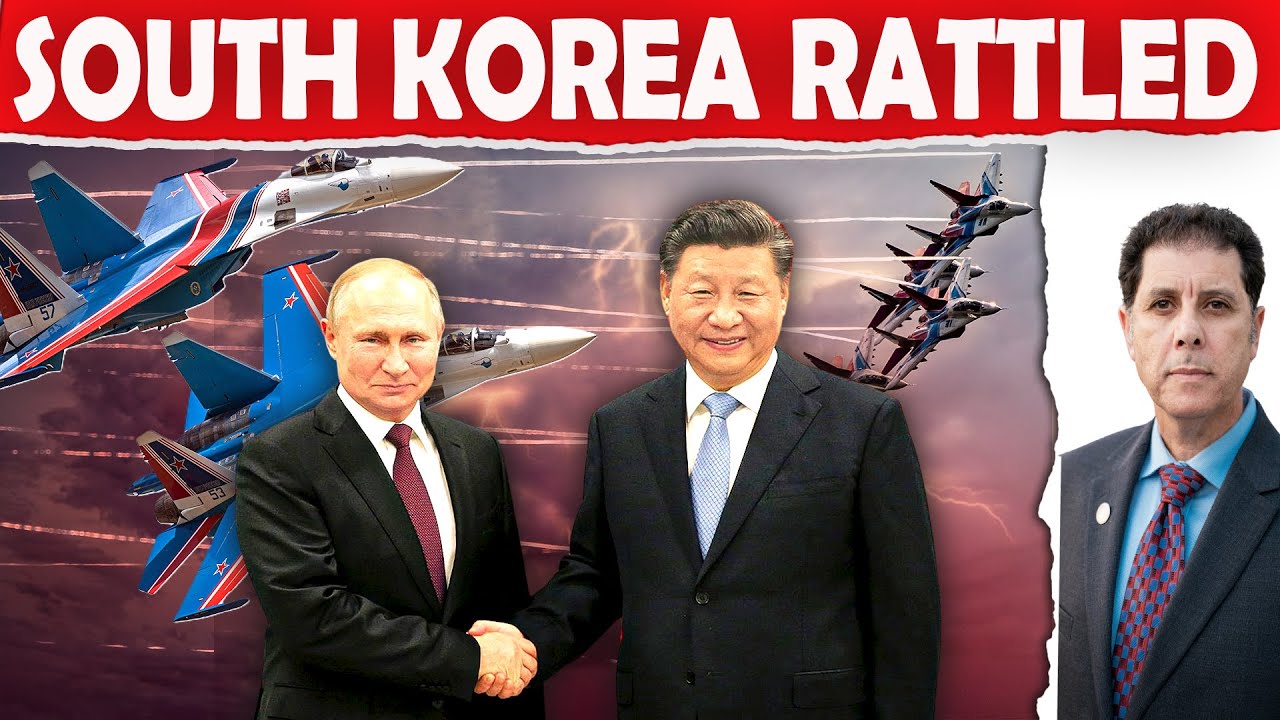
This content was created by David Oualaalou. This content was uploaded by David Oualaalou. This is a YouTube livestream/video titled "Panic in South Korea! Geopolitical Trends" (published 2025-12-10). It is a geopolitics commentary/presentation by a single host (identified in the transcript as SPEAKER A) speaking to an online audience and chat. The host analyzes a recent Russia–China joint strategic air patrol in the Asia‑Pacific (using Tu-95 and H-6K bombers), clarifies that the flight occurred over international waters and within South Korea's Air Defense Identification Zone (KADIZ) rather than sovereign airspace, and critiques media/Seoul reporting. He discusses strategic aims — interoperability, deterrence, power projection, links to North Korea, responses to U.S. missile‑defense initiatives, and the drill's implications for regional security arrangements (including whether it might accelerate moves toward a NATO‑style Asian security architecture). The video includes Q&A with viewers and calls for channel support.
Chapters
Hello everybody and welcome to Geopolitical Trends, where truth matters. Excited to be with you once again. I know to those who've, uh, missed this morning my conversation with Professor Anna Moundag, I will put a link for you shortly here. So very, very excited to be with you once again. I will be addressing in this particular, uh, analysis here the development that took place yesterday between South Korea, Russia, and China. So I'll, I'll provide you an insight, even though there is one particular statement already coming in the Western media suggesting that the Russians and the Chinese have violated the South Korean airspace, which is not true. They have not. And I'm going to provide you a detail into how this all plays out. But first, let me say hi to our Wonderful community as always. Uh, Schwerder, good to see you. Say It Like It Is, Leanne, good to see you. Dave H, as always. Truth Seeker, here you are. Oh, you missed the live? No worries, I'll put the link for you. As always, good to see you. Phil, good to see you, Phil. I haven't seen you for a while, so good to see you, Phil. Excited to have you here. Uh, and Taiwan still as always here. So let me put the link quickly here to those who missed, uh, my conversation with Professor Anna Malindog is worth listening to when you have time to do it, if you feel like it. So I'll put the link in the chat box for you. So, uh, I only have one housekeeping item for you is tomorrow, remember to join me, uh, uh, and Elizabeth, we will be talking tomorrow on the Geopolitical, uh, Geopolitics and Money channel We will be addressing some very, very interesting topic for you for tomorrow. So I'm not going to do headlines today, guys. I'm going directly into the topic. So because there's a lot to cover, and especially now when you consider, uh, the reaction of the South Koreans, you know, basically just freaked out, the, the, the kind of being rattled, uh, as to what the Chinese and the Russians are doing. Which is nothing new, by the way. I am going to explain. So you have basically what you have, you have the Russian Airspace Force and you have the PLA or the People's Liberation Army's Air Force, the Air Force part of the Chinese military. Both of them, the Russians and the Chinese, were conducting a joint strategic patrol. That's usually a routine for them. You know, so, so what the, the China— the Russians were using, they were using a strategic bomber, the Tu-95, and the Chinese were using the H-6K, which is also a strategic bomber. So, and what they end up doing is they were, uh, doing patrolling for 8 hours, and that's a joint flight. So, which took place yesterday. So, and this was in, of course, in the Asia-Pacific region We're talking about South China Sea, we're talking about the East Sea of Japan, and we're talking about the western part of the Pacific. So, and the patrol, by the way, just to sort of put you at ease, especially for my viewers in that part of the world, the patrol was conducted so over international waters, not as some have claimed that it's violated the South Korean airspace. It did not. It's over international water, and I'm gonna explain to you how that is so. And the patrol, by the way, this air patrol was part of a sort of a bilateral military cooperation between China and the Russians for this year. They've done it the year before. And by the way, both countries, Moscow and Beijing, they both sort of stated that in conducting this, which by the way, they announced it anyway, it's not in secret, that they were also compliant with the international law. So basically what we're looking at, we're looking at nothing but some sort of a routine, a military cooperation between the two countries. So, and, and this exercise, in my opinion, is not, and I, I repeat, is not directed at any country. It's not directed at Japan, it's not directed at South Korea, it's not directed at Philippines, Australia, or what have you, or US. It's not. However, it does have a message very loud and clear, and I'm gonna be detailing this with you. So, so nothing new here. Let's just, uh, put this, uh, on the record here. So, so, so this kind of— this is one of those maneuvers that both countries have been conducting because they have been conducting joint patrolling. So it's nothing. It just— what it highlights now is the depth of the military aspects between those two countries. So when North Korea— I'm sorry, South Korea, not North Korea. When South Korea launched this complaint with the Chinese and the Russian defense attachés in Seoul, because they already did a day, one day after the warplanes, uh, sort of— here is where the misleading information coming out of Seoul. They said when the warplanes entered their airspace, it did not. It is what's called for the South Korean, uh, it's called the— this is called, uh, the South Korean, uh, defensive zone. Now You need to understand what that mean— the meaning of that defense zone, that is the Air Defense Identification Zone, known, known as KADIZ zone. What is it basically? Basically, some countries delineate an air identification defense zone, okay, wherein they require that any foreign plane or planes coming closer by to identify themselves. However, what you need to understand from a legal perspective, international law, is that this, this, uh, the air defense identification zone is not part of a sovereign airspace under international law. So in my opinion, and I am no legal scholar here, except for what the law says, international law-based as I know it. South Korea has no right to claim that its airspace has been violated because it has not been. And this is, again, this is just one of those technical, you know, I was like shaking my head when I read this. Why? Because I knew in, in the back of my mind that China and Russia will not do this. Why will they want to create issues? Why would they want to go and violate another country's airspace? They're not going to do that. And this is where the South Koreans, uh, some sort of, uh, uh, scramble their own fighter jets in response to this Russia-China air drill. So that is all it's about, basically the basic of it. So one thing I need you to understand so far is that is air identification, uh, air defense identification zone does not constitute an air sovereignty of the country, whatever that is. Every country has one. We have one too. And last time the, the Russians, I think, went into some areas in Alaska. It didn't enter into the US airspace. So this is what this is all about. So, and this is why the Chinese Defense Ministry confirmed the, uh, that, that what took place was part of a pre-planned joint drills with the Russians, and describing it, by the way, as their 10th— this is the 10th time the joint strategic air patrol, and that's conducted over the East China Sea and the Western Pacific, which is, by the way, both locations in line with the annual cooperation plan according to the Chinese and the Russians who confirmed. So this is not an isolated provocation as some have sort of categorized it. It is part of an established pattern of joint exercises between Beijing and Moscow. What you need to understand is the big picture. So, so such as, once again, some have In the West and even in Seoul, certain media that I had a chance to look at, they use the term as incursion, such an announced incursions by the Chinese and the Russians, which once again, it is not a violation of the South Korean airspace. So, and of course they referred back to what took place in 2019. Because similar events involving 5 Chinese and 6 Russian planes forced Seoul to scramble their jets the same way they did yesterday. So what is the difference with this incident or this particular patrolling this time around? It has to do with the regional context, you know, because you have to think about one turn— on one end, you have the Russians and the Chinese the Russians and the Chinese strengthening their military ties, deepening, deepening it sharply since, of course, since 2022, of course, the Ukraine conflict. So on the other hand, you think about what Japan just did last November, last week, last few weeks, you know, by provoking the Chinese. So, and this is why, in my opinion, the way you look at this because remember, China and Russia both have North Korea as the wild card. So, and of course, North Korea sees South Korea as a primary adversary, given the presence, massive presence of the US troops on South Korean soil. So, so these joint patrols essentially demonstrates, in my opinion, not only just the Russians and the Chinese, but the North Korean also that this 3 countries, North Korea, China, and Russia, the alignment, that is what it shows in my opinion. Even though the North Korean didn't take part of this, but they are. So, and this also is testing the readiness of the security readiness of those 3 countries. So particularly when you consider what the US is doing with Japan and South Korea. So that becomes the objective. What is the objective of this Russian-Chinese air maneuvers? So what the joint— this joint maneuvers serve several strategic objectives. So I'm gonna be sharing with you some of them. So you think about the military interoperability and cooperation that exists between the Russians and the Chinese on one hand, And the third one with the North Korean behind the scenes. Because remember, just last July, who was in North Korea? None other than Mr. Lavrov. Why do you think Mr. Lavrov went to North Korea, the foreign minister of Russia? You know, just to say hi to Kim Jong-un? No. It's about to strengthen the ties between the Russians and the North Koreans, but also to make clear that should an event arises where the regional security is threatened, we can count on your support. That's, that's the way I read the message from the visit of Mr. Lavrov to North Korea last July. So now here is the thing where you have to understand the big picture of this. This is this joint military exercises or the air patrolling, whatever term you want to use. So It's focusing on improving the ability of both the Russians and the Chinese to operate side by side in the military theaters. This is not like what you've seen in Ukraine with the NATO behind, hiding behind the scenes, providing some relic weapons that stands no chance. No, no, no, no, no. What the Russians and Chinese is doing is completely different. Why? Because the complexities of these joint exercises, which will increase over time to include more coordination— and I'm talking about some sort of, uh, uh, uh, using different platforms— air, sea, and, and land. That's what they mean by the interoperability and cooperation or coordination. So, and this is why you have to understand that this cooperation that is moving forward, it's not moving into a level of a treaty yet. There's a possibility there, but now you are seeing that the, the, the troops from both sides, from the Russians and from the Chinese, some sort of training to use each other high-end military equipment. So this is what's important. Then comes also the strategic deterrence. And not only that, because both countries, the Russians and Chinese, are also projecting power, and they do have it, especially when it comes down to the military hardware. So, so as an analyst, I do see that this joint naval and air drills are an effort now by both the Russians and the Chinese to not only deepen their military ties, but also to counter the increased, uh, uh, security coordination between the US, Japan, South Korea, Philippines, and Australia. And this is why in this analysis, make sure to stay with me till the end, because at the end I'm going to answer one of the fundamental questions you need to know about. And that's the whole idea of what this analysis is all about, is to provide you that basic, that understanding for you to understand where things are headed. So, and which security coordination I'm talking about on part of the US, you know, and its allies in the Asia-Pacific region, that's the one where you're seeing now Japan provoking the Chinese, Philippines calling for the increase of nuclear deterrence, Australia moving into supporting Japan in whatever way, and South Koreans, of course, they are between the sort of on both sides of the fence, between a rock and a hard place, if I may use the term here. And this is why, so this, in my opinion, this particular drill, the air patrolling, is designed to improve the strategic cooperation and strengthen the ability of both countries, the Russians and the Chinese, to jointly deal with any security threats. Why? Because they're seeing what's coming. And this is where that specific message to the region comes in. Why they did it, where they did it, meaning the Russians and the Chinese conducting the patrolling. So from China's perspective, If you are to think in terms of this, you have to think in terms of these drills, these drills as a deterrence, because this will function by demonstrating the Russian support. And it's vice versa. The Russians could also claim the same thing. So particularly now, at least from the Chinese perspective, with the tensions over the Taiwan Strait, given what Japan just did. So China wants to show that it can deepen its relationship with Russia beyond what any can even imagine. And that in itself, if they want to, meaning the Russians and the Chinese, if they want to, they could cause problems for certain countries in the region, if that is what they want. And what are we referring to here? We're referring about the region of the South China Sea mainly, and mainly around Japan. So basically what the Russians and the Chinese, mainly the Chinese, are sending a very loud and clear message. Then comes the display of power. What type of fighter jets or aircraft were used? Strategic bombers. That's a subtle message, subtle, just through the machine. %. So because the exercises, the joint patrolling, in my opinion, serves as a calculated— this is what strategic thinking comes in— as a calculated display of military power. Because when you do this, you are functioning some sort of as a form of a strategic communication. Because, because to this, to deploy strategic bombers, you have to have your ducks in a row, no errors happens and so forth. So, and this also provides them this joint drills or joint patrolling, provide them an opportunity, you know, to sort of for crucial operational experience, especially for Beijing. So, because here's the thing, so far, because history knows Beijing hasn't, or China hasn't, get engaged in a real war during the last 40 to 50 years. Think about it. To the Russians is different, but the Chinese is different. And there is also the, the big elephant in Rome is the US. Of course, this particular joint drills is to counter US influence in the region because the US is pushing. Look what they just did with Japan and look what Japan ended up doing by provoking China beyond. Look what the Philippines is doing right now. And I just talked to Professor Anna Malindog this morning about the call by the, his name is Anthony Carpio, the one who's calling for the increase of type of missiles and nuclear deterrence and so forth. Why will Philippines even go that route? And this is exactly why this display is all about. So when you think about the rising frequency, if you notice, just go back 2 or 3 years. You've been with me for a few years, and I do cover the Russian-Chinese military drills and so forth. So think of the frequency of this because it reflects So the interest of both parties, the Chinese and the Russians, to continue their perceived importance at a time when the United States and its various subservient states in, in Asia, like Japan, South Korea, Philippines, and Australia, you know, are stepping up their defense cooperation. You look at the Quad, you look at some other forms of defense and so forth. And this is what the importance of what this is all about. Now, are the Chinese and the Russians' air maneuvers a response to Japan's recent tension with China? Because it's worth asking, is it related also to what Japan just did recently? So? And in my opinion, and that's my opinion, the answer is yes, there is a direct connection. So the Russian, the Chinese air maneuvers are partly a response to the escalating tensions between China and Japan. Because remember, Russia has also some issue, island issues with Japan. So of course we're not gonna say that it is solely Oh, based on about Japan? No, but it is part of that because what Japan did recently, as you all know, and again, I'm not gonna beat the dead horse here. You know what happened in November of this year when the Japanese Prime Minister Sani Takashi said in parliament that a Chinese naval blockade of Taiwan could constitute, and I put this in quote, survival-threatening situation. Situation. You remember that statement. We're not going to beat the dead horse over this. Now you have to think about how China sees it, for particularly within the context of these drills, because the tensions have escalated between the Chinese and the Japanese, or between China and Japan, so dramatically. I— nobody saw this coming. With incidents now including the Chinese military aircraft locking fire control radars, which I did a video for you yesterday. Once again, if you— to those who missed it, just go back and check it out when you have a chance to do so. So those suggest, in my opinion, where things are headed vis-à-vis what this particular drill is all about. And when you get— where you're going to see, you're going to see the connection, the Russian-Chinese connection within this context, because Russia has supported China's position. And this is where you had— and I remember reading somewhere, I couldn't remember where, statements by Maria Zarova when she stated, and I paraphrase here, that Takayashi remarks were extremely dangerous in— and that Japan, according to Maria Zakharova, who— she's the spokesperson, spokeswoman for the Foreign Ministry— stating that Japan should learn from World War II history. And again, she hit the nail on the head because I was saying the same thing to myself the first time I read about the statements of the Japanese Prime Minister and I said, didn't she learn anything from history? So basically, the way you're going to look at it is that the joint drills between the Russians and the Chinese, the air patrolling, demonstrate now the solidarity that exists between those two countries. And also, not only that, it is also a show of force against what they perceive, not just the Chinese, but the Russians also perceive that, an increasing militarism by Japan and US allies in the region. Remember, Japan increasing its defense budget by 2.6%. Remember, Philippines wants now to push into the nuclear by having nuclear missiles stationed on or placed on its soil, by looking at what Australia is doing. And of course, South Korea is remaining quiet, but they are doing things behind the scenes. So this is why I'm saying it's not exclusively about Japan, but Japan is part of it because while the Russians and the Chinese sort of air drill or air patrolling or operations over the East China Sea aren't exclusively about Japan or a response to Japan. They definitely, those joint exercises, they definitely, in my opinion, reflect the broader strategic alignment between Beijing and Moscow. And of course, what is this gonna be for? It's gonna be for against what they perceive and view as a growing threat from Japan's military rearmament and more assertive regarding the Taiwan stance. That's the only way you can read it. I don't see any other way. And if there is other way, then if I am wrong, I am wrong, be it. But that's the only way I see it as far as it's going right now. Liking this video so far? Don't just be a watcher. Go ahead and hit the like, share, and subscribe button, and don't forget to tap the bell so you will not miss any of my videos or livestreams. This way, you will be supporting a channel that stands for the truth and objective reporting. The choice is yours. Thanks for your support. Now, let us consider the security and geopolitical significance of of these maneuvers, because they are. And especially when you consider just what happened in July with the visit of Lavrov to North Korea, and what just happened recently with the UK— it will be scaling back its permanent military deployments in the Asia Pacific. Think about it. So, so this is why the security and the geopolitical significance of this Russian-Chinese maneuvers is substantial, in my opinion. So you're going to have to think about it in terms of many, many, uh, dimensions. So think of it about the demonstration of the integrated military capabilities of both countries, the Russians and the Chinese, because the exercise or the drills or the patrolling whatever term you feel like using, you know, show, in my opinion at least, improving military coordination between the Russians and the Chinese. This interoperability that is now moving into the realm of real scenarios and their ability, meaning the ability of the Chinese and the Russians, so, to work together as a coordinated force, because these things don't happen quickly just because you have a massive force. Whatever, you need to train and train and train to really hone in that skill of ensuring the coordination and communications and so forth. So, so, and this is, of course, when I go into the same level of whatever NATO is doing, but NATO is also, you know, we— I'm not gonna even compare it to NATO, you know. Let's, let me just, uh, say this. So what I am going to say is that these exercises, in my opinion, sort of strengthen the argument of this strategic partnership between the Russians and the Chinese. It's because when you involve the Air Force, when you involve advanced equipment, when you involve Sometimes when you do the, the naval drills, you involve the submarines and so forth. All of this, you're talking— we're talking about triads, you know, the air, land, and sea platforms. And this basically also because what the Russians and the Chinese want is also to send a loud and clear message to the United States. And its sort of subservient states, that their dominance in the Asia-Pacific is coming to an end. It's because the Russians and the Chinese see what's coming. They're not going to wait. It's too late. That's why they are— those exercises send in a strong geopolitical message, particularly in regions where you have shared interest. It's like the idea of the South China Sea. You think about the Pacific, you think about the Arctic, you think about the Taiwan Strait, the Strait of Malacca. All this, this is where the Chinese and the Russians wanted to really focus on. This, this is one area which really wanted to, and we are ready to challenge the US and its allies here because the allies are not doing what is for their own security. They are doing what is being told to do. I mean, I am, I'm convinced that what Japan did, it wasn't on its own will. I think Japan was pushed into it. The same thing I'm seeing now with Philippines. What it's doing. And the same, of course, it goes without saying about Australia. When you— if you only hear what their defense minister said regarding the support for Japan, makes you just shake your head. So, and this is where the importance of this kind of patrolling. This patrolling is not about just show of force, because they also can complicate the strategic planning for the United States. And its allies. So yeah, it's because if the US wanted to counter this, it's going to be extremely costly and complex because most of the other countries, these so-called allies, don't have the capabilities. So, and this is where the Chinese and the Russians wanted to really drive home the message. That's the way I see it. There is another major, uh, dimension to this, and this one has with the Chinese and the Russians both responding to the U.S. missile defense plans. The Pentagon is working about a strategy for the missile defense plans. This is why you're hearing what you're hearing about Philippines going into that direction. So that's why I was like, wait a minute, why is this guy, uh, his name is Caprio, was talking about the, the stationing of certain types of missiles in Philippines? And the US has been working on this. Remember, we, we signed the agreement with the Philippines about the 5 military bases, but there are not 5, there are 9. Only 5 were declared. The other 4 in Philippines were not declared for a specific reason. Because those usually will hold some or host some specific types of weapons that even the Filipino government will not have access or knowledge about. Why? Because who dictate the terms inside the Philippines? It's not Marcos, it's Washington. The same applies to Australia, the same applies to South Korea, and the same applies to Japan. So the idea is that these recent anti-missile drills, because that's what it was, what the Chinese and the Russians did, this patrolling, it's an anti-missile drills. It reflects a calculated response to evolving US missile defense initiatives, particularly when Washington has proposed, and I don't know if you are aware of it, the so-called the Golden Dome as part of this strategic shield. So, and this is where when you have the Japanese— I'm sorry, the Chinese and the Russians coordinating their missile defense, that means that China and Russia are communicating that any attempt to neutralize their nuclear deterrence through missile shields will encounter collective resistance and destruction. So, and that is the important aspects of this. And of course, uh, uh, we talked about the, uh, we talked about the strategic alignment, the deepening of the strategic alignment. Of course, the drills or the naval— of the air patrolling, rather, sort of function as a calibrated, uh, message to the US allies, not only in the Asia Pacific but also in Europe. Because you remember last time, and I remember was about, uh, I think 8 months ago or so, I did a video by which I, I did a live stream rather, and by which I mentioned about the deployment of the German, uh, uh, naval assets, either the Germans or the Dutch— couldn't remember exactly. And I asked the question, what the heck is the Germans and the Dutch doing in South China Sea with their naval asset? This is the answer for you. This is why these drills by the Russians and the Chinese function as a calibrated message to the US, the US allies in Europe, the US allies in the Asia Pacific. And basically because the way you're going to— now, if you are in Washington, if you are in London, if you are in Brussels, you're going to have to read this in a way that the, the Russian-Chinese strategic coordination is no longer just some sort of periodic exercises or a symbolic or what have you. But rather, you're going to have to start to think about it being as institutionalized, meaning it is part across many domains critical to high-end state-of-state conflicts. That's how you're going to read it if you are sitting on the other side of the fence. To those who argue, oh, this is about the Chinese and the Russians intimidation— no, it is not about It is about power projection. Chinese and the Russians are compelled to show their capabilities, what they can do. So to those who say, well, this is about intimidation, it is not. So it's because, remember, go back to the history and look, and I've been aware of the Chinese and the Russians sort of drills for, from way back, even before my days in Washington. I mean, when you look at it between the two so far, it just, just since 2000, if I am to recall, '16 or '17, just somewhere like that. Don't quote me on this exact year, but one of those, you know, I, because I used to keep track of all this, they conducted over 100 military exercises just between that year, between 19, um, between 2016-17 to now 2025. Over 100. Think about it, what it means. So, and by the way, even with this, by which one particular exercise I was aware of it, where they have entered meaning the Russian air chain, the US Air Defense Identification Zone near Alaska. But they have not violated the US airspace, as some claimed in Washington at that time. So you have to think— and I'm going to do conclusion here for you because I have specific this for you. That's all. Like, you all know, if I don't have anything of importance to say, I stop. So, so I'm going to give you my conclusion on this, how I see it. And that's why I want you to stay with me till the end, because I told you I will answer one specific question as part of this conclusion. So, and this question is whether with this incident now will provide the US a reason to push its allies in, in, in the Asia Pacific to form the equivalency of mini-Asia NATO. Think about it, because it is— it will be a perceptive question to think about. And if you don't think about it, then you are not seeing the full picture. After all, this is what the US is after— the potential US strategic responses. Mini-NATO in Asia with US allies? Think about that. The Russians and the Chinese air drills could indeed accelerate momentum towards a more formal Asian security architecture. But at the same time, I will not go— I just had to ask the question. That doesn't mean it will happen. And I will not go full length as far as saying that a full mini, uh, Asia NATO will happen. No, because it will face so many obstacles. So, and I'm going to cite for you a few just to put things in perspective for you. Remember, in September of 2024 Who was the former Japanese Prime Minister at that time? Does anybody know? If you remember, let me see in the chat box. Just last year, if you remember who was the, uh, okay, let me see. I saw something here. All right, let me see your answer. Who was the former prime minister of, uh, Japan in 2024? And there is a reason why I'm asking this. And, and pardon me, guys, I am looking at the chat box for a specific thing. Because I saw a comment from one of you and I need to take care of that. Ah, let me see here. Okay, let me see here. Taiwan still— why it takes forever for the answers to show up here? All right, just bear with me, guys. Bear with me, please. Yeah, I don't see the answer here. So anyway, let me move on. Uh, okay, 2024, the former Japanese Prime Minister at the time, Ishida, he laid out— remember, this is why now I'm one of those who are questioning about the Japanese instinct, militarism, imperialist instincts. Are Japan's imperialist instincts reemerging? In 2024, the former Prime Minister Ishiba laid out a comprehensive vision proposing the creation of an Asian NATO. And his argument— arguing that the absence of a collective self-defense system comparable to NATO in Asia heightens the risk of a conflict because no formal obligation for mutual defense exists among regional partners. And that is where you have to think. But so far it might not work. When you think about East Asia security issues, of course, as I dealt with them, uh, or, or study them in my master's degree some 20 years ago or so, of course they have changed. But some will say, well, they are now moving into some upgrade level, some sort of an alliance system of them. Where the US has sort of separate bilateral treaties with Japan, with South Korea, with the Philippines, and of course Australia moving forward. And this will be one of the obstacles to that. So, so because when you think about it, so rather than having a formal NATO-style alliance at that time, I remember when Biden was in charge, He was also laying the foundation for some kind of multilateral alliance system, and it didn't move forward because it was like this overlap of, uh, sort of coordination. They only moved with the trilateral alliance among Japan, South Korea, and the United States, which was later on elevated to Quad. Adding Australia. So, and that is why a full Asia-NATO, it's unlikely in my opinion, because those significant barriers prevent an actual formal alliance structure. And this is where the Japanese, the Chinese, and the Russians air patrol drills came to suggest don't ever— to the West, to the US subservient states in Asia, don't think about it. So forming a coherent alliance in Asia is significantly more complicated than in Europe. Because you have to consider the enduring historical animosity between, for example, Japan and South Korea. Do you think that the South Koreans forgot? Because that can resurface. So this is one of the ideas. So, uh, and, and even some have argued that we could— we pull India into this because we can always use India. India is one of those tools you just use, when you're done with it, get rid of it. So could we use This is the thinking was in Washington. Just use India. So for the— to sort of codify this defense commitment, use its troops, use its whatever it has, then get rid of it when it's served its purpose. So this is why when you have Indians joining the Quad and all that stuff, so are you mixing? Just wonder. But on the other hand, the Indians want to have India went ahead and signed a treaty with the Americans to allow the naval assets in one of India's coasts. So this is where, the way I see it, most states in the region in Asia, so will sort of expect to show hesitation regarding commitments to some regional defense pact. So, uh, they won't be able to do it in the economic front either. Why? Because you have China is the dominating factor when it comes down to trade in Asia. I mean, who's going to compete with China economically? Which, by the way, they just posted a $1 trillion surplus. I just read it 2 days ago. I was like, mind-blowing. So every major economy in the region So there is no way they can pull it off because their relationship with China economically is far greater than what the US can provide. Even Japan itself, which now is gonna suffer and find out. So the bottom line that I need you to understand before I conclude this here is that the Russian-Chinese, uh, air drills reinforces the security case for closer Asian coordination, at least when it comes down to the Asian theater. That in itself, there are some who argue that this could accelerate the developments of some sort of interconnected bilateral or multilateral arrangements rather than triggering some sort of a former NATO style, which I don't see that happening anyway. So what is going to be is that the regional countries will have to be likely, we are more likely to now start to think twice before the engaging with the US in any defense initiative or proposal. Otherwise they're going to be paying the price very heavy. Let me see if I have any questions from you. And, uh, and I'll just go from there. Uh, the, the reason I stopped earlier, guys, just to let you know, because we are about, you know, I, uh, because one of you sent me a comment about, uh, someone who was causing trouble here in the chat box. So I wanted to just remove the person. That is the reason why. So And thank you for doing that. So yeah, because I have no tolerance for that. So if you are not here to contribute to the conversation, I will greatly appreciate you sign off. So okay, I don't see, I don't see that specific individual here. So anyway, life goes on. Let me, uh, see if I have any question from you, and I'll take one or two. And also, I'm going to be working on setting up the, uh, the, uh, exclusive Q&A for the members, because you all know I have to do something for the members. Remember, members have been supporting the channel since I started, so it's only fair and right, and I'm sure you understand that. So, all right, let me see, uh, the One question here from Hong Wong: Dr. Oh, will North Korea respond to South Korea's fighter jet deployment? No, they won't. They won't at this point because it's nothing for North Korea to be concerned about. What South Korea did is just to show that we are ready to deal with whatever. But South Korea will stand no chance in case of a conflict. Let me just tell you this because North Korea will wipe it out in no time. So, and this is why one of the reasons why we have refrained from agitating North Korea, because we are concerned that the North Korea might retaliate against South Korea and we will be the one causing it. The same arguments I've been making about why we have been pushing Philippines to fight the Chinese. And look what happened when the Chinese responded to the Philippines. The same thing we did to Australia few years ago. And look what happened to Australia when China shut down the trade. So, so I don't see North Korea doing that. But on the other hand, North Korea is the wild card. Anytime you think about the Chinese-Russian alliance, remember, keep in mind the wild card North Korea, because it is part of that also. It just doesn't get involved in this at this point. So That's the way I see it. So, all right, let me see one more, if there is one more question. If not, I will see you tomorrow on the other channel. I'll be talking with Elizabeth about a really interesting topic. So, all right, I don't see any here. I'm gonna move on. Uh, I'm gonna put the link for you, for those who wants to support the channel, should you decide to do so. There is the link for if you want to Buy Me a Coffee in support of the channel. I'll be very, very grateful to you for that. And you all know the type of information you are receiving here. So, and, and again, oh, oh, Marco, thank you very much. You're most welcome. Liang, you're most welcome. Some of you saying thank you, so truly appreciate it. You're most welcome. So, uh, I just, uh, so you, you all know I do spend quite a time researching and reading the stuff because then the type of information I wanted to share with you, I want you to have a quality information. I don't want you just waste your time, come over here and listen if you are not interested. And so, so that is the reason why So that is the, uh, that's where, where everything is. So I'm very, very grateful to you all. I look forward to seeing you next time. As always, remember, geopolitics impacts your daily life in more ways than one. Till next time, bye-bye.
More from David


Beyond the Single Actor: Why the Gulf Isn't Choosing Between the US and China


Iran, Iraq's Militias, and the Houthis Are Coordinating! This Changes Everything




Who Controls the Next Decade's Resources? Latin America and Africa's Geopolitical Crossroads

The Chokepoint Trap: How Washington's Stupidity Triggered a Cascade That Now Controls the World

Trump Spooked as IRGC Unveiled dual-use SLV, Deployed Ghadir Mini-Subs & Hinted at Tactical Nukes!
