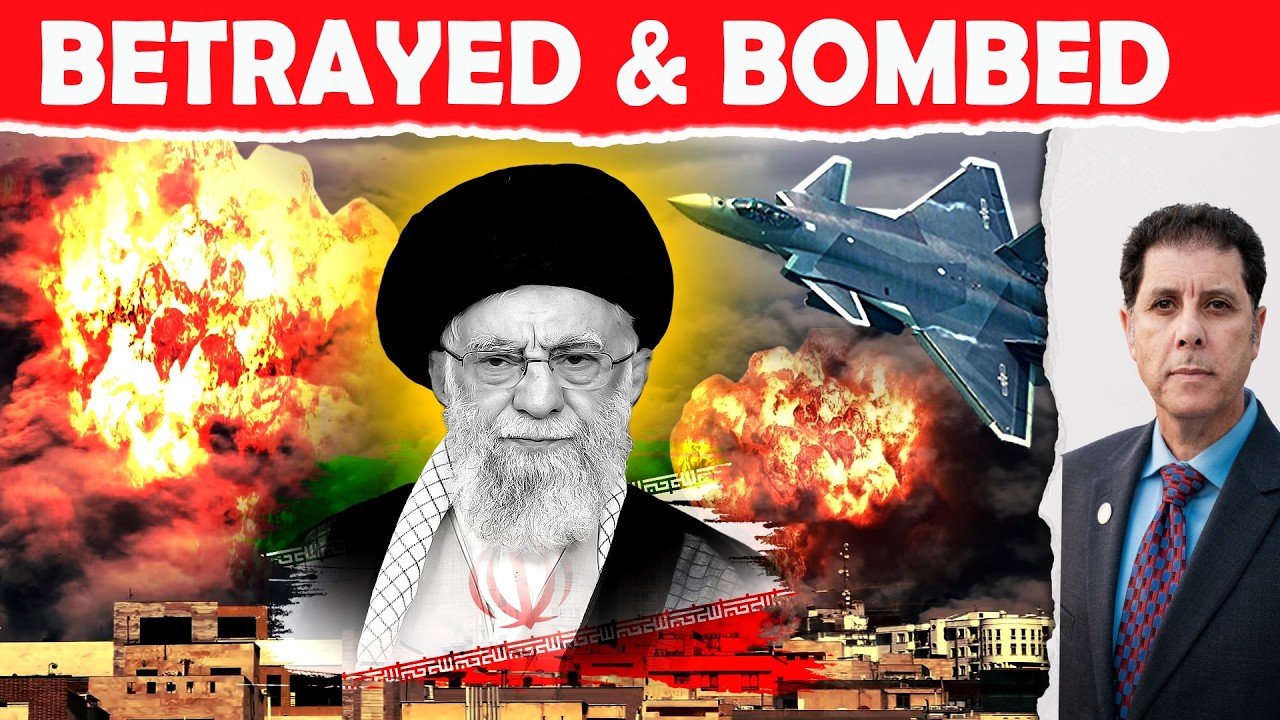
In this live‑stream analysis, the host (Speaker A) and a secondary anchor (Speaker B) dissect the fallout from a coordinated US‑Israeli strike—dubbed Operation Epic Fury—that killed Iran’s Supreme Leader Ali Khamenei and several senior defense and intelligence officials. The discussion moves from the immediate Iranian missile retaliation, the closure of the Strait of Hormuz, and the targeting of US‑aligned bases across the Gulf, to deeper questions about Iran’s succession mechanisms, the resilience of its political‑military structure, and the potential for a regional power vacuum. The presenters outline three possible trajectories for the coming weeks: rapid regime collapse, a grinding multi‑front escalation driven by proxy forces (Hezbollah, Hamas, Houthis, Kataʿib Hezbollah), or a catastrophic miscalculation that could involve nuclear escalation. They also examine the role of intelligence—whether a mole or sophisticated SIGINT enabled the strike—, the reactions of great powers (Russia, China, the United States, Israel), and the broader economic impact on oil markets. Throughout, the host stresses the need for viewers to critically assess media narratives and warns that the next 72 hours will determine whether the Middle East passes a “point of no return.”
Chapters
Hello everybody and welcome to Geopolitical Trends, where truth matters. As you know, at 09:40 on Saturday morning, the most protected man in the Middle East, at least by the estimates of some, was killed at his breakfast table. Within hours, the world's most volatile region, the Middle East or West Asia, is set on fire, if I am to use the term here. And one man in Washington was betting his entire legacy on what happens next. Because when you consider every American president who tried to reshape the Middle East by force left it worse than they found it— Libya, Iraq, Afghanistan, Yemen, you name it. Now Donald Trump is attempting sort of What none of other presidents dare to do, the total destruction of the Islamic Republic of Iran. History says it cannot be done from the air alone. You know what Trump is saying? History is wrong. It is what I'm saying. This is not merely another escalation. This is a civilizational rupture in the Middle East order. As we move forward into what lies ahead. And this is again where the challenge is. So what I'm going to be doing this entire week, I'm going to be doing updates for you to keep you informed of the development. So I'll do one at a time once I confirm the information and so forth. So the next question we need to ask now: is the Middle East at a point of no return? Did the strike change everything that we know about the region. So the operation, the joint operation between the US and, and Israel, uh, which simultaneously struck three separate gatherings of senior Iranian officials, of course killing the Supreme Leader Ali Khamenei, uh, along with the top defense and intelligence chiefs, including the defense minister and the IRGC commander. I have, and I'm gonna be— here is the list of those who died. Those are high-ranking officers, and I'm gonna be saying something about the background just for you to know. So the operation, which dubbed Operation Epic Fury, was months in planning, by the way. This is almost a reminiscent of what happened in Abbottabad in Pakistan with Osama bin Laden. Same pattern, same schedule. Same time frame, to my knowledge. Khamenei, as you know, has held power in Iran since 1989, guiding the Islamic Republic through decades of whatever has been happening with sanctions, with tensions with the West, and so forth. So now things have changed. And the first thing you're going to notice is the Iran counterattack. What I need you to understand, one thing, is that you might not be able to see see everything that is happening. Why? The media is going to be really controlling how the narrative goes. And I'm gonna share some clips. This is the one from Tehran itself when the 30, 30 bombs were dropped after the missile strike here. So I'm gonna show you, I'll share a clip with you as I move forward. And that's why I'm gonna be doing this week the updates regarding these aspects of it. So far, Iran didn't collapse, and it will not collapse. Let me just say this, because now the IRGC, the Iran Revolutionary Guard Corps, that is, he stated right after the, the announcements of the death of Ali Khamenei that it will launch its most intensive offensive operations in the history of the armed forces. As of now, There are missiles, a barrage of missiles launching at Tel Aviv and Shemesh. Shemesh is in the north part of Israel, and I'm going to show you a clip as I move forward. And targeting both— what IRGC is saying— targeting both Israel and the US bases, because Iran struck multiple cities across the region. That includes Jerusalem itself. There are also missiles that went went to Qatar, be launched at Qatar, which hosts the US military bases, as well as Dubai, United Arab Emirates, Kuwait, Bahrain, Jordan, and one location in Saudi Arabia. And now there are those who are saying, oh, now the Arab country is gonna turn on Iran. Well, wait a minute. Aren't the Arab countries themselves that have hosted the US military bases? Doesn't Iran have the right to sort of strike back according to international law? So we can't be just cherry-picking. I'm not supporting Iran here, I'm saying what's factual. And as a matter of fact, an Iranian drone has hit a hotel in Manama, Bahrain, while another one struck or struck in the United Arab Emirates, killing 3 and injuring dozens. Iran has also closed the Strait of Hormuz. And what you have now, about to my knowledge as of yesterday, about 150 to 160 freight ships that is stalled behind. I saw a satellite image. I wish I would have picked it up for you. You see the dots, the dots for the ships, all of them behind from either side of the strait. And Tel Aviv was not spared, by the way. Because like the other locations in Shemesh, which is up north, were not spared as well. All the while, Netanyahu has fled to Germany. It was— someone was tracking the flight. His wife was spotted in Miami with her son. So whatever, we're not judging here. It's just to put things in perspective. Now the question we're gonna have to ask also The succession issue, and I'm gonna— the reason I want to address this one here, it's because it's very important to understand. There are those who say now the Republic is in chaos. There is no chaos, let me tell you. As one who wrote a book about Iran, and one of the things that I had to do is to detail in a chapter about the government, the structure of the Iranian government. So to those who already got a copy of my book, you will have better understanding about why it's important to understand. So, so far, Khamenei is killing some sort of— it's setting an immediate succession, but I won't call it crisis, even though there are those who are saying crisis, because under Iran's constitution, especially Article— I think Article 210 and Article 211. An interim council assumes now power while the Assembly of Experts— this Assembly of Experts has in its, uh, of its members about 88 Islamic clerics, and those are selected by the Supreme Court, uh, by Supreme Leader, uh, at the time. So Israel is claiming that its opening strikes decimated the chain of command. Not necessarily, because you have 3 individuals now that they are holding power. You have the head of the justice, you have the president, and you have another individual, uh, I forgot what was his role within the government, till a supreme leader is nominated within a week. And there are already two names that they are circulating. One is the son of Ali Khamenei, the second is Mr. Arifi. And, and we'll see how this is gonna work out. Now, where the issue was for the, the targeting is the killing of the 7 senior defense and intelligence, uh, officials, and of course the targeting of other 30. Remember, there were more than one building that was struck, and that is in itself might give you an idea that the institutional framework of Iran is severely weakened. There is some truth to it. Yeah, possibly to a degree. You have one individual who survived, none other than Ali Lajjani. Ali Lajjani is looked at, uh, I don't have a picture, I'm sorry. Ali Lajjani, uh, is looked at as an Iranian— he's a politician, of course, but he's looked at as one who's pragmatic. He's a former military officer. In the IRGC. Current position: serving as the secretary of the Supreme National Security Council as of 2025. The importance about him is he's been closer to the Supreme Leader, the, the late Khamenei, but he has emerged as one of the most senior officials still standing. And this is why Iran now is moving into temporary leadership cancel. You need to understand this aspect to highlight to you the idea that the system is collapsing. It's not true. It is not true. Because what the US might think, that it wants to end the regime or change the regime, it's not going to work. But the logical other question we have to ask beside this succession issue and so forth is, are we, are we as of today at the point of no return? Many will say yes. Others will say not necessarily because the US showed its strength. Yes, I agree with you on that aspect. So where are the arguments that we are having right now is that the assassination, basically that's what it amounts to, of a Syrian head of state, whether you like Khamenei, you liked him or not, beside the point. He's a head of state. By a foreign military coalition, it's somehow, it's becoming now the norm. Usually it's unprecedented historically in modern era, but it's becoming the norm. We've been seeing this from the US. And this in itself will pave the way for now Iran's proxies to be activated across the region. Iran already moved forward into closing the Strait of Hormuz. Global oil market is already in shock with prices are going up, but for both oil and gold. And there is no obvious ramp-off when the other side's leadership has been killed. In other words, the continuation of the government is still on. Of course, Trump indicated that he is willing to talk. To the Iranian leadership saying, and I quote, "They want to talk and I have agreed to talk," end of quote. I don't think so they want to talk. I did read, however, statements by the Foreign Minister, Araghchi, that's saying, "We still open for negotiations." You got to be out of your mind, man, to even be thinking about this. As a matter of fact, it is my opinion that we will not be where we are today if Iran did not make the strategic mistake. And you know what was that? Back in 2018, when the US withdrew from the JCPOA, and Iran was like, what are we left with? You should have made a decision back then. Look what North Korea did. Look what Pakistan did, or even India for that matter, all of them pulling out of the NPT. I think I am to say here that is Iran's decision is to blame also. For this chaos that is existing. For, uh, the late Ali Khamenei to say, well, the Islamic relation— that's nonsense, respectfully. Because here is, you have a Pakistan, a Muslim country, they are not making the same argument. And there, the US too threatened Pakistan?
No.
So let's, uh, sort of be objective in our assessment. And I believe Iran made a strategic mistake, but life goes on. So here is the wild cards. The wild card is that Iran, inside Iran itself, you're looking at now two types of elements: those who are celebrating the death of Khamenei and those who are enforcing the law through the IRGC. And that in itself, why am I bringing this up? Just to highlight to you the trajectory of this conflict, where it can go, because it can shift dramatically. And it's very important for us to understand, as this is gonna now go into a different level altogether, you're gonna be seeing so many developments moving forward that the next few days is gonna determine this trajectory of the region moving forward. So, so as of now In my opinion, the Middle East has not simply just entered into a dangerous period. It has entered an era of some sort of a forced transformation because that's what it is. It's a forced transformation. I'm just wondering now who's gonna be next. And I already got a tip about it. You know who's next that Israel is thinking about from within? It's Turkey. Yeah, Turkey is on the— over the horizon. When it comes down to Israel, how he sees its role in the Middle East. So Turkey might be next. The question once again, not the question, but rather to think about this transformation, because this transformation is gonna whether lead to, whether this transformation is gonna lead to some sort of a stable regional order, or is gonna lead to a wider catastrophic war And all this will depend on the next 72 hours, a few days for that matter. And that's why I use the term point of no return. The point of no return may not be— I want you to understand this— may not be a single moment. It may be the accumulation of the next several days. That's what I meant by the point of return. The one thing that the US needs to understand, Iran is not Iraq. Iran is not Afghanistan. And of course, there are those who will be arguing, well, where is this hype about its missiles and so forth? Look what happened to the, uh, Gerald Ford. It moved out of its possession. Why that is? And again, I don't want to get ahead of myself because for today I want just provide you the framework of where things are, and in subsequent live streams, or even I might do recording analysis for you about this stuff. It's a country that I wrote about, so I kind of learned quite a deal about its structure and so forth. Now, the first— there are certain things you need to understand with something of this magnitude. The first one is the regional power vacuum. Because no matter how you look at it, the death of Khamenei, it creates a significant leadership void in Iran. Can it be refilled? Yes, it can in due time. Will it be a succession struggle within the Islamic Republic? I don't know. But if it is, it will lead to an internal instability. If it happens, it will lead to factional conflict. And of course, with that comes the unpredictable shift in Iran foreign policy direction. What do I mean by this? The idea that we took out Khamenei, we didn't think in terms that the next guy could be about 5 clicks to the right from Khamenei, from where Khamenei was. Could it be that the next guy will say, forget about this talking with the West, let's push for the nuclear weapon and be done with it. That's something we didn't think about because we thought in terms of we're gonna just bomb whatever. And let alone the issue of even if you bomb the nuclear facilities, the radiation and so forth. So you have the regional power vacuum, then you have the other element of the Gulf state vulnerabilities because now what it exposes, The countries in the Gulf, because they're all about the survival, they care less for their population. As a matter of fact, they give the stipends to their citizens to keep them quiet. And they always were sort of suspicion of Iran because Iran didn't bow to the West. They did. United Arab Emirates. So I think in United Arab Emirates, you think Israel right away. Qatar, largest military base of the US in the region. Bahrain, the Fifth Fleet. Kuwait, the presentation, uh, the, the presence rather of some military installations. Saudi Arabia, even on Saudi soil, there are military installations there for the Americans. Saudis do not know, the citizens. The Jordanian on the border, there are. So you have now Saudi Arabia, United Arab Emirates, Qatar, and other Gulf nations finding themselves now between two powerful forces. So the risk of them becoming a collateral target is a foregone conclusion. How are they gonna protect their economies? How are they gonna protect their oil infrastructure? How are they gonna sort of protect their diplomatic relations between both the East and the West? Because after all, remember, it's a Muslim country that's been attacked now. Regardless, Shia, Sunni, that's beside the point. Which the Shia is going to come into the fore soon. You have also the nuclear threat escalation. There are those who argue in some Western think tanks, as of 48 hours ago, that without a strong central leadership inside Iran, control over Iran's nuclear program could become uncertain. I see the logical argument in that. This is not an emotional reaction, it is fact. The next guy, as I said, could be 5 or 6 clicks right to Ali Khamenei, and his first order of business will be, let's move on with the nuclear, withdraw from the NPT, we done. And you're gonna have even hardline factions from within Iran, me pushing us for the acceleration of nuclear development as a deterrent. Because once it is declared, forget about attacking the Israelis. And that's a part of the big, the problem that we didn't see the big picture. We never see the big picture. We did it. History reveals itself. We did that in Iraq. We did that in Afghanistan. I argued in 2003 against the invasion for fear that it's going to transform the region, but you won't be able to control it. And what I was told, don't worry, it's going to be a quick walk. We're going to go liberate Baghdad and leave. I said, you won't. You will be there for the next decade plus. And even today, we still have military presence. As a matter of fact, to my knowledge, Some of the missiles went over the Iraqi airspace, which means what? The Iraqi government allowed its airspace to be used. And I am starting to wonder about the Iraqi government. Is it sovereign? I'm shaking my head. I was there and I saw. The other question that many are wondering now is what we're going to see from Hezbollah, what we're going to see from Hamas, what we're going to see from Ansarullah forces and so forth. Because their engagement may intensify the operation independently. They don't wait now for Iran. And that in itself will extend the conflict into Lebanon, into Gaza more than what it is, into Yemen and beyond. And it's going to make the containment of the conflict very hard, difficult, and challenging. And the global economic impact, that's a foregone conclusion. The Strait of Hormuz, you have 20% of the world oil that passes through that. It's going to become a flashpoint. If we're dead in the Strait of Hormuz, You have that, and you have Bab el-Mandeb in the Yemen part. That's it. You're going to shut down. Actually, you have right now, you have certain companies that that's it. The flights have been canceled to the region. So it's major transformation. And the bigger element of all this, and once again, this is where history comes in, is the US entanglement into this. But this time it's going to be slightly different. Why? Because of Iran. Iran is not Iraq. Iran is not Afghanistan. Even in Afghanistan, we saw it. I saw it because I was there. What am I referring to here? I am referring to the involvements of NATO because that's where the US and Western entanglement is going to take effect. American bases, military bases across the region, remain active target for the Iranians. So deeper US involvement risks drawing NATO into, into the conflict. And that in itself will complicate an already complicated global security landscape. So what can we expect moving forward? Militarily speaking, you're going to be looking at phases. Yes, it is about Israel thinking to maintain its hegemony and dominance in the region militarily. This is why the missile systems— and this is why Israel is struggling right now. Its 4 defense systems have failed to stop some of the missiles that Iran launched. And I'll show you the pictures. You'll judge yourself. So where are we right now? When I say right now, you're looking at from the zero point to, let's say, the next 50 hours. Zero point from the attack, from Saturday morning to now, because the opening military picture is already staggering in scope. Of course, Israel will have to declare that the— this— the dismantled Iran's aerial defense system and so forth. Whatever that— I'm not going to get into those details yet because I have to see and I have to, uh, fact-check certain type of information before I'll share it with you. For now, suffice it to say that some of Israel attacks, yes, did rock Tehran and makes you just wonder about the accuracy of the systems. On the other hand, the launching of the missiles from Iran into Israel with the 4 defense systems were unable to stop that. And all this while this happening, Donald Trump declared that heavy and pinpoint bombing will continue uninterrupted throughout the week for as long as necessary, in quote. And that you realize Donald Trump is being pressured to get into this. He has no choice. American president has no choice. You have to understand how the system is set up. And Tel Aviv does have a stronghold on the US government. I'm not the only one saying this, and it's not a secret. It's, it's, it's, you know, I worked in DC. I was around, you kind of start to learn how things are. And this, uh, will lead me to talk about how far the proxy war activation is going to be, because it is critical variable. And that's, in my opinion, the most dangerous military dimension going forward, because we learned in Iraq we couldn't defeat the guerrilla warfare, because that's what it will be. We couldn't defeat in Yemen, we couldn't defeat in Afghanistan. Because now you have these proxy forces on the edge of a direct engagement. Ansarullah or Houthis have already launched something, to my knowledge. So could Hezbollah become the wild card because its proximity to Israel? Maybe, maybe not. Is this why Israel is attacking Lebanon for the last few weeks and months? Possibly. Could it be why Iran targeted a specific location inside Lebanon where the American presence was? Maybe, maybe not. The Houthis have already been reactivated, by the way. The leader of Ansarullah, Abdel Malik al-Houthi, declared his forces are "in a state of high readiness for any necessary developments." And it's already resuming the attacks in the Red Sea. That tells you the story right there. This is what I'm saying. It's too— we're going to see what the next days is going to bring. And I want you to be careful as to what you are listening to or watching. This is where you have this sensationalization of stuff. But let's, let's, let's take step back and be— so I want my— our community to be careful as to what you are listening to. So be, be your own judge. And that's all I have to say about this. You have another group that I am keeping an eye on, and this one is in Iraq, and the group is called Kata'ib Hezbollah. That's separate from Hezbollah in Lebanon. Those are separate. Because what this group in Iraq has done is gone further by announcing and threatening that, in quote, "We will soon be attacking US bases in response to their aggression." End of quote. That gives you an idea right there. It's how it's going to proceed. Will be very, very, very important to understand. Of course, all this happened at the time when, for example, the Russians have— and I'll get to Russia and China in a minute here— for the Russians, when they have already requested an emergency special session of the IAEA, the International Atomic Energy Agency Board of Governors in Vienna. Why? Because specifically, Siren concerns about military strikes against nuclear facilities under the IAEA safeguards. It shows you right there, the IAEA has no power. The IAEA is the backdoor of the US. This is, once again, I found myself have to say this, Iran made a strategic mistake when in 2018 When the US pulled out, they should have not allowed the IAEA and closed the door once for all. North Korea did it and didn't take them long. And by 2000, it was 2002 that I recall, by 2006 they declared nuclear power, tested the stuff. That's it, it was over. US never dared to threaten them. And that's again because To my knowledge, and I wrote about it in a book, the idea that the late Khamenei justifying, "Well, because of religion," it's nonsense, respectfully. It's nonsense. Because if it were the case, why the Saudis are going behind closed doors and asking the Americans for nuclear technology? And I argued by writing an article that said there will be a mistake if you trust the Saudis with the nukes. Now, there are those who saying, well, this might be significant. No, it's about the Russians saying this to the IAEA, requesting this special session. It won't matter. It won't matter because now what matters is what Iran can show and demonstrate vis-à-vis its capabilities in retaliating one way or another, because now all the cards are on the table. Cave in now, it's over. If Iran caves in, it's over. If— whatever Iran does now is going to determine the future, simple as that. Because here is Donald Trump's objective that's lately stated, that he wanted to raise Iran's missile industry, destroy its navy, and topple the regime. Well, to me, those are not surgical goals, Mr. President. They are objective for a full regime change, which, by the way, historically requires sustained military commitments that goes far beyond initial strikes. And this is again where it's gonna be crucial for the next few days as to what Iran is gonna do. And I'm gonna keep an eye open as to what the decision is gonna be, when the decisions are made, who's gonna be in charge, and so forth. That'll give us an idea what should we expect. But as far as the son of the Shah coming to Iran and taking over power, that ain't gonna happen. At least for the time being. I don't know, but for now I don't see any signs whatsoever to this. The other aspect is you have the great power dimension into this aspect. No, I'm referring to China and Russia because this is already creating a problem. And what is that problem? Is the optics, especially when it comes down to new global order. 'Cause remember, and I did say this for the record, if we ever think in terms of the global order, who we gonna be, a new global order, who we gonna be thinking about? In terms of three, Russia, Iran, and China. And this is again where some are critical of the lack of Russia and China involvement. Well, of course, that will be suicide for them to get involved Could it also be that Iran wanted to fight alone? There's a lot of dimensions to it. For now, suffice it to say that the conflict might not remain bilateral. In other words, just between the US and Iran, just between the US/Israel and Iran. Because what you have, you have the Chinese Foreign Minister, Mr. Wang Yi, called the attack, and I use, and I quote here, unacceptable, condemning the killing of the sovereign leader and warning, in quote, "May be pushed into a dangerous abyss." And this happened in a call with his counterpart, the Russian counterpart, Sergey Lavrov. Here is what's important. It's not about the call. It's not about the statement. What's important is about the fact that Beijing and Moscow are coordinating their response in real time signals that this conflict has already become a flashpoint in the broader US-China-Russia rivalry. Because one thing you need to understand, the much bigger picture is that these strikes about Iran goes beyond just maintaining Israel hegemony. Or dominance or influence militarily. It is also about choking China. You have to look very far. The same arguments I've made regarding Venezuela, it is about choking China. That's what's at the heart of it. And you need to keep that in mind as we move forward. So the military bottom line, If I am to summarize it for you, is that the military trajectory over the next maybe a week or two, maybe between now and the end of Ramadan, breaks down into some— the way I see it, I could think of two or three scenarios that I would like to share with you. Scenario one will be the rapid regime collapse. They are those who are arguing in Washington as we speak. The US-Israeli strikes devastate now the Iran command structure, that the IRGC fragments, and of course, pave the way for internal uprising might succeed. And that is when a new government will seek a ceasefire. And this is an optimistic scenario. Trump appears to be betting on. And all I'm sharing here with you guys, it's a scenario— pardon me, scenarios, possibilities. I like to think outside the box. So rapid regime collapse. Scenario 2, you have to consider that one, a grinding escalation, which I see more and more of it. Iran's surviving leadership consolidate. Proxies fully activates and the region descend into multi-front war that is stretching from Lebanon to Yemen to Iraq with one aspect, with US forces drawn into combat on a multiple front simultaneously. Scenario number 3, It's the miscalculation leading to catastrophe. And one of the first things that comes to my mind is that if Israel sees itself on the verge of being— maybe Iran might use some other types of missiles, whatever. If Israel perceives its demise, they will resolve to using nukes. That's to me the worst scenario that I hope we never get to that. And that's beside the strike on nuclear facilities, which will trigger radiological incidents and prompting Iran to pursue an emergency nuclear device because that's the only way it's going to stop it. The other one possibly within this will be the large number of U.S. troops being killed. Which means what? That will force Washington to commit ground troops. And this last part is also what I believe— there is a disconnect within the Pentagon about this scenario. Possibility is there. But bombing a regime out of existence rarely works. And it's not even an effective strategy in my opinion, because history offers us very, very few examples of air power alone achieving regime change without catastrophic and unpredictable second-order consequences. And that is exactly what Donald Trump has bet on, thinking that just with, oh, I'm going to just do the airstrikes and we will change everything. Shortsighted. Liking this video so far? Don't just be a watcher. Go ahead and hit the like, share, and subscribe button, and don't forget to tap the bell so you will not miss any of my videos or live streams. This way, you will be supporting a channel that stands for the truth and objective reporting. The choice is yours. Thanks for your support. Now let me address one aspect. In, back in my, in my, uh, professional life, which I used to deal with in the intelligence community and so forth, was there an intelligence breach or spies from within that facilitated the location of the, uh, of, uh, Khamenei and his top commanders? What do you guys think? Was there an intelligence breach in your opinion, yes or no? Because here's the thing, this kind of questions, it's really what gets at the heart of how the success or a failure of an operation— how an operation this precise could have, have happened. That, that's to me the only way I look at it, and I'm talking based on experience here. Let me see your comments whether you're saying that that existed or not. All right, I don't, I don't see this yet, but I'm going to move on here. If it is, then there is a, a breach from within. And of course, the two you're going to have to think of, Mossad and CIA. And I'm going to mention few about the our, at least for on our side with the agency here, because the plan sort of been in, in the making for months. This is not a lucky strike because it doesn't work that way in the intelligence field. There is no lucky strike. We were lucky. No, because here is the hard truth. CIA has been tracking Khamenei for months. Gaining increasing confidence about his locations and movement patterns. And that's usually how you build an intelligence picture. That's what they, they give it a code name, High Fidelity. That's the code name. That was the code name used within the intelligence community of, of his whereabouts. And that intelligence in itself was passed on to the Mossad, to the Israelis, which planned and executed the strike. It's the same scenario. The breakthrough came when the intelligence agencies detected the unusual meeting. That's what was at the heart of this strike. Because the meeting was planned for that morning of Saturday, February 28th. So the gathering that included the late Khamenei and several of his senior political and military figures, that to the intelligence community was a rare opportunity to strike multiple high-value targets simultaneously. But how would you go about knowing that? You have to have someone inside, a mole inside that's been feeding you, not even names, maybe just the coordinates. That's all you need. And this is what prompted the planners to accelerate the operation timing to ensure maximum impact. That is why the first fighter strikes took off at 0600 hours. Decision was made at about 0400 0:430, around that time. 5 o'clock, zero, zero dark, 5:05, decision finalized. 06, plane took off, took that distance and so forth. 09:40, hit the buildings. And here are the— I'm gonna briefly share with you who these individuals here that they were part of this particular, uh, the first one is Ali Shamkhani. Ali Shamkhani is this individual here. Ali Shamkhani is the first on my right. It's right here. That's Ali Shamkhani. Ali Shamkhani was the secretary of Iran's Defense Council and close advisor to the late Ali Khamenei. The next one you have, Abdur-Rahim, is this one right here, Abdur-Rahim Mousavi. Mousavi served as the Chief of Staff of Iran Armed Forces, and he has been appointed to this post by Khamenei just days before Israel strikes on Iran last year in June. The third person, uh, to my knowledge is Aziz Nazirzadeh. Aziz Nazirzadeh, sorry, is this individual right here. Right here is a general. Uh, Aziz served as Iran's Minister of Defense in the current government. Which came to power after 2024 elections. And the last one is this individual right here. This is Mohammad Baghor. Baghor served as commander-in-chief of Iran Islamic Revolutionary Guard, IRGC, from June '25 till his death. So I just need to, uh, sort of share these pictures with you to see. How precise was the operations? Remarkably precise. So 6 AM, that's when they took off, the fighter jets took off from their bases. 2 hours and 5 minutes later, 0940, we're in air on time, 0940 air on time, the long-range missile struck the compound. Straightforward. Once again, we have to ask the logical question: was there a spy or spies from within? And this, in my opinion, a question that's going to be hunting Iran's surviving leadership for years to come. Because the case for an inside source is compelling, is compelling when you have the— oh, somebody knows the whereabouts, the movement, it's compelling because Khamenei was really the most protected man in the region, considered by many. He moved constantly. He was never in one same spot, rarely followed predictable patterns, and even operated within layers of IRGC security. And that is, again, makes you just wonder. Makes you just wonder because the meeting in itself, these meetings, the meeting itself was the kill shot. The fact that 3 separate gathering of senior officials were struck simultaneously is the detail that stands out the most. There is no way satellites won't be able to achieve that for you. There is no way. There is no way. You have to have human intelligence as part of that. And if you think about what Trump was saying, when Trump stated, you guys remember, and I quote here, "Khamenei was unable to avoid our intelligence and highly sophisticated tracking system." In quote, a language, in my opinion, that implies a real active, real-time human, in addition to a signal penetration of Iran's innermost circle or security circles. Because remember, Iran used to use GPS. When they switched to Beidou, not everything has been switched. Takes a while to switch all that. And this is again where the historical parallel, and I want to provide you an example. This exactly mirrors really step by step one of the most another famous intelligence operation sort of for the US, the tracking of Osama bin Laden through his career. All I can tell you about that op is that there was somebody inside who spoke Arabic. I'll just leave it at that. But that app took years of patient human intelligence work before it led to it. It took about, uh, 4 months, 3, 3 and a half of training, just that, for the precise location needed to be accessed. Khamenei's case is not different. A month of life patterns surveillance combined with humans and signals, all this revealed to you the patterns. And once you know the patterns in the intelligence field, to those who know a little bit about intelligence community, patterns tells you a lot. Now the next key question is a question that Iran must answer now. Is who's going to fill the void left by Khamenei because his death is deeply steeped into an ideology of the Islamic Revolution. I have lived through decades of confrontation with the US or the West for that matter, because they will be consumed by one of the most urgent, in my opinion, internal question above all. Who talked? Who shared the info or the intelligence? Now let me play a clip with you here, uh, uh, for you, because I want to share, uh, something with you about, uh, the Iran's missiles that are confirmed so far. And I'm going to, as I said, I will keep an eye open for you to make sure. Okay, let's make this bigger here. All right, let's take a listen.
With urgent breaking developments, and what we are about to tell you is something that changes the entire calculus of this conflict. The third wave has arrived. Iran is striking Tel Aviv again. Videos are flooding in right now from across the metropolitan area. Not one or two clips. Dozens. From different neighborhoods, different angles, different distances. All documenting the same thing. Explosions. Fires. A city absorbing punishment for the third time in less than 24 hours. And this wave is different from the first two. Not just in scale, in what it tells us about where this conflict is heading. Because the Patriot batteries are not holding. The Iron Dome is not holding. Two of the most expensive, most battle-tested, most politically significant air defense systems ever deployed in a single theater are being penetrated simultaneously, again, by a country that the pre-conflict assessment described as militarily degraded. Let us be direct about what that means. After the first wave, American and Israeli commanders conducted emergency recalibration. Battery positions were adjusted. Radar parameters were updated based on the flight profiles observed in the first engagement. Additional interceptor stocks were brought forward. The operational assumption going into the second wave was that the lessons of the first wave had been absorbed and that the defense architecture was better positioned to respond. The second wave proved that assumption wrong. After the second wave, the same process happened again. More adjustments. More recalibration. More confidence expressed in official channels that the systems were adapting to the threat. The third wave is now proving that assumption wrong too. And here is the question that nobody in Washington or Tel Aviv has a comfortable answer to right now: at what point does recalibration stop working? At what point does the pattern of wave, failure, adjustment, wave, failure, adjustment tell us something fundamental about the capability gap between what the Fatah missile is and what the existing defense architecture was designed to defeat? That point may be now. The Patriot system deserves specific examination in the context of this third wave because its failure carries implications that extend far beyond Israel.
All right, I'm gonna stop right here, uh, uh, because— and I'm gonna share the link with you. And by the way, I give credit to The Prime News. That's the clip from their news outlet, and I looked at, listened to it, and I wanted to share it with you. So I just need you to see— you, you are not going to be seeing a lot of that because media, especially in the US, US is not going to show much of those. But again, I want the community to be well informed of what's going on. The last question I'm going to address in this live stream, it's, uh, Russia and China. It's worth asking. There are those who say all talks and no action. Is it a fair assessment? And the verdict according to some is yes. So the criticism is well-founded. Both powers have responded with words, so far, but there are some things going on behind the scenes, but have stopped short, well short of anything that is materially help Iran on the battlefield. Well, there is a reason for that. You know, they're not going to put themselves into, uh, uh, it's a suicide mission will be for them to get involved in that way. That, that's just common sense. It's just how it works because there is no military treaty signed between all three. That, that's, that's the norm. The question is, it becomes of how this so-called alliance will be perceived on the global stage. So you have condemnation You have coordinations, okay, which is all good, but you have zero material intervention. To me, it's logical. We can— we cannot ignore something of this magnitude because this is very critical to understand. In the case of Russia, Russia is simply exhausted with what's going on. Years of grinding war with Ukraine. Russia wouldn't want to drag itself into another. It's just common sense. The Chinese, Chinese nature is calculating. They're not paralyzed. They're not scared of America, whatever. Let me just— both countries, Russia and China, they're not. It's just you have to think. We can't think emotionally about this. Just imagine the Russians and the Chinese gets involved militarily on the ground. That's opening World War III right there. Who wants that? Because we all know what the consequence is going to be. Once the survival of Israel is going to become a question, questionable, then they're gonna, they're gonna use the nukes. Well, can you imagine? You have the Russian troops, you have the Chinese troops on in the region being vaporized by nuclear. How do you think the Russians or the Chinese gonna respond? And this is why we can't emotionally— yes, I know everybody will say, well, where are they? They should have stepped. Sometimes you have to draw a line somewhere where you say, okay, this is how far I will go, how far I will go. For the Chinese, as I said, China's restraint, it also has its own strategic objectives. Because remember, a weakened Iran will actually suit Chinese interest. A weaker Iran will also suit the Russians' interest. That's just the calculus. You have to think in those terms. You can assume that's what is going to be. So especially now for Iran, you consider the economic lifeline. Because who has that economic lifeline? Who's providing that? It's China to Iran. The same way for North Korea. When you consider that China purchased more than 80% of Tehran-shipped oil, that's what they try— they imported last year, the Chinese, in 2025. That accounted for 13.5% of all crude China imports by sea. That's a major one. Were they afraid of US retaliation? Not necessarily. There are those who say yes. I disagree with that assessment. The fear is a factor, but it's not the reason. Chinese and the Russians will not fear the Americans. That's just the way I see it. Because both Moscow and Beijing, both of them understand that a direct military intervention on Iran's behalf almost certainly will trigger Article 5-style response. It will also add to sanction escalations. It will add also to potential direct confrontation. With the most powerful military in human history between all three. That's why I, I thought about it, I read up on it some. No, it's— for now, Russia is going to stick to strongly worded statements in addition to some cyber attacks and tools and so forth. China will call for restraints and so forth, but They still provide some assistance behind the scenes. Hezbollah will be also condemnation for now, but there is a little hesitation to enter a full-fledged war. Only the Houthis, the Houthis that have launched missiles so far. Yeah, it depends. And that's gonna be in itself, you have to think in terms of the long-term geopolitical consequences. That's the way I see it playing out. So what I'm gonna be doing is— the reality is that no alliance with any country, if it doesn't have a military treaty in it, then in time of need, you're gonna be sort of hand-tight. Because we already saw the lessons from Venezuela. Well, now we're seeing the lessons in Tehran, you know, and maybe even Pyongyang in North Korea. But North Korea has the weapon. We're not gonna mess around with North Korea. Once again, my big concern, it has to do with that image of the new global order by those three: Russia, China, and Iran. You're gonna have to figure something out. So anyway, I'm coming to the top of the hour here. I'm gonna stop right here. As a matter of fact, I'm gonna keep an eye open on the developments. I will be doing live streams and I will be doing recorded videos for you as I move forward into all this. I'll take this opportunity to say thank you to Army with Harmony. Truly appreciate your kind support as always. Noel, as always, greeting Dr. O. Looks like the spirit of Judah. And Brutus are lurking in Iran too. So much appreciate you, Noel. And I have, uh, EI Oriano, thank you so much for your super sticker. You wrote, but what's point— was the point in a new successor if Israel keeps killing them every time? I believe Mossad is deeply infiltrated inside the Iranian government. They just need to find the Trojan horse. I couldn't agree more. You know what it means? It means that Iran will have to embark on a major intelligence purge. That's the only way. They are infiltrated deeply, deeply. I mean, and this at the highest level. I don't know. I know they just— I was informed last night that the new security head of security of the intelligence just been appointed. Appointed a new guy. He's a former IRGC and an old, old combatant. I don't know, but, but they are, they are, they are infiltrated beyond belief. So I want to thank you all for your kind support. Once again, to those who provided Super Sticker, much appreciate you for that. Noel, as always, an army with harmony. So thank you so much. If you want to Should you decide to read up on Iran, as I said, I wrote a book about Iran. You might find it very, very interesting. Let me get you the link right here. So this, you go to this link and you, if you want to purchase a copy of my Iran book, should you decide to that, you'll find it very, very interesting and it reflects some of what's going on. Today. As always, remember, geopolitics impacts your daily life in more ways than one. Till next time, bye-bye.
More from David


Beyond the Single Actor: Why the Gulf Isn't Choosing Between the US and China


Iran, Iraq's Militias, and the Houthis Are Coordinating! This Changes Everything




Who Controls the Next Decade's Resources? Latin America and Africa's Geopolitical Crossroads

The Chokepoint Trap: How Washington's Stupidity Triggered a Cascade That Now Controls the World

Trump Spooked as IRGC Unveiled dual-use SLV, Deployed Ghadir Mini-Subs & Hinted at Tactical Nukes!
