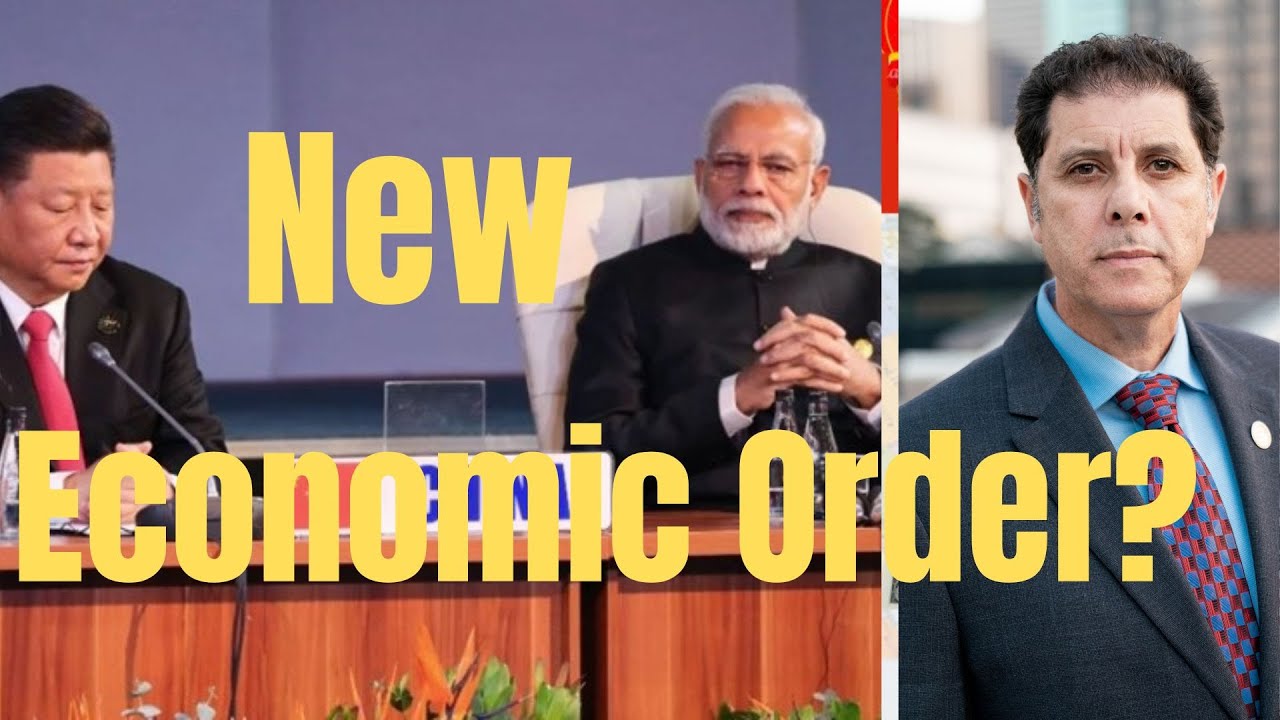
In this Geopolitical Trends video, host David Oualaalou examines a recent National Bureau of Economic Research study by economists Lawrence Kotlikoff and Seth Benzell that projects the United States will fall to the third‑largest economy by the end of the 21st century, while China and India ascend to the top two spots. He outlines the study’s methodology—using United Nations demographic forecasts and International Monetary Fund financial data—to argue that production growth and demographic trends will drive China’s 30% and India’s 13% productivity gains by 2050, outpacing the United States. Oualaalou interprets these findings as heralding a new multipolar world organized around economic blocs such as BRICS, ASEAN, and the Shanghai Cooperation Organization, rather than ideology. He discusses the gradual erosion of the US dollar’s share of global reserves, the rise of alternative transaction currencies (rupee, ruble, yuan), gold accumulation, and digital currencies, drawing parallels to the 1971 Nixon shock. The video also warns of geopolitical instability that could arise from a declining dollar, citing China’s cautious stance on Taiwan, the impact of US sanctions on Huawei, and potential alignment with Russia. Finally, Oualaalou invites viewers to share their perspectives on the future of the global economy.
Chapters
Hello everyone and welcome to Geopolitical Trends. My name is David Oualaalou. So glad to be with you guys here. Here's a provocative question for you: will China and India displace the US as an economic superpower? You know, in this video today, I am going to be providing you some insights regarding a research that just came out by two US economist, and the result might surprise you. But before I delve deeper into this topic, remember to subscribe if you have not done so already and smash that notification button so you will be notified every time I upload a new video. And as always, I can't thank you enough for your support. So let's dive in into this. Well, here is the outcome of that research. America, the US, will fall to the third place in the balance of economic superpowers. Yeah, it's shocking. I know some of us Americans do not want to admit to the reality that the world is changing. I've been writing about it. I remember one article that I wrote back in 2018 in which I indicated that, you know, it will be within a decade or so that China will overtake US economy. Of course, there are those who are saying, no, no, no, the Chinese economy is going to collapse. Yeah, they are entitled to their opinion, but I happen to disagree with that assessment. So here's the thing. The US position as the world dominant economic power is constantly declining. There are few, and I use the term few, Americans, including politicians, that are aware of this reality. Because here is the, here is the shocking thing about this outcome of the research. And of course, I will provide you the link and all that for to see where, where I got this research from. All indications are that China and India will be the world's two greatest economic powers outperforming the US. Of course, this is not going to happen next year. Or a decade from today. It's gonna take time. Well, here is where this information came from. Two US economists, one his name is, uh, let me get his name here, Lawrence Kotlikoff, and the second economist is Seth Benzell. They argued in a joint article that the US will decline to be the world's third superpower by the end of this century, which we'll be looking at about 78 years from today. Uh, my prediction is it might happen before that, but this is just to be cautious. That's why they put the time according to their research. And when— this is also when classified— this decline, when classified by GDP, the gross— the Gross Domestic Product, which does not exceed only 12% of the world output for the United States in comparison to 27% for China and 16% for India respectively. So it tells you right there where the changes are. So the two economists highlighted that a comprehensive study they co-authored together recently, which was released by the National Bureau of Economic Research here in the United States found the certainty— that's the key word there— the certainty of the decline of the US and the rise of China and India. So according to, uh, this article that included the results of their research, the study divided the countries over the world into 17 regions and is based, of course, on two main issues. One is demographics, which is the projections issued by the United Nations, as well as the financial statements of the International Monetary Fund. The two, the two statements by the UN and the IMF can confirm the, the two economists' conclusion that the US will decline or become the third-ranking economic power. So, so the two main forces that determine a region's economic future are its production growth and demographics. And based on historical data, labor productivity in in China and India respectively is projected to be— get this, guys— 30% for China and 13% for India, which is outperforming the United States production by 2050. That's an interesting, uh, statements. And something like this you don't just issue, uh, uh, uh, willy-nilly because I'm sure they've done their own homework and their research for them to reach their conclusion. So the two economists predicted that China's economy would grow to be twice as weak as the US economy by the end of the century, and predicted that Russia's GDP, gross domestic product, which is now counts for about 3% of global GDP will fall to just 1% at the end of the century. So again, about 78 years from now. But here is my take personally about all this. My thinking is, is this one here, is that the new multipolar system that we are witnessing, of course, will not— and get this— will not be based on ideology or political orientation. Rather, it will be based on economic blocks. And this is what I've always believed in, that the upcoming change to the global order, it will be based on economic blocks where the region— and this is why you are witnessing, for example, so many countries now wants to join BRICS. Euro are realizing the impact of ASEAN, the Association of Southeast Asian Nations. You are realizing the impact of the SCO, the Shanghai Cooperation Organization. So it's the economic blocks that's going to define the new global order moving forward. And this is why you're seeing the changes into the financial structure, because remember, all this is going to take time, because to change a currency or embark on using another currency, you will need to have the financial infrastructure for that. And these things don't happen overnight. So let's not be— to those who think that, oh, the US dollar is gonna be weak and drop overnight, no, no, it's not overnight. It's gonna take time, but it's coming. It is coming. So, so the United States dollar— speaking of the US dollar, the US dollar today constitutes the largest part of the world financial reserves. And I'm sure you know this by now, but here's the thing: the US economy, you know, is no longer as strong as it was a decade ago. Only a decade ago, things have changed. You know, the dollar, the dollar will not remain dominant over the global economies forever. And the reason being is because many countries are now using local currencies in foreign transactions and external exchange among themselves. And that's why I say— I've said, I do remember when I mentioned to you about the possibility of Saudi Arabia joining the BRICS. First line order of business is going to be to drop the petrodollar. That doesn't mean Saudi Arabia is going to drop the dollar completely. It's going to drop the dollar only from the energy transactions. Because the dollar is the most dominant when it comes down to energy transactions and others as well. But you can just see with this outcome of this research, the indication is that the, uh, foreign countries are working into this. We're already seeing, for example, transactions between Russia and China, between India and Russia, they're using the rupees and rubles for the energy exchange, and even Saudi Arabia itself. And I did talk about this in previous videos that is in talks with China about using the yuan for— as a form of payment for energy deliveries from Saudi Arabia to China. So, but here's the thing also about the US dollar is that the size of the dollar of the global economy does not exceed 25%. So you have to put the stats in perspective. So here's the thing, the alternatives can be for example, eliminate the dollars are sort of numerous because most countries are now moving towards that. This is what explains certain countries like, for example, the BRICS has been amassing gold. You know, even today the Western central banks have accumulated about 400 tons of gold that is worth about $20 billion. So what does it tell you? It tells you that something in the works is in the works as far as the foreign currency. And China and Russia, two countries that been sort of hoarding gold for the last 20 years. So of course, certain countries, even within the central banks in the West, do not disclose how much gold do they have, you know. And this is what we're saying. The alternative to that, the dollar, can be, for example, gold, can be digital currencies that would pull the rug from under the throne of the US dollar and to be on the list of the most traded currencies in the world. And this is exactly what we are witnessing right now with the deal between China and Russia regarding the transactions, uh, a form of payments regarding energy deliveries. And same thing between India and Russia, between Iran and China. And even now Saudi Arabia, as I said earlier, is considering accepting the yuan. So you can just see where the trends are headed. So, so the same thing happened in 1971, and you all know what happened in '71. And the aim is to absorb absorb money from the markets because US has made it a base currency, especially when we dumped the, the gold that it will not back the dollars at all. So, so when the US did this, uh, uh, back in 1971, and to make, to make the US dollar as the base currency in global transaction and its obligations to the world Uh, today are about $35— I mean, I'm sorry, about $53 trillion, and the American people's assets around the world are about $35 trillion. So you can just see why some other countries are moving into the direction. And like I said, even with the election of Lula of Brazil, he's the one who've been calling for a single currency in Latin America. Basically his way of saying let's ditch the dollar and create a single currency in Latin America by which we're going to be transacting with China and the rest of the world. So, so here's the— here is another thing for you to consider. In the event of a decline of the US dollar, the world will enter— because we need to consider what are the ramifications, because countries, if they start to realize their currency is, uh, losing value Sometimes they might end up embarking on some crazy policies, or foreign policies that is, including a military confrontation. So my thinking is that there's the possibility— I'm not laughing out of laughing, I'm laughing out of concern— in the event that a decline in the US dollar, the world will enter into some sort of a spiral of conflicts, and it will not be able to get out of You know, and I am pointing out in this case, for example, uh, like, like as an example, to China avoiding entering into conflict with the United States right now over Taiwan. Why, why is this? It's because China understands and knows that the size of the losses that it will affect it, because its cash reserves are about 3 $1.5 trillion. So entering into a conflict with the United States will certainly affect or impact industries in China. And you don't have to look far. Just use the example that just took place a few years ago. What am I referring to here? I am referring to the Chinese company of Huawei, and we covered this a lot on our videos. For Huawei, after it was subjected to the US sanctions as an example of this. So this is what I'm saying. Again, you look at the trends. So to those who say, well, China is not becoming military, this— no, no, no, no, no, no. China is thinking pragmatically about the consequences if it engages in a military at this time. Could it be that when it publicly declared its support for Russia— is an indication that it might be ready now because it will count on the support of Russia? That's a possibility. So, so here's my question for today, you know, where do you see the global economy going? I repeat, where do you see the global economy going? So make sure to let me know your thoughts, and I truly enjoy reading your comments, guys. Guys, you know, all of us, this is a community. That's what I'm hoping to sort of build with all this, for us to exchange ideas and learn from each other. This is for the sake of our, our world here, you know. It doesn't matter what part of the world you're, you're in, you know, your opinion matters, and, and we are here to just learn from each other. So as always, remember, geopolitics impacts your daily life in more ways than one. Till next time, guys, bye-bye.