Russia and Iran Send a Message — Is Washington Listening?
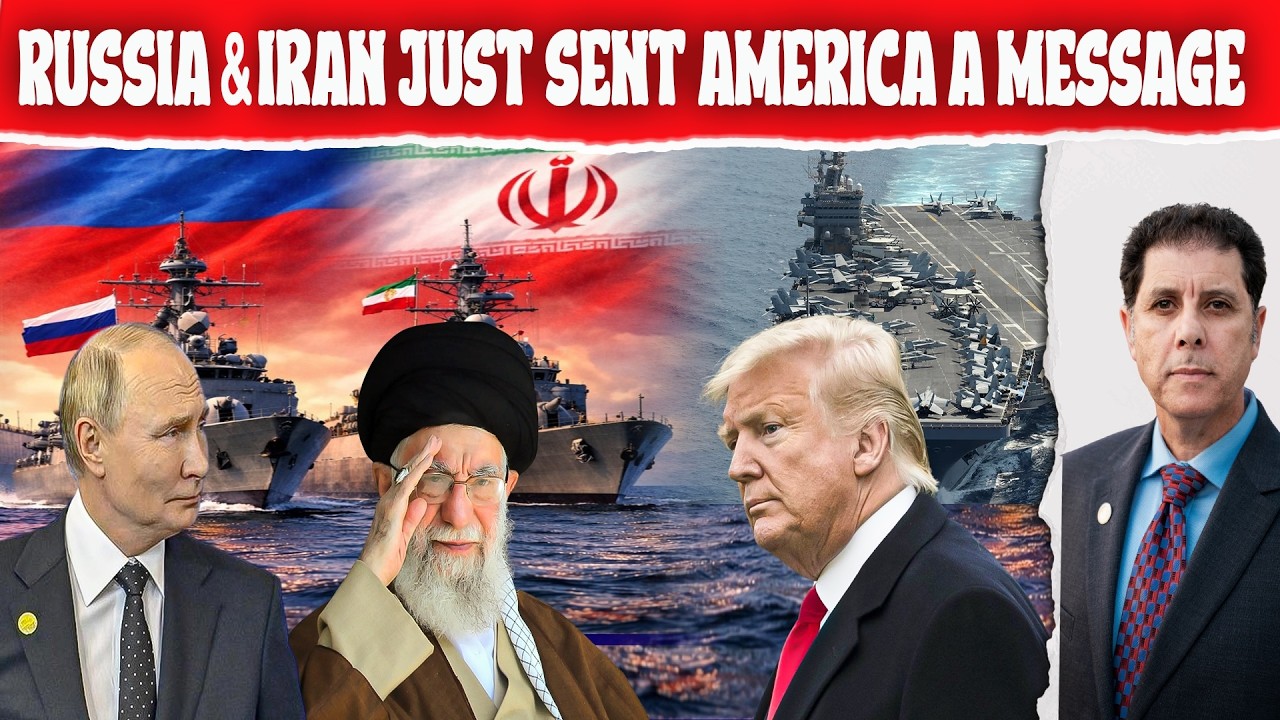
Dr. O analyzes Iran and Russia's coordinated naval drills in the Persian Gulf as a message to Washington ahead of Trump's 10-day nuclear ultimatum. Iran has tested hypersonic missiles and carrier-killer weapons, possibly with Russian help, while three U.S. carrier strike groups deploy to the region.
Chapters
Hello everybody and welcome to Geopolitical Trends, where truth matters. 10 days, that's all the time Mr. Trump has given now Iran to strike a meaningful nuclear deal or face consequences he described as bad things. You know how Trump talks. As the clock ticks, Russian warships are already in the Strait of Hormuz. You have that, the Russian warships, you have Iran's hypersonic missile test that just did 2 days ago, you have other missiles are on standby, and you have 2 American carrier strike groups are cutting through the Persian Gulf. The question is no longer if this explodes, is when. This is what I'm going to be addressing for you in this analysis today, in this live stream. So, and the first thing that comes to mind is, is Donald Trump bluffing? Iran thinks so. Russia is betting on it. But here is what everyone seems to sort of forget: Trump has already struck Iran once before. And why is this important? It's because he did— for you to know, because back then he didn't warn anybody. And now you have with the largest US air and naval buildup in the region, Middle East, since 2003, the invasion of Iraq. Uh, the real question now isn't whether America is ready to strike, and as a matter of fact, it's now— it's whether Iran truly understand that this time is also very different? And in conclusion of this analysis, I'm gonna share one question for you pertaining to this particular aspect. So what I'm gonna do, I'm gonna start by talking about Iran and Russia naval drills, then I'll move into Donald Trump, a 10-day ultimatum, if I may use the term here. So, so what happened recently? As of yesterday, the 19th, Iran and Russia launched joint naval drills in the southern part of Iran. The drill took place in— and I have some pictures here I'm going to be sharing with you as I explain a few things here. The place took— I'm sorry, the drills took place in the Strait of Hormuz. The Gulf of Oman, and the northern Indian Ocean. And those are three locations, very, very strategic and interesting to understand. And this is where, uh, the, uh, you have the Russian corvette, the Stoikoi. Uh, actually, I looked at, uh, one of the pictures for you so you have an idea of it. This is the Russian Navy Stoikoi. That's a helicopter carrier also. That participated in this. What's interesting is that China does not appear to be involved in this current drill. A lot of— there was a lot of confusion out there that the Chinese are part— no, no, no, no, the Chinese weren't part of this. Technically, just to clear up the confusion here, the confusion is understandable from some. The broader Maritime Security Belt This is the trilateral between Russia, China, and Iran. And this started in 2019. And that was originally an Iranian initiative, except in 2021, if I recall, China did not participate. But this one is slightly different here. This time, Russia— China didn't participate in the drills themselves. It was just Russia and Iran. And this is why it is described as some sort of small but symbolic. This is what a former Iranian naval officer described them. So I just wanted to clear this up for you here. So the bilateral drills between Iran and Russia, smaller and more symbolic than the broader trilateral framework suggests. And there are those who argue that, well, even with Russia participation, they cannot imagine that Russia some sort of will offer real support in direct confrontation between Iran and the United States. I have to push back against that argument because there are, again, those who argue that, well, maybe, maybe Russia is just using Iran as leverage in its broader standoff with the West, meaning the Russian standoff with the West as well. I, I don't think so in this one here. This is slightly different because Russia understands the changing dynamics in the landscape. And because the three countries, Russia, Iran, and China, this is what constitute the core of the new multipolar order. And Russia does not want to be left behind without having a say into that. What's interesting about these drills is the timing of it. One of the— I have a picture for you right here. One of the interesting aspects of these drills between Russia and Iran is that it follows Iran's launch of 5 missiles towards the Strait of Hormuz on the day before. So, and those launches struck targets as part of a larger-scale maritime exercises that Iran conducted. Once again, the timing of it is crucial. And of course, you have to add the statements of the Supreme Leader Ali Khamenei when he said that the capabilities of Iran of sinking a carrier, uh, uh, the US, uh, uh, carrier, uh, stri— or the aircraft carrier, I'm sorry, that is within reach. Why? Because Iran might have something. You put the two and two together and you figure, okay, if Iran is doing this 5 launches, 5 missile launch towards the Strait of Hormuz and conducting the day after drills with Russia, all this, this is what they came up with that operation that is called smart control of the Hormuz Strait. This is where you have to put this in perspective. Russia showing its naval assets as part of this, it highlights something for us, and it's worth addressing. So I'm going to share a clip with you here briefly. Actually, the thing is this clip is in English, so I don't need to do translation for you here. So let's take a listen here, please. Okay, here we go. Iran and Russia will launch a joint naval exercise in the Sea of Oman and the northern Indian Ocean on Thursday, according to spokesperson for the drill, Rear Admiral Hassan Mahsoudloo. The exercise is aimed at boosting security and strengthening durable maritime interactions in the region. He says expanding joint maritime cooperation, especially in protecting commercial ships and tankers, as well as combating maritime terrorism, is among the main goals of the drill. Iran's Navy official made the remarks during his visit to the Russian Navy's helicopter carrier stoisky, which docked in Iran's southern waters. Russia's naval force commander, Captain Alexei Sergeyev, for his part, praised the close ties between the two countries, saying both navies are prepared for specialized drills, including maritime counterterrorism operations. All right, I'm gonna stop right there. And why is this important also? Because you have to understand where the Russians are coming from. Russians also have to think about access to water, and this is why they decide to do it. It's symbolic. And the next, next question we have to ask is to whom the message is sent. I know everybody's going to say is the, is the US. Yes, that's part of it, but it's more than that. So I'm going to divide it into three parts here, the, the, this message. First one is to the United States, the primary audience. Meaning us Americans. And to me, in my opinion, this is the largest or the clearest— I'm sorry, the clearest and most direct message. The drills comes as the U.S. officials remain concerned about retaliation against American bases in the Gulf and naval assets operating in a nearby— you're talking about, we're talking about the Fifth Fleet. In Bahrain or anything near the Strait of Hormuz. So despite the heightened power or military posturing, that is, including the possible arrival of the USS Gerald Ford with the strike group, Trump has publicly maintained some sort of that argument of, well, diplomacy remains the preferred course of action. We don't know. That's Trump. You can't take him for what he says at face value. So the message to Washington within this is this: any military strike on Iran comes with complications. Russian assets are in these waters. Think carefully. This is what the Iranians are saying. So having the Russian warships nearby, once again, the optics matter. Having the Russian warships in these waters aimed at possible US attack on Iran could have military and political implications that sort of the American planners will have to address moving forward. They can't assume without that. The second message goes to Trump administration specifically, and this also tied to the nuclear negotiations. The timing is no accident. Yeah, it's no accident. The timing is strategically calculated for this. The drills between Russia and Iran, okay, come as Iranian and American officials said they have made progress in the nuclear talks. I don't believe it. That's just what they say, being mediated by Oman. But at the same time aimed at the U.S. military buildup in the region as part of Trump's pressure campaign on Iran. So in this context, within this message, Iran and Russia are essentially saying, you know, Iran is not alone. At the negotiating table. It has partners with military reach. Just think about it. And the third message, it's going to Iran's own population. That means the domestic messaging here. What's important about that is that Iran's leadership is also speaking inward to the Iranians. And the way they're doing this— and this is where you have, uh, the Iranian, uh, Rear Admiral, uh, his name is Shahram Irani. I think I have a picture. Yes, right here. The commanding officer, that's the Rear Admiral, uh, Shahram Irani. He warned that the presence of extra-regional fleets in West Asia is unjustified. "By the way." And he's adding also that "any or if the extra-regional fleet feels it has come with power, it should know that the Iranian people will confront them with greater power." This is his message from the Iranian government to the people. And this, in my opinion, designed to project some sort of, uh, resiliency and boost the morale at home, aimed the real economic and military pressure. Then we have one more message here, which is the broader Western alliance and US Gulf partners, specifically Gulf partners. We're looking at United Arab Emirates, Qatar, and Bahrain, Kuwait to a degree, and Saudi Arabia to a degree. So It is what the Russian presidential aide, uh, I have a picture of him right here. He framed the Russian involvement as part of building a multipolar world order on the oceans, and that he's— this is in response to what he called as Western hegemony. And he also added that BRICS should now be given a full-fledged strategic maritime dimension. That's interesting that he brought BRICS into this conversation. Why? Because it has been questions for the past few years about whether BRICS could have a military, the equivalency of NATO within, within, within BRICS. I'm among the first one to say no. As long as you have India there, it won't work. India will undermine you from every corner. And if you are to put the resources, the technology, the manpower, and it gets undermined, it's not worth it. What do you think? Should BRICS have a military unit that specifically deals with issues pertaining to BRICS countries? So just leave me, uh, your answer in the chat box. But I found it very interesting that the, uh, the Russian presidential aide Patrushev mentioned BRICS into this. But here is the message that's been sent to US allies: Saudi Arabia, United Arab Emirates, Bahrain, which is home of the, uh, Fifth Fleet, and, and others, of course. The message is that the regional order is shifting and Russia intends to be a permanent naval presence in these waters. Because remember, if you look at the larger picture geographically, so if you move into certain directions as far as the Arabian Sea and others, Russia will have to think in terms of access. So the bottom line, when you think about the meaning of this real, those naval drills, those drills are fundamentally deterrence. Yeah, they are fundamentally deterrence theater aimed first and foremost at Washington, of course. So, and this also intended for some another objective, and that objective is to complicate US military planning. At the same time, reinforces Iran's leverage in nuclear talks. And I'm gonna go far and extend it to even signaling that Moscow stands with Tehran, at least diplomatically and symbolically. I'm going to add one more, and you know what that is? This one has to do with China— with— I'm sorry, with Russia even considering what if I don't do this and China end up having the upper hand? Because in geopolitics you have to think in those terms. Remember what I talked about, the secret weapon that Iran might have, which by the way I had a picture and last time I forgot to upload it, so I'm doing it this time around. It's the, uh, the DF— uh, where is it now? I didn't have it here. Is, is the DF-21. Uh, where is— yeah, no, I don't, I don't. Sorry. Uh, is the DF-21. So to Russians, they are thinking in terms, you know what, we're gonna have to show something at least. Because with, with China having 16 cargo with weapons to Iran, that's gonna put Russia on the sideline, and Russia doesn't want to be left behind. This is why they did what they did as a show that we can also be involved inside or in support of Iran. That's just my— me thinking outside the box. So But there are those who are saying, well, all this is nothing. Some military analysts in the West here are suggesting that all these vessels that Russia is sending and so forth are more of a political factor, no more, no less, than operational ones. So at least for the time being, and I can see that, you know, but the, the real question becomes is whether Russia will really fight on behalf of Iran. I don't see that. The common sense would suggest so. But its presence alone raises some sort of the cost and risk calculus for any American military action because you have to think about it. And when you see the big picture, here is the Russia deploying the Stoikovoy, the naval assets here. You have the, uh, you have the Chinese deploying some sort of the, uh, 055 destroyer, okay? Then this, the spy ship that I think I had a picture, uh, not here. So, so what we can think about is, is, oh, here's the DF-21. This is the Chinese, the carrier killers. So we don't know. So, but just put this in a picture. You have the Russians, Stoikoi, you have the Chinese missiles, and beside the missiles, the surveillance ship to Iran. And of course, what you had 2 days ago when Iran shut down the Strait of Hormuz for a few hours. So to host live fire. Part of that live fire were the missiles that were launched. All this, you put this picture together and, and it gives you an idea about how the US is preparing on one end, Iran is preparing on the others. And when you take what's happening on, on the waters on that side, then you take on the other hand Trump giving 10 days to Iran to reach a meaningful deal in the ongoing talks between the two sides or face, as Donald Trump said, bad things. The next question becomes for us is, is Donald Trump bluffing? What do you guys think? By the way, I need to have your input into this conversation here. In your opinion, based on what you know so far, and what I have shared with you for the last week and a half since I've been covering this Iran developments. In your opinion, do you believe Donald Trump is bluffing? And I'm gonna take a look later on as I move forward into your responses here. So the military backing is real and substantial. I mean, it's common sense, based on facts, based on what we see. The US military is, as we speak, is stationing some sort of advanced array of forces in West Asia, including the two aircraft carriers. As a matter of fact, to my knowledge, the third one might end up joining. Got a word that there is a conversation about a third aircraft carrier is going to be going. Then you have the fighter jets, then you have the refueling tanks. The US's Abraham Lincoln is already there. Then you have now the USS Gerald Ford, which is, by the way, I had to check something yesterday to find out where the Gerald Ford is. It is, as we speak, on the Gulf of Morocco, but it's left, it's already left and it's gonna cross, it's crossing as we speak across the Mediterranean on its way. But as of yesterday, it was on the Gulf of Morocco, reached out over there. So I got a picture of the satellite, the public satellite, not a government satellite stuff. And so she's en route right now. So when you think of the accumulation of the US power, air power, as the largest in the region since 2000, since the invasion of Iraq. So, and this is where you have, uh, One of the— I got a word also from a member of the National Security Council, an official. He did go on the record by semi-officially. What he's saying is that the U.S. military is ready for a potential strike. Get this, guys, as early as tomorrow. It's unlikely, but It's just for it to come from someone from inside the National Security Council with coordination with Trump, the timing is unlikely. I don't know why the person will say this. I can't read his mind or her mind, but it's unlikely. It's unlikely because it will extend beyond this weekend. Trump has not yet made a final decision. Because with conversations now described as fluid and ongoing, don't know where the concern is, is if Israel proceed anything and go ahead and strike Iran, and that's gonna have to force the US to get in. Everybody's watching. Because to me, what you're seeing with the US presence, with the movement now of the Gerald Ford towards that area, with the presence of the Abraham Lincoln already, and some others gonna be moving from Diego Garcia, then you have the Gerald Ford, the Abraham Lincoln and so forth. When you look at all this, it's not just posturing here. You know, we're talking about the machinery of, for a potential strike. That could be actively in motion. That's the way I read it as a former military. Now, whether the decision— I've been in the situations where we were ready to go in, whatever, got the phone call, stand down, to the last minute, literally to the last minute. I could see the same scenario here, the possibility. So the question, as I, uh, the question I raised earlier, whether Donald Trump is bluffing or not, We're going to make a case for that on two sides. There are several factors that suggest Donald Trump is using maximum pressure as a negotiating tool rather than genuinely itching to pull the trigger. In other words, Donald Trump doesn't want to have a war. But he has done this before. Trump pulled back from the brink just last month, remember, against Iran, stepping back from attacking Iran. I'm sure you, you remember, after saying the country agreed to hold the execution of dissidents under US pressure. It has nothing to do with the truth. That wasn't true. What is factual is that Donald Trump has a well-documented pattern of dramatic ultimatums followed by deal-making. Except Donald Trump found out he couldn't pull that nonsense stuff on the Chinese. You all remember with the tariffs? And he ended up, you know, the Supreme Court, by the way, here in the United States just overruled Donald Trump's own tariffs. Consider them unconstitutional. So because what Donald Trump was doing with the Chinese, bluffing and threatening them, that bluff didn't, didn't cut it with the Chinese. They pushed back and we saw the result. We are dealing with the consequences of that. But the talks between US and Iran through third party are actually progressing. The Iranian Foreign Minister Abbas Arakchi, they stated that the two sides are making good progress. I don't buy that either, Mr. Arakchi. I got to be straightforward here. They were able to reach some sort of a broad agreement on a set of guideline principles. Well, here is the thing. The US now wants Iran to halt a complete enrichment of the uranium. Even the Iranian president, Raisi, said that Iran might reduce the uranium enrichment. So you have the prime minister saying one thing, you have the president saying one thing. So I, I don't buy what they're saying as far as, uh, the, the talks are going good. No, no, because you— Iran opened the door for itself to be pressured when they agreed to go into this route to begin with. That's like they haven't learned from 2019. Even Trump himself is calling now the talks are very good. So you don't typically bomb a country you just had a very good talk with. This is what Trump is saying, so read between the lines. And there is one other thing that Trump is dealing with domestically, and it's not making itself to the media outside, is there is a congressional resistance to what Trump is planning on doing. You have now both Democrats lawmakers and some Republicans have voiced opposition to any military action against Iran. Even Britain, the UK, Starmer is saying now, "We not allow Americans to take off from the British bases." That tells you the story right there. Whether Trump is gonna just go ahead and do the attack without congressional approval, I won't be surprised. We've done it before. So the gap remains enormous. You have part of the cabinet saying one thing, you have other parts of their government is saying otherwise. Because here is one thing, Iran has also some red lines. Because when you have, for example, the Vice President, J.D. Vance, say— saying Iran did not address the red lines set by Donald Trump, during the Geneva talks? Well, still very far because they're still very far apart on some of the issues. The US demands now to include curbing uranium enrichment into the talks. They also wanted to include limiting the ballistic missiles and also wanted Iran to stop support for regional proxies. All of which, in my opinion, to Iran is a red line, non-negotiable. So the bottom line to this is the idea that this is a classic Trump, Trump madman theory per se in action, keeping the adversary some sort of generally uncertain about whether he will act or not, because that's going to keep some country— I think he tried it with the Chinese, but he learned the hard way. Chinese didn't care. They pushed back. Doesn't matter, because they told Trump— and I was following this development— they told Trump, sure, we'll negotiate with you once you lift the tariffs, then we'll talk. Trump couldn't. Because if he would've done that, he will lose face. He already lost face. And when the Chinese want to hit and hit back, it's too late. Because the case now with Iran, you know, the threat is credible enough to be taken seriously. The threat of what? We're talking on both sides, the real military assets. So of course the US did the prior strike. June 2025, uh, on the nuclear facilities. But the diplomatic track still also is real. You have two tracks. You have a military and a diplomatic one. But you are not going to ignore what the possibility of what surprises Iran might have. And I'm going to talk about this in a second here. And now that Iran has some secret weapons from China? You know, I keep thinking the only thing that came to mind is this D— the, uh, DF-21, the carrier killers. Because if, if the United States is going to have 3 aircraft carriers, that's sitting duck right there. It is what the US is saying. The U.S. officials are saying, well, Iran needs to come back to the Trump administration by the end of the month with a package of steps to address U.S. concerns raised in Geneva. That's to me, what makes us think that Iran is going to agree to whatever? And that is worth addressing. Sort of a question we ought to address as we move forward. Liking this video so far? Don't just be a watcher. Go ahead and hit the like, share, and subscribe button, and don't forget to tap the bell so you will not miss any of my videos or live streams. This way, you will be supporting a channel that stands for the truth and objective reporting. The choice is yours. Thanks for your support. And what I meant by that is two options or three options. I'm gonna state the arguments on both sides. I'll let you decide. As always, that's how we do it in this channel here. Will Iran cave in? It's, it's— I'm gonna ask the question. I know some would say, well, Dr. O, there is no way. It's beside the point. We have to address the possibilities. When you do an assessment, when you do an analysis, you can't just look into one angle. You have to have a variety of sort of perspectives to have a much clearer picture. So I'm going to start with the first question: will Iran cave in? So here is the thing, why Iran may partially yield or cave in. There's one thing first that comes to mind is the economic desperation. Inflation or the economic pressure because it's real. Tehran is really in a delicate position to get the damaging US economic sanctions eased up because Iran's economy has been battered for years by maximum pressures. And I know almost 40 years. And Iran's still standing. But at the same time, we're going to have to address what's factual. And the population inside Iran, not everybody is okay with the economic conditions as they are. And this, when you think about these conditions, it gives Trump enormous leverage. So the Iranian leadership knows a deal is only path back to economic normality. Iranians. That means they have to cut a deal. That's just one option. The military reality has fundamentally shifted as part of why Iran might consider partial agreement, too. And this is the most critical factor, in my opinion, because remember, on the eve of Israel's war against Iran last June, Iranian officials, and I have it on a record, Iranian officials assessed that Israel will not strike before the 6th round of negotiations concluded. They were off. Instead, what happened? Iran's capital Tehran awoke before dawn to coordinated strikes and internal drone operation that eliminated much of the country's senior military leadership. And that is why Iran was caught completely off guard once before and knows that Trump will strike again. And again, I'm just providing you the possible thinking that might be going on inside the Iranian administration. The other consideration will also be that the talks in Geneva are progressing genuinely. And that's what, again, what Iran's Foreign Minister Abbas Araghchi stated. We were, and I quote, we were able to reach a general agreement on a number of guiding principles, and from now on we will proceed on the basis of those principles and move forwards towards drafting the text of a— pardon me— of a potential agreement. End of quote. Uh, for this one, I'm shaking my head once again, using history as my guide. It's the exact process we went through in 2015 nuclear agreement with Iran. Everything, the text was provided to the P5+1. Everybody agreed on it. It was signed. Everything was good to go. Some of the sanctions were lifted. Donald Trump pulled the U.S. unilaterally. And as a matter of fact, it's been reported inside Iran that Iran has now agreed to submit a written proposal addressing Washington's concern, which in my opinion, it's a significant diplomatic steps. This is if we go with that argument, the first one. The other argument is that— or the other question— why will Iran, uh, uh, why Iran will not fully cave in? And this one is very important because here it's where it gets very dangerous. Iran has red lines. It appears unwilling to cross regardless of the consequences. Iran insists its nuclear program is for peaceful purposes. We all know this and move forward with that. But it says it is willing to discuss limits only in exchange for sanctions relief. Yeah, once again, you're going to open that door, it will never— the US and the West will never mainly the US because the West, Europe, it's useless anyway. The US and Israel, that's the one pushing the US for all this. We'll never stop. We'll never stop till two conditions are met. So the missile capabilities are destroyed completely and all the enriched uranium that is already pure enriched uranium be taken out of the country, out of Iran. It's already been suggested that it needs to be, uh, uh, uh, exported to Turkey, be stored in Turkey. Well, guess what we have in Turkey? We have Incirlik base. That's where we have our nuclear bombers and all that stuff. And at the same time, Iran has rejected the zero uranium enrichment and rule out the talks on its missile capabilities entirely, because to Iran, that's, that's the wild card they have. If they get rid of their missiles, it's over for Iran. Why will they ever do that? Not— no one in a right mind will agree to something like this. No way. No way. And that's why I don't understand the arguments of why they are pushing— they meaning US and Israel— for, well, we have to eliminate, we have to sort of remove all Iran's missiles. No, it's not going to— that's the wild card they have. That's why it doesn't make any sense. Now, there are those who argue because if Iran does that, it will leave it defenseless. For now, they have something. The US knows it and they are concerned about it. There is one other point that I was thinking about, and, and it's just, again, we're just thinking outside the box here, which in my opinion, if it is the case, that then it will be the most alarming factor. And that is if Iran may be misreading the situation. And again, I'm just thinking out loud here. That's the most concern to me. It will be that if Iranian decision-makers continue to interpret mounting US military deployment as a pressure designed, that pressure is designed for one specific, to force negotiations rather than preparation for escalation, that's a problem. That's misguided thinking. So the dominant belief remains that Washington ultimately seeks a nuclear agreement and wants to avoid a prolonged regional war. That's just— I had to share this with you. In another word, Iran thinks this is all about negotiating tactics, just like before. But the geopolitical environment surrounding Iran has transformed. Remember what's going on in Syria. Syria has fallen out of Iran's strategic equation. Hezbollah and Hamas lost much of their— some sort of some capabilities, not all, during the '23-'24 war with Israel. I'm not gonna go as far as saying, like some other analysts which I disagree with, that Iran is far weaker today than it was a few years— no, I won't go that far because still Iran can surprise you. We don't know. We don't know. And that is again where you have to think to yourself, Iran will likely offer enough to keep the talks alive. That's the way I see it. Partial concessions, maybe. A written proposal, maybe. Another round of negotiations, maybe. But it's unlikely to meet all of Trump's core demands. Particularly on missile technologies. So within— and of course, Mr. Trump wants this within the next 10 or 15 days window. So the real danger, in my opinion, with all this is the gap between what Trump demands and what Iran can politically offer. That's the way I see it. Otherwise, we're looking at a full-blown war. And also whether within this gap triggers military action before diplomacy has truly been exhausted. Because no one wants an increase of tensions in the region, because everyone understands that they're playing with fire. And this is again where the next 10, 15 days may be among the most consequential of this decade, believe it or not. And I am not left without wondering about one other aspect, and I'll close with this. What if Iran surprises the US with some advanced weapons? Yeah, yeah. What if Iran's not gonna show its— all its cards? It's common sense. They're gonna play all that? No, they won't. But what if they end up surprising the US? Yeah, first thing that comes to mind is the hypersonic arsenal. Of course, some will say, some Western military analysts will say, oh, that's just overhyped. No, no, no, no, I think they're real. Those are considered the most advanced missiles for Iran, especially the Fattah-1 or Fattah-1, because that one— it deserves scrutiny on part of the U.S. military because they have to consider the consequences of that. Of course, Iran describes it as a hypersonic. Some independent analysts are saying, and those are within part of the— and I looked into their analysis, read some of it— part of the International Institute for Strategic Studies. They characterized it as a medium-range ballistic missile. With maneuverable reentry vehicle and not truly hypersonic. I, I don't buy that argument they're saying. I won't buy that because they won't want to admit it, because they are saying, oh, it's not truly hypersonic glide vehicle in the same class as the Russians or the Chinese systems. Well, after all, this technology was transferred by two countries, to my knowledge, North Korea and Russia. Yeah, some will say, well, maybe they are near hypersonic or quasi-hypersonic. It won't matter. It won't matter. The fact that it exists, that is where the— still a serious threat in practical terms. You have to think in those terms. And in extreme speed, Because when you think about this type of hypersonic, over 5 times the speed of sound combined with the mid-flight maneuverability makes it far harder to track and intercept, even for advanced systems like the Israeli Arrow missile defense systems. They won't be able to do it. Of course, Iran has already used these types of weapons, because in April '24, it launched roughly between 110 and 130 ballistic missiles at Israel. Some say nearly half of them were intercepted. Some other stat— data said that about 90%. Others saying only about 7 or 9 missiles get through through. And that's all you need, one or two to get through to specific target. And in this case, we're talking about the US aircraft carrier. Then the other aspect will have to do with the anti-radar surprise cards. Perhaps that's the most genuinely alarming capability Iran could deploy in less— that is less discussed, by the way. This is why Iran's Hormuz anti-radar ballistic missiles is home in one enemy radar emissions and attack the signal source itself. This is why the Iranians launched those 5 missiles at specific targets in a Strait of Hormuz, and they hit the target, by the way. And that's where the Russian connection comes in. Because the Russians provided this type of radars. They provided the jamming systems for radars. And this is again, you're gonna see the readings or the analysis from the Western think tanks, military institutions, and so forth, as saying, oh, there is no hypersonic for Or Iran didn't develop the hypersonic capabilities. Others will say, yeah, they developed some, but not on its own. Well, who cares as long as they have it? Because one thing for sure that I am certain of is that the Russian technical assistance is involved in this capability. Russia did it quietly transferred some advanced missile technology during deepening partnership, which by the way, Iran never, never disclosed that publicly or revealed it. And that's to me where it will represent a genuine strategic surprise for the Americans. And that's the way I see it. It is what I'm going to conclude with. Uh, I conclude with another aspect that maybe Trump didn't even think about, something else. And this one is, like I said earlier, maybe Iran misread certain things. What Trump also may have misread, Iran's position and why Tehran is likely to calculate that capitulating to Trump's deal is riskier than a military confrontation with the United States? What do you think? So make sure to leave me some comments in the comment section. I would, I would really like to read your feedback about this question. Was not a question, but this, this statement. In your opinion, sort of, if we think that Donald Trump misread Iran's position and why Tehran is likely to calculate that capitulating to Mr. Trump's deal is far riskier than a military confrontation with the United States. So as I said, again, I will, I will really like to read your feedback on this. I thank Hangin' G for sharing some of the comments on this one. Truly, truly appreciate you for that, and all of you All of you guys, I truly read your stuff. I take this opportunity, by the way, to say happy Ramadan to those who observe the fasting. I'm sorry I missed it last time we did the live stream on the first day of Ramadan. I forgot, but I just want to wish my followers, those who observe Ramadan, I want to wish you a happy Ramadan. And also take this opportunity to say thank you to FU for your Super Sticker in support, uh, your donation. I'm sorry, not Super Sticker, your donation in support of my upcoming Asia trip. I'm very, very grateful to you for that. And I'll take this opportunity to say thank you to Flying Boar. Get rid of Prizeshian, the guy is weak. Thank you first of all for your Super Sticker. And you know what, your statements, I've heard it from some people inside Iran. They are really, really wondering about, about Brzezinski and not being this firm, strong president they were hoping for. So, so I, I can see your point on this one. I appreciate you all for your support for the channel. Please share this video with others and subscribe if you have not done so. And I look forward to seeing you next time. As always, remember, geopolitics impacts your daily life. In more ways than one. Till next time, bye-bye!
More from David


Beyond the Single Actor: Why the Gulf Isn't Choosing Between the US and China


Iran, Iraq's Militias, and the Houthis Are Coordinating! This Changes Everything




Who Controls the Next Decade's Resources? Latin America and Africa's Geopolitical Crossroads

The Chokepoint Trap: How Washington's Stupidity Triggered a Cascade That Now Controls the World

Trump Spooked as IRGC Unveiled dual-use SLV, Deployed Ghadir Mini-Subs & Hinted at Tactical Nukes!
