Russia: Blind Trust in India or a Strategic Necessity? W/Jayant Bhandari
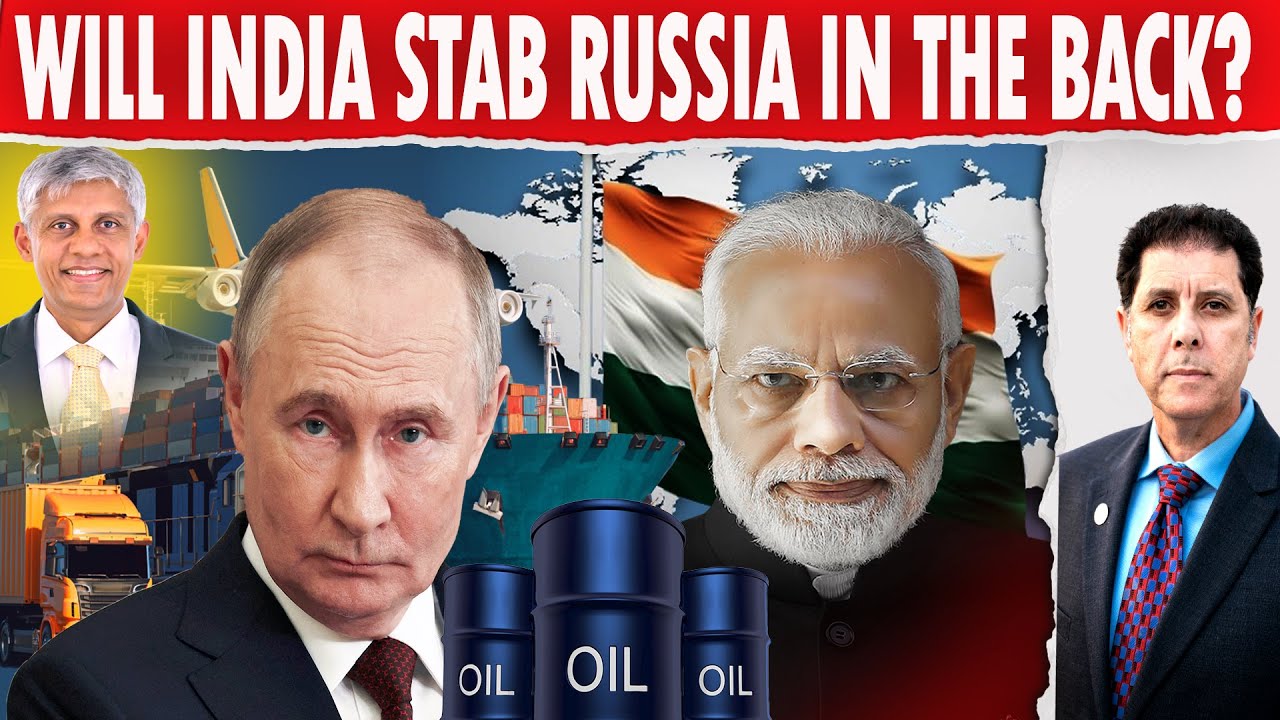
In this livestream, host David Oualaalou interviews long‑time US‑based institutional investor advisor Jayant Bhandari about the geopolitical and economic ramifications of President Vladimir Putin’s recent visit to India. Bhandari argues that India is an internationally isolated, "no‑trust" society that relies on a purely transactional, elite‑to‑elite relationship with Russia for oil, defense equipment, and diplomatic backing. He explains how India pays for Russian oil via UAE dirhams and Chinese yuan, dismisses the rupee as a viable currency, and notes that Russia is issuing yuan‑denominated bonds to secure liquidity. The conversation shifts to India’s internal dysfunction: pervasive corruption, bureaucratic incompetence, failing public services, environmental neglect, and a cultural lack of honor or values. Bhandari critiques Western scholars such as Jeffrey Sachs for over‑optimism, contends that India’s caste system is a symptom rather than a cause, and predicts that India will increasingly become a manufacturing back‑office for China while descending socially and politically. He foresees heightened communal tensions, erosion of democratic institutions, and a continued strategic reliance on Russia despite the absence of people‑to‑people ties. The interview ends with a bleak outlook for India in 2026 and a preview of upcoming livestreams on China‑Japan tensions and ASEAN politics.
Chapters
Hello everybody and welcome to Geopolitical Trends, where truth matters. Excited to be with you once again, uh, in this live stream here. I will be having a conversation with my dear friend Jayant Bhandari, but before I bring him in, I need to let you know about few, uh, uh, housekeeping stuff. Remember to join me for my conversation with, uh, Professor Anna Malindog. We will be talking on the 10th at about, I think, 0:30, 8:30 in the morning my time here, which will be, uh, 9 or 10 PM her time in, in Asia. So I'm gonna put the link for you for that, uh, live stream. I put it in the chat box especially for my Filipino viewers because they will be waiting for that conversation. Also tomorrow, uh, something came up regarding the China-Japan tensions. And as a matter of fact, Tokyo, or the Foreign Ministry in Japan, in Tokyo, just summoned the Chinese ambassador over a fighter jet threat. So I will be doing a livestream for you tomorrow about this. I spent actually the last 4 hours researching on this and confirming certain information. So I put the link for both livestreams coming up soon. So it is the live, the TN for that particular, uh, livestream tomorrow. So for now, let me bring my, uh, uh, uh, my dear friend, uh, Jayant Bhandari. Hi, Jayant.
Hi, good evening, David. Thanks for having me.
Of course, as always, it's a treat to have you. To those who do not know who Jayant is, Jayant Bhandari has been a US-based institutional investor advisor for many, many years. He has also written extensively on political, economic, and cultural issues. Please make sure to go to the— under the description of the video, I put a full bio of, of Jayant Pandhari there, including his website links and also his social media links and everything over there. So make sure to check it out, please. So, Jayant, we're gonna get into it right away because we got a lot to cover. Of course, we're going to be talking about the, uh, recent visit of the Russian President Vladimir Putin, who just recently visited India and promised an unlimited and uninterrupted, uh, flow of oil to India. So we'll talk details as to, uh, about this. But first, I would like to ask your opinion, your overall assessments of where India stands on the global stage since last time we spoke, and given also India's political diplomacy?
Uh, David, India is today, uh, and as has been the case in the past, a very isolated country. Um, no one really trusts India. The US wants to desperately want to work with India, but India is unable to commit itself fully to anything. It commits itself to no values, no future together, and it is prepared to change its views as time goes by. And they harass people for no good reason. A Nepalese woman passing through Delhi was harassed for hours at a time in New Delhi for no good reason while she was just on transit. So India trusts no one, Indians trust no one. And Indians trust— don't trust each other, which is where the core of the problem comes from. It's a no-trust society. It is not a low-trust society. It's a no-trust society. So India stands alone. The only friend that India today has is Russia. And that's what I guess you want to talk about today. But that is the only and the only friend India has today in the world space.
Well, speaking of Russia, Jayant, and we're going to get into more detail about this, how do you see the overall, your overall assessment about the Russian President Vladimir Putin to India? Is it significant?
Absolutely, it is a very significant trip, David, and there's a reason behind it. This is not because of any commonality of values. This is not because they believe or like each other. It is because you scratch my back and I scratch my back kind of relationship. It is virtually 100% elite-to-elite relationship between the top government officers— sorry, politicians— to top government politicians in the other country. There is virtually no people-to-people contact between the two countries. I know it would surprise a lot of people, but there's virtually no contact between the people. Um, the only understanding a lot of Indians might have about Russia would be about Russian prostitutes, ironically. And those are not Russian prostitutes, they are from Central Asian Republic who speak a bit of Russian, so they pass, get passed around as Russian prostitutes. Um, and this is probably what Indians like, but There is no people-to-people relationship, very similar to what has been the case with Bangladesh. India had a great friendship with Sheikh Hasina, and the moment she left, everything dissolved into nothing because there was no decent people-to-people relation. India's relationship with Russia has been ongoing for decades now. And they have worked very well as, as, as a 'you scratch my back and I scratch your back' kind of system. It's a mutually exploitative relationship. It's a relationship of convenience. It's a transactional relationship. There's no values, no emotions attached to it. It's purely transactional.
So if we are to assess this relationship this way, So who's benefiting? Who's benefiting from whom? Is it India benefiting from Russia, or is it Russia benefiting from India? Or, or how do you see it?
Well, again, it's a very transactional relationship, and it works very well for both the countries, particularly today. So remember, there was no news of Putin visiting India until about, I guess, 2 or 3 weeks back. It was a sudden decision. But this helps Putin in many ways. Putin now can show to the world that not only China is on its side, but India is also on its side. And it also conveys to the world that China will continue to supply oil to India and India will continue to buy it. So it improves the negotiating power of Putin in the Ukrainian affairs. The world now recognizes that now Russia also has its own support. Russia also is better confident about the fact that its oil will continue to be bought by India despite the US pressure that India faces. Now, I think Trump overplayed his cards when it came to India. India was badly cornered and Trump very likely overplayed by asking too much that India could not deliver. So India, of course, purely on the basis of what was convenient to it, what was left over for it, went to the camp of Russia completely. But Russia also needs to depend not just on China. China— there are three superpowers: Russia, China, and the US. And Russia does not want to depend solely, does not want to become a vassal state of China either. So, it wants to make sure that India is there to sort of hedge itself a bit from China and continue to diversify its oil supplies. So, Russia benefits a lot from all this and Modi benefits enormously as well. I mean, India's profit, the so-called profit, which is not a genuine profit, it is only a profit because of sanctions, is into tens of billions of dollars. The last time I saw was that it was over $50 billion. So it's a huge profit that accrues to India for no good reason, which will evaporate if the war comes to an end. And I doubt if Modi really wants the war to come to an end. Because it benefits India indirectly. Uh, but also, uh, Modi is an isolated figure. Modi has no friends today. Um, remember, David, recently at G20 summit in Johannesburg, Modi decided to go the moment he realized that Xi Jinping and Trump weren't going there. So Modi does not face the most important people India should face because India should sort out its problems with both the US and China. But Modi has no capabilities, no competencies, and his bureaucrats are brain dead. They are only focused on collecting bribes and sending their own children to study and live in the US. Jaishankar's children live in the US. They're probably citizens of the US. So the problem is that Modi has no friends and Modi wanted to show to Indians that he still has some friends. And by raising the profile of Putin and Russia and giving a pomp and show, um, uh, arrival, uh, greeting to Putin in New Delhi, Modi conveyed to Indians that, listen, I'm still an international star, I'm still a world leader. And one key, and the probably the Biggest reason is that elections in the state of Bengal is coming in about 6 weeks' time. And always remember, when you think about India, always think about how it might help the politicians to win the next elections. So it is for the next elections that Modi is very keen on.
Very, very interesting point you brought up, especially, Jayant, when you mentioned about India's getting those many billion billions of dollars, and where do they go? I'm going to share a clip of some issues inside India, and I just wonder why can the government spend money on that particular. So we'll get into that as I move forward here. But before I forget, since we're talking about this one, do you think that India will stab Russia in the back if an opportunity presents itself?
Well, India will stab anyone on the back whenever the time comes. But why? Why would you do that? Because India, and primarily because Indians have no value system, they have no concept of honor, no concept of loyalty. It's an amoral society, which means that the politicians and bureaucrats don't have any values. They are always after resource acquisition. And if they are nationalistic enough, they are after benefiting, helping India benefit. As Hadi Puri, I would say, might do. But usually they don't even do that. Their focus stays on the maximization of bribe collection. That is what Indian bureaucrats are focused on, and for politicians to win the next election. So India will backstab you whenever the time comes, but India cannot backstab Russia. And here is why. More than 50% of Indian defense equipment belong to, are of Russian origin. So India needs Russia to continue to defend itself. US cannot trust India, so US does not provide the top-level defense equipment to India. So India is dependent on Russia. Russia— two things to do with Russia ensured that the war with, the recent war with Pakistan was not a complete disaster for India. One was BrahMos missiles, which are produced in India but are produced in collaboration with the Russians, and it's Russian technology. Also, the defense communication system S-400 is a Russian system. If India did not have that in the war, the recent war would have been a disaster. So India really cannot afford to backstab Russia but it would backstab anyone when the time comes. For now, India is simply not in a position to backstab Russia. Also remember, India needs a superpower on its side. It does not have US on its side anymore. There's always a border conflict with China, and India always wants to have someone it can depend on in case there's a war with China. And Russia is there to help India out. Also, Russia has always helped India in the UN Security Council to veto anything that goes against India. So I think it's a transactional relationship, but it's such a concrete transactional relationship that it will continue. Yeah.
Well, I am— the reason I brought this up, just in case, what if the US offers India a carrot? And say to India, hey, we want you to turn on Russia. And that's what I was wondering. Okay, now they're getting this oil for cheap. The Russians— the Russian president, as a matter of fact, mentioned that they're gonna— now India will have an uninterrupted flow of oil. And at the same time, I'm questioning the judgments of the Russian president. Is he making a strategic mistake, in your opinion?
I, I don't think so. I think Putin and Modi are doing the right thing for their personal benefits, and Putin certainly is doing the right thing for the benefits of Russia, the way he sees it. He is there to do good to his country. Now, we might disagree with some of the things to do with the Ukraine war, but he is clearly doing what he thinks is right. Modi does only one thing, that is to ensure that he wins again. If that leads to India falling apart or the destruction of India, which is inevitable, David Oualaalou, it's just a the country is going absolutely crazy. I don't even know if you know that Indian flights have not been operating for almost a week now. Literally thousands and tens of thousands of flights have been canceled in the country. People are stuck inside the airports. Crazy things are happening. And Modi is discussing a 150-year-old poem in the parliament today. So that's how grotesque the situation of the country is. Uh, but, um, India is so closely welded with Russia that because of defense, because of cheap oil, because of its strategic reasons that India must have at least a superpower on its side. Remember, US can, uh, even if India gets wedded to the US today, it is never certain because after 4 years another president might change the situation. So India needs a reliable partner. And also, India cannot stand on its own feet, it always depends on crutches. So it either needs the crutches of the US or the crutches of Russia. Ideally, for showmanship, you want to depend on the crutches of India, on crutches of the US, because that has the most emotional impact on Indians because the US is the is the superpower, real superpower, and US is the sexy name, whereas Russian word is so often associated with prostitutes in India. So Indians likely want to, most preferably want to go along with the US, but US cannot trust India because India can make no commitment to anything. The security system, the court system, None of those things work out the moment India touches it because India is an unreliable partner. It cannot make any commitment. And then when you start working with Indians, you start to realize that everything is dysfunctional. Nothing works.
Yeah. Well, I'm starting to think, Giant, and please correct me if I'm wrong, I'm just starting to think outside the box. Why would the Russian president embark on something like this? Yes, of course. The ability to sell oil and so forth. But could this also have to do with something like, let's say, for example, ensuring the continuity of BRICS? Because we know how India is one of those elements inside BRICS that can just swing from one, one, one side to the another whenever they feel like it. Could, could the Russian president Vladimir Putin be thinking in these terms of a strategic thinking to ensure the stability of BRICS?
I think his visit was primarily because of what I said, but also do some backdoor, backroom dealings. I think that probably has something to do with currency exchanges. But I don't think BRICS is the issue here because, you know, in my mind, BRICS continues to be a useless organization. There's only China and Russia in there, and they work cooperate well with each other anyway. They don't need an over— a bigger organization to oversee their affairs. They work out well between each other. So I don't think it has anything to do with BRICS. And at the end of the day, people who work closely with Indians understand that everything is dysfunctional. Everything that India touches turns to dust anyway. So, uh, so I think they, they very likely recognize that.
Okay. Well, I just, I wanted to just seek your opinion on this because it crossed my mind that that could be, could be, maybe, maybe not. So I'm glad you clarified that one, Jayant. So, uh, let me, since we are talking and mentioning Russia here, uh, recently Russia has, uh, issued, uh, recently its first bonds denominated in the Chinese yuan. Uh, and, and I think the— of course, the West, they are not going to be covering this one. And I even read the details of the percentages. If you get the— this one for 3.5 years, you get it for about 6%. If you get it for 7.5, you get it for about 7%. So my, my, my question, Giant, is Well, for example, given that now India is importing massive amount of oil from Russians, will they be paying in yuan, or how they gonna pay for the import of the oil, in your opinion?
So there are two channels available for India, from what I understand, to pay Russia for the oil and defense equipment imports. One is dirhams, the UAE currency, and that happens through the UAE. The other one is yuan. So these are the only two mechanisms available for India to pay Russia. They tried paying in rupee, but Indian rupee is a toilet paper currency. It has no value. It keeps depreciating very badly.. And it has— and what can you buy with it? It's a— there are huge capital controls and it is an overvalued currency in my view. So no one has a value for Indian rupees. So China can only transact with India either through, um, dirham or through yuan. My guess is that there might have been a backdoor, uh, dealing about the usage of the yuans India has. So hypothetically, you could do a trade with China using USD, trade with other countries in USD, and send all the yuan to Russia. That lubricates China's— Russia's financial situation. It gets as much yuan it wants, it can get, and it helps it indirectly convert its USD into Renminbi without making a big scene internationally in front of the US. So I, I, I, you, you see, it's so simple. You can— India can do it straight with China in USD and do it straight in with Russia in, in Renminbi, for example. So I, I think this could be one of the reasons. And the bond creates liquidity for Russia. They— you want to— you, you want to ensure that your currency, uh, what you hold as your biggest foreign reserve, which is yuan, is, uh, is properly, um, has a proper value in the market. Uh, so I, I guess that's the reason why they raised the, the bond recently.
Yeah. Is there any possibility for the Russians, in your opinion, to request payments in gold, maybe?
No, uh, sure. Well, I, I'm sure they can do that, and, uh, I, I don't know how that will work, but the transaction cost will probably increase if they requested payments in gold. They— the reason why I think Russia wants to move from, uh, as much from dirham to yuan is that dirham is still connected with the USD and Eventually, Trump might start applying pressures on UAE with respect to this trade. And the transaction costs apparently are quite high. So that's why they want to move to yuan. But clearly, gold becomes the next option if yuan does not work too well. I mean, at the end of the day, Russia must— while Russia and China are very good friends, I'm sure Russia worries that it does not want to become a vassal state of China because currently it is a subordinate state to China when it comes to monetary transactions. It must depend on Chinese banks for all its international transactions.
Yeah, well, because— yeah, because the Chinese represent a lifeline economically speaking for the Russians at this moment. So things could change, of course, down the road. But I'm just find it very surprising that the, the, the Indian government will go ahead with the yuan knowing that last year when BRICS were addressing the issue of the currency, a joint currency among BRICS, India was the first one to— as a matter of fact, the only one to block that proposal. So they didn't want to. Why all of a sudden now they are accepting yuan as a form of payment?
Well, Indians do say something and do something else. Jaishankar, you know, they all talk against the West, but send their children to study and live in the West. Modi recently said that Macaulay, who was one of the first Britishers to arrive in India, destroyed India. At the same time, they keep encouraging their own children to go and study in the US and the UK. So there's a lot of hypocrisy behind it. Now, India cannot operate with Russia without having the other crutch as yuan. Depending on their harm solely does not work because India is in a very tight corner. It must depend on Russia for its defense equipment and for oil. So India has no way out. And, uh, but then there's demagoguery involved. Indian politicians, Modi particularly, has to say, continue to say bad things about China because that to him seemingly gives a leverage, uh, from voters. And everything is focused on winning the next election.
Wow, wow. I mean, I'm just appalled as to how, for example, since the independence of India, you will think over what, 70, 75, almost 80 years or so, you will think that things will change in that country for the better.
Well, yeah, things are changing, and things are changing much faster now. India is getting worse by the day. This country is falling apart. Yeah, David. And, you know, a few things you can always do these days, which is to— let's try, go to a website of an Indian government website, and you will get lost in that website. It's badly structured. It collapses all the time. If you try to log in, do some login work there,, it does not work very well. You might spend hours doing what you would, what would take a minute or two. So when even in IT sector where India claims so-called international supremacy, it can, it fails so badly. You can imagine how bad the situation is. As I referred to you earlier, Indian airport system is in a complete crisis right now with thousands of flights canceled. Because it's just everything continues to worsen. And David, one key thing that shows me that things are becoming so bad is that when I was younger, when it came to offering bribes, it was euphemized. You would give them bribe as a gift or as something for the wife of the guy or or children of the guy. But today a bureaucrat will shamelessly ask for bribe. He openly feels proud about taking bribes. So even this veneer of values that India had a few decades back about not accepting bribes is all gone. Now they are proud that they get bribes and that they collect a lot of bribes.
Wow, that's very disturbing. And this is why I find it very ironic that some well-established scholars here in the West, and I'm going to mention names, like for example, Professor Sachs, which I disagree with his assessments for stating that India is going to be this great power in the next few years. And I kind of find that the statement's very, you know, wrong, straightforward. I have great respect for Professor Sachs, but when I see how the Indian government's managing just the basic necessities and the basic needs of its citizens, which are not being met, and when you hear, you know, well-established scholars in the West saying that India is the next global economic hegemon, I'm left to shake my head. What say you on that?
Me too, David. And this is something that I have faced in the past. What happens, David, is that people like Jeffrey Sachs, who I also like in many ways, is truly confused because he arrives in India in a business class flight, gets picked up from the airport by— through a limousine. The bureaucrats already know about his arrival. So everything is streamlined for him. He meets some of the top officers and goes to the top hotels in New Delhi and returns back. And then the only thing he gets about India is this 8.5% GDP growth, which comes up as a headline. And he then wants to assume that India is all great.
All great.
And this is the problem with the Western intelligentsia anyway. I mean, remember, for most of the USSR's existence, Western intelligentsia was in love with Stalin or whatever was happening in USSR. So the intelligentsia has a habit of looking at the superficial aspects rather than the complex and the deeper aspects of anything. Now, Jeffrey Sachs can engage me for a day, I will take him out on a street walk, I will explain to him the dysfunctionality and pettiness of the Indian mind, and he will come out enlightened, as I have come out enlightened from many of his talks. So nothing against him as such, but I seriously, seriously recommend that people who want to have an opinion on countries like India or any country, or including a country like China, go and walk the street by yourself and try to spend a few days working things out for yourself and see what happens.
Yeah, well, I agree with you. I mean, I've been, I've been really literally struggling with this notion, uh, that, uh, Professor Sachs has talked about. But anyway, he's, he's entitled to his opinion, so it won't matter. So I'm gonna share, uh, I want to go back to what you mentioned earlier at the beginning, that's the profit that India is making, the billions of dollars but they have not been invested in improving the quality of life inside India. So I'm gonna share a video with the community. I would like to have your take on it, uh, Jayant. But before I'll do this, please, for the community, please refrain from any sort of bad wording based on what you're going to be seeing. So let's not judge the entire country. It just— I have to present you the facts but let's be respectful. I will greatly appreciate it. So, so let's take a listen here, and I'm gonna share the screen with the community here. Okay, first of all, Uh, Jayant, I want to ask the first question. Why is no official is preventing that stuff from happening, throwing that kind of dirt, whatever, into the river?
Well, uh, David, again, you have to walk the street of India. I, um, so what happens with the sweepers early in the morning every day is that they collect all the dead leaves from the streets right in New Delhi, put them at the bottom of trees, uh, whatever trees are left, and put them on fire. Now you tell me, why can't an official take an interest in stopping burning of garbage in the city? Because it contributes, creates a massive amount of pollution, and it's something that has value, nutrient value for farming, etc. So I fought for it for many years in New Delhi, and I tell you, you can do nothing about it. Because no one is interested. Either the bureaucrats are brain dead, then they are brain dead anyway, but their interest is into collecting bribes. They have no interest in anything. So the whole of the country is a shithole as a result. You cannot escape garbage in that country anywhere. Anything that can be shoved under the carpet will be shoved under the carpet invariably. And that is why I would be extremely scared of India's nuclear power plants, for example. But also the same river that you showed is the river I know very well because I used to deal with a bureaucrat, a very senior bureaucrat in New Delhi, to supply monitoring equipment for a power plant. This was a coal-fired power plant called Indhrasthra Power Plant. And they used to dump their ash from burning coal right into the same river. Amazing! Can you believe it? They used to dump ash right into the river, and the bureaucrat used to be proud that he could get away with it because no one had the capacity to stop him. That was a feeling of importance for him, that he could do damage and no one could stop him from doing it. This is the Indian pettiness. This is something that Jeffrey Sachs kind of people must understand to understand the higher order factors governing the future of India, which are disastrous. Because every institution, as a result of these— this kind of petty thinking, this irresponsible thinking, will, uh, every institution will fall apart. And they have already fallen apart. I think it's only the inertia which is keeping India together right now. Now.
Well, that to me was very disturbing when I saw that. It was in a sense that, so where is the government into all this? And if they got in this billion dollars, then what is that? What they have? Somebody giant. Somebody has to hold someone accountable.
There is no accountability in that country. You— I, I tell you this, you have to operate in that country, you have to meet the chief justices, you have to meet the top politicians and top bureaucrats, and you realize that there is zero accountability among those people. Even if they could do something good, when they know that they cannot get bribes, they will not do it. It is just a strange pettiness. A very senior bureaucrat in India used to tell me that, Jayant, I enjoy my black label whiskey more when the other person does not have access to whiskey at all, when he cannot find any alcohol. So that is the pettiness of Indian bureaucrats. And unless you understand it, I don't think you can fully understand that there is zero accountability in that country. And in fact, they are proud of the fact that they can harm you and they consistently do it.
Wow, wow, yeah, you're right, I won't be able to understand something like that.
And also remember that this is not just about the bureaucracy and politicians, they are a symptom of the underpinning Indian culture and Indians behave that way. They will throw garbage on their street after eating whatever and They will throw the wrappers right on the street invariably, but then once a year they will all get together to do some cleaning exercise in a remote part of a city to make a show. They don't care about the environment. And I go a step further and claim that if it's clean, they start getting an existential crisis. They need garbage pollution and poop smell. To keep themselves engaged. And you can see that, that, uh, that is now already starting to happen in Canada and Australia with the Indian immigrants. They throw away, uh, certain, uh, waste products from, uh, religious rituals into the rivers and lakes of Canada and Australia, something that Canadians and Australians completely dislike. But they probably don't even have the laws against it, because why would you create laws when you don't have those problems, but they will eventually have to create laws as some of the countries probably had to create laws against female infanticide. Uh, because if you don't have those problems, you don't have the laws, but eventually you will need to create those laws. So this is an Indian problem. There is no, um, no awareness among the country. Uh, and, uh, uh, and Indians, uh, that's the culture and, uh, Yeah, unfortunately, that's the culture.
Well, I had one day an incident here in the supermarket with an individual from India, and I kind of had to stop him, sort of, kind of, man, you are breaking certain rules. I say, you need to stop what you're doing. He was shocked that I kind of hold him accountable to what he was doing, because what he was doing was not right. Without going into details into this. And I kind of, I said, listen, you do not behave that way here. You got it? And I think he understood it. So I'm sorry. I said, it's not about me, it's about the environment here. So whether he understood or not.
Well, yeah. And also Indians don't fight back. They don't stand their ground. They don't, they don't, they are seen as sheepish people as well. So I would have preferred if Indians were crooked, they at least fought for themselves. They don't even fight. And this is the history of India. Foreigners were able to enter the country, enter that area unaccosted. People did not fight back. People took bribes and agreed with the opposing party, whether it was the British or the Muslim invaders. And even today, it's the same thing. They go to a government officer and plead with every officer. They use sir or madam 3 times in a sentence. They beg, they prostrate, they genuflect in front of the bureaucrats. And I keep telling them, don't do it. They are your servants. They are public servants. You are the master. But they don't understand it because Indians have no value system. There's no concept of honor of honor among them. So they will sacrifice everything for resources and getting their work done.
Well, I guess it's going to take a few generations before that society will ever sort of develop into—
No, it will. No, it will continue to get worse, David Oualaalou. You see, if you go back to the history of India, and this is what Jeffrey Sachs must understand, that while the foreign influence was always a positive influence for that country, it was a wretched country with really no future. The foreigners brought in technology. There's virtually nothing in terms of science and technology that you attribute to Indians. You probably hear about zero, ad nauseam, related with India. But, you know, for a country that produces one-fourth of the world's population, if that's the only scientific or mathematical or technological contribution you have made, it is disgusting. So India was always improved by the Europeans and other invaders. And now that India is in the hands of India, Indians, it will continue to deteriorate. It will actually be far worse 5 years from now, or even 2 years from now. I think things are getting worse at a faster rate, despite the fact that people like Jeffrey Sachs continue to be extremely bullish about India for the wrong reason, because they don't walk the street. Political correctness stops the clean flow of information, and the media and people, intelligentsia, live a 5-star life in India, so they really don't understand the truth about the street-level life of India.
Is this exacerbated by the caste system, in your opinion? Does the caste system have anything to do with the living conditions of an average citizen?
So the caste system was horrible in the country before the arrival of the British. It was the British who started teaching people and making people aware that human beings should be treated like human beings, not as animals. So, in fact, animals should be treated much better than they are in India. But the caste system is only a symptom of the problem. It's one aspect of the whole mix of the depravities, pettiness, lack of absence of values, immorality of that country. So caste system is only one issue. So dealing with the caste issue will not solve the problem at all. You have to address the underpinning foundational problems to do with India, which is that the society has no values. It is an immoral society. And you can see that in the fact that when lower caste people are elevated to positions of power, they are more casteist than the upper caste people are. So the caste— the solution of the caste problem is not to think much about the caste problem. Today, the Prime Minister, the President, uh, the Chief Justice of India are all from the lower caste. And look at India, it is getting worse by the day. The lower caste people have been given reservation, which is affirmative action policies in the government. And I tell you, when I walk into those government office, they are brain dead people. They're truly brain dead. And I repeat it ad nauseam that I often wonder if I'm facing a chimpanzee or a human being because they have no understanding of anything. In fact, they are so brain dead that they might have the latest iPhones, but they have no concept of browsers. They have no concept of researching, you know. Things that even the illiterate people take for granted, like putting USB in the computer to download files, they can't do those things. They have no understanding of it. The only thing they use their high technology iPhones is to exchange WhatsApp messages. That's all they know. Wow.
So, so, so in this case, caste system is separate from what is going on. So even if they get rid of it, hypothetically?
Well, a caste system is part and parcel of the whole complex of— complex created by the, the absence of values and immorality of Indians. So you, you can't say that, hey, I can go to, um, the Mediterranean, Mediterranean Sea and remove salt from it and it will stay clean. Uh, no, you can pump out all that water, clean it up, and after, uh 2 days, it's back to the same. It will start because the ocean, the bigger ocean system is there to bring it back to normal. So the only way out for India is to start working on the foundational aspects of the country, which is what the British were doing. And unless you start working back on it, there is no hope for stopping destruction of India. But these days the British cannot even control their own country. How can they go to India and try to save it?
You're absolutely correct. If only people know the conditions in the UK right now. I mean, it's disturbing as to the level of poverty that is going up and the economic downturn that is going on in Europe, in England. So that—
well, you and I can get arrested in the UK for saying, having this conversation inside the UK.
I know they just, they just detained, uh, what's his name, uh, he was a former MP at the Parliament, uh, George Callaway. They detained the individual, they confiscated his material stuff. I mean, in the UK, whoever thought? Yeah, so that is, that is disturbing to begin. It's disturbing to me.
So this is what a great country it was. What a great country it was.
What a great country. Actually, as a matter of fact, Giant, today I did a live stream about Europe, an entire Europe, how Europe now— the US wants to see them only either as a colony or they're going to have to face death, meaning economic downturn. And appears to me the solutions are as clear as daylight. So that's, that's, that's what I'm seeing. So to circle back to our original topic, since you provided details into how the Indian society is and so forth. In your opinion, do you think once again, is Russia-India relations can be considered a strategic one?
It is clearly a strategic relationship and it is a transactional relationship, but it is not a brittle relationship. It has to stay on because India does not have a way out from its defense equipment needs, and particularly defense equipment need. And also, and this will continue despite the fact that there's no people-to-people contact, virtually none. There are about 15,000, 20,000 Indians studying medicine in Russia, but that's about it. There's really no people-to-people contact between the two countries.
Yeah, well, this is what I'm saying to myself. Wouldn't it make more sense for India to, for example, not even learn, cooperate with China and get the benefits of infrastructure? Gets, you know, doesn't make sense.
Doesn't make sense to you, David? I've said this repeatedly that, uh, you know, I am an American guy. I prefer to live in the US because I think it's a great country for me. But for India, the greatest country is China. If India wants to give jobs to its hundreds of millions of people, not tens of millions, but hundreds of millions of people, it must become the back office operation of China. There's no way out for India now. So America and the UK are too far from India. India needs basic, basic manufacturing, nut and bolt industry. That China will happily offload to India, and that will give food and jobs to Indians. Thousands of Indians starve, starve to death because of lack of food. India must become a vassal state of China, directly or indirectly. There's no way out. But the problem is that Indian politicians, to win elections, must always create a conflict with China. But moreover, they don't want Indians to understand how much better China is today. David, I'm sitting in San Francisco. I'm leaving for China tomorrow in less than 24 hours. And I tell you, when I go to China, sometimes I think it's better than the US from my perspective. And I fully understand there's still poverty and backwardness in China. But China has become a great nation. Every third world country should pay attention to what's happening in China, and everyone interested in public policy or economics should understand China because China continues to achieve the unbelievable, something that is unbelievable to my eyes even today.
Well, I agree with you. I was there on the ground. I saw, I saw, I saw from Beijing to Shanghai to Guangzhou, to Shenzhen, Hong Kong, Taiwan. I mean, I've seen the development. Now, in the case of India, is it an issue of pride, ego? Is that why they are not willing to reach out to China for help or assistance?
Well, mostly because of demagoguery. Indian politicians need to win elections and they cannot accept anyone better than themselves, particularly those people who were on your side in the past. So here is the issue, in India, your relationship with people, if you have friends from school or from the university, and if you do better in life than they do, they want to pull you down. This is this lobster crab mentality that pervades the country. So remember, there's nothing like Ten Commandments in India. There is no concept of envy being a sin among Indians. So they openly are envious, and this you have to see to believe it, how envious they can, and they think they are— there's nothing wrong about it. So because China was similar to India 30 years back, they cannot see, they cannot— don't want to accept that China has risen to almost, you know, to become a country which is not just 5 times in my view, which is what mathematically it is, but 100 times better than India or a million times better than India. Now India will continue to see Americans as superior because they were always superior. So with Indians, there's only one possibility, either you are an oppressed or an oppressor. There's no possibility of standing shoulder to shoulder. So, uh, and that is where the conflict comes from. And Indians don't want to accept that China has risen so much. In fact, China has risen so much even compared to the West in many ways today.
Well, you're absolutely correct. And this is again where I see the problem with BRICS moving forward. I am very pointing my eyes on this particular aspect because of the success China has achieved and India is not willing to cooperate. But again, it's their country, they can decide whatever they want. Before I give you a last word, uh, Janet, since you mentioned the US, do you believe, in your opinion, that the United States has lost India?
Uh, well, uh, I, I think Trump recognizes that Trump is not Jeffrey Sachs. And just coming back to the fact that Biden kind of people probably believed, because they were so far away from the street-level life of India, Biden kind of people believe that India was the future superpower, as you still continue to see with a lot of Western leaders, because they are so far away from the street-level realities of life. I think Trump came around to understanding that India was not a trustworthy partner. Modi was not trustworthy. And Modi backstabbed Trump. If you remember, there was this Howdy Modi event, Howdy Trump event that was happening in the US and India to help Trump at one point of time. Remember, exactly the same thing that India did with Putin happened with Trump in the the election that Trump lost in 2016 or whatever. Yeah, 2020. Yeah.
So the one you were talking about, giant, was in Houston, right here in Texas.
Yeah. And so, so Modi backstabbed Trump last year in, uh, before the elections, and Trump came to recognize— and Trump is a street-level guy, he has worked in, uh, you know, in the construction industry I know he has, you know, he has dealt with all kinds of people, so he has a feel for what Modi is. So under Trump, Modi— US has recognized that India is a, is a, is an untrustworthy country which cannot be depended for either security for Quad or for anything else. So, uh, but things can change in the future. But the problem is that because India is a democracy, US is a democracy, you can never know the future. There has to be people-to-people relationship. And the only way, and that is why the relationship with Russia will continue because Russia is not a democracy from most metrics. I mean, at the end of the day, I might like Putin myself. And sometimes I actually like him, but, He is an unelected— he's a dictator at the end of the day, and India likes that. And because it's a sustainable relationship, because it's a linear relationship, it's an elite-to-elite relationship, it's not based on people-to-people contact.
Well, I'm glad you shared your perspective on this, Jayant. It's always nice to hear different aspects of a topic, whatever that might be. We might disagree, but still, that's the beauty of having a conversation. And this is why I'm always grateful when you carve out time for my community here, because that's how we end up learning from each other. Anyway, I want to give you a last word, Jayant, before I let you go. And what I want to ask you is, what do you see moving forward, especially with next year, 2026? Where India is going to be? How— what, what do you anticipate?
Far worse than I can imagine. It will be far worse. I mean, I could not have foreseen the airlines crisis that's currently happening in India. India is just falling apart. It's, you know, right now Indian Parliament Prime Minister is sitting in Parliament at this moment discussing about a poem which Abrahamic religions don't like because it deifies India. It makes India a god, India as a goddess. And that goes against the basic principles of Christianity and Islam. They don't like it. And Hindu— the Modi wants to force it on these people. But remember, you are destroying their basic belief system because it's a mortal sin to do idolatry in your religion or to deify a piece of land. It's a pagan ritual. It's not— and I have nothing against Hindus. I think they should believe in what they want to believe in. Let Christians and Muslims believe in what they want to believe in. India will continue to get worse because this Hindu-Muslim conflict will increase. The Khalistani movement will find rationalization in this Hindutva movement, because if you want to make it a Hindu Rashtra, why can't Sikhs make a Sikh country either. And Muslims lose any nationalistic interest in India because if I were a Muslim or a Christian, why would I feel any allegiance to a country which declares itself a Hindu Rashtra? So I think there's a lot of conflicts ahead of India. It will fall apart. It will be worse than I can imagine. The only thing I want to correct myself earlier when I ridiculed the United Kingdom is that sometimes when Western people who haven't been to India— when I say that, that the UK is now such a worst bad country, they think that now UK and India are similar countries. No, that's not the case. Even in the worst form, the United Kingdom is a million times better than India, a million or a trillion times better, and it will always be. And, uh, UK will continue to degrade, but India will degrade so much faster that my mental capacity does not allow me to imagine how bad it will get.
Yeah, no, I'm sure, I'm sure, at least for my community here, they understood where you— what you were saying there. There is no way there will ever be a comparison between India and the UK. Even in the worst case scenario for the UK, there will be no comparison. One thing that now you triggered in my mind, uh, Jayantha, has to do with, uh, Will we see more of persecution of the Christians and the Muslims inside India?
Yes and no. It will happen, but it will, you know, it will happen only to the extent that Muslims will then gang up and start creating a ruckus on the street, and then sheepish Indians, I would say Hindus in this case, will pull back. So, you know, the conflicts with minorities will continue to increase. This is part and parcel of life, but they will— so yes, this will continue, but Muslims in India have a better capability to fight back than Hindus have. So eventually there will be a blowback that the ruling regime will face.
It feels like a ticking social bomb that is going to happen in India.
Uh, well, uh, the funny thing about India is that India will always degenerate slowly. It is not, uh, it is not like Ukraine or Russia. Both, you know, like Pakistan-India War lasted for 4 days. They have no capacity to fight for 4 years as Ukrainians and Russians are prepared to, or have a First World War which ran for again years and Second World War which ran for years. Indians are afraid of blood and even when they fight, they slap each other rather than use punches. So unfortunately, and fortunately, India will degrade, it will degrade degrade slowly. There will not be an abrupt degradation of the country because people don't really fight. And because they don't fight, good things don't happen, but also rapid degradation also does not happen either.
Wow, what fascinating insights, Jayant. I can't thank you enough, my friend, for once again carving out time for us here. Anytime I reach out to you, You're always there. I want you to know how much the community appreciates you and appreciates you sharing your knowledge and insights, uh, with us so we can learn more about really, really what's going on in India. Uh, the media is not disclosing the accurate information, and we are left with sources like you, the one to count on. So we are very, very, uh, grateful to you for carving out time for us, and we look Forward to seeing you next time. Thanks, Jayant.
Thank you for the opportunity, David Oualaalou.
Of course, my pleasure. So you guys, hope you enjoyed listening to Jayant. He's a wealth of information, and that's why I always like to have him here, uh, on the channel to share his knowledge with you so you'll have a better understanding at least of what's going on. I know the media, whether in India or outside, they just whatever they blabbing on that's their prerogative. In any event, remember tomorrow to join me for, as I said again, I will be addressing for you the escalation, the escalated tensions between China and Japan, given that the Japanese Foreign Ministry has summoned the Chinese ambassador over the fighter jet threat. So I'm gonna be providing you some details about this. And on the 10th, we will be having a conversation with Professor Anna Malandog regarding the Philippines chairing ASEAN, but also as the calls for Marcos to step down intensify. So look forward to seeing you, uh, for that as well. So as always, remember, geopolitics impacts your daily life in more ways than one. Till next time, bye-bye.
More from David


Beyond the Single Actor: Why the Gulf Isn't Choosing Between the US and China


Iran, Iraq's Militias, and the Houthis Are Coordinating! This Changes Everything




Who Controls the Next Decade's Resources? Latin America and Africa's Geopolitical Crossroads

The Chokepoint Trap: How Washington's Stupidity Triggered a Cascade That Now Controls the World

Trump Spooked as IRGC Unveiled dual-use SLV, Deployed Ghadir Mini-Subs & Hinted at Tactical Nukes!
