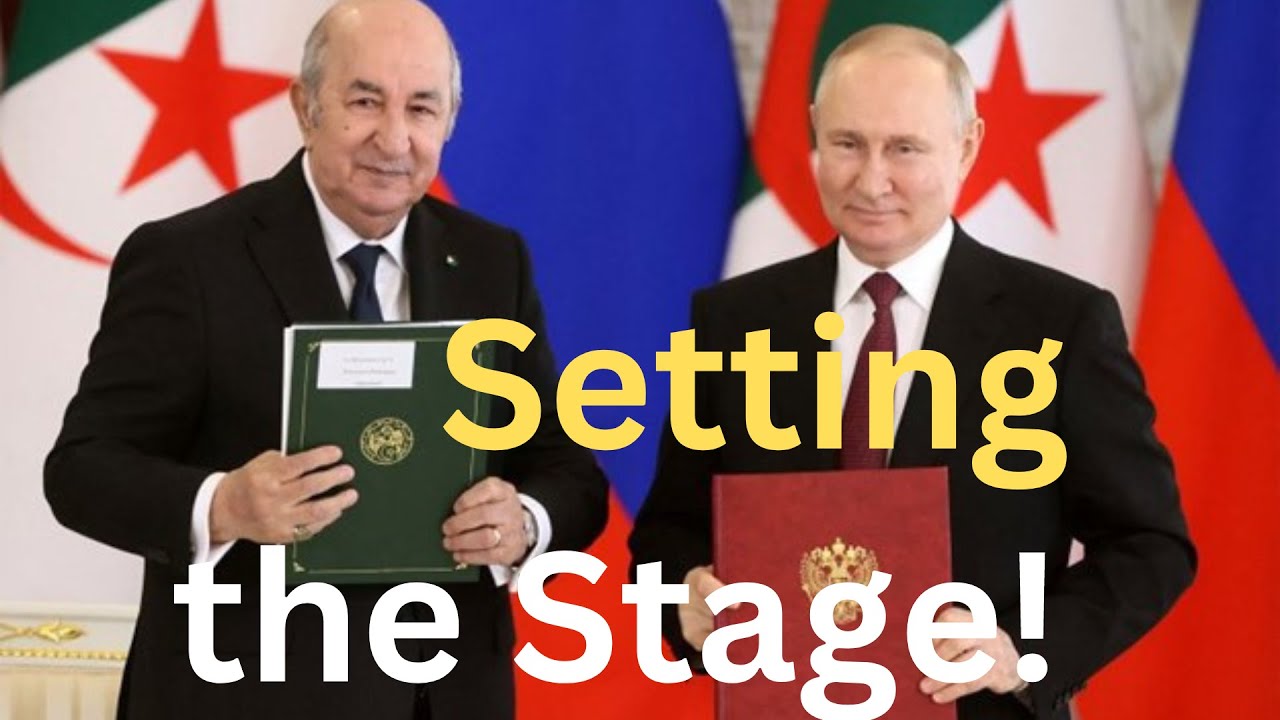
This content was created by David Oualaalou. This content was uploaded by David Oualaalou. This is a YouTube video titled "Russia's Secret Strategic Alliance!" (uploaded 2023-06-25T06:51:50+00:00). No transcript excerpt was provided; based on the title it appears to be an informational/analytical video about Russia's strategic alliances. Participants or speakers are not identified in the metadata or excerpt.
Chapters
Hello everybody and welcome to Geopolitical Trends. My name is David Oualaalou. So good to be with you as always on this weekend. Uh, very excited to be here. So, uh, what I am gonna be talking about today, just to give you a heads up, uh, I, I did just release a video on this this morning, and I'm gonna talking— be talking about the trip of the Algerian president. Now some might say, okay, why do we care about all this? There is a lot that meets the eye. And this is why I decided to do a live stream, because the setting in this will allow me to talk further by providing you the really big picture. So I'm gonna get into this, but first, like I always do, I like to extend my sincere thanks to the channel supporters and members and subscribers. And if this is your first time landing on my channel here, you are, you are welcome to our community here. And if you feel like subscribing, please do so. I also would like to give a shout out to a new member for the channel. That's to Joy Cho. Thank you so much for becoming a member. Remember guys, I am still counting till we get to 100 members. The moment we reach that number, I am going to do an exclusive, exclusive Q&A for the channel members. So, uh, if you would like to support the channel, become a member. If if you want to. And once we reach that number, we will go ahead and do the Q&A. So as I said, again, the topic today, we'll be talking about the importance— why is it important, uh, for you to know the Algerian president trip to Russia. And by the way, he was invited by the Russians. So, and what are the geopolitical implications, again, on a global and regional? There are those— I already saw a comment that somebody said, well, there is nothing of this, that there Uh, sorry, I disagree with you, and I respect your opinion, but you are missing the big picture, you know, and that's what I intend to explain here. Then there is also the idea of BRICS, why BRICS is coming into the conversation within this, and the big elephant in a room. It has to do with the arch enemies, Morocco and Algeria. Yes, there's the whole issue of the Western Sahara, which I am going to be tackling briefly here because it's a long history. So, uh, but before I always do this, I'd like to know where are you joining me from. So if you would be kind and just type in, uh, what part of the world you are joining me from. So, oh, thank you, Boon, uh, the, the mic is working. Click. Thank you very much. So yeah, when you get a chance, guys, please type in where you are joining me from. So it is what we're gonna be doing. I'm gonna be do a tour around the world. There are few issues that I believe you need to know about. Now, most of those have been covered in the Western media. I saw them overseas as well, so it is covered. It depends again from which angle. That, that's always the key to all this. So So let me start with the first one here before I'll talk about the health tip of the, of the day. Then I'll jump in into the topic of this live stream here. So, all right, let me share with you some images here because it's very important. We're gonna do this one here, the first image. And by the way, this is what I'm going to be talking about today. As I said, I released the video this morning and I'm gonna elaborate even further on what I talked about in the video here. So, so let's talk about this first one here. You know, this one pertains to— believe it or not, it pertains to Japan. It has to do with Japan. Yesterday denied President Biden's claim that it had, meaning the United States, persuaded Japanese Prime Minister Fumio Kishida Fumio, rather, Fumio Kishida to increase, uh, Tokyo's defense spending. I talked about it, you know. What I do find is, how come the prime minister is reversing course? Is he feeling the heat inside Japan? Remember, this is the reason why I do certain topics. I know at the beginning those topics might appear to you boring, maybe, or not of interest, but there is reason to why I do certain topics. And the reason I did the Japanese topic about when 80% of people surveyed, they want Japan to stay out of the China-Taiwan issue, you know. And now this was issued yesterday. Could this be that the Fumio Kishida, the Prime Minister, realizing what people in Japan are saying, uh, what are saying vis-à-vis the China-Taiwan issue and try to shift the blame on President Biden. So, and this is where, uh, I see the importance of it for you to know. And by the way, the denial came after Biden said at a reception in California this week, at the beginning of this week, that Japan has significantly increased its defense spending as a result of convincing Kishida to do so. This is what I find very— now you're going to ask yourself, who do you believe? Do you believe the President of the United States, or do you believe the Prime Minister of Japan, or you don't believe any of them? So anyway, that's what I wanted to, uh, that's the first story. Let me share the second story that I feel you need to know, which is going on right now as we speak in Russia. As a matter of fact, Uh, before I came on the air, I listened to President Putin's speech. He just gave a speech. Of course, I don't speak Russian, but I, I read the translation of his speech about what's going on with the rebellion inside the Wagner Group. You know, there are some rebellions going on inside. It's almost like Wagner's Group, about 5,000 fighters, are marching towards Moscow. You know, the big question, because to the Russians, or to President Putin, is looking at it as betrayal, and in their laws they will be severely punished. But the question we need to ask is, is this something fermented through foreign entities? I don't see that, because how would you get— if it were the case, why, why they didn't sort of create these issues when Wagner were in Africa, for example? So that's just from within, I believe. But again, it might have some hallmark of some foreign influence, uh, one way or another. So, uh, third one, let's move to the third issue here. And the third issue has to do with this. This is UK, by the way. And by the way, guys, be on a lookout for a video that I did for you about United Kingdom. Once again, there is a lot of lies coming out of government data, economic data from London. So UK, by the way, the people— and we do have some, I remember, like Jack Robert is from UK usually when he joined me here for live. So, so here's what's going on with UK inflation. It's putting millions of Brits at a risk of exploding loans crisis. Yeah, because inflation is still— the measures of the inflation still high. You know, and this come in a time where the— I, I did the research on it because I prepared the video for you guys. It will be released in few days once my editor finish up the images and so forth. Uh, uh, the Central Bank of England raised interest rate to 5%. That is a major jump. If you remember, only 2 years ago the interest rate was about, uh, I think 0.8% or even 1% or something like that. You know, that jumped all the way to that 5%. So the way I see it is that UK is experiencing the same fate, economically speaking, as Germany, as other eurozone countries. They just— governments want to minimize the impact by using certain terminology that it has a softer blow, per se, so people won't be shocked. But Brits are dealing with major inflation issues that is now translating to food prices, energy. Their factories, some of them are shutting down because they can't afford energy. So that's what I found very interesting. And the last one I'm going to be talking about is Mr. Macron, or President Macron, Emmanuel Macron. Why is this important? Once again, I made a video for you about this topic because It's not— I read the articles on it, it's not covered in detail. There are some information here and there, but I am getting to the depth of it. That's the whole reason for why I do what I do. So basically what President, uh, Macron, uh, he's accusing Russia of seeking to— and I put this in quote— to destabilize Africa. I was like, hold on a second, which is exactly what I argued in a video. Hold on a second, who's this? Who's been colonizing Africa? Who's taking advantage of Africa? You know, till today there's still some countries that been colonized by France still have to make deposits, believe it or not, on their natural resources. They make them in French franc in banks in Paris till today. And I give you a quick example, one country Niger. And if you know anything about Niger, I've been in that part of the world, I've been in Ivory Coast, and I kind of learned what their natural resources are all about, whatever. In the case of Niger, they are rich in gold, but they are seeing zero profit from it. Why? Because everything is deposited in, uh, La Banque de France, uh, French bank, or Bank of France. That's, that's where the issues But I did a video on it. Just be on the lookout, uh, for that one, guys. So let me take a look quickly to see where are you joining me from before I'll jump into the health tip of today, because we're gonna do a health tip today. Uh, Jack Robert, good to see you. Jack Robert is from England, usually join me from England here. So, uh, and, and, and I'll, I'll trust Jack, you know, he sometimes puts comments. It's like our view— my viewers in Australia, they really put it down exactly what's going on, because the government is going to want to soften the blow, per se. So because government will look bad, that's the reason why. So, uh, all right, let me see where you're joining me from. Once again, I want to say welcome to George, who become a channel's members. Thank you for becoming a member here. So Boone is here. Boone is our, uh, member, has been for a while. Thank you so much, Boone, for— appreciate your support. Raymond Lee from Vancouver. I will be in Canada next month. So, uh, Steve watching from UK. There's another person from UK, Steve. You, you are there, Steve. You can see with your own eyes. Aren't the inflation hitting food prices and energy prices? So you can see, please put a, a comment for our viewers to see it because you are on the ground. So, oh, uh, who's— oh, Valentina D from Doha, Qatar. Good to see you, Valentina. Appreciate you in Qatar. Qatar, by the way, just got a deal with, uh, uh, not Qatar, I'm sorry, that's United Arab Emirates that got a deal with Russia. But Qatar also is working now on a project with China, and I just find that out about it. So good to see you, Valentin— Valentina from Qatar. So let me see who else here. BK Zoo from Hong Kong, good to see you. Uh, Jack Rabbit from, uh, UK, from London, that is. Uh, Norian, Dr. O, any insights on Wagner coup attempt in Russia? Well, what can I say? It's, it's internal. I, I am surprised, and that's why I don't want to say anything about it till I gather the facts. I can't assume. I can't— you guys know me. I don't— even if I talk about this a week from now, I rather wait and provide accurate information than just rush because I want to have so many views. Well, I don't do that. I'm sorry, I don't do that. So this is something going on inside, from within. Because all of a sudden, for some members to take— to flip, if I may use the term— that tells me they've been, they've been influenced somehow. Is it, is it from within Russia or is it from outside Russia? I can't answer that. I don't have enough information to base my conclusion on, but I will be looking into this and I might even make a video on it. So till I gather the information, I don't like to say things. So, uh, Johansson from Sweden, good to see you. I'm sorry, couldn't pronounce that. Perhagan, I, I, I'm— I hope I pronounce it correctly. So good to see you, brother. Thank you so much. Uh, all right, let me, uh, to the sea and causing USSR I'll get to your question, Boone, about the significance of the Chinese bomber. I will, I'll get to it later on. So, and please remind me in case I forgot. So let me just see again who is joining me from what part of the world. All right, yeah, it takes a delay, guys, but, but we'll, we'll move on and we'll, uh, I'll get to it later on. So, uh, let's talk about a health tip of today because it's very important. And again, I am working on figuring out how I'm gonna either make a channel just for health tips. And once again, let me put this as a disclaimer from the get-go: I am not an MD, a medical doctor. I am, however, a, a, a, a health nut per se. I keep my eyes open on health tips and all That's for me. So the information that I use for me, I want to share it with you. If you want to use it, you use it. If you don't, no, no, no hard feeling whatsoever. So, so here is the picture, and you guys can tell me what I'm talking about here. What is that? It is another picture of the same thing, just in a different way. Let me see the answer. Can Can anybody answer here? Oh, Paradox from Singapore, good to have you. Papa Doc, I'm sorry, Papa Doc from Salt, you're absolutely correct, Boon. So I'm gonna be talking to you guys about salt, what you need to know about, uh, first of all, we start with the tables, the table salt. Why is this important for you to know? Well, it's because most of us consume— I don't consume table salt, salt, not anymore. I did before. Why? In general, in general term, salt is good for you in moderation. And here is why. Salt, believe it or not, helps the brain and nerves perform essential functions such as sending electric— electrical pulses. If you look at your brain under infrared or something, you'll see those neurons. That's basically the role of the salt, that is sending those electrical impulses. And of course, maintaining fluid balance and muscle functions. This is why, if you realize, when you get sweaty sometimes, and if you happen to be drinking something and a drip of sweat, whatever, it's salty a little bit. So Salt has to do a role, uh, play a role into that. Now becomes the question of the difference between this table salt and the Himalayan salt. Now there is a difference between the two. Table salt, also known as sodium chloride— here is where the big difference in the table salt, it is made out of 60% of sodium and 40% of chloride. And you all know what chloride is, right? So one of other factors that you need to know about table salt— that's why I don't recommend using table salt. But again, when you go to restaurants, what do you expect? They're not gonna put Himalayan salt, it's expensive for them. Table salt is heated at 1,200 Fahrenheit, degree Fahrenheit, 1,200 degree Fahrenheit. Which means what? The majority— here's the thing— the majority of its impurity and trace minerals are removed during processing. Salt has some minerals in it, that's why it's very important. But when you heat up salt at 1,200 degrees Fahrenheit, it's gone. So table salt also includes additives. Why? To keep clumps from forming. That is the reason why. That's why when you go to McDonald's, for example, or Burger King or whatever, and you use the salt, it's very soft and it doesn't— because it won't clump. It won't clump because they are adding additives to prevent that from having— from forming. So it's not as natural as it may seem, you know. Loden, and there is, is, uh Sodium is an artificial chemical used. It's added to table salt. No. And here is the thing that you need to know about salt: the danger of consumption of too much salt, because it can cause— and I'm going to just share a few things about it— high blood pressure, water retention, cardiovascular disease, stroke, kidney disease, liver damage, and osteoporosis. This is what's important about understanding what you are consuming, okay? We're talking about table salt here. Himalayan salt, on the other hand, it's slightly different. It is pricey, it is expensive. I wish I could have brought the bottle of, uh, uh, Himalayan salt that I have that I use right here, so show it to you. So, uh, Himalayan salt is mostly, uh, which is mostly, by the way, sourced from Pakistan, believe it or not, the second biggest salt mine in the world. And the trace amount in it of iron oxide, which gives it that vibrant color— that's why Himalayan salt have that kind of color. This salt, the Himalayan salt, includes minerals such as calcium, iron, magnesium, potassium, and many others. It is lower in sodium. If you think about— I mean, uh, anybody knows when you consume too much salt, your sodium goes up. Himalayan salt doesn't have that. It is lower in sodium than table salt and, uh, and, and has a lower amount of iodine on it. So So this is why, if you have a choice, do you use sea salt or Himalayan salt? Go with the latter. Himalayan salt is better for you. So, all right guys, let me jump to my topic because I got a lot to cover. This is what I'm going to be talking about for those who miss up— who missed the beginning of the, uh, introduction of the topics here. So So I'm going to be going back and forth between, uh, screens here because I have a variety of information, uh, but I am going to focus— I already did the video on it, guys, that one you can take a look at it, but here I'm going to get into the depth of certain aspects of it. So, so the visit of the, uh, Algerian president Abdelmajid Tebboune, which by the way was invited by the Russian president, so he was based on an invitation. So anytime, at least what I learned in, in international diplomacy and international relations, when a country invites you, they're not inviting you just to have a cup of coffee, you know. There is always a reason for that, and the reasons usually they are tied to economics. It's no different than this case because there are so many agreements have been agreed upon the two But there is always the other side of it, the geopolitical dimension to it. And the geopolitical one includes the military aspects of it. And this is what's at the heart of this trip, because here is what's at the heart of it. Beside the military sales of, uh, the sales of military hardware, beside economics, is oil at the heart of it. And I am going to explain— oh, I dropped my glasses. All right, what's at the heart of it? It's oil. It's because it's very, very important. And I'm going to explain, as I said, uh, what's this all about. So now, Algeria and Russia, if you go back to Soviet Union They had a strong relationship. They're still maintaining strong relationship. Why is this? Geopolitically or geographically, or geo— yeah, geographically. If you think, you look at the neighbors of, uh, of, uh, uh, Algeria. What am I referring to? I'm referring to two countries, Tunisia and Morocco. Both of them are clients of the United States. Now, Libya has always been leaning towards the Soviet Union. So is Algeria. Egypt plays both sides, as it's doing today. Egypt receives military aid from the US. It was back then, used to be about $2.1 billion every year from taxpayers. By the way, you know, I will— this— I would not agree to sending money to Egypt. You know why? Because that money doesn't end up in service of the Egyptian people. That money ends up in a private account. When I did the research about the Saudi book, you know, I had to touch on Egypt for some reason because I was talking about the Muslim world and so forth. And what I found out, that after the death of, or the passing, uh, of Hosni Mubarak, the late president, you know, they found out $30 billion in his account in Switzerland. How did the heck is president generating all all this money over a span of 30 years, because that's when Hosni Mubarak served. So that's why they're playing both sides, and because it's the military that controls the economy in Egypt, not a civilian government. This is not a topic for me to talk about right now. If you guys like me to talk about Egypt one day, I'll be happy. I am thinking about writing a book about Egypt down the road, but For now, let's just focus on Algeria. So, so this is where that issue is as to why all of a sudden the Algerian president is going to, to Russia given the changes that's going on. Well, it's because Russia wants to ensure always a foothold in Africa. Now, if you think of a country like Algeria, what is Algeria known for? Even though somebody put a comment, well, it's not a major producer in OPEC, I respectfully disagree. It doesn't matter if they are an OPEC member, that means they are producing enough oil. That's the point of it. And this is why I'm saying, the reason I wanted to do this live is to highlight to you what's at the heart of it. What's at the heart of it is oil. It's because Russia basically, by doing this, is telling Algeria, hey, we want you to know that you still can count on us. We will sell your hardware, military that is, we'll sign economic incentives with you, but in return, without saying it— Russia didn't have to say it— when Russia wants to cut production when it comes down to OPEC+, Algeria is not going to object to that. That is what the— this is what just happened 3 weeks ago when OPEC+ decided to cut production in a total by about 3.6 million barrels a day. I just looked at prices this morning, they're up. Why do you think, uh, the central bank in England raising interest rate? We're gonna do the same here soon. Jerome Powell is already the, the chairman of the, of the Fed, is already talking about, oh, I'm gonna keep interest rate high because we're noticing oil prices are going up. This is what I believe at the heart of it. And also because Algeria has been asked by Europe to provide gas. Algeria might not able to do that, conveniently or ignorantly. I'll let you think, could Algeria do that or should Algeria do that? And the thinking, you know, for you to think as an analyst, could it be that Russia wants to ensure that Algeria does not agree to, to, uh, providing, uh, gas to Europe? They're just food for that. So this is one of the key aspects of why, uh, uh, uh, uh, both the president, President Putin and President Teboun, highlighted the economic ties that they are already strong. Yeah, because they want to keep that. And as a matter of fact, I did look at some stats. Let me share it with you guys here, uh, uh, uh, between Algeria and, uh, uh, Russia. The trade between them reached about $3 billion in 2021, you know, and this is according to Algerian figures from the government. So Algeria is also the third biggest importer of Russian weapons in the world. So that just gives you an idea as to why that is. You know, there is— and this is where I believe, uh, uh, as one who's familiar with that part of the world— as a matter of fact, I just came back from the country of Morocco, the Kingdom of Morocco rather, uh, that's what I was there. So I'm very familiar with what's going on between Morocco and Algeria, and I intend to address some of it here briefly, because if I am to talk about the, the ongoing issues that I would need about 5 hours to cover all this, and we can't do that. You know, common sense suggests you can't do that. So, so basically the way I see it is that Algeria is caught between a rock and a hard place, you know, because here's the thing: the Algerian president's visit, you know, has not gone without criticism. Yeah, there already been some players around the world expressing concern and disbelief about— oh, here we see, he, the president of Algeria, received an invitation from his counterpart in Russia, President Putin, and he went. So, so some Algerian media— this is the media inside Algeria— believe that there will be ramifications for the country due to the president's un-calculated— and I put this in quotes because it's not my word— un-calculated, in quotes, trip to Moscow. Why? Interesting enough that one of the viewers of the channel put a comment, uh, will Algeria suffer the same fate as Libya? I don't see that happening, and it won't. They won't dare. Libya is not Algeria. So, uh, that just, uh, the— what's the word— the political setting in Algeria is very different than, than Libya when it was during the time of, of the late Gaddafi. So I'm not saying that the possibility is always there. I mean, look what's going on right now inside Russia with Wagner Group. Whoever thought— I, I didn't think about that would be happening, and it is. So there is a possibility. It's just so far I do not see that. And the reason why I do not see that is because, uh, when it comes down to North Africa, especially when it comes down to that part of the world— Algeria, Morocco— especially with Morocco. Morocco is a very stable country. The last thing you want, any, any issues, security or political or, or chaos, whatever, in Morocco, that's the last thing you want. Why? Because the whole region, North Africa, that is across the board beside Libya right now, you know, when you think about which country is the most stable, what comes to mind? I'll ask you that question. Which country, guys, do you think is the most stable in North Africa between Morocco, Algeria, Libya, Tunisia, and Egypt? Or Morocco, Algeria, Tunisia Libya and Egypt. So yeah, leave me an answer on the, on the, in the chat box. So, so, so this is where I see, uh, the role of this trip. What prompts me to even talk about this? It's not only from an economic side. I'm seeing the geopolitical, uh, uh, uh, dimension to it on both sides, meaning on, in Africa, but also on the global stage. In Africa, because Africa now is pushing the US out, is pushing France out, and is welcoming Russia and China. So on the global stage, you look at the dynamics that's taking place, especially when it comes down to BRICS, because now you are to talk about BRICS not for just from a regional bloc, it's on a global stage. Especially, uh, I just did a video, uh, uh, I will release it soon for you guys. I did some digging into— I was approached by a, a, a company, uh, to do an analysis for them about gold. So I did the research, I figured out what's going on and all that. And just to explain it to you here, as far as the role of BRICS, on the global stage is because the— for in BRICS, there are two steps working on right now. The first step is already done. What am I referring to here? About the establishment of the currency. The conversation about moving forward with that is already done. What is left is the second step, and second step is going to be announced during the official meeting in late— in August in South Africa, if the meeting holds place in South Africa. If not, it's going to be moved to China for fear that the arrest of the Russian president, uh, Vladimir Putin— because South Africa is part of ICC, is a member of the ICC. So even though I don't see that happening, but let's just assume the meeting moves over to China. In the meeting, I believe that's where the official announcements about the currency. And here is the kicker of all this. Now, I believe gold is what's going to back that new currency. Otherwise, how would you explain China, for example, just in March and April— March and April— China moved about 1,700— not moved, but rather acquired about 1,078— I remember the figure because I did the video on it, I did the analysis on it— 1,078 tons of gold just in March and April. So, and he moved up by about 8.9 tons of gold. You know, China's not going to be doing this just for the heck of it. Russia is acquiring more gold, Brazil is acquiring more gold. South Africa is acquiring more gold. And even I'll go as far as saying— and again, I'm thinking outside the box— I'll go as far as saying even for France. France is not a member of BRICS, but France to express interest. And here is where I will tie it to Niger. Why? Because as I said earlier, Niger is rich in gold, and all that stuff is set— is, uh, set in, uh, La Banque de France, Bank of France. So is France already thinking? Because isn't France was the one European country that is calling for to stay away from the US dollar, urging European countries to minimize the reliance on the dollar? And again as geopolitical analyst, this is where I will put the dots together and say, well, this is what it's about. So the trip of the Algerian president to Russia, yes, he talks about economic and weapons, but also with an eye on BRICS. It's because Algerian president made it clear to the Russian president that he, the Algerian president, is interested in joining BRICS. Once again, guys, look at the big picture. We already— it's a foregone conclusion that Iran and Saudi Arabia will join BRICS. What do these two have in common? Oil-producing countries, in addition to Russia, of course. Russia is already there. Then you add Algeria. Who's going to be next? Nigeria? Well, Nigeria is rich in oil. Except that corruption, of course, is massive in Africa across the board. And I don't, I don't shy away from saying this, you know, this is what's hindering progress in Africa. Africa is rich in both natural resources and manpower, but it's the damn corruption, is the damn corruption that is hindering the progress for Africans to move forward. You know, I'll say it, shame on those leaders who end up stealing from the country's resources. Those resources belong to the people. That's why, you know, I, I respect them as human beings, but that's about it. I don't regard them in high esteem, especially when you find out the amount of corruption they've been involved in. But anyway, that's a conversation for another day. Maybe I should do a topic about that right here in the US. I'll start with home first before I'll talk about other country. So why did I say— excuse me— why did I say oil is at the heart of it? No, it's because, remember, Algeria has already been asked by the EU, right? They said no, but not in a way, you know, in a diplomatic way. Well, we're gonna have to think about it because we have to ensure the capacity. Algeria maintained cordial ties with Europe. You know, because its role— meaning Algeria— its role as an alternative source of gas and oil to Russia, because Europe doesn't get now oil or gas from Russia. Once again, you think outside the box. Is this why Russian president invited the Algerian president to tell him face to face, hey, we want you to know we'll still support you, we'll provide weapons and so forth, but there is also other stuff we would like you to do. You know, in, in, in, uh, in this international affairs stuff, it's all about ensuring, uh, that you achieve your objective one way or another. Could it be this one of— well, one of them, since Russia is sanctioned by the EU, Russia wants to ensure that its client Algeria does not provide gas. And I don't think so they will be able. Why? Because there is an issue with Morocco, and I will get into it as I move forward here. So the idea that as to the weapons, well, Russia has been importing— I'm sorry, Algeria has been importing, uh, weapons from, uh, Russia. I was aware of a case, as a matter of fact, uh, uh, it's nothing classified, I can discuss it. I was asked to consider, uh, doing, uh, part of some negotiations, uh, for some, uh, transfer of weapons from Washington. Believe it or not, despite what you hear, we still want to sell weapons to Algeria. Yes, it's a client of Russia, you know, that, that, that's how it always has been. Like I said to you guys one time, and I remember I said this before, the decision after World War II was made, especially around 1952, that we, we the United States, should get involved in conflict or ensure that conflicts drag on for one reason and one reason only. Is to make money. It's because there is no money in peace. That's how they are thinking in Washington. Instead of promoting peace— I mean, wouldn't be nice? We'll have a peaceful world. This is why now you are hearing about, oh my gosh, aliens are coming, aliens are threat to our security, which is nothing but a hoax, guys. It's a hoax. Aliens are, are not interested in— what do we have to offer them? They are far ahead of us technologically by about hundreds and hundreds, if not a thousand years. To them, we are primitive. Their, their 2 or 3-year-old or 4-year-old can do complicated physics and math equations in his sleep. That's what Einstein used to— that's just ridiculous. That's why I don't buy the argument of what the government said. But the government has a reason for saying it this way, articulating it this way. Fear. Oh my gosh, aliens going to take over. Aliens are not interested in— in— in— again, what are we What do we have to offer them? Nothing. They might even be concerned about us then, you know. This is why you're saying— if you noticed, if you look at the history, I usually don't get involved in conversation on this because, I mean, yes, I can talk about knowing what I know, but again, the forum for this is not for that, in my opinion. But I have to mention certain things to put in perspective for you to understand. You know, why all of a sudden, all of a sudden we are hearing about, oh my gosh, it's an invasion from aliens, we have the threats and so forth, we have to allocate weapons in space and to confend off— what, you know, aliens are far advanced. If they want to wipe us out, they would have done it in no time. But that's not what they're interested in. So the government is fear, fear sells. You look at just what happened with the— what took place with what's going on, the health issues that just took place few years ago. You know, I was shaking my head when I start hearing, oh, the government saying this or government saying that. I knew better. I was like, yeah, yeah, Big Pharma is pushing from behind the scenes. So it's no different than weapons. As I said, I was asked to be involved and I was like, uh, hold on a second. You need to clear this with so-and-so in Pentagon and all that stuff, because I knew where they're getting into and I didn't want to be part of it. And basically what it was is for Algeria to purchase, to purchase some advanced weapons from a US manufacturer company, which is a defense contractor. I am not at liberty to disclose the name of that company, and I would not, but I was asked and I said no. It's because, again, why am I bringing this up? I'm bringing this up for you to understand. Yeah, despite what you hear, we still prefer to have the, the, the tensions that exist between Morocco and Algeria drag on. It's because it benefits us, the Americans. So Russians also looking at it that way. And Russians, by the way, think the same way. You know, without conflicts, they're not going to be able to sell weapons. That's just name of the game. That's, that's how it is. So, and this is why I am seeing, uh, about the need to understand this from a much bigger picture. So on the economic front, let me, uh, because I need— there is one, uh, particular aspect that I need to talk about. And it touches on the history of, uh, the tensions between, uh, Morocco and Algeria. Like I— before I'll get into that, like I mentioned in the, in the video, I don't know if you guys got a chance to watch the video or not, uh, beside the joining BRICS, uh, Russia also expressed interest in supporting Algeria in outer space ventures. And interesting enough is that Russia left it vague like that. So outer space, from which dimension are we talking about? Research lab, like what China and Russia are doing right now. And by the way, guys, China is, uh, moving forward in space projects. There We are very surprised and astonished by the speed by which China completed its, uh, International Space Station, are moving forward with the establishment of the research lab that they're going to be having in a joint one with Russia. And Russia has a lot of experience in space. So Russia left it, uh, open as to the space. Well, this one has to do— and I didn't mention it in the, uh, in the video. This has to do with, uh, back in 2000, I think '17 if I'm not mistaken, uh, Morocco launched a satellite and I tweeted on it. So there is a record for it there. Uh, of course at that time I just put it in general term because it was still at that time, uh, sensitive information, shall we say. Even though I am not in Washington, I'm still bound by certain regulations and laws that I respect and adhere to because that's the law. I, I respect the law. That's just how it works. So that's why when you think about the books that I publish, they have to be cleared. Now I'll give the government, the US government credit. They never dictate to me what to write and not to write. There might be something that they said, well, Doc, you, you know, you're gonna have to either remove that or because it's too sensitive. So, and I always ask for an explanation why. Well, it's A, B, and C. I can see the argument sometimes, and if it is, and I agree to it, of course, because if it is public domain, I will challenge it. So, and if it needs to be redacted, that's why I left them the way they are in the book. They are— if you ever look at my books, some things are redacted there, but just the way it is. So why am I mentioning this? Because that's how I mentioned it on that tweet. So, so when Morocco launched that satellite, but that satellite, it was built by France and Italy in a joint venture. So it was built by a company called Thales Alenia Space, which is half— not half, uh, 67% of that company is owned by— it's a joint venture between France and, and, and, and Italy. So the 67% is owned by, uh, a French technology company called Thales Group, and the remaining 33% is, uh, uh, controlled or owned by the Italian conglomerate, uh, defense company called Leonardo. So now the question that needs to be addressed or asked is, why is Morocco sending a satellite up there. And by the way, this is not a weather satellite, it's a recon. And if you know anything about recon satellites, we do have a lot, not on a military-grade level but a civilian. This one that was sent wasn't a military-grade, it was a civilian level. So because the military, military one, and even if France will send it, uh, they won't be in comparison to what we have. We have the higher, higher level, per se. Uh, uh, so becomes the question, what is the purpose of it? Well, it's because— because this one ties to the tensions that still persist between Morocco and Algeria. This is why I'm, I'm saying the trip in itself holds a significant geopolitical implication, both regionally and globally. And it works to the benefits of Russians, of course, because that will give them a, a foothold in addition to the other locations they are. They are— I'm aware of, uh, I was asked few years ago, uh, to provide, uh, some consulting services to an individual who want to do some projects in Mali. And, uh, it became clear to me that the individual wasn't aware of really what was going on. Yes, of course, the government in Mali will tell him, oh, it's okay to do this, that, but they're not going to disclose certain aspects. And at that time, there were the Russian forces present in, in Mali. This is what led— and again, this is again understanding where the pieces, uh, fell. This is why Mali asked France to get out. So could it be that been convinced by the Russians to push the French out? But French era in Africa is already came to an end, you know. Look at it just with those two countries that we're talking about, and I'm going to mention about the French colony here, Algeria and Morocco. Both of them were colonized by France. Both of them, French language is the the business, the language of business, and so forth. Well, they are moving— Algeria is moving away from it. Algeria is adopting now English. So is Morocco. Morocco is moving into adopting, uh, everything in English. I was there and I could see, uh, the, the, the structure of the French system still hold place inside the, the system in Morocco. And I think it's about time for Morocco to wash its hand of French and move on where the world is headed. You know, you're still holding to French language for what? Uh, you know, I'm, I'm not saying, well, I need to advocate for English, but no, no, no, no, you do whatever you want as a sovereign nation. But if you are to move forward, uh, along with where the global economy is going, you're going to have to upgrade your infrastructure. Well, one of them has to do with languages. You know, for, for Morocco to be still using French language is, to me, it's like, oh, you guys behind, falling behind. You better update your system here. So, and the, the, the administrative system in Morocco still follow French system, and it doesn't work. It's meritocracy. You know, you get individuals in Morocco in charge of certain things that they are not qualified. Right, you know, straightforward. You can't be sugarcoating this. It's because the prosperity of a country depends on the quality of the directors, the managers, the, the foreign ministers, the whatever, whatever. You got the idea, you know. You can't have mediocrity and expect to achieve results. And because the French system is set up in a way that has been adopted in Morocco since the 50 since independence. This is where part, part of where the problem is in Morocco. And I'll, I'll touch on this briefly here, but, but let me get to the, uh, oh yeah, let me talk about BRICS quickly here. Uh, the Algerian president proposed during the talks with the Russian president about Algeria joining BRICS. Once again, this request didn't happen in a vacuum. And the reason why the Algerian president wanted to talk with the Russian president, because Russia is a founding member, that's one. And second, Algeria is aware of the 24 countries that are lining up to join BRICS. I do foresee that if BRICS just open the door wide, it's going to be a problem. Look no further than what they have right now. You know, because here is the question, and again, I have nothing against India, I respect the country, but there is question that is now some analysts are talking about: who would you prefer to have, Indonesia or India? At least you don't have to change the name of BRICS for the I. I belongs to Indonesia as well, so But that's not the point. The point is, who will contribute more to BRICS, Indonesia or India? What do you guys think? Just leave me a comment on the chat box and I'll take a look at it. So, and this is again what prompts me to say that the Algerian president wants at least to be among those 24. You know, he's not— his request, of course, gonna have to be in return for something of value. Maybe this time comes from Russia. Who's to say the next visit will be to China? Who's to say the next visit will be to India and Brazil and South Africa? You got the idea. But again, it becomes the question: if Algeria gets in, what does it have to contribute to BRICS? You know, and you take again Indonesia, because there is a big concern in Australia, and I'm following up on it, by the way, inside the government in Canberra. There is a concern about where Indonesia is moving economically. So if, if the calls are getting vociferously louder and louder as far as, well, maybe it's better to have Indonesia than India in BRICS, I can see what the reaction of Australia is. That's just food for thoughts. It's because BRICS will have to come to a grip with the reality. If the changes on the global stage— it's moving from a unipolar to a multipolar, and BRICS wants to play a role, it better play a role based on its capability of what it can offer. It can't be just words, it can't be just talks, it has to be deeds and actions, which means every country in BRICS will have to contribute its share. Once again, I'm just thinking outside the box. The other aspects of this, why the Algerian president asked the Russian president about joining BRICS. It has to do also with Algeria's desire to reduce dependency on the dollar and the euro, because remember, Algeria is an OPEC member, which means all the oil transactions are conducted in the US dollar. This is once again, you see why when that company reached out to me asking me for analysis about the BRICS currency and gold, it became evident to me And again, that's based on my own research and information and access that I have, that I was able to put this analysis for them, uh, uh, as to where I see the gold playing the role in backing the new currency of BRICS. So could be Algeria wants to also get on with this. Is this why Saudi Arabia already declared that it will be using the yuan, Chinese currency, with China in its bilateral trade, including energy, just between the two countries, not on global trade, but bilateral trade. You know, this is also gives us a moment to think, oh, what are we looking at? We're looking at the internationalization of the renminbi, the Chinese currency, you know. And if it's backed by gold as a currency for the BRICS, you all see where this is going. So, all right, let me take a look, see if, uh, that answer is there before I'll jump on to the one of the core issues as to what's going on between Morocco and Algeria. Go, good to see you, man, as always. Uh, I did ask the question. Yeah. Oh, Naku Naima, she's saying 100% or 100 times Indonesia. Yeah, Adam saying India needs a master to bow nose to. Uh, interesting point, interesting point you mentioned this. I've read at some point in my academic career so far, I've read something about the psychology of a nation. You know, can really— is there such thing as a psychology of a nation? Can a nation be psychologically, uh, uh, uh, structured in a way that it represents an old history based on which country colonized it? You know, and I can see two examples here. I've seen one with India, and I see the other one with both countries Algeria and Morocco regarding France. And this is why you are noticing now tensions between Algeria and France. Yeah, there are major tensions. It's because we all know the atrocities France committed in Algeria, and I'm not gonna get into this, but you, you, you can look it up, guys, and check it out. Massive atrocities. So let's not— this is why This is what prompted me to make that video about when the French president Emmanuel Macron, uh, calling that, uh, uh, about France— about, uh, Russia destabilizing Africa. You know, did France forget what it did in Africa? What it did to Africans? You know, the resources that they've been taking? It's no different than what the UK did to India. And still there are gold in England that belongs to India, and yet it has not been returned. There is gold that belongs to Venezuela in the Central Bank of England, and it has not been returned. We have gold right here that belongs to Germany, has never been returned. And we got massive amount of gold that belongs to Saudi Arabia, it's still there. So my point— you got my point. You got my point. And this is where I am seeing the idea of, uh, uh, uh, thinking in terms of France can be just saying whatever when its history is a testimony to whatever it did before. So, and, and it behooves in the case of both countries, Algeria and Morocco, to rid themselves. I can't talk much about Algeria because I never been in Algeria. I am familiar with their, uh, government structure and so forth, and the language and all that. I'm familiar with Morocco. I was in Morocco. I understand it a little bit better. And also because Morocco will have to move forward. Morocco is facing some serious challenges, and I'll get into them as I move forward. So, so yeah, you're absolutely correct about Indonesia, but again, that depends again how this is going to move forward, uh, or how BRICS intend to, uh, uh, move forward into this. Now let me talk about one of the key issues of tensions between Morocco and Algeria and why you are seeing both countries, Algeria and Morocco, represent that, uh, that not a conflict but that competition among major powers Back then, before the fall of the Soviet Union, the world, as you know, was divided into East and West. When Morocco was with the West, the US, Algeria was with the East, the Soviet Union at that time. But it's still till today, the issue of the Western Sahara still remains an issue because there's still some tensions here and there. But you can't understand that till you understand its history. And its history is so long. I'm just gonna provide some snippets here and there to provide you at least a brief, uh, uh, uh, uh, or frame, uh, the issue for you to understand why this trip took place and why even for us some defense contractors wants to sell weapons to Algeria. It's no different than what we did between Iraq and Iran during the Iraq-Iran War. We were selling weapons to both countries even though we don't have diplomatic relations with Iran. We were selling them behind the scenes in return for money that we could use in Latin America in the— to find— to fight communism, uh, via the Sandinistas at that time. Reagan admitted to it. He came over and apologized, but it was Oliver North, Colonel North, Ollie as he's known here in circles, that took the fall for the president at that time. So, so let's go back to how it all started. Well, Morocco was involved, believe it or not, in the French conquest of Algeria that started in 1830. That doesn't mean that Morocco helped France, No, it was involved in supporting the Algerian resistance at that time. So Morocco did provide support. That goes back to 1844. That's how far back, you know, following the French bombardment of none other than Tangier, the city of Tangier up north, which is the tip of North Africa, across from Gibraltar into southern Spain. Of city of, uh, Algeciras. Then you cross into Spain from there. So, so the bombardment of Tangier, uh, was during the, the Battle of Isly. It's called the Isly Battle. So, so French and Morocco then agreed at that time on a border. And guess where the border took place? And I'm going to show— I don't know if I have it on a map here. Maybe I do, maybe I don't. So let me see. No, I don't have the map here for that, so I have a different map, but I'm going to share it with you later. So, so, uh, on till the Atlas Mountains, and Atlas Mountains in Morocco stretches all the way down. It's, it's, it's a long stretch of, of, of mountains there which remained, you know. And Morocco, once Morocco turned into a French and Spanish, uh, uh, protectorate, leaving the border south. Because when Morocco went in under the colony of France, it left— that border was left at that time. So, uh, it was, it was unknown. Well, the border is there, but belongs to whom at that time? So, so back in 1912, the border between the French protectorate of Morocco and French Algeria— remember French conquer both Morocco and Algeria. That's why I believe time is of the essence for Morocco and Algeria, for that matter, to get rid themselves of the French system altogether, you know. Uh, at least again, in the case of Morocco, you know, I don't know who's advising His Majesty, but time is of the essence. They need to move on with, you know, get rid of that French language, get rid of that French system in administration, you know, and build it upon merit, not this, this, this idiocy of, uh, because my last name is so-and-so or so-and-so, I'm gonna give you the position when you are in reality you are unqualified for. You know, that, that's usually a bad sign. No, but I don't know if whomever is advising the king is telling him those kind of issues or not. But that's beside the point. So, so the, the, the border between the French Protectorate and Morocco, uh, and French Algeria was extended further to the Vernier Line. What the Vernier Line was created by France, that's when it was. Then comes the post-colonization at that time, as, as it's known in history as the Sand War. So, so after Morocco gained its independence in 1956, back then King Mohammed V, who is by the way grandfather of the current, the current king, that's his grandfather, he provided— King Mohammed V provided arms, money, and medicine to Algerian FLN. FLN stands for, uh, Le Front de Libération Nationale, which is a French language for National Liberation Front. You know, those forces were waging war of independence against France. This is why Morocco was first to gain independence from France in 1956, then Algeria later on in 1963, uh, if my memory serves me well. So So Morocco also, believe it or not, that's how friendly they were with Algeria back then. Morocco also served as a rear base for Algerian insurgents to set up training camp and to recruit individuals during this period because they were fighting the French. So at the same time, back then, uh, uh, Muhammad V King Mohammed V also refused to negotiate with France over precise outline of Morocco's border with Algeria in the Sahara Desert. That's where the issue that is remaining today. And again, like I said, without knowing the history, you won't be able to understand. It is my belief, and again as somebody looking from outside in, as geopolitical analyst, that I have to understand the key players, the fomentation, or, or, or the tensions rather, of the issue here in the Western Sahara. Even though from American side it's a done deal, but there are some foreign elements that are influencing the direction of the conflict. It's no different than what we've noticed in other parts of the world. You look at, for example, Pakistan and India with the area of Ladakh, okay? That's no different than, you know, it's, it's pressure point. Uh, some, uh, some key players in on the world stage can press that button anytime. I don't see the difference with this one here in the, in the Western side. This is why sort of tensions despite there is a diplomatic relations, whatever, but tensions remain between Algeria and Morocco. So with Moroccan border with Algeria in the, in the desert has not been yet demarcated earlier because it wasn't demarcated back in 1844. It's no different than what it was in India, between India and China for the, uh, Ladakh area. So because the Brits just made havoc on it and left, they did the same in, in the Middle East, you know, colonial powers at that time. So, so this was further complicated, uh, by the popularity of reinstating the border of the Greater Morocco among Moroccan politicians. You know, Morocco, like any other country, It has its own political elites that will sort of not exert influence, but at least try to push, uh, the policy one direction or another. And this is where I see the problems in Morocco personally, as one who just came back from there. I was able to see, and I talked to people, uh, I had a conversation with people, and I kind of, uh, uh, it gives me a clear indication where things are headed because I base my analysis on the trends that I'm seeing going on in the world. So, so I'll take this back. The independence of Algeria was in 1963, but rather 1962. So my memory failed me. Anyway, so after Algeria's independence in 1962, which was about July 3rd, 1962, the border dispute remained because it led to certain scrimmages between both countries, Algerian and Moroccan, at the border area. So, and this is still the outbreak of what they called it at that time the Sand War in 1963. So this is where it becomes very, very contentious at that time, of course, with the region surrounding Tindouf And it became a big problem. Uh, of course, now, uh, uh, Morocco has agreed to establish relations with Israel. That was the key moment for why the United States recognized the sovereignty of Morocco over the Western Sahara. So Morocco has to do something to get something. It's the world of politics. So Algeria, of course, uh, didn't like that. Well, you like it or not, uh, uh, every free country, it's sovereign nations to do whatever. And Algeria's argument, by the way, was about— wasn't about that, is about making a recognition with Israel. Because most of some other countries, there is now a question looming in the Muslim world and Arab world, and the question is, will Saudi Arabia recognize Israel? That's, that's one of those. So And this is where the issue of the Western Sahara remains. And again, there are two main points you need to understand on all this. One of them has to do with the October 1963 initiative which was taken in Bamako in Mali. And there were two points to this initiative. To establish peace, that is. So one of them entails the— that the pre-war border will remain and that the border area would be demilitarized. I couldn't speak. Demilitarized. I can't speak anymore. Removing the military. Demilitarized. And this was initiated by two countries Ethiopia and Mali. So they played as the supervisor. So that is the, uh, then comes the big event of them all in 1975 with the Green March, uh, in which, you know, you get a massive, uh, population, about 350,000, march into the, uh, uh, the, the, uh, the Western Sahara. It was organized by the king, uh, the late king, King Hassan, uh, the Second. That was the one that, uh, organized that one. Uh, it was a big deal at that time. Uh, but you can tell, you know, the demonstrations of the three— not demonstrations, but the support of the 350,000 people volunteered and went to. So that is where at least to provide you a brief historical snapshot of what's going on. There is one looming issue, of course, that doesn't come to the surface, and it has to do with which— what is under that sand as far as natural resources. Yeah, including oil, because remember, Algeria is an oil producer. But also, the— there is— Morocco is also known in phosphate Morocco is one of the top oil-producing in phosphates. But, uh, at least for this issue here, the, uh, the king, the current king, King Mohammed VI, has a majority support of the population regarding this issue, and they supporting him for that and so forth. So, so that is one of the, the, the issue. Now, uh, for the Western Sahara, because this is a This is, by the way, uh, uh, the one of the largest, uh, uh, solar panel in Morocco that, uh, Morocco has built in, in, in, in the desert. It's, it's well known, very, very well known, one of the largest in the world. Uh, let me see notes on this one here because it's very important for you guys to understand the importance of it. But also, as I said, Morocco is known for phosphate. And as a matter of fact, they just got a deal, bought, uh, 50% stake, uh, in a Spanish company and expects to make about $11.3 billion from phosphate. So because Morocco produces a lot, Morocco is one of the top, uh, countries in the world when it comes down to West Bank. So, but here is one of the things about this one here. Of course, with the tensions that exist, Algeria will be sort of, uh, limited in its ability, uh, to provide gas, uh, through what's called the Gaz Maghreb Europe pipeline, uh, known as GMA in the oil industry and so forth. The idea that, uh, a couple years ago I was asked about, uh, gas for Europe and all that, and I advised to the individual who was talking to me about this that whoever is interested will have to go, uh, from the, uh, the, the Red Sea, Mediterranean, or from the Red Sea in Egypt side, but it has to go either through Libya or through Algeria or through Morocco. To get the pipelines all the way to Europe. Or another time it was like, oh no, that can't be, and here it is. Why? Because Morocco just got a deal with Nigeria to build a pipeline that's gonna import gas through Morocco all the way up. So Algeria basically, uh, sort of, uh, can deliver the gas to Spain and Portugal via Morocco because the tensions that exist. And Algeria doesn't have any other way of doing it. They can't go through the middle, through the Atlantic and go. That will be very, very, very costly. The only way to go is through Morocco and up. Well, Morocco is not going to do that for nothing, first of all. So Morocco, on the other hand, has been receiving only about 10% of its gas, uh, supply as a compensation, which is not enough because Morocco— this is why this picture comes in. That's why Morocco invested in these solar panels here, one of the largest. That's the reason why. So because they need more, and, uh, uh, Morocco has some challenges based on what I saw, and I'm going to spell them out quickly here. You know, first of all, Morocco has two things that work in its favor: geography and population. What do I mean by this? Morocco has a population, a large segment of population between 18 and 28 years of old. And what does it represent? This is the most vibrant segment of society. No offense to the older generation, and no offense to the younger ones, you know. Know, but this is your most vibrant, uh, soci— uh, segment of society. So it behooves the Moroccan governments to at least create job opportunities, needs to upgrade infrastructure, and needs to rid of corruptions that exist from within. Otherwise, there will be a problem. I do foresee a problem down the road. Once there is a problem within society, that society becomes discontent because you are lacking job opportunities. You know, you get now individuals going through the education system only to finish their education and there are no jobs for them. Well, it's a problem for the government. Why? Because the government is focusing on some other issues that haven't— they don't translate to average Joe, average Jane in Moroccan society. That's one issue. Second one, as I mentioned earlier, Morocco has to get rid itself of the French system because the French system doesn't work anymore given what's going on on the global stage currently, economically speaking. In other words, Morocco will have to sort of go parallel with where the world is going. You know, get rid of French, okay? Get away— get rid of this meritocracy system of appointing individuals who deserve based on what their qualifications, their knowledge, and their ability to articulate what the problems are. You know, if you don't do that, you, you're bound to just chase your tail, basically, as we said. Then the third element, you have to get rid of corruption that exists within the system. You know, and I'm not pointing fingers at Morocco. Every country has corruptions. We have corruptions right here in America. And as a matter of fact, I'm even thinking about doing a live stream one day about how deep this corruption is and who is behind it. So I might do this one day. But, but till Morocco do this— because whomever is advising the king, of course telling the king, uh, not what the king wants to hear, but they have to say the good news. In other words, they are cherry-picking. And you know how a good leader can tell the people that working with him or for him or with her or for her is by how honest they are. They don't need to sugarcoat things. You ask a question, you provide an answer. And I have an— I had an experience here in the US with some high-ranking officer one time when he asked the question and I gave him the answer and didn't like the answer. I was like in the back of my head I don't give a damn what you think. You know, I worry about the welfare of my country. So if you want me just to tell you what you want to hear, I'm not your guy. And of course I didn't say it that way. I was, well, sir, this is where most analysis points based on your question. Well, Mr. O— I didn't have the PhD at that time, so— and usually because they will address you as Dr. So-and-so. And I said, well, sir, no. This is where it's going. This is again based on the data that I looked at, the analysis and so forth. And it was like, well, we can think of it that way. And I said, you know, I respectfully disagree, sir. You know, later on come to me and say, well, I didn't mean it that way. And in the back of my mind, but I did say it because I wasn't working for the guy. And I said, no, yes sir, you did mean it that way because I don't work for the guy. If you got an issue, take it with the boss in the White House. That ain't my problem because I look for the welfare of the country, not your political career. And this is the problem that exists, I believe, in Morocco based on what I saw. And I can just tell, so they need to have whomever is advising the king tell him exactly what the truth is on the ground. This to me where honesty comes in. Then you have the big elephants in a room which Moroccans themselves do not even know. And this one has to do with the financial health of the country. Morocco is facing serious financial problems come 2027 and 2035. Why am I saying this? I'm saying this based on the data that I research, and it's pointing exactly to retirement funds. This is no different than what Canada is experiencing. Canada is going to run out of the funds in 15 years. This is why Canada is opening immigration. No, Japan might be running into the same issue. Morocco is no different. As a matter of fact, by '27, Morocco will need to put about $1 billion— needs to put $1 billion into the coffers of the pension funds, otherwise retirees won't be able to get their money. And if this issue is not resolved, resolved by 2027, It will get worse by 2035. And this is why I'm saying, whomever is advising the king, you better advise the king on issues that can translate to the population. You know, building some monuments and all that, that's ridiculous. It is ridiculous. You know, it's the economy that creates prosperity, and when you have prosperity, people benefit. When you have people benefiting, you have security. When you have security, you have stability. That's how it works. So until Morocco does this, I don't see anything changing. So, so this is basically the big picture of what's going on between, uh, why Algerian president went over to, uh, Russia, because you needed to understand the background of this. Now at least you know the reason why. So anyway, let me go check the questions here, and I'm gonna take one question or two, and I am gonna take off, go finish up some stuff on the garden. By the way, uh, I'm gonna— next time I'll do a live stream, I'll share some videos with you, some pictures, not videos, about some veggies from the garden right here at home. So, all right, let me have my reading glasses. By the way, guys, I want to say thank you for your kind words, uh, in response to the posting that I post for the community, thanking you for watching the live streams, and I truly appreciate it. So, okay, let's take a look, see Who is from— who is joining me from beside of what I mentioned before? Then I'll take a look, go all the way up and check out one question or two before I sign out, or signed off rather. And once again, truly appreciate you guys. And, uh, and be on the lookout, be on a lookout on, uh, 3 videos. Yeah, be on a lookout on those. One of them has to do with the gold and currency that the company asked me to do analysis for. One of them about the French president's statement that Russia is destabilizing Africa and the global order and all, which is hypocrisy. And one of them is, uh, what was the other one? I already forgot. Do you believe that? Yeah, I forgot. It'll come to me, it'll come to me. Uh, yes, yes, I remember now. It's about Bank of England, how England economy, UK British economy, it's going down, is faltering despite what you hear and read. Mike, my word, is faltering, and it might even be on the verge of collapse. Yes, and Sunak, the Prime Minister, idiot, incompetent Sunak, is going to Ukraine and pledging more billions of pounds and all that stuff. So, all right, let me go back here and see. Okay, let's take question from Yvette here, from Yvette from New York, if I'm not mistaken, right? You know, question: how does the greenhouse effect factor into war versus Russia? Oh, that's an interesting one. I don't know, I can't answer that. I, I, you know, climate change and all that hoax stuff, that's no different than aliens gonna invade Earth and all that. I don't buy— yeah, I'm sorry, Yvette, I can't answer that one. I, I really— because it's something, uh, I don't know much about and I can't speculate. And second, I know as one who worked in Washington, when Washington pushes certain narrative, I always knew the reasons for it. And it starts always with fear. You know, this is the exact— if look around, look around about, uh, even, even some are doing videos about, oh my gosh, aliens gonna invade the Earth, whatever. They, they just don't understand. They don't understand the machine. Of the government, that is, unless they are doing the videos because they want numbers and all that, which is, to me, it's, you know, what comes first, quality or quantity? You decide based on what you want. So, so I'm sorry, I cannot answer that question. So let me see if there's another question here, then I am gonna, uh, uh, oh, here is one from Sari. Question: How does Israel factor in the Algerian-Moroccan conflict? Big deal, big deal. Morocco, by the way, guys, just for you to know, uh, Moroccan Jew— there's a lot of people do not know— Moroccan Jew are the most influential in the world. You know, there are a lot of Jewish Moroccans and there are a lot Jewish community, uh, in Morocco. And, uh, uh, yeah, and the Moroccan Jew, as a matter of fact, one of the member of the Israeli, uh, the Israeli Knesset, like the equivalent of parliament, is of Moroccan descent. So yeah, it's, uh, uh, Israel will support Morocco one way or another. So that just because that's how it's always been, and especially now that we— Morocco got a deal with, uh, recognized Israel, that is. That, that's how I see it. All right, let me go back up here and Uh, uh, see if there are any other question. And once again, guys, just let me know the topics you would like me to address in a live stream. Uh, and I am even debating whether to do two live stream for you during the week. So, uh, I can, I can say more on a live stream, that I, that I do on, uh, on, on a video, because the videos, the recorded, I like to keep them short, to the point, in— but live stream I can elaborate more. Yasser Nasser, uh, Dr. David, you are right again. Thank you very much. I don't know what it was about because I couldn't tell from here, uh, but I appreciate it. So, uh, uh, Kocho Hoy from Malaysia, as always. Yeah, here's Koy from Malaysia. Thank you for your support, I truly appreciate it. So, okay guys, I don't see any other question here, so I'm gonna sign down now. There is one, uh, uh, no, I don't see here, I don't see any question. Uh, oh, that is an interesting, uh, question more. You mentioned too many Western military bases in Niger Republic. That's a good— I'm glad you brought this up because, uh, I have information that I didn't get a chance to make a video on, believe it or not, and it has to do with NATO in the Sahel area. If you guys would like me to do a video on it, I'll be happy to do it. So just, just leave me a comment, say like, yeah, please do the, uh, just remind me, do the video on NATO in the Sahel., and I know which one you're referring to, and I'll be happy to do one. And yes, there is the presence of NATO, and this is why you are noticing what France is saying. France is not saying that in a vacuum about, uh, uh, Russia is destabilizing Africa, because as I said earlier, Mali kicked France out and other locations in Africa are kicking France out too. So, so France era in Africa is gone. So this is why Morocco and Algeria, they better move on with getting rid of the French system altogether. So, okay guys, I hope you find this live stream very informative because I don't like to waste your time, and I would never waste your time. You have my word on it. Once again, just watch for those 3 videos, and as always, remember, geopolitics impacts your daily life. In more ways than one. Till next time, guys. Bye-bye.
More from David


Beyond the Single Actor: Why the Gulf Isn't Choosing Between the US and China


Iran, Iraq's Militias, and the Houthis Are Coordinating! This Changes Everything




Who Controls the Next Decade's Resources? Latin America and Africa's Geopolitical Crossroads

The Chokepoint Trap: How Washington's Stupidity Triggered a Cascade That Now Controls the World

Trump Spooked as IRGC Unveiled dual-use SLV, Deployed Ghadir Mini-Subs & Hinted at Tactical Nukes!
