Saudis Roll Out Red Carpet for Xi’s Visit as the US Watches on!
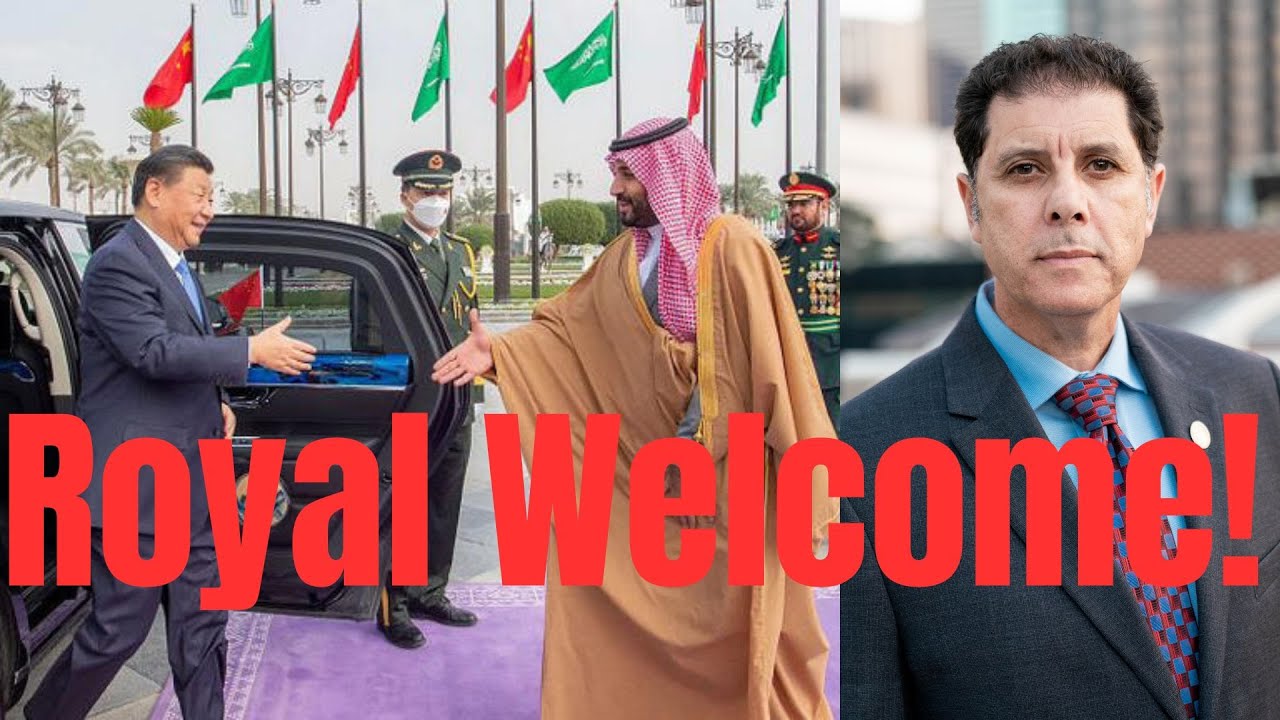
David Oualaalou analyzes Xi Jinping's visit to Saudi Arabia, where the countries announced $30 billion in deals including Huawei technology cooperation and guaranteed oil exports to China. The visit signals Saudi Arabia's shift toward Beijing as the U.S. focuses on Asia, with potential Saudi membership in BRICS and Chinese involvement in Gulf infrastructure projects like NEOM.
Chapters
Hello everyone and welcome to Geopolitical Trends. My name is David Oualaalou. So good to be with you as always. Chinese President Xi Jinping is on an official visit to Saudi Arabia. What does it mean when it comes down to a global geopolitical landscape? In this video, I'm going to provide you some insights and also a brief analysis about what it all means moving forward, you know. But before I'll dive deeper, make sure to subscribe if you have not done so, and also check out my new membership because I will be doing some live Q&As for, for some members if you are interested. So, and as always, thank you for your support. So, so let's dive in into this I will use the term fascinating topic, no. President Xi is already in Saudi Arabia, and basically what I found very interesting is that how President Xi's statement that he already mentioned that he held the Saudi Arabia's visit with sort of a new political and trade deals that is worth about $30 billion. So basically, President Xi sees the visit as a new era in the Saudi-Chinese relationship. So a new era, that's usually in, in, in the world of politics, it's a very measured and calculated word. When you say about a new era, you're looking at developments, you know, cooperation forging a new path of partnership, that is. So, well, as I said, uh, there are some deals worth about $30 billion between the, the two countries. And, uh, of course there is the political and the trade deals that comes with both. And the interesting aspect about all this is that given with what's going on on the global geopolitical landscape, of course with the Ukraine conflict still going on, the shortage of energy in Europe, the inflation on the global stage, the hike in interest rates. All this plays a major role in understanding how the— first of all, in understanding why the Chinese president decided to visit China at this time, and also what could it indicate to you moving forward. Because like I always say, always watch for trends. What am I referring to here? I'm referring to the idea that— it's not just the idea, but the possibility of Saudi Arabia joining BRICS next, uh, next year. BRICS: Brazil, China, India, Russia, and South Africa. And we all know, and I've talked about this enough, about the impact it's gonna have into that. And when I move forward into the discussions here, I'll provide you a key analysis that I am very familiar with due to my own research and my dissertation topics that I talked about and so forth. So I'm very, very familiar with Saudi Arabia or the Middle East writ large for that case. So the two leaders, the Saudi Crown Prince or Saudi King at the time, of the signing of the ceremony, King Salman and the Chinese President Xi signed a comprehensive strategic partnership agreement. And here's the interesting thing about what's involved in that. Well, what's included in that is tech companies will be involved, technology that is, and also the Chinese is gonna be helping the Saudis now with technology, including the Chinese company Huawei. Yeah, Huawei is gonna be building the iCloud's technological advancements for the kingdom, that is. And of course, the agreements secure now Saudi Arabia's crude oil exports to China. As you may know, you may or may not, China is number one importer of the Saudi oil, believe it or not. So Saudi Arabia sent a lot of oil to China. So, and of course, for China being the world largest crude oil importer, it relies heavily in on Saudi Arabia, and it makes more perfect sense. You want to forge the ties with the country where you get most of your energy from, you know, and because China pays billions and billions, billions of dollars to the Saudis for that. The other aspect that is very interesting about Chinese President's visit is that the meeting he's going to be attending, I think tomorrow, with the GCC, the Gulf Council Cooperate— no, the Gulf Cooperation Council, GCC. So those Gulf Arab states, what they are known for is they have massive oil, so energy. Of course, because China has built some infrastructure for, like, for example, in Dubai, you know, in United Arab Emirates as well. So, and all this It comes in a time when you have to think about it from a global perspective. It comes in a time when some Gulf Arab states are trying now to reconfigure their foreign policy as the United States now is shifting its attention from the Middle East into Asia. It's a— you can just see the writing on the wall as to what the Gulf states might be thinking. So Of course, this comes at a time also when there is a price cap on the Russian oil. So, which by the way, even though the European Union agreed on it to cap it at $60 a barrel, if I'm not mistaken, uh, what do you think Russia is gonna do, just sit idle and watch? No, what they're gonna hit with, or they hit back at the European Union by just stopping the flow of oil altogether. And you all know what it means. It means that the global output of oil is going to decrease and oil prices are going to shut up. And basically OPEC+, which is basically Russia, has just agreed with OPEC, the oil-producing exporting countries, that it will be no increase in production anytime soon. So you can just see where this is headed, basically. So There is the other interesting aspect is about the Crown Prince of Saudi Arabia, Mohammed bin Salman, known also as MBS, you know, because he was the one who hosted the Chinese president. But of course, when you think about MBS, you think about his reason for really being excited about the visit. Why is this? Actually, both of them, MBS and President Xi. And I'm telling you, I'm going to tell you why for each one of them. So for MBS, hosting Xi basically boosts his own international profile. That's for the MBS, that is, after being linked, as you may know, to the killing of Jamal Khashoggi, who was a Washington Post columnist. Of course, this is what creates one of the tensions between Central Intelligence Agency and Prince— and MBS. So they don't, they don't get along. And the reason being is this: the previous prince, Crown Prince Mohammed bin Nayef, had a good relationship with the Central Intelligence Agency. MBS does not. Well, the reason why, because the CIA was able to tap into a communication that proves that it was the MBS who ordered the assassination of Jamal Khashoggi. So from that time on, the relations have never been the same. And the other concern that the United States has is that MBS, who's only about in his mid-30s right now, most likely, and I am sure he will, take over the power when his dad passes away, when his dad dies. And basically what the West or what the United States is expecting is that it will be expecting MBS to be in power for the next 5, 6, 7 decades because he's very, very young. So for Xi, President Xi, that is, the trip to Saudi Arabia is to restore— and get this, guys— is to restore his global profile after most likely spending— not most likely, but he spent most of the pandemic years inside China. No, what makes it also interesting for Xi, President Xi, is that he just won the— or been granted a third 5-year term as a leader in October. So, but even with that, now given the, uh, the demonstrations that's going on in China regarding the, uh, zero COVID policy, which by the way, I just find out they are loosening up a little bit, but it will backfire on the Chinese government if they don't take care of this. It's because it's harming the economy and people's gonna have to at some point sort of make it clear to the central government that they need to reverse course. And I think it will be a smart idea for the government to do so. So So as I said earlier, President Xi is expected to attend the meeting of the GCC, the Gulf Cooperation Council. So beyond the oil purchases, China, of course, is known for its infrastructure construction expertise, you know, because here is the deal that I see it in the works, is that China could tap into the Crown Prince Mohammed bin Salman's planned $500 billion or €472 billion into his futuristic city of NEOM, which will be on the Red Sea. Whether it's gonna work or not, it remains to be seen. That's quite a substantial amount of money for that, so. So here's my brief analysis, just to give you, as somebody who wrote a book about Saudi Arabia, uh, and I did devote a section in the book about the Saudi-China relations. So I kind of know something about, uh, where this is headed given the President Xi's visit. So, so it is important for us to note that the China-Saudi relations is for convenience and reciprocity. And why is this? For two main reasons, or two points. So one is economic, and second is geopolitics. That's just common sense. Saudi Arabia realizes that the shift of wealth from the West to the East is already underway. So as a result, Saudi Arabia choose to preposition itself, uh, for maximum benefits from the economic boom, uh, that is anticipated in Asia soon. It is already there in Asia and headed or led by China. This is why Saudi Arabia wanted to join BRICS next year. And as a matter of fact, there is a conversation which Western media is not talking much about about the possibility of Saudi Arabia joining SCO, the Shanghai Cooperation Organization. So this also explains why Qatar— you know, somebody has helped me pronounce the word— why Qatar has cut a deal with China regarding the energy deal for 27 years. And I did a video on this one here, so So Saudi Arabia's pivot towards China is driven by the political shift taking place also in the Middle East, as much as it is driven by economics, you know. Well, because for economics there will be opportunities for Saudi Arabia and they don't want to, they don't want to miss. This is again why Qatar jumped on the deal with China and ignored Europe, as I mentioned in the video. So, so, all things being equal, Saudi Arabia's oil richness, of course, is one of interest to China. Why is this? For fueling its growing economy. Even though there is a slowdown, don't expect the Chinese economy to go very, very, very low, and the consumption of energy is one of the fundamental pillars on which the economy stands on. So, so as a result, this is why China decided to increase its economic cooperation with Saudi Arabia, for one reason and one reason only, is to ensure access to energy, in addition of course to expanding cooperation in defense and other areas. Yeah. China is helping Saudi Arabia on certain missile technology. So, so, and here's the thing also you need to know when you think about the global geopolitical landscape, you also have to think about this is not about just China but also Saudi Arabia. So Saudi Arabia, consider two main points, and again, because I did the research on this topic, so I'm very, very familiar with it. So First is that China's increased presence in the Middle East will significantly shape the region's political and economic trajectory moving forward. That's one of the things that Saudi Arabia, it has been thinking about. So second thing is that China and Iran rapprochement could and would hinder Saudi Arabia's ability to play an influential role as it once did in the Middle East, or in the regional affairs for that matter. So, so that influence in itself is already faltering, you know, as— because for Saudi Arabia, if you think about it, if you know the history of how it works and all that, Saudi Arabia's role today in the Middle East is not what it was 20 years ago before 9/11. Things have changed now, and this is why they are concerned about— because the influence that Saudi Arabia played one time now is faltering, uh, and key players like Iran, like Turkey, like even Israel, so, uh, are taking notice of all this. So also major powers realize that Saudi Arabia's ability to influence events on the ground in the Middle East is becoming more and more limited. This is why the West, at least in Washington, uh, they are paying close attention to the Chinese president's visit to Saudi Arabia because of what it will mean moving forward. And this explains also why United States went ahead and— Congress, that is— and approved the defense budget for next year. I will do a separate video for you guys within a day or two. I'm just waiting to confirm some information before I, I get on the air like I always do. Yeah, sometimes I might come on the air after certain events have happened but also I do due diligence to make sure the information is as accurate as possible to the best of my knowledge. So, so here is my question for you for today. What will become, in your opinion, of course, what will become of China-Saudi relations? Will it flourish or will it be undermined? Let me repeat the question: what will become of China-Saudi Arabia's relations? Will it flourish or will it be undermined? Make sure to let me know what you think. And as always, remember, geopolitics impacts your daily life in more ways than one. Till next time, guys. Bye-bye.
More from David


Beyond the Single Actor: Why the Gulf Isn't Choosing Between the US and China


Iran, Iraq's Militias, and the Houthis Are Coordinating! This Changes Everything




Who Controls the Next Decade's Resources? Latin America and Africa's Geopolitical Crossroads

The Chokepoint Trap: How Washington's Stupidity Triggered a Cascade That Now Controls the World

Trump Spooked as IRGC Unveiled dual-use SLV, Deployed Ghadir Mini-Subs & Hinted at Tactical Nukes!
