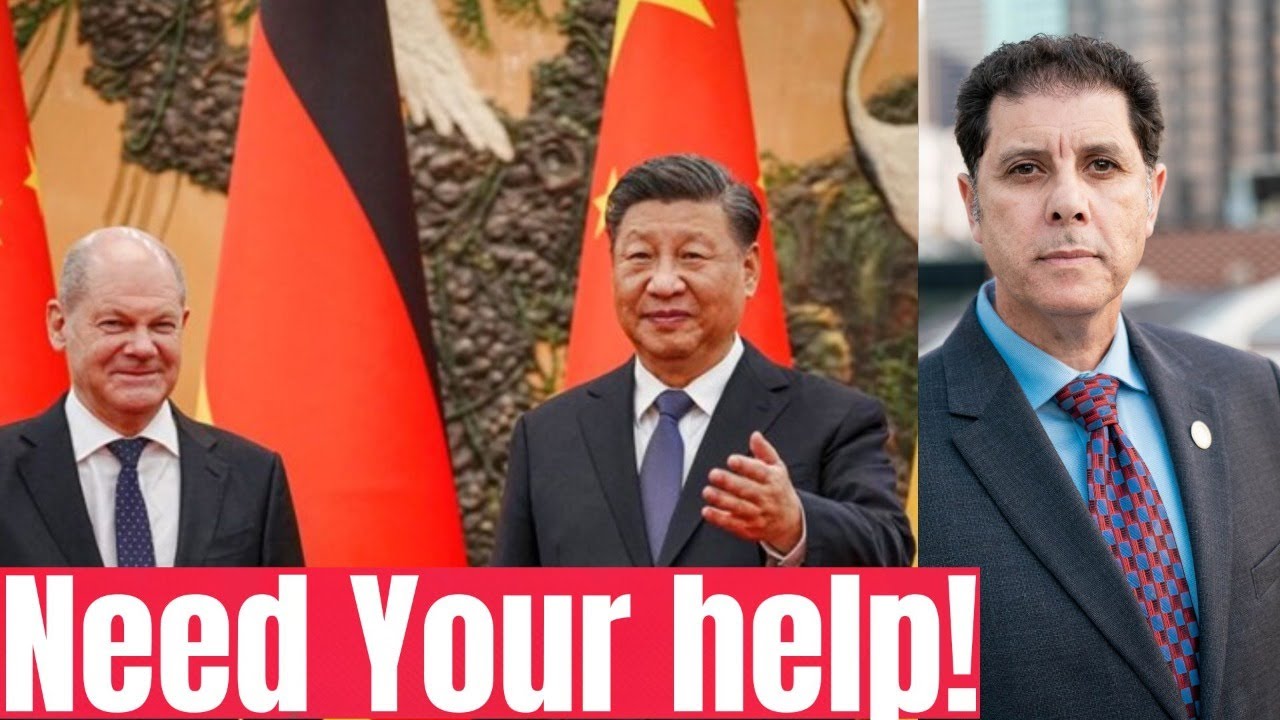
This content was created by David Oualaalou. This content was uploaded by David Oualaalou. This is a YouTube livestream (title: "Scholz Visits China as German Economy Crumbles!", published April 16, 2024) featuring a single host (identified in the transcript as SPEAKER A) delivering a live commentary on German Chancellor Olaf Scholz's visit to China. The host analyzes economic and geopolitical implications—German economic troubles, China-Germany auto/EV deals, EU protectionism and tariffs, US influence/NATO, sanctions on Russia, and optics of Scholz's reception in China—and engages with a live chat/audience (naming several viewers, referencing guests such as Larry Johnson and a contributor called Boone). The format is a monologue-style live talk with Q&A from viewers and mentions of upcoming interviews and donation links. Language: English. Content type: YouTube live commentary focused on geopolitics and economics.
Chapters
Everybody, and welcome to Geopolitical Trends, where truth matters. Very excited to be with you as always. Got an interesting topic for you today. We're going to be talking about, uh, German Chancellor, uh, Olaf Scholz's visit to China. It's going to be for 3 days. He's already there, arrived I believe on Sunday afternoon. I was going to do this on Monday, yesterday, but I decided not to because I had to address the Iran topic for you. So, so today this is what I'm going to be providing you, some insights and link it to some videos I made way back, some 7 or 8 months. I have a link to one of them by which China decided to drop the auto deal for Germany. So now that begs the question, which we're gonna put it there in the questions that I'm gonna be addressing for you. First, let me say hi as always to many of you. Uh, Willie Holman, good to see you as always. Taiwan Steel, as always. Muslim Revert, as always. And yes, and I agree with you on your statement. Uh, uh, who else? Muslim Revert. Oh, there's the couple, Ron and Julie Holiday. Good to see you there from down south, I guess. David King, good to see you as always. John Smith, Camp 35M, good to see you. Timeline Dunkley, Uh, Reynold Lazaro, William N, good to see you as always. Karakulak, good to see you. And Pika— Peekaboo, rather. So good to see you as always, guys. Very, very excited to be with you. All right, let me— today I don't have headlines, I don't have a history or geography. We're not going to do that. We're going to get into this because it has economic dimensions to it. Of course, the geopolitical aspect, given that Olaf Scholz, you won't believe it, he is wanted to pressure China to convince Russia. So it just doesn't make any sense. And to me was like, wait a minute, wait a minute, are you, Olaf Scholz, going to Germany for your own interest, for your own country, or are you to push the, the, uh, the, the Western agenda as a whole? Which, by the way, it was the West that created the problem to begin with. Regarding the Ukraine thing. So what we're going to get into this mainly is going to be the focus on the economic aspects, given how the German economy is crumbling. Uh, I wish Boone was here because he is in Germany. He'll be able to sort of corroborate some of the information I'm going to be sharing with you. All right, let's ask the questions, the key questions, that is, that I believe. Here's the first question: Is Germany Now that Olaf Scholz is there, he's going to ask China to reconsider its auto deal. And this one, I did a video on it about 7 months ago. I have the link for you. As a matter of fact, let me put it up before I forget. Uh, I saved it for you guys so you can have access to it later on if you want. Uh, copy hyperlink here. I'm gonna put it in the chat box for you guys. You can look it up later on, uh, if you choose to. I did it on YouTube here 8 months ago, and, uh, it was, it was like a big hit. It got a lot of, lot of, lot of feedback because both the EU and Germany was shocked that, that China made that decision back then. So, all right, the second question is, is Germany seeking help from China at the expense of the EU member? Because remember who was in China just a few weeks ago? It was the US. Why did, uh, Janet Yellen went over there for? To beg for money. Now why is Germany going there for? It's because their economy is crumbling and they are concerned about now that the Chinese EVs, electronic, uh, vehicles, that it's gonna dominate the market. If it dominates the market in Europe Well, which market are we talking about? Is going to dominate the market in Romania? In Bulgaria? No, it's going to be Germany. So is the German Chancellor's trip for this reason? Third question: what will China do now? Will China acquiesce to Olaf Scholz's requests, or will China stand firm by saying Sure, we can collaborate if you kind of change your approach to the tariffs and sort of the restrictions that now Ursula von der Leyen is putting on, on, on, on the Chinese, uh, uh, products. And the fourth question, which is the key, believe it or not: will the US approve of Germany's doing? Because remember, only a few years ago we threatened to sanction Germany if if they want to head with the Nord Stream 2. So those are legitimate questions we had to ask because you have to put it within this context of what it all means. And then, then we'll move on with our conversation. Prepare your questions because I'm going to answer a few questions for you at the end. Then, then we'll just go from there. Uh, by the way, don't forget to join me tomorrow at 12:30. Usually that's when I do the live streams. Today is different. Uh, tomorrow I'm gonna be having a part 2 conversation with Larry Johnson, so make sure to join me tomorrow at 12:30. So before we do this, let me share a screen with you as far as, uh, Olaf Scholz's arrival. Why is this important? It tells the story right there as to who was welcoming the German Chancellor. Yeah, he wasn't some high-ranking official from Beijing. He wasn't President Xi. He was not the Foreign Minister, Mr. Wang Yi. He was, I believe, the mayor of the city. But I found it very, very interesting. So, and I'll let you decide for yourselves. And I know there is no sound on it, but it won't matter. And I just want you to see, this is the mayor from the city. That was his work. There was no high-ranking official from the Chinese government, which says what? I'm gonna stop it right here, guys. It says a lot. Why? Like I always say, in international relations, context matters. The fact that he is the chancellor, the equivalency of a president basically, because German system, you do have a president. Of course there is a president. I think his name is, uh, uh, uh, Stoltenberg, if I'm not mistaken. Anyway, it doesn't matter, but his pre— the president of Germany is a, is a figurehead. Is the chancellor, that is the, the, the person that takes care of the government, running the government. So the fact that he's the equivalency of a president, and yet he was a mayor of a city that met him, that says the story right there. It was the same approach when Janet Yellen went over as Secretary of Treasury. So, but again, just the optics of it. So the idea that, uh, uh, his trip at this time? What for? Right after, right after Janet Yellen went over there. So, but of course, the Western narrative is going to be that, oh, Western allies are putting pressure on, on, on, on, on China. So, and this is what Olaf Scholz is expected to do. He is expected to underline the European expert rejects for decoupling. Well, decoupling, which by the way we heard it a lot, now you don't hear much about it. It's because, simple as that, the Western world came to realize that you cannot decouple from China's economy or Chinese market. You'll sink yourself into a big hole, economically speaking. Why? Because most of the goods are made in China, not in Europe. And they are cheaper and they are affordable. So, and this is one of the interesting aspects that I found, uh, the German Chancellor is talking about, is the idea that, uh, here is a visit here to, uh, upon his arrival here, sort of, here's the thing Will the friendly overture now towards China from the, the Germans, will that spark now the ear, uh, from Washington and other European partners or EU members? Why? Because like as I said earlier, was Olaf Scholz, or is Olaf Scholz's trip to China for Germany or is it for the EU? What do you guys think? Please just leave me the answer in the chat box and I'm gonna take a look at it because it's very important. If you look at the trends and history, uh, uh, what's his name, uh, French President Emmanuel Macron made the same arguments and he traveled solo the second time, I believe, to China. Why? Because he wanted to push for the interest of China— of, uh, France. What happened to the EU? What happened to the unity? What happened to the Western collective, uh, sort of marching together on the same tune, economically speaking. It shows you the crack and the disagreements exist from within. So let me just see your answer quickly here, guys, if you could. Uh, yes, it was the, the vice mayor of the city that met him. Now, yeah, you're absolutely correct. Yeah. Okay, yep, you're saying for the EU. Uh, EU is a beggar. Uh, Jane Juan, you're saying for Germany first, then EU later. I see the logic of— I see the logic to that. Melgon, you're saying for the EU. Yeah, I personally will say it's for Germany, but again, that's just my personal opinion. Why? It's because the German economy is crumbling. There are economic, uh, uh, uh, economic analysts, or yeah, economists rather, or analysts, whatever you want to call it, you know. They are stating that the German economy is in a recession. It's just not been coming forward to that. So, and this is when I came across, uh, uh, uh, an article. It was, uh, written by Andreas Rink. I give credit to the author, and I read it. There were some valid arguments, some valid points into it, and I'm gonna get into that as I move forward. So, and this is where now the European country, the EU— when you say the EU, we're not talking about the whole, uh, uh, uh, members. We're talking about France, Germany, and the key, the one that matters. So they're saying they've been pushing back against Beijing's subsidies for industries? Well, their country, it's because they're moving forward and the European couldn't catch up with the Chinese. So do the Americans, we couldn't catch up with that. And this is what that article came in. And, uh, the picture you guys seeing, uh, I have a picture here, I'm gonna share it with you. Uh, this is when Olaf Scholz visited. I give credit, by the way, to Reuters, uh, uh, for the picture there. Uh, Thomson Reuters, that is. This is when the German Chancellor visits the research projects on the monitoring of water quality in Chongqing. If I pronounce it correctly, please correct me if I mispronounce this one. I would greatly appreciate it. Chongqing, that's where he went there. So And the whole idea of that Olaf, Olaf's trip, based on the article written by Andreas Rink, uh, that the German chancellor is thinking in terms of what do I do now to ensure that the German economy survives, because it's crumbling, it's crumbling because of the sanctions that the US imposed and the German had to go along against Russia. Now that they don't have access— they, Germany, that is, doesn't have access to energy. And that in itself has contributed to shutting down industry— pardon me, industries in Germany. So what's left? Eastward, China. We're gonna have to go to beg for money in China. Yeah, of course it's not going to be stated in articles coming out of Western media that the German chancellor is going to beg for, uh, China's help. This is what I put in the, in the thumbnail. As I always say, guys, usually my message is always in the picture with the word in there. So, but the key to all this, as I mentioned earlier, is the article that I, uh, not an article, rather is the video that I made about 7 or 8 months ago by which China dumped an auto deal with Germany. Shut down everything. They were shocked, meaning Germany and the EU were shocked at that, as to why all of a sudden Germany— uh, China will sort of drop the deal. Now, I won't be surprised that probably during— I'm not— I don't know what went through the conversation between President Xi and the chancellor. But if I am to guess, it would be some sort of a hint into request from Germany for China to reconsider that deal, because that deal was worth a lot of money. So, and this is why, uh, uh, even Europeans, which is the same narrative the US said Do you remember what Janet Yellen said to the Chinese about overcapacity? Is the same arguments Olaf Scholz has made. He stated it on the record and makes you wonder, was the trip approved by Washington to China? Yeah, I will go as far as saying that. I know to some this might be a little bit out of out of line because Germany is a sovereign state. No, it's not. It's a sovereign state on paper. So, and this is why the European Union is pushing, uh, uh, to act out, uh, as far as protectionism, which is what, uh, Ursula von der Leyen just stated yesterday. And Olaf Scholz has to retract that statement by Ursula von der Leyen. So, and, and, and the whole thinking of why Olaf Scholz is taking an entire delegation with him of business executives, including 3 ministers. So this is almost like a hint or something to watch for as to how Europe maybe— and this is a big maybe— independently from the US will calibrate its response to China. Because you all know what the US wants to do, but we all know also that we won't succeed into that. And that also pushed me to ask the question: is this trip will be a success for Olaf Scholz, or just another photo op? This is how I see it. So, so his trip, which is 3 days, it should end tomorrow, by the way. So This is almost since the German government launched the so-called de-risking strategy last year. Yeah, well, they launched it because they were under pressure by the US. It's the same arguments when the Dutch government in Netherlands was forced to stop selling equipments for microchips to China. It's not that the Dutch wanted to do it willy-nilly is because they were pressured by the United States. Why they were pressured, you may ask, is because Mike Rohr, who's the head of the government there in Dutch, he's aiming at one position soon. And you know what that position is? NATO Secretary General. So he has to cater a favor for the US in return for the— that's where power corrupts and, and it becomes problematic. So, but what I found all this disturbing for the trip, instead of the incompetent Shultz should focus on the German economy, guess what was he talking about in China? He was talking about warning Iran not to launch the attack on, on, on, on Israel, the strike, that is. You are going to China to deal with economic issues? Why don't you leave those matters of Israel and, and China and, and Iran and whatever, uh, West Asia and all that? Leave them there. You are on one specific trip for a specific reason. Why overlap all this? And then right there, it tells me that Olaf Scholz has no strategy. He's just going to beg. Going to see what he can get as far as a deal. And that's again why I ask the question, what will China do? What do you guys think? Should China compromise, or should China say, sorry, we moving on? Let me see your answer, because I like to have your input, guys. Your input matters to me. So, uh, Okay, it takes a while for the answers to show up here, and I need to make sure I can read up those. So I'm going to continue while at the same time be on the lookout for your answer. Once again, in your opinion, should China compromise or should China stand firm by saying, sorry, we're gonna maintain our trajectory, we don't care what you're asking for, we moving on? So they should move on. Lori, I say, Emil gone. You said, nope, China has had enough of the collective, uh, Western hypocrisy. I see your point. Cam35, you say, no, no compromise. John Smith, you say, sorry, we are moving on. Eto, you say, Scholz will be gone by the end of this year. I see your point there because governments change. Uh, Tony, you said China is about business. You're absolutely correct. Bobby Ishak, you said stand firm. And, and that, and that aligns exactly with my thinking, first of all. And some economic analysts, they are saying the same, that China ain't gonna compromise on this because you can't trust the Europeans, because the Europeans have to embark on policy that is directed by the United States. Because Europe, like I always say, and you can quote me on this, Europe is like a, a child that never grows up and is always in constant need of direction and discipline. Let me repeat this: Europe is like a child that never grows up and is always in constant need of discipline and guidance. That's how I think about— that's how I feel about Europe. So, and this is where the idea of, uh, uh, sort of China could do something. And the one thing that I believe China can do is to sort of, uh, push back against European Union measures. Because remember, European Union, European Union, the EU now is working about putting some restrictions on the Chinese cars. And you all know EVs, the Chinese BYD is taking over. You don't hear much about Tesla anymore. It's because the cost and of course the quality. You know, what would you buy, a $75,000 car Tesla, or you buy about $15,000 or $20,000? I think the higher end of BYD is about $30,000. Please correct me if I'm wrong.. And even if at that price, $30,000 or $75,000, choice is clear. So, and this is where I believe, uh, uh, the Chinese could consider that because Chinese will be thinking about the strategic aspects of it down the road. And given where the supply chain, which will be mainly managed and controlled by China over in the other side, This is why China is moving ahead with certain waterways, the plans for the canal in Cambodia. I don't know about Thailand, uh, I am yet to figure that out where Thailand stands. Of course with the Philippines, now that the Philippines is saying, oh, no more US bases, uh, I believe it when I see it, you know, that, that's— I can't trust Bong Mong, I, I won't. But again That's how I see it. Here's the thing, in response to all this, Scholz, the Chancellor Scholz, is saying that he is recognizing that one way or another Chinese vehicles, EVs, will be in Europe. Why? Is consumers demand And what, what do you and I do as a consumer? What do we look for? Price value, you know. And again, we'll go back to our example, Tesla and BYD. Are you gonna buy $75,000 or are you gonna buy $30,000? And, and regardless whether you have money or not, it just— we think logically, you know. It's a— it's consumer behavior. That's just the norm. We go for what's cheaper. Of course, quality matters. So even the German chancellor is saying, one way or another, Chinese cars are going to be in Europe. There is no doubt about it. It's going to be in Germany. There is no doubt about it. Why? Consumers demand. No, but he's adding, oh, by the way, we have to consider the competition to be fair. What is he talking about? Where is the fairness in the European approach when putting a tariff on foreign cars? It's just because they're going to compete. Well, they competing because the quality, because the price. So I just don't see the logic in his argument. So, and this is where I see that the statement by Ursula von der Leyen You know, the liar. I call her liar, Brenda, uh, Ursula. She's the Commission, uh, uh, president, uh, uh, for the EU bloc. So what she said is, uh, the EU is gonna protect itself from Chinese— listen to this— overcapacity. And how did Scholz respond to this? Because here is interesting. She stated this while Scholz is in Germany. You will think maybe could have wait till he returned. No, it was intended. Sholes also responded by saying, I do have reservations regarding her statements, which shows you right there the right hand doesn't know what the left hand is doing. That's how I see it. So, and even if he, which I'm assuming during his meeting with President Xi He raised this particular issue, but to what end? If you as a consumer willing to pay the price, the product is there. So it's the consumer that decides, simple as that. Then I found it very disturbing, disturbing in the sense that the, the trip didn't have specific uh, objectives. Because if I am to ask now, hypothetically, if I were to meet Olaf Scholz and I ask him one question, by the way, what are your objectives for the trip specifically? Just give me 3 or 2 points. I probably won't get an answer for that. And the reason I'm saying this, because Olaf Scholz was scattered all over the place as far as the issues he's raising up with the Chinese, uh, officials. For example, Olaf Scholz plans to question— listen to this carefully, this is according to the article— plan to question President Xi's support for Russia's, uh, economy. Once again, if you are going to a country to further your economic interest, why the heck are you getting involved in talking about some other issues that have nothing to do with you? Because you, in this case Germany, decided to go ahead with the sanctions against the Russian energy knowing what it's going to do to your economy. So why are you going to China and asking Chinese to intervene? That just doesn't make sense. So, and this is why it just didn't make sense to me and, and convinced me that the trip in itself, first of all, it came hastily. Second, it was no plan, no strategy, and no specific talking points that they're gonna be focusing on, meaning the German delegation for the, for this matter. So And here is the kicker of them all. They brought up the issue that the business community in Germany— listen to this carefully, and I put it in quote— the business community in Germany is wary of any potential future conflict over Taiwan, end of quote. Once again, I found myself saying that he either— he's been given the talking points by the US ambassador in Germany, which is the White House basically giving him the talking points, or he's just brain scattered all over. There is no focus. I never had faith in Olaf Scholz when he even— he was running. I looked at into his background, uh, as far as political aspects. Yes, member of this, member of that, and— but qualification-wise, not— doesn't come close to what Angela Merkel was, even though Angela Merkel was not appreciated by everybody. The same thing of Gerhard Schröder before them, the same thing with Helmut Schmidt, the same thing with Helmut Kohl. All of them, they went through at least They had a better understanding. Olaf Scholz is a basket case, in my opinion. And this is why I am like, that just doesn't make sense. You know, Taiwan is another issue altogether. You deal with that in the right time. You are going to deal with economic matters pertaining to your country. Why the heck are you bringing up Taiwan? Why the heck are you talking about Russia? Why the heck are you Because in my opinion, Germany couldn't take stand, so it has to follow its masters. That's the only way I see it. So, and, uh, without mentioning China by name, listen carefully, and I quote, Olaf Scholz said small countries should not have to live in fear of big countries and that borders should not be changed by force, end of quote. It's so vague, and this to me, it's not diplomacy, this is stupidity. That's how I look at it. I understand diplomacy as one who works around this field for quite a while. This is not how you go about communicating your position on a specific issue assuming it is the right time for it. I mean, mind you that you were welcomed by the vice mayor when you came on this official visit. That should tell you the message right there. And Chinese tends to do this a lot. They are good at it. Actually, I remember when Obama went over there. Did you know where Obama came from the plane? It wasn't from— it was from the belly of the plane, the back door. That's a slap in the face. Chinese did it for purpose. It was because right before Obama's trip, he was the one saying we need to pivot to China, to Asia, and focus our interest on China. So, and all of a sudden you ask him to go visit with the Chinese leaders, you are not going to expect an official welcome. They didn't bring the stairs to the front of the plane. They let Obama came out of— I had a pic— I wrote an article about it on the Huffington Post at the time, and I showed the same picture where Obama was coming out of the back of the plane with the villain. So that, that, that's to me how it works. That's how it works. So, and, uh, that just didn't make sense. The whole issue with this is that Germany's economy is crumbling and they don't know what to do. They don't know where to turn to. Industries are shutting down, manufacturing are shutting down. And I wish, again, I wish Boone was here. He lives there, he's— he can see with— I have family lives in Germany. So I'm very aware. I was in Frankfurt about a few months ago, passing through, didn't stay, but I can talk with the locals there, at least some at the airport. So, and this is where the challenges, uh, that I, I just didn't understand that the arguments for why the incompetent shorts will be talking about Taiwan, talking about Russia, talking about when your economy is going down. You know, it's in a recession. UK is in a recession. Uh, some other European countries— Italy. Now even Georgina now is thinking about going to China. Well, hold on a second, aren't you the one who pulled out of the BRI under pressure? All of a sudden now you find yourself wanted to go to talk to the Chinese. What for? Except for begging for assistance. Economic assistance, that is. And what the reason I'm bringing this up to you guys is the pattern. We had Secretary of Treasury Janet Yellen, Olaf Scholz, Georgina is gonna go after that. I won't be surprised that the, the, uh, the incompetent Sunak of, of England will be going there as well. Europe understands without the Chinese market their economy won't survive. Straightforward. They are finding out with the gas prices after the sanctions on Russia that the US now is selling gas to Europe, mainly Germany, 7 or 8 times the price that what they were paying back then. I don't care how much money you have as an industry, at some point you say, you know, I am not being profitable enough, I can't sustain this. I only have two options: either to cut the workforce or shut down the plants. Shutting down the plants will cut down on your production. Simple as that. It's basic economics. But you will think Europeans were thinking, uh, on their own. They couldn't. And that's, to me, where the idea of we control the Europeans No, it's not independent. I've been convinced of this over decades and decades. This is why you always hear, if you read foreign affairs articles and all that stuff— pardon me— doesn't matter where it's printed mainly from the Western world, it will always mention the word the transatlantic relations. They will never refer to it as an American-European relations or the EU-American, whatever. It's always the transatlantic because they wanted to keep that term highlighting how intertwined, when in reality it's not about being intertwined, it's about being in, uh, being, uh, under the thumb of the US. And we maintain this through— there is another venue we go through. Can anybody tell me which venue is that? Don't think economics, something else. Let me see, because I like to have your feedback, guys, always. What other venue? It's, it's open, it's in the open, it's clear. You should know it, guys. You should know it. Oh, Francis Tango, thank you so much for your super sticker. Truly, truly appreciate you, Francis. Let me see, guys, what you type in. You should know it. You should know it, guys, because it's in the open. You all should be aware of it. And again, has nothing to do with economics, something separate. Oh, Rafael León, go on. Thank you so much, Rafael. You wrote, as I see it, Putin is the equivalent of General George B. McLellan during the Civil War. The West are insane, and Russia and China are both afraid to take control. Timid souls cannot be in charge. Yeah, but they are not interested in, uh, in, in wanting that because the multipolar— that's just my opinion, Rafael. My opinion is that they wanted the multipolar to be managed by more than just one player or more than just two. That's the way I see it. I could misread this one, uh, uh, yeah, that's the way I see it. So, so, but thank you very much for your super sticker. Truly, truly appreciate you for that. All right, let me see your answer, guys. Uh, and there is one specific— oh, Francis Tango, once again, thank you very much, man. Appreciate it. Yeah, what is the other thing that we are maintaining the control of the Europeans? And again, it's very— oh, you got it, you got it. David, David, you got it. NATO. NATO. So it's because the economic is on one aspect, NATO is the other, but it's NATO that is, that is also influencing the direction of the economic decisions. And look at just the Ukraine conflict and see the economic aspects of it, but see also the military dimension aspects of the pressure that we are using. That is my point, guys. And this is why, for Olaf Scholz to be thinking in terms of, you know, you going all the way to Germany, you're going all the way to China, well, you need to focus on your economy, you need to focus on your interests, and don't get distracted with other issues. You deal with that some other time, maybe another trip for that. He just sending the wrong message to the Chinese. Like, probably they'll be asking themselves, what the heck is he doing here? He doesn't— he goes from right to left as far as topics and so forth. So, and the idea of where the German economy is, there are a lot of concerns as, as far as its, uh, uh, uh a recession. Like I said earlier, UK is in recession. Of course, the UK government in London is not gonna sort of disclose it. The same for us here. You look at inflation, you know, ask, ask average American, ask average American, and I will tell you. But we're not disclosing the truth. That, that's to me the whole idea of why And, and when you see this kind of statements by Ursula von der Leyen as far as the tariffs and protectionism and all that, and you see Olaf Scholz saying, well, I do have reservations about that statement, right hand doesn't know what the left hand's doing. No, I will be curious to see what now Georgina of Italy, when she goes over there, what she will be— to China— what she will be talking about. And I wonder also who's going to be welcoming her at the airport. I will do a live stream for you guys about that one, because Italy was pressured to pull out of the BRI. They have no clue, uh, what they're gonna be losing. They shot themselves in the foot because of the location, geography, that is. So So this is where I see the challenge coming forward for, uh, the German economy. I tell you, I ain't gonna recuperate anytime soon. I think that train has left the station. Question becomes now, is time for a new leadership in Germany? You know, Germans are— German people, they are aware of what's going on. They know how incompetent their chancellor is. You know, Merkel, at least in my opinion— now some will disagree, and that's perfectly okay— at least the German economy was doing great during her tenure. She was able to say no to the United States but maintained friendship or, or, uh, sort of cordial relations with the US administration. But she wasn't afraid to say no. This guy, Olaf Scholz, uh, he's, he's just like, like wet noodles. That's always how I describe him. So that's how I see it, guys. So anyway, that's all I have for you about this one here, because again, if I don't have something of substance, I don't stay in the air to waste your time and money. So, uh, let me— I'm going to take a look at some of your questions. I want to say, of course, thanks to those supporting the channel, to all of you for that matter. I would greatly appreciate it. Uh, this is my, uh, link to PayPal. I'm on PayPal if you want to, uh, donate for the channel down there. Here's the links to Buy Me a Coffee on both, the one for Asia Trip. And yes, I am still on Asia Trip. Uh, there's some changes, uh, I'm working on right now without detailing stuff dealing with some government embassies here in Washington. So, and that's normal, you know, it's kind of, uh, because you guys remember, you have to understand my background, my professional background, and some governments will have to ask questions, and that's normal. It's their, it's their country. I respect their laws, their traditions, and so forth, and, and it's their decision, not mine. So, but anyway, the trip's still on. It's just the time frame is gonna change, and that's a foregone conclusion. So, uh, once again, remember to join me tomorrow for my, uh, uh, part 2 with Larry Johnson. And I am also gonna set up the conversation with Carlza soon. Uh, I did reach out to 2 of the individuals you guys sent me, uh, uh, a request to interview. Uh, one of them is Escobar I hope if you guys are member over there with his channel, whatever, just send him a comment, say, hey, Dr. O's trying to reach you, man, if to invite you for the show. So I'll be happy to have him here. All right, let me see your answer here, guys. And if you— ah, questions rather, not answers. And I'm gonna scroll all the way up to the top and, and we go from there. And thank you guys for keeping the conversation civil here. Truly, truly appreciate you for that. All right, let me see. Uh, Karakulak, you're right, you're right. Yeah, Americans pay, uh, live paycheck to paycheck. You ask an average person does he have $1,000 in a bank account? The answer would be no. So it's, it's the truth, is the reality. And it just pains me. It's my country. It pains me to see where my country is headed. But also it concerns me greatly that an average Americans have no idea what lies ahead, what's coming. So, uh, oh, oh, thank you for bringing this up, X Doug, isn't China slowing compared to US? So why aren't they going to the US for money? I'm glad you brought this up. You know why, guys? Because I just read something this morning and I'm going to share it with you, uh, this morning about the recent data, the economic data that is. I want to share with you, uh, let me get to it first here. Uh, German Chancellor Scholz. Somebody wrote Scholz is a comedian. Uh, uh, and this one has to do with— oh, I need to plug in my computer, is dying. All right, let me— okay, plug this in. Here we go. Uh, I'm trying to get to one particular, uh, I just had it. This one has to do with the, uh, the economic data that just came up this morning in China. It defies the expectations by having now China 5.8% GDP. Nobody was expecting this. And I'm trying to— I'm trying to see it here, uh, if you bear with me here, guys. Let me— it really shows. Now, there are those who say, well, maybe the Chinese government is manipulating the data. Yeah, that's your opinion, you're entitled to it if that is the case. Uh, for me personally, I usually check the information from different, different parts, and I am yet to check the second one about, uh, this particular aspects of it. So, uh, if I can get to it here. No, I don't see it here. But anyway, it shows 5% increase for GDP that it sort of surpassed the analyst expectations. So that means the Chinese economy maybe is rebounding, maybe, I don't know. So, but thank you, uh, XD for bringing this up. So, all right, let me see, uh, and by the way guys, I found out yesterday light late last night to confirm my story to you about the US reaching out to Iran behind closed doors. It was, it was confirmed, you know. So, and even now Saudi Arabia and United Arab Emirates share the intelligence with Israel about Iran. That's why I told you last time, like, you can't trust the Arab or Muslim world. For that matter. So, all right, let me see a question from you. Oh, Ahmed K. Ahmed K, thank you so much for your super sticker. Truly appreciate you. That's so kind of you, man. Truly appreciate you for that. Okay, uh, yeah, if you guys remember, just put Q so I know it's question. And I'm scrolling down to see here, uh, uh, all right, I take this question from Johannes, uh, Dharma. Okay, how many percentage of Americans know what's really going on? Not a lot, literally. If I am to guess, and again, just my guess, I won't go beyond 28%. It's about it. Well, we don't because we are too preoccupied and distracted by so many things. Assuming I'm talking in general terms here, most Americans do not. They step outside, they don't know what's going on. You know, I was even thinking one day to just go outside and conduct public interviews and do live stream on it. So, so yeah, they're, they're not gonna know. They don't know, unfortunately. So, uh, a question from JD1. Did India stop buying Russian oil? I, I do not know. I am not aware of it. Does anybody guys know? I am not aware of it. I do know there was the issue of the rupees and Russia saying, you know what, your rupees ain't gonna serve us any, any good. Uh, but I do not know whether Russia stopped, uh, giving, uh, oil to India. By the way, India was going and selling it to Europe. I mean, would you blame the, the Indians? No, it's, it's business transaction. I don't blame them for that. The Saudis were doing the same, you know. Uh, I even found out a North African country, I think it was Tunisia if I'm not mistaken, uh, Tunisia or Algeria, either or. No, Tunisia. They were selling oil to Europe. No, because Europe is holding the end of the stick, had to pay that price. And all this has to do with their failed policies embarking on joining the US for sanctions. And it turns out to be, uh, again, you don't blame anyone else. It's like for us, we don't blame other countries for where we are domestically. We cause this ourselves. So we have to figure out a way of how, uh, to, uh, uh, figure this out and come up ahead. So let's hope that will happen soon. All right guys, I hope you find this very informative, and I look forward to seeing you tomorrow for my interview with Larry Johnson. As always, remember, geopolitics impacts your daily life in more ways than one. Till next time, guys. Bye-bye.
More from David


Beyond the Single Actor: Why the Gulf Isn't Choosing Between the US and China


Iran, Iraq's Militias, and the Houthis Are Coordinating! This Changes Everything




Who Controls the Next Decade's Resources? Latin America and Africa's Geopolitical Crossroads

The Chokepoint Trap: How Washington's Stupidity Triggered a Cascade That Now Controls the World

Trump Spooked as IRGC Unveiled dual-use SLV, Deployed Ghadir Mini-Subs & Hinted at Tactical Nukes!
