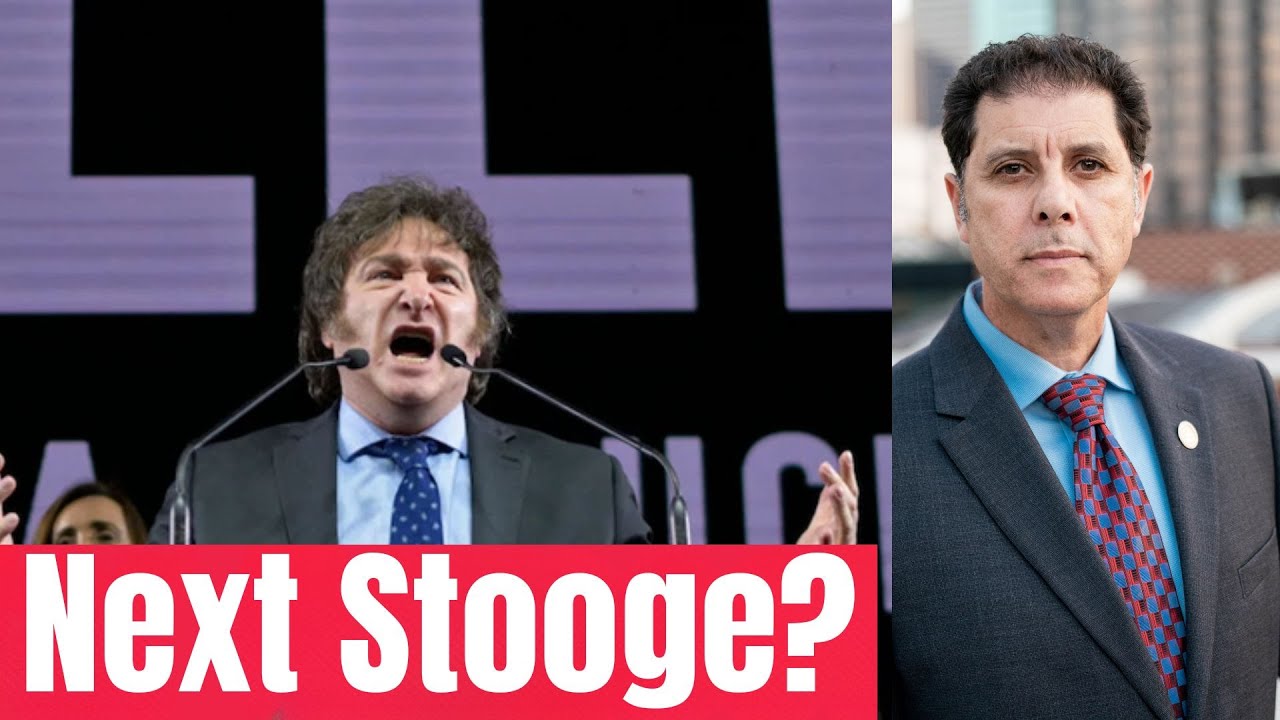
In this video, the host examines Argentine presidential candidate Javier Milei’s proposal to replace the peso with the U.S. dollar. The analysis covers Milei’s political background, his libertarian platform, and his running mate Victoria Villarreal, as well as the advisory role of economist Emilio Ocampo, who outlines a voluntary, first‑year dollarization plan that includes lifting FX controls, creating an overseas Monetary Stabilization Fund, and fixing an equilibrium exchange rate. The speaker situates the proposal within Argentina’s severe macro‑economic crisis—hyperinflation around 113 % YoY, a peso that has lost 20 % of its value, and a sovereign debt burden estimated between $277 bn and $323 bn (45‑80 % of GDP). Historical hyperinflation cases (Hungary, Zimbabwe, Yugoslavia, Germany, Greece, Venezuela) are cited to illustrate the risks of uncontrolled inflation. The video questions whether Milei’s dollarization is a domestic solution to curb inflation or a move that aligns Argentina with U.S. interests, especially given recent tensions with China and the abandonment of a proposed Brazil‑Argentina common currency (El Sur). The host expresses skepticism about the feasibility of paying off debt within four to five years via the proposed fund and warns that dollarization would reduce monetary sovereignty. The narrative concludes by inviting viewer feedback and emphasizing the broader geopolitical impact of such economic policy choices.
Chapters
Hello everyone and welcome to Geopolitical Trends. As a geopolitical analyst, I ask, why is Argentina's presidential candidate Javier Milei wants his country to use the US dollar instead of the pesos? Is this his ticket to winning the presidency, or the elections that is? Or is he serving Washington? In this video, I am going to provide you my brief analysis about what Javier is really thinking considering the geopolitical and economic changes on the global stage. Let's dive in. Argentina's top presidential candidate wants to use the US dollar. Yeah, you heard me correct, wants to use the US dollar to crash inflation and transform his country's economy. Interesting. Who is Jaffer, by the way? Jaffer Gerardo Milei is an Argentinian politician and an economist. That's what's interesting. Since December of 2021, Milei has held the position of national deputy in Buenos Aires, representing La Libertad Avanza Party, which is— which was his— the leader of that party. Milei is also a presidential candidate in the upcoming October 2022-2023, uh, Argentina presidential general elections. And his running mate is going to be Victoria Villarreal. I did my research and find out about all of the, the kind of the policies, economic policies that is. And this is kind of trigger my attention about, wow, I didn't see this coming, as far as a Latin American country going back to the US dollar. So, so Victoria Villarreal is going to be as his running mate. And in August 2023, this month, Milei achieved a significant election— significant victory, rather— in the primary elections in Argentina, emerging as the top-voted candidate leading to a major elections upset. They're very interesting. So, so here's the thing, uh, an advisor to Milei said replacing pesos with the dollar should occur in the first year of Milei's administration. Interesting. So it is a foregone conclusion that he's gonna win the elections. So, and this is why I asked the question at the beginning, Is he serving Washington's interest? Because if you know anything about Argentina, they just made an agreement with Brazil to consider the creation of a unified currency between Brazil and Argentina called El Sur. All of a sudden, you got a candidate now who is intending on using the dollar. Very, very interesting. Argentina's leading presidential candidate, Javier Milei, has no intention— get this, guys— no intentions of joining the de-dollarization wave. He has planned to do the opposite. That's what's interesting. So the libertarian politician pulled off a surprise primary win this month, you know, and he is now considered the favorite to win the October general elections. As you may know, economically speaking, the pesos plunged to about 20% or about 350 per dollar as of Monday the 11th of this month here, which was after the primary result came out, as Milei has a bold vision to dollarize— not de-dollarize, to dollarize the Argentinian economy. So The way I look at it is while dollar rising will diminish some of Argentina's autonomy as far as monetary policy, Milei believes that it's necessary to crash inflation, which is soaring at 113% in about a year. Very interesting how he's looking. He's an economist, he has some economic background based on my research that I found about him. So I would say, yeah, he knows what he's talking about. But the idea that all of a sudden you're adopting the dollar when many countries are staying away makes me put a question mark. So, so the idea stems from economist Emilio Ocampo, who is an advisor to Malay and wrote a book on dollarization. So in an interview with Bloomberg, uh, Ocampo said hyperinflation is an obstacle to structural reform and that dollarization, in other words using the dollar, provides, and I put this in quote, a means to achieve economic and political objectives, end of quote. And by the way, just FYI, what is hyperinflation? Well, hyperinflation is defined as when inflation rates are greater than 50% per month and persist for more than 30 consecutive days. And I'm gonna share with you here some historical trends that happened. I, I remember about 4 or 5 countries. We're talking about historical trends since World War II, for example. For example, Hungary in 1946, the day inflation rate was about 207%.— and prices doubled every 15 hours. Another country was Zimbabwe. In 2008, the daily inflation rate was about 98% and the prices doubled every 25 hours. Another country is Yugoslavia. You go back to 1994, the daily inflation rate was about 65% and the prices doubled every 34 hours. And number 4, it comes Germany, 1923, even before World War II. The daily inflation rate was about 21%, and the prices doubled every 3 days and 17 hours. And on number 5, I found about Greece, 1944. The daily inflation rate was about 18% and prices doubled every 4 days and 6 hours. And of course Venezuela, we all know how it is. So, Malay— I'm sorry, the economist Incampo also described how dollarization would work, saying replacing the pesos with the dollars should occur in the first year of of a Malay administration, adding that it would be, and I put this in quote, "voluntarily," end of quote. Interesting. And that people will be able to use both currencies, the pesos and the dollar, with absolute freedom to move capital. I don't think so. I just don't see that. Additionally, he called for an equilibrium exchange rate, and I put this in quote, which is close to where the pesos is trading on unofficial currency markets, where the currency is less than half of the official rate. Well, basically you're talking about manipulating the rate here. So that's the way I see it. Foreign exchange restrictions, by the way, and barriers too, will be lifted in the event of dollarization. And right there it became clear to me that this guy got the nod from Washington. If you dollarize, we will lift certain restrictions of— on foreign exchange. Notably, the central bank in Argentina won't be able to print money, and its holdings will be converted from the pesos to the dollar. No. You all know why all this happening. It's because the tensions that economic that exists between Argentina and China, because China has been expanding certain economic projects in Argentina. So, so it will lose— the pesos will lose its role. I'm sorry, the central bank in Argentina will lose its role as the custodian of reserves, and instead 'a special purpose vehicle called the Monetary Stabilization Fund,' end of quote here, 'will be created overseas in country—' because they have similar to that in countries like Switzerland. I'm familiar with the two more countries, Luxembourg and Ireland, if I'm not mistaken. And this is also according to Ocampo because he's the advisor. So So the fund basically will be overcollateralized at a 4-to-1 ratio, and incoming cash flow will be used to pay down debt. Ah, I don't know, I don't know. If you only know the ratio of debt to GDP in Argentina, and I will share with you this towards the end, so make sure you watch the video till the end here. So So ultimately, Ocampo believes that transition to the dollar would allow Argentina to pay off its debt to the Monetary Stabilization Fund within 4 to 5 years. Yeah, that's wishful thinking. Think about the interest rate and how much they have to pay on the IMF loan. And this will mark the largest cancellation of Argentina's debt without default. I, I, it's wishful thinking. I hope Argentinians people understand the dynamics of this. There is no way they can pay off that debt in 4 years. There is no way. So, so the pesos for its part has been depreciating since 2008, since they got the IMF loan, thanks to the hyperinflation and debt. So the country, Argentina that is, external debt climbed to, climbed to 45%. Of his GDP at the end of last year, so, to about $277 billion according to Global Economic Data Indicator charts. As a matter of fact, in my research I found other, uh, sources suggested that Argentina has a large and a complex debt of around $323 billion or about 80.7% of GDP, and mostly denominated in foreign currencies. That's what's fascinating about this. So, so this hype of, uh, the, the upcoming, uh, candidates that's gonna relieve the debt, it's, it's hype. So I'll be happy to further elaborate more on this topic. I have a lot of information on it if you are interested. Uh, uh, just let me know what you think. I always like to read your, your feedback. If you like this video, please hit the like button and don't forget to subscribe. I would greatly appreciate it. As always, remember, geopolitics impacts your daily life in more ways than one. Till next time, bye-bye.