The 2026 Iran War Report: A Sourced Breakdown of Who Won, Who Lost, and What Comes Next...
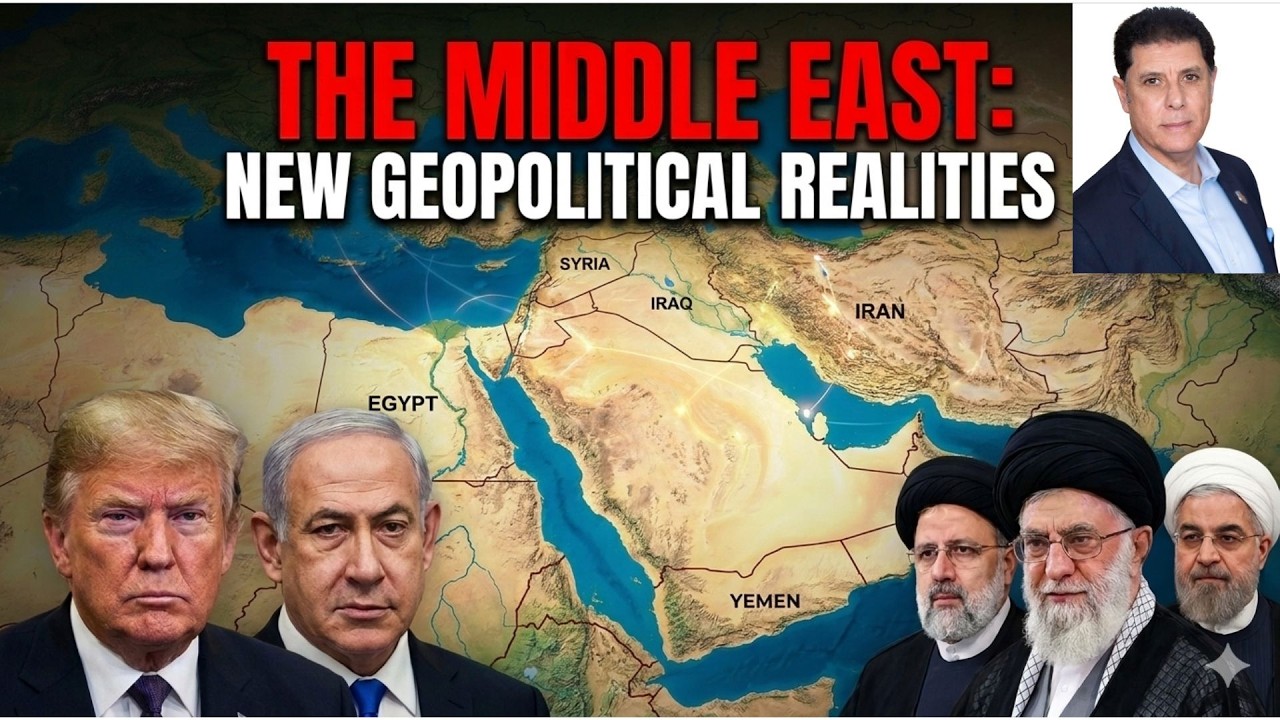
A breakdown of the 2026 US-Iran conflict (Operation Epic Fury) and its aftermath. Iran lost massive personnel and infrastructure but secured a favorable deal and kept its regime intact, while the US failed to achieve its objectives and lost credibility with Gulf partners. West Asia has shifted from US-centric to multipolar, with China and Russia positioned to gain from reconstruction and energy markets.
Chapters
Hello everyone and welcome to Geopolitical Trends, where truth matters. The United States, as you know, launched the biggest military operation in the Middle East, West Asia, since the Iraq War. They killed Iran's Supreme Leader Ali Khamenei. They struck Tehran directly. They closed Iran ports. And 3 months later, they signed a deal that doesn't mention Iranian missiles doesn't touch the proxy network and leaves the Islamic Republic standing. So let me ask you something: what exactly did America win? All this at the same time America spent over 3 months burning through munition, credibility, and yes, diplomatic capital. And then signed a 14-point memo, what I call a surrender deal, that doesn't even mention, like, the Iranian ballistic missiles and other stuff. So let's ask the uncomfortable question, and that question is, who actually won? Because the answer shapes everything that comes next. We're talking about the security order in West Asia. We're talking about the economic trajectory of the Gulf states. We're talking about the role of Washington in the region, and of course, the emerging influence of Beijing and Moscow. And this is not a story about a war that ended. No, it's a story about a new phase that just begun. So there are 5 key questions I am going to address for you in this analysis. Number 1: Has West Asia entered a new phase? Let's start with the structural question. Is this a phase shift or just particularly violent episode in a long-running conflict? I would argue it's genuinely a phase shift, and here is why. For the past 4 decades, the Middle East or West Asia operated under a certain architecture. US military dominance provided the security umbrella. Gulf monarchies accepted that umbrella even when they resented it. Iran maneuvered inside that system through proxies, plausible deniability, and asymmetric tools. And Israel maintained qualitative military superiority backed by the US political cover. That architecture has now ended, not collapsed, that fundamentally cracked on multiple dimensions simultaneously. First, the legitimacy of force. The US and Israel launched this Operation Epic Fury on February 28th, assassinated Iran's Supreme Leader Ali Khamenei in the opening salvo. Struck Tehran directly, and after 3 months of bombardment, ended up negotiating a framework and signing a deal that Iran's new leadership immediately endorsed. The Middle East Council on Global Affairs puts it very well, and I quote: Major transformations don't happen when one state defeats another. They happen when the rules of power themselves change and the rules just change, end of quote. Second, the Gulf strategic posture. The Arab Gulf states did not want this war. By early 2026, the United Arab Emirates, Saudi Arabia, and others in what Brookings Institute described as a strategic sweet spot— Iran's nuclear and proxy capabilities had been degraded by the 12-day war of 2025. So we thought. And both countries were pursuing hundreds of billions of dollars in data centers and financial sector investments that requires stability. Washington overrode these preferences and went ahead and attacked Iran anyway and inflicted major collateral damage on its own partners. Dubai International Airport was struck by Iranian drones. Gulf oil infrastructure was targeted. Qatar is now demanding Iran pay compensation for damage to its territory. Qatar, by the way, the same country that hosts US air operations. Third, the architecture of relevance. Who brokered the ceasefire? Pakistan and Qatar, with Turkey and Egypt in supporting roles. China also. Not NATO, not the G7, not even the UN Security Council, which, by the way, Russia and China paralyzed with vetoes. The diplomacy of this war was conducted through the Global South, and that tells you something profound about where influence now Lives. West Asia has entered a new phase. The old order scaffolding is still there, but the building it was holding up has shifted. Number 2: Did Iran win? Now the hardest question, and the one that has the most analytical consequences. Did Iran come out of this war as a winner? The short answer is strategically yes, despite catastrophic tactical losses. And let me break that down for you. What Iran lost: hundreds of IRGC personnel killed, Ali Khamenei himself dead, nuclear facilities struck again, ballistic missiles infrastructure degraded but still operational. Major port infrastructure at Bandar Abbas was damaged to a degree. Its currency, already in free fall, hammered further. Civilian deaths and a new untested Supreme Leader, Mojtaba Khamenei, the late leader's son, at the helm of power in a period of maximum volatility. Those are not trivial losses, if I may add. Those are devastating tactical and operational setbacks. But here is what Iran's preserved, or gained, if I may use the term. The Islamic Republic of Iran survived despite US cyber attacks calling on Iranians to rise up, despite regime change being a stated goal of the operation. And despite the killing of senior leadership, the Iranian state held. The IRGC now, not civilians, reformers consolidate power around Mujtaba Khamenei. The Islamabad Memorandum, the digital deal signed June 17th, contains no mention of Iranian ballistic missiles. No mentions of the proxy network. Iran committed not to acquire nuclear weapon, exactly what it pledged in the JCPOA a decade ago, but it kept its enrichment infrastructure. Frozen assets are being released. The US naval blockade of Iranian port has been lifted. Sanctions were waived for 60 days with a path towards permanent relief. You have the Center for Strategic and International Studies, known as CSIS, was blunt about it, stating, and I quote, the framework deal is lopsided. Iran gets most of what it wants, and it gets it upfront before negotiations on a final deal even start, end of quote. And critically so, Iran demonstrated something that will echo across the region for generations to come. It absorbed a joint US-Israeli military campaign but survived as a functioning state. It struck US bases in Qatar, Bahrain, in Arab Emirates. It kept the Strait of Hormuz closed for months. It forced the world's largest economy to beg Pakistan and Qatar to mediate a ceasefire. On the military future, what are we going to be looking at? The IRGC will reconstitute. The question is the procurement pathways. With the United Arab Emirates' traditional role as the re-export hub disrupted, new channels through Central Asia, China, and Russia will be established. The core lesson Iran's military drew from this war is one it learned in 2025 and reinforced in 2026: ballistic missiles, drone swarm, and Hormuz leverage are the real deterrent. Expect deep investments there. On the economic front, or the future that is, the path is painful but not terminal. Sanctions relief, frozen asset repatriation, and reconstruction investments from China creates a viable recovery trajectory. Iran will orient its economy even more firmly eastward. The look east policy is now not just a, a preference but rather a survival strategy. On status, Iran entered this war as a weakened regional power under sanctions, exits as a state that fought the United States militarily to a negotiated ceasefire, maintained its revolutionary government and secured its deal that major US allies, particularly Israel, openly opposed. That is a status transformation regardless of the physical damage. Number 3: Washington's failure and its future role. Let's talk about the United States and what it can and cannot do now in this new phase. Remember, the stated goals of Operation Epic Fury were destroy Iran's nuclear program, decimate its armed forces, change the regime, help protesters, and demonstrate American power. Let me be blunt. Washington made little progress or none on most of these goals. And what did it achieve? Temporary degradation of Iranian capabilities, but what it creates is an Iran with an unprecedented, almost leverage, a new hardline military-dominated regime that is more mistrustful of Washington than the previous one. And of course, a demonstration to every US partner in the region that Americans will override their preferences when Israel lobbies hard enough. And then comes the credibility problem, which is, by the way, layered in three parts. The first one is with the Gulf partners— United Arab Emirates, Saudi Arabia, Qatar, Bahrain. All of them suffered real damage. They did not want to suffer, of course, for a war they did not want to fight. The signal to those governments is clear: the US security umbrella is not neutral protection, it is a liability that can activate against your interests. Expect now accelerated hedging, Riyadh deepening ties with Beijing, Abu Dhabi diversifying its strategic partnership, Gulf states investing more in their own defense capability. Unless in assumed American protection. With the broader Global South, the war confirmed what many governments in Asia, Africa, and Latin America already believed, and that is the United States applies international law selectively. The killing of a head of state, the targeting of civilian infrastructure, the violation of a country in active negotiations. These images circulated widely and reinforced the narrative that Washington's rule-based order is a selective order. That narrative now has photographic and forensic evidence behind it. What Washington can still do To a degree, the United States remains enormous hard power in the region. I mean, we're not going to ignore that. Two carrier strike groups, air bases, intelligence relations, financial architecture— it is not absent from West Asia. But its role has fundamentally changed from architect of the regional order to one actor among many and several whose preferences are now openly contested, whose mediation is now secondary to Islamabad and Doha, and whose security guarantees now carry an asterisk. The 60-day negotiating clock is ticking as we speak. The harder issue, which is the enrichment level The highly enriched uranium stockpile, the ballistic missile program are all deferred. If those talks collapse, Washington credibility problem becomes a credibility crisis. If they succeed, the administration will claim victory, but the structural damage to US influence is already done. It won't serve anything. Number 4: What lies ahead? You have two areas: security and economic landscape. So let's look forward. What does the regional landscape geopolitically and economically actually look like from here moving forward? On the security side, you have the immediate— now test is in Lebanon, the June 21st Switzerland talks established deconfliction cell to end hostility between Israel and Hezbollah, but Iran's foreign minister Abbas Arakchi called it the first real test of the whole agreement. And Israel's Netanyahu has already said Israel forces will remain in southern Lebanon for as long as Israel deems necessary. This is a live fuse, in my opinion. Then you have the Ansarullah called the ceasefire a historical victory for Iran and the Axis of Resistance. They remain in control of significant territory in Yemen. The proxy network weakened, not destroyed, retain structural coherence. The deeper security question is what kind of deterrence architecture replaces the one that just collapsed and failed. The region, West Asia, is moving towards what many analysts, especially those at the Middle East Council, call a security pluralism— multiple overlapping framework None of them dominant. The GCC states are investing in their own deterrence. Israel is rethinking its doctrine after a war that costed real damage. Iran is reconstituting around hardened military ones, and US forces remain but without political authority they once had. With this in mind, Iran's deal includes a pledge not to acquire nuclear weapon, but no enforcement mechanism yet decided on. Saudi Arabia's longstanding position, which is this: if Iran acquires nuclear weapon, so do we, has not changed. A region where two or three states have nuclear weapons is not theoretically impossible within a decade. That calculus changes everything. On the economic side, the Strait of Hormuz is somehow reopening, but the economic damage from its closure will be felt for years to come. The IEA, the International Energy Agency, called it the largest oil supply disruption in the history of the global market. European manufacturers now imposed 30% surcharge on energy cost. The European Central Bank warned of stagflation. Fertilizer prices surged 50% during the Northern Hemisphere planting season, and the downstream food security effect won't be visible until like 2027 harvests. For the Gulf states, the war paradoxically created an opportunity. Energy revenues sort of surged with oil above $120 a barrel, but the political cost— being caught in a war you didn't choose— has accelerated diversification ambitions. Think about Vision 2030. Think about United Arab Emirates diversification into AI and finance. Think about Qatar LNG positioning. These are now more urgent, not less. For Iran, reconstruction will be the dominant economic reality for the next 5 to 7 years. The framework of Look East— Chinese investments, Russian trade infrastructure through the International North-South Transport Corridor becomes the economic spine of Iranian recovery. The INSTC, connecting Russia to India to agree markets through Iranian ports, is now strategically critical for multiple parties simultaneously. Number 5, China Russia in the new phase. Now here is the great power dimensions, and this is where you have the long game analysis gets really interesting. Russia is the clearest immediate winner of this war, and Russia didn't fire a single missile. How so, you may ask? Moscow built its 2026 federal budget on oil at $60 per barrel. Brent surged past $120 at peak. So what you have— the estimation of Russia windfall was roughly $161 billion in additional export revenues in 3-month war scenarios, roughly half a billion dollar per day. That's money sustaining Russia's operations in Ukraine, precisely where when Western sanctions were supposed to bite the hardest. But Russia's contribution wasn't purely passive. US officials confirmed that Russia was providing Iran with satellite imagery and intelligence on locations of American warships and aircraft. Similarly, the Beidou, the Chinese navigation system, the equivalency of GPS, was reportedly used by Iran to direct regional attacks. Russian-made air defense system, the Su-35 fighters and S-400 components, those were parts of the Iranian defensive architecture that absorbed the campaign long enough to force negotiations. And that's where you have Russia's credibility took a hit. However, the, the apparent limitations of Russia's air defense systems against sustained US-Israeli strikes were visible to every government in the world. Why is this important? Because they are considering military procurement. That's a real cost to Moscow's arms export narrative. China played a mere— a more complex game, and the results are more ambiguous. Beijing officially declared neutrality, of course, in practice, but it provided the dual-use technology, satellite intelligence through linked companies, and diplomatic cover while abstaining on the UN votes and vetoing resolutions alongside Russia. Intelligence assessments confirm Chinese missile components in Iranian arsenal. A Chinese-manufactured shoulder-launched missile likely brought down the US F-15E. Very interesting. China's strategic goals were: A, preserve Iran as an oil supplier and BRI partner. B, position itself as the responsible alternative to American militarism, and C, avoid a direct confrontation with Washington that would damage its core economic relationship. On the first goal, the potential, or the partial success, that is, Iran survived, the BRI corridor through Iran remained viable, and the Chinese oil imports from Iran continued even during the conflict. On the second goal, significant success. Chinese Five-Point Peace Plan— you remember that— its mediation posture and its consistent call for dialogue have earned it substantial diplomatic capital across the Global South. The contrast with American Unilateralism was unmistakable and deliberate. On the third goal, it was mixed. US sanctions on Chinese companies for processing Iranian crude and providing satellite data created some sort of friction. Trump warned President Xi Jinping directly. The relationship absorbed the tension, but not without a cost. Here is the deeper strategic question for China. If the US had achieved actual regime change in Iran, installing a pliable government— Beijing 2023, uh, Saudi Arabia-Iran rapprochement, Iran's membership in the SCO and BRICS— the entire multipolar architecture China has been constructing since 2021 will have been seriously undermined. The survival of the Islamic Republic of Iran, paradoxically, is a Chinese strategic win, even though Beijing was never willing to fight for it and never wanted to anyway. As the, uh, Peterson Institute for International Economics framed it, Both Moscow and Beijing prefer to let Washington entangle itself in protracted Middle Eastern wars while they expand influence elsewhere— Russia in Ukraine's neighborhood, China in the Asia-Pacific. The Iran war brought them time, treasure, and political position. The divergence between the two is also worth noting as part of this analysis. Russia accepts alignment with Iran because it needs the confrontation with the West. China, on the other hand, seeks flexibility, preserving relationship with Gulf states, Israel's trading partners, and Iranian oil simultaneously. One plays for the front pages the other plays for the ledger. That is the important lesson. And here is my conclusion for you: West Asia or Middle East has entered now a multipolar transition period without a transitional architecture to manage it. The old order— the American primacy, Gulf dependency, Iranian containment— is functionally over. What replaces it isn't yet defined. Iran survived as a revolutionary state, secured a favorable deal, and emerges as a symbol, however battered, of asymmetric resistance. The IRGC is now the dominant institutional force in a country that will be rebuilding for years to come. And yet Washington demonstrated it can deliver massive destruction but not durable outcomes. Its Gulf partners are now hedging. Its Israeli ally is furious with the deal. Its broader credibility now in the Global South has declined further and permanently. China and Russia are consolidating influence through the vacuum. Russia through energy, economic, and military alignment. China through trade architecture and diplomatic building. And by the way, the 60-day negotiating clock is running. If the final deal collapses, this isn't over. The harder issues— enrichment, missiles, praxis are still on the table. Because what you are watching isn't the end of a conflict, it's the opening of a new geopolitical competition for architecture of a region, West Asia, that sits on the top of the world's most important waterways and substantial fraction of its energy reserves. That competition It's just beginning. If you found this analysis useful, please subscribe and turn on that notification. As you know, I cover the structural shifts, not just headlines. And drop me your questions in the comments. I read all of them. As always, remember, geopolitics impacts your daily life in more ways than one. Till next time.
More from David


Beyond the Single Actor: Why the Gulf Isn't Choosing Between the US and China


Iran, Iraq's Militias, and the Houthis Are Coordinating! This Changes Everything




Who Controls the Next Decade's Resources? Latin America and Africa's Geopolitical Crossroads

The Chokepoint Trap: How Washington's Stupidity Triggered a Cascade That Now Controls the World

Trump Spooked as IRGC Unveiled dual-use SLV, Deployed Ghadir Mini-Subs & Hinted at Tactical Nukes!
