The $500 Drone That's Defeating a Billion-Dollar Military
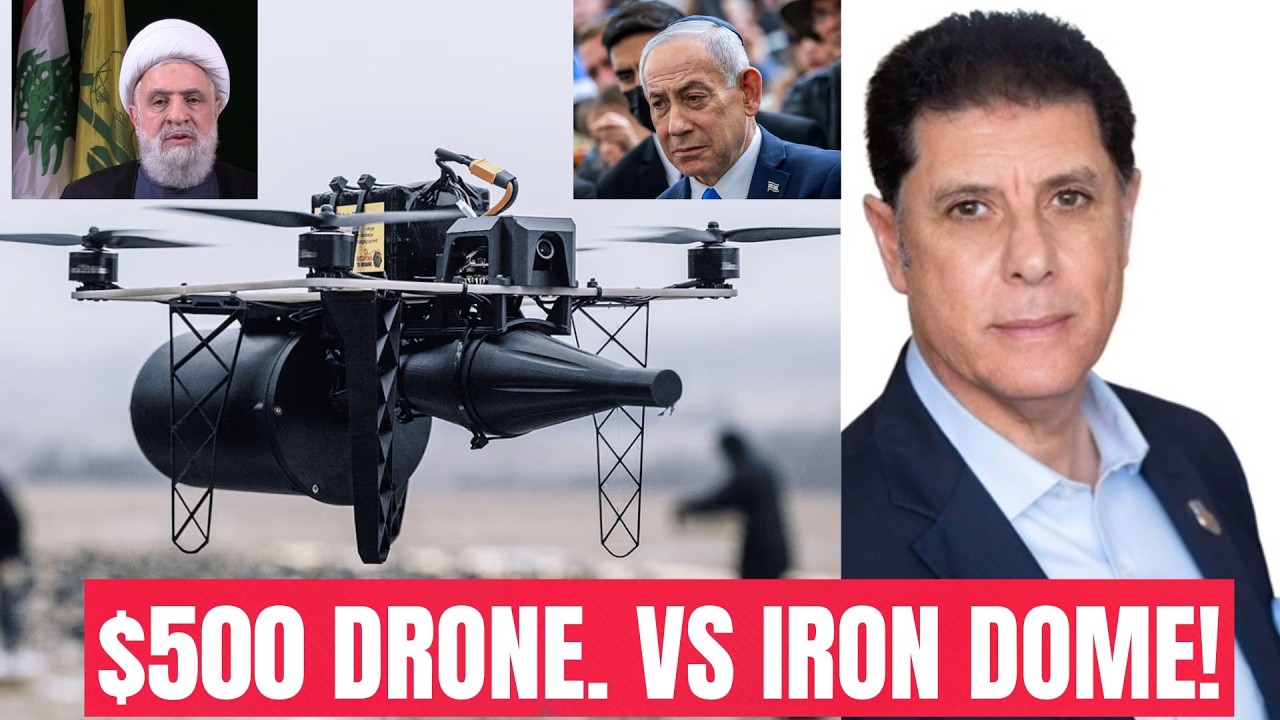
In this livestream, the host (Speaker A) examines the emergence of cheap, fiber‑optic first‑person‑view (FPV) drones—often assembled from off‑the‑shelf components and costing around $500—that have been used by Hezbollah to kill an Israeli soldier, damage a Merkava tank and evade Israel’s sophisticated air‑defence systems. He explains the technical advantage of a thin fiber‑optic guidance link, which is immune to conventional electronic‑jamming and allows up to 15 km range with a 6 kg payload. The discussion traces the technology’s origins to Russian‑Ukrainian conflict R&D, its supply chain through China (fiber‑optic cables) and Iran, and its diffusion to other non‑state actors such as the Houthis and Ansarullah. The host cites Israeli Defense Forces statements acknowledging a lack of effective counter‑measures, and highlights the strategic shift this creates: cheap drones can neutralise expensive military hardware, eroding the traditional model of decisive victory over non‑state actors. He situates the development within the broader Middle‑East stalemate—Hezbollah’s resurgence after the death of Hassan Nasrallah, the ongoing Gaza conflict, Iran’s missile re‑constitution, and the “exhausted realignment” of regional power. The livestream also includes fundraising appeals, a preview of upcoming Asia reporting, and a call for audience engagement on the future of warfare. The overall narrative argues that the fiber‑optic drone represents a new force‑multiplier that forces established militaries worldwide to rethink force protection and that the era of decisive, technology‑driven victory over insurgent groups may be ending.
Chapters
Hello everybody and welcome to Geopolitical Trends, where truth matters. A $500 drone built from Amazon parts just killed an Israeli soldier. It's not a laughing matter, of course, but it also destroys a Merkava tank, which Israel has, all this, and defeated one of the most sophisticated air defense systems on the planet. Even though it became clear that it's not. And Israeli own military admits now that they have no answer to these new drones. They have no answer for it, basically. So what we're looking at, we're looking at after 30 months of war, billions of dollars in weapons, and of course, the assassination of the Iranian Supreme Leader, Iran's Supreme Leader Ali Khamenei, the late, and also the late leader of Hezbollah, Hassan Nasrallah. And yet Hezbollah is still firing as of today. Hamas is still standing as of today. And a new weapon just emerged that no army on Earth knew how to stop it, especially when it comes down to the Israelis. So what are we talking about? We're talking about the fiber optic drones that's now swamping through northern part of Israel and the Middle East. Now, you thought sort of, uh, we understood that there is no longer exist the way it used to be, given what's going on with Iran and, and the US. Which, by the way, make sure to join me either tomorrow or after. I am waiting on a confirmation regarding one specific information, and once I get the confirmation, I will go ahead and do the analysis for you tomorrow or the following day. So basically, what are we talking about here? We're talking about the Israelis being sort of shocked and devastated at what Hezbollah is doing. Of course. Oh, my sound went off. No, you guys can hear me, right? The idea that Hezbollah is, you know, because we heard this before, oh, Hezbollah is done for. No, it's not. So everyone said at some point a few months ago that Hezbollah was finished. Their leader Hassan Nasrallah was dead, of course, when he was assassinated, and then it's the end of Hezbollah. So their weapons was destroyed, their supply line was cut. So if all this is true, how come they are still firing? Is the same argument that's been made about Iran, which the Washington establishment, both the White House and the Pentagon, are lying about. And I'm going to show you towards the end the clip from one of the closest US allies, what they are saying about the US now vis-à-vis the war in Iran. So make sure you stick with me till the end here because I'm going to show you that clip untranslated because it's not showing here in the US. So So why are they now, Hezbollah, winning a war that Israel's own generals admit they don't know how to win it? This is exactly now the dilemma for Israel. And I'm going to show you a screenshot here of those are Hezbollah. That says in Arabic right there, "Moussayarat Mutatawir al-Hezbollah." They are developed or sophisticated drones for Hezbollah. This is Hezbollah stuff. And this is again where the surprise is. So I'm going to play a clip for you, uh, as to the moment of the targeting of the soldiers in, uh, in Israel with this particular drone. Take a look at it. Lebanese drone takes out a number of Israeli soldiers in Lebanon. This resulted in multiple deaths and injuries. Subscribe for updates. So, and that shows you right there is the idea that, to me, in my opinion, the way when I came across this, it was a significant development unfolding as we speak. Because here is the thing that I need you to understand about the fiber optic drones known as FPV. Let me show you a picture of, uh, this one. No, this is the GBU. Oh, it's right there, right here. Those are Russian-made, okay? Of course, the Ukrainians also using some of these. But here's the thing, the attack that brought this into a sharp focus, which happened on the 26th of April, just like what, 3 days ago. And that's when you had this small drone piloted by Hezbollah operative slammed into an Israeli soldier repairing their tank in southern Lebanese town of Tayeba. Of course, that sergeant was killed. His name is Idan Fuchs. He was 19 years old. And of course, the attack wounded 6 others. But we're not talking about this one. We're talking about really the sophistication of this. What makes these drones so dangerous? Because that is, again, The key 5, because the dangerous— because is the fiber optic guidance system in it. These drones are controlled via a very thin fiber optic line. That's what makes them very sophisticated, making them impossible or susceptible to jamming with electronic warfare. And the other thing is that they can operate up to 15 kilometers from their operator. And carry up to 6 kilograms of explosives. That's what makes them— this is why Israel didn't have anything to, to deal with this. And that's again, when you think about his— of these particular drones, there's different types, of course. So the next question we have to ask ourselves is, what is the strategic really the strategic significance of this particular development, because with Hezbollah deploying this, it defeats Israel's primary countermeasures. So because the preferred method Israel uses to counter drones is jamming or electronic warfare. Now they are not able to do this. The same applies to Iran Shahed, which, by the way, thanks to those who corrected my pronunciation,— is Shahed, not Shaheed, Shahed 136. Those drones, the Israelis could not stop them. The Americans could not stop them. As a matter of fact, we went ahead and reverse-engineered those particular drones, the Iranian ones, because they are good. That's how important that is. In the case of Hezbollah, some of those drones operated by Hezbollah are now immune to such measures. Which means they can enter the airspace of Israel, you know, whenever they want to. And Israel itself admits it has no solution to this. So Israeli official, which is usually rare that they will come forward and state something like that, they stated openly and bluntly, and I'm going to quote here because I read the article inside Tel Aviv. And disclosed it. Here is what it says, quote, "We need to work fast and on a large scale. The learning curve has to be faster. At this point, this is not solvable," end of quote. This is the IDF, the Israeli Defense Forces security establishment, stating this and also adding that it does not have an adequate response to this problem. So I'm going to share the link with you in the chat box like I always do. If you want to read it later on, feel free. So this way you have, uh, YouTube rejected comment. This is fairly common. Okay, it's rejected my, uh, okay, didn't want me to put that in, whatever reason for. You may need to share the link other way. So they don't want me to put this on YouTube. Anyway, so you guys see there that it's banned, whatever. Let's move on. Now, where is the other concern from the strategic aspects, or the significance of this, is the technology transfer. So Russia is the primary developer of this user of fiber optics. Uh, the FPV stands for first-person view drones. And again, let me share the image with you.. So you see it right there. There's this one here, there's this one here, fiber optics, and there is this one. This is Russia's fiber optics right there. Very, very interesting. And pioneered this widespread use in combat. The Russians been using them since 2024 to counter the electronic warfare. But there is another country that is play crucial, crucial role into all this behind the scenes quietly, and that country is China. China plays a critical role as a key supplier of components like the fiber optic cables, while Iran has also demonstrated possession of fiber optic guided drones. This is why I found the— which I will do for you tomorrow or after tomorrow— this particular information coming out that Iran has targeted some ship belongs to the US, blow it up, not only because the missile, but also because the ammo inside the ship. So, but the fiber optic guided drones, Iran has been using this. And like I said, it's been developed in Russia, but at the same time offering Hezbollah a way of getting cheap, precise weapons that, that can bypass Israel's electronic defenses. And of course, this is ongoing in the Russia-Ukraine war because the way served is served as an open R&D, research and development lab for Hezbollah, which is non-state actor. The Houthis will be as well and some other groups. And this is again where Hezbollah is adapting the supply chain disruption. So, because why? Hezbollah has been cut off from many of its suppliers that used to come from Iran via Iraq and Syria. And with the new Syrian government stopping shipments under the Zulani, you all know, uh, former member of ISIS, and it was installed by the US, by the way. It's not a secret, it's not classified. We funded him, we armed him and his group, which is ISIS basically, and we put him in power, so he's going to serve the US agenda. And this is again where Hezbollah finds itself pivoting towards locally producing drone technology. Why? Because it's cheaper, harder to interdict, or intercept rather, and harder to defend against, which is what the Israelis are finding out. And that in itself changes the calculus now in southern Lebanon because Israel is maintaining its so-called the security belt in southern Lebanon where civilians have been evacuated. As a matter of fact, a lot of Israelis left. That area is deserted. Of course, the media will not disclose this. And Hezbollah was easily, or at some point it wasn't easy for Hezbollah to infiltrate personnel, but fiber optics drones gave Hezbollah the ability to strike from several miles away, reaching real well inside the security zone of Israel. Why? Because they found out that Iron Dome or what have you will not intercept with this. Nothing will do. The same way Iran found out about its Fateh missile, which is hypersonic, the Khoramshahr-4, Naymad, and so forth, all of them. The Iron Dome stands no chance into this. And with this idea of now having access to penetrate the Israeli perimeter becomes the broader military implication to this, because this particular drone, it changes the calculus now for Oh, Israel didn't count on that. Once again, the Israeli military acknowledges that even though it has this so-called sophisticated equipment and so forth to start the war with, but it has not achieved the objective. It's the same way the US did with Iran. Which now we are finding out Iran is not interested in talking to us anymore. That means they are not willing to say, you know what, we'll accept your term. No, it's going to be Iran's term. And the same way Israel is finding out because the doctrine, based on my reading that I did on the IDF, they have a doctrine by which to detect drones relies primarily on soldiers and commanders serving as spotters. Not anymore. Yeah, because what Hezbollah is doing right now is employing drones, is sort of in a sophisticated layers, a combination. And that is again where you have the difference as to what Hezbollah is doing. And this is why there are some information that has not been disclosed. For example, when Hezbollah attacked certain air bases belong to Israel was never disclosed. So I'm going to share clip with you, and that was for a few months ago, wasn't disclosed earlier. So I'm going to share it with you, and I want you to listen. It's in English anyway, so, so take a listen, please. Released footage from one of its reconnaissance drones flying undisturbed over northern Israel. The target this time, the Ramat David Air Base, located some 30 miles from the Lebanon border. According to Hezbollah, the 9-minute-long video was taken on Tuesday, and the propaganda video clearly shows the base's various facilities, including fighter jets, electronic systems, and even Iron Dome launchers. Earlier this month, Hezbollah published a drone video showing Israeli military sites in the Golan Heights,, and before that, it released a video showing the Haifa area, further exposing Israel's aerial vulnerability. The IDF said the latest Hezbollah video was filmed by a drone for photography purposes only. Activity on the base was not armed. Our support front will continue as long as the attacks continue on Gaza Strip, its people, and its resistance. All right, that was from way back. I just wanted to share at least that part of the access to the surveillance or recon through Hezbollah using the drones for that. So here is what I need you to understand. The significant development of this has some sort of several reasons for it. So one, it represents the technology transfer from almost like peer-state conflict. We're talking about Russia and Ukraine because the conflict is there. And that transfer comes from those states, Ukraine and Russia, to a non-state actor. In this case, it's Hezbollah. And with this, Hezbollah is now in a position to defeat Israel's most capable electronic countermeasures. And also it demonstrated Hezbollah deploying this kind of fiber drones. It demonstrated that cheap Mass-produced weapons can neutralize expensive military hardware. And again, towards the end of this livestream, I'm going to share a clip with you showing the, the losses of the United States. Regardless, despite our sort of surveillance technology and all that stuff, the massive amount of loss we have experienced so far against Iran. So make sure stay with me to see that particular clip. And this is where, again, we go back to the Israeli part, that the Israeli military official acknowledging that the IDF still lacks an effective countermeasures to the fiber optic guided drones, these particular ones right there. They don't have anything to deal with this. Yeah. And even, even sort of the experts within the military realm are saying that, you know what, unless you're lucky or the operator makes a mistake, the only reliable counter is to shoot them down. That's the only way. And this has a profound implication, not just for Israel, but for how modern militaries now worldwide thinking about force protection. Because what you need to understand is what's taking place right now between Israel and Hezbollah, between the US, Israel, and Iran, but mainly the US and Iran. Israel stepped back from Iran and told the US, you deal with that, because it became our war now, right now. What I wanted to say is that the rest of the world are watching. Actor states, non-state actors are watching. Militaries, established militaries from other parts of the world are watching. And this again, where it gives you an idea as to where this is headed. That means now the drones being used by Hezbollah are being outfitted with this fiber optic spool straight from Chinese sources. Yeah. Oh, it's— China's not going to get involved into this. Yeah, you want to buy fiber optic cables, so We don't care what you use it for. So because if I had to sort of put my bet on this, it's unlikely that this will pull China into a conflict. I just don't see— I don't see that. So the bottom line to this is that no proper defense exists as of now 4 explosive drones guided by fiber optic cables. Once again, just to remind you, it can be jammed electronically. And Israel now is wondering what to do. So I had a chance to read an article by— I forgot the name of the author. No, let me get the name of the author. Emmanuel Fabien. Very, very interesting. No proper defense exists, and he wrote about it. So I'm going to share a link with you, very interesting, if you are interested in learning about this aspect, and you can read it later on. So, and, uh, let me, let me play this clip here before we move on into our conversation. If the truth matters to you Hit like, subscribe, and tap that bell. No spin, no agenda, just the stories they don't want you to know. Don't watch from the sideline. Be part of the movement. Your support keeps the truth alive. Thank you. Indeed. Thank you very much for your support. And I am finding out a lot of information that is not being reported here. And I'm— what I share with you is not from the US mainstream media or whatever. When you travel around the world, you tend— and I do have some contacts in different parts of the world, so people I trust, and I verify certain aspects because I want to bring you the accuracy of the information that you are looking for. Now, once again, and I'm gonna— I have this brief, by the way, just to provide you my own analysis about this, what the way I see it from a geopolitical political and security landscape. Because now Israel failed to defeat Hezbollah and Hamas as it claimed it could. Because the conversions now of Hezbollah, drawn adaptation, the unresolved conflict with Hamas, because remember, the war against Hamas never ended and Hamas was never defeated. And of course, you add the Iran war to the conflict, to the landscape. So the broader regional churn creates now a genuinely transformed geopolitical landscape. And that's why I wanted to provide you my own analysis about this, how I see it moving forward. What I see is I see the down but not out paradigm shift. This is common when you assess the geopolitical and security landscape within the conflict that is sort of occurring. So the most significant strategic lesson of this era is the failure of the decisive victory, especially the model against non-state actors. Remember what Donald Trump's been saying, and I have— I will share with you a specific clip tomorrow or after tomorrow when I do this, uh, the other live stream that I'm gonna wait in on information and highlight to you the, the, the, the, the arrogance of the American president, how he's saying, oh, we, this, we decisively defeated Iran. And it's the same arguments I can make about Israelis saying we defeated Hezbollah, and that is not the case. So when Israel and Hezbollah agreed to ceasefire Remember back in November 2024? So the popular perception was that, oh, Hezbollah was spent force. In other words, was defeated. Its senior leadership, including Hassan Nasrallah, was eliminated, which was the case. I'm not saying otherwise. It was the case. And its military capacity according to what's been stated from Tel Aviv and Washington, is that has been sort of degraded. And yet Hezbollah is now back on the battlefield, appearing not nearly as degraded as many believed. And it doesn't disclose, of course, how many missiles they have. It won't be smart of them to do so. It's the same way Iran is doing. So this is what it says in Arabic right here. Hezbollah is using its strategic weapons. They have plans. They have things in place. And this is why when the media is saying what is not true, someone will have to push back against those lies. And this is exactly what we're seeing now. This pattern has repeated itself with Hamas vis-à-vis Israel. So Hamas was hollowed out as military organizations. Iran Axis of, Axis of Resistance was shattered and Hezbollah was decapitated. That's what the Western media is saying. That's what Tel Aviv is saying. Yet as of 2025, last year drew to a close. Remember, in November and December, and I remember did a video for you about this. These promising developments collided with the harsh reality and truth of regional politics. And that regional politics and the reality is Hamas, Hezbollah, and Iran are down but not out. And now Iran is proving, Hezbollah is proving, Ansarullah is proving, and Hamas is proving too. Because the way you look at it, Israel's experience in Gaza shows that even with ground troops, Non-state actors, the likes of Hamas, the likes of Hezbollah, the likes of Ansarullah, blend in into the civilian population only to reappear later. And this is again what I need you to get out of this tactics. This is the central strategic dilemma with no clean military solution in sight. Because remember, to give you an idea about the— in this case of Iran, when the American president Donald Trump, the incompetent Trump, or saying, 'I'm gonna blow up the civilian infrastructure.' Doesn't he realize that just by thinking and saying that, you're already committing a war crime? Because there is a war crime clause in the Geneva Convention that if you target the civilian infrastructure, that's considered a war crime. If you target the water sanitation, that's a war crime. And this is again where you— makes you wonder, where are those advisors that needs to tell these leaders, you know, you can't be just saying whatever because it doesn't work. And the same arguments I am making right now about this strategy, about these non-actor states, they know how to do it. Because now what you're looking at, you're looking at this drone revolution, not only about this fiber optic one, but you look at also about the other types of drones, the Iranian drones that also the Ansarullah drones that they are using. You look at this drone revolution as a geopolitical force multiplier. The, especially in the case of the fiber optics, this particular one right here. Because the development isn't, isn't just a tactical problem. No, it is not. It is a strategic equalizer. This is what well-established so-called militaries, the US, the Israelis, and so forth, are finding out. The military, as a matter of fact, the military explains back inside Israel, explains that Hezbollah recognized the potential of using drones because they are cheap and can be purchased in large quantities. You know, Hezbollah has a force built up and was rapid, by the way, especially after the assassination of Hassan Nasrallah. A lot of people thought, oh, Hezbollah is done for. No, they went quickly and rebuilt their force, especially when it comes down to the drones because of the shortage traditional ammo. That was another objective to them. And of course, because Hezbollah also does not fall under the regulation or quality control or external oversight that apply to a regular military. That's one of the advantage they have. And this, in my opinion, has cascading the geopolitical implications. Every— now what you have, every non-state actor and other type of groups, call them proxies, call them whatever you want in the world, they are now watching and learning from this. Is the same argument I will make about established military in some other parts of the world are watching and learning from what Iran is doing to the Americans. So I'm thinking immediately, as a matter of fact, in Japan now there are demonstrations about they want their prime minister to leave because they are realizing, first of all, you can't count on the US, and second, you're gonna become, you know, a target, let alone against China. So With all this puts us into, since we're talking about Israel and Hezbollah, puts us about, I mean, put the question forth about Israeli strategic position. Is it still dominant in the Middle East? What do you think? Or is it constrained by this new development? Yes. Some say, some analysts are saying, no, no, no, no, Israel is still the region's dominant, even though it's unpopular, but it's still a military dominance. I have to push back a little bit against that. Why I say a little bit? It's because when it comes down to the other Muslim and Arab countries, except Iran and Yemen, and of course Hezbollah in that case, all of the rest will stand no chance against against Israel. Why? It's because they have no will to fight. In the case of Iran, in the case of Hezbollah, in the case of Ansarullah, it's different. That's why I'm saying against those Arab and Muslim countries, yeah, Israel is still the dominant. But one thing is sure is that it's freedom. Of action is now narrowing very closely. There is right now to do anything foolish against Iran because Iran also learned that now it can penetrate the skies in Israel. Hezbollah is finding that out. And that falls back to that notion inside Israel about the territorial extension. Or over, remember? Because now what's happening, especially for Israel now, it's overextended beyond its limit. That's why they couldn't be on the Iran theater, because they just can't. And of course, Israel cannot fight Iran anyway. Iran will wipe it out in no time. Iran is a strong force. Or even with Hezbollah, they couldn't, they couldn't defeat Hezbollah. And Israel has said it will maintain control of the so-called security zone. And that security zone, especially in the southern Lebanon— I'm sorry, I didn't have the map, I forgot to put it up— from the southern Lebanon all the way to the Litani River. Okay, this is what Israel is still saying, because he will do this unless the Hezbollah threat is removed. Well, you can't remove Hezbollah. You can't remove, because if Israel is thinking that way, how come it is sort of occupying real estate in Gaza, in Lebanon, in Syria. And that in itself where the overextension comes in, because sustaining multiple occupations is economically and militarily costly with no clear exit condition. That is the challenge for Israel right now that is finding out. And of course, this leads you to the broader regional geopolitical consequences. When we think about the idea of the deployment of certain types of drones that Hezbollah is using, when we think about what Iran is doing on the other, we think about what Ansarullah is doing on the other end, they are different. And again, I am not surprised because I argued this before. You have to think about what's going on inside Lebanon. Because some efforts have failed to disarm Hezbollah. You can disarm Hezbollah. The Lebanese government, which by the way, it's so weak. And the Lebanese government in itself, what's his name? I forgot the president's name. Not Aoun, I think Aoun. But anyway, one of the, the leader is, it's weak politically speaking. And he just being put there as puppet anyway. So they won't be able to disarm Hezbollah. And at the same time, the continuation of the Israeli strikes in Lebanon risk destabilizing the central government. And that in itself, if it's not controlled, is going to ignite a wider sectarian conflict. You all remember the civil war in Lebanon back then. So the Lebanese state is caught between an enforceable mandate to disarm Hezbollah because the US told them and the Israelis told the central government in Beirut to do so. And of course, a group that simply refuses to comply. And Hezbollah will not disarm no matter what. As a matter of fact, the Hezbollah force is far stronger than the Lebanese military. All this happened while you still have Gaza that remain ungoverned as of now because there is nothing there. Because the absence of a large-scale reconstruction initiative fosters some sort of instability, if I may use the term, and that could escalate into intense urban combat. Remember, in Gaza there are factions, different, all of them vying for power because the Palestinian Authority It's not doing what it's supposed to do. So, and of course, the Arab and Muslim countries are using the Palestinian cause to divert attention from their own failure economically and otherwise. All this happening, you have Iran reconstitute— what do I mean by this? It's— I'm talking about Iran's ballistic missile. Yeah, this is the era. This is again why I decided to do this next time. And I can check on the confirmation of the info about the targeting of this ship, of a US ship by Iran. We're talking about launching of some substantial number of missiles. Is something coming up and Iran wants to get ahead of it? I don't know yet. So we'll see, but suffice it to say that Iran's ballistic missile reconstitution is the primary focus for Iran at the beginning as we started the year. And that is why IRGC always, always emphasize the sort of the production of missiles suggest that is a strategy of deterrence through value. Remember yesterday I mentioned to you that Iran, or IRGC, has about 500 ICBMs on standby. What will be that for? You got the idea. Deterrence through value. And that's basically aimed at overpowering Israeli and US missile defenses in any future conflict. And in my opinion, this rapid reconstitution narrows sort of the window of any diplomatic de-risking efforts. And that is why, that is why Iran is in a much better position. And the US, by the way, is behind closed doors asking for negotiations with Iran. Don't believe what the Western media is saying. 'Oh, we don't want to negotiate with Iran till they agree to our terms.' It's a lie. It's a lie. And the big of all this is ISIS, because the resurgence of ISIS is in the vacuum with all these dynamics. And remember, so far now you start to hear about, 'Oh, the urge, the most urgent Security threat of 2026 is ISIS. But of course, the first thing that comes to mind is Zulani, who was a member of ISIS. As a matter of fact, we put him in power to make a deal with the Israelis regarding the Golan Heights. And he's asking that, and Israel is saying the Golan Heights, forget about it. But he was the Zulani we put there. And what you have is that ISIS has now transitioned to a highly mobile, decentralized insurgent force. And this is where it's going to be capitalizing on vacuums in Syria, of course, in certain parts of the Iraqi border regions. That's the most important into all this. So the bottom line to all this, before I play the clips for you, the bottom line to all this that I need you to understand. The overarching geopolitical consequences of this erosion of decisive victory model. We've been talking about this because this model is what's known in modern warfare. You declare victory. But in this case, you have Israel, even though we consider it the most technologically sophisticated military in the region. Has now fought two prolonged campaigns against non-state actors and achieved degradation, not defeat. You look at it in Lebanon against Hezbollah. It's hard to anticipate now any progress on disarming Hezbollah. And like Hamas, it is down but is not out and is rebuilding. The launching of this type of drones is a strong message. So the results of all this is that you have a region locked into what I call exhausted realignment. It's a term used by many geopolitical analysts, those in the know. That's usually when you— a situation like what we are dealing with right now from the, the part of Iran, Hezbollah, Ansarullah, Hamas, and what have you. It's the exhausted realignments. So because it's too unstable for peace, too costly for war, and with no political framework capable of resolving the underlying grievances that are driving the conflict. And the best way to see this is in the Iran-US conflict. That's the best way to see it. So, all right, let me play a clip for you. The first one is in English, uh, you can just, uh, take a listen here, and it addresses exactly the cost. Okay, let me— and I don't remember, and pardon me, pardon me, guys, if, if I don't remember doing this before, but there is reason why I wanted to share this with you. I wanted to share it with you to bring to the fore the idea of the missiles. Remember how many missiles Iran got a hold of? Like I told you yesterday, besides GBU and so forth, there are other types of missiles Iran got a hold of, the technology. This clip will tell you how many things been lost, how many planes. And you put the two and two together. And you figure, I can see why. All right, let's take a listen, please. The total aircraft losses for the US in the fight against Iran now total over $2 billion. 4 F-15Es, 1 A-10 Warthog, 1 F-35 severely damaged, 1 E-3 Sentry completely destroyed, 2 KC-135s completely destroyed, 6 additional KC-135s damaged, 17 Reaper drones, 3 HH-60 helicopters damaged, 2 C-130s destroyed, 4 Little Birds destroyed, and 2 CH-47 Chinooks. So I mean, think about it, those planes, they don't just fly with no weapons in them. And that's why when the story said about IRGC claiming to have in its possession the GBU, I kind of took a step back and start to look for the confirmation for that, and and it was true. No, the Pentagon does not want to disclose all this. Uh, the next clip I want to play for you here before I'll do my conclusion for this particular live stream, it's, uh, it's coming from none other than the German Chancellor. Uh, actually, no, no, it's about the, uh, how Iran humiliated the US. And even the German chancellor, he himself disclosed this one. So let's take a— I'm gonna do the translation for you and share the screen here. All right, I'll start it from the beginning. Yeah, okay. Here's what it says. We will return to the war once again. This is what Donald Trump told his administration senior staff during pivotal meeting held to determine the fate of the conflicts with Iran. According to New York Times, the US president informed his advisers of his dissatisfaction with the Iranian proposal, which entailed lifting the US naval blockade in exchange for reopening the strait. Yet conspicuously ignored the issue of Iran's nuclear program. On the other hand, the Iranians were leaking their stance and expectations to the media. We will not back down. War will return, and then we will force Trump to seek negotiations once more. We will— it is a position that even Europeans, it seems, has come to accept. Indeed, German politician Friedrich Merz, the chancellor, German chancellor, stunned the world with resounding statements asserting that the United States will be unable to bring the war in Iran to a swift conclusion, as the Americans, by all appearances, lack of truly compelling negotiation strategy while the Iranians are far stronger than many realize. This was followed by a remark, a remark for which Trump is unlikely to ever forgive him when Mers declared, "Look at the Iranian, they are humiliating the United States." That is the important part about it. So I'm gonna move it forward here for you to see. Once again, it's the fact, the facts speak for themselves. Even now you have the German Chancellor Mers, is really sort of taking it to the US. And once again, his statement was, look at the Iranians, they are humiliating the United States. Very, very interesting. And I couldn't agree more with that. Now, here's my conclusion for you. As I said, we are witnessing now— what we are witnessing rather in Lebanon and Gaza isn't just another Middle Eastern conflict. No, it's not about just that. It is about fundamentally rewriting the rules of modern warfare. That's what it is about. Because for the first time in history, you have a non-state actor that has successfully deployed an unjamable fiber optic guided drones to defeat one of the world's most advanced military on, on consistent basis. And they did it with technology borrowed from a war in Eastern Europe and assembled from parts you could order online through Amazon, maybe. Even though Iran— I'm sorry, Israel has assassinated leaders before, has destroyed tunnels, has leveled neighborhoods. And deployed the most sophisticated air defense system money can buy. And yet Hamas is still governing parts of Gaza. Hezbollah is still firing across the Lebanese border. The uncomfortable truth, which what I try to bring you, the truth here, but the media is hiding this. The uncomfortable truth that generals, the politicians, the media, defense contractors, all don't want to say it out loud. And what they don't want to say is this: the era of decisive military victory over non-state actors may be permanently over. That is the harsh reality. So, because what you're looking at— let me put that picture again of that drone, a $500 drone— what you're looking at is that the 500 drone didn't just kill an Israeli soldiers. No, no, no, no. It killed the strategy, you know, the supremacy of the military Israeli in the region. That's what this drone did. And you have now, and as every military, You think about it, from Washington to Beijing, watching these lessons unfold in real time. The world is quietly asking the questions that nobody has answers to yet. If the most powerful conventional military in the Middle East can't finish the fight, what does that mean for the conflict in the next country? With the next group that gets access to this technology? It's worth asking. So I'm going to leave you with one question if you would like to comment on this. If a $500 fiber optics can defeat a billion-dollar air defense system, and Israel with all its military might cannot deliver a decisive victory against Hamas or Hezbollah? What does that tell us about the future of warfare? And which country or group do you think, in your opinion, will be the next to use this technology against a major military power? So make sure you drop me your thoughts below in the comment section. I would greatly appreciate it. And please, please, please do me a favor. If this is your first time here, I will greatly appreciate if you can subscribe. To the channel. We want to reach as many people around the world that are looking for truth somewhere. I'm doing my best, but I can't do it by myself. I need your assistance. I need your help. So the best way you can help me out is by subscribing and sharing it with others. So I will greatly appreciate that. Uh, let me say thank you to First of all, and I want to talk briefly about my upcoming Asia trip because something happened yesterday. Remember yesterday I shared with you this particular, uh, uh, thermometer, funding thermometer, where we were as far as the funding. And so far we had $2,382. That was as of yesterday. This morning, here is the new figure, is $200— $2,882. Why is this? It's because it was a donor yesterday that donated $500, and he or she— I don't know who the person is, it's a donor, I didn't get the green light to disclose everything— but he or she is willing to match the next donor up to $1,000. So if anyone donated that amount this particular supporter and donor will match dollar for dollar up to $1,000. So I want to really say thank you to, uh, Dottoressa Salerno, known as D-R-A-L-A. So thank you so much for your generosity. Thank you very much for your support. And, uh, I just, uh I'm very, very touched by the, the, the, because I just talked about it yesterday, remember? And, and all of a sudden this individual, and here is what he wrote, this individual, he or she, I do not know. It is my honor and pleasure to donate towards your Asia trip as you continue to seek knowledge and truth regarding geopolitics. In addition to this donation, I am willing to match donations from this point forward up to $1,000. Perhaps this challenge will spur your other subscribers to donate. I look forward to hearing about your progress in this fundraising effort. So I can't thank you enough for your support for this. The next person I want to give shout out to is, uh, Zero88. Thank you for buying me couple cups of teas in support of the Asia trip. And the last person I want to give shout out to is Tay C. Thank you, who bought me a few cups of teas this morning in support of the, uh, my upcoming Asia trip. And let me see if there is the note from, uh, yeah, thank you very much for that. I'm very, very grateful to you for that. Let me, uh, and once again, for those who wanted to support, uh, uh, this upcoming trip to Asia, and once again, remember, this is about bringing you the truth. Here is the link if you want to donate, uh, buy me couple of tea, cups of teas in support of the Asia trip. This is for Asia trip. I intend to go to one particular location I have in mind. It's because Western media have been saying lies about this particular location. I want to be on the ground. It's like I did— I'm doing in my last few days, moving in different parts of Europe, and I talk to people, I see things on the ground, and I report it to you. That's again, if you want to donate in support of this particular Asia trip, here is the link for it, and I am very grateful to you for your support. To those who wants to support the channel, because you know the type of analysis that I bring you here, here is the link for supporting the channel should you decide to do that. And, uh, no, it's this one right here. And if you want to get a copy of, uh, I don't know where it is. The one for my, uh, my, my books extra right there. Yeah, this is if you want to get a copy of my, uh, any of my books. Unfortunately, I can't show the picture because the screen froze on me in that part. So, but anyway, in any event, I hope you, uh, I will be looking forward to seeing you again once I get certain confirmation, certain aspects to do the next topic for you. And again, I will be talking about Iranian attack on one of the largest U.S. warships. Surprising, and I'm not surprised they're getting ahead of something. So, and at the same time, I will be addressing the other part of this is whether the United States is preparing for new attacks on Iran. That's what I wanted to share with you. So, all right, I hope you enjoyed this, and I look forward to seeing you next time. As always, remember, geopolitics impacts your daily life in more ways than one. Till next time, bye-bye.
More from David


Beyond the Single Actor: Why the Gulf Isn't Choosing Between the US and China


Iran, Iraq's Militias, and the Houthis Are Coordinating! This Changes Everything




Who Controls the Next Decade's Resources? Latin America and Africa's Geopolitical Crossroads

The Chokepoint Trap: How Washington's Stupidity Triggered a Cascade That Now Controls the World

Trump Spooked as IRGC Unveiled dual-use SLV, Deployed Ghadir Mini-Subs & Hinted at Tactical Nukes!
