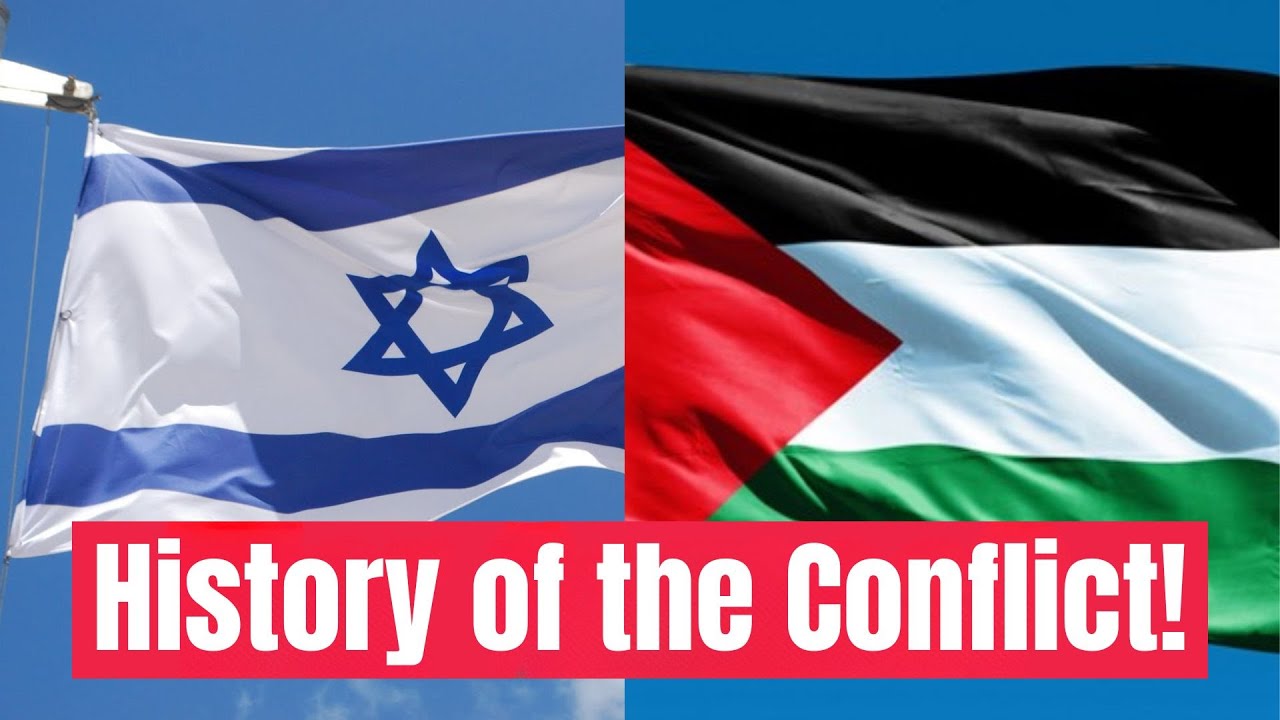
A historian traces the Arab-Israeli conflict from ancient times through the Balfour Declaration, 1948 war, and recent Gaza escalations, arguing the US has favored Israel and that an impartial mediator is essential for a two-state solution.
Chapters
Hello everybody and welcome to Geopolitical Trends. So excited to be with you on this Monday. All right, this time I'm gonna be providing a historical snapshot about the— not only about the Arab-Israeli conflict, but also about how Israel came to be. Because most of the— there is a record out there, historically speaking. Most of it will go back to after World War II, of course World War I, when things start to be reshaped, till the Declaration of Independence of Israel, or after World War II. So, but I'm gonna go way back, as far back as the Roman time. And this is why I figured this is nothing but a just a snapshot. Of course, we can't cover this in 1 hour or 2 or even 3. You're talking about a long history. But at least to provide you some, uh, uh, uh, uh, ground, or some, uh, what's the word I'm looking for, uh, some basic understanding of how things have evolved over time to where it is today. So, so I am not going to be talking about the political aspects of the Middle East, the conflicts and so, because that's a conversation that is separate, that falls under geopolitics and so forth, which there's a lot of dynamics. Like I said last time, suffice it to say, anytime there is an eruption to the, uh, conflict of the Arab-Israeli, uh, tensions, the global economy ends up being impacted, and we're already witnessing that. So, but that's not what I'm going to be talking But so before I'll delve deeper, I want to extend my sincere thanks to all of you, uh, my, uh, great, uh, uh, appreciation for your continued support. And please, if this is your first time landing on this channel here, please make sure to subscribe. I would greatly appreciate it. So, all right, let me start with the 3 questions because we're gonna need to ask this. How far back does the history of the Arab-Israeli conflict go. And by the way, there are now certain circles, uh, I've been thinking about it myself, do we always have to refer to it as the Arab-Israeli conflict or the Palestinian-Israeli conflict? What do you guys think? Because that's a slight diff— there is a difference out there. You look at the countries that have normalized relations with Israel, the four countries: Bahrain, United Arab Emirates, Morocco and Sudan. Speaking of Morocco, there were massive demonstrations yesterday in Morocco. They are against this now normalizations and so forth. Uh, uh, usually in Morocco you still have demonstrations like that in support of Palestinians, and, and I'm, I'm sure the Moroccan government understand that. The same argument can be made about Jordan, where the massive demonstrations in Jordan The same argument can be made about demonstrations in London, you know, uh, and, and all this. Now, some governments, not all, I shall not generalize, but some of them are sort of clamping down on, like what's happened now in Germany, like what's happening in France, you know, they're kind of like, well, wait a minute, where is that freedom of expression? Those are peaceful demonstrations. Yes, there's, they don't like the fact that they are in support of Palestine. Well, It's kind of, you know, isn't that what democracy is all about, or is it just an illusion? So, so in this case, we're gonna go back about, as I said, do we call it the Arab-Israeli or the Palestinian-Israeli conflict? So just let me know your answers in the chat box. The second question we're going to ask is, what's the balance? Once I go through the history, you can think about— this question: was the balance always tilted towards Israel? This is the reason again why I did that survey yesterday for the community. Which country do you think will play the most honest broker role? Russia, China, the EU, or the African Union? There was a reason why I didn't put the United States, because we know the United States cannot be an honest broker. It pains me to say it as an American, but it's the truth. So the third question we need to ask is, what's next? What is after all this? Briefly, my own assessment is that this later— this recent event now exposed really, first of all, the hypocrisy of the West. That's one. And second, it's going to put now even Israel itself, it's going to put it in a very serious dilemma. Their survival now, because now you're looking at a forefront, everything's coming out for forward. What am I referring to? I'm referring to, for example, Iran is mentioning that, hey, maybe it's time to face the Israelis. And if Iran gets involved through its groups, it's going to take the tensions to another level. The US is going to come to the aid of Israel, then we don't know what other countries in the Middle East going to do. We don't know what Russia will do. So that's just part of how the geopolitical calculations are, and, and that's normal. You look no further than what just took place in Ukraine, you know. So this is how I see it. So, uh, all right, let me go back to where comments are just to see some of you here. Uh, hi, Athene Wu, good to see you as well. Uh, asshole Biden, Uh, you said great channel. Uh, wow, that's an interesting, uh, screen name, man, you know. Uh, you wrote great channel for history lover. Dr. O sure did a lot of investigations into history. Oh, it's for sure. It's because without understanding the history, we won't be able to place it within the greatest context, you know. Hi Boone, good to see you. Uh, I read your, your message on the Discord., and I respond to it. And as a matter of fact, I'm going to share something you, uh, shared with, with, with me, if that's okay with you, of course. Lucio Delgado, good to see you from Montreal. You know, it's sad to see what's going on in Canada, what's becoming of Canada. And please just share with us, Lucio, if this is true: a lot of Canadians are leaving Canada. Is that true? I'm seeing some reports, uh, uh Some people are leaving Canada because of where it's headed, you know. Uh, Sanket Kanpur, good to see you, and thank, uh, William N, good morning to you. I know you are in the different parts of the world. Uh, Kathmosphere, good to see you as well. So sure, be happy to have, to have it as discussion. Okay, Boon, I will share what you shared with me because interesting. What you shared with me via Discord falls exactly within what I'm going to be talking about. So, uh, and of course I will answer, uh, 2 or 3 questions of you towards the end. So, so let's get into the history of— and I have some pictures of course I will share with you, uh, that I dig through the archives. And this is one, uh, one pictures that I just came across through the historical records as to Really, this is like the cycle of the biblical time, which I'm not going to talk about. I am not a religious scholar. I don't talk about religion. Uh, I'm not qualified for that kind of stuff. Uh, but it suffices for us to mention the reference to it, which I will talk about, to give you an idea of really how the whole historical trends have evolved. This is a picture from the desert in the in, in, within Israel, which I will get into as I move forward. So, well, here is the basic thing: understanding, understanding the basic historical facts about a country in the region, like any country in the Middle East, you know, because Israel is in the Middle East. So understanding this basic history will allow us to place it within the context of the greater Middle East, because the Middle East has evolved over time. As I always say, and I'm not bragging here, but I'm just highlighting the fact I wrote extensively on the Middle East, so, and I kind of learned over the years, over decades, how the evolvements of its history, you know. And this is why I will always consider Middle East a volatile region that has always been, and it will always remain for the foreseeable future, the center of gravity for the ultimate dreams of conquerors and also peacemakers alike. And, and I wrote, by the way, uh, one of these descriptions here in one of my books. That's when I remembered, uh, because I've always, uh, assessed that the Middle East will always be there. So for us, within this context of what I'm going to be talking about, the political events in the Middle East post-World War II. That's when it was unfolded. Why is this important? Because right after that, those major events that include, for example, the invitation of Turkey to NATO, the North Atlantic Treaty Organization, North— and of course the establishment of the State of Israel, which by the way, from a historical perspective, just for you guys to know, At that time, he used to be the former President Harry Truman, which was, you know, disastrous for American presidency. As a president, I never liked the guy because of his policies, not him as human being. You know, uh, you can't do that. Who are we to judge? You know, I don't like you because the way you look or the way you are from, whatever. No, that's ridiculous. But I did not like the guy because of his policies. That I read about, and because I had to do the research myself for my own writing. So, so Truman— here is what happened with Truman right after the establishment of the State of Israel. Truman recognized— here's the thing— recognized Israel 11 minutes, 11 minutes after its creation, which tells you what? It tells you the story right there. So it was on May 14th, 1948, which highlight to me as a whole, it highlight the fast changing political dynamics that exist in the Middle East early on. So while the emergence of Israel on the Middle East political scene was a monumental and highly debatable event, We're gonna have to go way back before 1948, and this is where the history of how Israel was created came about. And that's will be the focus of what I'm going to be talking about soon. Well, of course, you think about the Arab-Israeli because it's been always known that way. It will be hard for now to change it to the Palestinian-Israeli conflict. You know, I just, uh Even though it makes logical sense, but it's been always there because Arabs also benefit from the conflict. Let's not forget that one. So, so the Arab-Israeli conflict is an ongoing, uh, uh, intercommunal, if I may use the term, uh, phenomenon involving, uh, political tensions, military conflict, and also other disputes between various Arab countries and Israel. You look at right now as we speak economically, there are already tensions about natural gas fields that Israel claiming that is part of its territory, but Lebanon saying, forget about it, we have a right to that as well. Egypt has a right to that as well. So this is why I always said there is always a link between geopolitical outcomes and economics, or energy for that matter. So, so, and this is why those tensions have escalated during the 20th century but mostly faded, uh, uh, out by the early— that's the key word— the early 21st century. But the roots of the Arab-Israeli conflict have been attributed to the support by the Arab League member countries for the Palestinians because Palestine is a fellow member of the Arab League, you know. So this is why sometimes you have to call it the Arab-Israeli conflict and sometimes you're going to have to call it the Palestinian-Israeli conflict. So, and all this has in turn contributed to simultaneous rise of Zionism. Now don't confuse Zionism with Judaism, two separate things, one from a religious aspect the other one from an ideological perspective. So, but the rise of Zionism wasn't the only one, because to counter that, it was the rise of Arab nationalism. This is why you had the like of Hafez al-Assad of Syria back then. You have the like of Anwar Sadat, or even before him, Gamal Abdel Nasser. You know, you got the likes of Saddam Hussein back then. All those were part of Arab nationalism. So. And this was towards the end of the 19th century, though the two national movements, meaning the Zionism and the national, uh, uh, or the Arab nationalism, had not clashed until 1920. That's when it began. So this is why it's very important to understand at least this aspect of the beginning of where this whole saga of the Arab-Israeli or Palestinian-Israeli conflict came to be. So, so let us get into the old history and the timeline of the Israeli history, that is. So, so of course there are two records, at least the one I came across, which I will put the link for you guys in the description. You can always see this later on. So So what happened is that the history of the timeline of the Arab-Israeli conflict began with Israel and Judea back in 1400 BC. And I did find some archives pictures, uh, to reflect this one as I move along, and I'll talk about this. This is a copy of a book, I believe, uh, that was about the history of the Kings of Israel and Judea. And this one started back, as I said, 1400 BC, the Roman conquest of Israel and its remaining to Palestine. This is what I see the record in history here somehow, because remember, even with history, I mean, we had it right here in the US, believe it or not. I, I teach, I'm a faculty And a couple years ago, it was, uh, it was an issue here with some historic history books that we published here regarding the Mexican-American history. And this has to do with the state of Texas, you know. And some of the writing of the history of the Mexico-US wars and so forth have been altered, and there was some professors that stepped forward and said, no, no, no, no, you have to correct the record. We can't be teaching this because it's not right. That's altering history. So that's what I'm saying, the same thing. You have to always be careful with history here. So the Roman conquest of Israel and its renaming to Palestine— this is again kind of confusing because it was no Israel to begin with. So if the Roman time Israel was known, then why will it be created in 1948? So, so the Muslim armies of the Ottoman Empire, the partition of Palestine, the State of Israel, and the wars between Israel and its neighbors— all this has shaped the trajectory that started back since the Roman conquest. And this is why it's very important to understand at least this aspect of it. So, so Israel as a whole, we're going to think, think about it as an independent entity for now, just to— because it is an independent state. So Israel is a small country in the Middle East, about the size of New Jersey, for those who are familiar with the United States, the state of New Jersey. Which is located on the eastern shore, uh, of the Mediterranean Sea. That's for Israel, that is. So, and it bordered, uh, uh, I think I have a map here because you need to see, uh, where that is. Maybe let's see here. No, I don't have that one, so it's okay. Uh, it bordered Egypt, Jordan, Lebanon, and Syria. So, uh, Israel has about a population of 9 million people. Most of them are Jewish, uh, some of them are— have, uh, hold dual citizenship. Like right now, the US is trying to evacuate American citizens, Israeli, uh, that is, uh, from Israel, and other countries are doing the same. So, and Israel of course has many archaeological and religious sites considered sacred by the Jews, the Muslims, and the Christian alike, and I will talk about the Dome of the Rock and Jerusalem. So, and this is where part of where the complexity of the history, that's why it's, it saw throughout its trajectory moments of peace and moments of conflict. So the early history of Israel, much of what scholars know about Israel ancient history comes from the Hebrew Bible. This is where I saw this picture here that I had to share with you. And, uh, so it came back from that era or that time. So according to the text, you know, Israel's origin can be traced back to Abraham, who is considered the father of both, uh, Judaism through his son Isaac and Islam through his son Ishmael. So there is some, uh, this is religious stuff and I usually don't get involved in religion much. Uh, it's because, you know, I question religion myself. So, uh, I did find that over, as I grow older, I question more and I find that interesting how religion can be also a manipulative tool entities can use to justify one direction or another. You look at it no further than a no I don't mean disrespect for Catholics and so forth, but look at it no further than the Vatican. It's no different than in Judaism, it's no different than Islam, it's no different than the Catholic Church and so forth. So Abraham's descendants were thought to be enslaved by the Egyptians for hundreds of years before settling in Canaan, which is approximately the region of modern-day Israel. So the word Israel itself comes from Abraham's grandson Jacob, who was renamed— yeah, who was renamed Israel by the Hebrew God of— in the Bible. Then what comes after this? You have to understand King David and King Solomon. And this is why this book was— I think was about this, uh, not this one, I'm sorry. It has to do with this one here. Yeah, King Solomon and the Temple of Solomon. So it's very important to understand this part of history also. King David ruled the region around 1000 BC. Okay, his son who became King Solomon is credited with building the first holy temple in ancient Jerusalem. That's why I said the three monotheistic religions— Islam, Judaism, and Christianity— have a right to that. Now you see why when I shared with you last time, when we did the role play, when I was doing my graduate program in international security and the Arab-Israeli conflict was one of our topics, I suggested how about making Jerusalem as an international city and you rotate, the, uh, the, uh, the leadership of it among the three entities on a yearly basis. So King Solomon was credited with building the first holy temple in ancient— in ancient Jerusalem. And in about 931 BC, the area was divided into two kingdoms: Israel in the north and Judea the south. Around 722 BC, the Assyrians invaded and destroyed the northern kingdom of Israel. In 568 BC, the Babylonians conquered Jerusalem and destroyed the First Temple, which was replaced by the Second Temple in about 516 BC. And as a matter of fact, to think about this, uh, to those of you who are from Arabic countries, you will know if I mention the name Salahdin al-Ayyubi, because Salahdin was the one that went to Jerusalem and, and free it from the Jews at that time. So, so for the next several centuries, the land of modern-day Israel was conquered and ruled by various groups including the Persians, the Greeks, the Romans, and the Arabs, including the Fatimids, the Seljuks, and the Seljuks Turks, and the Crusaders, Egyptians, Mamluks, Islamists, and others. So you can just see, and this very important to understand that it was never stability in that part of the world from back then. Then you f— you fast forward to 1517 to 1917, and this is where is the day Israel, along with much of the Middle East, was ruled by— who was ruling during this era? Can anybody tell me, or can you type it in in the chat box. Between 1517 to 1917, who ruled much of the area in the Middle East? Can anybody tell me? So I know it takes time. Oh, you're absolutely correct, you're absolutely correct, Cam35mm. The Ottoman Empire. You're absolutely correct, and it's very important to understand this part. So, but World War I dramatically altered the geopolitical landscape in the Middle East in 1917. Why? Because the Ottoman Empire fell. So at the height of the war, British Foreign Secretary Arthur James Balfour submitted a letter of intent supporting the establishment of the Jewish homeland in Palestine. So the— to say it in different words, it was the British that created Israel. Yeah, there is a religious and historical ties of Israel to the past, but the creation was pushed by the Brits because the Brits did a lot of stuff in the Middle East and of course in some parts in Asia. So, so he supported the, uh, supported the establishment of the Jewish homeland in Palestine. So the British government hoped that the formal declaration known thereafter as Balfour Declaration— that's where it bore the name for, for him— uh, would encourage support for the Allies in World War I. So basically, the declaration was to support the outcome of World War I. So it has a political, uh, ambitious to it. So when World War I ended in 1918 with an Allied victory, the 400 years Ottoman Empire rule ended, because Ottoman ruled for 4 centuries. So, and Great Britain took control over what became known as modern-day Palestine and Israel and, uh, Jordan. That's— you lump them all, Palestine, Israel, and Jordan, modern day, of course, known now as Palestine. So, so the Balfour Declaration and the British Mandate over Palestine were approved by the League of Nations in 1922. Arabs at that time vehemently opposed the Balfour Declaration because concerned that a Jewish homeland will mean a subjugation of the Arab Palestine. So the British controlled Palestine until Israel in the years, uh, following the end of World War II, and that's when it became independent in 1947. 7. This leads us to move into the conflict between the Jews and Arabs. And I think I have a picture of something. This is, by the way, uh, during the era of the, uh, a Roman way back. As you know, it's Germania Ben, uh, uh, and it was the whole region as far as Palestine, Israel, and Jordan. So this is an old map, uh, back during the Roman time. This is about the history of the Jewish king and his temple. This is King Solomon. So we move into the Jews and the Arabs conflict zone. So throughout Israel's long history. Tensions between the Jews and Arab Muslims have existed, sometimes used to be over religious line, but at the same time the Jews coexisted with Muslims. But the complex hostility between the two groups dates all the way back to the ancient time when both populated the area that To both of them, that area was considered holy. This is why we're seeing the tensions still to today, and it will remain if there is no solutions one for all, or once for all, that is. Why? Because, for example, while Israel says that it has a right to Jerusalem, which is— there is some religious ties to that, so do the Christians, so do the Muslims. That, that just is why it's very important. So this is why politically, when Israel moved its embassy from Tel Aviv to Jerusalem, the US was the first to support that, and it became clear as to what the objective. So, so both the Jews and the Muslims consider the city of Jerusalem sacred. You know, it contains, of course, the Temple Mount, which includes the holy sites of the Al-Aqsa Mosque, the Western Wall the Dome of the Rock, and even more other religious sites. So much of the conflict in recent years has centered around who is occupying the following areas, and there are 3 areas that you need to pay close attention to, and I'm going to detail it, and I provide you some maps for this. Let's start with the Gaza Strip, and let me share, uh, with you one picture of the Gaza Strip. Uh, this is a picture of the Gaza Strip. Very, very important to understand it. So, and there's three areas where they— as I said, the Gaza Strip, then you have the other area is the Golan Heights, which is right here. Not this one, this is the Golan Heights. Okay, then we have the third one, I believe, which is the, uh, Golan Heights. By the way, it's a rocky plateau between Syria and modern-day Israel, which Israel took, uh, from Syria back then. So that's why it's very, very crucial. Then the other one has to do with West Bank. That's why that's another very crucial area. This is the West Bank. And West Bank is a territory that divides part of modern-day Israel and Jordan. This is why the monarchy in Jordan is very concerned about the demonstrations that take— taking place in, uh, Jordan, because they are in support of the Palestinians. So, so there is another key important thing to understand, which was during World War II. That's why If you noticed that a whole idea during World War II, the Allies had to support the, the concept of the creation of Israel at that time because it was preceded by the Declaration of Balfour, uh, in England, which made it even in 1947, '48, with the Declaration of, uh, Israel as an independent state. So let's talk about the Zionism movement. And again, like I mentioned earlier, you have to differentiate between Zionism and Judaism— two separate things. In the late 19th century and early 20th century, an organized religious and political movement known as Zionism emerged among Jews. This is one thing that is now happening on the global stage, and I tell you because I do have Jewish friends and and we talk and all that, there is a concern among the Jewish, uh, community that the support for the Jewish state is declining around the world. So, and it is a big concern for the Israeli government. So, so Zionism wanted to reestablish a Jewish homeland in Palestine. So this is why you are seeing massive A number of Jews emigrated to the ancient Holy Land and built settlements. That's another issue that is fermenting more tensions between— regarding the Arab-Israeli conflict. It has to do with the settlements. Even the US couldn't control Israel for that. So between 1882 and 1903, there were about 35,000 Jews relocated to Palestine. They came from different parts of the world. And of course, uh, uh, another 40,000 settled in the area between 1904 and 1914. We all remember the Jews from, uh, the former Soviet Union, uh, went to, um, back to Israel. Jews from Poland, uh, in, in— so of course what happened to the Jews in Germany, uh, under the Nazism, which I will talk about. What I found very interesting now is that Germany now is banning any demonstrations, uh, about Palestine and so forth. So I, I found it very ironic. So many Jews living in Europe and elsewhere, fearing prosecution during the Nazi reign, found refuge in Palestine and embraced Zionism. So after the Holocaust and World War II ended, members of the Zionist movement primarily, primarily rather focused on creating an independent Jewish state. And this is what happened. This is what this map is all about. That's when the flow of the Israelis to Israel was taking place at that time. So then it becomes the question of what will Arabs do? Well, of course the Arabs resisted the Zionism movement at that time, and that's when the tensions between the two groups emerged forcefully till today, still to a degree. So an Arab nationalist movement developed as a result. That's what was the era of, uh, Jamal Abdel Nasser and Hafez Assad back then, Saddam, uh, I can't think of anyone else at the time, even Gaddafi later on. So, uh, Israeli independence, 1947. The United Nations approved the plan to partition Palestine into Jewish and Arab states in 1947. Of course, the Arab rejected that, and in May 1948, Israel was officially declared as an independent state, with David Ben-Gurion, the head of the Jewish Agency, as the prime minister. Because remember, in Israel, the president is a ceremonial, uh, figurehead. It's the prime minister who's the caregiver— or the caretaker, rather— of the government. So while this historic event seems to be a victory for the Jews, It also marked the beginning of more violence, uh, with the Arabs. And we start with the 1948 Arab-Israeli War. This one took place, of course, following the indepen— the Declaration of Independence of Israel. And you had the 5 Arab countries— Egypt, Jordan, Iraq, Syria, and Lebanon— immediately invaded the region in what became known as the 1948 Arab-Israeli War. Civil war broke out throughout all of Israel, but a ceasefire agreement was reached in 1949. So as part of that temporary armistice agreement, the West Bank became part of Jordan. That's how it became. And the Gaza Strip— Gaza Strip became part of Egypt, or Egyptian territory. That's why there's two countries, Jordan and Egypt, will always be involved in this because any, uh, uh, uh, tensions in, in Palestine or, or, or, or the flood of immigrants, whatever. This is why it didn't make sense when Israel had to warn about a million, uh, people in Gaza to leave. Where are they gonna go? You know, uh, Jordan cannot absorb that. Egypt cannot absorb that. Most Arab countries will not be able to absorb that. So, so the, the Arab-Israeli conflict also witnessed some major events. You take, for example, what took place in the, uh, during 1948, the Suez Canal Crisis. And I have a picture that I found here, an old one. Uh, this is the settlers when they were— not settlers, I'm sorry, the local, the Palestinians, when they were leaving at that time because, uh, the conflict just took too, too much for them to handle. So, and this also reflection of what happened in the, what's called at that time, Nakba, which I will talk about here shortly. So 1956, Egyptian President Gamal Abdel Nasser at that time overtook and nationalized the Suez Canal, which was very problematic for the West, UK and the US at the time. That's why, at least the— that's why the US got involved to begin with. So the important shipping water, uh, for, uh, for, uh, trade. And here's the Suez Canal. This was an aircraft carrier there. That's the US back then. Uh, it's a narrow strait, but it's very, very, very, very crucial. And this is what's connected, by the way, the Suez Canal is what connected the Red Sea to the Mediterranean Sea. So, and with the help of the British and the French forces, yeah, Israel attacked the Sinai Peninsula and retook the Suez Canal. So basically, what you look at it, the key players in the West, France, uh, uh, the UK, the United— the three, rather— France, uh, UK, and the United States. Then what comes after that is the Six-Day War. This is what started the surprise attack Israel in 1967 defeated, uh, in which Israel defeated Egypt, Jordan, and Syria in the Six-Day War. Well, of course, because the United States gets involved. And as a matter of fact, uh, there was— you have to understand how this came to be. Uh, uh, the aircraft carrier USS Liberty was attacked, and based on the historical record, it suggested that it was attacked by Israel itself to incite or to push the US to get in into, uh, uh, the, the, the fight in support of Israel. So after a brief war, Israel control— took over control of the Gaza Strip, the Sinai Peninsula, the West Bank, and the Golan Heights. And this area were considered occupied. So fast forward to Yom Kippur, which is a big day for the, the Israelis, uh, and so this one happens because in the hope to catch Israel off guard. In 1973, Egypt and Syria launched an airstrike against Israel on the holy day of Yom Kippur. So the fighting went on for 2 weeks. It was until the UN, United Nations, adopted a resolution to stop the war. Syria hoped to recapture its Golan Heights during this battle but was unsuccessful. This is why Syria cannot get this Golan Heights. And Golan Heights, by the way, is a very strategic location. And in 1981, Israel annexed the Golan Heights, but Syria continued to claim it was its territory. Fast forward to 1982, Lebanon War. This one, Israel invaded Lebanon and ejected the Palestinian Liberation Organization known as PLO. This group, which started in 1964 and declared all Arab citizens living in Palestine up to 1947 to be called Palestinians, which focused on creating the Palestinian state within Israel. This is why there's always an argument— not, uh, uh, uh, yeah, an argument regarding this conflict that Israel will have to go back to the borders of 1967. Some say they have to go back to the borders of 1947, which I don't see that happening. No. So the US gets involved. Of course, the US was involved all along. This is why the US cannot be an honest broker. And that's why I put that survey for you, uh, on the community as to which country do you believe will be an honest broker in this conflict. But the complexity of this conflict, it, it's not easy. It's not easy. It's not easy, I can tell you this. This, of course, these tensions led to what was first known as Intifada, which is the rising, uh, uh, of the Palestinians. The first Intifada, there was— I got a picture here. This is the first Intifada, is the— what's the— the resistance. Intifada, that's what it was. And it was, it was not an easy thing to for all parties involved. So the first Palestinian Intifada, this one Israeli occupation of Gaza and the West Bank led to 1987. That's where the first, uh, it's uprising, that's the translation for it, Intifada, Arabic term for uprising. And it led to really hindrance of that, a peace process known as the Oslo peace was established and ended the Intifada at that time. So Intifada, also another word for it is the shaking off. So after this, the Palestinian Authority formed and took over some territories in Israel, and in 1997, the Israeli Army withdrew from parts of the West Bank. Yes, it took place. I remember that one. So then there was a second Palestinian Intifada. This one, that's when they launched, uh, some suicide bombers and other attacks on the Israelis in 2000. That's the results of where they start to see the suicide bomb, because it was introduced through, uh, uh, uh, when Israel went into the southern Lebanon at that time. And that created just more tensions. So the resulting violence of this lasted for years until a ceasefire was reached. Israel announced a plan at that time to remove all troops and Jewish settlements from the Gaza Strip by the end of 2005. Then came Second Lebanon War. Israel went to war with Hezbollah. That's why Israel does get concerned about, uh, Hezbollah. They, they are— if Israel— if you ask Israeli military commanders who they fear the most, they will tell you— what they won't tell you, of course— but it's Hezbollah, you know, which is a Shiite Islamic militant group in Lebanon. So in 2006, the UN negotiated ceasefire which ended the conflict a month, a couple of months after that. So that's what led to the Hamas war, the first one. Uh, Hamas, on the other hand, is a Sunni, uh, Islamist, uh, group. And that's what the war, the first one in 2006, took place. Uh, some of the more significant, uh, conflict took place between 2008, 2012, 2014, 2021. And the recent event in 2023. So this is why it's important to understand, uh, this aspect. So, uh, basically, where things stand today, well, clashes between Israel and Palestinians are still commonplace. That's why I'm saying to resolve this issue, you have first of all to have an honest broker. That's one. Second, you have to consider the security concerns of all all parties. And third, you have to really establish a lasting solution once for all. And the only way I see this personally as an outsider looking in is that you're gonna have to do the two-state solutions, which some have been calling for, but it was never a push for it to allow, for example, Palestine to have a representation at the UN as an independent state. Uh, to me, that's the only way to see this resolved. And of course, at that time, each entity is a sovereign state, and if you encroach on the other country, then the country has the right to defend itself by any means. So, but I don't see how this is going to happen because remember, one thing I need you to understand, guys, is that when it comes down to the politicians in the United States, they are so scared of the Jewish lobby. In Washington. It's the reality. So nobody will want to admit to it, but it's the truth. So this is why the two-state solutions, which again, it's nothing new, it has been called upon for quite a while, but it just didn't move forward. The US didn't really push for it the right way because the US has always been viewed, perceived tilting towards Israel more so than Palestinians. And again, as one who watches from outside in, I've been on the ground, I've been in that part of the world, I wrote extensively on the Middle East. I do have an understanding of this. It's very complicated. Till you have an honest broker, nothing's going to change. So the state, the two-state solution is the best outcome. So, but the issue of the border will not be easy to settle between both Israel and Palestine. So, and, and even now inside Israel, you get some Israeli citizens that they are questioning the judgment of the Prime Minister, uh, Netanyahu, that, that's kind of, uh, of course, Zihak Rabin, back then he was the opposite pushing for peace with— and he was assassinated. So like we said, like for example in India you get the BJP party, not all of them are hardliners, you have elements. Uh, same thing in Israel, same thing in the US, same thing in China, same thing in Russia, same thing in Germany, in France, in Sweden, in UK, it's everywhere. So most, most, most countries have this kind of hardliners It just depends of, again, how things are talked about or addressed internally before they become a policy. That is where the difference is. Uh, the UN, of course, UN is toothless. UN doesn't have any strength or power to— because if you look at it, anytime the UN deployed, uh, UN peacekeepers, what do you notice? They will never be American forces under that, ever. So, so even with Donald Trump, the former president, back in 2017, which was through his son-in-law Jared Kushner, who is a Jewish, by the way, his dad is Jewish, and was pushing for the Arab— for a solution to the Arab-Israeli. He wasn't pushing for that. He was pushing for the normalization of relations. That's why those 4 countries— Morocco, Sudan, Bahrain, and United Arab Emirates— agreed to normalize. Now they are being put on the spot. This is why the Saudis now sort of froze the plan for any normalization. Most countries in the Arab world are like, no way, no way, that ain't gonna happen. So that's whether it's gonna happen or not. I don't know, that's remain to be seen. So I want to go back to one point that Boone mentioned during, uh, because he sent me a message on Discord. I'm on Discord, this, that's for members, uh, and so forth. You can always, if you are a member, you can, uh, access the, uh, uh, Discord. And usually I communicate with the members through there. So, and that's what I intend to do, uh, at least with either Patreon uh, where I will have one monthly, uh, uh, live with you, and I'll do the Q&A for the channel members and supporters. So what Bruno wrote, and I quote here, uh, if we look in the Roman Empire period, they resisted the religious cult of the emperor, and because of that, they were prosecuted or, and forced away from their homeland. And throughout the Middle Ages in Europe, they were also unable to integrate in whichever Christian state, meaning the, the Jewish. Perhaps it was more a problem of the Christian mentality than theirs, meaning theirs, the Jewish, since they coexisted well with enough, well enough with Islamist state as in Spain and Iraq and so forth. End of quote. Spot on, because that's what Jewish coexisted with Muslims even back then. With the Christians, a different story. So, and, and I was aware when I growing up, I saw the Jewish people. I remember the synagogue because I used to walk by it, uh, the area where I was born and so forth. There were some Jewish communities there. They lived in peace. Nobody harmed them. Nobody touched them. Nobody they were, uh, free to worship, whatever. They never had an issue with that. So the question becomes, is, are they able to kind of, uh, uh, coexist with others? Well, we've looking throughout history, uh, that they coexisted with Muslims, but now we're seeing the tensions between even the Jewish and the Christians, the Jewish kids in Israel attacking Christians I saw some images of the kids spitting on the cross. You know, it's kind of— that's no need for something like that. You're gonna have to control those kids, because if you are teaching the kids to do this now, what will they do when they turn 20 or 30 or 40, whatever that is? So that's what I want you guys to understand, and this is what I wanted to talk about today. It's the brief, this history aspects of it. Uh, it's brief but it's not brief. So, but we can cover a lot into this, but this is what I wanted. Hi Osiris, good to see you as always. I'm sorry, I picked the wrong one here. Where is Osiris? There he is. Hi Osiris. Osiris has been a, a great supporter of the channel. Thank you so much, Osiris, and good morning or good afternoon to you as well. Oh, here is Osiris. I'm not surprised. Thank you so much for your Super Sticker, truly appreciate it. I, I really, I really mean it. I thank you so much. Yeah, you've been so, so supportive. It means a lot to all of you guys. I, I mean it. Thank you so much. Let me see if there is a question, uh, from you guys, one or two, and, uh, and that would be it. So I'm gonna be working I am even thinking about, uh, doing more lives than doing videos. What do you guys think? Because in lives we get a chance to, uh, elaborate more, but videos are also short, concise, and good sometimes. So I'm debating, I'm debating. I like to have your input on this, and I'll put the question for you later on. So, all right, let me see a question here. Oh, KL, here is KL. Thank you so much, another, another great supporter. Kael, I truly appreciate it. I want you to know, to all of you guys, I really— yes, the ones with the super stickers— I want you to know how much I appreciate this, and I mean it. And I'm not that type to say things just to sound nice, or— that's not my personality. I'll say it as is. So I truly mean it, and I greatly appreciate your continued support. Thank you so much. Uh, yeah, David K, I, I could down the road. Yeah, yeah, because it's worth highlighting both sides of the arguments. Remember, the Arab-Israeli conflict, uh, you have to look at it also in a way that even some Arab or Muslim countries do think, uh, or, or use the Arab-Israeli conflict as justification to sometimes divert the attentions from the local failure in economic, education, social settings, and so forth. I'm not denying this. I argue with openly because some Arab countries do that, and that's just the norm because remember, it's the survival of those leadership because Here's the thing, in Arab countries, this is why democracy will never— there is no such thing as democracy. Heck, we don't even have it here. We have elections, yeah, but in Arab countries is different. Uh, you, you look at what just took place in Iraq after the invasion under the name of democracy. Well, look where Iraq is today. You know, monarchies are different monarchies because it goes from the king to his son or daughter or whatever. So it's heredity, you know, like in England, even though in England the king or queen is not getting involved in daily, uh, uh, business of the government, uh, but it's still, it's still, it's sometimes it's, uh, it's the, uh, prime minister that manages this kind of relations. And it's the same thing in the Arab world. Uh, it goes both ways. And I've always argued this. Till they figure out, uh, how things are, I don't see how it's going to change. And this is why some Arab countries use the Arab-Israeli conflict as justification. So, all right, let me see if there's question here before I sign off, and I will answer this for you. And thank you guys all for keeping it civil. In the, in the chat box. Truly appreciate it. Yeah, I had to track down, believe it or not, last time. I, I do have my ways of finding out. I had to track down where that particular troll was coming from. So, and now I understand why. And, uh, so anyway, it's, uh, in the past. Let's see if there's a question from you guys, and I will Then I'll, I'll go from there. Yeah, because I want you guys to be part of this conversation also, uh, and to me that's the whole idea of learning, you know. All right, let's see, question here from 1984: Will the current conflict in Gaza be enough to pivot the US back into Persian Gulf, or will the US still remain laser-focused on Russia and China? Well, the US will— that's a great question, by the way. Uh, the US will try to do all which we can't. That's why I always say, if you remember my conversation with Scott Ritter, can we fight two-front wars? There is no way. We can't even fight one with a well-established army and military like Russia, like China. No, we can't. Even North Korea, we can't. Or Iran for that matter. So what the US is going to end up doing, this is why you have the Secretary of State is already in Israel again. They want to pave a way for Biden to go to calm things down. Well, if Biden has truly in it, in his heart to be an honest broker, he would have at least called for ceasefire. He never did. Because that's when it gives you an idea that the president of the United States is, is with no power. The president of the United States is doing what he or she is being told. In this case, he, because we always had a male president. The American president is— that's why the politicians in Washington are so scared of the Jewish lobby or the Israeli lobby. Not Jewish lobby, Israeli lobby. They control Congress. So, and most the politicians, our politicians, are in there for their political career and corruption and so forth. How can you expect them to go against, uh, uh, who's providing them donations and supporting their political campaigns and so forth, including the president? Because donations to the Democratic Party— I never saw Biden qualified for president to begin with, you know. He was never— even his hypes in the Senate when he was the Foreign Relations chair. Yeah, talking loud doesn't justify, you know, the heart of the issues. It was nothing but theatrical, in my opinion. I never believed in his qualifications as a president. So, and we don't have any leaders anyway. So the way I see it, as of now, uh, it just— we want to show force by sending the aircraft carrier that we stand in solidarity with Israel and all that. Well, more power to you, but are you going to be able to— if Iran gets involved and other groups, the US, that means will US will get involved? Well, what's in it for us? You know, let alone we're already sending about— we used to send $4 billion a year to Israel since its beginning. That's taxpayers' money. You know, I have an issue with that. You know, why am I giving my tax dollars to Israel or any country for that matter? And by the way, Let me put this on a record. Israel is not the only recipient of the US money. We have Jordan, you have Morocco, you have other countries as well. So why are we giving them money when they can do their own? But again, that's part of our foreign policy for us to dictate the terms. That's why Jordan can't do anything without our approval. That's why Egypt can't do anything without our approval. Morocco, to a degree, but Morocco also agreed to normalize relations with Israel. You know, for Morocco, it has another reason for that, and it has to do with the southern part of the Sahara Desert. But still, it's going to push because this is how events in geopolitics, you know, you don't, in the case of the Arab-Israeli conflict, You don't assume that tension is not going to erupt as long as you don't have a permanent solution. So for the US to be sending aircraft carrier, what are you trying to intimidate the locals? What? You know, one thing we don't understand in the West is that some entities in that part of the world, in the Middle East, they don't fear death. They don't fear it. So, well, so the second part of your question is, will the US still remain laser-focused on Russia and China? Yeah, for China, it's mainly for the South China Sea and Taiwan. That's just to foment the tensions because it was never about the war. It was about sustaining the conflict. And it's not even the US government. What's behind it is the bankers. Behind the scenes, the lobbyists behind the scenes. This is why it's very, very complicated. Uh, sometimes, uh, it's not what you see in front of you but what's behind. That is how it's always been, and it's getting worse in the United States. I've been watching for the last 30 years or so. It's getting worse in the United States. Uh, this democracy stuff, we're just using it loosely. I don't know. I really don't know. I don't know. I really do get concerned. Where are we headed here? And one challenge we have in the United States is that this is why the government was trying to sort of take the guns away from— I ain't going to make the mistake Australians did, or the Canadians for that matter. They still can hold on to this hunting rifle, whatever. Not here in the US. Biden was trying, the governor of New Mexico in Albuquerque was trying. They tried it for 30 days and they realized, oh no, you know, there is no way I'm going to surrender my weapons that I have in my place. So ain't going to happen. The government understand that, but because that time is coming for the US. So if you are an American watching this, I'm here not to scare you. I'm not here not to be negative or talking only, uh, uh, uh, being pessimistic, whatever. No, no, I'm talking the truth and I'm talking the reality. I've been on both sides and I saw. This is what, what concerns me the most. So I'm, I'm seeing if there is a question here, but if not, I'm going to sign off, guys, and, uh, I thank you for being here. And who knows, I might be back online tomorrow for another live stream. So I always welcome your feedback as far as the topics, and we'll be happy to address it for you. As always, remember, geopolitics impact your daily life in more ways than one. Till next time, bye-bye.
More from David


Beyond the Single Actor: Why the Gulf Isn't Choosing Between the US and China


Iran, Iraq's Militias, and the Houthis Are Coordinating! This Changes Everything




Who Controls the Next Decade's Resources? Latin America and Africa's Geopolitical Crossroads

The Chokepoint Trap: How Washington's Stupidity Triggered a Cascade That Now Controls the World

Trump Spooked as IRGC Unveiled dual-use SLV, Deployed Ghadir Mini-Subs & Hinted at Tactical Nukes!
