The Battle for Africa: US Strategy Against Chinese Dominance & Russian Influence!
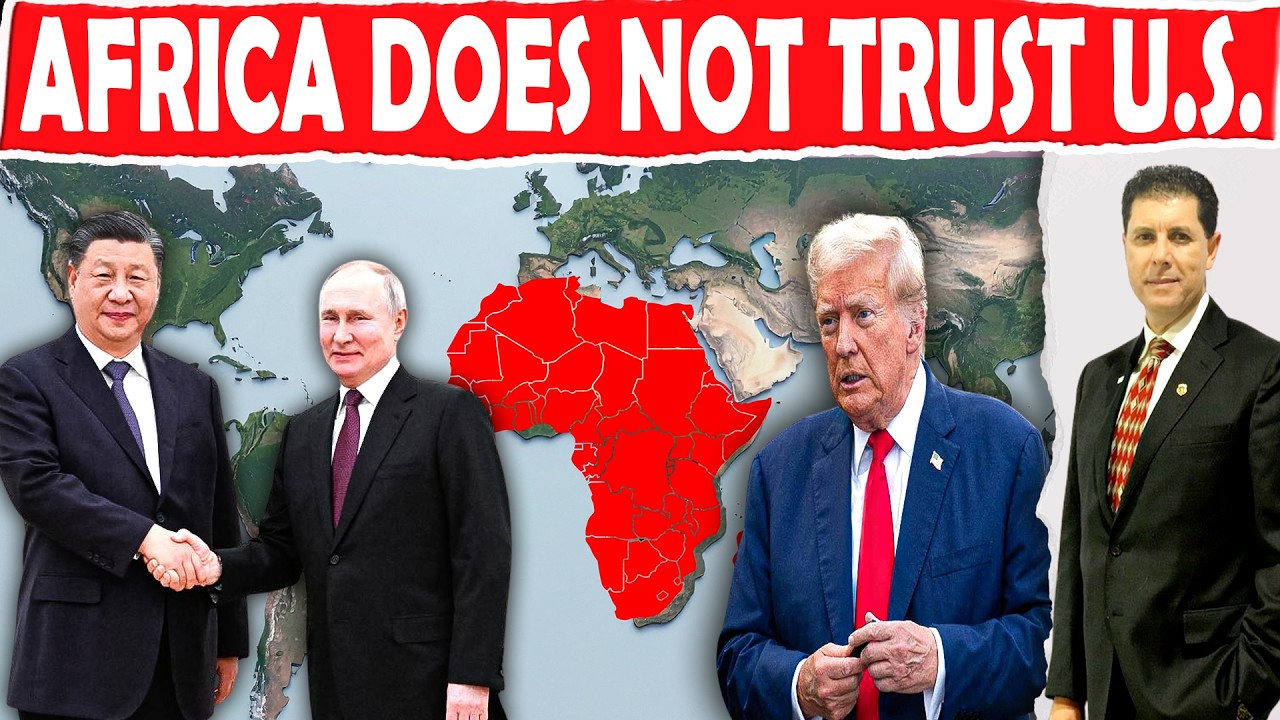
In this livestream, Dr. David Oualaalou provides a comprehensive geopolitical and economic analysis of the intensifying great‑power competition over Africa, focusing on the United States’ sudden policy shift under the Trump administration, China’s extensive infrastructure and resource investments, and Russia’s limited but strategic military and resource engagements. He begins with a brief geography and deep‑time history of Africa, tracing ancient civilizations, colonial partitions, and post‑colonial independence to contextualize current perceptions of foreign powers. Oualaalou critiques Trump’s rhetoric, highlighting inconsistencies and past US actions that erode African trust. He details China’s role as Africa’s largest trading partner, its Belt‑and‑Road projects, and counters the “debt‑trap” narrative with specific examples (e.g., Kenya railway, Moroccan high‑speed train, Zambian airport). He outlines Russia’s focus on arms sales and selective resource extraction. The core question examined is whether the US can realistically compete with China’s economic clout and Russia’s military foothold, given its reliance on soft power, historical mistrust, and internal challenges such as corruption, poverty, and infrastructure gaps. Oualaalou emphasizes Africa’s strategic importance—its demographic dividend, abundant rare‑earth and mineral resources, and growing intra‑African trade—as drivers of great‑power interest. He concludes that Africa’s future role in the 21st‑century geopolitical landscape will depend on how African nations manage external pressures while addressing internal development needs.
Chapters
Hello everybody and welcome to Geopolitical Trends, where truth matters. I'm your host, Dr. Oualaalou, excited to be with you today. I decided to do an analysis for you, uh, it's a geopolitical one driven by the changes that's going on on the global landscape from an economic perspective and a political one, that is, as to why all of a sudden Trump has sort of sort of reverse his sights on Africa, claiming that we wanted to cooperate with Africa. And all this has to do with the competition with China and Russia. So I'm going to be detailing for you a lot, a lot of aspects pertaining both to economics and geopolitics, but I'm also going to be providing you geography and history about Africa writ large. This will put things in perspective for you. So But before I'll do this, let me, uh, share with you one thing about some housekeeping. Uh, next week on the 22nd, I believe— let me see the calendar to make sure— uh, I'm sorry, on the 28th. So I will be having a conversation with, uh, with none other than James Bradley. James Bradley will be here next week at 09:30 AM Central Standard Time, because he's in the Pacific time, so, or the Indo-Pacific, that is. So I look forward, uh, to my conversation with James, because he promised us he would be here for a second part of the interview. We'll be addressing some issues or topics, that is. Uh, I have one headline for you, and then I'll move into the conversation about Africa. Now, Uh, this is Hassan Rashad. He is the head of the Egyptian intelligence services. So where is he now? He is meeting with Netanyahu in Jerusalem, believe it or not. So makes you just wonder. This is why I never— and I speak for myself here— I never trusted what the Egyptians are saying, the Jordanians, the Saudis. David Oualaalou, you name it, you got the idea. So he's meeting with, uh, he is meeting in Jerusalem, uh, uh, with, uh, Netanyahu. Yeah, Prime Minister, because, uh, as you know, the ICC, the International Criminal Court, refused to remove the case of the arrest, the arrest warrant on Benjamin Netanyahu. So even the US has threatened the court and so forth, which tells you, is this like a mafia style? You know, there is something called the law that applies to everybody. So however, the visit of the Egyptian, uh, intelligence chief, even though they said, oh, this is aimed at, uh, this is aimed at the some sort of working out regional efforts to consolidate the ceasefire in Gaza, because as you know, Israel have violated that already. No, it has nothing to do with that. They are using— they, some Arab, Arab Muslim countries using the Palestinian case just as justification to push their own agenda. So anyway, I wanted to share that with you regarding this. So all right, let's get into our topic about what I'm going to be talking about today regarding Africa and regarding Donald Trump's all of a sudden shifting wanted— not shifting— he's wanting to shift the policy of the US towards Africa. So what I'm going to do in this video, I'm going to sort of examine for you or provide you my own analysis about the intensifying sort of geopolitical competition between the United States, China, and Russia. I'm not surprised at this. I've argued this few years ago. As a matter of fact, I did a video with Dr. Stewart back then, about 5 years ago. And I mentioned in, in, in that video, I mentioned, uh, it's going to be over the next few years where we're going to see Africa becoming the really, really geopolitical hub for competition between major powers. So, and all this has to do with the United States now wanting to have influence and access, uh, across Africa. So, and with this analysis, I'm going to explore also the Trump administration's emerging interest because they wanted to reshape, uh, uh, US Africa policy. No, I don't think so it's gonna work anyway. But suffice it to say, I'll provide you the information and you reach your own conclusion. The question that becomes while I'm providing you this analysis is whether the US can effectively compete with China. Why? Because China has established a foundation in Africa through infrastructure investments on one hand, and Russia did it through military partnerships. So both countries, China and Russia, had something to offer Africa. The question becomes, is what are we going to offer Africa? You know, I mean, you look at now what's going on in Latin America with the failed assassination on Maduro, or attempt, whatever you want to call it. Uh, why are we even there? To begin with. So, because to me, the reason I decided to do this, and I did a reading on it last night, is I believe this analysis will provide you some sort of— will address fundamental questions about African trust in American systems or American leadership, that is. And whether— because we're gonna have to ask again the fundamental question also— whether this policy shift can alter the continent's dynamics, which has evolved over many decades. Because you all see where Africa is going right now, especially with the Sahel region. Let me bring the map here. You all see the changes that's going on. Even like when I was— and I just was in Morocco and I returned from there. As a matter of fact, Moroccan government this morning has agreed now to a new increase in its, in its, uh, spending for 2026. Allocating over $12 billion in both sectors, the, the healthcare and the education, which what the demonstrations were all about. I hope the Moroccan government will touch on the judicial system because it is corrupted. The judicial system is corrupted and needs some fixing in Morocco. But suffice it to say, for, uh, the US doing all this, we're gonna figure out how this is gonna evolve over time, and this is what I'm gonna be providing you my analysis about. So, but first, let me do some geography for you. Let me share the link— I'm sorry, share the, uh, screen with you. And I give credit to World Atlas for the map because I need you to see. I know it's not a, a specific country that I'm going to be addressing. No, it's just writ large Africa as a whole. So you'll see the— I know it's a smaller screen here, uh, this is starting from, uh, all the way from the Mediterranean. There's Morocco, Tunisia, and so forth, all the way down to South Africa, Lesotho, and Swaziland. So what's interesting about the continent of Africa— Africa geography is because it is defined by what? Its diverse landscapes. So you have the mountains, uh, the Atlas Mountains in Morocco. You have Kilimanjaro in, in the southern part of Africa. You have the desert like the Sahara. You have the large river systems like the Nile and Congo. All of this, this is what it's including Africa. This is why I wanted to do geography for you, because Africa, as I said earlier, is defined by its diverse landscapes that includes the vast deserts like the Sahara Desert, which is in southern Morocco, that is, and parts of Algeria on the other side, and Libya, and so forth. Then you have large river systems like the Nile and Congo, and major lakes like the one— like such— like Victoria. Victoria Lake is very, very known. And there is almost a prominent plateau in Africa. Africa is also the world's second largest continent uh, bisected by the equator, and it is home to diverse biomes including rainforests, savannas, and highlands like the Ethiopian Highlands, or Highlands, that is. So key features that includes the Great Rift Valley and mountains like the mountain of Kilimanjaro. Very, very interesting aspects for you to understand at least these aspects of the geography of Africa. And again, I'm going to just be brief into this, uh, even the, the history aspects of it. I will be, uh, brief into this. Now, when it comes down to the history of Africa, first of all, I need to let you know there are about 54 countries in Africa. When I say 54, I am referring to the ones that are officially recognized by the United Nations, you know. Of course, some sources may include additional territories within Africa to varying degree, uh, of recognition. However, they are not recognized officially, but that doesn't mean they don't exist. Except that what you need to know is that the 54 countries, it's the standard, standard number, for independent and sovereign state. That is very, very, uh, known. So this is what's important about this part here. Now, for the history of Africa, uh, when you think— I'm gonna share a map with you, uh, that goes back to— I hope I have it here. Uh, oh, I forgot to put the map, but I can, uh, just bear with me here a second. I'm gonna upload it quickly here. Uh, because you need to see this map. This map was drawn, uh, was drawn back in 1910. That's how far back it goes, right there. So why is this important? Because this historical map of Africa shows the possessions of the different European powers back in 1910, and this is what I'm going to be detailing a little bit more about the history of Africa that I believe will be worth you knowing. So, so, but I start with one fundamental, uh, uh, uh, statement. Whether you agree with it or not, it's up to you, but I, I've read it in many different sources, and that one is, as for Africa, majority of scientists when I say scientists, I'm referring to archaeologists and so forth. They all have formally concluded that it is— Africa is the birthplace of mankind. What do you think? Is it true or not? Please just, uh, say yes or no in the chat box. Is Africa, in your opinion, based on what you know, is Africa the birthplace of mankind. So, and I'm going to continue in my, uh, in my, uh, conversation here, but I will see your, uh, Francis Tango, you say yes. Uh, Muhammad Mazhardin, you say no. That, that's fine. Truth Seeker, you say yes. Uh, Son, uh, I'm sorry, Son of Albi, I'm sorry, it's more— the screen moves faster. You say Ibrahim Abbas, you say yes. Uh, Alistair, can you say yes and no, depends? Yeah, yeah, there's back and forth. That's why we're just sharing the knowledge here. So now, as large of a number of humans-like fossils were discovered nowhere else but in Africa. So we're found on African continent, and those fossils are dating back some 3.5 million years ago. So If you are to go back about 1.7 million years ago, yeah, early man spread out sort of throughout parts of Africa, and they became— just to survive, they had to become aggressive hunters, you know, because they lived in caves back then and used fires once they learned how to develop it, and their ability to create stones as tools. Just to survive is what's important. Then you think about, uh, the— some about 200,000 years ago, sort of the first inhabitants in Northern Africa, that's where they were, and across some parts of the Southern European continent. So there is also clear evidence that they had control of fire. Because they learned how to do it. They lived in caves because they managed to protect themselves from the elements. And of course, they had some sort of learn how to make veggie— vegetables and farming and so forth. So one of the most important, at least according to historical record, and I will share the link with you later on, important developments of a primitive man was the creation of stone tools. And this by about 5000 BC, before Camille. Farming was somewhat common in northern areas of Africa, northern part of the continent. So as people were growing crops and herding their livestock, this is, uh, this is part of, of what, what happened back then. So Then you go into the ancient African history, and this starts in about 3200 BC. And what is one known in this part of his— in this era, uh, in, in, in the history of Africa was the Egyptian culture that emerged. So because Egyptian civilization did bring a lot of changes to Africa, I know there is always that controversial issue whether Africa— Egypt is an African country or the Middle Eastern. Why Egypt is in Africa, I have no idea why they keep calling it a Middle Eastern. Egypt is not a Middle Eastern country in my opinion, but that's my opinion, so I respect yours. Suffice it to say that the Egyptian culture emerged along the lower reaches of the Nile River. This is why the Nile River plays a major role in the history of Egypt, and it was amongst the earliest civilizations. So, and that's where those tools that were made of bronze and all that became part of, of, of the Egyptian culture. So Egyptians developed— of course, not all of them, because even though some historical record mentioned that, which I have to question that mentioned that Egyptians developed mathematics. I have to challenge a little bit that because it was the Persians, especially al-Khwarizmi, that developed the algorithm and so forth. That doesn't mean Egyptians did not evolve in mathematics, so they did to a degree. There were also some innovative systems of medicine, uh, irrigations, and agricultural production techniques. The writing, the hieroglyphic, hieroglyphic writings, of course, was part also in Egypt, you know. And also the first ships were developed within the Egyptian civilization. So suffice it to say that the Egyptians left a lasting legacy upon the world from that time back then. Then around 600 BC, and we are moving towards modern day. 600 BC, the use of metal— that's the metal tools spread across, uh, the, the area, and mainly in North Africa. So, and gradual spreads all the way to South Africa. But then you have the Phoenicians, uh, when, uh, they came to power, uh, an enterprising maritime trading culture. Definitions we know. And this culture, this maritime— by the way, just for you to know, it took from Lebanon, modern-day Lebanon, and spread all the way across the Mediterranean. Let me show you the map here just for— to put things in perspective for you. So all the way from, uh, you look at across the Mediterranean, all the way in this area here. From Lebanon. Lebanon in, in the Middle East. So, uh, and from 1500 BC all the way to 300 BC. So that— this is when this maritime trading took place. And according to historical record, in 1814 BC they founded the city of Carthage. Where is the city of Carthage located in modern day? Does anybody know which country it's when? No, it's even— it's in Arabic, or Carthage. Carthage or Carthage. Which country? Algeria? No, no, good try. I'm glad you tried, but no. Jigdo, which other country? I'll give you a hint, is in North Africa, of course. Oh, Infidel, you got it. Infidel, you got it. In Tunisia, in Tunisia, the city of Carthage. It's well known, especially among the North Africans, or some people who study history will know. So suffice it to say that Carthage city was established in Tunisia, in North Africa. Only here is the— here's the interesting aspect— only to be destroyed by the Romans in 146 BC. Because remember, the Roman Empire expanded all the way from Sevilla— that's where my ancestors came from, Sevilla in Spain— all the way to the other side of the world. So they were— they crossed through everything. So what's important about this, and the reason I wanted to bring— and I'm not gonna go through this because, uh, literally I will need about 5 hours to cover all this, so I'm gonna be just brief, very, very, very brief in this. Suffice it to say, I'll mention a few historical aspects to put things in perspective. So you think about the Egyptian continued their spread of their culture across Northern Africa back then, and of course through this the kingdoms were created. And where were created— a lot of people do not know the history, for example, of Ethiopia. Ethiopia used to be a kingdom. So they were created in two, in Ethiopia and Sudan. So, so however, the— at that time, the growing Roman Empire continued to expand its influence, and in 30 BC, Egypt became a province of Rome. Morocco became also a province of Rome in 42 AD. This is why understanding the history of Africa will put things in perspective for you. Sadly for us— when I say us, I'm referring to Washington politicians— have no clue about history prior to structuring or formulating a policy towards a country. We did the same mistake in, in, in, in when, when, when we invaded Iraq. And I remember I argued in a report, you do not want to invade Iraq. First of all, you need to understand the history of that country. And my sort of advice was ignored. We all know the outcome of that. So now you have to think about the fall of the Roman Empire and when this starts. That was almost, almost during the time of the Middle Ages. Began. That's when the Roman Empire collapsed. And who came after it? The Arabs quickly took their place on the continent. So the Arabs came over and took over. Because remember, the Roman Empire was extended from Sevilla in the eastern part, in Andalusia, that is in Spain, all the way, all the way to almost closer to Southeast Asia, to a degree. And in 698, 700 AD, they invaded Tunisia, or Tunis, and Carthage, and soon controlled the coastal North African area. This is in the map right here, you see it. So this is Tunisia right here, this Tunisia, small country And Carthage is right here on the coast. It's not here. You see Tripoli and you see Tunis. Tunis, the capital. So Tunisia is the country. So just for you to understand difference there. So, and the Arabs were of course Muslims. So, and most of North Africa of course at that time converted to Islam. Ethiopia was the exception. So a lot of people do not sort of realize that one. So, so some kingdom emerged in Africa writ large. So, and that is when they traded with the Arabs using gold plus some sort of valuable commodities. So there is, however, one particular aspect during this time which was the slavery. So one of the first kingdoms during that time was none other than Ghana. So, which is located in what is now southeastern part of Mauritania and western Mali. Let me bring up again the map. I don't know if you see, there is Mali, there is Mauritania, and Ghana. That's where it was located. So the empire grew rich from the trans-Saharan trade in gold and salt, but then lost its power in the 11th century. You should know what happened in the 11th century. So this is what's important to understand, these aspects of it. Then you have, as I mentioned again, additional kingdoms were emerged, like Benin and Mali. Both became rich also through trading, not war. Non-invasion, not conquering other countries, is through trade. So, and mainly they were trading in gold, uh, and, and salt, and of course slavery, because that's when at that time slavery took off and it became part of the trade. So, and most of the kingdom, like most of them before them, uh, on any continent for that matter, not just in Africa So they were invaded and then destroyed. That's just part of the history. So I'm going to bring one city that you should know about. It's Mogadishu in Somalia. You all remember the movie Black Hawk Down. I had a colleague who was there at that time, and it wasn't a pretty scene. And of course, what do we expect? We go to countries and invade, and I think they're going to welcome us with open arms. No, it doesn't work that way. So Mogadishu, why is that important? Mogadishu, which is now the largest city in Somalia, was settled by Arabs first, not Somalis. There was Arabs who traveled and traded on the east coast of Africa. And as a matter of fact, the Arab— and I remember this way back when I read history— Remember, they reached as far as Zinjibar, Swenao, which was used at that time as a base for travels between Middle East or Western Asia and India. That's how far back it goes. So then, then you think about, of course, the, uh, the, the, uh, Cape, uh, of Good Hope, then you have the River of Congo, and so on, so on. Again, I'm going to just be brief on this. Suffice it to say, I have to talk about the African colonization because it's very, very important to understand because where Africa is today and trying to free itself from the shackles of colonialism, and yet the collective West does not want it to do that. This is why, I mean, if you are an African, you'll be asking yourself why the heck America all of a sudden is interested in Africa. So, so you go back to 16th century, and that is where sort of certain changes on the ground start to take place in Africa. And this of course came or began with the emergence of the Europeans. Europeans doing what? They weren't doing trade, they were trading in slavery. So they took the African slave, transport them to America for profit. So, so a slave purchased on the African coast, uh, coast rather, for the equivalent, the equivalency of 14 English pound, the equivalency of $14. So, and sort of they entered into bottled good could sell for about £45 in the American market. So it's, it's a dark, you know, for us to learn, it's a dark history, but we have— we can't shy away from not stating that. So, and this is one of the important aspects to it. So this is why the British, because there is best known method of commerce at that time. So, and it's called the triangular, triangular trading system. Remember this if you ever come across in your reading, you see the term triangular trading system, that means Britain, Africa, and the US in a form of triangle. That's what it means. So it involved the Britain, uh, British and other European countries manufacturing goods which were shipped to Africa, then slaves from there to the West Indies, and then sugar and other products back to Europe. This is why, for example, France, uh, is pissed now. Uh, Macron is kind of pissed why he was kicked out of Sahel. Why? Because he has no access anymore to raw material to fuel the French economy. And this is why you're seeing France going down. And as a matter of fact, the whole European economy is collapsing, and I will do a video for you in due time about that one. So, so then you think about, uh, uh, uh, uh, from 16th century all the way to 19th century. Why is this important, this time frame? Because an estimated 800,000— between 800,000 to 1.2 million people were taken captives as slaves. So, and of course, the pirates were also involved in, in, in, in, in this, uh, ventures, that is, impacts on the continent. And that one picked. It really picked in the 17th century. So, and this is where you have, for example, in the 16th century you have the Portuguese settled in what is known today as Angola. And if you know anything about Angola, what is known for— then later on the Dutch found the colony in what is now known as South Africa. So, so you have the French, you have the British, you have the Dutch, you have the Portuguese. So, and there is where some strong movements start to emerge in the 18th century to fight this slavery. France, during this time, became one of the first countries to abolish slavery in 1794. Britain banned trade in slavery in 1807. So, but it was not officially abolished until 1848. So, and in some parts of Africa, as a matter of fact, uh, slave-like practices continue to this day. It's sad, sad to see, or sad to hear about all this. So, and this is again, when you think about Africa as a continent. This wholesale colonization of Africa by European countries began in 1814, to be exact. Uh, what I shared with you was pre-1814, because this is when the British snatched the Dutch colony of South Africa, carved up like a pie. Yeah, they looked at the country like a pie and start carving it up. So the Brits, the Dutch, French, German, and Portuguese, all of them grabbed all the valuable pieces. And of course, by the end of the 19th century, from Angola— let me see if you can see it on the map. I doubt it, but, uh, I'm gonna see if I can point it for you. Now you won't see it here. It's a little bit south here. So Angola, from all the way from Angola all the way to Zimbabwe, and from Botswana all the way to Niger, the continent was now all but controlled by European powers. So, and of course, in the early 20th century became the land grab Because it continued, this land grab continued by the British. I remember watching a historical documentary about the, uh, what's her name, Elizabeth the— she died of Britain— when she flew to Africa. I mean, that was back then, that was part of this time frame when the British sort of snatched, uh, uh, the land, because he continued to do this as Britain took control of Egypt. This is what's important to understand, why there is a push by collective West against the developments of Africa. So, and of course, in 1920— well, and I'll conclude with this— 1920, the, the forced occupation of African lands began to sour in Europe. So, and change was about sort of over on the horizon. So Africans were also driven by their passionate desire for independence, and the movements for some became unstoppable. And by mid-century, the 20th century, most of the continent was independent, with Angola because most of them, at least to my knowledge, for North Africa in the '50s, early '60s. But for Angola was the only exception, its final independence took place in 1975. That's how far. Then come the post-colonial Africa, and this is where you start to have, for example, although Africa remained the world's poorest inhabited continent, there are many bright spots in this land. For over sort of 1 billion people. Yeah, there's over 1 billion people, so, and over 2,000 languages that includes dialects. So, so significant economic and social gains have some sort of, uh, uh, took place, start to emerge to the surface. So over the last few years, when I say last few years, I'm referring to the few decades And that's this kind of social gain and economic changes started with some South Africa, Nigeria, Morocco, and Egypt leading the way. This is why for the case of North African, they wanted to kick France out. As a matter of fact, the case in Morocco now is trying to replace French language with English. And as a matter of fact, it's better to do so. So today, the 54 African countries have a great potential, but this question must be asked: can it change soon enough to meet the needs of its people? And this is exactly what I'm going to get in, into my analysis. Let me just play this clip here, then we'll move on. Liking this video so far? Don't just be a watcher. Go ahead and hit the like, share, and subscribe button, and don't forget to tap the bell so you will not miss any of my videos or live streams. This way, you will be supporting a channel that stands for the truth and objective reporting. The choice is yours. Thanks for your support. Indeed, why the United States all of a sudden is, uh, wanted to turn its attention to Africa. You know, first of all, you have to think about the two countries, the other two, China and Russia. But mainly we're going to talk— I'm going to talk about China, then I'm going to talk about Russia. So for China's developments in Africa, which by the way is characterized by one main aspect And, and I'm going to share some pictures to make my point, uh, you know, just look at the picture and reach your own conclusion. And what is characterized by this? China's development in Africa is characterized by its role as Africa's largest trading partner and a major investor in its infrastructure. I know the IMF and the World Bank have been spreading these rumors of the trap, the, the debt trap by China. I'm here to tell you based on facts, you know, there is no debt trap because I was aware of the case in North Morocco when China wanted to develop the city of Tangier and Morocco was pressured by the United States and the, the Moroccan government said to Chinese, no, we are not interested anymore. And what did the Chinese do? They said, okay, that's fine with us, you don't want it, that's fine. We moved on. So, which is by the mistake on part of Morocco, in my opinion. And speaking of Morocco, by the way, before I forget, do you guys know that Morocco has the fastest speed train in Africa? Speed train that we don't even have here in the United States. So, so can you imagine where Morocco would have been had it get involved with China's infrastructure development. It's never too late, but Moroccan government will have to make that decision. Suffice it to say that Afri— China's investments— and there is no this debt trap nonsense, because I'm going to show you images of infrastructure that is completed by the Chinese, you know, in coordination with the local governments. So, and China has always been a major investor in this infrastructure. And also, there is a reason also why China's doing this. China's not doing it because he wants to. Every country, when it gets involved in projects, there is a reason for it— national strategic interest. China is no exception. And that is because China's demand for resources. China needs resources for its developing— for its economy. Look where China is today regarding the rare earth elements. And as I said last time, I am preparing a video for you, recorded one, by the end of this week. Uh, the editor is working on it, putting it together, uh, in which China is choking— and I use the term— is choking the US regarding rare earth elements. As a matter of fact, this morning I just found out that the White House is reaching out to Malaysia for access to rare earth. It's going to become very, very tricky for Malaysia because China and Malaysia are getting closer as far as infrastructure. And we know that the US wanted to use Malaysia no more, no less. So, so to go back to my topic about Africa here, for China is demand for resources, the new markets, and of course the geopolitical influence. This is what's driving the United States towards Africa right now. So, and the key projects that China has been involved in and developed and completed, we're talking about a major transportation infrastructure like, for example, the Kenya Standard Gauge Railway. And I have a picture of this one here, right here. China developed the railway system inside Kenya because Kenya didn't even have this before. China went ahead and developed it. So in addition to other numerous developments of ports as well as energy an IT project. Uh, I had to read up an analysis by a think tank here in the US and provided certain— the, the, uh, the involvements of the sectors. You look at all this where the involvements is, and that should give you an idea where things are. And this is why you look at the investments that China and the offer, the opportunities what these investments offer, these job opportunities for modernization, for also economic growth, but it also contribute to the growing or the growth of Africa. Of course, the West, and I know this for fact, the IMF and World Bank will always include that trap into the narrative to mislead the masses. Sometimes you see it that way, sometimes you see it as a debt burden, when none of those exist. There is no debt trap and there is no debt burden. What China does, it come to the country, they sit down, they negotiate. Are you willing to take a loan? Here are the terms. If you are able to repay your loan, we'll move forward with it. If you are not, then we're gonna have to figure something. As a matter of fact, I was aware of last year China renegotiated its investments with some countries in Africa, restructuring that investments as far as the, the interest on. The Russians have forgiven certain debts. China also did in some countries, to my knowledge. So when you think about Chinese involvement in Africa, for, for example, infrastructure, you know, you think about the transportation. Like I always say, for an economy to develop, you need to have an infrastructure. So you look at what, what the Chinese have developed for certain aspects in, in, in, uh, in Africa. Because China is the main founder and builder of transportation infrastructure, like railways, like, like highways, like ports. So that includes— and I'm going to show you a picture of Mombasa. This is in, uh, I have one picture first of all of Zambia. This is in Zambia. So what you're looking at, you're looking at the, uh, uh, the— yeah, this one that was developed in, uh, in, in, in, in Zambia. There was the Chinese that built it, not the Americans. Then you think about the idea of the largest bilateral trading with the African continent. So, so you think about the foreign direct investments in Africa for the sake of improving infrastructure. And of course, China has reasons for getting involved into this, and that has to do with economic interest, the strategic interest, national interest, like every other country. But as long as it is done in a fair manner. You don't, you don't enslave the country. You don't take its resources for your own use and leave them with nothing. You all remember, and I disclose this for the record, when France was taking uranium from Niger, selling it on the global market for almost $200 a pound while giving the Nigerians uh, sort of the Niger— in Niger, I'm sorry— or giving them about, uh, like $10 a pound or so. That belongs to them. Why are you shortchanging them? At least, at least China is not doing that. This is where the difference. So, and that's again, where do you see, like what I mentioned earlier, China has completed numerous infrastructure, uh, inside, inside Africa. There is one example right here. This is the railway, like the Kenya Standard Gauge Railway, and the Lagos-Ibadan Railway. This is in Nigeria. So, which by the way, this one significantly cut travel times. So between, in, in, in these locations, that's the important aspect. You think about, uh, the exterior of the international airport. Let me show you right here. This is in Zambia. What you're looking at— and this, by the way, was completed in 2021— this is the exterior of the new Simon Nwasa Kipapwe International Airport, which was financed by China in the province of Zambia. And, and I give credit, by the way, to Zhao Yupeng. That's the image belong to that individual. So then you have also, in— because China wasn't involved just in, uh, in, in a railway, they were involved also in renewable and technology. And I got a picture of Egyptian students right here. What you're looking at, those are students, uh, learning about the hybrid renewable energy. Which one? Systems. The systems was backed by China, by the way, and it was backed by China at the University of Ain Shams, the university in Cairo. So, and there was a forum on China-Africa cooperation. So that's just— this is again, uh, and I give credit to Ahmed Goma, uh, for this picture here. So This is again to highlight to you the investments in technological training in Africa as a way of boosting development by plugging skill gaps. So, so you see something like this and you ask yourself, what do we have to offer? What is the United States offering? So, so, and that leads us to the key question: can the United States compete with China and Russia in Africa? So no, because you think about, once again, uh, I just don't see how the US, uh, will, will play, uh, this particular role in Africa. So I'm going to share a clip with you about Donald Trump talking about Africa and let you take a listen here. All right, let's take a listen to this.
So Donald Trump is saying, from AID to trade, we had AID, or aid as we sometimes call it, right to trade. And trade seems to be a foundation that I've been able to settle a lot of these disputes, like as an example, India and Pakistan.
Oh no, that's a lie. You didn't— this— you didn't settle that. You know, I don't get it. I don't get it why Trump keeps getting credit for something he didn't do. The reason the issue between India and Pakistan settled is because Pakistan defeated India and India didn't want to move forward any longer. Has nothing to do with Trump. So the Pakistani developments of its Air Force dominated the, the, dominated the, the Indian forces. That's simple as it is. So Trump keeps lying about this nonsense stuff.
Uh, Kosovo, Serbia, he said you guys are going to fight.
Once again, has no clue. Donald Trump has no clue about what took place in Kosovo, what took place in Serbia, and the role of NATO that plays into the conflict in itself. So he just talks on the top of his head with no facts and no understanding and no knowledge of the real issues, what they are.
We're not going to trade, and we seem to be quite successful in doing that. To that end, we have closed the USAID group to eliminate waste, fraud, and abuse, which was tremendous waste, fraud, and abuse. And we're working tirelessly to forge new economic opportunities.
And what economic opportunities when you are shutting down the average American citizen here who is now struggling to purchase items because of the tariffs that Trump himself imposed, which is a failed policy to begin with? You could at least— well, wait until you guys see what's coming. America regarding the financial aspects. And I might share this with you later on if I have enough time, uh, on, on, on, on this live stream here involving both the United States and many African nations.
There's great economic potential in Africa, uh, like few other places in many ways. And the long—
he is right about the potentials in Africa like any other places. That is true. It's because of the resources, but also because the US is realizing that it's playing catch-up with China and Russia, mainly China, because of the economic aspects of it.
In the long run, this will be far more effective and sustainable and beneficial than anything else that we could be doing together. I'm eager to work with each of you on your vital issues and also to just—
okay, I'm gonna stop right there. Now, you work with African vital issues. What vital issues are we talking about here? Is the idea of, uh, African themselves, are they going to trust what Trump— of course you have some individuals in Africa that will rather have rub shoulders with Trump and all that, or be bribed like the one that, uh, in, in Nigeria, you know, that guy in Nigeria, it's Tinubu. Oh man, if you only know the massive corruption behind the scenes. But suffice it to say, we're not talking about that right now here. But the idea of how, uh, Africa now— because we have to think about the US capacity to compete with China and Russia, it's, it's very complex. It's very complex because you're gonna have to think about what kind of metrics and what kind of time frame are we talking about. You know, this is not an easy thing because China has substantial advantages, uh, in, in Africa, because China has invested not just last year or the year before. China's been investing in Africa's infrastructure through the BRI, the Belt and Road Initiative. So what makes us think that we're gonna just overnight, uh, turn over all that stuff? Yeah, because Chinese companies are heavily involved in Africa regarding mining, regarding manufacturing, regarding infrastructure projects. Then when you consider Russia's role, you know, maybe Russia's role is more limited economically speaking in specific area, but Russia has some sort of major military partnerships with some African countries, no, the arms sales relationships that exist, and some also resource extraction interests between the two. You think about, for example, in Central Africa. So, but suffice it to say, which is a fact on the ground, that Russia's economic footprints are very small in comparison to that of China. So for the United States, it's going to have to have some starting point. And where will that starting point be— is going to begin with or start from? So it's going to only be left with soft power, and that soft power is not going to cut it. It's because what Africa needs— Africa needs development. They don't need soft power as far as cultural aspects of it. And second, What makes us think that Africa is going to welcome our culture the way it is? I mean, we say one thing and do another. You know, we couldn't even hold our end of the bargain regarding contracts or international engagements. So, so yes, we might have some sort of a military influence that we could compete with the Russians. We could, to a degree, compete with the Chinese regarding the trade relations, or we could also compete with the Chinese and the Russians regarding access to resources. But the Chinese have gone so far, it's too late. We will be just playing catch-up. It's the same trend that I am seeing moving forward regarding the rare earth elements. So, and this is again Where it's going to be— is there a specific aspect of this competition that we might be thinking about? Where can we compete with? In trade, we won't be able to. In military presence, we won't be able to. So because we were asked to be— to leave, uh, uh, uh, uh, the Niger, remember, they gave us a, a time frame and said, we need you to pack and leave. It's their country. So where we get technology, you know, are we better than the Chinese? I don't think so. So resource access, the Chinese will do it far better. Then comes the key element, is that whether Africa is going to trust the Americans or not. And most of the— if, if I am to ask anybody in the street, if I step out and I say, do you think Africans going to trust Americans? The answer is going to be no. This is the same president who called Africa a shithole. Pardon my language. All of a sudden you want to trade with them? Do you think Africans forgot what was stated? You insult people like that and all of a sudden you want to sit down and do trade with them? That just, just doesn't make any sense. Because they— this is the reason why I shared the history with you at the beginning, because historical context matters significantly. For you to understand the, the, the complicated legacy of the US in Africa. You think about the Cold War time, you think about the support we provided certain authoritarian regimes. It's no different than what we did in Latin America and we continue to do. So this history in itself is going to shape the perception in ways that won't be easy to overcome. And this is the shortcoming of the US administration in, in, in sort of getting embarking on certain initiative. You think you're gonna just walk into Africa and say, hey, we want to trade with you, we want you to replace us with the Chinese, you know, get rid of the Chinese and put us there? And the Africans are going to say, sure, America, welcome. No, it's not going to happen, even though the trust level is going to vary from country to country. I'm not denying this because some African nations have some sort of a strong, long-standing relationship with the US. I mean, you think about Egypt, for example, and as I mentioned to you earlier in the headline, the head of the intelligence service of Egypt is going to Jerusalem to meet with Netanyahu. I mean, you should see the writing on the wall right there. Is he going to take marching orders? Most likely the case. It's no different than what his predecessor, Amr Moussa, who was the head of the Egyptian intelligence, used to do. We were aware of it. I was in Washington. We kind of were aware of the movements of the intelligence service of the Egyptians, and because we coordinate with them, we coordinate for them with the Israelis and vice versa. So, and that's why this trust level, uh, it's not going to be— because you think, for example, think about the US involvement, uh, in, in some regions and the perceived double standards in the foreign policy. All this, what it's going to do, is going to generate distrust. And we don't seem to think logically and pragmatically about this kind of stuff. Second thing, one thing that is not going to work to our favor is now you have Africa changing generational and demographic aspect. The younger Africans, you get like, uh, Ibrahim Traoré and so forth, he just want to move his country forward. He doesn't care for America. As a matter of fact, the US reached out to him— and remember when, when the delegation of their members of Congress went over? And I did a video for you about that. He didn't want to meet with them, and the US flipped it. It said, oh, we didn't want to meet with Captain Ebrahim Traoré. No, no, no, no, no, no, no! It was a lie. It was Captain Ibrahim Traoré who did not want to meet with the American delegation because he had no interest. So And this is where you're gonna think in terms of this young African that are educated. So, so, and you think also about the urban population. They want to move their country forward because their views about Africa today differ from what it was 15 years ago, 20 years ago. The older generations used to think differently. The rural population used to think differently. And of course, who do you have to thank for that? The Chinese that paved the way for infrastructure inside Africa. So yeah, the older generation, some of them were admiring the American institutions or maybe even the education system. Now the scale has tipped off in favor of China. And I was in China and I saw and I read where China is going, uh, when it comes down to education, for example, technology, and so forth. So whatever the case might be, majority of Africans remain skeptical about the US motives in Africa. And this is why this trust, uh, the reality is that African nations and individuals are pragmatic, so to speak. Yeah, I work with the Americans, which is nothing wrong with that. You still can conduct a business, but it's going to be on your own term on certain issues. But they're gonna— in leaders or young leaders, they're gonna maintain some sort of skepticism about overall intentions of the United States. Yeah, it's, it's no more that blanket trust And it's more about transactional relationship with varying degree of sort of a confidence. This is why they went ahead and kicked France out. So, and this leads me as a geopolitical analyst as to the fundamental question— again, another one— is what role Africa is going to play in this century, 21st century, both geopolitically and economically. It's a question that we cannot ignore. So Africa rules in the 21st century is becoming increasingly significant. You know, of course, in certain Western capitals, the London, Berlin, Paris, Washington, Ottawa, they still saying, oh no, it's not doing much, because they underestimated Africa in the geopolitical discussions. I don't, because I do see the role of Africa in also contributing— I won't use the term influencing, but contributing, contributing to the geopolitical trajectory of the 21st century. Because Africa, as I mentioned earlier, is a battleground of great powers competition. This is the reason why we are going, wanting to go. So you're looking at 54 countries, uh, sovereign states, over a billion people, which making it demographically very, very crucial. A great market. If you are a CEO of a company, you're gonna have to think about the African market. So, but you have to think also about how Africa can move in this geopolitical trajectory by having control over African alliances, military bases, and of course voting blocs on the international institutions, because those are matters of great matters to global politics. This is what that role is going to consist of. Of course, you have the US, China, and Russia, and to a degree the European countries, which to me, the Europeans Uh, and again, I'm going to do a video for you. Suffice it to say, we'll, we'll, we'll include them in this conversation about the European powers, that they all compete for influence in Africa. So, and because when you consider Africa's vast territory also offers a strategic positioning, this is why you are seeing, for example, Morocco dispatched its foreign minister to Moscow 2 or 3 days ago. This is why you see NATO reaching out to Mauritania, wanted to do some training exercises near the Sahel region. When you see the map, you see why. Here is Mauritania, and they wanted to do, uh, the, the, the training exercises right here at the— right above Burkina Faso. You know, with Mali, or near Mali rather. All this stuff doesn't happen in a vacuum. So because now what you are seeing is you're seeing African nations asserting their own agency rather than simply be passive recipients of external influence, which by the way reshaped how geopolitics operates on the continent. The young African leaders saw that their countries for the last 50 years haven't— they have massive resources but they are not benefiting from. This is no different than what's going on in Latin America or what's going on in West Asia or Middle East. I'll give the example of Iraq. Iraq, you know, you guys know how wealthy Iraq is regarding its oil. And yet the people living in poverty. Why? It's because we control the, the profits of the oil sales, uh, for Iraqi sales on the international market, and we put them in an account in New York City. Why? It's not ours. When you consider the economic aspects regarding Africa, as I mentioned, this, this role in the 21st century is going to be both on the geopolitical and economic trajectory. On the economic, uh, aspects of it, Africa holds some sort of enormous potentials. And you know why? Because it's not fully developed yet. I mean, consider, just think about it, if it is fully developed, if all the resources under its ground has been extracted and used to develop the country. The continent Africa has so much natural resources that has not been tapped into yet. You're looking at oil, you're looking at minerals like cobalt, lithium, which are critical, by the way, for batteries, as you know, technology, smartphones, and so forth. Agricultural land, they even exist in Africa. A rare earth elements. And if I am to guess why the US is shifting, this is because of rare earth elements. That's one of the key why we wanted to go. And the reason for all this is because the global demand for these resources is kind of— is growing, especially when you consider what's going on with the energy market. Or the power of AI. So in this context, or within this context rather, Africa becomes economically very important to global powers. And Africa has one thing to its advantage, is a vibrant young demographic dividend, and that in itself could drive the economic growth only in one condition: if it is properly harnessed. And how it's going to be harnessed? Through education and job creation and training. And this is exactly in the case of Burkina Faso what Ibrahim Traoré is trying to do— educate the local population. They can ask China to build them a university, and they will. So, but let me remind you, despite what I shared with you, Africa still struggle with poverty. Still there is an infrastructure gap. Still there is governance challenges, because again Corruption is— if you get rid of corruption, you get rid of a major, major problem in the structure of a government or the future of a country. Corruption is one of the things. I mean, I look at how China's dealing with corrupted individuals. As a matter of fact, and I'm going to share this with you even though it's not part of this conversation, but And I'll be honest with you because it's my community and I'll be straightforward about you. I was aware, for example, of the tensions that was going on between President Xi Jinping and some generals inside the Chinese military. I didn't want to talk about it at that time because it was evolving. As a matter of fact, 3 days ago, the Chinese purged 9 top generals because that was during the investigation phase. And also these ties to corruption, whatever you want to call it. My point is, you look at how China dealing with corruption. So this is why the country is moving forward. Africa will benefit if it embarks on something like this. Will they do it? I don't know. I can't answer that question. And that is, again, this is, this is the paradox that exists regarding Africa. Africa needs to get rid— they need to get rid itself of corruption first, and second, poverty, and third, close the infrastructure gap. So it's not a problem about foreign direct investment, you know, foreign investment. It's not the, the, the FDI, foreign direct investments. It's not a problem for Africa. It just needs to get its act together. And this, you look at it within the, the emerging trends regarding this approach. So when you look at intra-Africa trade, is growing. We look at technological adoption. Speaking of intra-African trade, I'm aware again of a project between Nigeria, I believe, and Morocco for a pipeline. For gas. You know, makes you just wonder where the, uh, sort of, uh, who's going to undermine something like this? Because if you get the pipelines through Morocco all the way to— because you look at the locations into Europe, Morocco is in a strategically located location. That's what I'm saying. You think about this big picture. The intra-trade is growing. Technology adoption in Africa is accelerating. So, and of course, you're looking now at African nations already negotiating some sort of, uh, uh, with other countries, and they are negotiating from strength, not weakness, because they are in a strong position after what happened in the Sahel region. Because the terms are no longer dictated by outsiders. And if what Africa is concerned about, if the US gets in, is start dictating the term. So the 21st century, in my opinion, will be likely one where Africa's role is going to expand significantly. Whether that's going to benefit African people themselves depends partly on how African nations manage these external pressures in addition to the internal development. So it's not going to happen overnight, of course, but so far they are on the right track. And again, I found myself thinking— and I'm going to close with this— I found myself thinking about really what could motivate the US all of a sudden to shift its And I go back to the rare earth elements. If, if the US is reaching out to Malaysia, if US is already pressuring Australia, Africa has vast access to, uh, rare earth elements. So, but there is one thing that is sure, is that China has demonstrated, my opinion, that it is willing to take on a strong stand against the United States in order to achieve its long-term goals. And make no mistake about it, China is in possession to actually stop everyone's industry. That's the reality the Trump administration did not factor in when it embarked on this hyper— sort of failed policies on tariffs and so forth. Cold water. Trump administration doesn't think strategically. They don't think long term. That is where the shortcoming is. And I am going to end right here. I think I talked enough. So anyway, hope you enjoyed listening to this. Oh my gosh, I gotta say thank you to Kevin Baptist. You know, I'm gonna share this, uh, with the community right here. Kevin, thank you so much. Uh, US has always sought to secure its primacy through war, whether economic or narrative. China and Russia have taken an approach to Africa that benefits the continent and themselves by respecting the sovereignty of the motherland's nations. I couldn't agree more, Kevin. You are spot on. And that's what prompts me to do this video for you. I wanted to provide you this analysis. Hope you find it interesting. Please hit the like button and make sure to share this video with others. Once again, thank you very much, Kevin, for your generous Super Sticker. I'm very, very grateful to you. So, and to the community, I would greatly appreciate if you could support the channel should you decide to. You know the type of information that I provide you here. This is not something I, uh, talk on the top of my head. I conduct research. I, I spend hours just reading stuff because I want you to have, uh, the accurate information, and I want you to learn something. I'm learning from you as well. I want you always to know, in the community, it goes both ways. You know, that, that, that's a fact for me. It's, it's the way— that's the way I operate. It goes both ways. So, so I'm very, very grateful if, if you can support the channel Uh, is because I don't have some major sponsors, whatever. Yes, they reach out to me once a while to do analysis for them according to my term, not theirs, and, and I'm willing to do that. But as far as the channel in itself, I would greatly appreciate if you can support it. So once again, I will be working on, uh, uh, setting up the, uh, the interview, uh, with some other guests. Uh, I, I sent, uh, I sent emails and so forth. I'm waiting for them to reach out. Just remember, next Tuesday, which I will remind you— I know it's still too early, but I like to get ahead of it— remember my upcoming conversation with James Bradley. We're not going to be talking about just the legacy of his dad. No, we're going to be talking about really some interesting topics. You will be very, very— uh, uh, uh, it will be worth your time. Take my word for it. So And I look forward to seeing you next time. As always, remember, geopolitics impacts your daily life in more ways than one. Till next time, bye-bye.
More from David


Beyond the Single Actor: Why the Gulf Isn't Choosing Between the US and China


Iran, Iraq's Militias, and the Houthis Are Coordinating! This Changes Everything




Who Controls the Next Decade's Resources? Latin America and Africa's Geopolitical Crossroads

The Chokepoint Trap: How Washington's Stupidity Triggered a Cascade That Now Controls the World

Trump Spooked as IRGC Unveiled dual-use SLV, Deployed Ghadir Mini-Subs & Hinted at Tactical Nukes!
