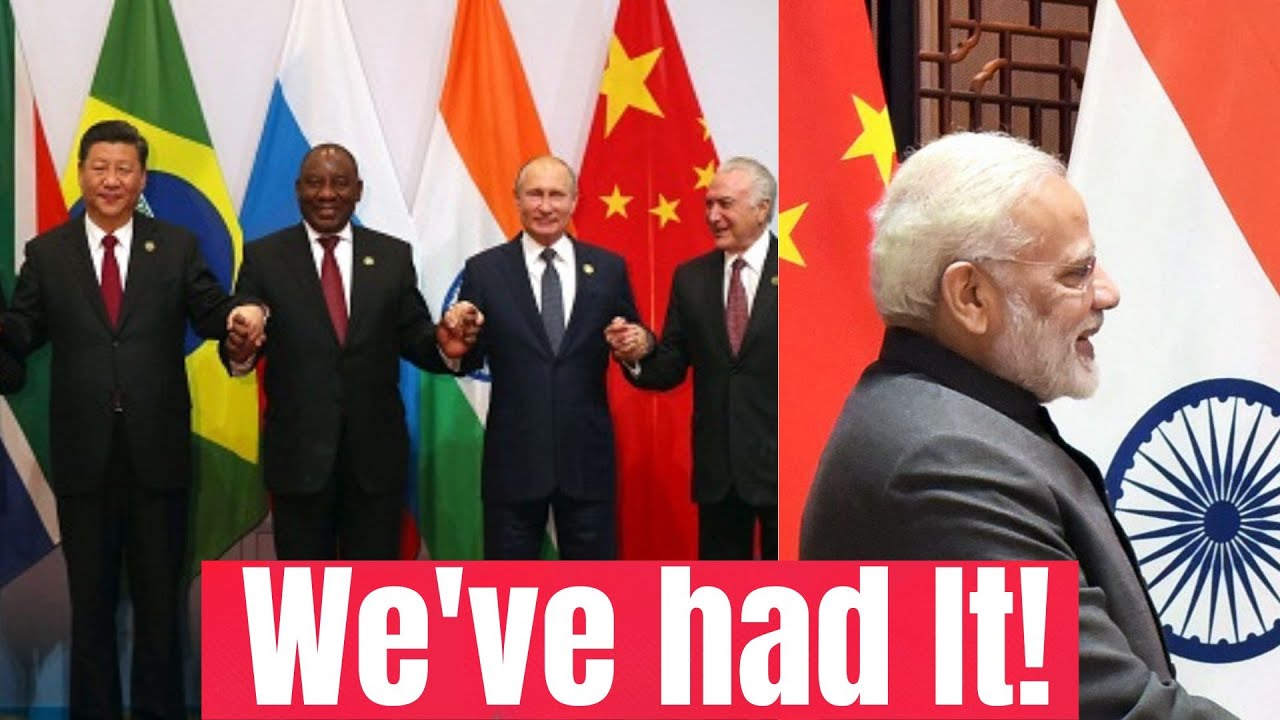
In this Geopolitical Trends video, host David Oualaalou examines India’s recent decision to block discussion of a BRICS‑wide, gold‑backed common currency. He frames the move as surprising, especially after Prime Minister Narendra Modi’s recent, arguably coerced, visit to the United States and India’s parallel actions such as refusing to sign the SCO’s 2030 development strategy and permitting U.S. naval logistics hubs. Oualaalou contrasts India’s stance with Brazil and South Africa, which have publicly endorsed a de‑dollarisation agenda and are expected to push the new currency at the upcoming August BRICS summit in South Africa. He cites statements from Indian Foreign Minister S. Jaishankar (denying a BRICS currency) and commentator Jan Sagar, arguing that India is using “national‑currency” rhetoric to protect the rupee, which he deems too weak to serve as a global anchor. The video references a Carnegie Endowment fellow, Frederick Grary, who predicts India will resist pressure to de‑dollarise, and U.S. Treasury Secretary Janet Yellen, who defends the dollar’s dominance. Oualaalou interprets these signals as India possibly sabotaging BRICS’s de‑dollarisation drive, suggesting that the bloc may need to reconsider India’s membership or replace it with another willing country (e.g., Argentina, Indonesia, Turkey). He concludes that without India’s cooperation, BRICS’s economic‑political project could be undermined, urging viewers to comment on the issue.
Chapters
Hello everyone and welcome to Geopolitical Trends. My name is David Oualaalou. So good to be with you as always. India wants to shut down the talks about BRICS new currency. So the question is, is India undermining BRICS? Is India sabotaging BRICS? What's really going on? In this video, I'm going to provide you my assessment as to why India decides to embark or take this stance against allowing BRICS new currency to move forward, which by the way, this new currency will be backed by gold. But before I delve deeper into this, I'd like to extend my sincere thanks to the channel's members and supporters. And for you, if this is your first time, please, uh, subscribe and smash that notification button so you will be notified every time I upload a new video. Or do a live stream session. And thank you all for your support. Let's dive in into this. It's a fascinating development. India now refuses to support BRICS new currency. Interestingly enough is that India's recent decision, for example, refusing to sign the SCO, the Shanghai Cooperation Organization's 2030 development strategy For example, another example will be India's allowing the establishment of US naval logistic hubs. And now with this idea of blocking the— or shutting down the conversation about BRICS and your currency, what's really, really going on? And here is what's interesting about all this. All this happens right after Prime Minister Modi returned from his visit to the United States, by which I argue he wasn't invited, he was summoned. Now, that's my opinion, you know. So the shutdown of the conversation about BRICS new currency came up as a very surprise in many circles around the world. So even the Foreign Minister, uh, uh, Jeanne Sarkozy He's saying that, well, the new BRICS currency is currently not on the agenda. Well, that's not true because the other members, like for example Brazil and South Africa, confirmed that they're going to be talking about the new currency. As a matter of fact, I'm expecting that during the upcoming summit of BRICS in August in South Africa, which will be between 23rd and 24th of August, The major announcement is going to be is the new currency. That's what I found very surprising. So, so Brazil and South Africa's leaders recently made a statement about an alternative to the US dollar. So, so why India all of a sudden is shutting down the speculations in recent weeks? You know, that, that's just surprising, and it doesn't fit the norm of, of a member of an economic bloc. You know, unless you are, you in this case India, planning to sabotage or undermine BRICS as a whole entity, that is. So the idea of that BRICS nations were planning a common currency to de-risk their economies from the kind of, well, also the devastating sanctions that the United States has levied on Russia and other countries by leveraging the US dollar global dominance. That is the whole idea. Of why BRICS decided to move forward with a new currency. I mean, I'm not surprised. I'm shocked. What I'm surprised at, at India's undermining this effort, which, by the way, India will benefit from it. But India is saying, no, no, no, no, no, this is going to undermine our currency, the rupees. Well, wait a minute, your currency doesn't hold, you know, it won't stand on the global stage. Because India's economy is not where it needs to be. Simple as that. Russia and China have already— have been, rather, exploring alternatives to the dollar, which has so far remained the main currency in the global trade and transactions. And it is, you know, about 48%, if I'm not mistaken, but it dropped down from about 78% a few years ago, give or take. Don't quote me on these exact numbers. That's the last figure I read a few weeks ago, even if not a few months ago. So, so many countries trade, of course, in, in the US dollar in global trade and transactions. But many countries now have started conducting trade in currencies like, for example, the yuan or the rubles for that matter. But this will be in bilateral trade. But in the case of BRICS, it will be a global trade. So, and this is what, uh, so, uh, the foreign minister, uh, Indian foreign minister that is, indicated clearly that a common BRICS currency like the euro won't be coming anytime soon. And again, I'm seeing the signs of it really wants to undermine, uh, or sort of prevent the emergence of new currency that will challenge the dollar. So the 5-member BRICS block, which is the fast-growing sort of countries or economies, that is, which made of Brazil, Russia, China, India, and South Africa, had been pushing for trade more among, among themselves in local currencies. So, and so if India is arguing that, well, rupees, well, wait a minute, you still can trade in bilateral way using rupees. But why prevent the BRICS from moving forward in a global currency that will challenge the US dollar? So the foreign minister, Jaishankar, said, and I quote, let me get you guys the quote. He said, and I quote, on what we will discuss at the BRICS meeting, we will have to see because there are many other issues but there is no idea of a BRICS currency, end of quote. No, no, no, no, no, no, no. He is twisting the word, trying to put a lid on the conversation about the emergence of a new currency that would challenge the dollar. So to me, it becomes a sign. Is India sabotaging BRICS? What do you think? Jan Sagar also added, and I quote, currencies will remain a national issue for a long time to come, end of quote. Well, of course there are national issues. All the BRICS are doing here is thinking about global trade. They're not forcing countries to trade in a new currency, no. So I think India is playing with words here to sort of sway the public opinion about this currency. What's interesting about all this is that some Western institutions already coming to the defense of India, not because they care for India or about India, but rather undermine BRICS. So to me, it will be like, wow, having a member like India that is doing the Western bidding for it. Yeah, and why am I bringing the Western institutions? Because there's one guy by the name of Frederick Grary Frederick Grary is a non-resident senior fellow at the Carnegie Endowment for International Peace. So what the Carnegie Endowment is saying is that on behalf of— what, I'm sorry, what Frederick is saying on behalf of the Carnegie Endowment is that India will most likely not allow to be pressurized into de-dollarization as it will go against its own interest. Ah, no, no, no, no, no, no, he is wording it to really push the narrative into that direction. He said, and I quote, it remains to be seen how serious BRICS countries apart from Russia and China are about de-dollarization. 'But there is no reason to believe that India will accept it even under pressure.' End of quote. He's playing with words here. Well, my answer to him is this: if India doesn't like it, it can get out of BRICS altogether, and the BRICS will replace it with another country. There are plenty. There are about 40 countries lined up. BRICS can choose which one. So the top of my head, I can think of Argentina, I can think of India, and I can think of Indonesia, Turkey maybe. So, so this is where I see, uh, maybe this has nothing to do with the dollarization or the currency, whatever. Maybe it has to do with India's perception of itself as like a growing economy when it's reality it is not, because given the strength of the Chinese economy. You know, you— we can compare China to India, it's, it's, it's, it's no-brainer. So, so the Chinese economy, uh, de-dollarization will mean strengthening China's position. Well, yeah, of course, because its economy is on an equal footing with that of the US, which means its currency will be accepted by many countries around the world. Unlike India's currency, rupees. Who wants to trade in rupees? No one. So, so there is simply no reason to imagine why India will align with the BRICS proposal, and it will most likely block it. This is why the Carnegie Endowment, which is a think tank in Washington, DC— once again, and I'm just putting this out there— all the policies India is embarking on embarked on him right after Prime Minister Modi returned from Washington. So I'll let you reach your own conclusion for that. But just to let you know about BRICS, BRICS is a home to 41% of the global population, which account for about 16% of global trade, and their share of the world GDP is at about 31%, 31.5%, surpasses those of the G7 groupings of the world advanced economies. So this is why I think BRICS is at a crossing path when it comes down to India. They're gonna have to decide collectively, is it time to either ask India to leave on its own term or expel India altogether and replace it. So, so since its inception back in 2009, members of the BRICS bloc have attempted to counterbalance American dominance of the world economy and the challenge, of course, the preeminence of the, the greenback, the dollar. That is, that dominance has been sort of used by US recent policies in squeezing various countries or nations that have sort of pursued an agenda that is contrary to America's geopolitical and economic interests. So this is why other nations are wary about doing transactions in the US dollar, and they are seeing a new alternative. That's the way I read it. As geopolitical analysts. So even US Treasury Secretary Janet Yellen defended the dollar at a recent press conference and said, and I quote, "There is a very good reason why the dollar is used widely in trade, and that's because we have deep, liquid, open capital markets, rule of law"— here we go again— "and long and deep financial instruments." End of quote. But she refrained from saying that we also can punish countries by imposing sanctions since their economy depends on trading in the US dollar. So that's to me wishy-washy. You are saying one thing and doing another. That's what I call hypocrisy or double hypocrisy. And this is what India doesn't see, or maybe is sort of asked to be or to act that way. So, and we all know after the United States-led Western sanctions squeezed Russia's economy, which by the way, the Russian economy is thriving despite the sanctions because Western media is lying about it. So Russia and China sort of appear to intensify the effort to de-dollarize and push their own currencies. And actually, it precipitated the sanctions that the US imposed, precipitated this move forward. So this is when I see why, you know, it's surprising. I'm really— I couldn't wrap my head around India's decision. If you don't intend to be supportive, then get out of the club altogether. Simple as that. So leaders of Brazil and South Africa, two other members of the BRICS grouping, already made a statement signaling their support for alternative to the US dollar. As a matter of fact, the Brazilian president, Luiz Inácio da Silva, Lula da Silva, urged countries when he said, and I put this in quote, why can't we trade in our own currencies, end of quote. He asked about his country's deals with Argentina and China during a finance summit in Paris last month. So interesting, even South African President Cyril Ramaphosa, who was on the same panel at the summit, said the same thing. He said, and I quote, the issue of currency will be discussed at the upcoming BRICS summit, where he's the chairman, because South Africa will be taking the lead on the summit. So I don't know where the statement from India is coming. So here's my conclusion for you, because I like to keep this brief, uh, to the point. Uh, it is time for economic blocs like the BRICS, like SCO, the Shanghai Cooperation Organization, to reconsider their options vis-à-vis India, given the shifting of the geopolitical global order. Otherwise, BRICS progress will be undermined at every turn. This is how I see it. What do you think? Make sure to leave me some comments. And by the way, if you like the content of this video, please hit that like button and subscribe. I would really appreciate it. As always, guys, hope you find this informative. And I look forward to seeing you next time. Remember, geopolitics impacts your daily life in more ways than one. Till next time, guys. Bye-bye.