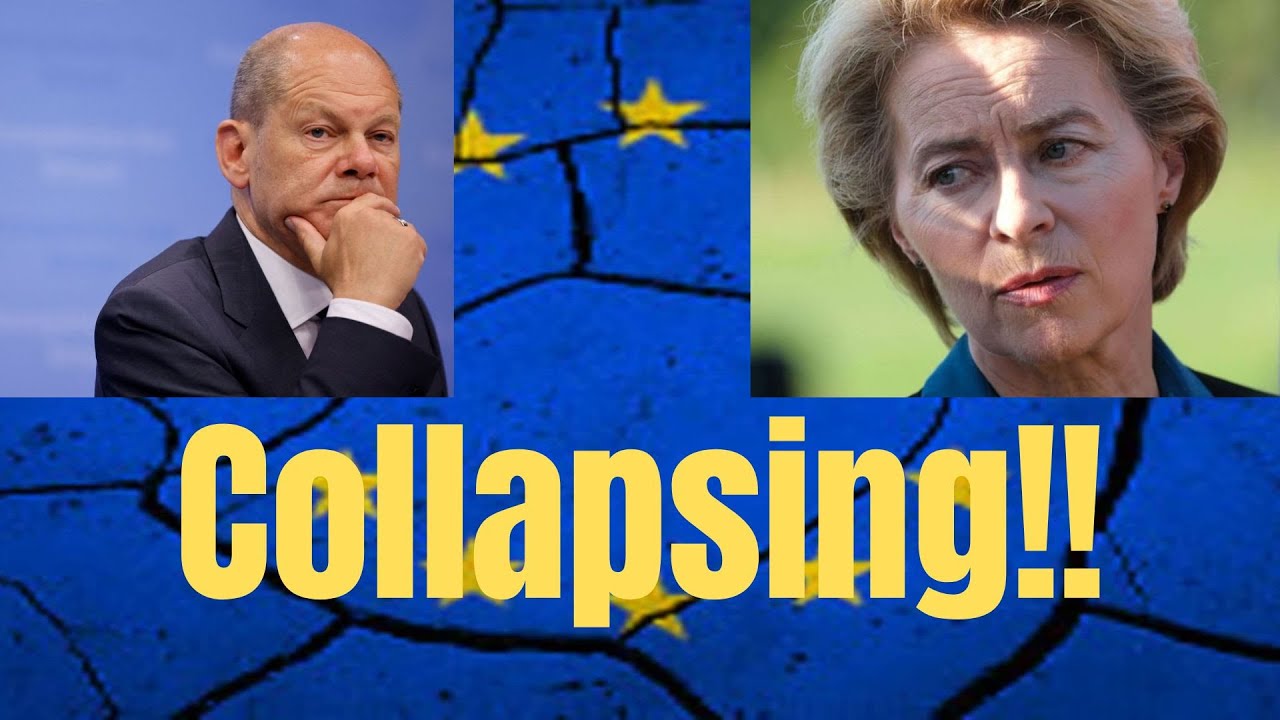
David Oualaalou argues German Chancellor Olaf Scholz is pushing the EU toward conflict with Russia while the bloc's economy collapses. Natural gas prices hit $100 per megawatt-hour, forcing steel mills to close. Forecasts show Germany contracting 2.3% and the eurozone sliding into recession through 2023.
Chapters
Hello everyone and welcome to Geopolitical Trends, and my name is David Oualaalou. Does the EU really want a war with Russia? This question comes on the heels of the German Chancellor Olaf Scholz's call for the EU enlargement to the European Union. Is he delusional? Doesn't he understand what's going on? In today's video, I am going to provide you insight into why there is this push in both Brussels and Washington for a war with Russia. I will also place the statements of the German Chancellor within the context of what's taking place currently in Europe. And this is basically— I will focus mainly on the economic aspect. But before I proceed, don't forget to subscribe and hit the like and the notification buttons so you will be notified every time I upload a new video. And thank you for your support. So here's what I'm gonna do in this video. Since there are two, almost two different topics, but they are, they are like, uh, joined, shall we say. In the next video, I'm gonna talk specifically about NATO and the US regarding the expansion of a war with Russia. But in this video, I'm gonna focus mainly on the economic aspects and tie it to the statements of Olaf Scholz, given where his country is headed economically speaking, because it just defies logic. And I want you to understand of what's going on since the mainstream media is not going to disclose the truth as to what's going on. Well, here is a brief background as to what's going on. German Chancellor Olaf Scholz just on Saturday, yesterday, you know, he called for the enlargement or the expansion of the European Union. You know, he's calling for the inclusion of new members. This is almost remind me of after the fall of the Soviet Union, in 1991 with the NATO expansion eastward. Remember, NATO went from about 17 members or so to about 30, majority of them from Eastern Europe. Well, the same case, I'm seeing the same trend with Olaf Scholz calling for the inclusion of new members so he can fulfill his promise to candidate countries. Because that's what he promised when he was running for office. And this is what Olaf Scholz told a gathering of, because it took place just a few days ago, with the European Social Democrats. That is a union basically which currently has about 27 members. And his arguments for enlarging the EU is that it will increase its influence in world affairs. That is the— he is delusional. The AU will not have the same weight as, let's say, the ASEAN, the Association of Southeast Asian Nations, economically speaking. But that's what he's selling his arguments for. And he's noting that the continued A growth of the EU eastward is a gain for all of us. End of quote. And again, I'm like lost as to where is he coming from with this policy to begin with, you know. And I'm going to provide you some stats regarding where the German economy is headed, and you can put things in perspective and reach your own conclusion, of course. So the German chancellor has made the expansion of the EU to include the Balkans, okay, and other countries a key item in his foreign policy since taking office. And this is what he disclosed in the gathering. And I quote, I had to look for this specific quote. So let me get it here. So I quote him right. And he said, and I quote, the EU, "The European Union could have more weight in the world if it includes 30 or 36 countries where more than 500 million citizens enjoy freedom and justice." End of quote. Don't you find that ironic how in the West, Western leaders use the term freedom, democracy, ideals, and so forth, when we couldn't even have our own freedom right here at home. When you start to have censorship, when you start to have government deciding what you say and not say. So I'm seeing like double standard here. So here's the fact that is not being reported again in Western media is that the decline of the European social democratic parties is evident. They're not saying that These social democratic parties have been declining in Europe. And here is the reality on the ground. And this is where I usually put my analysis for you, brief one that is just to put things in perspective for you. And the reality on the ground is this: in several Eastern German states, in Germany, but on the Eastern side, thousands of Thousands of people demonstrated against energy policy, inflation, and the consequences of the Ukraine war. One demand among what the protesters were saying is that the lifting of sanctions against Russia, and you all know why, the flow of energy and gas. So according to their preliminary police reports, The police report suggests that it was about 7,000 demonstrators took to the streets in more than 15 cities. In Schwerin and Nürnberg, speakers called for, among other things, an energy policy that people can afford and also an affordable living costs. Plus, get this, plus view on their part as to how the Ukraine conflict is going because they are calling for peace negotiations and also to stop German weapons or German arms deliveries to Ukraine. And there is another demand that they are asking for. Which is the withdrawal of sanctions against Russia. Why? Because they are seeing, they, the people who are demonstrating, are now feeling the heat and the cost of these sanctions. It's impacting them. But here is the reality that is not being disclosed in detail. I find it very interesting that Western media is cherry-picking the information. And I'm gonna just provide you the facts here, and of course I will provide you the links where I found all this. And of course you reach your own conclusion. Here's the thing, with natural gas prices over $100 more per megawatt hour than they were a year ago, Western European economies are heading to the Middle Ages. Forests in Europe are being now cut for firewood as Russia, of course, retaliates with its own Ukraine war sanctions by shutting off the trickle of natural gas it was still piping into Europe. No, they cutting those at all. So Germany is watching now companies suffering high electricity bills. You take, for example, there's a company called ArcelorMittal is closing two steel mills and is finally talking about decoupling from China. Why is this? Because the energy crisis is making them nervous. They want to make it harder. The German government now, that is, wanted to make it harder for manufacturers to outsource now that their energy bills is at an all-time high. And not only for companies, but also for citizens. So the fact of the matter is this: what's going on right now in Europe economically, it no longer looks like a short-term crisis. This is going to drag on for years to come. There are even stories now coming out of Western Europe, which again, if you know where to look at, mainstream media is not gonna— don't count on this, I'm telling you, do not count on this to hear it from the mainstream media. So it would be platforms, simple ones like this and others. There are others on YouTube as well, uh, that they have a good, uh, sort of, uh, uh, insights they providing to share with their viewers. But to me, that's the point, is you need to know different perspectives and reach your own conclusion. Stories from Western Europe are like stories, uh, you once heard in countries like Bolivia, as an example, with high inflation and resources rationed. They are rationed or imposed by the states. This is exactly where Europe is headed. You know, and even for corporate investments now, usually corporate investment goes where money goes the farthest, right? No, it used to be taxes, it used to be labor, it used to be environmental cost that they look at. You know, any company, when you invest your money, you're going to look for this kind of items. Now European companies will have to add electricity to the mix. And to me personally, this does not bode well for European businesses moving forward. This is why you're going to be seeing by the end of the year some German companies shutting down, some companies in Europe, in France, shutting down. Italy is smart. He moved in another direction by reestablishing ties with Russia and receiving gas from Russia. Once again, you don't hear much about it. Because here's what to expect. What you will expect now is a deeper prolonged recession and more persistent elevated inflation due to the impact of higher energy prices. And once again, the governments, be it in Germany or France or Spain or UK, They're not going to be saying this. You know, they're lying to their citizens. You know, and the question that you need to ask yourself is really, how bad is Europe recession, or how bad will it be? And it's fair question. So, and I'm going to share with you some estimates that I found that came through Barclay. And, and you know, Barclays— I'm sorry, Barclays— this is usually, it's a global financial services, and I read their analysis, you know. Sometimes I disagree with their assessments. Like the IMF, I disagree with their assessments because some of them will only want you to hear what sounds right. No. And this, the one from Barclays, you know, forecasts a eurozone recession in the fourth quarter that will persist until 2023. Second quarter in 2023. With about 1.7%, 1.7% contractions in real GDP, the global domestic product. Some countries that will be worse off than others, of course, it's because that's just how it works. For example, Germany in 2023, which is the second quarter of 2023, you will see a minus contraction of -2.3%. Italy, you will see -2.0%. In France, you will see -1.2%. And in Spain, you will see -1.6%. And I will provide you, of course, a link to all this. And once again, just to put this within a perspective, because economic indications also highlight to you and indicate to you the health and, and where the country is doing, or how a country is doing politically also, because economics is a reflection of political landscape, and landscape is a reflection of political landscape. They go hand in hand. So here is my conclusion to you briefly. Germany, which is the EU's economic powerhouse, is now expected to post negative annual growth as Italy, France, and Spain, as I mentioned. What's interesting is that the IMF, which is the International Monetary Fund, which is a Washington-based financial institution, interesting enough is that in its estimate, it kept its projections unchanged for the United States, which is seen by about a growth of 1%. While Asia is expected to post the highest growth of 4.9%, almost 5%. Even in Germany itself, top forecasters have now said Europe's biggest economy will lose about $225 billion over the next 2 years. Meanwhile, the high-stakes political drama has already played out in some countries in Europe, like Italy, for example, which is the third largest economy in the EU. And what am I referring to here? I'm referring to the election of Giorgia Meloni, the far right, you know, and right away made the decision to allow the gas of Russia coming into Italy. Basically saying to Europe, to the EU, we don't care. But usually to me personally, and I look, as I said, I always look at the trend. This to me hints at what lies ahead for Europe. And what lies ahead is this. Of course, those are just possibilities. But what I'm seeing is by the end of the year, you probably see Olaf Scholz forced to leave office. You will most likely see Macron forced to resign because demonstration is going to come up. And of course, we're already seeing what's going on in the UK. And I am sure there are already calls about replacing the clown, the PM, Prime Minister Liz Truss, who's first— I'm laughing because the idiocy. When she took office, her first word was, I am going to cut taxes. She had no clue what she was talking about. Now the British government is forced to reverse course because just 2 days ago, the Treasury Secretary for Britain has resigned. It's just the idiot policies, the ill-conceived, that they are not thinking straight, the whole Europe. Why are they doing what they're doing? Against the will of their citizens. It makes you just wonder, are we being pressured to do so? And that's a conversation for another day. So here is my question for you for today: Does Europe's economic crisis contribute to global recession? Let me repeat the question: Does Europe's economic crisis contribute to global recession? Let me know your thoughts and leave me comments in the comment section. And as always, remember, geopolitics impacts your daily life in more ways than one. Till next time, guys. Bye-bye.
More from David


Beyond the Single Actor: Why the Gulf Isn't Choosing Between the US and China


Iran, Iraq's Militias, and the Houthis Are Coordinating! This Changes Everything




Who Controls the Next Decade's Resources? Latin America and Africa's Geopolitical Crossroads

The Chokepoint Trap: How Washington's Stupidity Triggered a Cascade That Now Controls the World

Trump Spooked as IRGC Unveiled dual-use SLV, Deployed Ghadir Mini-Subs & Hinted at Tactical Nukes!
