The First US Submarine Kill in 80 Years — and India's Fingerprints Are on It
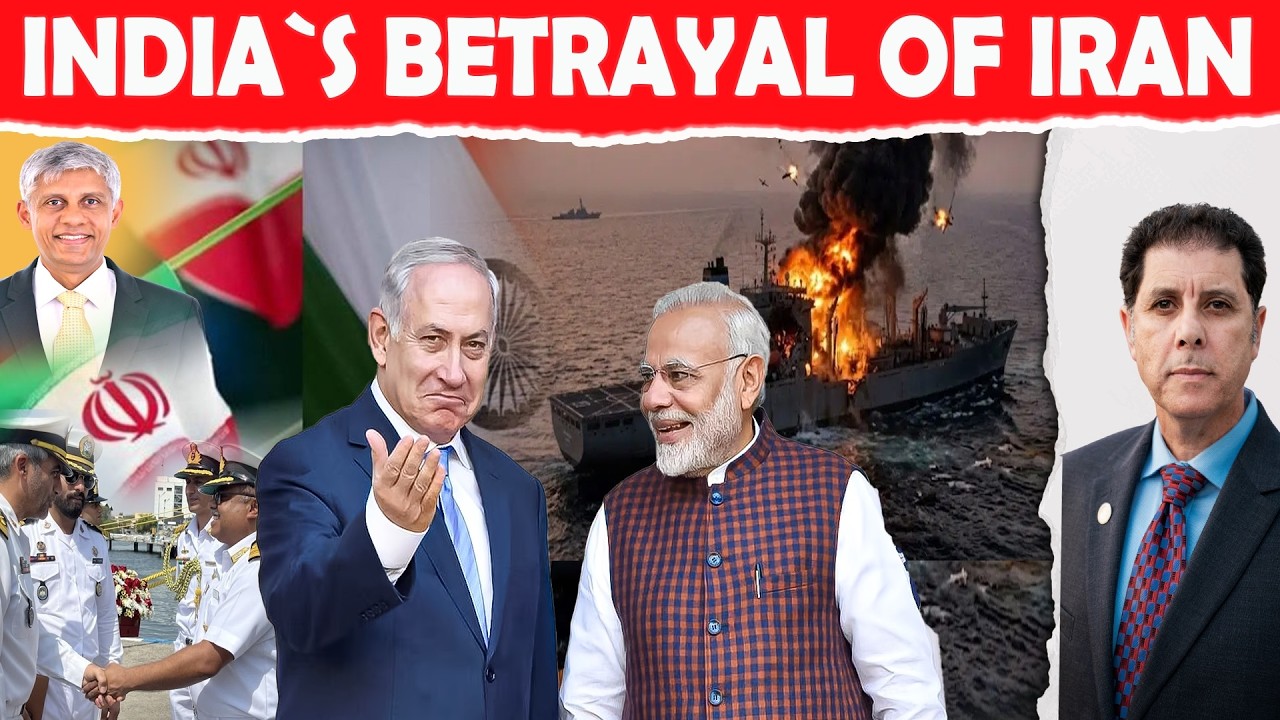
This content was created by David Oualaalou. This content was uploaded by David Oualaalou. This is a YouTube interview-style episode from Geopolitical Trends (title: "The First US Submarine Kill in 80 Years — and India's Fingerprints Are on It", published Mar 22, 2026). Host David Oualaalou interviews guest Jayant Bhandari (US-based institutional investor and commentator). The discussion focuses on alleged Indian involvement in sharing coordinates that enabled a US strike on an Iranian naval vessel, Iran–India–US relations, the Strait of Hormuz and oil/energy market impacts, BRICS and India’s chairmanship, and domestic/regional issues including Sikhs/Khalistan and Kashmir. The content is a conversational, opinionated geopolitical analysis drawing on recent events, sanctions, and economic implications.
Chapters
Hello everybody and welcome to Geopolitical Trends, where truth matters. An Iranian warship arrived in India shores as an honored guest, welcomed, hosted, and celebrated at one of the world naval exercises that India did a few, uh, days ago, a few weeks ago. Days later, it was at the bottom of the Indian Ocean. Sunk by an American torpedo. The coordinates that sealed its fate, guess what? It was shared by the very country that has just waved goodbye to Indian sailors. So to address this particular betrayal of Iran by India, I have none other than my dear friend Jayant Bahndari, He's gonna be here sharing this with us in addition to other topics. To those who do not know who Jayant Bhandari is, Jayant is a US-based institutional investor advisor for the last few years. He received his Master of Business Administration from Manchester Business School in the UK, and he frequently writes on cultural, political, and social issues for several magazines. I'm gonna put in the chat box Giant's website. You might want to go and check it out there later. And in the description, I have a full bio for Giant. All right, let me bring in Giant here. Hi, Giant.
Hi, thanks very much for having me, David.
Of course, as always, a treat to have you here. The, the, the chat box people were waiting for you, Giant. Um, uh, before we get into this topic and others. I want to play first a quick clip for you and for our audience, then I'll take your assessment or response on it. So let me share it quickly here on the screen, and I'm gonna play it for you and you can hear, and I'll do the translation for you later on. Let's take a listen. Supreme Leader Khan Naye Sahib who Unlike you, did not bow down to America but embraced martyrdom. Basically what the individual is saying is that Iran didn't kneel to America, but you did. This is from representatives of the, uh, of the parliament to Modi. What do you make out of that video, Giant, or that clip rather?
Well, uh, David, India has clearly become a vassal state of the US, but unfortunately India cannot decide whether it wants to be a vassal state of the US or of China or of Russia, or to be independent, or to backstab everyone and get whatever it wants. Unfortunately, world doesn't work that way. There has to be some concept of honor and loyalty in a, in a government to be treated respectfully by its partners. So, uh, at this moment, clearly, uh, India is, uh, on the side of the US, uh, and, um, uh, my view has been that India should have been on the side of China because the future of India lies in supplying maids and servants and chauffeurs to China. And that is why India should be in the sphere of influence of China. It is destined to be a vassal state irrespective of which country it is.
Well, that's exactly why, uh, this particular representative, when, when he— and I read the— I looked at the translation for it— the words were measured when he said, and I quote, we salute Iran's Supreme Leader Khamenei, uh, who unlike you— meaning a reference to Modi did not bow down before America, but instead embraced martyrdom. So that leads me to the fundamental question, uh, uh, uh, giant, and that fundamental question is, why did India betray Iran by providing coordinates to the US to strike the Iran naval asset?
Well, uh, David, I don't know if India provided coordinates to the US They did.
They did, giant. They did. I got a confirmation. The head of the naval assets in India, he was the one provided the coordinates. I confirmed it.
Okay, so I don't know about this, David, uh, but, uh, the fact is that in Vishakhapatnam, where the naval event was happening, there were American team present as well. So they physically knew about the presence of Iran. And the US, of course, monitors everything through the satellite anyway. So the US knew that the, the Iranian 3 boats were high sea. They were tracking those. So I, my concern here is that America would not want to involve India, where information gets leaked all the time. Again, Because India has— Indian government has no concept of loyalty and friendship. And the biggest embarrassing and humiliating thing for India was that had these naval ships of Iran were visiting China, the US would not have had the guts to blow them away. These were on a friendly visit to India. They were guests. And, uh, in this part of the world, particularly Afghanistan, Pakistan, Iran, loyalty and friendship has a huge amount of value. Your guest is your honored, uh, honored person, and you have to protect that person even if that person is your enemy. So, uh, it was a huge humiliation for India that America blew away an Iranian ship right outside the Indian waters, a ship that was visiting India.
Yeah, and the facts there, to me, what gets really— what bothered me in a sense, you know, once again, nothing against the Indian people. I want to make this clear. I do know that some people think I just, you know, with the— I'm painting with broad brush all Indian society. That is not what I'm talking about. But what gets under my skin is this double standard of the Indian government, of Modi himself. You know, you say one thing and you do the opposite. And after they did this to Iran, after what India did and betrayed them, they went ahead and asked Iran to allow Indian ship of energy to cross the Strait of Hormuz. And Iran went ahead and agreed. And again, I am thinking that Iran made a mistake by allowing this ship to get through. Would I be right in this assessment, Giant?
Well, uh, India has, uh, has pretty much broken its financial relationship with Iran over the last 7 or 8 years because of American sanctions. India was no longer buying Iranian oil. The Chabahar port that was being developed by India was not getting financed anymore. And even the small amount of transactions that were happening were going to stop in April 2026 because of American sanctions. Now, my best understanding of why Iran allowed those ships to pass through the strait is that India apparently, under the pressure of the US, had taken over 2 or 3 oil vessels of Iran, which were parts of the shadow fleet of Iran. So very likely the agreement, it was a transactional agreement with Iran, that we will let go of these 3 ships which are under Indian control, and you let us let go of the 2 ships that are passing through the strait. So, you know, no one trusts India, David Oualaalou. China doesn't trust India. Russia doesn't trust India. The US doesn't trust India. Iran doesn't trust India. India belongs to nowhere. It's a rudderless country, and it is just a floating country. It goes wherever the more convenience of the moment takes it. So my view is that Iran no longer trusts India, no longer believes in any friendship with India, and it, uh, it was a transaction based on you give me the, my 3 ships and I'll let you go, let go of the 2 ships of yours.
Well, in that case then, that will be— I see the fairness of this sort of a transactional. Yeah, I, I can see the logic of it, but on the other hand To me, at least personally, and I speak for myself here, betrayal is very hard for me to forgive or forget. So that's— but anyway, that's my personal—
but specifically, betrayal doesn't register in the Indian mind. However, they fail to understand, they fail to understand that Afghanis, Iranians, and people in the Gulf countries are very conscious of a friendship, betrayal, izzat, honesty. So they will unfortunately remember it. And India, you know, my biggest problem with India is not that it is— my biggest problem with India is that it does not belong to any— it doesn't have set values to believe in, whether it's Chinese or Russian or American, it doesn't believe in anything.
Well, that's problematic. So very, very, very problematic. Uh, there was one, uh, particular, uh, recent statements by some individuals here in the United States. Some people were in the military, they have a good reputation and so forth, but they have been stating that one of the countries in the world that can play the role of a mediator is India. I was the first one to say, hell no. What do you make out of this?
Well, uh, I, David, I, I do, I, I have watched those kind of interviews and videos, and I, it shocks me no end when I listen to those. But 100% of those interviews are conducted by, uh, people who are academics, who have no understanding of the reality of life or even if they are in the government or in the military, they are the people who sit in the back office, who don't really understand what real life is about. And these are the people who get influenced by political correctness, the, you know, all the fancy talks about India, which have no underpinning logic. So yes, you hear that, but I just shake my head with disbelief because They are so utterly naive that Modi can sort anything out. In fact, it's just so embarrassing, David, that the war is happening really next door to India, but India was never taken into confidence. Modi was visiting Israel. He was used as a cover-up, again, humiliated because he was used as a cover-up. He was never informed, from what I understand, about the war, and I'm reasonably confident that Netanyahu never informed Modi about the war because no one can trust India with keeping any information secret. So, uh, they used him as a cover-up. So again, India keeps getting humiliated all the time in the international arena, but then there are many naive people, including the European Union leaders, who are just so naive and so impressed by India including the Finnish prime minister or the Canadian prime minister. So, uh, again, uh, this is not uncommon in politically correct world of today.
Oh, you're absolutely correct. Uh, uh, while we talking about Iran and India, I want to just touch on one aspect here before we move, uh, to the next topics. And this one has to do with the Strait of Hormuz. As you know, Iran's control now the Strait of Hormuz. There is this energy crisis that's going on around the world and And it's only going— getting even worse as we speak. How do you see it moving forward, especially when it comes down to the world of investments? There's a lot of investments into the energy sector. How do you see it playing out?
Well, David, my view is that the war should end within the next few weeks. As a result, my clients and I are selling our oil stocks. We think that oil price will revert back to normal within the next 2 or 3 months. And we see no reason to hold on to oil stocks which have gone up by anything like 50% or so. So our— my personal view has been that this war should end in the next few months, or end in a way that Strait of Hormuz should open up open up enough to allow traffic of oil tankers?
Well, basically the Iranians are saying, you know, the Strait of Hormuz is open except, except for the Americans and Israelis or anybody who deals with them. So I say it's fair. It is fair because we didn't consider the strategic consequences of this. And this is why Trump now is coming and saying, you know, I'm going to declare victory because we're done and that's it. No, no, no, no, no, no. You dug us into a hole, and you're gonna have to figure out how to get us out of it, because most Americans are not in support of this war. So I just wanted to get your sense of, uh, where things going on with oil. And you are right, Giant, the prices went up by 50% because as of this morning, uh, just for the community, I'm going to be releasing a video tomorrow. I did an analysis about the Middle Eastern aspects of this. The oil, the barrel of oil now has reached $183 as of this morning.
Really?
Wow. $183 as of this morning, giant. So I checked this.
I didn't know about it. That's shocking.
That's shocking. I just saw it this morning and I have the reference.
And you see, David, the biggest victim of this war has been India. Gas has disappeared. Petrol is disappearing in that country. And in fact, I'm being told that plastic is disappearing, glue is disappearing, everything is disappearing from India, because India has no strategic reserve of oil. Well, except for 7 or 8 days, which is oil in process, but they don't have reserves of oil. And India is really going back to its primitive ways very rapidly, even in the legislatures and 5-star hotels are now cooking food using wood and coal.
Oh, is this means that India is gonna now be begging Russia for cheap oil?
Well, and Russia has declined to give— provide India cheap oil. Uh, Russia is now asking for a full premium because, you know, at the end of the day, no one likes backstabbers. Uh, no one with any sanity does not like backstabbers. America doesn't like it, China doesn't like it, Russia doesn't like it. Iran doesn't like it. No one likes India. So, uh, unfortunately India is in a crisis. Indian stock market is falling like a rock and Indian currency is falling like a rock even compared to the US dollar, which itself is falling. So, uh, you know, there is a huge amount of crisis and I'm told that gold is being sold in India right now because, uh, Indians are now so poverty-stricken suddenly that they have to sell their gold to, uh, buy food and other, other things of regular use.
Wow, that's bad because we all know that India is considered like the— there's a lot of gold within. That's why the population, especially the female, buy more gold.
Yeah, it's, it's mostly a myth though, David, because you have to consider ownership of gold on per capita basis, and Indians don't own all that much gold on per capita basis. But it is indeed true that whatever they save, they'd like to put that money into gold. But India is such a poverty-stricken, poor, wretched country whose GDP per capita is about $2,800 that they don't really have much money to buy gold. I mean, their per year GDP per capita is no more than half an ounce less, you know, something like half an ounce of gold, and they have to eat with that money as well. So they don't really have much money to buy gold anyway, but they are now selling right now.
You know what, I didn't, uh, something crossed my mind, Giant, as you were talking, uh, and, and, and of, of great importance, especially when the Iranian issue that particular statement. And the statement is, for us to allow any oil crossing through the Strait of Hormuz, the, uh, the individuals will have to pay, the countries will have to pay in the Chinese yuan. Is this mean that India now will have to pay Iran to allow those the ships to go, they have to pay in the Chinese yuan.
Well, you know, you have to really understand that India is friend of no one. China is able to get oil, has been getting oil from Iran. Most of the Iranian oil gets sold to China. And America does not object to it. Because, you know, of course, everyone knows China is eventually buying that oil, because China has negotiating power. India has no negotiating power. So India will have to buy oil from wherever it gets it at a premium, at a full premium, and probably at an extra premium because people are probably just sick and tired of India. So, you know, at this moment, India is getting oil from Russia when only 2 or 3 weeks back India had claimed it was going to stop buying from Russia.
Oh, that's an interesting developments moving forward. So, uh, I want to move quickly just to get your assessment on the arrest of some, uh, Indian nationals spying on behalf of Israel inside Bahrain. And to my knowledge, there was one individual or two, uh, actually one I was for sure because I saw, uh, the, the, the, uh, uh, press release with the info about it. Of Indian descent was arrested in Tehran. Is this, in your opinion— remember last time, Jayant, we talked about how the Saudis kicked all Indian nationals— is this has to do with the fear from the part of the Saudis of the spying of the Indian nationals inside Saudi Arabia?
Well, I, I don't think so, uh, David. No one will trust the Indian government to spy on its behalf because Indian government bureaucrats just take bribes to leak information. Or, you know, I was actually surprised when Indian government paid someone money to kill one person in Canada, because usually Indian bureaucrats pocket all the money. They don't pass it on to the contract killers. So, you know, I heard the same information about Indian national getting arrested in Bahrain. But the reality is that they were arrested— the people arrested were actually Pakistanis and Bangladeshis, and they were arrested not for espionage but because of stupidly video recording and uploading on social media, uh, information related with, uh, the, the, the war.
Yeah, well, I'm glad you cleared— you cleared this up, uh, Giants. Thank you for that one. Let me just play a quick clip here and we'll move on into our next topic. If the truth matters to you, hit like, subscribe, and tap that bell. No spin, no agenda, just the stories they don't want you to know. Don't watch from the sideline, be part of the movement. Your support keeps the truth alive. Thank you. Now let's move on to talk about BRICS. And the reason I want to bring this up, Giant, is because India's chairmanship was started January 1st of this year. Uh, sort of, uh, how do— first of all, do you see India's taking the role of chairmanship on BRICS? And second question, why so many wants India out of BRICS?
Well, and firstly, uh, India turns every international organization that it becomes a participant in impotent. That organization, it becomes indecisive, does nothing. It just becomes a bureaucratic affair. And the reason is that Indians cannot decide on anything. They have no policies. They have, they have no guiding principles in their mind. So Indian bureaucrats have only one guiding principle, which is to maximize collection of bribes. And in the international arena, it translates into maximizing what is beneficial for India, irrespective of whether it is correct or not. So India turns every organization, cripples every organization. However, David, the truth is that despite the fact that India is such a poor, wretched country of only 2,800 per capita GDP, when you multiply that number with 1.5 billion, in many ways it has an influence. The influence is that when 1.5 billion people start using a couple of drops of oil, it consumes an enormous amount of oil by world standards. So you cannot really get rid of India from BRICS either. Also, China, Chinese are, and you might have experienced this with Chinese individually in the US and elsewhere, Chinese like to keep their head down and continue their work. Unlike Indians, they don't make a big show and dance and drama about how great they are and how many CEOs or deep-seeks or space activities they have got involved in. So China wants to look an unimportant, you know, or at best one out of the two major actors in BRICS. If India leaves BRICS, then it becomes a Chinese organization. And I don't think China wants to look as the prime mover of BRICS. It wants to do what it wants and it will do it selfishly, but it still wants it to be seen as a community decision rather than a Chinese decision. So it will be a dilemma for everyone. And this is a dilemma for everyone in the world anyway, that wherever India, whatever India touches turns into dust.
Oh yeah, because I mean, you're absolutely spot on, Jayant, because the problem that I see, moving forward with this, with this war that's going on. This also— this is not just about Iran's nuclear program, what have you. This is about also the ability of BRICS. When you have 15, 20, 30 countries waiting to be part of BRICS, and you see the, the writing on the wall as far as the drop of the petrodollar in, in favor of some other currency, I can see why other countries will be concerned about India being inside. Because India will always undermine the policies of BRICS that can move it forward. Will I be wrong?
Yeah. And also, David, Indian foreign currency reserves are falling very rapidly over the last 3 weeks. Again, they are having to buy oil at a premium. India is extremely short of oil and gas. There's desperation. You can actually scroll through the videos of major cities in India. Poor people in cities are running away to their villages because there's no gas available in the country anymore. You have to pay 400% black market rates to buy LPG in, in the country today. Restaurants are across the board closed. Businesses are closing because the secondary products of oil are disappearing from the market. So India is in a grave crisis and it's You know, hilariously, it seems to me, and maybe I'm exaggerating here right now, but hilariously, it seems to me that while Iran might only be facing tremors from the war, India is already facing earthquakes because Indians don't plan anything. There's no planning. There's no strategic reserves in that country. As I said, India maintains a strategic reserve for between 10 days to 30 days depending on oil in process at the plants. Rather than as strategic reserves. I was recently in China. China maintains about 6 months of oil reserves. And there is no— no one really cares about shortage or pricing of oil in China, because they have already become mostly energy independent. The two-wheelers in China are all electric vehicles, half of the cars are electric vehicles. So unfortunately, India is facing the brunt of this war. And, you know, I have in the past told you, David, that India will just decay slowly. But now I think that an external shock can suddenly break that country apart, because India is such a brittle country and so extraordinarily dependent on outside help. In this currently, in terms of oil, and as you recall, when Pakistan-India war happened with Modi was very courageous about when it started. He could not continue it for even 4 days. He had to start calling up Trump to help out to stop the war.
Yeah, well, because Pakistan sort of taught India a lesson regarding that, and it became clear and evident as to what the outcome of that war was. Now, when we think about what you just said, to piggyback on it, uh, Giant, The idea to me where that I struggle with this notion of when you read, for example, the statements that, or the theme of India's chairmanship of BRICS, and here's what it says in quote, building for resilience, innovation, cooperation, and sustainability, end of quote. And when I read something like this and see the reality on the ground, I see like, for example, the betrayal of India, India's betrayal of Iran. And I start to wonder, how must the Global South now see India?
Well, you know, those words you used are words that you use in middle school essays. These are puerile, childish words which have no meaning in practical life. You have to bring them down to concrete action. You have to have a vision to really, uh, you know, we talked about the AI summit last time, uh, David Oualaalou, which was an utter disaster. You use all these high-flying words with no real concrete foundations. Indian bureaucrats regress mentally once they join the government. They have no real-life experience. They rise through the hierarchy without really experiencing real life or real business. So all they do is to use these great words and hope that they can impress the world, world, world. But again, this India's presidentialship, which is nothing but a rotation, so there's nothing— it does not mean that this is a, this is a symbol of India's competence. It is just a rotation of presidency. So, uh, but, uh, whenever anything lands in India, it becomes impotent, and that will— what will happen to BRICS presidency.
Yeah, yeah, I don't have much faith on, on India having managed this chairmanship. It's because my big concern, Giant, from a strategic perspective, I'm looking for the next 15 years. You know the fear we have right here in the US, especially in Washington? About BRICS is the concern about the petrodollar. And now it's becoming evident to us through this war that Iran doesn't need to match US capabilities militarily speaking. All Iran needs to do is hit the economic side of the equation. That's where I see it. And India, to me, that's the concern about India within BRICS is it's not gonna play ball with the other team members to move the agenda forward. They will always be undermining it. And that means BRICS will become a failed entity when there are potentials. There are potentials with BRICS. And now you have— yeah, you have India and United Arab Emirates lining up. So why not take India out and put Iran, and you don't have to worry about—
yeah, but then, uh, the problem with China is that China doesn't want to show BRICS as a Chinese-centered organization. And as you clearly alluded to, if BRICS, uh, as time passes by, yuan will become the BRICS currency. There's no other thing backing BRICS currency. And yuan is really, uh, after the US yuan, is the more— is becoming one of the most recognized currencies. So, so unfortunately, BRICS is the, the prime mover of BRICS continues to be China. It will continue to be China, but China will want to keep it— keep its head down and not seen as the prime mover because it wants— Chinese are just inward-looking, shy people. They don't want to brag about their competencies and successes, whereas Indians do.
You're absolutely correct. You're absolutely correct, uh, Giant. Uh, let's move to our last topic here because I needed to address this. I know I hardly ever covered this and I always waited for the right opportunity, and, and, and today is that moment here. And what I wanted to learn, not only for me, for the community as well, but because I want to, I want to learn more about the conditions of the Sikhs inside India. We talked about the Christians before, we talked about the Muslims Muslims before, but we hardly ever touched on the Sikh, uh, inside India. First of all, just to share with the community, to my knowledge— and please, Jayant, correct me if I'm wrong— uh, based on the readings that I did here, there are about 20 to 21 million Sikhs inside India, most of them concentrated in Punjab. But there are also, like Muslims, Unlike the Christians, they are facing complex situations involving political, social, and economic challenges incurred by the Indian government, by Modi's government or the BJP. So what can you say about the Sikhs in general terms for the community to learn?
Yeah, so it's a long topic, David, and it's a very complex topic. You are indeed correct that Sikhs are about 2% or less than 2% of India's population. My view is that they are very well assimilated in the country. They are taken as just another people. The kind of envy that Hindus have for Christians or hatred they might have for Muslims is not what they have for Sikhs. So Sikhs are well placed in the country. They are in higher positions in the country. The Federal Minister of Petroleum is a Sikh. India has had presidents, at least one president who was a Sikh. So Sikhs are well represented in the country. They rise through the hierarchy without any problems and they are well assimilated. And I don't think they face any special— and I'm saying special because you have to use that word within the context of India where everyone is is at war with everyone else. There's no special problem against Sikhs, uh, as far as I understand and as far as I have seen. I lived in New Delhi for almost 10 years, so, uh, and then New Delhi has about 10% of India's Sikh population.
So you will be better positioned to sort of— your assessments will, will make more sense since you lived there for almost a decade, as you stated.. And that gives you an idea because you were dealing with this on a daily basis. Here in the US, we have no idea who the Sikhs are. And I'm going to give example, quick example for the community. After 9/11, because I was inside the government at that time, it was an incident in California. And the incident was about a grocery store that was run by Sikhs. And some people went ahead and attacked the Sikhs. Why? Because they were thinking they were Muslims because they had the turban and they had the beard. And later on, the FBI report came out and it's like, those are not Muslims, first of all. Second, you can't do that. And, uh, even my former investor, financial investor, was a Sikh. Very smart guy with the numbers. So, so I'm glad you shared this with us, uh, Giants, because maybe one day, if that will be okay with you, I'd like to concentrate an entire session about the ins and outs of the relationship within society since you're right about cultural aspects. If you can share more with us.
Well, yeah, and I, you know, this is a long topic, uh, the Sikh issues. Uh, here is one big thing, David, that there are a lot of Sikh Khalistanis living in North America and the UK who want to pray as if Sikhs are special sufferers within India. Now, everyone is suffering in that country. All I'm saying is that Sikhs are not suffering especially bad within the context of India, but the Khalistani Sikhs make it a point just to keep fighting for this Wakanda. The Wakanda is the movie I'm referring to, which they think that if Khalistan becomes an independent country, somehow it would become a very prosperous country. Punjab is one of the more poor places in the country today because it has failed to industrialize, it has failed to hitch on the modernization of the— on high technology. So it will be a very poor place if it ever came to exist. I think people should have the right to secede, they should have the right to become independent if they want to. But if anyone thinks that Punjab will become a prosperous country if it became independent of India is deluded. And these people who are fighting for Khalistan while living in relative security in the US, Canada, or UK, none of them is going to return back to India. So they are just creating unnecessary social conflicts and participating in agitating Sikhs and Hindus in India.
Well, this one, what you just said, uh, Jayant, highlights the complexities of the Indian society. I mean, uh, it's not easy to understand.
Well, you know, the easiest way to understand India is to understand that every Indian is at war with every other Indian. Now, within that context, of course, Muslims and Christians suffer more But otherwise, everyone is at war with everyone else. Within the Sikh communities, people are warring with each other. Talk with your Sikh friends in the US and Canada. There are always fights within the management in gurdwaras, very aggressive, violent fights actually. So they are all at war with each other. Sikhs, you know, beat up people from Bihar and elsewhere in of the country when they visit Punjab. So within the context of India, which is a country which is at war with itself, Sikhs are not suffering anything special within the context of the country.
Yeah, I just want to go quickly to your point about Punjab, and I'm going to push back against this, Jayant. You and I are friends. We can disagree with each other. And so forth. I still feel, and again, when I say I feel, meaning I am thinking pragmatically given my past years of experience and so forth. If Benjab becomes independent, it could forge a path towards an economic independence if it associates with other countries, the likes of China, because China is big, or Singapore or some other country. So there is, in my opinion, and if I'm wrong, I'm wrong, There are potentials, and I say potentials. You will be better suited to assess this since you are familiar with the culture more than I am. What do you think?
Very, very roughly, David, 50% of Sikhs in India live in Punjab. 50% of Sikhs live in the rest of the country. Now, within Punjab, the Sikh population is just over 50%. So it is not easy to make it a separate country when 40 to 45% of Punjab's population is Hindus and Christians, and a large number of Sikhs are actually converting to Christianity. Because my view is that a lot of them are getting tired of this unnecessary violence that was in the past of in that province. So if it became an independent place, what will happen to half of the Sikhs of India which are outside Punjab? And what will happen to 45% of the population of Punjab which is non-Sikh? But moreover, David Oualaalou, Punjab would be a landlocked country with Pakistan in the west and India in the east. And Pakistan is the, you know, Sikhism came as a revolt against Islam. So at the end of the day, Sikhs cannot be true friends with, uh, with Islam. And I'm not saying it shouldn't be, but what all I'm saying is that within this context of tribal fight, if they have to associate with India, they cannot fight with India and leave India. So it just creates— it's just an impossible situation. I think it's a dream which will never come to a realization. The way it is construed, it will become independent when India falls apart. India will fall into separate countries, but not because of what Khalistani want, and it will not make Khalistan any better than what it is. There's another thing, David Oualaalou, Punjab has failed to keep track in terms of economic progress. The state has stagnated for the last 2-3 decades. It is an agricultural place. Sikhs are mostly into agriculture and trucking, and they are exactly the same in the US and in Canada and the UK as well. They might go into retail operations or trucking or taxi driving. In Vancouver, my guess is that until about before Uber came, about 95 to 99% of the taxi drivers were Sikhs. So they have— it is not a community that has managed to educate itself enough to become participant in proportion to their population in the high technology arena. Now, of course, I have friends, Sikhs friends, and all my Sikh friends are against this separatist movement because they are very well educated. They want to stay away from this this unnecessary fight which will never have a conclusion. So, um, so no, Punjab will never become prosperous. It is actually one of the most stagnating economies within India. You can Google it. The GDP per capita of Punjab is only about 2,100 when the GDP per capita of India is about 2,800.
Well, I'm glad, I'm glad, uh, Jayant, you, you are, you are providing us some deep understanding because It's too complicated. I don't claim to know. I'm still learning about just the ethnicities within Indian society. We dealt with them on the government level. You know how it is within the government. Things are structured in a meeting for an hour or two and that's it, you're done.
One thing.
Yeah.
Let me just tell you one more thing, David, which the Khalistani Sikhs refuse to acknowledge. They blew up an Air India plane, uh, 20, 30, 35, 40 years back when it flew out of Canada flying to India. And then, uh, the, the terrorism that India faced because of the Khalistanis was, uh, the worst terrorism India has ever faced, or I think any of these emerging markets any of these third world countries have faced. So they were, they were blowing up people. Anyone who said anything against the Khalistan movement, including if that was a Sikh, was murdered. And I was actually staying in a hotel in Delhi, and I left my hotel, and half an hour later there was a blast in the reception done by Khalistani terrorists. So unfortunately, you know, I survived by maybe 10 or 15 minutes that day. So anyone who tells you that this is a peaceful revolution is completely misguided because the terrorists that they ran in India was horrible. They killed Indian Prime Minister Indira Gandhi as well. And they now take out rallies with people shooting Modi. Now, David, I don't like Modi, but I don't want violence. I don't want him to be killed. He's an elected prime minister and he deserves to be accepted as the elected prime minister of the country.
One thing about this aspect, it just crossed my mind quickly when I'm thinking about, does the caste system apply to the Sikhs?
Well, caste system should not be a part of Islam, Christianity, or Sikhism. But at the end of the day, these are all Indians. So that if you look at the gurudwaras, the gurudwaras— Sikhs are completely against the caste system theoretically, but then there are gurudwaras depending on whose caste those Sikhs belong to. Similarly, the caste system is very much a part of Islam and Christianity in India. So while those religions are completely against the caste system, because the underpinning substrate is the Indian culture— they are all Indians at the end of the day— caste is very much a part of it.
Wow, that's interesting. My last point before I give you the last word, I want to go back to the— just for the sake of comparison and understanding, we talked about the Sikhs and so forth. Can the same be said about Kashmir?
No, because the thing is that Kashmir, according to the agreement on accession, was supposed to be a separate state. It was— there used to be an Article 360, I think, which allowed Kashmir to be completely independent except for monetary and defense purposes. So, uh, Indian, uh, forceful incorporation of Kashmir into India was completely illegal. Although my belief is that Kashmir is better off within India than, uh, than within Pakistan or being independent, but that's my view. They had more of a right to independence, and I think Punjab should have the right to independence as well. They should be able to secede. Every part of the country should be able to secede. But the problem is that Indians will just fight a forever war by becoming separate because then there will be no federal jurisdiction over them to control their infighting. So yeah, I think it would be much better off for these people to forget about this insurgency and cooperate with the federal government. Well, sorry, You know, this is more complex than that because the problem is that they should be allowed to run their economies themselves. The problem is that Modi is centralizing the country. So there is now a lot of huge amount of stress within the country, which is the reason why I keep saying India is falling apart. So they will all become independent countries eventually, but not because of all the— because of the fight they are having. But because of the way India is changing, and once they have broken into separate countries, they will not be utopias, they will not be Wakandas, they will be far worse off than they are today.
Yeah, well, all I can say, Giant, is what a mess Britain has created, not only in that part of the world but also in West Asia or the Middle East. That's, that's just a mess. I want to give you a last word, my friend. Where do you see this now with this issue of the Middle East, the war, and the closure of the Strait of Hormuz, and India's role into managing this, this really geopolitical shift on the global stage?
Well, so, David, I mean, I am certainly in favor of what Trump has been up to. I think Iran was clearly developing nuclear weapons. It proved by sending missiles to the Indian Ocean that it was also developing long-range missiles. And I do hope this turns— this war comes to an end over the next one month or so. I also think that Iranians are capable of much better than they have been given a space for. So once this war happens, and if a kind of mellowness comes into the Iranian regime, Iran will become probably one of the most prosperous place in that area because Iranians have proven themselves to be technically better than, you know, more intelligent, more capable than people in compared to the Gulf countries, compared to Pakistanis, or compared to Indians. So I hope it ends in a positive way rather than in a negative way, because a negative war would be just a Third World War.
Well, I must admit, Giant, I wish I can share your optimism, but I don't see it going that direction.
I understand that.
Even what's going on here, I was inside the government. I understand how this dynamics works. The control over our government is what's leading to where we are. Right now. And I think we underestimated and misinterpreted the, uh, sort of the restraint of Iran. I wrote a book about Iran and I used to warn about this: do not mistake Iran's restraint for weakness. And now, you know, the chickens come home to roost, per se. And, uh, they're not gonna— it— the outcomes, it changed forever. That invincibility of Israel is gone, is gone permanently.
Yeah, I'm, you know, despite that I'm on the side of the US right now, but I cannot but be hugely respectful of how good Iranians are at in continuing to fight for what they believe in. So, you know, this is not India, which gave in after days of war. This continues fighting with the world's biggest superpower after 3 weeks and is unrelenting in its war. I really hope they— yeah, I mean, at the same time, I think US— I'm on the side of Trump and the US in the current war.
Yeah, well, let's see how it's going to end up. So, well, my friend, I can't thank you enough for really Karvi, now time for us here to share your insight with us. And I really would love one day, Jayant, if we can work it out to go through the two main issues, the Kashmir and the Sikhs, because I'd like to learn more and it would be nice to have you to share your perspective.
Well, I'll be very happy to talk about it because the Sikh issue needs to be discussed. It has, uh, people are very confused about it. Yeah. And also the Kashmir thing, which has to be discussed because it shows, I agree, how incompetent incompetent and impotent the Supreme Court of India is, which took a decision almost overnight to forcefully incorporate Kashmir into India and create this unnecessary problem with China and Pakistan.
You are absolutely correct. We will do this, and I'll reach out to you down the road, and we set the time. So once again, Jayant, on behalf of the entire community, We say thank you for sharing your knowledge with us and look forward to seeing you next time.
Thanks very much, David Oualaalou.
My pleasure. To the community, just be aware tomorrow I will be releasing an analysis that I did about the invest— not investments, but rather the Gulf States, what's coming up. I am also preparing the live stream for you for Monday. We will be talking about the shutdown, the, the downing of the F-16, the F-35. And I am also going to be providing you an update that just happened last night regarding the Deimona, because now there was a missile that just landed and damaged buildings. As a matter of fact, there were some major damage around Deimona. So I'm going to be providing you my insights about this. Hope you enjoyed listening to Giant for what he had to share with us. And before I'll go, I want to say thank you to Albert Chang for becoming a YouTube member here. Much appreciate your support, uh, for the channel. I also want to give a shout out to, uh, Mitsu Morata 1952. Thank you for becoming a new member for the channel here. Uh, third person is Susie, uh, Grashback. Thank you for your support, truly, truly appreciate you. And the last person I give a shout out to is Darshi 9071. Thanks for your support. To all of you, I say thank you for being here, and I look forward to seeing you next time. As always, remember, geopolitics impacts your daily life in more ways than one. Till next time, bye-bye.
More from David


Beyond the Single Actor: Why the Gulf Isn't Choosing Between the US and China


Iran, Iraq's Militias, and the Houthis Are Coordinating! This Changes Everything




Who Controls the Next Decade's Resources? Latin America and Africa's Geopolitical Crossroads

The Chokepoint Trap: How Washington's Stupidity Triggered a Cascade That Now Controls the World

Trump Spooked as IRGC Unveiled dual-use SLV, Deployed Ghadir Mini-Subs & Hinted at Tactical Nukes!
