The PM's Gamble: Why Singapore's Japan Statement Backfired & What Comes Next! Geopolitical Trends
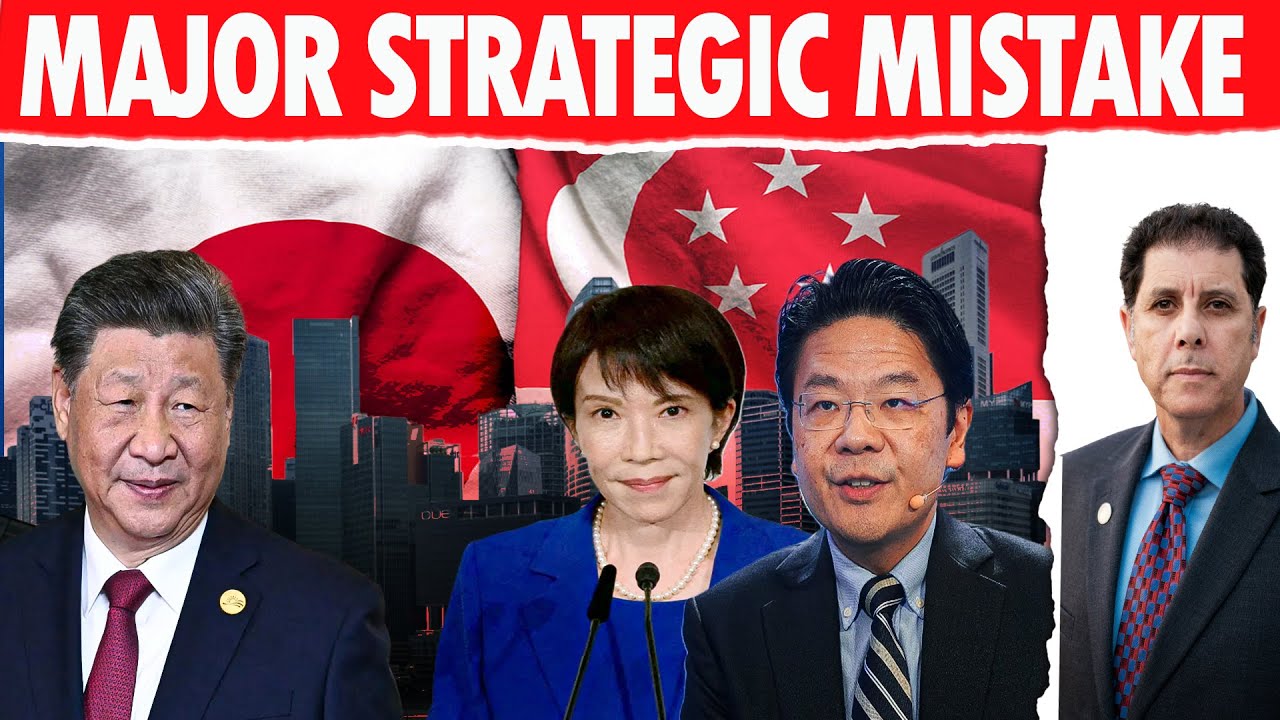
Dr. David Oualaalou analyzes Singapore PM Lawrence Wong's statement urging Southeast Asia to trust Japan over China, calling it a strategic miscalculation. China's rare-earth ban on Japan and deep-water ports in Malaysia and Indonesia threaten Singapore's role as the Strait of Malacca's premier hub, with cargo rerouted to Hainan saving 32 percent. Singapore's GDP growth forecast dropped from 4 percent to under 2 percent for 2026.
Chapters
Hello everybody and welcome to Geopolitical Trends, where truth matters. I'm your host, Dr. Oualaalou, excited to be with you as always. Today's topic, I will be talking about what's going on with Singapore. Whoever thought the, the Prime Minister Lawrence Wong, some sort of an ill-conceived, uh, diplomatic statement, has no idea about the, uh, strategic mistake he's made when asking the rest of Southeast Asia, in addition to some other Asian nations, to side with Japan. Basically, oh, we gotta forgive, you know, forget about all the historical atrocities Japan committed. Uh, basically, we need to trust Japan more so than China. That's what it comes down to. So So what I'm going to be providing you in this live stream, I'm going to be providing you my own analysis about what's really behind all this and then put it in perspective for you within the context of, of course, the tensions that's going on between Japan and China, given what China just did today. And I'm going to be sharing with you as I move forward. So, so quickly here, let me see. As a matter of fact, I need to get on, on this quickly here. I'm going to be talking about— once again, we'll be talking about Singapore supporting sort of Japan against China. If you look at the big picture into what is going on, and that in itself, some sort of— it just, it just creates some more tensions, if I may use the term for that. So Some housekeeping item before I, I delve deeper into all this. After, I'll do the headlines for you as well. Tomorrow I will be talking once again about Singapore, but from a different, uh, aspects altogether. And this has to do with, once again, a colossal mistake that Singapore is going to be making since now the government in Singapore is considering importing workers from India, given what just came out of India yesterday about the fake diplomas that's been issued in India. So, so I'll be talking about this tomorrow, so make sure to join me for this particular topic. I have two more topics on Asia, then I'll move into the Middle East because we're going to be talking about the hour of a major confrontation whether it is approaching between Iran and Israel. So I'm keeping an eye open on this one here. So I'm gonna do two headlines for you, then I'll delve into my analysis about this. And the first one has to do with, uh, actually no, it has to do with, uh, China and what's going on with Venezuela. Of course, uh, what the Chinese, what the Beijing, or what the government in China just announced this morning is that they are ready to work with countries in the region to defend peace in Latin America. Of course, this has to have a reason for it. And that reason is, and this is exactly what the Chinese Foreign Ministry stated today, that Beijing is ready to work with regional countries to defend peace in Latin America and the Caribbean following the US attack on Venezuela and the abduction of the Venezuelan president, Maduro from his residency. Of course, as you all know, this— the whole abduction operation and so forth ain't about Venezuela. It is about China. Let's just say it's straightforward. And this is what China now is going to have to think about its investments in Venezuela and some other regional countries there. So this is why Beijing is issuing these statements to put the US on notice here. Just, hey, FYI, We do have our strategic interests. The other major development here, which I'm going to be addressing for you soon, but I'm going to give you a headline about it. It has to do with China again and Japan. And this time is that China— you all remember I did a video for you about 3 weeks ago and I said, if China reached this decision, that's the end. And that's exactly what China now decided. To do is decided to ban the export of any material that could be used in military, uh, that could be, uh, of used militarily to Japan. So any— you all know what we're referring to here. We're referring to the rare earth elements. So, so China has banned now the export of the dual-use material which can be used for military purposes, and this to Japan. According to statements was issued by the Chinese Ministry of Commerce today. I just read this this morning. Of course, it's evening time in China. So that tells me right there where things are headed. And this is why we're going to segue into our topics today, why the Prime Minister of Singapore, Lawrence Wong, will make such an an ill-conceived statement. You know, doesn't he understand history? Does any of his advisors give him a crash course about history and how— and what Japan did to Singapore in itself? So in any event, this is what I'm going to be highlighting for you. So in this particular analysis, I'm going to be highlighting or addressing Singapore's complex position now in this increasing multipolar era that Asia is, is going through as well. And with this, I will examine and provide my own assessment about the Prime Minister Lawrence Wong's controversial diplomatic statement supporting Japan regional role and its ripple effects across geopolitical and economic spheres. That's what's important. So what I'm going to cover in this analysis is Singapore's evolving sort of maritime economic strategy, which is a concern. Why it's concerned today? Because of Chinese competition and Chinese expansion, given that China has invested in some other deep water ports, which is gonna render Singapore irrelevant to a degree. So I remember I did a private speaking event for a private entity, and they were asking me at that time what wanted to know is, with the emergence of the Gwadar Port, Shabahar, and also the United Arab Emirates port, how is this going to impact, uh, Singapore? And my argument back then, I said, and I'm paraphrasing here, that if any country gets involved into infrastructure of deep water ports, Singapore will not have the edge anymore. And here we are, because now you have China invested through the BRI And of course, with Indonesia, I believe, and also some projects with Malaysia, but specifically for the ports of deep water, because it makes now the commodities bypass Singapore and come directly to China. And could it be what Singapore now is, is, is, is having a problem with this? And with this, this analysis, I decided to do for you a historical snapshot of the Sino-Singapore relations with spanning millennia, by the way. So to those who do not understand the history of China and Singapore, you might want to sort of educate yourself about that one to understand what's going on or what has been throughout the history. So I have decided to do this particular aspect of historical snapshots on this. So, so once again, the Prime Minister of Singapore, the, uh, the Prime Minister Lawrence Wong— let me get a picture of him right here. Here, this guy here, which by the way, it doesn't seem that all people in Singapore are in favor. Of course there is a backlash regarding what he said, but he found himself now embroiled in hot water after his recent remarks on China and Japan tensions, being labeled because they are already labeled that being inclined towards Japan. So, which was deemed as suggesting that Beijing— this is what he's saying, basically. He's suggesting to Beijing to put history aside and move forward. I mean, if you saw what I saw, or if you see what I saw when I went to Nanjing Museum and saw the images of the atrocities committed by Japan, and if that's not enough, Just ask other countries in the region. Ask the South Koreans. Ask even Singapore, the older generation and what they have experienced. And this is where this issue now about why the Prime Minister is calling on Southeast Asia, uh, uh, suggest that the whole Asia for that matter, just move past historical grievances with Japan. How can they do that? So because that's sort of the, uh, uh, it puts him, meaning Lawrence, now almost like speaking on behalf of the entire region. So regarding the sentiment pertaining to the historical issues between Asian countries and Japan. So as a matter of fact, Singapore itself, being a Southeast Asian nation, with its own complex history during World War II and the Japanese occupation. So, and this is why some are, are like, is he losing his mind here or what? Or is there something behind the scenes that we are not aware of? So when you think about it, you, you, you put that big picture of the economic and strategic cooperation and so forth. So of course the arguments coming from Lawrence is that Southeast Asia and Japan have significant trade relationship. And security interests, particularly in maintaining some sort of stability in the Indo-Pacific region and the greater power competition. Yeah, nobody's denying that. But at the same time, when you are calling basically, well, we're going to have to trust Japan more so than China, that's going to sort of put forward the question of your credibility. In other words, do you have a substance understanding of the issues before you issue a statement like this. And this is where that problem came in as far as Lawrence, Lawrence Hwang, the Prime Minister of Singapore, asking for Southeast Asia to move beyond, yeah, beyond the grievances that took place back then. So there are those who are saying, well, wait a minute, Dr. O, maybe Singapore is just trying to play a balancing act. Maybe, maybe not, you know. But when I look at the trends, for example, with Philippines that is being pushed for what it's doing with, with, with against China, then now you have the Singapore statement, then you have the Japan provocation. Because I will answer one specific question for you later on, whether China sees this as a provocation or not. So And this is where those who are in support of Lawrence will say, well, this is just a Singapore particular approach to dealing with the— what's going on with the multipolarity in that part of the world. This has to do with its pragmatic and business-oriented. Well, if I am to say this, how come the government does not understand the ramification of what Japan did last month or the month before when the Prime Minister Sanné Takahashi issued that provocation. So, and to those who say, well, no, no, no, Singapore is focusing on future cooperation. No, I have to push back against that because Singapore is realizing that it's losing that edge, given that some deep ports have been built in the region which will bypass Singapore altogether. That's the way I look at it, because the logical question for me to ask is, is Singapore losing its economic edge as being a maritime hub now that China has built deep ports in Malaysia, for example? It's a logical question to ask, and this is where you're going to have to think. And if this is not enough, we're going to have to go into the Strait of Malacca. Okay, I have— I think I have a picture Either the map, whatever. Yeah, right there, Strait of Malacca. Why is this important? So because the arguments coming out of Singapore is the idea of the Strait of Malacca and Singapore piracy. So there are some sort of attacks that continued on, on Strait of Malacca even during 2025. So well, yeah, I'm not denying that might be there. But here is where I see the problem. Even India now wants to get involved, actively seeking to join or coordinate with the Malacca Strait Patrol to enhance maritime security in the crucial waterway. Really? Are you going to depend on India? I mean, let's just face it. Let's just face it. So if Singapore playing this kind of angle, And this is why, by the way, tomorrow I will be talking in great depth about why the government all of a sudden now, Singapore that is, considering importing Indian workers, which will be, you know, a colossal mistake. You know, it's all just waiting to happen. You know, a great, great mistake if they ever do that. And we'll deal with that tomorrow when I talk about it. But for now, suffice it to say that Singapore recently acknowledging sort of India's interest. And when you think about, is this why even the president of Singapore— that's right here, his name is, uh, what's his name, is Dharman, I'm sorry, I can't pronounce his last name— is the president of India, so of Singapore, I'm sorry, of Indian descent. And he is now with the labor, I think, minister of India. And this is where I'm seeing that connection. All of a sudden, the Singaporean government considering importing workers from India, but Singapore is already acknowledging India's interest in sort of joining or coordinating with the Malacca Strait Patrol. So because what it means to me personally, looking from outside in, is signaling a strategic move to counter China's influence. That's the only way I see it. What a best way to do it by, you know, a sort of recruiting India, because you— India can be used for anything. Just give it whatever, they'll, they'll go for whatever. So, and to safeguard trade routes, or routes, that is. Safeguard that from whom? So, so This is why I am concerned that if India gets involved, its navy gets involved, because there are 4 countries, as you may know, this Malacca Strait patrol. The 4 countries are Malaysia, Indonesia, Thailand, and Singapore. So adding India is going to just mess up things to begin with. And second, the mindset. If India gets involved, you all know what it means with the corruption. And bribery and all that stuff is going on. But, but that's not our issue. Our issue is understanding the real competitive pressure Singapore is facing right now. Because remember, Singapore traditional sort of inner part, which is a port city and other centers to which commodities and goods are brought in for imports and exports and also for some sort of distribution and all that. Well, China will not need that anymore because they have contributed to building deep water ports elsewhere. So China is, is a win-win for China and whatever country they end up building that in. So because the idea of this model, which accounts for roughly 90% of the total trade regarding this transfer of goods. So, and all this, and I'm starting to be convinced that these statements by the Prime Minister of Singapore is only meant to counter China's influence, especially in commerce or maritime and so forth. But not only that, is also to push against China-ASEAN trade volume, because Singapore is not seeing as much of that as other ASEAN, the, the Asia, the Association of Southeast Asian Nations, ASEAN, the trade volume which enable now direct shipping to sort of to, to bypassing, bypassing Singapore, which go directly advantage hubs like the one in Hainan. Which, by the way, can deliver value-added processing. Because remember, China has already have a fully automated ports. So, and this is, by the way, and I'm gonna provide you a link because I had to look for this to confirm the information. So I'm gonna put it for you in the chat box, you can read it later on, should you decide to. And this particular information, because there is a documentation of Indonesian cargo vessel rerouting directly to Hainan Yangpu Port instead of Singapore, which means what? Achieving a cost saving of up to 32%. Take step back and think about it. China is saving 32% of the cost associated with moving commodities if they bypass Singapore, which is exactly what is happening because now they're going directly to the Hainan Yangpo Port. And once again, I'm finding myself convinced that this statement, this ill-conceived statement by the Prime Minister of Singapore, didn't happen in a vacuum. So consider also what China is doing. China is investing heavily in, in competing port facilities throughout the region. So we're talking from Malaysia's Port Klang to Indonesia, new deepwater facilities. And of course, this gives you the idea about Chinese strategic calculus. For how the shipping companies is going to be moving forward in this particular— because they're going to be increasingly favoring ports in countries with more politically aligned with China than with the US. And Singapore, you know, I am very concerned now where things are headed to Singapore. And if they move forward which tomorrow I'll detail because I have video clips and I have some information for you about this one. If they move forward with this idea of importing workers from India, you— this is what's going to become of Singapore. Some of you might think I'm exaggerating. This is Singapore, as you all know, very clean place and all that stuff. It's not going to be like this, but this is what they're going to be importing. This is the slums from India. As a matter of fact, it was already a complaint in England, I think in Manchester City or London, about how the, uh, the, uh, regions where Indian lives, you know, it's just nasty, dirty. So, so if Singapore wants to become like this, then go ahead and invite Indian workers. And once again, let me put this on the record. I am not generalizing. Let me just put this on record. So there are those now who's saying, oh no, no, no, Dr. O, Singapore is just adapting strategically. Yeah, there is not no harm in that. So, so because to them they are saying, well, instead of just going tit for tat with the Chinese because they can't compete with the Chinese, they just evolving some sort of a global transshipment station. And what they want to do is they want to turn it into a global high-tech shipping and supply chain management center. This is, by the way, where that idea of, uh, conceived by, pushed by the President of Singapore and of course by the Prime Minister himself, the idea of considering, uh, inviting, uh, workers from India. And to me, it was like, don't do it, don't do it, Singapore, don't do it. Based on what I'm seeing here in the US and what I've, I've heard just now, what's going on in Toronto, in Canada, Toronto, the massive number of Indians I was just watching. So once again, nothing against Indians. This is not about individual, it's just about preserving certain cultures the way they ought to be. That's all it is. So if Singapore thinking in the big picture of investing, which is, is in, for example, the Tuas Port— I don't know if to those who are familiar with the Tuas Port— so, but this is just a project for now on papers. There is nothing of it that is concrete. It just did. It's just a project as far as the, the thinking in Singapore to develop the world's most ambitious maritime infrastructure, infrastructure projects. So, and this, by the way, is going to have automation in it and so forth. China already has those. So why do you think China went ahead and contributed in the infrastructure in other countries like Indonesia, like Malaysia? And, and others. So the big picture when you look at this is that now Singapore finding itself, oh, we never thought about having to now compete. Yeah, this is what Singapore didn't count on. So because when you look at what took place in the Hainan port, because this isn't being stable This is the keyword: stable and direct shipping route to China. So, so the whole Asia-Pacific shipment network now therefore will evolve from some sort of Singapore-centric hub to something else. This is where the problem for Singapore is, and they don't know how to deal with it. And this could lead to the question Is Singapore in a panic mode? Yeah, are those who say no, no, no, no. I had a conversation with dear friend of mine and, and we, we, we talked about this one and it was the idea that, you know, is Singapore in a panic mode? And this to me reflects exactly that it is. That's like what the US just did in Venezuela. Do you think this has to do with Venezuela? No, it's— US is in panic mode about not knowing what to do with this multipolar order and is afraid of losing its status as the sole superpower. Singapore is no different, the way I see it. Liking this video so far? Don't just be a watcher, go ahead and hit the like, share, and subscribe button. And don't forget to tap the bell so you will not miss any of my videos or live streams. This way you will be supporting a channel that stands for the truth and objective reporting. The choice is yours. Thanks for your support. Like I mentioned at the beginning, I am going to be providing you a brief historical snapshot about the Singapore-China relations or Sino-Singapore Singapore relations. So this is not— this, you have to go way back. You have to go way back to the Qing Dynasty, okay? So you think about what was China's influence in Singapore millennia ago. So because to me it's a— it's an important historical question to ask. Why? Because it helps us understand the layers that exist. China's influence is what would become Singapore was substantial to those who do not know that history. So however, it wasn't through, for example, taking over Singapore or, or, or being this imperialist. No, no, no, no, no, no, no, no. It works through maritime trade networks rather than direct political control. This is what's fascinating about it. I mean, think about it. The language, even language now in Singapore, most of these new leaders were educated in the West, you know. I mean, I, I know even, even Lee Hsien Loong was educated at Harvard, you know. Wong himself educated in the English-speaking part, but there were parts where the Chinese language still exists. So I'm gonna take you to 2 or 3 phases, eras rather. This will provide you a glimpse into this historical past. So I'm gonna take you to medieval maritime trade that took place between the 7th and the 14th centuries. What happened back then? So Srivijaya, which is a maritime empire, was based in Sumatra. Right, what happened with it at that time? It gained great benefit from the lucrative— at that time they used to be involved in spice trade, which was done through the tributary trade system. With whom? It was with China. Why? Because that one helped them controlling the strategic choke points of the Straits of Malacca. Once again, it takes us back to to Strait of Malacca, why it was very, very, very important to understand that. And that was back then. And the records, historical records, indicates— and I'm going to provide you the link— the historical records indicates that the merchants from the— pardon my pronunciation— is the Luoyou. It's, it's a, you know, it's a L-O -YUAH. So, and those have boarded the ships destined for Canton on an annual basis. So I'm going to provide you the link for this, and you can read the, uh, the historical snapshot for this briefly should you decide to do this. Then you move into the monsoon trade patterns. And during this era, you have the ships from China, okay, would sell the southwest part of the Malay Peninsula. Once again, let's put that map just for, for you guys to see. This one here from the Malay Peninsula, okay. And this one, uh, and, and, and you're all familiar with the monsoon season, right? Because they back then, they will put this through the Malay Peninsula in January, and it will return to China from June to August. So, and this with ports along the straits serving as halfway points, where basically the reason why you have halfway points is where goods and passengers were exchanged and supplies were restocked and so forth. So the monsoon winds were making a round trip voyage at that time because it was impossible in a single season. Then came after that the decline of this particular era, and this was based on archaeological evidence. That's what I found very fascinating about the historical aspect. The archaeological evidence indicate that both Tamsik and other regional inter-port were abandoned or basically declined as regional centers towards the end of the 14th century. And this was concurrent with the decline of none other than Fujian maritime trade when the Yuan lost— the Yuan Dynasty, that is— lost the Mandate of Heaven, to those who are familiar with that part. So in summary, and I told you I'm going to do this very, very, very brief. In summary, China's influence is ancient, you know, but it's also in ancient Singapore, wasn't colonial or political. That is a key factor I need you to keep in mind. It was commercial, it was cultural, and that operating through merchant networks and some sort of other type of relationships that made the region prosperous. And this is what I believe Mr. Lawrence Wong did not take a look at before issuing that statement. When you are in possession of power, any statement you issue has to be measured. So, and once again, this leads me to the fundamental question: is Singapore in a panic mode? It's, it's worth asking. Of course, if you are to have a conversation with the analysts from the, uh, the West, Western think tanks, they're gonna tell you, no, no, no, no, Dr. O, there is no indication for that. Panic mode? What are you talking about? So because to them it will be like, oh, this is normal, this is normal, it's just focused on a routine governance of life improvements. That's the argument they're gonna do or say. Yeah, of course they're entitled to their opinions. So because their argument will be, oh, the government's still rolling out the cost of living to support, uh, the people with vouchers and so forth, you know, they are just thinking positively about the future and all that, you know. I'm not, you know, and to them They'll support this argument with, for example, the pharmaceutical and electronic manufacturer performing well. That's the argument. This celebrating this sector, the public events and so on. But wait, wait till tomorrow when I talk to you about the mood, the mood of the people of Singapore inside regarding the announcement of the government. So all they're saying is the government is doing is implementing administrative changes. So no, no, because it matters to understand the origin of why the Prime Minister Lawrence Wong issued the statements to begin with. Once again, these kind of statements don't happen in a vacuum. So, and this in itself leads to the question, does China see Singapore's Prime Minister Lawrence Wong's diplomatic statements in support of Japan as provocation? It's worth, it's worth asking the question. So of course, once again, there are those who say no, that can't be, and others who say, you know what, this might be interpreted, Beijing will interpret it as such. So yes, there was a backlash from China. So to those who say, oh no, no, no, no, that's just an innocent statement, will this be the same like what the Prime Minister of Japan said and did and it turns out to be a provocation as I called it the first time I heard that? And I almost asked question, why is she provoking China? I'm saying the same about Lawrence. Why is he provoking China? So to those who say, well, we have to distinguish between official state reactions and public and online reactions. No, no, no. Facts are facts. So the actual response from Beijing is that the officials the official Chinese have amplified the controversy. So this is exactly even coming from the— some sort of the prominent Chinese scholars who have widely intervened in something like this, because that's the role of a scholar, you know. You can't have that knowledge and sit on it if you couldn't stand for what's right. This is the problem with our scholars, some here, not all, I shall not generalize, of course. Here in the US, you got the scholars that have to push the narrative for the government, even when the narrative of the government is wrong. And that's to me, you know, those scholars have to look inward. So the Chinese scholars had to take stand regarding what Mr. Lawrence stated. So of course, for now, they are seeing it remain a substantive diplomatic and economic developments rather than some sort of a different sentiment for it. But when you think about what the, the, uh, what the Chinese did on December 17th, I remember that one, the Chinese Foreign Ministry, because I read a lot about what's going on with China because that's my interest in understanding where things are headed. So when that the Foreign Ministry summoned ambassadors from ASEAN countries, including Singapore. So of course, what was that for? It was the reaction of the Japanese Prime Minister Takaichi statements and urge them, urge them to support what's right, which means was China's subtle way of telling them, remember history. And this is where I feel Mr. Lawrence failed to understand the historical grievances. That's why he used the term, they need to overlook the historical grievances. No, you can't. You can't because Japan didn't come to terms with that reality. Now, this Japan apologized publicly, And besides, publicly, the, the scars that, for example, some other Asian nations in addition to China have experienced at the hand of the Japanese can be forgotten, can be forgotten. So, and this is where the backlash came through from the public one, that is the Prime Minister's Wong comments sparked criticism across— you're looking at not only in mainland China, but is also in Hong Kong and across other platforms. So, so you're looking at, uh, sort of what I read, based on what I read, is that the headline suggesting that Mr. Wang has hinted for China to drop its historical prejudices, in quote. This is what's— what is mind-boggling. That's why I'm saying whomever was advising the Prime Minister didn't advise him well into taking into consideration the atrocities Japan committed. Those are not— I saw the images, you know, I had to hold my tears back, you know, ain't easy for me to cry. You know, but I had to hold my tears back, especially with this image. I can't, I can't, I can't shake myself off that image of this elderly Chinese lady in, in mid-70s, based on what I read. You know, I just— it shook me the way she was treated. And this is again what I see, this the problem with politicians. They don't— they jump quickly to statements for political to score political points. So, and this is where you have commentaries in different parts of Asia, not just China, criticizing Singapore, sort of, you know, you look at, yeah, one of them that I remember reading, it has a title that stated, I'm paraphrasing here, Singapore's obvious bias in the China-Japan spat. Is discomforting. Yeah, sort of. And you have the— this is why the Wang's comments pushing for Singapore to side with Japan, you have some even used derogatory terms to refer to Singapore. I'm not gonna say those here on openly here, so, so I'm not going to say that, but derogatory. This is why people are pissed in, in Singapore. So, and add to the top of this, the government wants to consider, is considering to import Indian workers after the many countries around the world deported Indians back because of what they are doing. Not only for that, violating the laws and so forth and all that, but also because of the fake IDs that have been confiscated recently. So, and I, I'll deal with this tomorrow, as I mentioned earlier. So, so to me, what this appears to be is more than just Mr. Lawrence Wong's perception, uh, of, of what's going on. So, uh, because it's outright provocation. That's, that's how I see it. What do you think? Do you think, in your opinion, Mr. Wong provoked China inadvertently or, or intentionally? Yes or no? So if you will be kind and just answer, leave your answer in the chat box. There's some— because Wong, the Prime Minister, emphasized that Singapore and Southeast Asian countries support Japan playing a bigger role in the region, including on the security front. Well, let me Let me put a, a pause here. If we are to talk about security, uh, uh, aspects of it, who's providing security for Japan? It's the US. So if Mr. Wong is arguing from this security front that Japan will provide this, Japan in itself cannot even secure itself. It depends on the US. So it depends for security and for stability. So that's why the, the comment from Mr. Wang didn't hold. So because he is framing, he's framing this statement as a neutral and focused on regional stability. So no, no, no, no, no. But if you are to say this, meaning you, you, Mr. Wang, in this case supporting Japan playing a bigger role in the region, who he has Who has the bigger role economically in the region or the world for that matter? Is it Japan? Is it South Korea? Is it Singapore? Is it the US? No, it's China. It's common sense, you know, and those are facts on the table. So the irony in my opinion is that Mr. Wang was attempting a diplomatic bridge building. And the way he wanted to do it— this is what playing with politics is— the way he wants to do it is by drawing some sort of parallels to South Asia's own reconciliation with Japan. Well, wait a minute, you know, what makes us think that this South Asian, all of them, has reconciled with Japan? I am not aware of any. Please, if you do, share with the community, because this comparison in itself Even if we are to go with it, in my opinion, is perceived as insensitive. So because what it means that it implies that China should do what Southeast Asia did and move past historical grievances. How can you in a right mind assume and think that the people of China will, will just let this go. Their ancestors were, were, were tortured, were, were treated like in, in the worst manner you can even imagine a human fellow will put on another human fellow. And that also paved the way for the next question, is whether Mr. Wong was pressured to do so. I'm just thinking out loud. I don't have evidence that suggests 100%, like in the case of Philippines, like in the case of Japan. So, so, however, there are some evidence that suggest US involvement. So because he was asked about, uh, directly about pressure from great powers— which great powers are we talking about? You know, so funny how they word this in a, in a cherry-picking the language to mislead you. You know, when he— when asked, because he was asked, and this is how his press corps sort of formulated this, when Mr. Lawrence Wong was asked about pressure from great powers. No, why couldn't he say when he was asked about pressure from the United States directly? Here is what Mr. Wong explicitly stated, and I quote, the great powers, he says, we do not want you to choose, but of course each one wants us to be closer friends to them. End of quote. How pathetic! This is just baloney. It's vague. It has no substance. There is no content into what he's saying. The great powers say, 'We do not want you to choose, but of course each one wants us to be closer friends to them,' end quote. So that means even if we are to go with this With this, with this theory, that means that Mr. Wang operates with pressure from multiple directions, not just the US. But at the same time, I mean, common sense would suggest, take a step back and think, which country in the region there that falls under the thumb of the US? But not under the thumb of, let's say, France, Germany, uh, whatever. And this is why I'm seeing his statements is, is it's just playing with words. It's just playing with words. So that, that's the way I see it. Mr. Wong's own explanation. So when it comes down to this Japan-China issue, I found it interesting how the wording of it, because remember This is where you have certain leaders in, in Singapore are Western educated versus the traditional. This is why even in Singapore you still see certain areas. I, I have never been there, I just read enough about, and I know some people that I trust, I can ask them, was there still influence from the past? There's still some corners inside Singapore where you see the traditional the Chinese culture still practice to a degree. And of course you have now the English-speaking entities and so forth. So I'm not denying this, but again, his arguments regarding the Japan-China issue, it is what he said. Now on Japan and China, we all— this is in quote— we all want stability in Asia. Singapore and all the Southeast Asian countries support Japan playing a bigger role in our region, including on the security front, because we think that provides for some stability in the region. End of quote. So, and once again, I find myself just shaking my head when I see what Japan is doing, when I see what the Philippines is doing, when I see what South Korea is doing, when I see what Australia is doing. And of course, India wanted to interject itself in this, uh, uh, maritime for Malacca and so forth. So, and this is to me where that challenge of, oh, Mr. Wong is expressing Singapore's independent position on regional stability. No, no, no, no, no, no, no, no. So even his statements has faced internal criticism from, for example, the former Minister George Yeo. You all know he is, by the way, I did send a request of an interview for Mr. Yao. I haven't heard back from him yet, so I hope if his schedule permits, he will do us the honor and come on the channel here and we can have a great conversation with him. So, but anyway, even Mr. George Yao, who refuted Wang's remarks, saying that calling on China to put aside history was a sign of lack of basic historical respect, end of quote. Those was his words. So because what Mr. Wong end up doing, he doesn't even realize it, he's violating ASEAN consensus procedures by making statements that should have been collectively discussed with other ASEAN members first. So, so when Mr. Wang is making this independent diplomatic miscalculation, you know, he is making a big strategic mistake. That's what I'm saying. Is he making a big strategic mistake? Because to me, that's the only way I can see it, and it is a strategic mistake because China's not going to forget this. And with where things are going economically and where the world is moving into. So, and we all know, I'm aware of what we've done in Singapore from the '70s of the last century, the, the, the evidence of corruption that involved JP Morgan. Uh, there were a lot, a lot of, a lot of issues. I was even aware of the the investigation by the FBI regarding some money laundering at some point a few years ago. And this is why the statements, it backfired domestically in Singapore. And not only did that, it drew also the Chinese criticism. And reportedly didn't even earn Mr. Wong the brownie points political from the US. This is where miscalculation is. So now with my last part of this livestream is my conclusion for you is what's next for Singapore, which is, which is a legitimate question to ask. Uh, yeah, what's next? Because it's, it's, we have to think about it. So Singapore faces, uh, faces a mixed, some sort of, uh, not only mixed but also strategic important period ahead moving forward. So because the first thing that comes to mind is the economic challenge, which is now with bypassing the port in Singapore. That's a big loss, big loss. The second one is going to be if they ever bring Indian workers into Singapore, you know, if they want Singapore to turn to this, then good luck, good luck, let alone the, the fake diplomas and so forth. So, and this is why, uh, sort of people are warning Mr. Wong about the growth of Singapore moving forward. So of course, uh, to Mr. Wong, it's kind of like didn't realize that you can't— you can play with some, or you can, uh, what's the word, you can challenge someone that is bigger than you if you know already you you will lose the fight. Why get involved to begin with? Fight for something you know you have a chance against. So, and this is again where the problem, uh, because the way I see it with where things are going, I hardly ever believe that Singapore will be able to sustain its economic growth that is achieved in 2024-25 moving into 2026. Because to my knowledge their growth is not going to even pass beyond 1.8%. So, and, and why am I saying this? Because if you look back a few months ago, they were saying, oh, 2026 we'll see about over 4.0% growth. They're changing this. They just changed it last week. By the way, and by the way, I have the link for this if you want to read it. So this way you know where my information is coming from. I'm going to put it in chat box for you. So labor markets concern, and this I'm not going to say much about it because I want to leave this for tomorrow, what I call it the Indian conundrum. So So they had a survey, survey inside Singapore from the Singapore National Employer Federation. You know what they found? Almost 60% of employer plan to freeze entry jobs in 2026. So that is up by 50% from 2024. So, and this is where the government is thinking about bringing Indian workers, you know. You also— what the Saudis did with, with the— they pour in over 10,000, almost 11,000 Indian workers. United Arab Emirates did the same. Some other Gulf states did the same. The US restricting H-1 visa, and I hope they ban it, you know. You know, I have nothing against, but when I When I went over this weekend, I went some to the outlet. I took my son over there, I want to buy something, whatever. And he told me, hey, did you notice something? I said, what? See, did you notice how many Indians here? And I don't know if it was just the holiday or whatever. And I've seen, uh, you know, military age men. I've seen also some older people in their late 30s, mid-40s. I've seen also some families. I'm seeing little kids. But it was too many, too many. I've never seen this before. And I walk around and I watch. I'm very aware of my surroundings. And this is one of the easy— the labor market in India. And I will talk detail about this tomorrow. So, but for those who say, oh, Singapore is just taking some sort of strategic initiatives, no, no, no, this has nothing to do. It has nothing to do. It has to do with the— Singapore is realizing that it's losing its grip on the status it used to have. Even the US, okay, even the US, Donald Trump did not refer to Singapore as the favor status. You know, you usually do this for certain countries. David Trump didn't do it, and that tells you the story right there. So moving forward, it's, uh, the broader message here. So you're looking at Prime Minister Wong and even Senior Minister Lee Hsien Loong, known as LHL. So sort of, yeah, this kind of feel more dangerous and uncertain where the world is going. But when you add what's, what the Prime Minister of Singapore just stated, that's just adding fuel to the fire, basically. So, and again, there are those who will say, oh, it's the opposite, Dr. O. This reflects nothing but Singapore's approach, acknowledging the challenges candidly and so forth. Yeah, maybe, maybe not. So, so I still, I feel, and again, my opinion I feel Singapore is in panic mode. That's why when you have certain ill-conceived policies emanating from a government, that's usually a panic, panic signal. What do you think? Make sure to leave me some comments in the chat box or, or in the comment section. I would love to read your, uh, your, uh, your comments. That is, tomorrow remember to join me for— I will be talking about really what is going to be happening for Singapore if they ever move forward with bringing in Indian workers. It will be, you know, you could— you— Singapore will never be the same. Let me just tell you this straightforward. And again, I'm not against whatever. I'm just— because to my understanding is that some are unable to integrate into the new culture. You can bring the cultural mindset of India into other countries. That just doesn't work now. Anyway, that's all I have for you for today. Uh, to those who know, uh, I have, uh, launched the fundraising for, uh, my upcoming trip to Asia. So I'm gonna put the link for you in the chat box there, and if you wanted to support, uh, my upcoming trip to Asia, it is the link for you should you decide, uh, to to do so, and I will be grateful to you. So here's the link for it, and I look forward to seeing you tomorrow. As always, remember, geopolitics impacts your daily life in more ways than one. Till next time, bye-bye.
More from David


Beyond the Single Actor: Why the Gulf Isn't Choosing Between the US and China


Iran, Iraq's Militias, and the Houthis Are Coordinating! This Changes Everything




Who Controls the Next Decade's Resources? Latin America and Africa's Geopolitical Crossroads

The Chokepoint Trap: How Washington's Stupidity Triggered a Cascade That Now Controls the World

Trump Spooked as IRGC Unveiled dual-use SLV, Deployed Ghadir Mini-Subs & Hinted at Tactical Nukes!
