The Qaem-100: Iran's Most Dangerous Weapon the Media Isn't Talking About
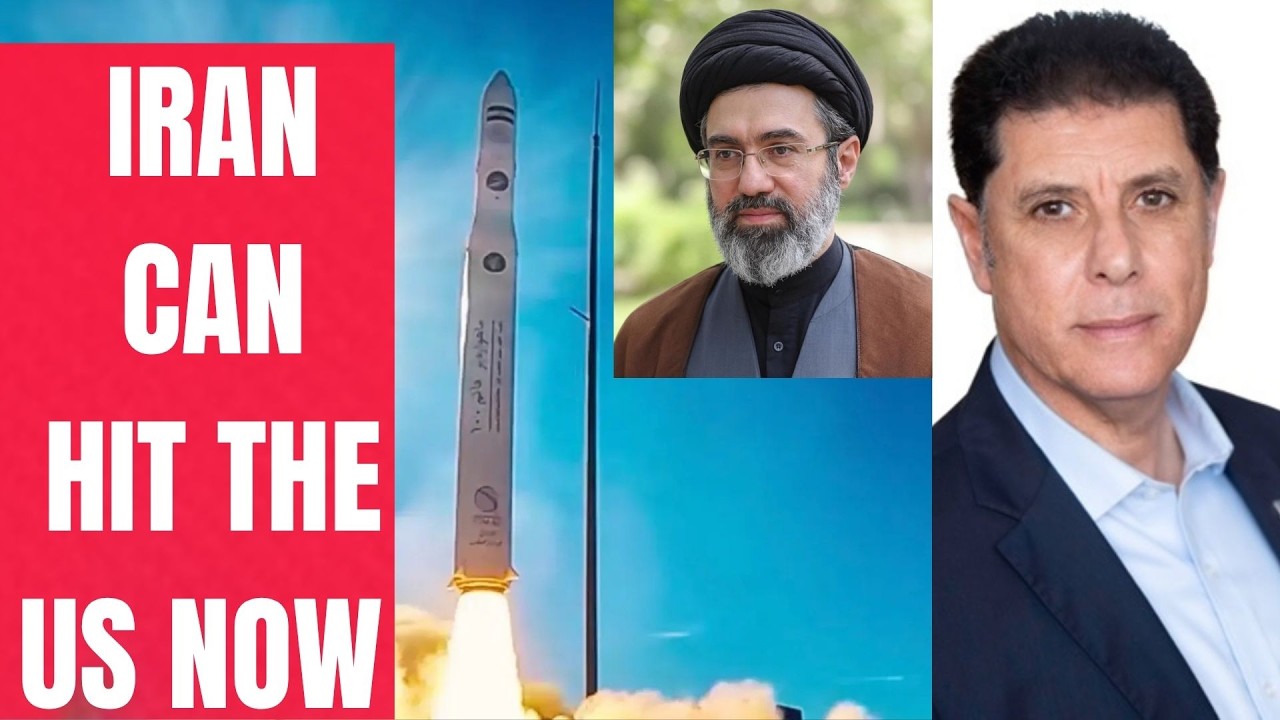
In this livestream, the host examines Iran’s recent missile developments, focusing on the Qaem‑100 solid‑fuel, three‑stage launch vehicle originally designed for satellite deployment but now repurposed for long‑range ballistic missiles. The discussion traces Iran’s demonstrated 4,000 km strike on the U.S.–UK base at Diego Garcia, the claim of a 10,800 km intercontinental capability, and the broader pattern of dual‑use space technology enabling ICBM growth. The host links these advances to Iran’s strategic messaging, the perceived U.S. intelligence blind spots, and the reactions (or lack thereof) from Europe, the United Nations, and the United States. He also draws parallels with North Korea’s missile program, highlights China’s material support, and warns that the missile gap is closing faster than policymakers anticipate. Throughout, he urges viewers to recognize the shifting security calculus, the limitations of sanctions, and the urgent need for public awareness, while soliciting audience comments on possible diplomatic solutions.
Chapters
Hello everybody and welcome to Geopolitical Trends, where truth matters. 10,800 kilometers, that is the exact distance between Tehran and Washington, DC. And only a few weeks ago, which by the way now it's confirmed, Iran fired the missile 4,000 kilometers. Destination was San Diego Garcia. The base. So, and by doing this, Iran doubled its previous known range overnight. So do the math. The gap between where Iran is and where it needs to be to hit the US soil directly is closing faster than any intelligence agency predicted within the US. All over the Atlantic, like in Europe where I'm currently. And here is what it means for you, whether you are American or otherwise, because you think about it this way: a missile that can travel 10,000 kilometers, and Iran proved, of course, it will use it in defense of its sovereignty and security and so forth, but it's— it will be willing to use it. And the US government has been caught completely off guard. And that's exactly what Iran did at San Diego Garcia. It wasn't a warning shot. No, no, no, no, no, no. A lot of people were thinking— I was thinking that too. I won't deny it. I was thinking, is this a warning shot? No, it was a demonstration. And if you think the American mainland is safe, you need to watch this video right now. And that's why I'm gonna have a great show for you tonight— today, it's daytime anyway where you are. And, uh, so I'm gonna be sharing a few clips. Make sure you stay with me till the end because I have a specific, uh, a clip that you need to be aware of, and this one coming out of North Korea. And to me, I'm already starting to see the writing on the wall? Is North Korea preparing for something in the assumption that the US might end up having to use tactical nukes or some other aspects of it? So, so here's what I'm going to do first. And by the way, I'll play this short clip here and I'll provide my own analysis. And like I always did, I give credit where credit is due. This, this clip is from Al Arabiya News. Foundation, which is very, very, very spot on. That's the way I look at it. So let me post it here for you and I'll do very brief translation here just about the beginning. We're not going to play the entire clip, then we go from there. So let's take a listen, please. Or as a matter of fact, I'm going to just play it and do the translation for you. So this way You can see, uh, where it is going. So basically what it says: until recently, Iran claimed its missile has maximum range of 2,500 kilometers. The Diego Garcia missile proved that they have missiles with a range of up to 4,000 kilometers, and this worried Europe and many other regions around the world. So what is the technical challenge of this matter? The anchor asked. The apparent technical challenge is that Iran claimed to have a fatwa prohibiting exceeding 2,000 kilometers. Another reason is that they only possessed two-stage missiles. To exceed the 2,000-kilometer range or to develop multi— medium and long-range ICBMs, intercontinental ballistic missiles, we need three-stage missiles. The missiles we are seeing on the screen right here is Khaim-100. This missile was initially designed to launch spacecraft and satellites. It entered service in 2022 and was first tested in 2023, but the mission failed to place the satellite into orbit. Then they repeated the test until 2024. They succeeded this time around in placing a satellite into orbit at about 700 meters, an altitude of 700 50 above Earth. We call these satellites in the LEO layer, which is the distance between 500 meters, low orbit, and 2,000 meters. Uh, we are talking about satellites. Look, the missiles are weak compared to this size, the size of space rocket. But what made Iran use this missile, the Qaem-1, which we see on the air, to target Diego Garcia? This trick is clear. If they had built the three-stage ballistic missile It will be obvious that they are developing missiles with a range beyond Israel's, missiles that threaten Europe, threaten London, and even the US in the future if they succeeded in increasing the range. The game is that they developed the missile supposedly for peaceful purposes first, which is to transport satellite, but they used or designed it in a way that will make it easy to convert from space purposes to military purposes, and they used it to strike the Diego Garcia base because it is a three-stage heavy missile, uh, missiles. That is exactly why it's very, very important to understand, uh, this. And I'm going to stop it right here. I just wanted to show you, and I'm going to be providing, uh, the details of my own analysis based on the research that I did on this specific missile. It's right here, Qa'im. There's this one here. And of course, I had to go to Defense Institute to acquire some information pertaining to this. So now the next question we need to ask within this context is, why does it concern the US? It's because of the dual problem, the dual-use problem, that is. And again, I'm going to have to go back About a month ago when I did the video and I said to you, still on the record, I said I couldn't confirm whether Iran launched the missile or not. Why? Because the IRGC denied it at that time. But on the other hand, the missile was launched, the heat signal, whatever, it indicated something. And a lot of— we weren't sure if Iran did that, that means They have now broken into the 4,000 range. And if they broke into 4,000 range, they can broke into the 10,000 range, which is the ICBM. So this is why— so what the denial of the IRGC back then, back then was strategic. It's not that they were lying. There is nothing about lying here. It's about strategic moves. So the dual use problem, that is where the concern for the US. And the core issue is that The technologies needed to launch satellites and to deliver warheads across continents, meaning in the ICBM realm, are essentially the same. If you use a rocket to launch a satellite, you will have the same technology to use it to launch a warhead. That is the, that is the key as to why Iran didn't say much at that time. So, Kha'im 100. Is a solid fuel propulsion enabled rapid preparation and launch without the vulnerabilities of liquid fueling, and that in itself facilitating the salvo fire capabilities adaptable to military payload such as nuclear warhead. That is the key as to why Iran, the IRGC, didn't confirm the firing on San Diego. Base, San Diego Garcia. And as I said earlier, it was a demonstration on part of Iran. We can do it. I mentioned it again on the record that I do believe Iran still has some surprises for the US. This is why Donald Trump now is stuck and confused as to what needs to be done. My big concern is the tactical nuclear will be an option. And as a matter of fact, in the US, I just got a word the night before that the head of the, uh, an individual who works into the nuclear triad within the US, in other words, uh, one of the officers who's involved in the launching of the nukes once they get the orders, has resigned and disclosed some information. Of course, not breaking the, the, the classified side, but disclose some information. And that tells me right there, is Donald Trump thinking in these terms? Maybe, maybe not, because in my opinion— and I'm not a psychologist— but he's not stable mentally. He's not, you know, you can't be flip-flopping within, within the same hour you're speaking about something serious like this. And that's again where that idea is, and this is where that concern come in. So the staging configuration parallels that elements of Iran. It's no different than the, the missile Sejjil-2 medium-range ballistic missile, and which suggests, in my opinion, the evolution of the missile heritage that could extend the range beyond the 2,000 kilometers with the payload, with the trajectory modification. That is the key. About all this. And this is again what military experts, people in the know regarding this, this technologies and so forth, they are stating that Qa'im— let me put the, uh, picture— Qa'im right here, the Qa'im solid, uh, the Qa'im, uh, 100 missile solid fuel engine and capable of lifting— here is the key capability of it— of lifting, uh, payloads into low orbits. Which means what? It could be adapted for long-range ballistic purposes. That is the key. That's what I found in the research from the defense entities. And as one European defense analyst observed, which I found out yesterday, what Iran learns from putting satellites into orbit can be used to send warheads across continents. Fair game, I would say. Let me put the link for you and you can read the article later on should you decide to do so. We'll continue with our conversation. And that is why the US now has designated Qa'em-100, the missile— put a picture because visuals make sense— Qa'em-100 has designated as contributing to ballistic missile proliferation risks and expanded sanctions. Well, wait a minute, US, you know, you're the one imposing sanctions on countries. What do you expect Iran to do, just cave in like other countries? Iran is not willing to do that. And that is why Iran is working quietly. This is exactly the path that North Korea did, which, by the way, I'm gonna— stay with me till the end. I'm gonna show you a clip, very interesting, about the stages that North Korea went through, which is exactly what Iran is doing right now. So for the US to say, oh, this is because it's gonna create proliferation and so forth. Nonsense. Nonsense after what we are doing. So, and this is why you have now, uh, uh, uh, uh, back in, I remember, uh, back in 2023 or '24, don't quote me on this. Uh, one of those, either '23 or '24, it was France, it was Germany, and it was the UK, the Stooges of Europe. Like I talked to Mike Grupe yesterday, Dr. Mike Grupe, about European. So what those three countries did, they issued a joint condemnation expressing alarm that the vehicle's solid fuel technology and orbital insertion capabilities could enhance Iran's ICBM potential in violation of UN Security Council Resolution 22:31. Well, hold on a second, Europe. Where was Europe when the US violated the UN-agreed-upon JCPOA between the P5+1? Why the Europeans didn't say anything? And even if they said, why they didn't take stand? And this is again where you see the double standard. Oh, we stand with what's right, but when it's time for you to do it, you couldn't. That's to me, that's the pinnacle of weakness. It's exactly. So the US can say all he wants. What matters now is that Iran demonstrated it has the capability. And I will not be surprised that at some point will issue a warning to the US that if Iran is attacked, we will see missiles falling in Washington. In New York, in Dallas, in Houston, in Florida, in whatever else. I won't be surprised. And this is where that 10,000-kilometer missile claim comes in. And again, what I've learned, and again, as one who did the research about Iran when I wrote my book, and I learned about the political thinking within Iran, the process of it. They don't tend to just bluff. I won't use the term lying, that's beside the point, is the idea of bluffing. So when Iran mentioned a 10,000-kilometer claim, I don't think so they bluffing. We said the same about when the first time the missile was launched to Diego Garcia, said, oh, Iran can do it. And it turns out to be the case. Iran has the capability of doing. The same thing we said about, oh, Iran missiles will not be able to penetrate Tel Aviv, the Iron Dome and all that. And all of a sudden we found out that Iran owns the skies in Israel. And I'm going to show you a clip later on about one specific missile that Iran developed that nothing, nothing will stop it. Even for us, even for us, the Patriot missile systems will not do it. Because it is hypersonic. That is— that's why I take this claim seriously from the IRGC. Well, in any event, back in November 2025, the Tasnim, which is affiliated with the government, reported that Iran's newest ICBM is almost ready for service. And remember, a year before 2024, uh, '25, that's when they, they tested one and failed, and they tried again in '24 and and succeeded the second time. And that's why this claim of 10,000 kilometers, if accurate, the range will extend Iran's strike capabilities. Europe will be within reach, of course, but also the US. Remember, the distance between Tehran and Washington is about 10,800, something like that. The distance between Tehran and Tel Aviv is about 1,593 kilometers, give or take. Depends which calculations you do. And when we say these missiles will hit North America, we include US mainland. Of course, you're going to hear the media in the West, think tanks and so forth, saying, oh, the claim cannot be independently verified, which is a logical argument, I can see. Why? Because Iran did not use it yet. Yet is the same argument we can now make about Diego Garcia. Oh, Iran doesn't have that range to— and it did. And this is where you have now Western defense officials, even here in Europe, especially in Paris, Berlin, and London, have not— here's my keyword to you. Have not commented on their report so far. Makes you wonder, do you know something maybe the Americans don't? Because remember, there are tensions between the US and Europe as we speak. But Europe, we all know, it's, it's, it's weak. There's no matter what they say, they can't do anything about, about it. So, and this brings me back to highlight to you the incidents that happened before, which it makes more sense for us to just mentioned here, the Diego Garcia incident. And that, in my opinion, was a strategic inflection point, very, very, very crucial in understanding. If we had to— if we are to put it within the context of operations, that one would be considered the most operationally significant developments in March 2026. No, that's when Iran fired the two ballistic missiles at the joint US-UK base at Diego Garcia in the Indian Ocean, roughly 4,000 kilometers away. Yeah, until that launch, you know, meaning before that or until that point, Iran's known arsenal consisted mainly of medium-range missiles. Because that's what the IRGC want everybody to know. This is a— it's, it's not about lying, that's nonsense anyway. It's about strategic movements. You don't play all your cards. For us, we do, because we're showing the aircraft carrier, we're showing the massive flex in our military when we realize we won't be able to. And that's exactly what Iran's war now has proven. That the US is not capable, no matter what you say on the asset. The same applies to this Diego Garcia incident, because the Diego Garcia incident places Iran now for— into what, what, the intermediate-range ballistic missile so far. And even if it is, it will be the first time. That tells you one step below the ICBMs. Like exactly what the Hwasong-15 ICBM, which is a North Korean. So Iran is only one step below that. Do you think that North Koreans are not going to help Iran? Think about it. With the Khorramshahr war, Iran is already there at that level. And remember when Iran launched the Khorramshahr at Ben Gurion Airport? No Israeli defense system was able to stop it. And as a matter of fact, I did found out that a retired IDF, Israeli Defense Force, air defense chief— was a chief— I found out that he stated, and I quote, is that the launch by Iran doubled the demonstrated capability overnight, end of quote. That's very heavy coming from an air defense chief, which means basically what are Iran's capability, what can achieve regarding the ICBM. As a matter of fact, it was classified. It's maybe still, maybe not. What I found out back then, it was classified. So you can have access to it that the US defense planner at that time They saw the San Diego Garcia incident as an important new chapter in the ICBM realm for Iran, which means in a simple language that Iran can hit the mainland. So the question was never purely whether Iran could reach the 2,000 kilometers, 4,000 kilometers. No, no, no, no, no. It was whether it would. The same applies to 10,000 kilometers, because on March 20th, 2026, that's the day when Iran launched the missile at Diego Garcia. That question received a definitive operational answer. That is the key to what I'm trying to convey to you. And now we have Qa'em-100. And Iran will be in a position to. I do believe they do have capabilities that they are not disclosing as we speak. If the truth matters to you, hit like, subscribe, and tap that bell. No spin, no agenda, just the stories they don't want you to know. Don't watch from the sideline. Be part of the movement. Your support keeps the truth alive. Thank you. Indeed, much appreciate your support. Now, if we are to ask another question is how significant is this? You know, because you're going to have to look at it. I wish, uh, uh, uh, which when I go back to the States, I will reach out to, uh, Dr. Postol. You know, he's busy now. Everybody's asking, so I told him I'll I will be overseas, and when I get back, I'll reach out to— he will be the one to really explain in detail, uh, because that's his background. You know, what I can tell you is that the experts who understand the technological pathway of this is saying it's over. The US can't do nothing about it because Iran had mastered the two-stage launch capability into space. Okay? It will not be difficult to extend the range of a missile to ICBM level. One multi-stage technology has already been developed. That is again, and again, who's reporting this? Not the Iranians. It's Western intelligence agencies, including the ones in Tel Aviv, be it Aman or Mossad or what have you, or Shin Bet for that matter. So, so on timeline, if you look at it from a timeline perspective, even for us back, the DIA, the Defense Intelligence Agency in the US, did an assessment, uh, and, and, uh, I had a chance to read it and I'm going to provide you the link, uh, did an assessment which of course they have to declassify the sensitive aspects of it, and that assessment was done in 2025, and in it— it disclosed that Iran could use its space launch vehicles to develop a militarily viable ICBM by 2035. The assessment was too optimistic about 2035. No, no, no, no. Iran, I would not be surprised, will be able to do it within a year or two, if not already did, it's just not disclosing it. And I would not rule that out. Because should Tehran decide to pursue that capability, it is within its reach. That's the bottom line that I need you to understand about really this missile, Qa'em-100. That's why I couldn't wait to do the livestream for you, because I need you to understand what— where this is leading to. Where this is leading to is leading to the same outcome like this one here. This is the Hwasong-15 ICBM. From North Korea. That's what Iran— you're going to be hearing it soon. Where the difference is, is that on 2026 of this year, in February, during the State of the Union address, which usually a US president are required by the Constitution to, to do that, what he said, if you go back to that, uh, speech, he mentioned something about, uh, uh, about Iran was working to build a missile that would soon reach the United States. The first time, it's the first time a US president has sort of portrayed Iran as being so close to developing an ICBM. What makes him think that they are not already did? Even the US intelligence agencies, or we call them the IC, the intelligence community, had previously offered a more cautious view on this because one official anonymously, of course, they are not going to disclose the name, but he stated, oh, no, no, no, no, no, no, there is no indication of dramatic progress in this endeavor. That's the mistake the Americans are making because it was the same assumption that was made about this missile or the one that I'm going to show you in a clip., or like Khorramshahr-4, or Fateh, or Emad, or what have you. All those type of capabilities, you know, the US was like, oh, they are far away from, from the window. No, no, it turns out to be accurate. On the strategic posturing perspective, this has a different, uh, uh, it sends a different message, that is. You know, because Iran's space program indicates that it is pursuing ICBM capability that could reach the continental United States. Why is this important, you may ask yourself? Because one country has to come to your mind that plays a role in supporting this, and that country is China, because China is critical Because mark my word on it, Iran will never forget what China has done for it during this critical time. It's like you're in a relationship with friends or whatever. You find out about your true friend in hard time, not in peacetime or whatever. When, when, when everything is hunky-dory and so forth, everybody is your friend. It's in a hard time you find out. China is critical. That is helping Iran in the ballistic missile production ambitions. I'm sure North Korea is also. I'm sure Russia is also. Russia is more on a nuclear aspect. North Korea is on the missile. China is on the technology of the satellites and, of course, the missiles. And this is where you see that cooperation between North Korea and Iran also. Is worth monitoring. That's why I wanted to share the clip with you towards the end of this. On the broader geopolitical shift, this means something. And it means what? That the ongoing escalation, which you're aware of, that the US now is just back and forth, that we don't know what we want. Iran is taking stand and firm stand. As a matter of fact, like I mentioned yesterday, Iran Central Bank now saw the first deposits of the fees for transiting the Strait of Hormuz, which gives you an idea who is in charge of the Strait of Hormuz. It's not Donald Trump. It's Iran that is in charge. And that's the reality of it. Of course, our media and all that is going to be lying to American people. American people start to— some start to wake up to the reality. And seeing this differently from what it is. So the broader geopolitical shift that is, is that this escalation fundamentally will alter now the calculations, especially from the US perspective, because one question they're gonna— the Pentagon is asking now, wondering, does Iran have an ICBM? And if Iran was able to penetrate the Israeli defense systems, which by the way is the same system we have, I'm here to tell you as one who was inside the government, anything that is produced in US, Israelis get a copy of it. When F-35 came up, and remember there are 3 types, F-35A, B, and C. The Israelis said, we want to have the F-35A, the same one you have. Of course, we went ahead and did some minor avionics changes and so forth. They weren't happy with that. So for the Iron Dome, Israel has the best per se that we have, which is no different from what we have. And to the Americans, they are thinking if the Iranian missiles, if the Iranian missiles are able to penetrate the Iron Dome, the David's Sling, the Arrow 3, and so forth, what makes us think that they won't be able to do it for us? With the caveat, and that caveat is Iran has a hypersonic. We don't have anything to counter that. That is the difference. And that is exactly what I meant by the broader geopolitical shift. Because that calculus is going to change. In what way? In a way that, you know, if you are to analyze it from the perspective of how is this going to impact regional parts of the world, the Middle East will no longer be geographically contained theater. And that is exactly, that is exactly what the late Ali Khamenei stated. And I have it on a record here that if Iran is attacked, the war is going to go beyond just the US and Israel. Or the US, I'm sorry, the US and Iran, or the Israel and Iran, or the US, Israel, and Iran. That's— I don't know, was, was the late Ali Khamenei hinting to something? Maybe, maybe not. Suffice it to say, you have right now— and again, I went through London and I had some conversation there. I'm gonna go soon to another location. And so far is that European capitals, including London, including Paris, and of course Berlin, now are like within reach, with incredible Iranian reach of its missiles. Of course, Iran is not going to attack Europe unless they contributed. That's why the Europeans said to Donald Trump, hell no, we are not sending our troops, because they know Iranian missiles is within reach to Europe. No country will be safe. Of course, if he participated in, into the war. The other thing we need to think about is the uncertainty of all this. Is this a calculated move by Iran, which I believe it is? You have to let your enemy wonder. Remember the Chinese Sun Tzu, The Art of War. You let your enemy— you don't need to fight openly, whatever. No, no, no, no, no, no. They are tactics. And that certainty remains because several crucial caveats will apply to this setting. And one of them will be a functioning ICBM from Iran, of course, require more than just range, which we know. But Iran has already access to Chinese technology and the assistance of North Korea. And developing a functional survival ICBM capable of delivering warheads accurately at sort of, uh, intercontinental distances— in other words, long, long distances— requires some substantial investments in re-entry vehicle technology. What makes us think that when Iran develops the hypersonic, it won't be able to do this? That's why whatever the Western think tank and military entities are saying they don't want to accept the fact that we might be now facing a reality. And that reality is Iran will be able to hit continental US. Simple. And we saw what Iran did with the cluster munition. They can do the same because they're going to have the reentry vehicle technology. They're going to have the guidance systems. They're gonna have the warhead miniaturization. And of course, all this will have to go through testing and so forth. Yes, the US intelligence and in coordination with MI6 and the Bundeswehr in Germany and so forth, and la DST in France, they all keeping an eye on. They can keep an eye all they want. Tell me if any of them was able to detect about this particular missile. Kha'em-100. Tell me if any of them was able to detect the hypersonic missile. Tell me if any of them was able to detect the Fatah missile, which I will show you the clip and you see with your own eyes. So what the intelligence agency is saying, basically saying, is we don't have, we don't have information, we don't know. That's the bottom line to it. So Iran's 10,000 km claim Even though to some it remains sort of unverified, one thing is for sure is that Iran's ICBM program, that's ballistic missile program and so forth. No, it— of course they're going to say, oh, the US and Israeli attacks have destroyed all that. Remember the statements that was said in June 2025. Oh, we obliterated all Iran defense systems and launching pads and all that stuff. In both, in Tel Aviv and Washington, it was the same coordinated message. And now Iran is proving them wrong. And even if we were, even if we go with the case that it was true that the US destroyed all this and all that and Israel and that. Iran has rapidly rebuilt its stockpile. As a matter of fact, to my knowledge, one assessment from the intelligence community indicates that Iran still has about 40% of its drones and 60% of its missile technologies, you know, launch pads and so forth. 40%. Of the, of the plane and 60% of the missiles. So where is this massive destruction of Iran capabilities and so forth? It's a lie, and we all know this one here. What I need you to understand, and I'm getting closer to the conclusion here just to conclude this live stream for you, is that Qaem-100 matters not because it is itself an ICBM, just in a different way. But because it's the technology bridge towards one. So think of, think of Haim 100 as a ladder with steps. They already have the ladder. All they need to do is put the next step so they can move up. Simple. Because when you consider the exact approach North Korea did is the same trajectory. That's what I need you to understand. So the same solid fuel, the multi-stage architecture that puts satellites in orbit, is the engineering foundation for the ICBM range weapons. So, and this put it in perspective for you, the Diego Garcia strike, which by the way Iran didn't aim at something specific. That's why they said, oh, they just missed whatever when it was confirmed. No, no, no, no, because it wasn't about that. It was about demonstration. As I said, the Diego Garcia strike in March 2023, it demonstrated that Iran was willing to use that expanding capability in the active conflict. If the US escalates, Or if the US uses tactical nukes, which I hope it doesn't, but we have an unstable president. I hope it doesn't get to that. Iran will have no, no hesitation because what Iran now showing the world that it has the capability and is showing the world that Iran self-declaration of the 2,000-kilometer ceiling for, for the range was politically constrained. No more. And even if it was, it was on a political level, not on a technological level. And of course, with the new leader, Supreme Leader, Mujtaba Khamenei, who is very different from his dad, is going forward. And that in itself changes the calculus for the United States homeland defense planning. Not just the US, I will include NATO Europe here, and I will also include the future Iran's nuclear diplomacy. There are those who are saying, you know what, enough of this nonsense with the Americans, go ahead, develop the bomb, declare it, and we go from there. That's what some are saying, and I had the conversations here in Europe. Suffice it to say one thing, and I, as I wrote in my article yesterday on, uh, on, on Substack, and I'm going to put the link for you for those who wants to read it because I address this particular aspects of, uh, uh, uh, I put it for in the chat box for you guys. I put about how Iran exposed the limits of American power. Both— it exposed the US and Israel. As we're approaching now, what, 56 days now? So make sure you read that article, and you can always leave me a comment there. I do read the feedback from the readers regarding that. And here's my conclusion for you, because I want to wrap this up here. Qaim al-Hanun didn't appear overnight. That's one thing you need to understand. It was built quietly, the same path North Korea did. It was tested patiently and it was disguised cleverly. That's what Iran did. Of course, they had to use the satellite labeling, so we do the same. You know, what makes the case in Iran different? I mean, remember when the US launched Israel and And the US launched missiles at those 3D planes thinking they were planes and they were just 3D printing. It's all about being shrewd and smart. That's what a war is all about. So, so the world still will argue about Iran's nuclear ambitions while they still arguing about Iran is working on something completely different. However, the Diego Garcia incident, that ripped that mask off permanently that Iran has the capability in a single launch. Only Iran did once. It didn't keep attacking Diego Garcia. No, it was only once to demonstrate. That's usually in the world of geopolitics, that's the subtle messages. Because Iran didn't just hit a military base, it sent a message to every defense planner in Washington, in London, in Brussels. And that message is the rules of engagement have fundamentally changed. And I believed in this from day one of the war. The end of the US dominance and Israel in the region is going to be at the hand of Iran. And Iran, by the way, put all the Arab and Muslim countries to shame. No exception, all of them. So consider what we know right now. Iran has a solid fuel, multi-stage rocket technology. It has also demonstrated its willingness to strike targets thousands of kilometers beyond what is publicly claimed it could reach. And for strategic reason, they won't disclose the, the accurate numbers, and they shouldn't. And it is also actively rebuilding now its missile stockpile despite the UN sanctions. UN is worthless anyway. But at the same time, Iran has something good going for it. It's China. It has China quietly supplying critical materials. That's what I'm saying. History will, will, will, will put it down, will well recorded that it was China that stood by Iran in time of need, and Iranians will never forget this. So which means what? All this happening, Iran has now stated the goal of its deterrence, its own, beyond geography, beyond what have you. So the gap between where Iran is today and a missile capable of reaching Washington, D.C. is no longer a question of if, it is a question of when, how fast, and crucially, what the world is prepared to do about it. Nothing. They can't because simple diplomacy has stalled. Sanctions didn't do anything to Iran. Air strikes on by both Israel and the US have showed, you know, it slowed down a little bit, but they have not stopped Iran's program in moving forward, especially with its missile technology. Yeah, and every year that passes, which Iran has been working on it for the last 3 decades, every year that passes from the point the missiles start to come out Every year the engineering gap is closing. Engineering gap between what the US claim to have with this ICBM and so forth and what Iran has, but that gap is closing. So here's the question I will leave you with, and I genuinely, genuinely want to know what you think. And by the way, I appreciate all of you who put in a comment. I might not respond to it, but I do read. I do read this, so thank you for taking the time to write your comment or response to that. The question is, if Iran successfully developed a missile capable of reaching the United States mainland, is there any diplomatic solution left on the table, or has the world already run out of time? So make sure you drop me your thoughts in the comment below. Because it's simple. This conversation, the world cannot afford to get it wrong. And at least in, in this channel here, I try to do my best to provide you, uh, substantive information. This is not about me just showing up in front of a camera, whatever. I care less for that. I care about what you can retain, what you can learn from spending time with me. At this level here. It's what I used to tell my students, both the graduate level and undergraduate level. If you haven't learned anything, then I have failed you, and failure is not an option for me. So let me put the link for you. The one that I wrote, again, another one I wrote is The War That Breaks America and Shatters Its Global Power Forever. Forever. Here's the link. You can, uh, you can read it there when you have time. Should be this side too. Now, time for the clips, as promised you. Uh, I promised I will do the clip, so we're gonna start with the first one. And the first one, and again, why am I bringing this up? Is the same pattern. And I'm gonna be showing you a clip about Fatah missile. Why is this important? Why is this important? It's because it's Iran's first hypersonic missile. To be made public. Public. And you know what's the shocking part about it? It can hit— it can reach Tel Aviv in 4 minutes. 4 minutes when you consider the distance between the two. So, so let me upload the screen here. And again, well, it's very brief and I'll do the translation. I'll do the translation for you because it's not that long. You just see it. So basically is that Tehran insists that today's dawn in Iran is no ordinary event. With these words, the Iranian— the Iranians announced the birth of Fateh, the first hypersonic missile, which they had spoken of extensively before its completion, claiming it could reach Tel Aviv in 4 minutes. That's about 1,549 kilometers distance between, uh, Tel Aviv and, uh, and Tehran. The event is as momentous as Tehran wanted the world, both friends and foes, to see it. Fatah missile, that is, according to the Iranian, is a hypersonic missile that bypass even the most advanced missile defense system due to its speed of 13 times the speed of sound. It is equipped with a solid-fuel spherical warhead and movable nozzles, enabling it to maneuver in all directions and accurately strike its target. It has a range of 1,400 kilometers and possesses stealth capability, allowing it to evade radar. Meanwhile, the way the West remains skeptical of Iran's weapons manufacturing capabilities. Once again, that is again why I wanted to show you. The reason I want to show you this is the same pattern we are noticing now with this new missile right here, with the, with Qa'em-100. I want to rule out that Iran might even have the ICBM, is just keeping that quiet for the moment till we see how things will evolve, because with, with, with Taco, you never know. So the second video I want to— a clip, I'm sorry, not a video, a clip I want to share with you is from my fellow citizen Jeffrey Sachs, and which, which convey my point that I did in my article on Substack. That's why I wanted to share the link with you so you can, you can read it should you decide to do. Iran has shown that it has a critical deterrent power, that it has leverage, that it will not be simply scared away by the threats or even by the bombs. Also, America's military bases along the Gulf have been shown to be what they are— magnets for trouble rather than protection for anybody. So I think Bahrain, Qatar, United Arab Emirates, Saudi Arabia have to be rethinking. These bases didn't protect us. They're not going to protect us. I think they won't come back in the old form. Okay. And by the way, I give credit for that clip to CGTN. There's a program there called The Heat, and I listened to the entire conversation or interview of Professor Sachs. Which, by the way, just to let you know, I do disagree on some points with Professor Sachs, and I don't agree with him on everything. And that's usually the importance of intellectual dialogue. You don't have to agree with scholars. You can disagree as long as you can articulate your arguments against or for and what have you. And the last one I want to share with you is about North Korea. This to me is what makes this, and I wanted to save the best for last. Why? It's because I'm seeing the same patterns. Iran is moving into that direction, and I will not rule out that already Iran or North Korea will support Iran moving forward should the demand come for that. So. Oh, I'm sorry, I will not play the sound here because it has a soundtrack. And YouTube tends to not like this one, so we're going to go ahead and I think I do have a very, very short translation. Limava to say do Korea for this one. Why is North Korea escalating its missile test? Since the beginning of April, Pyongyang has conducted 4 missile launches. This intensified activity comes amid war tensions with Iran and talk of a potential meeting with the US and South Korea regarding North Korea's nuclear program. According to experts, the accelerated pace of missile launches aimed to demonstrate Pyongyang's defensive capabilities while seeking to gain international influence. North Korea is also exploiting America's pre— pre— preoccupation with its war with Iran, considering it an ideal time to develop its nuclear and missile capabilities. This is an approach adhered to by Kim Jong-un, who has stated that his country's nuclear armament is irreversible, considering the expansion of its defensive nuclear deterrent essential for national security. Other experts, however, view it as a show of force to exert preemptive pressure before entering into any potential negotiations with the US. And South Korea. So that is the gist of what this is all about. I just want you to see the picture here. And by the way, I disagree with the last statements of those experts because North Korea is not showing force to exert preemptive pressure. No, no. What North Korea is doing is showing its deterrent capabilities and is showing his ability, his ability to really hammer down the massive amount of troops within Seoul. US troops, we have almost 30,000. All of them will be in body bags. That is exactly why. So I disagree with the last sentence when they says, oh, North Korea is only wanted to exert its preemptive pressure, view it as a show of force to exert preemptive pressure. No, it does not need to do that. It's because North Korea reached a point where the US will dare to challenge them or threaten them. Or tell me, when was the last time the US ever threatened North Korea? Yeah, we won't be able to. Why? Because the Hwasong-15 ICBM will be here in Washington will be here in Dallas, New York, Boston, Chicago, you name it. They're not gonna hesitate. And all the other medium range of North Korea's missiles are within range, within all the targets. I saw an interactive map. I wish I would have kept it for you guys to see within reach of all US bases in the region, in Asia, that is, is the same arguments I can make about And I'm going to show you the bases of the US in the Middle East. All these regions. Look at that. That's why Iran's capabilities, all of the— if these Gulf states or Arab countries have the gut to tell the Americans, you know what, we got any problems here because of your presence, we want you to pack and leave. We still can have diplomatic relations, but they don't have the gut because it was never about the security of those countries. It was about the survival of the regimes, the monarchies in those countries. That's what it's all about. It wasn't— but Iran now exposed that in the open because tomorrow Iran will always be there. So if they are thinking— they meaning Qatar, Bahrain, United Arab Emirates, and Kuwait and all, you know, that just— it's pathetic. It's pathetic, but that's the Arab culture. I'm not judging. Let me make that clear. I'm not judging the people. It's the regimes, the establishments. And that is exactly why in the case of North Korea, they went ahead and developed that. The US now knows that if they ever threaten North Korea, we will know what the response. That's why Donald Trump is very careful about— have you heard him last time saying the little man or rocket man or whatever? No more. No more of that language. Which is, by the way, it's inappropriate. Whether you agree with North Korea or not, they have a leader. Doesn't matter we agree or not. Rocket man, whatever, that language. But it tells you right there, Trump was never fit for president. I don't know, but again, Americans who voted for him, that's their problem, not mine. So anyway, I hope you— I don't know about tomorrow if I am going to do a live stream for you. I have another destination I need to get to soon. If I get a chance, I'll do it. If not, I'll do it some other time. But before I let you go, I'd like to say thank you to Noel, as always, always, always. Greetings, Dr. O, and good evening to you. Thank you so much, Noel, for your generosity. You've been, you've been, man, every live, every time I do live stream, you put in a Super Sticker. So I'm very I want you to know how grateful I am to that. So for the, uh, I also wanted to, wanted to say, uh, thank you to American Citizen X who bought me a few cups of tea in support of my upcoming trip to Asia. Yes, I am planning on it. Once I get back home, uh, what I intend to do is I'm gonna sit down, uh, calculate everything, share with you how far we we have, uh, we have, uh, uh, the fundraising where it is as of today, uh, and, and we'll just go from there. I do plan on this, and I plan on going to one specific location because I need to report from that location. It's going to cost money to— for me to get there. I did the calculations. I'm looking at about $10,000, uh, but I want a, a ground that Western media would never go to. So I hope you can support the channel for this particular— or support me for that particular trip if you want me to go there. If we reach the fund, we'll do it. If not, life goes on. Uh, also want to say thank you for those who've been supporting the channel. This is for Buy Me Coffee. This is in support of the content that you are enjoying in this channel here, and I am grateful to all of you. To all of you, no exception. The last one is if you want to get a copy of my books, those ones here. And I'm— again, I am working on another book. In due time, you will know the details about it. You will be the first, our community, and I'm going to share an excerpt with you after I get clearance from the government, because in my case, I have to clear the books by the government. So anyway, I hope you all enjoy this. Please, please share this video with others and subscribe if you have not done so. I will greatly appreciate it. As always, remember, geopolitics impacts your daily life in more ways than one. Till next time, bye-bye.
More from David


Beyond the Single Actor: Why the Gulf Isn't Choosing Between the US and China


Iran, Iraq's Militias, and the Houthis Are Coordinating! This Changes Everything




Who Controls the Next Decade's Resources? Latin America and Africa's Geopolitical Crossroads

The Chokepoint Trap: How Washington's Stupidity Triggered a Cascade That Now Controls the World

Trump Spooked as IRGC Unveiled dual-use SLV, Deployed Ghadir Mini-Subs & Hinted at Tactical Nukes!
