The Satellite That Changed the War — China's Hidden Role in the Iran Conflict
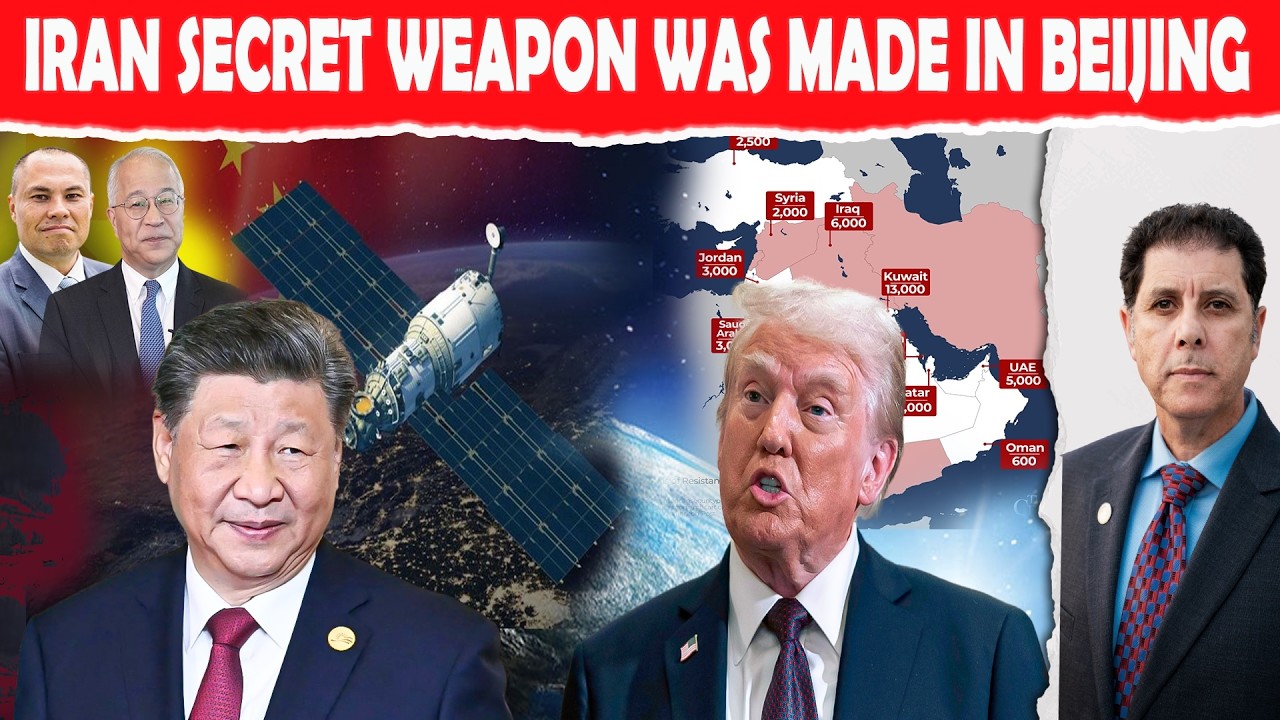
Inna Tangen and Warwick Bao break down the US-Israel strike on Iran, China's covert support through satellite imagery, and the economic shock from a Strait of Hormuz blockade. Oil could spike to $300 per barrel, disrupting global supply chains from fertilizer to AI data centers.
Chapters
Hello everyone and welcome to Geopolitical Trends, where truth matters. Excited to be with you as always, but I'm even more excited today because I have my two dear friends. Inna Tangen and Warwick Pao are here. We're gonna have a great, great discussions. To those who might be here for the first time, let me introduce my guests to you. So I'll start with Inna Tangen. Inna Tangen is a senior fellow at CIGI, which stands for Center for International Governance Innovation. He's also the— an international commentator on geopolitics and the global economy based in Beijing. He specializes in China's role in global governance and urban development. My other guest is Warwick Bao. He's an adjunct professor at Queensland University of Technology and a senior fellow at Tahei Institute in Beijing. His recent book which by the way, I have a copy of it for you guys just to see. Let me pull it up right there, which is gonna be released on the 15th of this month. It's called "Thermoeconomics in a Time of Monsters: Rethinking Theory, China, and International Geopolitical Economy." And he's also the host of the TIO Talks on, that's the one where he holds them. All right, let me bring in my guests here. Okay, welcome gentlemen.
Good morning, good morning.
All right, great to be here. Yeah, let's get in here. Einar, I'm going to start with you if I may. I would like to get your assessment on China's role. Uh, first of all, before we talk about China's role in the Iran conflict, what's going on, how do you assess the conflict that the US launched in the middle of negotiations?
Well, this is the second time that they've used negotiations as a ploy, in essence, to subterfuge an attack, attacks that were planned well in advance of the actual negotiations. So that has destroyed trust. In terms of why it happened, there are two time frames that people should keep in mind. One is in 1996, when Richard Perle put out a report that was sent to Netanyahu that said Israel should not bother with trying any kind of diplomatic approach to its survival, that its survival depended on weakening all countries in the Middle East. If you go back to that report, which is called Clean Break, you'll see that everything that— well, not everything, but 90% of what they forecast as being the plan for Israel has in fact been accomplished. In terms of Netanyahu, he's been saying for 30 years that Iran was 2 months to 2 weeks away from having a nuclear weapon, and this has been his raison d'être for getting the U.S. to attack Iran. Keep in mind that Iran and Israel are separated by 1,000 miles, and that you have 7.5 million Jews in the state of Israel versus 92 million Iranians. Obviously not something that they could accomplish, especially if it involved boots on the ground.
This—
the second time frame you have to look at is with Donald Trump. Donald Trump is— was facing tremendous pressure over, and he still is, over the Epstein files, where there are daily revelations which are more horrifying than the ones before, and also the failure of his domestic policies. He had run into Venezuela. He had deemed that a success, even though it was illegal, and he thought that this was a good way of distracting the public attention. He said so much before when he used to accuse Obama of— that he would say that Obama is about to start a war with Iran to cover up the fact that he has been an inconsequential and incompetent president. So you have Donald Trump basically saying, you know, why he starts wars. Uh, he did this and it has been a catastrophe. There was absolutely no thought put into how to get out of this. He thought it would be a quick win, in and out, distract the public, uh, you know, declare that he's in charge and therefore move on. But it's going to turn into a forever war. He does not understand that he lit a fuse. And regardless of whether the United States walks away at this point by declaring victory, the Iranians are not going to stop. They're in an asymmetrical situation where they cannot respond directly militarily, but they certainly can respond economically. And that's where the Straits of Hormuz, which I'm sure we'll be talking about, comes into play.
Warwick, how do you see it? What's your assessment of this really sort of the US in the middle of negotiations once again, is just launching at Iran in coordination with Israel?
Illegal, ill-conceived, ill-judged. Immoral, and from American power projection point of view, idiotic. We're now in a situation where the United States has no pathway to unilaterally ending this war that it started. It has exposures in two fundamental areas. Firstly, its military bases that were dotted across the Middle East or West Asia, ostensibly in the name of delivering protective cover to the Emiratis and other oil-rich nations of the region, as well as Israel, of course, have not been protected by the Americans and have now basically been decimated by the Iranians. The second problem is that the Iranians have shown their ability to bring the global economy, and more to the point, the American petrodollar system to a halt by controlling the Straits of Hormuz. And Trump and the American military have no capacity to make any changes to that. So both of these circumstances demonstrate that the American military does not have dominance in the area and cannot exercise the necessary dominance from the air that it needs to be able to unilaterally declare the end of the war. The second thing is that Iran gets a say. There is not going to be an end to this war simply because America declares so. I've seen footage overnight of President Trump declaring victory on a few occasions over the course of about 15 seconds at a rally. Well, the missiles from Iran continue to fly. The declarations of victory by Donald Trump amount to nothing. Trump and his people have actually sought to reach out to propose a ceasefire. And as I mentioned, the people doing the reaching out, Whitcoff, Kushner, were also the people who are central to the ratting out of Iran during the courses of previous negotiations. There is no trust, and the Iranians have now made clear that they have no intentions of engaging in this kind of small talk with the Americans whilst the Americans are no longer serious about considering in good faith Iran's security issues and its legitimate rights to develop a civilian nuclear program. So in summary, a disaster for the Americans, a humanitarian disaster for people in Iran and of course across the region, and one that has been caused by the United States and Israel failing to exercise any sense of responsibility as great— as a great nation and a great power to regional stability, which of course it claims to represent. Let alone global economic stability. So the reputational damage to the United States is tremendous militarily and also in terms of the United States as a global power that can pretend to exercise leadership that has the common interests of countries around the world at heart.
Now, uh, let me go to back to you, Einar. I need to ask now because there are so many, so many directions for this particular topic, which we're going to address to a degree because there are other important topics that I would like my community to learn about. But for now, we'll focus on this one here. There's some assessments coming out of Washington, and I've just read some that one of the questions they're asking, why isn't China intervening in the Iran war? And their argument is that the war proves once again that the relationship with Iran is less important to China than its internal economic stability and alignment with the United States, which I disagree fundamentally with that assessment. In your opinion, based on what you know and based on the information, shall we say, that's been disclosed openly as far as China providing deadly accurate precision imagery that has helped Iran target US military installations in the Gulf states. And that's, to me, it's an involvement on a higher capacity. It's not on missiles and so forth. What do you make of these assessments coming out of these entities in Washington?
Well, in addition to our military might, the United States engages in a very active disinformation campaign. You saw shortly after the fighting started, or the attack, I should say, shouldn't be fight. There was, you know, in the Washington Post, there was a planted article saying that Saudi Arabia had been calling up and demanding that Trump bomb Iran, although he was ostensibly out. Well, it's been proven to be false now. False. Yes. And this is the same thing. You had the former ambassador of the United States to China under the Biden administration coming out and saying, you know, oh, China is no good, they're not a friend, they're not getting into a war with us, therefore they don't care about you. Well, I'm, you know, frankly, I'm shocked by that coming from a diplomat. First off, China has a defensive army. They have not, like the United States, spent all their money trying to start wars or project power or have 800 bases around the world. They have one in Djibouti, and guess what? So does the US, so do the Brits, and so do the French. So, um, it's not exactly a good place for having an offensive capability given that you're right next to what would be, in a— in their— in their eyes, a, a direct threat. Uh, it's there for peacekeeping purposes. So there's always a tremendous amount of disinformation being spread that somehow China has the capabilities but isn't using them. China's army is purely defensive, and you can see that through a long history starting with Mao. It was always about repelling invaders. Remember, China was reacting to an illegal occupation of the Japanese, which killed 35 million people, uh, started before World War II. And ever since that time, it has been about protecting China, and you can still see that coming through in terms of what Xi Jinping has in terms of reorganizing the army. So this idea that China can at any time help Iran and do what?
Nothing.
I mean, there's, there's no way that they could project a force there. Any ships that they had there would be vulnerable to attack by the U.S. In terms of providing background support, there has been no credible claim even by the the Trump administration that China is helping in terms of the targeting. It is known that Iran has stopped using the GPS service that is provided by the U.S., instead using GLONASS and also the Baidu system, which are available through China. They're available to anybody. Now, whether or not that results in precision strikes or how much the claimed Russian intervention is, Trump has said he'd be very disappointed in that. I mean, he's attacking a country and he's disappointed that they have the right to defend themselves. I think that's a very odd type of thing. In terms of what China is doing, their main concern right now is that this thing is headed potentially for a nuclear catastrophe. Because what you have is the, you know, the Israelis had assumed that they could protect, um, you know, their country with the Iron Dome. That has proven to be false. There have been tons of strikes in Israel. People are very, very concerned. Now, Israel has somewhere between 110 and 120 undeclared nuclear missiles. Um, I've talked to people in Israel and they said we would not hesitate to use them if in fact we are in danger of being overwhelmed. Uh, in this particular case, if they believe that they're being overwhelmed by Iran, that the damage is too great, uh, the possibility of them using, uh, nuclear weapons increases dramatically. In fact, with Netanyahu, I think it's almost a certainty. So, um, that is one nuclear thing. The other is Trump. He's desperate to get out of this situation. As Warwick has pointed out, he's running around trying to sell this idea that it was a massive victory, he can now go away. Problem being, the Iranians aren't going to let it rest. The next time they sit down at the negotiating table with the United States, they want to do it with a severely wounded United States who realizes that this is not a one-sided type of situation and that they have to be respectful to another sovereign country. This, you know, they have had massive damage, but they have been planning this for years. They have what's called a mosaic defense, which basically has, uh, it uses the kind of guerrilla warfare thing where they have cells that are separate and can, are capable and have given long-term instructions on what to do. Uh, decapitation strikes aren't going to— it was assumed that there would be decapitation strikes and that these entities would go forward independently based on a large base plan right around this issue of the Straits of Hormuz blocking 20% of the world's oil. Uh, they— well, and taking out significant amounts of the oil infrastructure in other countries, uh, will cripple the United States. Politically because of the rise in oil prices, which could go somewhere between— we've seen it go over $100, then disinformation went down. Long-term though, you know, if you start looking historically, 1973, 7 to 8% or 7 to 9%, depending on how you talk about it, of the oil went off the market as OPEC asserted itself. That resulted— in the price of a barrel of oil going up by 4x, so 400%. In 1979, the first Iranian Revolution, the oil prices doubled, and that was less than 5%. And then you go forward to the Russian— or Ukrainian action— war, and what you have there is once again a doubling of the price of oil. Now, that was also less than the Iranian, uh, revolution amount, um, and it still doubled. So imagine what 20% will do. And it is not inconceivable to see prices go to between $200 and $300 per barrel if this continues for a long period of time. Oil is not elastic. I can't run my plane on air, and there isn't an alternative. So right now, uh, actually, I would say that Iran has the upper hand despite taking incredible losses. They are dedicated to pursuing this, and this is putting Donald Trump at things. Going back to my original point, if Donald Trump becomes anxious, decides that, you know, he needs to double down as his mentor Roy Cohn, the disgraced lawyer who was part of the witch hunts that were conducted by Senator Joe McCarthy, you know, doubling down might mean nuclear strikes, trying to impress the Iranians that he's serious, that, you know, I'll take out your cities. The problem is this still doesn't stop Iran. Taking out the cities is not the issue with a country that's the 17th largest in the world and the 17th largest in population, that is dotted all over the place with mountain ranges that can hide missiles, airplanes, you name it. Things. You're not gonna— if you nuke the whole country, what you would have is a disaster that would go around the world, literally. If you look at Iran in terms of weather patterns, it stands at this Euro-Asian jet stream, which means anything that goes up into the air is going to flow around the world, and it'll come back. It generally goes from east to west— I mean, from west to east., but it always goes around because we live on a globe. So this would affect, uh, incredible damage, talking about 10% less food, civil unrest, um, things like that. And so these, these things are extremely serious. Unfortunately, it's hard to put that genie back in the bag. So what is China trying to do? They're looking ahead and they're trying to figure out how they can prevent this. Given the fact, as Warwick has pointed out, that there is no trust, uh, the only way that you can be done is you have to have new people, new players, countries at the table. And I think that would mean Russia, China, uh, the BRICS, in addition Turkey, and perhaps, uh, and some other ones there, plus the main groups that are, uh, involved in terms of the Middle East. And have them be, in essence, the guarantors of any kind of peace that is created. But I don't think that Iran is ready to do that. They haven't inflicted the pain and suffering that they have endured that they want to put on the US. The US is aware that, you know, these kind of silly actions have consequences.
Very, very interesting insight, Einar. And we will, you mentioned about the energy and so forth, we're going to be addressing the energy security in a second here, but you have the source right here, you have a new book put out by Warwick which addresses this issue, it couldn't be any more topical than it is. Well, I had it on my agenda to ask these questions as we move forward. Warwick, I wanted just to mention something here about— other type of analyses that have come out from independent analysts. Those are not affiliated with the government, at least that I got a chance to read. And their argument is that China is the overall winner of this war between U.S., Iran, and Israel. Would that be an accurate assessment in your opinion, Mark?
Look, I think part of the problem in geopolitical discourse is the idea that there are winners and losers in this sporting analogy sense. In many respects, when you get these kinds of disruptions in the world with first order, second order, and third order downstream implications that are not good at all, then there are actually no winners. The real issue here is how different countries can seek to adapt to the changes that have been unleashed. Number one, who's well placed to adapt to those in ways that can continue to sustain those countries' own policy coherence and integrity to achieve the economic and social development that they seek. In a rapidly and significantly changing world. China will be affected. I touched on the effects of the jet streams blowing from west to east. China is also going to be affected because even though oil continues to flow at the moment, the uncertainties and the risks to global oil flows that have been caused by this attack on Iran and Iran's response will at some point in time start to affect China's own approach to energy security. It's going to affect China's interests in terms of its national food security because we are already going to see global food production adversely impacted. And whilst China is a significant food producer, and when push comes to shove, so long as people reduce some of the things that they eat and alter their food choices, China, I think, can function for a long time as a reasonably self-contained food secure nation, it is not an optimal outcome. In other words, the overall welfare of the people of China would be adversely affected by the impacts of this war and these attacks on Iran on global food production systems. And that's going to happen because we're going to see a, a reduction in the availability of critical fertilizers that global food production needs. Bear in mind that about 40% of global urea comes from the Middle East through the Straits of Hormuz. So we're not talking about peanuts anymore. So no, I, I think, uh, when people say things like so-and-so is a winner and so-and-so is a loser, It's too narrow a lens. These are global issues that require a wide lens. Nobody is immune from these issues. And sure, China, I think, has over the course of the last 20 years been working tirelessly to build a national economic structure that can withstand some of these risks and uncertainties. Nonetheless, it is not free from the adverse impacts. The other thing that I'll touch on very briefly on the question of China is this issue of, you know, why China doesn't ride in as a protective knight. As Ina said, China did not build a military capacity for these kinds of global adventurist purposes. In the first case. And the other thing is that China itself has a very clear view about what responsible great power behavior should be. And responsible great power behavior is not to emulate the United States. That would actually make things worse. So when you get former Ambassador Burns, for instance, trying to make some play on the idea that China's not coming to the aid of Iran, he's inadvertently trying to provoke a war between China and the United States. Now, if he's not aware of the implied antagonism and provocations of his words, then frankly, he was never up to the job of being a national representative in another country. But if he is actually aware that his words in effect imply a desire that China enters into the fray and becomes a belligerent in a conflict with America, started by America, then he's grossly irresponsible.
Irresponsible.
Either of these positions tells us a lot about the state of the American mind at a political elite level. It's a mind of simpletons who view the world through the lens of good guys and bad guys, winners and losers. And frankly, this particular recipe has led to the disasters that America has beset on the world over the course of not just the last 35 years, but arguably for the last 80 years. They need to take a good hard look in the mirror and reflect upon their own behavior, not their rhetoric, their behavior, and the problems they've caused in the world over the course of the last decades. And perhaps through this, actually understand that they are an interconnected part of a global community, not some exceptionalist vanguard Prosecuting some godly mission where they can get to hold hands in the White House, pretending to channel the powers of the Almighty to sit in behind their vision of what's good for everyone else. And they need to take a good hard look at themselves and realize that they need to behave like responsible adults, not simpletons and children.
Yeah. Well, that's why, that's why I mean, when I read that, uh, uh, Warwick, I was, I was perplexed, uh, to the idea that China is the winner of this war. Just, I didn't understand, I didn't get it because it didn't make sense to me. So thank you so much for explaining this one. I want to go back to Einar. Uh, Einar, I want to go back to your article. You had an article I had a chance to read, which by the way, the community, I'm gonna put the link for you. It's on Substack. I'm gonna put it in the chat box for you guys to read later on. I highly recommend it. And I'm gonna quote something, uh, I, I know mentioned here, and he'll explain it to us in conjunction what we're talking about. It is what I know wrote, and I quote, Donald Trump is doing exactly what criminals do when confronted by consequences. He is trying to shift responsibility. As a former criminal lawyer, the pattern is predictably familiar. The bravado in the ballroom doesn't survive the realities of the, of the charging room. Chest thumping turns into finger pointing. The swagger dissolves into recriminations against others and self-pity and victimization narratives. Precisely what we are watching now. End of quote. Once again, guys, please, please read that article. On Substack. Uh, Einar, what I wanted to ask with this in conjunction to what's going on, did Trump now realize that he dug himself into a hole that he's not in charge of because he is not in the driver's seat? It's Israel that is dictating the terms, which is the behavior of a criminal, like what's been happening.
Well, yeah, I mean, he's, uh, as Mordechai has pointed out, um, you know, these, these series of false narratives that you're either with me or against me, that everything is black and white, uh, is, is nonsensical. It's, uh, you know, the, the reason that we have the world that we're in right now and facing. Donald Trump is, is a criminal. He's, uh, you know, 42 convictions, 6 bankruptcies, uh, innumerable and growing numbers of sexual, uh, accusations against him. He's been successful, like Netanyahu, in postponing that. He jumped into this clearly because he thought that this would deflect attention away from his problems, especially the Epstein files. And, you know, what is he doing right now? He's doing exactly what I predicted, which is finger-pointing. All of a sudden, you know, it's like Rubio. They can't even get their story straight. And you know that this was a spur-of-the-moment decision. And the reason I say that is that You know, if you look at, uh, this is the same as Iraq, right? A bunch of lies, uh, perpetuated to start a war that has no purpose other than to make the military-industrial complex extremely wealthy. Uh, you have a situation there though that they had a huge buildup, remember? You know, all the false claims about, you know, the vial that Powell showed up, showed to the UN saying that it was you know, chemical weapons, and we know that they have weapons of mass destruction, nuclear bombs, you name it. Dirty bombs is what they put it. It was all false. But the fact is they spent an enormous amount of time perpetuating that, and you still see that. You know, you mentioned you were dismayed by this idea that China has won. Well, they've also said that Russia has won. Everybody's winning except them. But then Donald Trump gets up and tells you it's It's all over, it's victory, we won. I mean, this is just noise, but the fact that they didn't spend any time trying to sell the story tells you that they weren't prepared for it, that this was a last-minute decision which was against the expressed advice of both the CIA and the Joint Chiefs, who said, you don't know what you're getting into. He went ahead anyways. Now it's all of a sudden, you know, well, Vance wasn't on with it. Rubio, you know, these guys told me this. It's all Kushner and, you know, the idiot I appointed, the real estate agent I appointed to run my international peace plan. You know, these are the type of things. And, you know, it's— I just—
I—
the parallels between Trump's actions and what I experienced as a first as an intern in the Milwaukee County District Attorney's Office and then as a criminal lawyer for 5 years, are just eerily the same. I mean, they come in and, you know, when they're out in the bar room and they've just completed some sort of horrible crime, they're all bragging, you know, who I am, I'm tough, I, you know, I got away with it. As soon as they get in the charging room, who do I have to give up to get out of this? My mother? My son? And these things actually happened. Now, these people, you know, these tough guys would suddenly just say, hey, what do I have to do? Who do I have to give you? I had to tell a guy, I said, listen, giving up your son as part— as higher than you in this criminal drug enterprise isn't going to work. You have to give me somebody, 3 people higher than you, and your son isn't one of them. But this was, you know, this was very, very common. And when I say that Trump has the mentality and the actions of a criminal, I mean it.
Well, that's why now his advisors are telling him, you need to exit this war because where it's going, because they're fearing political backlash.
Look, I mean, this is the thing. Warwick and I both telling it, and everybody should be very clear, it doesn't matter. What Trump does at this moment in time.
Moment, yeah.
The Iranians are going to continue their actions until they can reduce the US down to a size where they can be assured that the US will sit down and in this time in good faith and negotiate. I'm not speaking as a proponent for Iran. I don't always agree what they do, but they're a sovereign country and it's been attacked And this was not just their political leader. We took out their spiritual leader. Imagine if, you know, somebody went and killed the Pope. Yeah, there might be many people who say, I didn't agree with his views, but I don't think Catholics would sit around and debate the fine points of whether that was okay. All right, they would respond viscerally, and it would be a long time. You want to talk about creating terrorism? Take out somebody's spiritual leader, especially a group of people who have no hope because you've been putting them under sanctions for years, right? This is, you know, we're doing exactly the opposite of what we are saying we intend to do. We're not spreading democracy. And Trump has already said he's not interested in democracy. He just wants somebody who's pliant, somebody who will do his bidding. How long would that last? They went through that with the Shah. In '48, they overthrew a democratically elected government to put in their own guys so they could steal the oil. This is what it's been. It's been a criminal conspiracy since day one. And unfortunately, it reflects the last 500 years of colonial rule throughout the world. Take what you can get and then justify it with religion or that you're spreading civilization.
Indeed, indeed. Warwick, I'd like to shift with you to addressing the economic outlook. And what do I mean by this? Of course, with what's going on now with the 13 ships carrying LNG has been stranded in the Strait of Hormuz. Nothing passes through except for one— to my knowledge, one Chinese oil tanker was allowed to pass through and it did. How do you see this moving forward, especially when it comes down to Asia forward slash China, energy security and the economic outlook?
Well, I think it's worth trying to get a bit of a picture about the importance of the resources that come through the Straits of Hormuz for the global economy at large. And how those resources impact many sectors, both directly and indirectly. And that will help us, I think, get a grip of what some of the downstream implications could be. Needless to say, a long-term choke on the flow of resources, gas and oil and other things which I'll come to in a moment, through the Straits of Hormuz will have a devastating economic effect across many parts of the world. The reason why I can say that with absolute certainty is that national governments who are party to the International Energy Agency have been meeting over the course of the last 48 hours to coordinate a release of significant amounts of stored up oil resources in an effort to keep a lid on oil prices. So there is clear understanding that if this, um, choke point remains in place for a protracted period of time, then first and foremost, we're going to see that reflected in rising prices, which will then be passed on to different economic sectors and eventually to household consumers. But also we're going to see an actual shortage of materials. So the material shortages, which many of us actually only experience through rising prices, is quite an important one to understand because some of these consequences, even if the blockade was lifted sometime in the next week or so will have already been set in stone to manifest themselves in a few months down the track. Because supply chain systems are interconnected systems, what has been stopped today eventually has an impact in something in some months' time. So what has been stopped? Well, obviously we have energy as the first order effect, both in terms of LNG and in terms of oil. We've seen in the UK, for example, very serious concerns about whether or not the UK actually has sufficient storage of LNG to last them more than a few days. The European Union, which prided itself on cutting its economies off piped Russian gas and turning their focus of supply to North America, or the United States more particularly, and gas supplies from Qatar to offset what they're losing from Russia and to complement what they get from Norway, will now see themselves also significantly exposed, leading to major concerns in the market. So we're seeing this already play out in futures markets for gas. As these material products become less available, we're going to see other implications. So we already know that gas is a critical precursor to the production of ammonia, which then feeds into the production of urea. This is a critical fertilizer for global food production. Some of that already gets produced in the Gulf region and comes through the Straits of Hormuz. Others of this will be produced as byproducts from gas activities elsewhere in the world. So we're going to see an effect on food production systems, as I mentioned earlier. The processing of oil and its refinement also creates other important chemical byproducts, including sulfur, which of course is critical to sulfuric acid, which is also critical to the manufacturing of many other things, including, I might add, the processes by which copper is made. Now, as this unfolds, we're going to see a tightening of global copper. And as global copper tightens, it will exacerbate the pressures in, for instance, the American electricity system that is craving copper to augment the capacity of the system to meet the needs, the growing demands of AI data centers. Now, in the pecking order, there's no doubt that for the time being, AI data centers are going to have first call on these additional capacities and resources, and this will bid up prices for other industries, and it will also ultimately bid up prices for electricity for households. So that's a second order, um, or even a third order consequence of this. If you want to get a sense of what that begins to look like economically and socially, I would suggest to members of the community that they dig up a movie from the mid-1990s called The Trigger Effect, which looked at the interweaving lives of a series of people and their experiences after an American city lost electricity. And it shows how quickly the social and economic fabric of a place unravels when you take electricity and power away. So the economic consequences are significant. Now, many people, contrary to those who argue that the winner is China, will say China is the big loser and that all of these attacks is about attacking Chinese oil supplies. As I mentioned earlier, China is not without exposure to these changes. But it's important to remember that the Chinese economy is relatively less dependent on, on oil, generally speaking, for energy than some others. Firstly. Secondly, of that oil, um, it isn't entirely dependent on either Venezuelan oil or Iranian oil. It draws oil from many sources, so it has diversity. But people need to be careful what they wish for, because if the Chinese refineries and others actually re-enter the global market to offset any losses from the Gulf, that's going to be a significant driver of price increases overall, which ironically is the reason why the United States has been forced to lift the sanctions on Russian oil, right? Um, it needs actually to bring more supply into the market. The Chinese economy also, I think, is arguably a demonstration of how countries need to prepare for a much longer future where oil risk plays a greater role, not only in terms of price volatility and potential risks associated with geopolitical events, but ultimately also to the depletion of readily available oil and gas. And so what China has been working on for the best part of 15 to 20 years is a significant program of national electrification. And electrification has taken place against the backdrop of ongoing economic growth. And the point of electrification is to support an economic system which is far more energy autonomous and energy sovereign than was the case in the past. So China's been working on that to a large degree of success. So it has immunized itself in many respects, but not entirely, from the consequences of these things. Last thing I'll mention, and I know I've gone on a little bit here, but the economic implications are quite, um, expansive. Is, um, for other parts of Asia which you've mentioned. So Korea is a significant dependent nation on energy from the Gulf region. Japan is too. 90+ percent of its oil comes from this part of the world. The difference is, is that Japan has much larger national reserves and can probably weather this a little bit better. Singapore is very exposed in two ways. Firstly, um, it obviously is also a significant importer of oil for its own needs. But secondly, Singapore and its economy is underpinned by global maritime trade. And should global maritime trade be adversely affected as a result of rising transport costs, then Singapore itself is going to be affected on that dimension as well. Let's add in there Thailand and perhaps the Philippines to round out this particular story. Both of those places are also significantly exposed to imported oil and gas for their energy needs, and they face a very, very significant period of energetic price headwinds and also potential shortages. I should mention Malaysia is actually a net exporter. It'll probably be least exposed. Indonesia will also be exposed. And Australia, where I am at the moment, has about 50 days of reserves and is consequently also significantly exposed to any sustained depletion of flows of oil. Australia also desperately needs the urea from the Middle East as well for its agricultural sector. And there are already concerns that major crops such as wheat will see in the upcoming season, 'cause it will become too late to do anything about this very soon, will see massive negative impacts on yield, which will of course affect food availability globally and also potentially affect earnings of Australian farmers. So there's not much good in any of this. Economically at this point in time.
Well, that's very, very interesting. Just for the community to know, uh, uh, I'm gonna be setting an appointment, uh, an interview with Anant, with, uh, Warwick Powell, to talk in detail about his upcoming book. He's going to be released on, on Sunday the 15th. Why is this important? Because of exactly what he was talking about right now, and it's part of, has to do with the international geopolitical economy. That is very, very important. So I'll set it up and I'll let the community know. I would like to address two more topics on this one here, gentlemen, before we move to something else. And, uh, I know I'm gonna ask you, uh, uh, your, your insight about the recent information coming out of the Gulf that the four countries— United Arab Emirates, Qatar, Kuwait, and Saudi Arabia— are in talks right now with their legal teams to figure out if there are any clauses that will allow them to withdraw their investments in the US. We're talking about $2.2 trillion. Do you see any feasibility to this?
Well, yeah, no, I mean, there's something called force majeure, uh, which covers this. There's an active war going on. They're under, uh, economic and military threat, there is very little chance that they wouldn't succeed on doing this. Every contract has a clause that said in the event of an unknown cataclysmic, you know, event, we have the right to suspend this contract. So they can go forward with that. I don't think there's any kind of issue there. In terms of the amount of money, you know, $2.2 trillion is the Trump number. I think if you actually add it up, what happened is when he would go to these countries, they would just throw in everything and the kitchen sink, all expected trade going both ways. They talk about investment. I remember accounting is not what people think. It's not about the numbers. It's how you characterize them. So you can be very, very clever in the way that you add it up. But it wasn't really $2.2 trillion. But to the extent that there was exposure in terms of them investing in the U.S., they're pulling back. Remember, this has made it clear that instead of bases, American bases being a shield against any kind of attack, they are in fact now a target. So you could see these countries saying, what is the point of hosting these bases here if they just simply make us into a target of opportunity for those who do not care for the United States. So there's a lot of things going on. I completely agree with, uh, Warwick on the profound economic consequences. Keep in mind that China has somewhere— I've heard for everyone from 300 million to 1.1 billion barrels of oil. They would have a deficit of about 2 or 3 million barrels a day after they can make changes to their own output and also increase the amount of oil that they're getting from other places, including Russia. So they have a significant cushion, but they also have a mountain of— for hundreds of years, this could support their energy needs with coal. The cost to the environment would be incredible, but points to the fact that they can get through this until other supply routes, uh, lines have been done, or until this action is finished. They're in much better shape than many other countries, but I would take it one step further than, uh, Warwick on this, and I said the danger here is that you'll have a nuclear action, uh, by either the United States or Israel or jointly, uh, in, uh, because they run out of frustration, they're afraid of going to jail, whatever the reason is, that this would lead to a compounding of the economic consequences. You would see civil unrest throughout the world, uh, props would disappear by 10%, you'd have conditions that could be like a nuclear winter, and then you'd have the death and destruction spread by the nuclear fallout that would go around the world.
Wow, that's interesting. Uh, we're gonna have one more question on this front here, and we're gonna move on to something else. So gentlemen, if you will be kind and be brief in this answer, because we still have a lot to cover. And, and I'll stay with you, Einar, first. What do you make out of the message of China that is sending a warning, issuing a warning to the United States about not to target the new Iranian leader. We're talking about Mojtaba Khamenei, he's the new Supreme Leader in Iran. How do you interpret that warning from China to the United States?
Well, China's staying consistent with its beliefs, its, you know, the four initiatives: security, development, civilization, and then global governance. Also the SCO, Shanghai Cooperation Organization, which is against extremism, terrorism, and, you know, this division, trying to partitions and things along these lines. They make clear, how do you expect to negotiate with somebody if you keep killing their leaders? This is something that echoes well in the Third World, especially after what happened in Venezuela. You know, these countries, small countries, have to be afraid. The U.S. at any moment in time could use it as a target of opportunity for whatever reason Donald Trump comes up with and come in and take out their leaders. This is an existential threat, so China is standing up. In terms of what they could do about it if he— if they did in fact kill him, not much. China is not going to get in lock horns with a nuclear power that is on the verge of collapsing the world. That would only make it worse. They're trying to find off-ramps for these two, which probably involved, uh, allowing them to go scot-free and their ill-gotten gains and their families to go scot-free into some sort of, uh, netherworld where they can't be, uh, some other country where they can't be prosecuted in order to avoid this issue that they would put their personal safety and power above the needs of their people.
Uh, Warwick, how do you interpret China's message to the United States?
Well, just what Anna said. Let's move on to the next topic.
That's it, let's move on.
Thank you for the vote of confidence.
That shows— says a lot. All right, gentlemen, let's talk about the recent visits of, uh, uh, I'm, I'm gonna— each one of you will take one, whoever wants to take Canada and whoever wants to take Germany. Uh, recently the Prime Minister of Canada and the Prime Minister— the, the Chancellor of Germany visited Beijing and cut a deal with, with China. As a matter of fact, I wrote an article about the Germans, uh, I use the term ditching, it's not 100%, but it's almost ditching the US for China, economically speaking. How do you interpret this, uh, uh, Warwick, regarding the German recent visit to China?
Well, I still think Germany is all over the shop. It doesn't have any clarity insofar as its own national economic development strategy is concerned. It has no serious clarity in relation to how it addresses its own regional security challenges and how they are impinging on the economic security of its own people, let alone those of the wider Western European context. And I think it is also all over the shop in relation to the conflict or the war, um, against Iran that we've been talking about. Uh, so, uh, there are all sorts of competing and at times, um, inconsistent forces pulling at the German political system, because on the one hand, it is now for the first time in its post-war experience experiencing a genuine global competitor in areas that German industry really saw as its own, which is precision engineering, sophisticated manufacturing, and the like. And Chinese manufacturing has emerged from stamping panels for Japanese washing machines and weaving socks and t-shirts and underwear for American brands to being more than a match for German precision engineering and technology, to a point where those areas where German industry once enjoyed a significant trade surplus in relation to China are now experiencing competition from Chinese firms. So they're feeling the pinch. On the other hand, there are many other parts of German's industrial and economic landscape, broadly speaking, that are deeply intertwined with Chinese supply chains. In a way that actually makes it possible and viable for these industries to continue. So the visit of the Chancellor to China, of course, highlighted the pulling and pushing that is currently sitting at the heart of the German political elite. They don't know which way to go. It really depends on who screams the loudest and whose wheel is the squeakiest. But at some point, the German political elite, its policymaking classes, are going to need to come to grips with the fact that the world actually has genuinely changed. It's a world in which their traditional foundations of low-cost energy, buttressing their highly skilled and capable industrial sectors, needs to be augmented from top to bottom. It can no longer turn its back on Chinese capabilities, particularly in the area of clean energy, um, in the name of protecting German industries, when it is Chinese clean energy technologies that will give German industries its next lease of life. So Germany if it is to find a path out of the quagmire that it is in, needs to achieve a few critical things, and I don't think it's gotten there yet. Firstly, it needs to have clarity about its own long-term interests and purpose. Secondly, it needs to overcome the Russophobia that has hampered its ability to think rationally about its own interests and the interests of Western Europe. Thirdly, it needs to overcome its Sinophobia and come to grips with the fact that Chinese industry is not only a competitor to many German industries, but is also potentially a lifeline to German industries. And if it can address these fundamental issues that sit at the heart of the idea of German civilization, then I think it has a chance of contributing to a Western European future that is less about Western Europe being the leftover, um, surplus end of a transatlantic empire and actually being the Western bulwark of a robust, peaceful, and prosperous Eurasian continent. So I think Germany's in some trouble still because its political economy remains one that has zero clarity about what it is that makes future prosperity and peace possible.
Einar, what about Canada? When Carney visited China, they cut some deals. They really had some major agreements regarding the tariffs, that the Canadians are going to lower the tariffs on the Chinese EVs. I mean, it was a big deal, at least from my reading from outside in here. And how is that going to progress? And what does it mean in the big picture regarding the tensions between the US and Canada, economically speaking?
Well, I think when you put it together with his speech where he in essence said we were fools to go along with the United States on this adventure and we need to change. It's all, uh, all good. Um, but here's the problem. Even at his best, he's targeting, uh, that, uh, the Canadian economy will only, uh, depend on the U.S. for 50% of its trade and GDP. That means that basically they're, uh, you know, they're a captive audience. Uh, the U.S. will continue to abuse them. Um, I don't think that has changed. He can try as he, as he might. He might get it up to 50%. He might even get 60%, but it's kind of a situation where it's going to be very, very difficult for Canada to escape the economic gravity of its— of the United States. So, um, I, I would— the only thing I would fault him on is I wish that he had, instead of saying we were fools recently, owned up to the fact that the colonial model has been toxic for the world, and that it's time to put that away and start embracing ideas about sovereignty, about security that does not depend on the insecurity of others, development paths that are determined by the countries themselves, not by banks or, you know, or other places, uh, in the world deciding what it is you should do. There has to be a mechanism to solve the inevitable disputes that arise between countries, but doing it with talks instead of tanks. If he had gone that extra mile, I think it would have been even more historic speech. As it was, it was a recognition of reality, but not necessarily something that's going to change dramatically due to, as I said, the economic gravity of the relationship with the US.
Well, we are at the top of the hour. We're almost— I don't know where time goes. I don't know where time goes. So I still need to ask because the community has been wondering about this particular topic, and this one has to do with the upcoming trip of Donald Trump to China from March 28th through April 2nd. And it's been confirmed in Washington, but Beijing has not confirmed yet, but What is the purpose of this trip? Any of you want to take this question?
Let me take it.
Go ahead, Amir.
Go ahead, Amir.
Okay. First off, the issue about confirming the trip is still a hot potato here. What they're doing is they're leaning towards having the meeting, even though, for some, you know, in the Global South, they would say, well, why are you meeting with these butchers? But the issue is what I have been talking about. We're facing an economic, political, and possibly security catastrophe if in fact Donald Trump reaches for the nuclear button or Netanyahu does it. The only way to avoid that is engagement. And, you know, it wasn't planned that this would be around this topic, but China is the responsible adult in the room, has to continue engaging Washington. I think it would be a grave mistake if they didn't. And then not— not as— it's not a reward to Washington, it is simply trying to make sure that things don't go further off the guardrails than Trump has pushed it already. We're standing at a precipice. You have to do everything you possibly can to try to save what's left of the world. And so as a result, I think China is doing the responsible thing. There's a tremendous amount of, of feeling, um, that the U.S. is out of control. There's a great deal of sympathy for Iran, um, but I mean, at this point, they, they don't have any choice but to, to go through and actively engage Trump. Now remember, the initial reason that they were engaging Trump is that they wanted to keep him at the table so he didn't get up to mischief. They thought the best way is to keep having things that, uh, you know, promises— okay, we'll do this, we'll have transactional deals, uh, which Trump is much more likely to keep than if you give him a bunch of money and then, you know, he's back the next day. So what'd you do for me lately? And you've seen that consistently. With the way he's treated many nations around the world. So that was the initial attempt. Now they're in a situation where, as a responsible party, they have no choice.
Yeah. Warwick, what do you think, given that this trip comes against the background, or the backdrop rather, of the U.S. Supreme Court stating that the tariffs that Donald Trump imposed are unconstitutional? Now, does Trump go into Beijing hoping for some miracle or something, or what do you think?
Well, I think it's very clear, not just from Beijing but from most other parts of the world, that the American body politic and its institutions of governance and political policy decision-making are a total shambles. I can think of a more colorful Australian-inspired phrase to describe it, but it would probably cause problems with the channel, so I won't.
I want to hear it afterwards. You can't hint around at this stuff and leave us hanging here, brother.
As a white colonial settlement originally for convicts, you could imagine the colour of the description. So it is, I think, fair to say that there is actually a great deal of concern that the American body politic is cascading into uncontrolled crisis domestically, directionless, capricious, and ultimately unreliable and incapable of making agreements with. That's a great concern to everybody. And bringing or creating the space in which President Trump could engage with China as the two largest economies in the world is, I think, an attempt to, um, at least give space for some of the conversations that ultimately are going to be needed from one adult to one putative adult. And that is that the United States is and has been the world's leading power for many decades. It still has much at stake. It has skin in the game, actually, despite its periodic attempts of late to become rogue. And because it has skin in the game, it needs to think long and hard about how it can behave in ways that are more commensurate with a great power that has skin in the game, as opposed to a juvenile that sees the world through zero-sum lenses, where they are likely to take their bat and ball and take it home. And as Ina intimated, worse than that, to blow up the world because they don't like the way it's going. So engaging with President Trump, I think, is an important and responsible thing to do. I think that there are more issues clearly on the table than originally anticipated last year when this visit was touted. Clearly, we've got the trade issues, but the shambles post-Supreme Court decision-making, I think, creates all sorts of problems as far as President Trump's ability to reach any long-standing agreements that counterparties in the world can feel confident in. Problem number one. Issue number two is, I think, related also to trade and the pivotal question back in September last year, which was around rare earths. The sensitivity from Washington on the question of rare earths went straight to the American military-industrial complex. Now, many people would have said, well, why would China supply America's military-industrial complex so that it could build armaments to point them at China? And I think that that's a fair point. But as recent events have unfolded, it is also clear that the United States is capable of being a belligerent regardless. And so I think this issue of rare earths is going to be back on the table again in the interests of peace and finding a settlement to the long-run questions of security globally. The, uh, the— and so there is no choice but for these great powers to sit down with each other and put the issues on the table and try to thrash them out. At, at worst, what will come from this is at least a mutual understanding of where each other is coming from. At best, I think we could probably hope for some calming of the nerves and perhaps a modicum of stability between these two great powers that will ensure that tensions between these two great powers does not add further fuel to the fire of tensions elsewhere in the world. So, um, I can see why China would of course have a debate about whether or not now is a good time, but in a sense there is no good time and no bad time. It's just a necessary time.
Makes perfect sense. I can see the logic arguments into that. Uh, our last topic, we're gonna— I can't let you guys go without asking at least your opinion on the two sessions that just took place in Beijing. Uh, Einar, I start with you. Uh, how do you assess this? And I want to just mention, uh, this is like the first time, I believe, This is based on an article written by a dear friend of mine, Dr. Yasser Massoud, who is based in Beijing. He wrote that interesting enough is that this year, the two sessions is also sort of comes during the time of the inaugural year of the 15th Five-Year Plan of the country for 2026 and 2030, which I found very, very interesting. What do you make out of those two sessions, and what is the overall objective long term for China?
All right, so everyone concentrated on the numbers, which was saying that they were choosing a number that was between 4.5% and 5% growth. And unfortunately, you know, the headlines of the West were, oh my goodness, you know, China is falling down. All right, well, let's take a look at reality. During the 14th Five-Year Plan, okay, which has just been completed, uh, China was able to add $1 trillion a year to its, uh, its GDP at a time during COVID Um, that is remarkable, uh, given that they had said 5%. I have no doubt, uh, given the toolbox they have, they could have said, okay, we're going to keep it at 5%, but instead they showed an enormous amount of confidence by saying, look, the reason we have an economy is to benefit our people, and we need to start focusing on the benefits that go to them. So, you know, 80 to 90% of all the issues that I covered when I was doing the commentary on this were about social issues. It was about education, about the needs of young people, jobs, elderly, improved safety nets, better healthcare, making the, you know, the environment not optional but central to people's lives. If you want to increase people's lives, they have to breathe clean air, they have to have surroundings which are pleasant, there has to be clean soil, water, I mean, all of these things. China chose this moment in time, at a time of great uncertainty, having just emerged from this, you know, pandemic, they've said, okay, it's time to really kind of focus because that's why we've been trying to achieve all these things. That's why we move people into the middle class. That's why I got rid of extreme poverty. So they're doubling down on the idea that economies serve people, not people serve economies.
Warwick, what's your take?
Yeah, look, the focus on improving people's quality of life is key. I'll touch on just two things. One is that as part of the 15th Five-Year Plan, there is a very strong emphasis on the role of science and technology, and the science and technology is going to be activated, if you will, to drive ongoing efficiencies in the economic system in all sorts of ways, but in ways that involve cleaner energy, more efficient use of energy, the ability for goods and services to flow smoother and quicker, and for finance to also flow smoother and quicker. So that's one piece of the jigsaw puzzle. So that's really a focus on the qualitative dimensions of applied technology development. The second thing, and this touches on Ina's observations about the centrality of the environment, in fact the environment not being an optional extra, is that this Five-Year Plan is intertwined with this idea of creating a beautiful China. And this sense of beauty isn't just an aesthetic visual proposition, but it's actually about working to achieve a better balance and harmony between people and the environment, and between the structures of government and the lives of ordinary people. And beauty in that sense is when those balances are achieved and sustained in harmonious ways. So I think that that is a very distinctly Chinese view of the success or otherwise of public policy, and one that really draws richly from China's own philosophical traditions and aesthetic traditions. And I think really says something about the way in which today's leadership, bearing in mind that we've now had 40 years of reform and opening up and, you know, almost 80 years since the founding of New China, that the foundations are now in place for the pursuit of these dimensions of life and the quality of life in our cities in China, as well as across the length and breadth of the country, in the countrysides and in the wilderness areas as well. So I'm looking forward to actually seeing not only how technology unfolds, but how these philosophical ambitions around a beautiful China actually impact people's everyday lives.
Well, gentlemen, I, I, I don't know what to say. I can't thank you enough. I truly mean it when I say this. I can't thank you enough for sharing your knowledge, your insights, your wisdom into at least helping the community understand the real issues, put them within the proper context, given now how we have this bombardment of misinformation coming from established so-called media and so forth, that, you know, having you here, it's a treasure, it's a treat, it's— and I'm very, very honored, and thank you so much on behalf of the entire community. Just to— yeah, go ahead, Einar. Go ahead.
Thank you, David Oualaalou. One other thing, I— if If you really want to have an in-depth understanding of what we're talking about, you need to read Boric's book. What he does in a digital age when everything is about economic— about energy, you cannot possibly understand the world until you understand that this is the major input, the input. Labor is a decreasing part of what goes into the economy, and with robots it will get less. So until you understand this energy quotient and how this affects you know, the interplay between countries, you're walking blind. This is a seminal piece, and it is something that people really need to pay attention to.
Well, indeed, for the community, I do plan on having Warwick. We'll set the time that is convenient for him because he's going to be probably on tour or something for this book, but he was kind enough to really allocate time for us here for the community, because I need you to understand. I start reading the first pages of it, very, very in-depth, uh, very insightful for you to understand the basics of really what's going on. And, and Warwick exemplified and articulated that particular theme in a, in a, in, in a succinct way that I need the community to know and learn about. I just want to share with you, gentlemen, uh, I have, uh, avid supporters of the channel. For example, Kevin Baptist. First of all, thank you for your Super Sticker. But here is what he wrote: under the hegemony of health, the health of the economy has no correlation to society. You gentlemen succinctly speak to this with your brilliant analysis. Thank you. Thank you very much, Kevin. Truly appreciate you. AFU, thank you so much for your for the channel. Truly, truly appreciate you. Noelle, I can't thank you enough. And every time, every livestream, you kind of support the channel. And I didn't forget your question. I will respond to you in an email. And to Gerald, thank you for becoming a channel member. Truly appreciate your support. And on behalf of the entire community, I'll say to you gentlemen, thank you so much for being here. I look forward to having you again.
Thank you very much.
My pleasure.
Thank you very much, David.
My pleasure. All right, guys, I hope you enjoyed listening to Einar and Warwick. A wealth of information, as always. It's always a treat, and I mean it when I say this. And I look forward to having them again here soon. As always, remember, geopolitics impacts your daily life in more ways than one. Until next time, bye-bye.
More from David


Beyond the Single Actor: Why the Gulf Isn't Choosing Between the US and China


Iran, Iraq's Militias, and the Houthis Are Coordinating! This Changes Everything




Who Controls the Next Decade's Resources? Latin America and Africa's Geopolitical Crossroads

The Chokepoint Trap: How Washington's Stupidity Triggered a Cascade That Now Controls the World

Trump Spooked as IRGC Unveiled dual-use SLV, Deployed Ghadir Mini-Subs & Hinted at Tactical Nukes!
