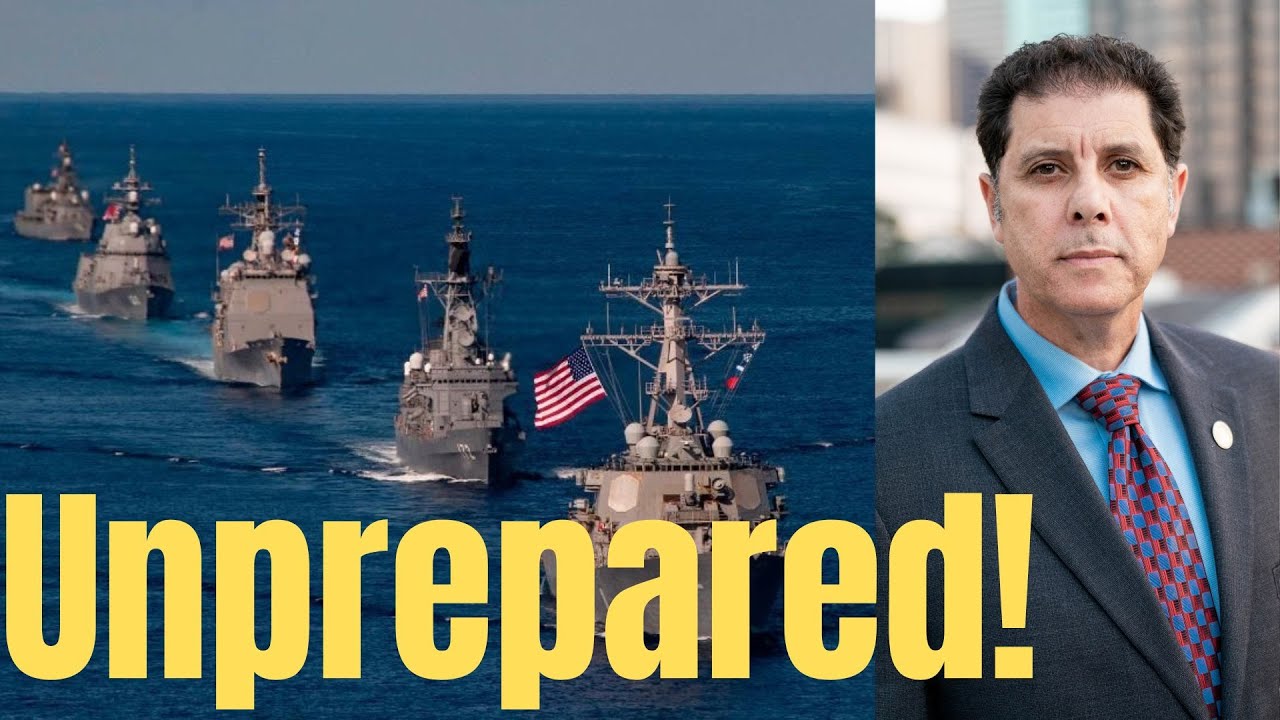
David Oualaalou analyzes three new Pentagon strategy documents that frame Russia as an immediate threat and China as the fundamental challenge to U.S. security. He questions whether America can fight two simultaneous wars and examines how commercial satellites like Starlink factor into modern conflict.
Chapters
Hello everyone and welcome to Geopolitical Trends. My name is David Oualaalou. So great to be with you guys. The Pentagon just released its report last night suggesting the following— it's not suggesting, that's what it stated— Russia poses a serious threat, but China is the key challenge. This is what I'm going to provide you some analysis about. What does it mean given that China just made a statement about supporting Russia? It's a very, very interesting, uh, dynamics that's going on right now on the geopolitical landscape. So, but before I'll delve deeper, please make sure to subscribe and hit the notification button so you will be notified every time I upload a new video. And I can't thank you enough, guys, for your support. We wanted to grow this platform so we can raise awareness, all of us. So thank you again for your support. So let's, let's, let's dive in into this. Last night, as I said, the Pentagon released its report, and it is in its comprehensive strategy released, the Pentagon considered that Russia, uh, the military operations in Ukraine highlight a serious threat that are posed by Russia. But also the reports indicated that China represents the— and I put this in quotes— the fundamental challenge to the United States. Of course, this following the, uh, uh, President Xi's that who has been granted now third term. You guys remember when I said last time the trends that I'm going to be looking for is what's going to be emanating from Washington, D.C. as far as policies? Well, this is the first one. So this is why I couldn't wait to come on the air, and I'm just gonna release this for you as soon as I'm— I'm— I finish everything here. So, so the new U.S. strategy made it clear that Russia represent the serious threat to vital US national, uh, interests abroad and at home. That is very profound because what you can read between the lines is that the US wants to— now it's like what we had back during the Cold War where the so-called enemy was identified. This is exactly where the content of this report is trying to allude to. So the Pentagon document stated, and I quote here, let me get you the quote, guys, so I can quote it right. It stated the following, and I quote, the most comprehensive and serious challenge to US national security is the growing aggressive Chinese effort to reshape the Indo-Pacific region and the international order to suit its authoritarian interests and choices. End of quote. It's very, very interesting. And as I said, this follows two main trends. One has to do with the reelection of President Xi, and third— and second one rather— has to do with the phone call that just took place yesterday between the Foreign Minister of China, Wang Yi, and his counterpart, the Russian counterpart, Lavrov, in which China now officially and publicly confirmed its support for Russia. And by the way, the term Indo-Pacific can be changed— can be used interchangeably with Asia-Pacific. It depends again where the report is being drafted and where it's coming from, you know. And I'm sure you noticed most of us here in the United States, we always use the term Indo-Pacific, but there are some other— just FYI, there are some other literatures, there are other reports that mention the, the term Asia-Pacific. I've been using both terms, you know, but just to let you know the difference between the two, which you need to know. This way you won't— sort of it become clear to you. Excuse me. The term Asia-Pacific is associated with the parts of Asia that lies in the Pacific Ocean. Okay, this is Asia-Pacific, while Indo-Pacific is an integrated region that combines the Indian Ocean the Pacific Ocean and landmass that surround them both. So what's interesting about this is the role of India, believe it or not, into the bigger picture. You guys remember when I said last time, you're gonna have to look again for now how every country is gonna be thinking about its strategic interest first, and second, how it's gonna preposition it itself within the new global geopolitical landscape? Well, here is the thing, because India has indeed outwitted the US in the geopolitical field. Yeah, don't be surprised, you know, because the war in Ukraine, India has revealed the US's blind spot in geopolitical vision, which is a smart move on part of India, you know. In the past, you have to understand a little bit the background of all this. In the past, the United States misunderstood that India wasn't an ally, you know, even offered India Prime Minister Narendra Modi special treatments and upgraded the Asia-Pacific strategy, which was based on the US traditional allies in the Indo-Pacific strategy, mainly Japan and South Korea, you know, for comprehensive cooperation with India. That's the reason why the United States did all this, so they can lure India to its side, you know. Prime Minister Modi then gladly enjoyed all this special treatment, you know, and declared support provided by the United States in the India-China tensions. Because you remember back then, the border issue, uh, and this is why I always say India and China need to resolve that issue once for all if they want to move forward. Yet India has no plan— get this, guys— India has no plan to do anything further, and nothing has changed. Vis-à-vis its relation with the United States. Therefore, apart from the issue of the India-China tensions, India has never intended to be an ally of the United States. So the thought that India being its ally, meaning United States ally, is just unilateral and naive wishful thinking of the United States strategy, you know. And I'm saying it as an analyst because our foreign policy has been ill-conceived. One failed policy after another. As a matter of fact, for the last 30 years, even when I was in Washington, DC, we didn't have a good strategy. For the last 30 years, we've been just reacting to conflicts and events and You know, India's seen through all this. So, so let me go back to the documents that was released yesterday by the Pentagon. So the documents also highlight Chinese rhetoric over Taiwan, which Beijing of course has vowed to take by force if necessary, if the red line is crossed, you know. So the Pentagon interpreted that statement from China as a destabilizing factor that leads to miscalculation and threat and threatens peace in the region. So let me ask you a question. How about us giving more weapons to Taiwan? Wouldn't that be perceived as a miscalculation or as a threat or threatens peace in the region? Come on, we gotta be realistic and pragmatic in our assessments. So, but that's what the statement from the Pentagon or the Pentagon report suggested. Even the defense— US Defense Secretary Lloyd Austin said that the National Defense Strategy focuses on, and I quote here, sustainable and enhanced deterrence towards China. Our secretary, of course, further explained that Beijing is the only— and I put this in quote— is the only competitor with the intention and power to reshape the international order. And that's exactly what I told you guys last time when I did the video about will the US and China, uh, uh, go to a war over Taiwan. I said I'm gonna be looking for trends emanating from Washington. This is the first because it just happened yesterday. So, uh, so the Biden administration released those three documents 3 last night. First one is the National Defense Strategy. Second one is the Nuclear Posture, uh, uh, purview. And the third is the Missile Defense Review. I'm not gonna detail each one of them because they are, first of all, long. There's a lot of technical stuff. I don't want to bore you with all this, but I'll be happy if any of you have any specific question. I'll answer it for you. But when you take all those 3 strategies together, okay, the 3 documents rather, not strategies, the 3 documents, when you take them together, they outline Washington's military priorities in the next few years. And this is exactly again what I said before about President Xi's foreign policy. What, how, what kind of foreign policy will it be when it comes down to US-China relations. And now with the statement of China publicly supporting Russia, you can just see it's like a chess game. You have to know where to go before your enemy make a move. So, uh, and just to highlight one brief thing, because I had a chance to look at those documents briefly, you know, I didn't delve deeper into them. For example, in the Nuclear Posture Review, you know, the document suggests, or the Pentagon said for that matter, its nuclear arsenal goal was to deter foreign nuclear and non-nuclear attacks with the strategic ramifications. And he went further as to saying that a staffer, a senior rather, Pentagon official Uh, he told the reporter, and I quote— let me get the quote here— the quote is this: this includes the use of nuclear weapons, no matter how powerful they may be, and also includes very large strategic attacks using non-nuclear means. End of quote. So you can just see what the United States strategy aiming at. Are we looking at more conflicts? Apparently it looks like that way. Haven't we had enough? Apparently not. So this is why I'm saying you always have to look at the trends. But there is one particular thing that I came across through the documents, and it has to do with satellites. You might ask yourself, what on earth satellites have to do with this? A lot. Maybe one day I'll do a specific video on this and of course only discuss what I can disclose. I'm still under obligations from Washington, you know, it's, uh, it's the law, it's, it's my obligation and my responsibility, end of story for that. But what you need to know is this: when it comes down to the satellites, Washington, or the White House that is, stated that the US would respond in an appropriate manner to any Russian attack against the US. I mean, just, just read between the lines. The White House didn't say will respond to any attack or any manner to any Chinese attack. Rather, it says Russian attack. So it tells you right there where the focus is. So it says, uh, manner to any Russian attack against US commercial satellites, noting that it would hold Russia responsible for any such attack if it occurs, end of quote. Of course, this came in response to the statements by the Russian Foreign Ministry officials, and his official rather, his name is Konstantin Voronostov, yeah, Voronostov, his statements at the United Nations on Wednesday, 2 days ago, that the use of commercial satellites in outer space for military purpose by Western countries represented, and I put this in quote, very dangerous propensity, end of quote. Constantine also added that, and I quote here, those countries do not realize that such actions actually constitute indirect participation in military conflict, and civilian infrastructure may become a legitimate target for response. End of quote. You know what he's referring to? He's referring to the satellites that are now helping Ukraine. So the Russian, of course, the Russian official did not specify which commercial satellites he was going to after. No, what comes to mind? Starlink satellites. And Starlink, if you know, for the space internet, is published by SpaceX, you know, under Elon Musk, you know, which is affiliated with American billionaire Elon Musk, which play a key role in the Ukraine military communications against the Russian forces. So you can just see why in the strategy of the Pentagon, or the report rather, that was released yesterday, satellites will have to be part of that, of that report. Once again, those are nothing but trends, indications where things are going. So here is my question for you for today. Do you think the United States is in position to fight two-front wars? Let me repeat this. Do you think, in your opinion, the United States is in position to fight two-front wars? Make sure let me know what you think and leave me some comments and I will respond. As always, guys, remember, geopolitics impacts your daily life in more ways than one. Till next time, bye-bye.
More from David


Beyond the Single Actor: Why the Gulf Isn't Choosing Between the US and China


Iran, Iraq's Militias, and the Houthis Are Coordinating! This Changes Everything




Who Controls the Next Decade's Resources? Latin America and Africa's Geopolitical Crossroads

The Chokepoint Trap: How Washington's Stupidity Triggered a Cascade That Now Controls the World

Trump Spooked as IRGC Unveiled dual-use SLV, Deployed Ghadir Mini-Subs & Hinted at Tactical Nukes!
