The US-Iran War Escalates? Tehran Threatened an Unprecedented Response?
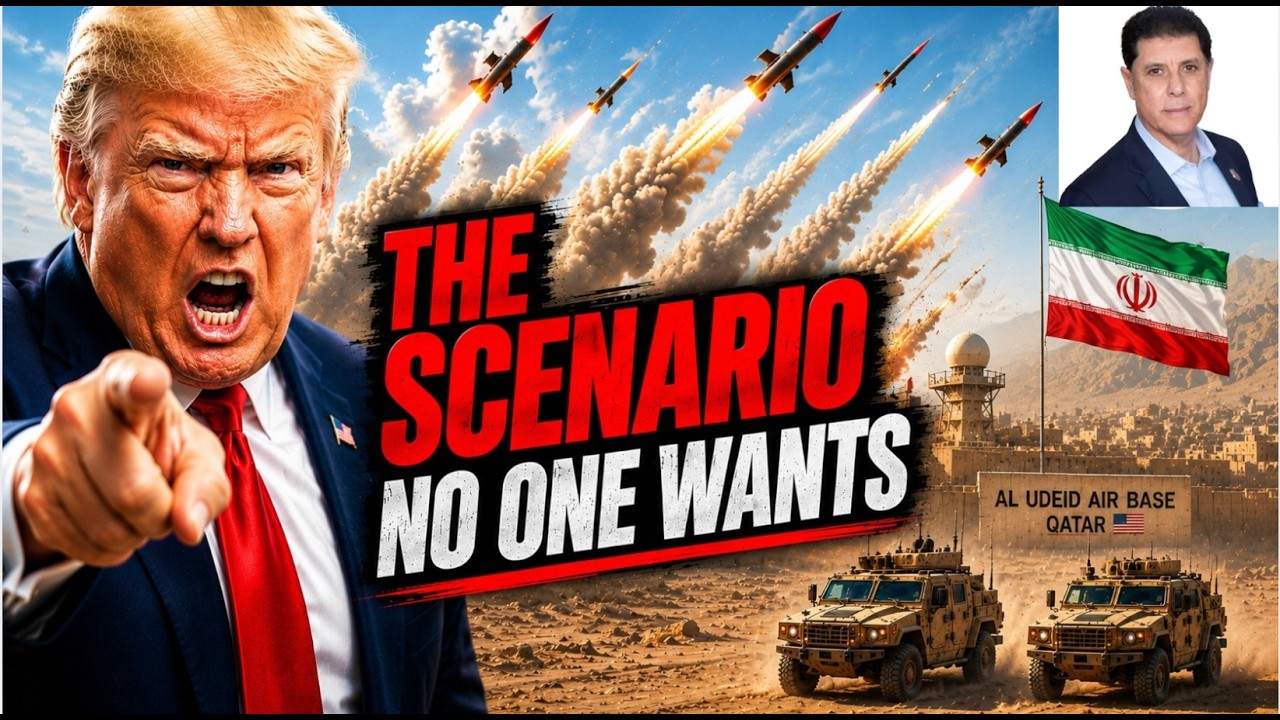
David Oualaalou analyzes Iran's escalating military posture, claiming it fired 557 missiles at a U.S. air base in Qatar in 85 seconds. He argues Iran is shifting to asymmetric tactics using drone swarms and fast boats to overwhelm U.S. naval defenses, and threatens to close the Strait of Hormuz, which would disrupt global oil supplies.
Chapters
Hello everybody and welcome to Geopolitical Trends, where truth matters. Well, we all know what is going on because right now the world's most critical energy chokepoint is locked down. You know, I wish I had different type of news and developments around the world to share with you because war only brings destructions, and I find myself very sad to be just covering what is going on. But at the same time, it's my responsibility towards you to keep you informed of what's going on, given that the media right here, at least for my American viewers, are not disclosing the truth. And here is the most important aspects to understand of all this, is that your daily life is about to change with this recent escalation. I don't care what part of the world you're in, you know, because with Iran now, it's not just threatening, it's already launching an unprecedented response. So ask any military analyst or geopolitical analyst, he will tell you that they are sounding the alarm that we are only a few days away from a major economic shock first that will skyrocket gas and oil prices overnight. In addition to the security and the changes to the geopolitical landscape that is gonna manifest themselves West Asia or Middle East, that is. Why? Is because it is exactly what an all-out war scenario looks like and why we are at a really crossroads right now. So in this analysis here, I'm going to be providing you on both sides what's going on, what the US did, what did US attack, and the unprecedented response of Iran promising even more as we move forward because it's, it's a, it's a, it's a reality that you need to know. And the media here is not disclosing exactly the massive destruction that, of course, Iran inflicted on the US bases. Of course, there are destructions that the US has inflicted on Iran, like for example the destruction of bridges. And I think I have a picture of a bridge somewhere that was, uh, I saw an image of it that was destroyed right there. So, and that in itself is a declaration of war for the US to go and start attacking infrastructure. What we are going to be witnessing in the next few hours, few days, this is just not a traditional war. So, because— and I'm not gonna say if, it's already happened. That the US-Iran war conflict crosses the point of no return. Because what you're going to be noticing moving forward now is that Iran's doctrine won't rely solely on matching firepower or what have you. No, no, no, no, no. Iran now doctrine is prepared and have already got on the process for that and launched to activate now a massive network of swarm boats, the ones that we didn't count on before. And I'm gonna tell you why. You have now the US naval assets, talking about aircraft carriers and so forth, are now very concerned because the way you're gonna sink an aircraft carrier, you're not gonna use missiles in this case. And that is one of the massive networks of the swarm boats Iran is now deploy, prepare— it's activating. It is also activating the precision drones that it has. Those are deadly. And of course, we're not going to forget the regional proxies to completely overwhelm Western air defenses. And this is the hidden strategy, in my opinion, behind Iran's ultimatum. Of course they are not going to disclose everything, and it shouldn't. So, so the question now, it's not about if the US-Iran war about to escalate. It's too late for that. What we are thinking about is what categorized, or what are the nature of Iran's not only threats but the unprecedented response. Because this is now the, the severity of the escalation is going beyond, makes you just wonder. And of course, Iran has the right to respond, has the right to defend itself. The US is embarking on a strategy because there is no strategy. This is just reacting to events. Trump's ego has been sort of hurt because he was expecting Iran's gonna bow. Forget about it, Mr. Trump. This is why his outrage now is unraveled. And the outrage of somebody like him, because he's not going to be sending his own sons to the war, he's going to send other kids to go die for a war that has nothing to do with us. And despite what you see about the US consecutive nights of heavily, uh, strikes on Iran. They destroyed— and I have a picture of the locations, I, I think, where, uh, where, uh, the whole areas were, were, were attacked. This is the Iran one, uh, I'm gonna play it for you in a clip because I, I saved a clip for you, for you to see. And when the US embarked now on attacking civilian infrastructure Uh, gloves off. So that's it, because to Iran now it's an existential threat, it's an existential war, because basically— and that is why it issued whatever it issued, the announcements that it's going to attack and destroy US bases in the region. Which means what? Which means the countries that are hosting US military bases are legitimate target. Wait until I share with you later on about what's happening in Jordan. Whoever thought, right? And Qatar and Bahrain and Kuwait. But the media is not disclosing here. So, so let me play the first— share with you the first clip, uh, about this one here, and, and, and we'll continue with our conversation. Yeah, take a listen, please.
Launched 557 missiles at America's most critical Iran launched 557 missiles at America's most critical military command center in the Middle East. 7 years of planning, $9.3 billion, and it bought them exactly 85 seconds. Here is the full story. Deep beneath the Qatari desert, 40 feet underground, sits the Combined Air Operations Center, the CAOC. At Al Udeid Air Base. This is not just a building. This is America's war brain for the entire Middle East. Every airstrike, every mission, every life-and-death military decision across the region flows through this single facility. Iran knew that, and for 16 years, they studied it. Their conclusion was this: destroy the CAOC, And you don't just destroy a building, you blind the most powerful military force on Earth. You cut the command voice that turns 40 individual aircraft into one unified, unstoppable force. So Iran built a plan to do exactly that. 557 missiles, 4 waves, 5 directions, all arriving within 85 seconds. This was not a random missile barrage. This was applied physics with warheads. The first wave, 103 ballistic missiles. Was designed to exhaust America's Patriot defense batteries before the real weapons arrived. The second wave, 141 heavier missiles, hammered the 12 meters of compacted earth above the CAOC's reinforced concrete roof. Their job was excavation— strip away the protection layer by layer. The third wave, 177 hypersonic glide vehicles traveling at Mach 12 Ds, drove tandem penetrating warheads through the now compromised concrete and detonated inside the structure. The fourth wave, 136 cruise missiles, simultaneously destroyed every antenna, every satellite uplink, every communications line on the surface. Even if the building survived, it would be deaf, dumb, and blind. Four categories, five vectors, 85 seconds. Iran had spent 7 years engineering this exact sequence.
But here, and that gives you an idea that has not been disclosed right here in the US. Of course, that was the whole reason for why I do what I do, because you need to know about the other side of the story that is— that has not been reported in Western mainstream media. So, so now you think about what the triggers to all this escalation, of course. And again, I am not going to be repeating myself especially certain key points we've already talked before. But suffice it to say that to those who might be here for the first time, you need to understand where this is, uh, the last— this latest round of intense, uh, combat centers on the control of the Strait of Hormuz. The blockade, you're gonna think about that because the US revoked the sanctions waivers, okay, and reimposed the strict naval blockade on Iranian port. Well, of course Iran will, will reserve the right to defend itself because that's its lifeline, economic one, that is. Then when you have the threats by the US, which they carry it now, of targeting infrastructure— infrastructure, once you start doing civilian infrastructure, that's a declaration of war. Once again, Iran, within international law, has the right to defend itself. And as a matter of fact, Donald Trump is saying Iran should expect more if they don't come to an agreement. You know, how stupid Trump can be. What makes him think that Iran is going to cave in? Whoever is advising him— and it gives you an idea right there that whoever surrounding him have no interest in peace. And this is why you have now the recent statements which I just saw this morning, uh, coming out of the Central Command, is saying that these strikes is going to even expand now deep into northern Iran. And their argument is because we want to pave the way for a possible ground invasion. Well, guess, guess what? You know how many we have, how many troops we have in the region for this? We have about 50,000. That's all we have. Iran is preparing about 190,000 troops just for this, twice or three times that amount. And that's when you realize the stupidity of those giving, uh, advice to Donald Trump. But this puts now the response of Iran, uh, right up in the open. And the Gulf States will be the first one to learn from this because they are a target. Not that Iran wants to target them, no. Iran is targeting the US installations that those countries are hosting. I've been saying this over and over and over again. Those countries do understand where the problem is. They just pretend not to see it, and they don't have the guts to ask America, say, hey, your presence now is becoming a liability, we would like you to just pack and leave. And mark my word, if those countries make that decision and the US end up leaving, Iran win not. I, I bet on it, Iran will not attack those countries because it has no reason to do so. And that is why Iran's response now to Donald Trump's, uh, strikes is unprecedented, because this is not about just— it's about the region. This is to the whole region. When you find out, which I will share with you in later on towards the end here, when you find out what Jordan has as far as US assets inside that country. Most Jordanians have no clue that their country is hosting American presence. The Saudis have no clue. And this is why the IRGC now has already begun retaliating. They not gonna wait. They're not gonna wait. Launching waves of missiles and drones directly at Jordan. At Bahrain, at Kuwait, and Qatar, nations that are hosting US military forces. It's, it's, it's, it's by design, and IRGC knows what they are doing, why they are attacking those particular locations, and rightly so. And that's again where the idea of, uh, uh, here's the location of those that Iran targeted all this. And in addition to the clip that I played for you earlier, there is a reason for all this. There is a reason for all this one here. And what's important about these aspects also is you're gonna have to think about— remember, 2 days ago I mentioned to you something about this location right here. Let me bring up the map right here. What am I referring to here? I am referring to Bab el-Mandeb. Well, guess what? Iran just sent the green light to Ansarullah in Yemen to prepare to complete shutdown of Bab el-Mandeb Strait in the Red Sea. So combine the closures with the ongoing closure of the Strait of Hormuz, this would cut off a massive portion of the world energy supply, threatening catastrophic global economic shock. And you all know what it's gonna do to Donald Trump comes November. Already gas prices now crossing through $4 a gallon here in the US, which is unusual even for my state here. We don't see usually $3 a gallon of gas here because we are an oil state. And yet you've seen prices going up. I've been noticing since last week, it's gonna even get higher. Moving forward. And this in itself leads us to the logical other question. Even though we are witnessing the escalation as we speak, is an all-out war avoidable? The answer is no, as of now. Because what you need to understand, it was— and I am gonna check into this for next week and, and report back to you. It was a special flight from Moscow with a special aircraft. They call them the doomsday, nuclear doomsday plane. I don't want to say much about all this till I confirm certain aspects. I just want to give you a heads up. And something landed in, in, in Iran in the last 48 hours. And you think about that, you think about the statements from the North Korean Kim Jong-un. You all remember that one. I shared the clip with you last time, right? And you add to this the statements by China. Put all this together and think what lies ahead, what's coming. Is an all-out war avoidable or not? Are the allies of Iran preparing? And that's exactly what is going on. Because what's going to be happening now moving forward is what those elements is going to shape now the operations going forward. As the US saying, we're going to escalate and all that. Yeah, good luck to you with that. Even though, even though the White House still saying, oh, the back channels are not completely dead, because what Donald Trump wants is to sort of keep that hope of I'm just so powerful, I am this, I'm going to show them and all that, but I still would love to have negotiations with the Iranians if I could. And even you think about Pakistan now is urging, uh, to revive the collapse. No, Islamabad is not going to succeed into that because we crossed the line. If we didn't honor the MOU before, what makes us think that we're going to honor the next one? I mean, Iran needs to get it also. Come on, come on, you will have learned by now since 2018, you cannot trust the American government. You cannot negotiate in good faith with the Americans. And again, I'm referring just to the government. We're not dealing with the people here. So, and the only thing is going to be left for Iran, like I always say, is the nuclear deterrence. Once again, go back to the example of North Korea, and that gives you an idea. So, and that is why you think in terms of what will be the targets for Iran in this scenario of an all-out war, because this is why I wanted to do this analysis for you. In an all-out war scenario, remember, we just had the almost like first phase of it. Because what you need to understand is that, to those who understand how these military operations work, you have to go back in history and understand the, the developments of certain phases within a, a conflict. Of course, we did the first phase, the shock and awe, like, you know, you're gonna intimidate And when we realized that intimidation didn't work, we kind of moved into, you know what, let's negotiate. We negotiated. And when we realized in the negotiations we're not getting what we want because we couldn't subdue and force Iran to agree, then we move into the phase 2 of the, of the, of the conflict. And the phase 2, that's when you do another shock and awe by threatening the civilian infrastructure. What we didn't understand is that with each phase, Iran responds with the same. Iran will negotiate if negotiations are warranted, but Iran has also its finger on a trigger should it demand that. And that is why for Iran is expected to coordinate a highly asymmetrical doctrine design. This doctrine now is designed to do one thing, and you know what that is? First is to overwhelm the military, the enemy defenses, in this case the US. Look what Iran targeted. They targeted a specific location in Al Udeid base. And Qatar, out of all what they saying, we condemn Iran, uh, attacks. Well, wait a minute, Qatar, why didn't you condemn the US strikes on a civilian infrastructure in Iran? Are the Iranian people less valuable than yours? Come on, where is this Muslim Brotherhood that you are supposed to defend what's right? We're not talking about defending Iran, whatever. No, no, no, no, we're talking about defending what's right. You know, Qatar in this case, Bahrain in this case, Kuwait in this case, Jordan in this case, United Arab Emirates, Oman. You all know Saudi Arabia, you all know what the US did goes against the, the what's against what's right. You can't target civilian infrastructure. And yet none of them condemned what the US did, except they condemning Iran. And that's to me, it's not just so. But in any event, Iran is moving forward, and with this new doctrine as I said, to over— to, uh, overwhelm the enemy defenses, to cripple the global shipping. Why? Because in addition to the Strait of Hormuz, we're going to be looking now at the Bab-el-Mandeb being shut down. Houthis have enough power to shut it down. They did before. We couldn't reopen it, and the Brits were screaming loud, we're gonna send our troop Come on, England, you are pathetic. If the US couldn't do it, what makes you think you could? That's one of the other doctrine. And the third one, if does the Iran wants to now inflict a massive economic pain, of course Iran is going to be hurt economically too, and is already being hurt economically too, economically as well, for the last 3 to 4 decades with the sanctions we imposed. And why, why did we impose sanctions to begin with? Because Iran wasn't willing to, to bow to American pressure, unlike some other countries in the region. And you all know what I'm talking about. So, and this is where you think, you put your geopolitical analyst hat on and you think in terms of what is the strategic sort of, uh, objective for the IRGC. There's only one particular one, and this strategic positioning, because by doing so, Iran will target and execute the following maneuvers, and I'm going to share them with you. Like I said, and in detail here, the global maritime and economic choke points. Instead of a direct battlefield confrontation, no, no, no, no, Iran, all he wants to do now is paralyze the global economy. Total closure using thousands of smart sea mines. You remember, those are still there, and Iran is about to deploy even more. And I won't be surprised that we might see the same in the Red Sea. That's why when you think about the swarm, the, the, the, uh, the fast boat, those will be— the mines will be also part of it. The smart sea mines, call them. The other one will be the anti-ship ballistic missiles. Yeah, then you have the key, which is the fast attack swarm boats. This is what's going to overwhelm. There is a name for it, uh, uh, the— in Iran— uh, not in Iran, I'm sorry, in Arabic language known as the Al-Baud. To those who speak Arabic, which translates to mosquitoes. What is the thing about mosquitoes? When they come, they come in swarm, right? Is the same concept that Iran intends to do. This is why you have the aircraft carrier far away. Iran is not going to use a missile on, on, on an aircraft carrier to sink it. No, they don't need to do that. This is what they need to do. And you can even send drones that way. So, and that's why you're seeing now the coordination coming up soon between Iran and Ansarullah to block the Red Sea entry point using suicide drones and anti-ship missiles in that location. Second one is the energy infrastructure. Precision drones and missile strikes targeting critical oil facilities. Distillation plants, which by the way Iran already hit one in Kuwait. I think I have a picture, uh, I don't know, uh, maybe, maybe not. I thought I did. Yeah, I thought I did have a picture for you. Sorry. Anyway, uh, that's one of the things that Iran, uh, wants to do. And also targeting refineries across two main countries. Why two main countries? Saudi Arabia and, and United Arab Emirates. United Arab Emirates, by the way, just to let you know, it's using some of its drones to attack Iran. It's, it's documented. I'm not saying something that— I, I looked at the sources and found out that it was indeed United Arab Emirates is using its drones to attack Iran. The second element to all this has to do with US bases. And once again, let me put this, uh, uh, map here because that's very important. This is where, uh, US military bases and its allied host Iran— well, Iran is, is planning, have already started to deny US forces freedom of movements in West Asia, not just in these locations in the Middle East, by targeting regional hubs. So you're looking at a host nations mass missile salvos now aimed at the major US hosting installations, particularly in Jordan, in Bahrain, and Kuwait. This is why I'm saying to you, the Jordanians are clueless as to how much American presence in the country is. Then you have the air defense sites. That is the role for why Iran is using the swarm attack, like the clip I played for you at the beginning of this, uh, live stream here. The swarm attack utilizing low-flying loitering munitions. Why even that? Why that? Because they wanted to oversaturate and really deplete US Patriot and allied air defense systems, which they succeeded in doing so. And the last one will be the asymmetrical regional escalations. Iran will activate its Axis of Resistance. You know, Leo, talking about a network launching simultaneous synchronized multi-front wars. We already saw so far the second fronts being open. I'm talking about Hezbollah action as well. You have Hezbollah is in possession of rockets and precision missile barrage fired from Lebanon into northern central Israel, both the cities and the military, uh, command centers. Then you have the two other locations, Iraq and Syria. The drone strikes on isolated US garrisons in eastern Syria, which by the way Iran targeted as well, and western Iraq. And I saw— I remember seeing the picture right here. This is Erbil. This is the location for this, uh, in, uh, in, in Iraq. And the location of Syria is not here, is not showing, but Iran did target a location inside Syria. Then comes the major one. This— where is the quiet because in the world of intelligence and cyber warfare, you don't announce anything. You do it quietly. We're talking about cyber warfare. So, and that's exactly what Iran is planning on doing— destructive malware attacks targeting US and Allied financial sectors, electric grids, and water infrastructure. This is the important aspects of all this moving forward. If the truth matters to you, hit like, subscribe, and tap that bell. No spin, no agenda, just the stories they don't want you to know. Don't watch from the sideline, be part of the movement. Your support keeps the truth alive.
Thank you.
Indeed. So what I'm going to do, and by the way, just to— what was I going to say? It was, it was key information Oh yeah, intelligence. Iran is in possession now of all the locations of the US bases, like the personnel and any movements. And as a matter of fact, I did find out from a reliable source that Iran will embark also on kidnapping American soldiers in the region. I was like surprised at this, but on the other hand, I'm not surprised. They know where everybody is. They've been doing— they've been watching and all that for a long, long, long time. So, all right, let me, let me play this for you, and I'm going to provide you my own translation on this one just briefly, and we'll move on with what we need to do. And why is this important? I found it very crucial, uh, for you to, uh, understand, uh, this one. What is the— right here, let me silence this because it's in Arabic. And, and I'm gonna play the, uh, I'm gonna play, uh, play the images, but I'll do the translation for you. Here's what it says. In fact, is a significant development to be discussing clashes between Iran and US forces in the Strait of Hormuz. Spanning the waters of the Gulf and the Sea of Oman. This information originated with an official in Hormuzgan Province, so it appears to be confirmed. The striking aspect here is the potential presence of US forces in that specific area. Historically, explosions there have typically resulted from Iran shooting down drones. US strikes on a coastal basis or possessions, or Iran targeting ships is deemed non-compliant—vessels attempting to transit the Strait of Hormuz in defiance of Iranian regulations. However, we are now discussing direct clashes between the Iran and the US sides. This is a remarkable development, especially given that the US forces have long maintained a distance from the Iranian coast, enforcing a naval blockade via bases naval assets in Arabian Sea and areas quite far from the Strait of Hormuz. As a result, the occurrence of clashes between the two sides in the Strait of Hormuz within the Gulf waters of the Sea of Oman is significant and noteworthy development. Another development from the past hours, few days that is, involves the activation of air defenses in the city of Bushehr. Initially, the Mehran News Agency reported that air defenses were activated in the vicinity of the Bouchère nuclear reactors. Subsequently, the governor of Bouchère stated that air defenses were activated within the city itself, not near the nuclear reactor, noting that there were no confirmed report of projectile— projectile, rather— striking the city. We know the Bouchère reactor is located at the far southern end of the city near the coastline the coast along the Gulf. Therefore, the activation of air defenses in the city could be linked to the reactor, or it could be some— something else entirely different. Allow me also to point out the breaking news item. Trump is telling Fox News, we are dealing very harsh blows to Iran. Back to you, please. Go ahead. Yes, these statements appear to align with the successive explosions and clashes reported over the past few days. A large number of explosions, as we were discussing earlier. There were few explosions in the Strait of Hormuz and in the city of Bushehr. The Iranian news agency, uh, also reported that there was explosions near the, uh, Hajibad in Hormuzgan Province, southern Iran. So And again, I just want you to be aware of this aspect, is to highlight to you what is going on with this development. So of course we are not going to be reporting here, meaning the media here in the US, the destruction of the US bases, which why I wanted to show you the images right here. This is the destroyed, uh, uh, by the drones, Iran launched right there. This one here, this satellite showed damage to US-made early warning radar systems. And this one was in Qatar. So this is Iran bombing Kuwait, uh, power plants— oh, water plants, I'm sorry, the water power— water plants. So, and of course, no disclosure of these details, which by the way, next week I'm gonna be working on this weekend, reaching out to some of my contacts and, and get a confirmation on certain aspects going on regarding this. I mentioned earlier one aspect of the intelligence. Allow me to just share with you the intelligence dimensions to all this. This is why Iran surprises the US forces with the high-impact strikes by combining intelligence from deep penetration cyber espionage and satellite network with synchronized low signature drone swarms. Because how so, you may ask? By utilizing non-GPS navigation like Beidou systems. That is what Iran's using and employing a mesh network drones Iran bypasses radar detection and jam conventional early warning system. So, and this is where you have to understand why now all US troops in the region are at a high risk of kidnapping. That, that's a fair complaint. First, you have to think about, uh, the core mechanism of this Iranian intelligence and operational successes regarding it. One is the radar disruption and jamming. Iran has deployed these advanced, uh, jamming systems, uh, accompanied several delay and disabled early warning system like the Patriot. Yeah, the Patriot batteries and the Iron Dome. Yeah, those being sort of paralyzed. The second one is the intelligence gathering and communication disruptions. In a strike spanning West Asia, Iran now has targeted American radar systems, satellite dishes, and communication hubs. And this degrades, in true sense, the US military ability to coordinate long-range defenses and track incoming threats before key logistical hubs are compromised. Once again, look at just the picture. Let the picture tell you the story right there. The next one is the mesh network drone swarms. Rather than relying on a singular heavy payload strikes, no, Eran decided now to deploy synchronized, coordinated drone formation. Often referred to in, in military terminology as a mesh, or there's another term for it, they use jellyfish formation. If you ever come across to that, you know they're talking about the, the, uh, the drone network, uh, swarms. And what is the purpose of this? These drones move in unison, you know, sharing targeting telemetry to saturate American air defenses. This is the same arguments can be made about the swarm boats, all launched at once. You overwhelm the systems. That's an important aspect. And the— what, what helps Iran succeed in all this is the alternative satellite navigation. By disengaging from the reliance of GPS, which you all know Iran did this, did this a while ago. And utilizing alternative systems like the Chinese Beidou navigation network, Iran has achieved now a total visibility of regional force movements. So, and that's exactly where the key to all this. Now, briefly, briefly, briefly, I'm going to talk to you about why Jordan is in the crosshair of the Iranian escalation. And I'm going to share a link with you. You can read it, uh, because this one was not— I got it through Al Jazeera in Arabic. I read it there and, and confirmed it through other sources. So just, uh, if you get a chance to read, uh, uh, that one, uh, you could. Why is that? So what is behind these repeated attacks? Because the— and I'm not gonna share the entire thing. All I need to tell you, one key And that key, in a form of question, is: are there American bases in Jordan? Straightforward. Jordanians, as I told you, Jordanian people are clueless, have no clue. And we do have presence, you know. I used to be involved in training Jordanians, so I kind of know what's going on, what was going on back then, and still from that time forward. Still, in contrast to the Iranian narrative that speaks of targeting American bases, Amman, the capital of Jordan, the government that is, is affirming that the kingdom does not host independent foreign bases but rather American forces operating within defense and training cooperation agreement and under Jordanian sovereignty. Yeah, right. Are you gonna trust what they're saying? It's because they don't want to disclose. They don't want the Jordanians to know. That there are presence of the American forces in, in, uh, this is by the way an image of the, uh, one of the, uh, landing missile or something from Iran, uh, ordnance was subjected there because Iran used ballistic missile in this case. So, and that is exactly where they're saying, oh no, no, no, no, no, no, oh, we just have a defense cooperation agreement, uh, with Iran— with the— I'm sorry, with the US. And what does it stipulate? By the way, this one was signed in, uh, to my knowledge, it was signed in 2020 or 2021, one of those times, one of those years. So, and that in itself regulate the framework of military cooperation between the two countries and allow— this is the key word— allow US forces to use a number of Jordanian military facilities in the kingdom. Of course, they're saying it's for only training, logistical support, and equipment maintenance. Come on, let's get real here. Is the same argument we made in the Philippines. Oh, we only have bases here for logistics and all that. Remember Philippines, we have 9 bases, we only declared 5, we didn't declare 4, and those 4 is where the key type of missiles, weapons, you name it, jamming equipment and all that. That's what it is. Filipinos have— Philippine government has no clue. It's the same applied to Jordan. The Jordanians have no clue. So, and that is why you need to understand why Iran is targeting these two, Jordan and Syria. Because to Syria, Iran targets Syria for the first time in this conflict. And where, where is the base there? It's in Al-Tanf base, and Tanf base is closer to the border. And all this puts in perspective what the US is— as I said to you at the beginning, we have about 50,000 to 60,000 troops in the region. Could Trump use them for a ground invasion? Maybe, maybe not. That guy is, is, is delusional with the reality. But 50 or 60, it's not enough because Iran already allocated 190,000, to my knowledge, that are ready to deal with this eventuality of 50,000 troops swarming, uh, the Iranian, uh, territories. So I don't see how it's going to work, but you never know. You know, Donald Trump is crazy enough, let alone now he is trying to start a war with China. I'll get into that when I do the clips in a second here. So, so here is my conclusion for you, because I'm, I'm almost done here with my analysis, and I'll do the clips for you and I'll sign off after that. So now, when you think about the delicate what should we call it, delicate balance from a security perspective, from geopolitical aspects. Uh, when you think about this delicate balance in Western Asia, it's fracturing because the line now between regional scrimmages, okay, and global economic crisis has never been this thinner. The line is going to become blurry. We don't know which where. And we add to this with critical maritime choke points now, and international, international roots, uh, energy, that is, roots are hanging in the balance. Sooner or later, if I am to guess, within the next 72 hours, 2, 4, 3 days, something like that, Iran is going to send the green light to Ansarullah to close the Bab-el-Mandeb. So for me, I will say any, any now single miscalculation to redefine modern geopolitical overnight is too late for that. Middle East has changed, West Asia has changed. That's just the way I see it. But still, I'm going to ask you the question, and if you like to comment in the comment section, I would greatly appreciate it. Still, do you believe diplomacy, in your opinion, can still prevent a total regional war, or has the conflict already crossed the point of no return? So I would greatly appreciate if you can share your, your thoughts in the comment sections. All right, let me play some clips for you here, and we're going to start with the first one here, and this one has to do with the Patriot missile systems. Uh, I'm just showing you the picture. I'll do the translation for you because it's just one paragraph, short paragraph, but it should ring a bell for you. Okay, it has a sound. Here's what it says. Washington, Washington. Translates to Washington could benefit, could rip more than $37 billion in selling the Patriot defense missile systems to the Gulf States in light of this escalation. You all know what it means. You know, the pathetic Gulf States, they are going to spend $37 billion buying an air defense system that is proved to be useless against the types of missiles Iran had. And it gives you an idea right there, uh, those countries— Kuwait, Qatar, Bahrain, United Arab Emirates, Oman, Saudi Arabia— it's all about the survival of the monarchies, has nothing to do with safety and security. So keep that in mind. The next one is about Iran, uh, of course, since we are talking about on. Let me show you. Here is the same thing. I'm just gonna share this and do the translation for you. Uh, is the content that I found very interesting and important for it. And the reason I want to share this with you, because this one is tied to what I mentioned earlier about the intelligence dimension. So again, there is a reason for why Here is what it says right there. Take a look. Uh, it says, uh, an Iranian official, uh, well-established Iranian officials announced the, uh, invasion of the US military bases in the region and the kidnapping of its soldiers. Once again, makes you just think in terms of the level of intelligence Iran has in its possession. The next one is about the strike list of Iran, of the American— of the IRGC target list. So take a listen to this one here. It's in English here.
Issued a press release putting Donald Trump's entire real estate— Breaking news, the IRGC just issued a press release putting Donald Trump's entire real estate empire in the Middle East on an official strike list. Every Trump hotel, tower, and golf club from Dubai, to Riyadh, to Jeddah, to Qatar, to Oman is now fair game for Iranian missiles. Iranian state TV followed that up with a detailed breakdown of Trump's Secret Service motorcade routes in New York and Florida— exact vehicles, the 10-minute Mar-a-Lago to airport drive, and every soft spot on the route. They're also tracking U.S. military personnel and contractors through their phones across the Middle East. Reports show Iran exploited SS7 mobile network flaws and commercial location data to pin down real-time cell tower locations of American troops and contractors in places like Bahrain, Kuwait, Iraq, Kurdistan, and other Gulf bases. The same intelligence they used to map those motorcade routes so tightly. And at the same time, Iran ordered the Houthis to fully close Bab el-Mandeb Strait the second America hits Iranian power plants. Missiles and drones are already deployed and ready. IRGC will give the final order. Hormuz is already shut. So both main oil routes would be gone. That means oil will be headed past $200. And on top of that, beyond the US-made Lucas drones, Iran's port of Bandar Abbas was also hit by UA-produced kamikaze drones. The UAE has been secretly striking Iranian territory multiple times but still won't admit its direct role in the war. And yesterday, a US bomb or shrapnel slapped Abu Zar Children's Hospital in Iran. The entire hospital was evacuated. This is exactly what happens when you keep pushing. Trump starts throwing threats about power plants and bridges, and now the IRGC is serving him the same medicine right back by putting every single one of his properties and golf clubs in the Gulf on the target list. They already know his motorcade routes better than his half his own security team, and they're tracking American troops through their phones like it's nothing. Then the second those plants get hit The Strait of Hormuz.
All right, and that is exactly the condition under which the, uh, uh, uh, Houthis or Ansarullah will shut down the Strait of Hormuz the moment a, a water, uh, water plant in Iran is targeted, or power grid, or, or what have you. That's why Iran went ahead and targeted the one in, uh, in, uh, Kuwait. So next one, this is very crucial. Uh, even though it's in— and I'm gonna dig into this for you, uh, I just want to show you the image of it, then we'll, uh, we'll, uh, because it's, it's in Arabic anyway. And I'll, uh, as I said, I'm gonna check this and I know where to call and get the information. Uh, basically what it says here, I'll let you just listen a few seconds here. Basically, these aircraft that cost billions of dollars are threatened of being sunk, and this not because of missiles or what have you, it's because of something called mosquitoes. And the mosquitoes, this is the reference, uh, for Iran to, uh, let me show you, uh, where that is, uh, Al-Bawt. That's what they call them, is a reference to this one right here, to those swarm boats and, and, and so forth. That's— so I'm going to look into this for you, and, uh, we'll, uh, uh, uh, we'll deal with this next week. I just want you to be aware of that. Uh, the last thing I want to share with you— before last, I want to share something as to why all of a sudden the, uh, the, uh, You know, his, his, his— I don't know what's wrong with his mental state. Now he's trying to literally start a war with China. You know why? Because he's accusing China of interfering in our elections. I mean, how pathetic and stupid one can get, you know? And, and maybe, maybe, maybe The US will be taught a lesson by China. You know, of course, who wants a conflict with China? That would be the end. But I just don't get it. I, I, I just don't get the logic of, of, of this guy's brain. Like, he doesn't, he doesn't have the logical, uh, process of how you think things through. So anyway, I just want to— uh, the last clip I will share with you is about China, but from different aspects altogether. And this one is about, uh, vehicles. Remember last time when I went to China, I was allowed to go into the showroom for BYD, and they allow me to, uh, record the video for the community and told you how incredible those cars are, let alone how affordable are. And of course, the US will put 100% tariffs because they don't want Americans to know that a car like that will cost only $13,000, $14,000, $16,000. An upscale BYD will cost $26,000. You know, this one is about something different. Uh, take a listen here, please.
Company just built an engine that gets 106 miles per gallon. Oh, sorry. Guinness World Records flew in, tested it, and made it official. That's not a typo. That's not a concept car sitting behind velvet ropes at some futuristic expo. That is a real car, already rolling off a production line, that you could theoretically drive from New York to Chicago and barely dent a tank of gas. Now, to put that in perspective, The average new car sold in America today gets somewhere between 28 and 35 miles per gallon. The Toyota Prius, the car that basically invented the word fuel-efficient in most people's minds, gets around 57 miles per gallon in the city. 106 miles per gallon is nearly double that. And the company behind it isn't Toyota. It isn't Honda. It isn't Ford or General Motors. It's a Chinese company called Geely, and if you've never heard that name before, don't worry, because by the end of this video you will never forget it. If this is the kind of story you love—
and interestingly, remember the word Geely? Remember who mentioned that way back? Is none other than Carl Zah. He was waiting on the production of certain cars, and one of them has to do with Geely. That was the reason why he mentioned it about, what, 7 months ago or 8 months ago when we talked, and he said, I'm thinking about it for— yeah, 106 miles on a single gallon. So, and it tells you where things are here in the US is— and they are not going to allow, uh, they're not going to allow this kind of cars here because you know how it is, system is corrupted. So anyway, hope you guys enjoyed this one here. Please, please, please, if you really like this analysis that I provide, hit the like button, and please, please make sure to share this with others. And I take this opportunity to let you know where we are on our campaign, the fundraising for my upcoming Asia trip. Uh, we are half of the month. Uh, I don't know if we're gonna make it by the end of the month to reach this target goal. We already had two major donors that donated substantially, uh, for this endeavor, for this particular trip. I'm so grateful, uh, to them. Uh, one of them is Doug. Uh, uh, uh, the other person asked me not to disclose the name, and I will honor that. Uh, but for the rest of the community, I would greatly appreciate if you could support this upcoming— and again, I go over to that part of the world to report to you the truth. To report to you what we don't hear about here, because we don't want to— uh, the media doesn't want you to know the developments, because if you find out the truth, you're going to get pissed, especially for my American audience here. So, so I would greatly appreciate if you want to support that upcoming trip. And if you like the content of this channel, the live streams that I do, the analysis and so forth, here is the link for the channel if you want to support it. So I'm I do my best. I spend time researching for the information for you to get you the accurate information that will serve you well. So I hope you enjoy this. Anyway, I wish you a safe, uh, restful weekend, and I look forward to seeing you next week. As always, remember, geopolitics impacts your daily life in more ways than one. Till next time, bye-bye.
More from David


Beyond the Single Actor: Why the Gulf Isn't Choosing Between the US and China


Iran, Iraq's Militias, and the Houthis Are Coordinating! This Changes Everything




Who Controls the Next Decade's Resources? Latin America and Africa's Geopolitical Crossroads

The Chokepoint Trap: How Washington's Stupidity Triggered a Cascade That Now Controls the World

Trump Spooked as IRGC Unveiled dual-use SLV, Deployed Ghadir Mini-Subs & Hinted at Tactical Nukes!
