The US Navy Is Fighting Iran Right Now! What's Next?
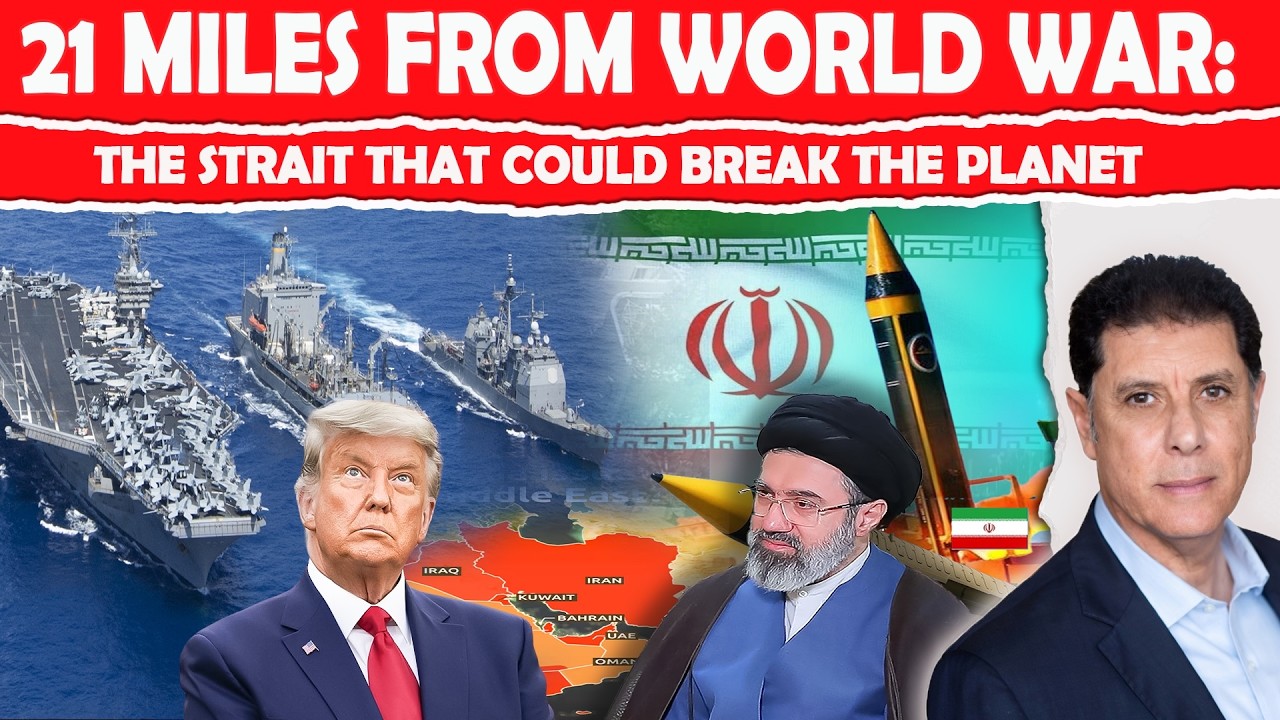
Three US destroyers clashed with Iranian missiles, drones, and fast-attack craft in the Strait of Hormuz, where the US is pushing to keep shipping lanes open after Iran blockaded its ports. The strait handles a quarter of global oil and 15% of LNG. Iran has built up cruise missiles and created a new authority to charge tolls, while the risk of miscalculation between densely packed US and Iranian forces keeps rising.
Chapters
Hello everybody and welcome to Geopolitical Trends, where truth matters. You have 21 miles of a strait, one quarter of the world oils, and you have two military powers pointing weapons at each other. That's the Strait of Hormuz, which has become now the most explosive patch of ocean on Earth. And you know what? The single miscalculation that starts a full-scale naval war could happen before this video ends, by the time I finish this analysis here. And that is the harsh reality that I needed to explain, that I wanted to share with you. And of course, I had to wait a day or two or day and a half, whatever, to, uh, confirm the information. Because what I wanted to report is the accuracy and the truth. And the US military just opened, opened fire yesterday in this part of the world, the most dangerous waterway. Let me just put a picture here for you. So basically, for you and I, if you fill your gas tank or you own a business or what have you, that doesn't matter what part of the world What happens the next few days will affect you one way or another because the Strait of Hormuz is no longer sort of a, just a crisis over the horizon. No, no, it has become a war zone right now as we speak. And at the same time, you're hearing these conflicting reports from both sides and some think tanks here in Washington some in Europe to a degree, but mainly here, and the president's statements and so forth. So what I decide to do in this, I'm going to be providing you my own analysis. I'm going to share some clips with you, then continue with my own analysis about this one here, and conclude with how I see it overall. But I do have a surprise for you towards the end, uh, some sort of a picture just to light up a little bit things here. Of course, after what happened yesterday when YouTube took down one of my video claiming that I sort of violated the community guidelines. So we'll, we'll address that at some point. So let's, let's move on with what we want to talk about. So what happened yesterday and the day before, as a matter of fact, for the last 48 hours? And yes, to those who say that I am late in the news about this, I'm not a news guy, I'm an analyst, you know. I have to take my time to ensure the accuracy of the information. So please refrain from this nonsense statements, because if you don't have anything of value to add to this conversation or to this community, I will greatly appreciate if you can just take off. Straightforward. And I don't shy away from this stuff. All right, let's talk about what happened. So the US military— here is what the US said through the Central Command. He said that an intercepted Iranian attack on three navy ships in the Strait of Hormuz. That's what the US did. And the US also targeted an Iranian military facilities responsible for attacking US forces. So the exchange— excuse me— the exchange occurred as the US Navy destroyers claimed to be transiting the Strait of Hormuz, which again, other accounts suggest that it didn't happen. Nothing crossed the Strait of Hormuz on the part that Iran controls. And once again, I'm going to provide you the info and you reach your own conclusion. You have Iran on the other hand, the semi-official Tasnim News cited a senior source saying that the 3 US Navy destroyers came under Iran's fire and fled towards the Gulf of Oman. Let me show again the map. This is the Gulf of Oman. That's where those, uh, uh, probably if they are referring to those, uh, oh, my is the, uh, I remember sharing this picture with you earlier. Yes, I have it here. This is the Qeshm. It's written in French, guys, sorry for that. Uh, Qeshm at the port, Qeshm Island, and also not only in that location, it was also in Bandar Abbas. This is where the explosions were heard, and specifically in the southern coastal city of Minab. Uh, Minab is— I have a picture, satellite one, here. This is, uh, uh, in this area right here. And these clashes represent now the first military military, yes, Iranian response to the US blockade on Iranian ports. Because you all remember for the last few weeks that the US military has seized several Iranian vessels and ordered dozens more to turn around. How accurate that statement? I don't know, because here is the problem with what we have right now. You can't, you as some reporter, physically can be on, on, in the area. You just can't because the waterways and so forth. So the reporting depends on what the governments are stating. I do know that our government tends to exaggerate. I do know also that Iran government will have to play the information war as well. But this is where we put the picture, the big thing, uh, uh, uh, we put everything within the big picture. The so-called Project Freedom And that was sort of, uh, it was intended for the US to force the Strait of Hormuz to open, which we started this, uh, earlier this week, right? And that's when the US has fired on Iranian forces and claimed to sink 6 small boats. Once again, I couldn't find, uh, an accurate sources that can determine this one here. So I'm, I'm holding my judgment on this one here. So what I do know is that one of the targeting was a civilian ship. So, and that I, I saw, I saw the images of the individuals being, uh, sort of moved out of the water. So two American flag merchant ships successfully transited the strait as part of the new initiative, Duke Project Freedom. Once again, I couldn't confirm that, but this is what's been reported in Washington. And with this comes the response of Iran to the United Arab Emirates, which once again the media is putting a lid on this information, and I am just sharing with you what I know. Because what Iran did, it fired about 15 missiles and 4 drones Arab Emirates target, and that drone sparked a fire in a key oil facility in Fujairah. So Iran countermove to all this is to formalizing this control. As you know, Iran has established a new government agency called the Persian Gulf Strait Authority. And this particular agency is positioning itself as the only valid authority to grant permission to ships transiting the Strait of Hormuz, effectively creating a toll and vetting system to institutionalize its control over the waterways. So the next question becomes, is how crucial is this? Because we're going to have to think about where this is going to lead to. Where it's going. And is this just the beginning of a much wider war? And if it does, we're gonna be looking at some other developments that's gonna be very serious, beyond, beyond what anyone can control. So how crucial is this? Well, it is extraordinary on, on a, on a multiple dimensions. Let's just start with the economic aspect, and I'm gonna stay brief on this. Economically speaking, The disruption has sent fuel prices skyrocketing already. But at the same time, the statement by Donald Trump was meant to be for a specific timing, so some individuals in Washington— investors, that is— were cashing in on the oil commodities. So, and this is again when Trump would say, well, we're closer to a deal. There is no deal. That's manipulating the market. But suffice it to say that so far the economic impact is felt, is felt throughout, because you have so many commercial vessels bottled up in the Persian Gulf right now, unable to reach the open sea. Then you have another one specific country, which is China. China receives a third of its oil via the Strait. That's China part. Europe receives about between, to my knowledge, between 12 and 15%, give or take, don't quote me on this number exactly, between 12 and 15% of LNG, the liquefied natural gas, coming from Qatar. And to add to this, you have about 30% of international traded fertilizer normally transit the, uh, transit the Strait of Hormuz. And this is why, again, the economic aspects of it is important. Diplomatically speaking, the ceasefire between the US and Iran has largely been held since April 8th, but it's a fragile one. But in sort of when you think about, uh, is it holding? No, it's not, to a degree, because now what Iran's saying is that the US violated the ceasefire. Geopolitically, which is— this is the key— you have now some key players in the region like Saudi Arabia, a key US ally, refused now to support Donald Trump's effort to reopen the strait by force. Why? Because the Saudis told the Americans, we don't want you operate from the bases here, we just don't want that. So it's because what Iran did— Iran warned that, and I quote here, we will knock out a lot harder and a lot more violently in the future if they don't get their deal signed fast. This is what Donald Trump said, warning Iran. But the Saudis looking at this differently. They're saying, we don't want you here, meaning the bases. And as a matter of fact, United Arab Emirates already asked the US to move out. So what you have now, you have as of April, because that's where the thick of the war, you have prominent voices inside, uh, United Arab Emirates called for the closure of the US military bases in the United Arab Emirates. And their argument is that they have become, meaning they, military bases have become a burden rather than a strategic asset following the Iran-related security, uh, uh, threats and so forth. However, there is no— let me put this on record— there is no formal government expulsion command. This is unlike what happened in Niger back, you remember, last year, and I did a video for you, when they gave the US 3 months to evac completely, either in Niger or Mali, one of those countries. In this case, we don't have However, this shows to you that the shift that is taking place— this is why UAE is restricting a certain, uh, the usage of airspace, because they are concerned about Iran's retaliation. And that's, by the way, I will do a separate video for you about the intense Iranian missile strikes targeting the United Arab Emirates heartland. That information is not coming out openly because there's a lid on it. So, so what I need you to understand before I, I'll do some clips here, then continue in my own analysis, it, it's very crucial as to what's taking place right now in the Strait of Hormuz, economically, militarily, and geopolitically. That's if you are to compare this to the last few decades, this is, this is far worse than what the US did in Iraq. Because you have now fragile ceasefire that is held by thread, so to speak. On the other hand, while the ceasefire is, is held by thread, basically you have the active military or naval combat occurring in this critical energy chokepoint. So the risk of a full re-escalation into open war with massive global economic consequences remains, in my opinion, real, very real, even as this so-called maybe negotiations will continue in the background, maybe, maybe not. And this is where, again, the report that came out of the Central Command as of yesterday, as of the 7th, May 7th, 48 hours ago, that what the Pentagon, what the Central Command is saying is that the Iranian forces launched multiple missiles drones and small boats at a US Navy destroyer. And the US Navy destroyer were the, the Traxton, the US Rafael Peralta, and the USS Mason. Those three, they were near the Strait of Hormuz. This is what the Central Command said. How close were they to the Strait of Hormuz? I can't confirm that. I don't know. I don't know because the data, what the Pentagon or the Central Command is saying versus what the reality, uh, there is a track record now of some sort of an exaggeration of sort. The other hand, on the other hand, the Iranian media claimed to have damaged, uh, US vessels. The Pentagon is saying no, no assets were struck. So it's hard to, to tell which one is telling, telling who. And this is again where I want to just put my own analysis here and let you decide for yourself as I continue on this. Now, when we think about what happened, can it be considered just an isolated incident? Maybe. Can it be also considered as a probing of intentions? That's also a possibility. Or could this be completely something different? That also could be a possibility. It's because what you're looking at, the fragile truth that exists, characterized by some sort of an absolute lack of trust. This is what happened between the two parties. On the other hand, you have the exaggeration that exists in the media narrative from both sides. It's an information war. What do you expect? So the United States asserts, we carried out a defensive operation. That's what the US is saying. Iran, on the other hand, is countering this argument that is stating that its action was a defensive reaction triggered by an offensive move on part of the United States. So when you look at it Both arguments make sense. But personally, the way I see this, I, I, I, I see it as a controlled maneuvering here, a controlled, uh, approach to dealing with this, because neither the US nor Iran want this to go out of control. That's why it is controlled. That's why it is a calculated friction. And that is why both parties now— or neither party in this case— wishes to see some sort of an escalation into a complete breakdown of truce, because that means open war. If you are to look at this from an analytical perspective, because there is the military dimension about it which I will share with you later on, analytically speaking What it's saying is that you can, you can acquire the understanding that the information released by both sides, the US and Iran, basically it tried to accommodate an incoming and outgoing vessels. And why is this important? Is because this one wanted to give a message as to who really in charge of the Strait of Hormuz. This is what I'm saying. If you think about it, is this about a probing of intentions? Is this an isolated incident, or is it something else completely? And that's something else. What I'm referring to here is the ability for the US to gather intelligence, to gauge the mood, and to assess the nature of the Iranian reaction. That's the way I see it. So if I am to think about these scrimmages that took place, or an exchange of fire, which it happened, it's just we don't know to what extent, the objective was basically to evaluate and update the— if you can use the term— intelligence database. Yeah, because what the US is after, the US is after pinpointing the locations of the missile launch zones. The US is also after finding out where the mobile missile platforms are and also the location of the fast attack crafts, drone per se. And this, in my opinion, explains why during this engagements that took place, the focus was concentrated on the port area near the Strait of Hormuz, because it was one particular location called the Bahman Pierre on Kishm Island. And I have the picture of it right here. This is the area here, Bandar Bahman. It's written in, in Farsi there. This is the Kishm Island. This is why it's important to understand this one here. And this suggests thus far, uh, the situation is still under control so far. So however, this doesn't guarantee it does not guarantee that this restraint will endure forever. No, no, no, no, no, no, no, because everything now is susceptible to some sort of an escalation at any moment. That is where the concern that I see. Basically what the, the US and Iran are doing is that they both saying, okay, we'll deal with this, both, both parties. And I'm not just saying the Iran or the— both parties, both of them have their fingers on the triggers. But at the same time, Iran demonstrated something here that is slightly different, that it is sort of exposing its force and dominance of the street. Depends how you look at it. So Uh, that's how I see it. And when you think about what Iran did, Iran went ahead and launched cruise missiles. So I have pictures for you. This is one of, uh, called Abu Mahdi, Iran Defense. That's a cruise missile, uh, based on what I, uh, found out. Uh, there is another type of cruise missile called Hoveish. I hope I pronounce it correctly. That's another cruise missile. And the next one is the Paveh cruise missile. And those are developed type of missile. That's a land attack cruise missile. Look at the range of it. Once again, you have to understand, because for Iran, as of May 26th, Iran maintains an advanced arsenal of cruise missiles capable of targeting US warships and of course regional sites. When I say, when I say regional sites I am referring to the locations right here. This is all within range, and Iran is able to do this. And a recent report highlighting the use of the Paveh and Quds series missiles— that's the one I, I showed you, the Paveh missile right here. I don't have the picture of the other type, Quds, uh, cruise missiles. So Iran was able— this is the recent one, uh, that has been used in the Strait of Hormuz. And these weapons feature a range of up to 1,650 kilometers. And by the way, some of the characteristics I read about this, uh, type of missiles, they are designed to evade defenses and fly at a low altitude to the sea surface, basically the closer, low, on the lower end. So, and they can attack in a mass swarm. So when you think about the missile crews being used, Iran also used drones and the fast attack craft, which to me, what they suggest is the concrete evidence of the genuine operational readiness and the anticipation that treachery might emanate from the American side. This is the calculation that Iran has as of now. So could we consider this situation dangerous? Not necessarily, but the friction, yes. Yeah, maybe the better way to say is the calculated friction. That would be the best way to say it. And this one in itself, what we are noticing, that is that the US is under the impression that Iran is going to be is going to submit, they're going to just raise the— or wave the white flag. No, that's wishful thinking. That's wishful thinking. It's because if we are to assess how this development is going, the condition dictated by the American side are not in reality some sort of terms for genuine negotiations. No, no. What they are, they are dictates. What the US is dictating to the Iranian. These are the terms of the hegemony intended to force a surrender. Iranian side, they don't see it that way. So Iranian side knows with absolute certainty that it has nothing to lose. This is why things are moving the way they are. So let me share one clip with you here, and, uh, Oh, I thought I had the clip on. Let me share it. Bear with me here, guys. And again, this happened, uh, recently. So let's take a listen. That's in English anyway.
This is the wreckage of a drone shot down by Iranian air defense over the Strait of Hormuz. The drone's debris was later recovered by local fishermen. The engagement occurred on the night of May 6th. The air defense system involved was most likely a medium-range platform from the Khordad air defense system series. The launch of a surface-to-air missile from Bandar Abbas toward the strait was also witnessed on the same night. The exact type of drone cannot be determined as only a few fragments of the fuselage remain.
Okay, I just want to share that once again. This is how we do it in this channel here. I'll I'll share the information that I check and let you reach your own conclusions. So the next one that I'm gonna do, I'm gonna do a translation for you, but it's long, but I'm only doing 2 minutes or so. And why is this important? Because I want you to hear the military side of this particular scrimmage between the US and Iran, because it's very important to understand dynamics. So let's take a listen. Yo, yo, I'll translate. You just watch the images here. And, uh, we give, we give credit to Al Jazeera for this clip because that's their clip here. So let's take a listen, and I'm only gonna play a little bit of it. So basically what they're saying, indeed, it could be argued that this is not the first friction of its kind. However, it remained a limited engagement, as I argued before, occurring beneath the umbrella of the ceasefire, an agreement which a US President Donald Trump has declared remain in effect. The incident took place in the Strait of Hormuz region, the very focal point we are discussing, which continues to be a source of concern for everyone. We are also now in the fourth week of the US naval blockade on Iranian ports. Essentially, the Americans are sealing off the Gulf of Oman to Iran vessels attempting to depart from Iran ports. US warships are actively preventing these Iranian vessels from exiting the Gulf of Oman and proceeding towards the Arabian Sea. Conversely, the Iranians are engaged in an operation to expand the scope of the blockade within the Strait of Hormuz, interdicting, interdicting vessels attempting to enter or exit the strait. We are currently viewing live footage depicting the halt of maritime traffic and shipping within the Strait of Hormuz, where a significant congestion of vessels can be observed on both sides of the strait. That provides the preliminary overview, but what specifically has transpired over the last few hours. So let us turn to a closer look at the situation in the strait here. Last Monday, two US destroyers transit or entered the Strait of Hormuz in a maneuver that marks the commencement of Operation Freedom, as announced by Donald Trump. Within the last few hours, three destroyers attempted to transit the Strait of the Gulf of Oman towards the Gulf of Oman, that is They attempted to exit the strait in the direction of the Gulf of Oman, according to the US narrative, and specifically statements issued by the US Central Command. These 3 destroyers came under fire, though they sustained no damage or casualties. Furthermore, the United States, or rather these specific destroyers, returned fire against the source of the incoming attacks. Statements from US Central Command and reports from the field indicate that targets include Qeshm Island, Sirri Island, the city of Bandar Abbas, and others. In Minab, a US Coast Guard facility was targeted. The Americans state that they struck the source of the incoming fire, specifically naval reconnaissance centers belonging to the Iranian Navy. The Iran account, conversely, asserts that two US destroyers, or US destroyers in general, attacked an Iranian oil tanker and another vessel in the Strait of Hormuz. Consequently, they were subjected to retaliatory strikes. According to Qhatem al-Anbiya headquarters, the military command responsible for coordinating Iran's armed forces, these destroyers were struck with precision The Americans, however, maintain that none of their destroyers sustained any damage. Thus, when placing this incident within its broader context, we are observing a limited military skirmish, uh, occurring beneath the threshold of a ceasefire. While this military friction is indeed relatively intense in terms of the volume and exchange of fire, We remain within a framework where the ceasefire as declared by Donald Trump remains in effect. Furthermore, in a statement issued by Central Command, the US military affirmed that it does not seek escalation during the upcoming period. Consequently, this incident can be contextualized as a limited escalation. So I'm going to stop right here. And I just wanted to provide you that aspects of it, so, because it's important to understand the military dimension of this, and because it has imagery and, uh, some sort of interactive map, I decided to do this for you, so to see where things are. If the truth matters to you, hit like, subscribe, and tap that bell. No spin, no agenda, just the stories they don't want you to know. Don't watch from the sideline. Be part of the movement. Your support keeps the truth alive. Thank you. All right, let me continue in my own analysis about this as we discuss really where this is headed, where this is headed. And the next question, uh, that it— that is, uh, uh, we ought to ask: is this a premonition for the next dangerous phase of the conflict? In other words, is a wider war in the Strait of Hormuz imminent? Because here is, here is the harsh reality. The short answer, it's not yes or no. No, no, no. The short answer is the conditions for escalations are all present on the table as we speak. So because now what you have, uh, in, uh, Let me just put the picture once again for you just to— what you have in the Strait of Hormuz is that you have the standoff that has moved now from a naval threat environment into an active combat environment. That is where the concern is. And you know, the concern also is that the gap in between that controlled scrimmages or exchange of fire or whatever term you want to call it and an open war at sea is narrowing dangerously. That is one of the— why the short answer will make more sense. So the escalation in itself triggers are stacking up. Today you have this escalation, tomorrow you have another one. It's escalating, it's stacking up because now the fear is going to become, in my opinion, it's not about the exchange of fire, whatever. It's about the active combat in itself becoming routine, become the norm, not exceptional. Oh, it's just another fire exchange when you have millions of, of, of, of dollar worth of oil, when you have the sea crew, uh, the ship crew and so forth, when you have a lot, lot, lot of stuff are in at stake here. And this is again because since the since the ceasefire was announced, you know, there has been an exchange of fire between the US and, uh, and the— and, and, and Iran. The same time, Iran is issuing direct warning. Well, they are warning that any— this is not about just the US, by the way— any foreign military force, any foreign military force that intend to approach or enter the Strait of Hormuz will be targeted. This is why the US now trying to solicit some other countries to come in. That's why the Saudis are saying no, we're done. The United Arab Emirates, 2, 3 weeks ago, were saying we want to, uh, support the opening of Hormuz and we can— now they don't even say that. Why? Because the direct warning coming from Iran. And this so-called Project Freedom that Donald Trump launched has already backfired. Because if this doesn't tell you— if he launched this particular project and already triggered fresh violence in the Gulf, that's— to me, this initiative appears to backfire. Because what you have now, aside from the military, you have the business community, you have the executives in oil industry or what have you, shipping, whatever that is. You have the shipping executives now remain extremely wary about what's going on because the strait is still incredibly hazardous. No, that, that's why. And that's why you have the United Arab Emirates pulled in, because the regional war, the expansion of it, is real. And guess who's gonna hit be hit the most or first? The neighbors. Why? Because they host American bases there. So United Arab Emirates said it has come under attack from Iran. Yeah, we heard that before, but now they are saying we don't want to be involved in this anymore. And there is a conversation about having the US to figure out a way to move out. So the— as of now, you still have that Iran is now institutionalizing the, the control over the Strait of Hormuz, because it's the wilder card. Iran, that's, that's the geopolitical card, that's the military card, that's the economic card, and whatever else, diplomatic one also. So the forces holding escalation back for now, it's sort of a diplomacy still a little bit active, but barely. Key US allies are refusing to join. You have Saudi Arabia, Yousfi Allah, refused to support now Donald Trump's effort to reopen the strait by force, which is a significant break on U.S. unilateral actions. And at the same time, Iran has also different calculations, and its calculations are strategic incentives to avoid the total war. How so, you may think? Because Iran's war strategy has followed the specific pattern which is known in the military terminology. That's the horizontal escalation. Horizontal. Usually escalation goes direct up. This is horizontal, which means what in a simple term? It's the widening the arena of the conflict into the political and economic realm for one objective, and that objective is to make the war too costly for the United States and Israel to sustain, rather than seeking a direct military knockout. Because a full Navy war or naval war or exchange, what have you, if Iran embark on this as a full engagement, is going to eliminate this strategy, and Iran doesn't want to do that. And what we have recently is that the US intelligence community, especially the CIA, Central Intelligence Agency. As of May, as of 2026, a classified US intelligence review— because it was leaked to the Washington Post, I had a chance to read some of it— intelligence review reported the finds that Iran would be capable of weathering a naval blockade in the Strait of Hormuz for several months before experiencing major economic deterioration, underscoring the limits of immediate pressure on Tehran. So I'm going to play a clip for you, and I want you to hear what the, uh, the intelligence community, or the CIA for that matter, is saying. All right, let me, let me rewind it here, and I'm going to share it. And what I found even more interesting is the reaction to this clip by none other than the Iranian Foreign Minister Abbas Araghchi, which I will share with you in a second. So let's take a listen, please.
US intelligence officials is raising serious concerns about Iran because despite months of pressure and threats around the Strait of Hormuz, Iran still reportedly controls nearly 70% of its missile stockpile and around 75% of its mobile missile launchers. A new secret assessment by US intelligence officials is raising serious concerns about Iran because despite months of pressure and threats around the Strait of Hormuz, Iran still reportedly controls nearly 70% of its missile stockpile and around 75% of its mobile missile launchers.
Now, this is what the CIA is saying. And I have another clip by which the foreign minister of Iran Mr. Abbas Arakchi or Dr. Abbas Arakchi contradicts what the CIA is saying. I said a few days ago, and I was aware of the number, that it was 70%. I'm not saying it's not accurate. It is. What is not accurate is that the assessments by the US intelligence agencies did not know the exact number. Mr. Arakchi or Dr. Arakchi contradicts that. Now, you decide once you see the clip. Is he just bluffing or is he real? So let's take a listen and we go from there.
Publicly ridiculed a classified— Foreign Minister Abbas Rakhchi publicly ridiculed a classified CIA assessment leaked to the Washington Post, which claimed Iran's missile and launcher capacity had been reduced to 75% of pre- pre-war levels. Arakchi countered that the inventory has actually surged to 120%, boasting that Tehran is 1,000% ready to defend its people. Accompanying this rhetoric is rare footage from the IRGC's hardened subterranean tunnels. These missile cities, carved hundreds of meters into solid rock, showcase rows of solid-fuel Sedjil and upgraded Shahab missiles on mobile transporters. Iran is demonstrating a second-strike doctrine designed for long-term endurance. Foreign Minister Abbas Rakhchi.
And by the way, I give credit for this clip to Global Military Forum. That's, that's their, uh, and, and the reason why I am had to consider what Dr. Rakhchi is saying is because of the production of missiles inside Iran. And I did a clip for you, uh, last week, I think, of someone I showed you the production of Iran can produce up to even 10 missiles a day. But I said let's just go with only 2 or 5. So I can see why the 120% might make more sense. So, and I have also an article, I'm going to share it with you in the chat box regarding this particular assessment by the US intelligence agency. You can read it, I posted in the chat box for you guys. So let me continue with my own, uh, uh, analysis, and we're almost done here. So, and now here is where I have my big concern, the gravest risks of them all is the miscalculation. And I've said this on many occasions. Why? Because this is the most dangerous scenario. Because is it— it's not about deliberate decision to go to war or what have you. No, no, no, no. It's an incident that occur in this scrimmage that spirals out of control. That is where the big concern is. Because an intentional or an inadvertent incident at sea can quickly escalate into a direct military confrontation and risk shipping through the critical energy chokepoint. So with, with, when you have US destroyers in there, in the area, when you have Iran, uh, uh, uh, ready to fire and have the missiles on standby, and those are not small, uh, those are cruise missiles, uh, when you have all these movements That's to me is kind of a very, very concern. No, you have the IRGC's speedboats, you have the US destroyers, you have the mines, you have the drones, you have the commercial vessels, all operating in an extremely close proximity in another waterway. So meaning what? The margin of error is vanishingly very, very, very thin. That is where the concern So this is not some sort of— because the next dangerous phase has already begun. That's my point. The Strait is now a live battlefield, maybe on a limited basis. The legal— the ceasefire, which I said is fragile, the ceasefire is a legal friction anyway, because combat now is the operational reality. When you have the exchange of fire, whether this tips into a full-scale war, naval war that is going to be on water, depends on 3 variables in my opinion. Number 1, the pace, how the speed of diplomacy. 2, the discipline of the commanders on the water, because now remember I said this before, both in Washington and in Tehran, they give the orders to the commanders to make decisions. And number 3 is whether one catastrophic miscalculation, uh, a sunken destroyer, a mass civilian casualty event on a tanker, this will force both sides past the point of restraint. Right now, all 3 conditions that I mentioned are fragile because we don't know. We don't know how it's going to be. And I, I'm going to just, uh, play some clips with you. As a matter of fact, not, not for today. This clips is for what I'm going to do, uh, next time regarding the downing of an MQ-9 despite the truth that Donald Trump is announced. I verified the info and, and I'm going to do a video for you. That's for— I just want to give you a heads up, you know. I also going to be talking about Iran, uh, uh, allies, allies mobilizes a massive naval fleet to support Iran. And which one am I referring to here? So far it's just a conversation. We're talking about China, we're talking about Russia, we're talking about North Korea, and we're talking about the Houthis. And the third topic that I am looking into right now, it has to do with the Supreme Leader, uh, uh, Mousavi Khamenei. Because he just met with the president of Iran, Przysieckiń, and, uh, he is sending some messages as to what comes next. So this is what I'm going to be doing probably next week because I'll be busy this weekend. And, uh, so what I'm gonna do now is that, like we always do, I'll do some clips here and share a few things and, and conclude, uh, with this live stream. So All right, let's share the clip with you here. And this has to do with what took place within the last 48 hours. So let's take, uh, you know, I'm going to translate for you. It's, it's short. Okay, let's play it. Sorry. So why is the United States avoiding a ground invasion in Iran? Many believe that the sole reason for refraining from attacking Iran is its military. However, there is a crucial factor that few discuss: the Caspian Sea. This body of water is bordered by only 5 nations: Iran, Russia, Kazakhstan, Turkmenistan, and Azerbaijan. Under an agreement among these states, no external military force is is permitted to enter the region. Simply put, this means that neither NATO nor Western naval fleet have any presence there. These arrangements provide both Iran and Russia with a secure operational zone. Indeed, in 2015, Russia launched, uh, uh, Kalibr missile from the Caspian Sea towards a distant target. Yet this does not imply that the sea serves as an unmonitored clandestine route. Rather, it constitutes an integral part of a complex web of interests and alliances. Very, very, very interesting. I just wanted to, uh, I wanted to share that with you for you to put it in perspective. And now I want to talk, uh, briefly about, uh, before I do my last surprise picture, uh, about what happened with YouTube yesterday when they took down my, uh, video about India. I didn't violate any community guidelines. You all know this. And like one of our, uh, uh, member of the community that put a comment, he said this most likely the result of a mass reporting. Somebody didn't like what I said because I don't make up things. And as a matter of fact, the argument I made is that the title and the content of the video were framed as an open question. I didn't say a factual— that is, it's an open question. And usually when you have an open question, usually is intended to stimulate thoughtful, thoughtful debate and discussion within the geopolitical analysis community, our community. This is a topic that not just me addressing, numerous credible analysts, journalists, and commentators have been actively exploring. So the video was not presented as a fact, but rather as an invitation for the community to engage with questions that is already widely circulating in public discourse. So just FYI, uh, I do have Plan B just in case something goes— you wouldn't know where to find me, and I'm gonna type them in in the chat box for you. You're smart enough to know what I'm referring to here. All right, let me put it because I already, uh, and I have accounts there and I have everything, so I'm gonna start probably streaming into those, uh, platforms as well, just in case you don't— oh, it's rejected. YouTube reject your comment. This usually means you think it's spam. Yeah, they didn't even— okay, so it's rejected it. All right, whatever. Well, you can see that anyway, uh, but that's what it's going to be. Because even for YouTube itself, it defines what, for example, misinformation is. That's its own policy. It's referred to the content that makes false claims presented as truth. I didn't say this is— I asked the question for a debate. This is what you do in the intellectual realm. So my video does not meet that threshold of this false one. We all know what it means. The bottom line is that the, uh, window for this so-called freedom of, of speech is closing slowly. So, but anyway, life goes on because there's more, much better things in life than just focusing on— this is a minor, minor thing. We're not going to worry much about it. And the last thing I want to share with you is that Donald Trump released documents yesterday. So you can read there, you know, you can read it. So now, I said earlier, uh, I'm not going to read it because you can, you can see what I'm referring, uh, what I'm referring to here, because it was released yesterday. That's what the Trump administration, uh, which by the way released just the first batch of the 160 declassified, or 160 declassified documents never seen before. Now you can think of it as a distraction, whatever, you know, but that's not why I wanted to share this. When I said I will be busy, because this is what I will be doing. It just— sometimes you just need to have fun a little bit. So that's the beauty of it. All right, let me conclude this live stream here. The Strait of Hormuz has become now the most, the most important 21-mile on Earth. Yes, Strait of Malacca is also important, but at least in Strait of Malacca you don't have, uh, what we have here in the Strait of Hormuz. And that's for a reason, because you have a fragile ceasefire, you have a live naval combat, and you have the world energy supply that are colliding in real time. So the US and Iran are both pushing hard. Diplomacy, it's there, but it's hanging by thread. Only one miscalculation, that's all it's going to take. One miscalculation could send oil prices way up, global trade and regional stability into a free fall. And at the same time, the world is watching. This happening in slow motion that could detonate overnight. That is where the concern is, and that is why I wanted to look into this and, and share with you what you need to, uh, have an understanding as to where this is gonna lead. So, so I'm gonna leave you with, uh, with a question that should you decide to comment, that would be great. If the Strait of Hormuz, in your opinion, falls into full-scale war and you have 25% of the world oil vanishes from the market overnight, does your country have a plan? Do you have a plan? So just make sure you drop me a comment in the comment section. I really would like to, to read your feedback. It doesn't matter whatever part of the world you're in, you because this is to me where you start to realize, is the world, is the world sleepwalking into the biggest crisis since World War II? Or to be on a positive side, or will diplomacy pull us back from the edge? I, I don't have an answer for this right now, as I am concerned where this is, is gonna go. I, uh, greatly appreciate you being here as always, our wonderful community. And let me say thank you first of all to Marvin Brando. Love this channel. Thank you, truly appreciate your kind words and your support. Your support for the channel, I get a super sticker, means a lot to me. Your kind words means a lot to me also, Marvin. I want you to know how much I appreciate it. Thank you so much, Marvin. Army with Harmony, an avid support of the channel, has been since I started this channel from way back. Uh, thank you so much for your continued support, Army with Harmony. Uh, you put oil will be traded in dollar or the Strait will stay closed. Oh, I see what you mean. But at the same time, you have to think as to what the Saudis are talking to the Chinese about right now. This is why the whole reason for why I I did the video about the, the BRICS last time, and of course was— you can still watch the video elsewhere, uh, you know my other platform where I am, uh, you can— I— the video is there, uh, but that was the reason, because it, it's reality. BRICS will not move forward as long as India is there, simple as that. So, uh, so far the dollar is traded on a limited basis regarding certain countries. But when you have Saudis start to think, when you have United Arab Emirates start to think in terms of, you know, want the Americans out, that gives you an idea as to the, the, the, the petrodollar is not going to be there forever. That's just that. Uh, once again, Marvin, once again, appreciate your super sticker. Uh, do we need another platform? Uh, well, I do. I am subscri— I do have another location. You know, for the community, you know what I'm referring to. Uh, yeah, I do. But for now it's okay. I mean, what they told me, just a warning, uh, but we have to take it down. And I know it has nothing to do— I will not violate, and I don't do that kind of sensational videos. But no, no, no, the question was I touched on something the establishment does not want people to know about. And I know, would not be surprised, given if you know who's the head of Google, you put the two and two together. I put it in the post for the community, you know. I won't be surprised that an order came from New Delhi. I would not be surprised at that. So that's, that's, that's where the problem is. It's, it's— but I am not gonna be— I don't get intimidated by this nonsense stuff. Because it matters. Truth matters. If I have to live for one thing, is I live for what I stand for, no matter what the consequences. I don't violate other people's rights or liberties or what have you. I don't engage in some misleading or misinformation. That's not me. But I will not be silenced either. So, and even if whatever happens here, There are other ways. You will still hear from me because you will know. As a matter of fact, for now, you know that we must be doing something right in this community. Otherwise, why will they bother with it? We must be doing something right. And I don't intend to just cave into this, but that's just not me. So, so, so appreciate you again, Marvin. Truly, truly appreciate you for that. Uh, Empress, once again an avid supporter of the channel. Thank you very much, Empress, for all your support. And I remember from way back, so thank you so much. You wrote, get a backup channel, Dr. O. Uh, I might consider that. Yeah, I might consider that. We'll, we'll see. I'm gonna look into this and start to think. It's because I want the community to, to be well informed. And again, I don't, uh, because I don't get involved in, in nonsense stuff that's to those who've been complaining, oh, your, your video is too long, it's one of— well, if it's too long, don't watch it, man. You know, that's, that's a comment like that just doesn't add any value to the conversation. So I said to those individuals, please just refrain from that. If you can contribute something to the community to learn from, you're most welcome. So, but I will look into this, Empress, uh, because To me, it was unjust what YouTube did with taking down my video. It was unjust, unjust. And when I sent the appeal, within literally 3 minutes they responded, well, where is the— where is the— you have to watch the video to see if there was any violation.
No.
And that became clear to me. I'm not surprised that the government in New Delhi sent the order whatever. So in any way, I want to say thank you all for your support, but I'm also going to give a shout out to Doug Lee, uh, who got me a generous donation through PayPal, uh, in support of my upcoming trip to Asia. Thank you so much, Lee, truly appreciate you for that. Uh, Jacinta Khan, uh, this one is so important. Why is this? Jacinta was also so generous in buying me cups of teas in support of the Asia trip. But here is what Jacinta wrote, and I quote here: Always listening from Fiji and appreciate your thorough work. End of quote. That means a lot to me, Jacinta. I want you to know, and, and thank you once again for your generous donation in support of my upcoming Asia trip. And the last person I want to give shout out to is Lim, uh, Nigel Lim, for buying me cups of teas in support of my upcoming trip, uh, to Asia. And to those who wants to support the trip, uh, here is the link for it. And I am going to show you where we are on the fundraising because transparency is crucial for me. Here is where we are, $3,215.05 or 50 cents. Usually this does not allow you to put the decimal stuff, so we are about 32%. Uh, we still have a long way to go. I am hoping at least by June to cross into the 50% mark, and we go from there because my plan is for the end of summer to head out to Asia and, and, and because I have to plan the routes and, and, and so forth. So, so I will greatly appreciate should you decide to support the, the, the upcoming Asia trip. And the last one will be for the channel if you want to support it, which I am very grateful to all of you for your continued support for that. And to those who wants to read some of my books, I am working on, uh, on the next book You'll, you'll see it in due time. Uh, you'll be the first to know about it, I, I promise you that. So, uh, there are some books here that I wrote, uh, should you decide to get a copy. Now, of course, I don't know, the publishers are charging over $100. That's too much. That's— but again, it's not my decision, it was publisher. I had to learn how these things work. So next book, it won't be through the publisher. I'm not interested because I want to have something affordable for our community to afford some. Anyway, wishing you a good, relaxed weekend. Please, please just enjoy your weekend. Chill out, do nothing. Sometimes the beauty of life is too short. Life is too short. And I will look forward to seeing you next week, and hopefully we'll be addressing the topics I mentioned to you earlier. As always, remember, geopolitics impacts your daily life in more ways than one. Till next time, bye-bye.
More from David


Beyond the Single Actor: Why the Gulf Isn't Choosing Between the US and China


Iran, Iraq's Militias, and the Houthis Are Coordinating! This Changes Everything




Who Controls the Next Decade's Resources? Latin America and Africa's Geopolitical Crossroads

The Chokepoint Trap: How Washington's Stupidity Triggered a Cascade That Now Controls the World

Trump Spooked as IRGC Unveiled dual-use SLV, Deployed Ghadir Mini-Subs & Hinted at Tactical Nukes!
