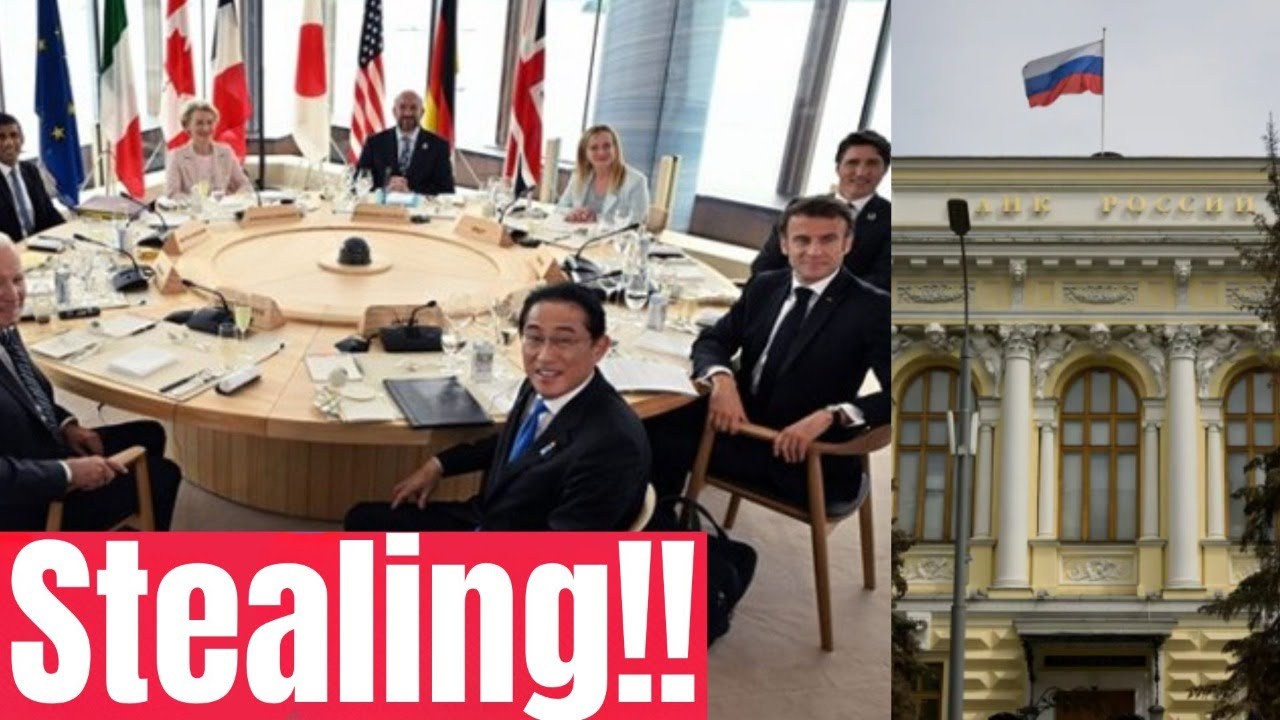
In a live YouTube stream dated January 3 2024, the host of Geopolitical Trends delivers a multi‑part commentary on the United States’ proposal, within the G7 framework, to confiscate roughly $300 billion of frozen Russian sovereign assets. The discussion weaves together a historical‑legal overview of the 18th‑century prize law (including its 1864 codification and a 2016 Israeli precedent), a brief history of the G7’s formation and membership, and the current split among G7 members— with Canada, the United Kingdom and Japan supporting the move, while France, Germany, Italy and, to a lesser extent, Hungary express legal and economic reservations. The host argues that the seizure would violate international law, be morally akin to theft, and likely fail to fund Ukraine’s reconstruction, while also noting the United States’ own fiscal pressures. The stream intersperses updates on unrelated headlines (the assassination of Hamas official Saleh Al‑Aruri, a Japanese airline crash), personal health advice about coffee‑cherry consumption, language‑learning recommendations, and extensive gratitude to channel supporters. The host solicits audience opinions on the terminology (confiscation vs stealing), the motivations behind the US policy, and possible Russian reactions, positioning the analysis as a call for critical scrutiny of Western geopolitical strategies.
Chapters
Hello everybody and welcome to Geopolitical Trends. So excited to be with you on this January 3rd in the new year. Well, first of all, Happy New Year to you all. Hope you had a safe, uh, uh, and, and, and enjoyable happy— I mean, New Year's Eve with your family and loved ones. So, so very excited to have you here, guys. I'm very excited to be here because I wanted to share with you some information regarding a key topic that is now emerging to the forefront. And this one has to do with what the US is about— is planning to do regarding the, uh, we use the term confiscation, or we use it as is, or you use the term as is, stealing. So what do you guys think? Is it a confiscation or is it a stealing? And there is the reason why I'm asking you this question. Because I'm going to take you back in history. There is an act that took place back in 1846. That's why I'm using the term. Is it a confiscation or is it a stealing? What do you guys think? So, uh, before I'll do all this, of course I'm going to save my thanks to the channel members and supporters towards the end, like I always do. But first, I want to see where are you guys joining me from. Oh, Army with Harmony, Oh, that was so kind of you, gifted one Geopolitical Trends membership. Thank you so much for, for whomever you did that for. I'm sure they are very, very grateful for your support. Thank you so much for that. Um, yeah, let me see where you guys joining me from. I will greatly appreciate it, uh, like, like whatever part of the world you are. Oh yeah, majority of you using the term stealing because it is what it is. We call it, we call it as is. And you know, guys, in this channel or even on the, the big channel one, I don't sugarcoat things. You call them as they are. Uh, let me say thanks to, uh, Devin. I'm sorry, that's a boon here. Hold on a second here. Uh, I saw this one here earlier. Uh, Scott Davis from England, good to have you here, man. Good to have you. Uh, there's somebody from Hong Kong that weigh in. Wow, good to have you here from Hong Kong watching. Robert Mata from California. Karakulak from Florida, good to have you as always. Uh, Boon, my great supporter here that has been with me since the beginning, thank you for being here. Uh, Mr. Farid from Malaysia, good to have you here. Uh, Athene Wu, as always, and Happy New Year to you too. Athen Wu, happy New Year to you too, from Europe as always. Uh, Boon from Berlin, uh, Onana from Philippines. Wow, very, very, very interesting. So yeah, good to have you guys. Suhati Wong from LA, good to have you here. Uh, Osiris Great, here is my man. Did you guys know Osiris buys me coffee every day. I'm gonna share this with you. Yeah, Osiris buys me coffee every day. I don't know how to thank you, man, and I hope to get an opportunity one day to meet you and do the same for you as well. So the treat will be on me. So, so thank you all for being here. Uh, Hussein, uh, Sidib, hello to you too as well. So All right guys, let's get into our topic here because there is a lot to cover. I'm gonna, uh, uh, detail a few things as to where I see things. Well, because the US is embarking on this, uh, sort of strategy for whatever reason, knowing that it is breaking international rules, norms, the law, whatever you want to call it. But hold on a second, as I said earlier I'm gonna take you back in history to provide you the counterarguments and let you reach your conclusion. So before we do all this, let's jump to our headlines. The first thing I would like to start with is, uh, my correction regarding the Lee Kuan Yew death. From— you remember Lee Kuan Yew that I mentioned? But I made a mistake. It's my mistake. I bear full responsibility on it. I was reading so many articles regarding him during that time. For some odd reason, you know, when you go fast— what— and I'm not providing justifications here, I just want to let you know I made a mistake. That makes me human, and I want to correct the record. Lee Kuan Yew died on March 23, 2015, at the age of 91. So that fix it once for all. So I don't shy away from when I make a mistake, I admit to it. So, all right, let's, uh, start about the headline regarding what just happened to this particular gentleman here. He passed away now because he was assassinated. So, uh, hold on a second. Yeah, yeah, that's the guy here. Now, this individual, he is the, he is the, uh, Saleh Al-Aruri. He's the deputy head of the Hamas political bureau. He was assassinated along with two, uh, uh, uh, brigade commanders, military one for the Qassam, which is the military wing. By the way, I will be talking not about this topic but pertaining to the military aspects on Rumble following this because I'm going to be detailing some stuff over there. So make sure to join me later on. And so what happened with this guy, he was, uh, he was assassinated, you, uh, through Israel using a drone, uh, in, in, uh, in Beirut, in, in the suburb area of Beirut. So, uh, this is another picture of him, and that's just the one I came across here. And by the way, Israel wanted to take him out for a long time. So, uh, I have one suspicion about all this. Is that somebody had to leak the information as to where he's about. It's the same scenario that I believe took place when, uh, the former IRGC General Soleimani of Iran was targeted in Iraq. Somebody had to feed the intelligence to that. So makes you wonder, even inside Lebanon, that's what spies do, I guess. So that, that's what it is. Uh, next one, guys, has to do with a Japanese airline. I don't know if I had a picture. Oh, I thought I had a picture of it. I didn't. Oh no, I do, I do. Here's a picture of it, the Japanese airline that crashed, which is caught in fire here at Tokyo Haneda. And I remember that airport when I stopped by on my way back to Washington, DC. Nice airport, by the way. It's them. Uh, so what happened is that the plane collided with the Coast Guard plane. So there were some death about, uh, based on the, on the, uh, information coming out of Tokyo, there were 5 people that died, but there were also others who were injured, uh, regarding that. So, uh, our heart goes to those individuals who suffered through this. So, and the last thing I want to share with you has to do with this individual. You all know who is Ah, no need for a comment, right? And I did share this with you on the community tab, by the way, and I wrote, you know, like, like it's a mockery, because that's how I look at it. I mean, having this guy being appointed in charge of the displacements of the Palestinians, I mean, it's laughable. Not in a good way, because that's an insult, really. It's an insult to the local people over there. You got a guy, probably somebody needs to remind him about Britain's history, or even his own history, that is full of, shall we say, crimes, atrocities, whatever term you want to use, against the Arab people. So, and again, if history proves anything, it proves that the UK was the most prominent contributor to the protracted tragedy of the Palestinian people. Straightforward. There is no ifs and buts. So as a matter of fact, now he is advocating for the agenda of World Economic Forum. So in my opinion, he should be held, uh, in trial and, uh, for the violations that's been committed. Before. We all know, right? That, that's just the reality of it. And the last thing I want to share with you, something, a good note, because, you know, we're starting the new year here. Of course we're gonna keep it positive. Yes, it's gloom and doom, whatever. That's, that's, that's how geopolitics is all about, the events of the global affairs. I am pretty, you know, but there's also, you have to keep your focus and think positively. Literally, how you think end up influencing your behavior. Like my work on this, I did some reading, especially from psychology, and I learned about how, how positive thinking does influence. So, so on a good note, I'm gonna share this with you because I am an avid coffee connoisseur. I'm interested in— and that's why I always say thanks to those who bought me coffee and so forth. Uh, this one here has to do with coffee cherries. Why is it important? It's because it can protect you against diabetes and fatty liver. And if you know, if you have a fatty liver, that's where your cholesterol goes up, but nothing problematic except depends on what you eat. So, so what happens is that German magazine Health Breaks published the result of study conducted by a research team from South Korea on the effective effect of coffee cherry. So this is a type of coffee, uh, and they found out through the research that it is— it can protect you against serious diseases such as diabetes and fatty liver. So, so I'm going to share a link with you later on when we get into this one here. All right, let's get into our topic. And, uh, today, as I said, I'm gonna be addressing this topic not just because the, uh, uh, the, the, the news leaked out about it, because all this happened towards the end of the year, the conversation on it, but it was put into conversation on the table, as we say, during the meeting of the, for, of the finance ministers of G7. So if that's been discussed in the agenda, that means there is preconceived notion that that conversation has been already— it just never leaked. And this is why I wanted to address this, uh, for, for you. So, so the idea that, uh, uh, the US now is proposing this working agenda or working groups, whatever you want to call it, from within G7. You know, we all know G7, it's useless anyway. Yes, its economy is good, but who dictates the terms? You and I know, right? So, so what's happening now is they are working on exploring ways to seize— well, we'll change that term of seize to steal because that's the truth. $300 billion in frozen, in frozen Russian assets. So now not everybody is on board, because if you look at who is supporting this particular, uh, initiative from the US, two countries: Canada and United Kingdom. So you got those two countries, and I think Japan also, it's part of that as well, if I'm not mistaken. If you think about it, those two countries, Canada and, uh, UK, they have always to toe the line with what the US says. There is no ifs and buts. And this is why when somebody like, for example, uh, this guy here is gonna be in charge of the displaced people, you can just see where the agenda is leading towards. There is no— make no bones about it, is the truth. So the idea of now the G7 is going to be working on this, backed of course by Canada and, and, and the UK, which two countries that in my opinion have no sovereignty whatsoever. It's on the paper, but they have no sovereignty whatsoever. Now that leaves you with what? The other members of the G7 which are mainly Europeans. We put Japan aside because Japan is another country that just have to toe the line with what the US says. There is no ifs and buts. You got Japan, South Korea, Philippines, Australia in that part of the world. But for this one here, you got the other three main countries in the, in the G7: France, Germany, and Italy. Well, those three countries now I like saying, forget— hold on a second, we are not on board with this. We have some reservations regarding this. And this is what I'm gonna get into the analysis as I move forward. But first, let me share with you something about history that ties to this. Then I'm gonna get into the, uh, the history of G7 with little geography. Then we get into the analysis. So you think about it. Back then, when I go say back then, I'm referring to World War I, World War II. We go way back in time. So let's say there was a fierce battle, okay, which was at some point in the North Sea, right? For those who know history, you know. And now you destroyed the German vessels, okay, you destroyed them but you didn't sink them. So what is the captain of the, let's say, uh, the, the American or British or French or whatever— we just give— this is just a scenario, but also based on reality in history. What he's gonna do before sailing back home? What he's gonna do before returning home? He will have to do something that other captains of ships have done before him. Which is what? To seize the defeated enemy ship on behalf of the government. So now here is where the tricky part— what makes me think why the US is pushing for this. Because the US thinks it's pushing about the seizure of the Russian assets is because he thinks— the United States thinks It has the legal justification to do so based on what I'm sharing with you here. Why? Because this step in the scenario that I shared with you, it was considered back then, and still to a degree, a perfect legal practice enshrined in what was called the prize law. Which— what if the prize law It dates back to the 18th century. Yeah, the rule of it is very obscure, but it remains in effect till today. As a matter of fact, to give you justification for why certain countries still do that— now the US is doing it, Israel did this back in 2016. What happened in 2016? The Israeli government invoked the prize law to seize the Zeytuna Olivia. Zeytuna Olivia was a Dutch flagship that has attempted to break Israel's maritime blockade on Gaza. Yeah, that's what Israel did back in 2016, activating that particular law. Okay, so the reasoning for all this was that modern-day, modern-day Israel, which is a successor to British Palestine, is that the British Naval Prize was Act of, uh, the Act of 1864 is applied. This is why I'm saying, like I asked you earlier, are we gonna call it confiscation, or we're gonna call it stealing. So this is what I want you to understand, because you need to know about the other side of the argument before we jump into the conclusion. So the US is thinking, oh, it will be okay to do this, when in reality it is not. So, and that's what I'm gonna get into here. So let's first talk about G7, because you need to I'm going to share a link with you, or picture rather, of, uh, what G7 is all about, bre— provide you a brief, uh, snapshot about its history. Then we move into the analysis part. Uh-oh, there it is. I was like, like, oh All right, not again, please, not again. So, so what you looking at? You're looking at intergovernmental, uh, uh, entity or association or group, whatever term you want to use. And that is made up of the, uh, uh, countries, 7 countries, that is, even though Here is what they say in the West, made up of countries that have the world's biggest, most developed economies. Okay, are we going to ignore China? Are we going to ignore Brazil? But that's beside the point. I just want to provide you— as always, you need to be aware of how you read certain reports when they come out to the public consumption, because that's what Western media is saying. So the G7, as you may know, it used to be G8. Who was the, who was the 8th country? Can anybody type in who was the 8th country back then? Let me just see here. And again, guys, just for the sake of having a conversation, uh, oh yeah, Robin, Muslim revert, that's a good one, Robin, that's true. So who was the 8th country? Uh, you got it, you got it, Hongwan, you got it. It was Russia, and of course Russia was kicked out. That's what happened back then. And of course, as we said, now the G7 does not include the world's biggest economies like China, like Brazil. That, that's very, very important to understand. So now the history of it— its history is very, very important to understand. It's very uh, sort of interesting to read, and I'm going to provide you the link, of course, guys, in the description later on, and you can read it on your own. For now, suffice it to— we're just going to share the idea of what the G7 historically, uh, have been. So G7, the short for Groups of Seven, uh, organizations of leaders, of course, from some, uh, largest global economies in the world. That includes Canada, France, Germany, Italy, Japan, the United Kingdom, and the US. Now when you see a list like this, you're gonna ask yourself, why is Italy there? Okay, you know, why is Japan there? Okay, yeah, if we were talking about back in the '80s, yeah, Japan was quite an economy, but we destroyed it by design because we wanted to do that. So that was the whole reason for it. So, so what happened with G7? G7 meets once a year. Of course, we saw the last one in Japan, uh, I believe that's what it was, uh, meets each year for summit to discuss the pressing— it's called pressing issues, in other words, most important issues on the global stage. But also the meeting is to coordinate policies. Which policies are we talking about? We're talking about American policy or policies. Look no further than what we did in Europe when it comes down to Ukraine, and the G7 end up being useless, powerless. That's usually how, how it is. So, uh, back then, if you recall, when, when, uh, uh, the— at the beginning of it, I, I remember one in the '80s because I used to watch that at that time used to be the, uh, UK Prime Minister, uh, Boris Johnson, and even before that, Margaret Thatcher at that time, Ronald Reagan, uh, uh, uh, Elliott Trudeau, um, it was the French president at that time, it was François Mitterrand, if I don't, uh, Helmut Kohl of Germany. I don't remember the Japanese Prime Minister at that time. So that is the interesting about aspects of it. So what's interesting about it, as I said, the primary value for G7 is to coordinate its policies and ends up making decisions of global consequences like the one we are about to embark on if the United States and G7 moves forward with it, because this is not only a violation, first of all, because the US can argue, oh, we're just using the prize law that is still active today. Well, this is a different case. Why I'm saying this is because we haven't defeated the Russians. So why are you going to confiscate from somebody you didn't defeat? That's one. So the idea of, uh, uh, uh, G7, which by the way meeting, the conversation that took place, it took place at the level of the finance ministerial level. And that's how we started at the beginning. It was the meeting of the financial— finance ministers who agreed to back— listen to this carefully— to back the global minimum tax, at least for 15%, on multinational corporations. So they want— basically have some sort of close control on really how things move forward. But one thing you need to understand is the year when the G7 was founded. Can anybody tell me what year G7, uh, was, uh, uh, founded? Because at that time used to be called Library group. Let me see what you guys typed in, because there is an interesting aspect of it as far as the year when it was founded. In the '80s. It was before that, Francis Tango. It was before that. It was before that, as in the 1982. Before that, it was the '70s. That's when the conversation started. And to be, uh, to be exact, what took place in specifically 1973, because that's how we moved forward. That is correct, Abel, you're absolutely correct. It starts in the '70s, 1973. Why 1973? What happened in 1973? You got it, Boone. Oil embargo. And you can just see where things are headed today. Why the concern about the US dollar? You guys see, the reason I'm saying it this way for you is to put the dots together. Nothing happens in a vacuum. So you're right, Muslim Convert. Oil crisis, the embargo. That was, uh, uh, placed on the US not sending, uh, the oil to the, uh, you know, to the United States. That is, Japan of course joined in 1975 with the two original participants having been, uh, become French president and German president at that time. And this is where the meeting after that turned into head of states and government. Of course, Canada and Italy soon joined thereafter and became known as the Group of Seven. So let me share, uh, uh, I'm gonna stop sharing this one here and I'm gonna share another picture, uh, with you to see the— because I used to follow up on this. I always, since I was a kid, I always took an interest in, uh, in global affairs and geopolitics and so forth. And so I remember, I remember, but also I know where to look for the information. Uh, look at this image here. No, this is one, the first one back then. This is François Mitterrand, this is Helmut Kohl. I don't remember this guy, this guy, and this guy. This is the, the former prime minister or head of Italy at that time. Of course, this Margaret Thatcher and Ronald Reagan and Elliot Trudeau, father of the current incompetent prime minister of Canada. So, uh, it is another image here. This is the recent one that took place when, uh, when, uh, Trump was president, when, uh, Merkel was still, uh, the head of the government in Germany, the chancellor. And this is the beginning of it. This is the whole back then. So you look at here, this is Henry Kissinger and this is, uh, Gerald Ford. So, uh, those were attending. This is Takeo Miki of Japan, that's right here. German Chancellor Helmut Schmidt and French Foreign Minister, uh, I don't remember this guy. I don't remember him. Uh, this is the French president right here. That's Valéry Giscard d'Estaing. All of them died. And the French, uh, economic— this is an old one anyway, so I just wanted to show you this image here. This is the recent one during 2007, 2008, I think, or '06 if I'm not mistaken. Yeah, so, uh And this is the, uh, that goes way back. This is during the meeting on June 22nd, 1980. This is the old ones there. So, so this is what I wanted to share with you guys. Let me put this one back up here, the other one, because, uh, I might be sharing something else with you here. The G7. There we go. Let me close this one here. No, we're done with this. So there we go, that's the group G7. So, so now let us talk about exactly where this is going. Where this is going. Well, as I mentioned, no decision have been made yet. It's because some European countries— when I say European countries, we're referring to three: Germany, Italy, and France. UK, even though it's a European country, UK is useless. Canada is useless. Japan is useless. But the three European countries are very concerned about and have reservations regarding this. It's because they saw what just took place with the sanctions applied on the Russians and how it backfired on their economies. Every citizens in Europe— and I know there are some, uh, viewers in the community here from Europe, you know, Hongwan, Boone, uh, Harry, you know, a lot of you, some of you guys from Europe— you will be a better judge. And please just share your input about where things are economically. Just with the community for them to know where is inflation, where is all this. And this is why the government's having now reservations. No, we're not going to go with this plan. Second argument to this: anytime there are conflict, tensions, whatever you want to call it, when some assets are put, uh, are frozen, that means you don't have the right to get to it. Those are frozen. That is the whole reason for why assets are frozen. That doesn't give you— whomever this country is— doesn't give you the right or the authority to just do whatever. And this is why the head of Hungary, Prime Minister Viktor Orbán, is pushing back against the EU, not only for that but also keep funding Ukraine, he's like, forget about it. Rightly so. And again, he's thinking of the welfare of his country. But Orbán, in comparison to Germany or France or Italy, it's not going to hold much weight except when it comes down to voting, that if there is no unanimous vote, no policy moves forward. This is why you're seeing the reservations already being emerged by those three countries: Italy, Germany, and France. And by the way, as I said earlier, Japan is backing the United States in this particular plan, per se. So, well, we all know Japan— Japan is useless, if I may use the term. So, because those three countries— Japan UK, Canada, in support— supporting the United States, have proposed that, yeah, we need to move forward with this. Or meaning the preparatory work, because this doesn't happen overnight, guys. This is going to take time. You have to have working groups. They're going to have to figure out the mechanisms by which to do this. Then you're going to have to look at the legality under international law. But at the same time What international law are we talking about? There are no more. We don't respect the law anymore. You know, we say we are a country of laws. Where is it? And again, you got to be fair, you got to be objective. Russia or not, any country, doesn't matter. What's right is what's right. What we are thinking of doing is not right. Yeah, we might have tensions with the Russians and so forth. But to go and steal their assets, yeah, that's, that's, that's like you and your neighbor. Let's say you got a, a disagreement with your neighbor. Are you gonna go and steal stuff from his or her house? No, it's not more— it's morally not right to do so. So then becomes the question, and this is why I'm saying there's 3 working groups. That is proposed by Washington. Here is the key: it's not proposed by G7, it's proposed by Washington, which leads you to think in terms of, it's really— this is about Russia? What is it about the US? Like I post for you guys in the community about, uh, I don't even remember the question. Do you guys remember the last posting I did for you guys? On the community. Let me see, I'm, I'm pulling it up here just for you to see, um, because I discussed this, the idea about how, uh, for example, and I put it in a survey in a form of question for you guys, and majority of you, uh, answered by 82%. Like I said, one of the trends I've been following when it comes down to geopolitics that has to do with Russia and China. And again, not because I wrote a book about Russia and I am in process of writing a book about China, but also because I knew back then that these two countries is going to influence the global trajectory, global direction, global order. And this is why I put the question for you as far as, uh, China and Russia's ability to really Have these two countries managed to shake off the dollar dominance? You know, and as I said, 82% of you said yes, 6% of you said no, and 11% of you are not sure. And the reason why I always put not sure option in a survey, because there is always that possibility. And I would love to know those who voted for not sure to share with all of us really why aren't they sure about. And I will be happy to all have a conversation about all this. So this is my point in all this one. So now you have, as I mentioned earlier, France, Germany, Italy, uh, have— and the EU for that matter. When I say EU, the other countries even though those other countries might not have a, a voice the same way Germany, France, and Italy do, they have expressed some reservation. And their argument is from the legal aspects of it, because they know legally you cannot steal or confiscate Russia's assets, uh, without— what is the justification? Yeah, you ask them. Well, the European Union is saying the justification is to maintain the support for Ukraine. How can you maintain support for Ukraine that is, according to some— and I've had many conversations with some people in Europe— that is considered a failed state? And I think it is fair to state that one, even now, which maybe one day I'll talk about this on the other on the other platform here, because there are certain things that, uh, the whole reason for why we're doing this now, uh, it, it, it just defies logic and, and defies the law. So how can we be saying we stand for the law, we stand for what's right, and we doing the opposite on one end? Second thing, how do you guys think now country is going to be seeing this behavior from the United States, because this is not the G7, it's the US. We just slapping the term G7 to minimize the impacts on the US, but this idea is the US's idea, it's not G7. G7 is just a followers. G7, G— G7 mainly just a followers. NATO just followers. They, they won't be able to do anything. The other thing is when you have frozen assets, those stays frozen till whatever disagreement, whatever conflict, whatever that is, is sorted out. It's exactly what happened when we released about $6 billion to Iran that belongs to Iran, frozen asset. And the same thing, South Korea got the, the green light from Washington to release, uh, some money that was frozen from the payments North— South Korea, I'm sorry, didn't make to, uh, Iran because the US ordered South Korea not to make the payment. It tells you the story right there. So now the idea that the legal case of seizing Russia's assets, both the EU and France, for that money Even with this, even with this, you move forward with this, the funds or that $300 billion is not going to be readily available. And even with that, it won't be enough to cover the so-called reconstruction efforts in, in, in Ukraine, which you and I know there will be no reconstruction. Ukraine is gone. Gone. That is gone. And now you're seeing why even US Congress now is thinking of, uh, uh, coming down hard on Hungary's refusal to back this EU deal, because Hungary, uh, Budapest, uh, or the government of, uh, Viktor Orbán is saying no. It's not right. We're not going to do that, and rightly so, because you can't justify actions like that by saying we're doing it because, uh, no, you can't, you can't, because we'll be breaking the law. Once again, let me just repeat this for those who might not, uh, came earlier. The US argument is we still under the— it's called the Prize Law that was enacted back in 1864. That is what they're saying, but that ain't gonna hold up given how things are right now. So this will end up being basically stealing money that doesn't belong to us. And for the US— and by the way, for the US we're dealing with the massive national debt that is skyrocketing, skyrocketing, and I use that term. So I will be dealing with that topic later on, on the other channel, uh, on the other platform, or rather, where I will be talking, uh, on, on this particular kind of, of, of issues and topic. Speaking of the next, uh Oh, I forgot to even share the questions with you. Uh, next, uh, uh, conversation I'm gonna have— here is the link, guys. I'm not gonna read it, you guys can see. That's what I'm gonna be talking about. Massive. It's just not being reported here. So make sure to join me, uh, in about, uh, probably 25 minutes from now or so. We will meet over there. Yeah, the other thing, and here is— I forgot, I'm sorry, those are the questions that I forgot to ask at the beginning. Why is the US G7 embarking on this policy? Is the US aiming at keeping Europe under its thumb? And third, how will Russia react? Those are legitimate questions. And that's question— the last one is for you guys. Let's say this moves forward. How do you think Russia will react? If you will be kind and just type in on the chat box, just your idea, what do you think should this move forward? How will Russia react to this? And this is where I see the big concern. And I can think of one particular, uh, uh, uh, not a venue, but rather option that Russia might exercise. But I want to wait till I read your response first. Excuse me, your response first for this, then we'll, uh, and I'll answer it, uh, moving forward. Uh, that is true. This one is true. I read this somewhere also. They given up. The West is gone. To honor your commitments, to honor your word, to honor your agreements and so forth, it's gone. It's over. It's over, especially for us, because it's, it's, it's just sad, sad to see what has become. But usually that's an indication for what lies ahead. It's because, uh, the era of the US dominance is coming to a close. Sad to say, it's my country, uh, but also I, I am not the type to shift the blame on others. I start with myself. When I make a mistake, I'll come forward and say, hey, I made a mistake, so my apologies for this. I'll fix it, but I don't go around and start shifting other— shifting the blame on others. It's the same thing for the US. We can't be shifting blame on others when we are causing the problems. Our policymakers are useless. Yeah, they are useless. Credibility is shattered beyond repair. I, I just don't see how, uh, I mean, as the world now is moving into multipolar— is already in it, it just— it will be even more prevalent, more evident as we move forward. And when I say move forward, we're talking about the next 3, 4, 5 years. It's gonna become as clear as daylight. It's already— we're seeing this right now. And if the US moves forward, which I can't recommend enough not to go this route, because if we do, uh, and I'm gonna see if your answer is here, guys. Uh, I don't see it yet. Let me see. Uh, Abel, that's one. I, I do see the possibility for that, but I'm talking about Russia by itself, just Russia by itself. Uh, this one, Cody. And Cody, thank you for your comments, by the way. I did read it earlier when I post, uh, uh, on the post for the community. Maybe Russia will demand the repar— no. No, Russia won't do that because their thinking is very, very different. I mean, we're talking about a major, uh, major strategy here, major, if that happens. So, okay, let me, let me share it with you guys. Russia will decide to cut off diplomatic ties with the US, and that is very, very problematic especially for us here. I hear siren, that's emergency, something going on. Uh, so if they do that, that means what? And I can think of them from one particular aspect: nuclear deterrence. That means the Russia will not be held up by any agreement or treaty with the US anymore, which means they can go about and do whatever they want to do. Yes, also Muslim revert, they can also go and do that for Europe. But Russia is not about to punish people, the citizens. Yeah, I can see that, but this will be mainly with the US because who's leading this effort is the US. And remember, this is going to be taking few weeks and I'm going to keep my eye on it because the G7, or the US that is, said they want to have this, uh, in, in, in, uh, enter into effect by February 2024 of this year, which means what? It marks the second year anniversary, uh, for Russia's military operations in Ukraine. That's what they want to do. So, so I'm gonna keep an eye on it the same way I'm doing with Taiwan. I didn't forget about this one, guys. I intend to do this one, uh, on Taiwan and, uh to let you know where it is. All right guys, this is what I wanted to share with you. Brief, concise, to the point. Oh, Muslim Revert, thank you so much. We all enjoy your lectures, Dr. O. Thank you so much. You're most welcome. And again, it's because your support, guys, is what keeps me coming and doing this. And I mean it. You all know I don't sugarcoat things. If I don't like something, I'll say it. If because of your support. I mean it, because of your support. I'm, I'm noticing some of you now became some sort of a member on the Buy Me a Coffee because we don't do it on this particular location here or platform. It's because, just for you to know, that this particular platform takes about 30% of what you donate for to support, uh, my, my work and my content. I want you to be aware of this. So most of the things from the other one, it takes about 5% in addition to 2.7% for the financial transactions through Stripe, which is fair, maximum of 10%. So I just want you to know, but because of your support is what I'm here, and I intend to do a lot for this year because I want to sort of, uh, have you part of this decision of how you want this to move forward. How do you want the channel to move forward? It's not about just me coming here and talk. Yeah, I'll do it, of course, but I'm talk— I'm, I'm thinking about innovative ideas that I want you to be part of it, because this is our channel. Yeah, my name is on it and all that stuff, but it's our channel. So the support I get is I turn around and use it for whatever I need, uh, even including And I just received this stuff here. All the, the stuff that I get as have as far as magazines and to keep up on what's going on around the world, uh, cost money and everything. You all know how it is. You all know how it is. And I intend to do something very, very big next few months, uh, that will require me funding. You were looking at a serious amount of funding because it won't be here in the US, and I'm not going to disclose anything yet. Until we get to that point. So, so your support means a lot, and I want you to know how much I appreciate it. So thank you so much again, Muslim Revert, truly appreciate it. All right, I'm gonna take a question, but before I'll do this, I'm gonna go and express my sincere thanks to the channel, uh, members and, uh, and supporters like I always do, because it's the right thing to do. If you don't show gratitude, there is a problem with that, but Anyway, uh, I want to give a shout out to Ben Ong, is the new channel supporter. Second person is Reby Lee. Thank you so much for becoming channel supporters. I also want to give shout out to a new channel member by the name of Francis. Thank you so much for becoming a channel, uh, member. So for Buy Me Coffee, uh, there's a new member by the screen name Edu Utopian. Thank you very much for becoming a channel— becoming, uh, a member on the Buy Me Coffee. So, and of course, as far as the donations from all of you, especially I want to give a shout out to Drag88. I rather keep the, uh, unless I get the green light from the— I know who this individual is with his name, but I will not disclose it till he gives me the green light. But for now, I'm using the screen name by Drag88, who, as I mentioned earlier— now, if you paid attention, you know the name— buys me coffee every day. So, so I can't thank you enough, guys, for your support. So All right, let me— oh, there's one, Franny. Franny, I need to address this quickly. Franny, you put a comment about languages, which language to pick up, the Chinese, Arabic, or Russians, if I'm not mistaken. I will go with, uh, Chinese and Arabic, either or. So the reason why is because if you think geopolitically where the shift is going, but if you think Who are the players in that shift? Well, the key player in that shift is not the United States, it's Middle Eastern countries. So, and if you speak the language, and I happen to speak Arabic language, it's challenging to learn, but you will learn it. We all are smart. Uh, the Chinese language is very important because the size of the economy of China, something you can ignore no matter what, no matter what you read, no matter what you hear about the Chinese economy is collapsing. It's nonsense. I'm here to tell you it's nonsense. So if I am to suggest to you, you consider this too. Now, for the Chinese, whether you consider Cantonese or Mandarin, I do not know. So it depends again on how you want to use the language. All right, let me take a question from you guys. And oh, KL, here is KL again, man. Thank you so much for your support. Thank you so much for your Super Sticker, KL. Truly appreciate it. And again, I want you guys to know I don't take it for granted. I don't. It means a lot to me, and I will pay it forward because that's the right thing to do. All right, let me see question from you guys. Uh, all right, Mike— nobody. I don't know who that is, but nobody. My question is, will Russia still play ball after Putin? What they mean after Putin? Meaning, uh, I did write about it in my book, What Lies Ahead for Russia After Putin, because it's reality. We can't deny this. But, uh, uh, I don't see two key players would not, would not even— they won't fill the shoes. Lavrov And Shoigu, the defense minister, those one, because Lavrov is more into the diplomacy than anything else. I am sure there is a plan as to the Russia after Putin at some point. So, uh, yeah, and there is that possibility that Russia will not play ball with the America or the US at all, especially if the, the diplomatic ties are cut off. Which will be very, very problematic. So that's the way I see it. All right, let me scroll back up one more time for see if there's any question, and otherwise I'm going to have to sign off here and go prepare for, uh, for the other topic that I'm going to be addressing. Once again, let me share with you the link for those who might not see it. Here it is. Just make sure you you join me immediately after that. Just give me about 15 minutes or so and we'll get on it there, and I'll address some stuff for you. And I have a lot of information, uh, uh, that I kept over time just to keep that with you guys. Okay, all right guys, I hope you find this very informative, and I look forward to seeing you soon. As always, remember, geopolitics impact your daily life in more ways than one. Till next time, guys, bye-bye.
More from David


Beyond the Single Actor: Why the Gulf Isn't Choosing Between the US and China


Iran, Iraq's Militias, and the Houthis Are Coordinating! This Changes Everything




Who Controls the Next Decade's Resources? Latin America and Africa's Geopolitical Crossroads

The Chokepoint Trap: How Washington's Stupidity Triggered a Cascade That Now Controls the World

Trump Spooked as IRGC Unveiled dual-use SLV, Deployed Ghadir Mini-Subs & Hinted at Tactical Nukes!
