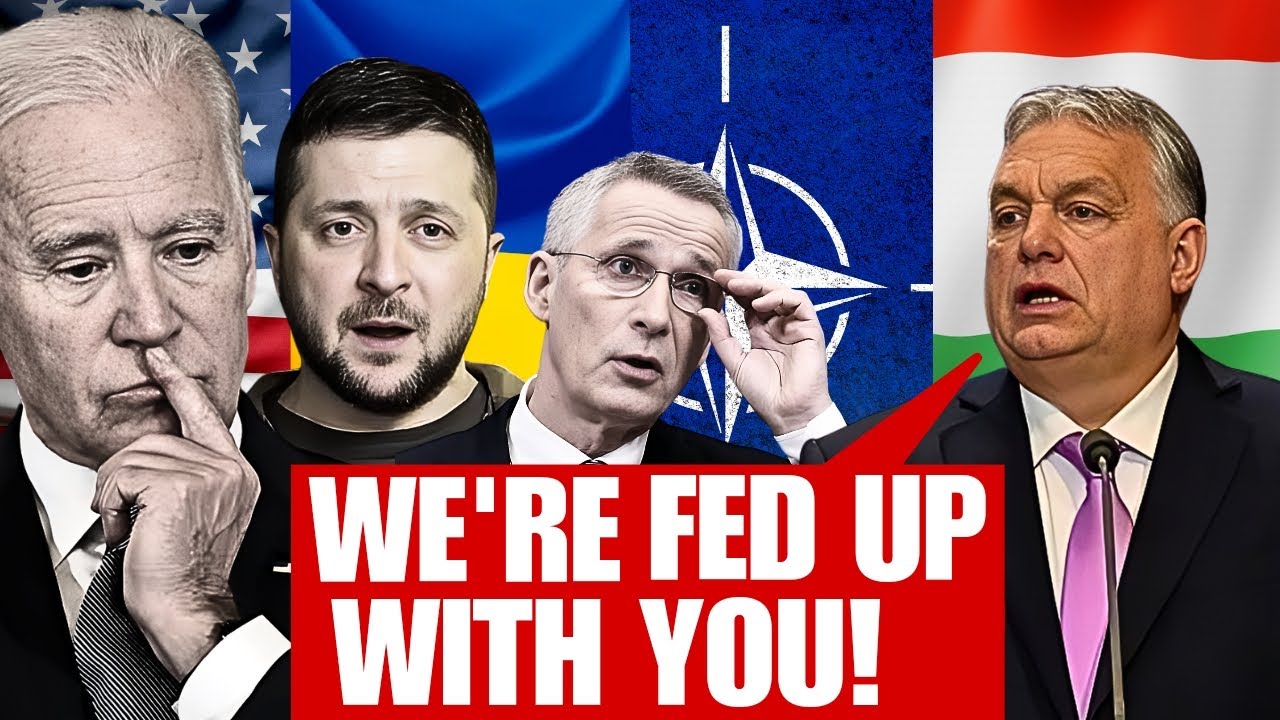
This content was created by David Oualaalou. This content was uploaded by David Oualaalou. This is a YouTube video titled "Time for Hungary to Leave NATO!" (uploaded 2024-06-04). No transcript text was provided in the excerpt. Based on the title, it appears to be political commentary arguing that Hungary should leave NATO, but the participants, speaker(s), and detailed context are not specified in the metadata or excerpt.
Chapters
All right, hello everybody and welcome to Geopolitical Trends, where truth matters. Excited to be with you as always. Uh, I, uh, put the vote for you guys regarding the polls, which topic you would like me to do. About 79% of you wants me to address what's going on in Hungary, in Budapest, regarding the protests or demonstrations, whatever term you want to use, that the Prime Minister Orbán is calling for, that they don't want— they want to opt out of NATO's support and all this stuff. So this is what I'm gonna get into because there is much more into it than just what we are hearing. And so this is what I'm gonna be providing you some insights about. In addition to sharing with you two major headlines today. So, but first, let me say hi to some of, of you. Uh, YouTube Super, hello Doctor, hello to you as well. YT, good afternoon to you as well. Matt Becky, hi all, one of the few times I am here early, front row seats. Well, good to have you, Matt, you know, glad you were able to make it. So, Marianne Dorcier, Uh, as always, Coach Hoy Hoy, good to see you. Willie Homan, Wong KC from Malaysia, as always. And Wango, good to see you. Uh, John Smith, uh, Hamed Sidi, Farhad Razavi, and Alice Tolikin, good to see you all. George, uh, Jesus Aguilar, good to see you from LA. I haven't seen you for a while, so hope all is well. Losio Delgado from Montreal, as always. And PK Wong, good to see you. Turkey already left NATO. Yeah, I see your point on this one, PK. Yeah, because Turkey is doing whatever he wants. Turkey was playing both sides, and smart move on their part. Taiwan Still, good to see you as always. All right guys, let's get into this topic here today. As I mentioned, uh, I did, I did some reading last night just to sort of prepare because When I was thinking about the topics I wanted to share with you, uh, which one you want, and as I mentioned earlier, most of you— and thank you, by the way, guys, for voting on this, so I know which topic you would like to learn more about, and this is what we're going to do, be doing. Uh, I have just one housekeeping item. Uh, next week I will be on the other channel. Me and Elizabeth will be there. So yeah, we, we took a pause from that, and there were some changes going on, so So we'll be there next week. Just be on the lookout for that. So, all right, we're talking about, uh, Hungary now. As I said, it is fed up, like I put in the title, it is fed up with both NATO and the EU for that matter. If you only, guys, know what Brussels— or Brussels, that is the, uh, the, the headquarters of both NATO and the EU Parliament— are pushing Hungary towards. So, and this is why I'm saying, and please correct me if I'm wrong, and I'm going to ask you a question: is it time for Hungary to leave both the EU and NATO? What do you guys think? Please. I know some might say, well, that's an obvious, Dr. O. No, no, no, no, it's beside. Still, I don't assume, I don't assume, because some will say no, they don't need to, to leave, they just need to take stand. That is also some logic arguments into that. So my question to you is, is it about time for Hungary to leave NATO and the EU for that matter? So, so like I mentioned, uh, and first we're gonna have to ask the questions, uh, pertaining to this particular topic. And here's the question, which is the same what I put: will Hungary leave NATO eventually? Not today, not tomorrow, but eventually. So Second question: is Hungary anticipating a major confrontation between NATO and, uh, uh, Russia? Because this is one of the things I am leaning towards as a geopolitical analyst. I am saying to myself, I think Hungary does not want to be caught in the middle because it is a NATO member, which means it has to sort of, uh, uh, uh, the, the, the rules of, uh, being part of an organization applies. Okay, that's one thing. And the second thing is the idea of they are also friends with the Russians. That's why I ask the question: is Hungary anticipating a major confrontation between Russia and NATO? And third question: if a war breaks out between NATO and, uh, uh, uh, uh, Russia, which by the way, who do you think is going to be? Are we going to be in it? No, you're going to send the French, which France, France by the way sent his troops already. Then you have the, uh, what do you call it, the British, which is— they are useless anyway. And the Germans. Well, Hungary is a member right? So are other countries, the like of Poland, whatever. Who do you think is going to be in the front line? They're going to push those countries. The US is not going to be in the front line, even though those forces will be commanded by a US general, because that is the rule, as I always explain to you. NATO will always be headed by a four-star general, US general. Okay, that is the rule. Same with the IMF and World Bank. Uh, I think IMF, IMF will be by an American and World Bank will be by a European. So, so the third question, if a war breaks out, what will Hungary do? So this is why it's important to ask, uh, and, and that's why I'm saying What do you think will happen, you know, should— or, or first of all, should Hungary start considering leaving NATO altogether? Yeah. Uh, uh, AF Gordon, uh, Corleone, you said Poland is going to be first. I agree with you. I am very concerned where the policy of Poland— as a matter of fact, I am in— I am thinking about reaching out to someone I know and I trust and bring him over on the show here for you guys to hear from him. He's on the ground over there, met with him, we had dinner when I was in Poland, my last visit there before I went over to other locations. And, uh, I'm thinking of reaching out, and someone I trust. So, so Poland, yeah, and given the stupidity of the Polish policies they are now embarking, to the point that they will— they said, Polish government said they will be okay with having a nuclear— US nuclear weapon on their soil. That's, to me, suicide. So that's where I see this is moving forward. So, all right, before I'll delve deeper into the analysis, as I said, I mentioned I have the two, uh, uh, uh, headlines, if I may use the term. You're all familiar what happened to Scott Ritter yesterday. So does anybody know? Can you guys type in, in the chat box if anybody know what happened to Scott Ritter? Yesterday, before I say anything, I want to see if you guys know. Let me see, it takes a while here for it to show up. Uh, oh, okay, you got— no, no, he wasn't arrested. Uh, I won't, I won't say arrested. He wasn't arrested. Uh, but he custom dragged off the phone. He got kicked out of— yes, he was deplaned. They took him out of plane but confiscated his passport. That is problematic. He didn't commit a crime. He didn't violate any laws. So under what? When he asked, they told him— those 3 cops, whatever they told him— orders from the State Department. Well, what kind of system we live in? And again, you know, I'm not defending Scott Hader. I'm defending what's right. Because what's right, what the, what the government is doing ain't right. You know, there is something called the First Amendment and there is something called the Fourth Amendment. First Amendment has to do with freedom of speech. Fourth Amendment has to do with the citizens being free from a government unreasonable search. In other words, the government cannot just take it upon itself and search your place without probable cause. For them to take him out of the plane, uh, that, that, that's kind of— yeah, he's critical of the government, so what? This is where that First Amendment comes in. And that, the optics of it around the world now— so are we living in a free country? Come on, you know, you can't shy away from these things. And we can't— and personally, I speak for myself here— you can't— we can't be giving in to this intimidation by the government. That's nonsense. This is what we called the F word. You all know what ideology I'm referring to with the F word, right? We don't live in that here, so ain't all right. They can't be doing this just with you. Of course, you have to know the background story. And Judge Napolitano also, yeah, was also, uh, happened to him. So, uh, the background story regarding Scott Ritter has to do with when he appeared in Congress to give a hearing. And who was the head of the Foreign Relations Committee at that time? None other than the incompetent Biden. And at that time, and they clashed. Why? It's because Biden was pushing into one direction to say that no, they were— there were some, uh, uh, weapon of mass destruction. And Skyraider say no, there were none. We search, there's nothing. And that's how they clash. Biden never forgot that one because Scott took his— stood his ground in that hearing, and rightly so. So, and, and to me, it was like very, very, very problematic. Very problematic. What I see coming next is that they could just all of a sudden start saying, well, he's a Russian agent. That ain't right. It's not right. All right, second thing has to do with, uh What's her name? New Mexico president. To me, what was disturbing is this picture here. You all know who, who's this guy here? Does anybody know, guys? This is the new, the female president. Let me remove this picture. Yeah, this one. Who's that guy in the picture? Let me see if you guys know who that is. Uh, Shane Baum. Yes, that's the female president. Uh, and I'm talking about the male. Yeah. Uh, Mr. Stein. No, no, that's Larry Fink. Larry Fink is the head of— here we go, you got it, Patrick. Patrick, you got it. That's Larry Fink, the head of BlackRock. Or if you know anything about BlackRock, their assets is almost cross over $10 trillion. Yes, don't be shocked and surprised. As a matter of fact, they lending money to countries. So the question becomes, what is Larry Fink meeting with the socialist? Because she's a socialist. Now whether you agree or not, that's beside the point as far as the ideology, whatever. The second concern to all this, in my opinion, you know, Claudia Sheinbaum, now Prado— her full name is Claudia Sheinbaum Prado— is a Mexican politician. Just FYI, she's also a scientist and an academician, so she has her background in academia. So, so now that she won the elections, uh, representing the left wing party of Morena. So what is very concerning about this, and what's concerning is the idea that— let me, I, I got something here that I saved because I do save my stuff. Uh, uh, when you consider what is the most dominant religion in Mexico, does anybody know? Can you guys type in, in the chat box?, as to what is the most dominant religion in, uh, in Mexico. What is Mexico known for, religiously speaking? Catholic. You got it. 99% are Catholics, Protestant, and Christian. So, so makes you wonder. The Jewish women winning 100% organic and fair elections. So I'll let you read between the lines. We're not judging here, we're presenting the facts, guys. Because the, the first question I'm going to be asking now, you know what it is, is what will all this mean for the United States? Because remember, when Mexico, when Obrador was still in power, it was about a year and a half or 2 years ago, whatever, he mentioned about, we are interested in joining BRICS. What did we say? We will invade Mexico. Of course it was just talks, you know, we won't be able to defeat, you know, go back to history of the, of the American-Mexican War. So it's how we end up taking, uh, so, so the question will become is now what does it mean for the United States? So anyway, there are just two things I wanted to share briefly with you before I'll delve into our topic today. All right, let me share some pictures with you, then we're gonna get in into— I have some history about, uh, uh, NATO, uh, just briefly here to move forward with the conversation. But for now, we're gonna be focusing on Hungary because that's where, uh— so I read an article, uh, by the Associated Press. Of course, I read from both ends, uh, or both sides of the Atlantic. From here and overseas, because that's how I, uh, the picture you are looking at is, uh, the Hungarian prime minister speaking during press conference at the Carmelite Monastery in Budapest. You know, this was on February, that's when that picture was taken. So beside the point. So now we're thinking about why all of a sudden Hungary is saying we are going to be looking for ways. As a matter of fact, Orbán mentioned that he has the lawyers looking into the legal aspects. Remember, when you become a part of an organization, that's like what happened with the UK when they left the EU. There were some legal entanglements. So that will be the same for NATO, you know. Hungary cannot just say tomorrow, I'm leaving, you know. Of course they can do it, but they're going to have to push through certain Brussels is already thinking about sinking— yeah, you heard me— sinking the Hungarian economy, especially now that you all saw the deal and the reception that the Chinese president got in Budapest. And all this because of the ventures, economic ventures that China decided to do with Hungary and Serbia, but not Germany, France, UK, and all the rest. So, and this is where that difference— so, uh, uh, Orbán is now asking the lawyers to look into the ways of how to opt out of NATO's operations altogether. And that's to me why I ask the question: is it about time for Hungary to leave NATO altogether? And I, and again, I can speak for Orbán, but I speak for myself, I think it is yes. The timing is right. Why? Is because when you think about what lies ahead, and again, I am seeing that Orbán was thinking in terms of, in terms of why is the West pushing Russians, you know, they want a war with— I ain't gonna be pretty anyway. And Hungary doesn't want to be caught in the middle because even being a member of NATO Hungary will not be forced because they already made it clear, should there be a conflict, we are not sending our troops, we're not getting involved. And that becomes the question, is why are you doing in the organization in the first place? And this is why, uh, uh, uh, Hungary now wants to opt out of NATO's operations that aim at supporting Ukraine. We all know there is no support for Ukraine. Ukraine is done for. It's, it's a, it's a joke. Even NATO itself is a joke. What do you expect? NATO is a relic of the past, simple as that. So, and this is part of where the support for Orbán was about— we don't want war. First of all, Hungary is a good friend with, with Russia. Second, Hungary used to depend a lot on Russian energy because it's cheap. And third is Orban is thinking about the welfare of his country, his people, rightly so. Look at the European Union is trying to shove down his throat the immigration policies. In other words, they want Hungary to open its borders to just all immigrants from whatever, and they're saying no, and rightly so. Look what's going on with us here. A lot of people, a lot of Americans have no idea. There's about 40 million illegal immigrants here in the US. So again, I have nothing against immigrants, but you can't just open the border. No, I'm an immigrant. All of us here are immigrants. Who's American here? You know, yeah, I was born— so what? So what? You, your ancestors came from somewhere. No one is from here. Straightforward. But on the other hand, if we are to say we live in a nation of laws, a country of laws, those laws will have to apply across the board. You can't be cherry-picking the law or applies to this category, which basically what we have in right now. This is exactly what we're having right now. You look at just the case of Scott being pulled out of plane just for no reason. What is his— what is the crime? There was no crime committed. And I hope he will go ahead and hire a lawyer that will sue the government because they need to be put into their place. You know, government listening or not, who gives a damn? It is the right within the First Amendment that we criticize the government because the government is for the people, by the people. But what we are witnessing in America now, it's, it's— I mean, you ask me 20 years ago, I'll tell you, no, you must be smoking weed. And here it is. And even this thing here has been in the works for a long time. So, so, and this is what, uh, uh, uh, Hungarian Prime Minister is doing, wanted to protect his country. He's like, why do I send my, my people's money to a corrupted Ukraine. Simple as that. So, and if NATO is going to be pushing on him, he may as well just say, you know what, we done, I don't want to be part of NATO. And, and, and take my word for this, guys, here is what I'm thinking. Even if he leaves NATO, okay, and war breaks out, Hungary will be spared, Russians will not. Will not, you know, target Hungary. They will target the, the likes of Lithuania, Estonia, Poland, Romania, and the likes, because those are dispensable, and the US will put them first. For Hungary is different story. For Serbia is different story. So let me talk about, uh, the history of NATO for those who might not know. And, uh, and by the way, I, I'm gonna provide you a link of a declassified information. When you hear the term declassified, that means is, is, is, has been cleared and all that. So, so, and by the way, before I forget, today is June 4th. There is something, uh, uh, coming up on June 6th from a historical perspective. Does anybody know What happened on June 6th, 1944? I just want to test your knowledge here. June 6th. And there is already, there is already something very idiota that is going on in Europe. D-Day! I'm seeing you got it, you got it. It was D-Day indeed. So D-Day was the name given to the June 6th, 1944 invasion of the beaches— of the beaches, rather, at Normandy in northern France by troops from US, UK, Canada, and Canada and other countries, some other countries, but there weren't many during World War II. So France at that time was occupied by, as you know, by the Germans, and the amphibious assault codenamed Operation Overlord That's what it was. So landed for some about 150,000+ Allied soldiers on the, on the beaches of Normandy by the end of the day. This is why, uh, but here is where I see the problem with this upcoming celebration. And I have a picture here, uh, of, of this, this chameleon here. Some say that he is not— I think because he's not running for president anymore, so he's like doing whatever. So, uh, I don't think so. Macron was ever qualified, in my opinion, because I kind of knew the history of— my family lives in France, some of them were born in France, so I'm very familiar with— if I am to compare this to the era of Charles de Gaulle, it's different. If I am to compare even this to, let's say, when I was born, because I wasn't born when Charles de Gaulle was around, uh, it was the— what's his name? Valéry Giscard d'Estaing, or even, even François Mitterrand. Those were kind of very different than the chameleon, this guy here. So here is where the problem I see with this guy. Macron now is inviting Zelensky for commemoration of the 80 years, of the 80 years since D-Day. So, so, I mean, just the optics of it. You call in a comedian, let alone what the history of that particular entity is, to be the one. So comedians, he supposed to honor the D-Day when in reality he wasn't supposed to be there. That's the whole idea of it. Makes you just wonder. Uh, and I think I had another picture of— yeah, right there. This is the Portuguese, Portuguese president. Uh, his name is Marcelo Rebelo de Sousa. So, and this was taken— this picture, by the way, was taken in May, I believe, somewhere around that time. So, and I'm gonna give credit to the pictures, by the way, to, uh, the first one of Makonto, Ibrahim Norozi, and for this picture you're looking at is Armando Franca. So, because it's the right thing to do, to give credit where credit is due. So So, and this is why the French president is saying, oh, he will greet the Ukrainian president— Ukrainian comedian, not president— he will greet the Ukrainian comedian, uh, Zelensky, along with other world leaders in Normandy. So, uh, of course, our incompetent Biden is also scheduled to attend, if he knows where he's going to be landing. Where he's at, uh, and, and it just— we all know it's nothing but a farce. That's all it is. It's a show, it's a picture, no more, no less. Uh, you know, even, even I found out that what's his name, uh, of Britain, uh, the king, who's still dealing with cancer, by the way, he's planning on attending. So Well, he might not make it either. So anyway, we all know it's a joke. Let's leave it at that. Uh, let's go into the history of, uh, uh, NATO. And as I mentioned, I am going to be sharing with you— as a matter of fact, I'm going to give you a link right now since I put it out of the, the archives from the declassified one. So I'm going to put it in the chat box for you. Guys, for later if you want to check it out. Here is the link, and it's, uh, it's declassified, so just FYI. And I got some pictures here I want to share with you, and the first one is this one right here. Now, and I'm going to be very brief on this because I— it's long, but I'm not going to go into all this one. So now it says, and, and again, the— I see the manipulation here. It is often said that the North Atlantic Treaty Organization, NATO, that is, was founded in response to the threat posed by the Soviet Union. And, and where's the manipulation? Right there at the beginning. It is often said No, it is a fact that it was created as a defense. Simple as that. Yeah, they're just playing with words. Anyway, uh, this is only partially true. In fact, the alliance creation was part of a broader effort to serve three purposes. One is deterring Soviet expansionism. Two, forbidding the revival of nationalist militarism in Europe. Through strong North American presence on the continent, and 3, encouraging European political integration. Well, they are lying because they didn't want to include the fourth element, which is to stay— meaning Europe— under the thumb of the US. This is why we moved the military as, uh, the military, uh, uh, structure into Europe. This is why we moved the troops into Germany. This is why we ensured that the commanding officer is a US 4-star general, has been always there. So, and of course, as you know, after World War II, which so much of Europe devastated— and by the way, if we keep pushing the Russians or cornering Russia, the devastation will be 10 times what it was back In World War II, when about 36.5 million people died, 19 of them, 19 million, were civilians. This time around, I was looking at a documentary yesterday about the, the, uh, the bomba. You all know what a bomba is, right? The Russian bomb, the big one. And I saw the, the, the, uh, the historical document It's a, it's a, it's a history, uh, uh, history, uh, uh, document— it's a documentary but based on historical aspects of it and, and, and the characterization of the bomb and so forth. And, and what they disclose as far as the devastation, what it will reach later along the distance, how far it will go, by about 976 kilometers. That's how far it will go. So if Europeans and the and NATO keep pushing, they're gonna have to be very, very, very careful. So, uh, I gotta see another picture for you. This one here, uh, this one here. Of course, what happened is the idea of when you started to, uh, see at that time in Czechoslovakia Uh, you started to having like communists aided by the Soviet Union were threatening elected government at that time. Uh, however, we did similar thing in Italy 1938 when we rigged the elections. So even with the writing of the historical record, they can be manipulated because remember, history is written by the victorious, right? So in February 1948, the Communist Party of Czechoslovakia, with covered backing of Soviet Union, overthrew the democratically elected government in that country. Well, we do the same. Look what we did in 1953— '53 or '56, I think '53— in Iran. Look what we did in some other countries in Asia, Latin America. So Then in a reaction to all this, the Soviet blockaded Allied-controlled West Berlin, and this is where that idea of, uh, of the wall came about. I have a picture here for you, wanted to share it with you right there. This is when the wall, uh, uh, became sort of, uh, separating East from West. So And of course, with the aid of the security umbrella of the United States. And that's how we increased our influence over Europe. And this is why now you understand that this ongoing conflict in Ukraine was by design, because we never wanted, uh, the Germans— especially Germany. I mean, when I say Germany, I'm saying Europe. Uh, we don't want them to— we didn't want them to get closer to Russia economically, not ideologically, they will never be, but economically. And that is where this traces its, its history back to the '50s after World War II. So, and this is where we restored Western European and the postwar economic miracle began, you know, Marshall Plan, right? Now, new allies joined the alliance the likes of Greece and Turkey in 1952. What does Greece have to offer? No offense to Greece, no offense to Turkey. Turkey at least has the geographical location, so is Greece to a degree, uh, but Turkey doesn't care. It is part of NATO, but who cares? It still does whatever it wants because they want to head and purchase the Russian S-400 missile systems. They want to, you know, they don't care. So, uh, and West Germany back in 1955. And European political integration at that time took its first hesitant steps. And in reaction to West Germany's NATO accession, the Soviet Union and its Eastern European client states formed the Warsaw Pact in 1955. And this is where Europe settled into an easy standoff between the East and the West, uh, especially once the construction of the Berlin Wall. By the way, what year the Berlin Wall was constructed? Does anybody know? I just want to ask you, does anybody know when the Berlin Wall was constructed? Uh, Hong Wong, you're right about your statements. Russia out, Europe down. And US in. This is exactly what NATO is, is, is all about. Yeah, let me see the year. Uh, LMC, no, no, no, later. It was later, not in the '40s. No, it was later, believe it or not. Yeah, Wonky C, 1961. That's when it was built. A lot of people, I mean, don't be surprised, a lot of people were under the impression that it was around after World War II, around the late '40s and so forth. No, It took a while for it to— till about 1961, that's when it happened. So, and, uh, then NATO moved into that strategic doctrine of massive retaliation. And the reason they were thinking about— if the Soviet Union attacked, NATO will respond with nuclear weapons. So the NATO were already thinking about is that one, of course, incorporating Article 5 and, uh The truth is this, guys. The truth is this: NATO will stand no chance against— at least based on what I saw from that documentary, there is no way. I looked at also— I looked at— I wish I, I should have kept some pictures for you. I looked at also some pictures of the, uh, the, the hypersonic missiles. The Russians developed, you know. The Europe will stand no chance. By the time they, they, they scramble their fighter jets, it's too late. It is too late. This is an image, by the way, was in Czechoslovakia. That's what it was back then. So, so when, when I think about this one and Europe and the NATO saying we will retaliate, you will have no chance whatsoever. The massive devastation that those bombs will cause. And this is Personally, for me, my concern— and I think the Prime Minister of Hungary is sensing something is about to happen militarily, and he doesn't want to drag his country in. And I bet you, I bet you, uh, Hungary and Serbia will be spared. As a matter of fact, you have now the Hungarian Prime— uh, Foreign Minister, not Prime Minister, Foreign Minister travel to Belarus. And to me, those are signs as far as the coordination and, and so forth. So, and this is where you move forward with what happened with the alliance. And again, I provided you the link, you can read up that later on if you like. So, and so, so what it becomes of NATO since it's, uh, it's, uh, it's a founding or the creation that is, the, the smaller allies, particular, because they were, they were just about 9. They start with 9, they moved to 12. I was following the development to 15, 17, 21, 27, and now 31. So that's how, uh, in that order it moved. And I could be off by one or two. It was, to me, it became clear when I start to see the likes of Montenegro being part of NATO. I knew that, that, that Alliance is done, let alone for why it was created. And this is why the document, even though it's declassified, still that first sentence, 'It is often said,' that's manipulation. It's not often said. It is the fact that NATO was created as a defense. So then you start to ask yourself, okay, if it is the case, so what is NATO doing in, in like like Afghanistan, you know, Iraq. What are they doing there? So, and that bears the question of, you know, sort of, uh, to me it just didn't make any sense whatsoever. And that becomes, uh, uh, uh, uh, this one has to do with, by the way, when NATO get into Serbia. So you all know what happened over there. So, and I have one picture here that's from Ronald Reagan and Mikhail Gorbachev. This is the signing of treaty. Mikhail Gorbachev made a, a grave mistake, uh, that he trusted the West. And, and I think something Putin was aware of because he learned from history. So, so what happened back at the alliances, uh, right after 1956? Uh, because what happened in 1956? Does anybody know? There was another major event happened in 1956. I'll give you a hint, guys. Think about the Red Sea location. What happened? So let me see what you guys have. Suez, you got it! Alice, you got it! The Suez Canal, that was part of that because that one laid bare to the sort of the lack of political consultation that divided some members in it. So at that time, the Soviet Union launched— oh, also, uh, what, what did the Soviets do in 1956? It transformed, uh, everything we know about space. What did the Soviet do, uh, or did rather— yeah, what did they do back in 1956? They launched what? Oh, Sputnik! Jesus Aguilar, you got it! They launched Sputnik in 1956, and that of course shocked the Allies into greater scientific cooperation. This is why I am here to tell you guys The US engagements in space was born out of geopolitical tensions. We didn't go to space because we want to. We went to space because the Soviets were first, and we start to think in terms of geopolitical implications to it. We never wanted to admit that. So all the money that was poured in into the, uh, space industry and all that, it was geopolitically motivated. Now you have the Chinese. The US won't be able to compete because you're going to have the Chinese and the Russians coordinating their space technologies. Soviet or Russia is very advanced into that. China made a very stride. They built their own, uh, uh, space station, and they just landed on the far side of the moon for the second time. That tells you the story right there. So, and, uh, so, and the rest of history till the Cold War, of course, revived back in 1979 with the— of course, there is another, uh, misinterpretation in history when the Western record suggested that the Soviet Union invaded Afghanistan. It's wrong. I wrote it in a book. I detailed the— I put, I put about 3 or 4 pages just explaining that, because at that time it was, uh, Trump who said, oh, they invaded because they failed for the invasion. Uh, and I wrote down, no, no, no, no, you're wrong. It was not an invasion. They were invited by the communist government at that time in Afghanistan. Yeah, they are mis— they're misleading the masses. They misleading the masses. So anyway, uh, when the Soviets were in Afghanistan, uh, and of course they deployed at that time the SS-20 ballistic missiles in Europe also. And that's where you started to see— this is where that signature between Reagan and Gorbachev It was about the limitation of Strategic Arm Reduction talks, START, at that time they called. There were START I, START II, so, and the rest, you know what happened after the Warsaw Pact was disintegrated because the Soviet Union ceased to exist, and that's the mistake Mikhail Gorbachev made that turned history You know, I'm a, you know, kind of Russians, uh, I talked to some Russians, they kind of were never happy with that. It's because they didn't— on the other hand, now they seeing that their current president is trying to sort of strengthen Russia. We're not talking about a lot in the West, they misinterpret that as being, uh, oh, they're going to take over Europe, whatever. No, Russia has no interest in that. It can't do it. They don't have the manpower to do that, and they're not interested in that. So, so this is where the whole idea of why this NATO was created— were created as a defense alliance— all of a sudden it became what it became today. So, uh, to me it's useless. And look at who's in this picture. So This is Japan, this is, uh, uh, South Korea, and this is, uh, uh, New Zealand. That's what's her name, I forgot her name, you know. Uh, and my big concern now is that Nairo is talking about the opening of offices in Japan, and that's, to me, it's, it's, it's troubling. It is troubling. It's a North Atlantic, deals with the North Atlantic part. What are you going to Asia for? And that doesn't— to me, it's a bad sign. It's a bad sign. Uh, there are the clowns here trying to joke with the Fumio Kishida of Japan. So they, they just useless. They are useless anyway. So, all right, let's get into part of— now that we talked about history, so It becomes now the question of Orbán. And Orbán disclosed to, uh, during an interview, he said it publicly, he opposes a plan of NATO providing more predictable military support to Ukraine. Here's the key: in the coming years. Which means what? Orbán is already wary about NATO dragging this too long. This is why it was never the intention of getting into face-to-face with the Russians, okay? Because first of all, they can't— NATO cannot defeat Russians. That's, that's, that's, that— it, it's clear. And second, it was always about the intention of extending the conflict. So you drag, you sacrifice Ukraine, because that's what it is. And this is why I've been saying that now Ukraine is embarking on snatching people from the streets, and I have the record for it. And I reached out to my own sources, and I know some people say, well, there is no— not— no, no, no, it is. I confirmed it. It is. And I will not say something that I couldn't confirm or check myself. So They are snatching people from the street, young male from there. Now you have civilians defending, you know. I, I had an image and I'm going to share it with you because I need you to see with your own eyes. All right, let me show you here where that is. Yeah, they don't because they don't have anybody to fight at the front line. Not this one. There's so many, I, I can't keep up on the— all right, here's the link, guys, and, and I'll let you just see, uh, those are civilians trying to prevent Let me share screen, and I double-checked on this. Let me see if you guys can hear. I don't know this now. I have, I have another one, guys. No, it's the same one here. And okay, so, so just to show you here that they're still doing this, uh, as a matter of fact, for, uh, uh, uh, snatching people too. It's the whole idea. It was about— never about the war, it was about the conflict. About the conflict. So this is why the, uh, uh, uh, prime minister is saying we don't want to be involved in any aid to Ukraine because they know the system is corrupted. And second, why should the Hungarian people be sending their money to a corrupted regime? You know, I wish our leadership does something like that. So that, that— so what Orbán said, and I quote here, I found one: we do not approve this, nor Do we want to participate in financial or armed support for Ukraine, even within the framework of NATO? Orbán added that Hungary has taken a position of non-participation or non-participant in any potential NATO operations to assist Kiev. And of course, it's becoming clear they don't wanna be part of it. And I think this is why I asked the question and I asked you guys, In your opinion, should Hungary leave NATO officially, declare we don't want to be part of this, and move on with their own? So, uh, he added one more quote which is very important, said, we've got to redefine our position within the military alliance, and our lawyers and officers are working on how Hungary can exist as a NATO member why not participating in NATO actions outside of its territory? End of quote. I don't think so it's gonna work. And the simple reason for that is Hungary cannot have it both ways. You either in or out, and rightly so. That, that's, that's to me the way I look at it, because you can be on both sides of the fence. That's gonna— it's gonna always lead to sort of questioning your credibility. Either you are in or out, and that's the way how it works. Now, moving forward, how this is going to be— well, it's because Hungary has already been, been pressured by the EU Parliament to allow, for example, for immigration, or they're going to withheld the economic aid that was supposed to be given to Hungary. Oh, that ain't right. If Hungary wants not to allow immigrants, for example, then they're going to say, then they should— their decision ought to be honored. The same thing for the military support. Yes, they are NATO member, but if they don't want to be part of it, they shouldn't be. So now you have, for example, the US and British training in Ukraine, training their military, whatever, training them for what? It's done for. Ukraine is done for. This is the reality that, uh, the West is not going to want to accept. And this is why this idea of this upcoming Ukraine, uh, uh, summit conference ain't about conflict. It's just a joke, you know. I am trying to find out the list of the countries that have already approved or confirmed their attendance. And I'm like trying— I will report back to you, uh, update you on that. So far, that list of the invitees dropped from 160 to 50. 160 to 50. Makes me just wonder. And especially, I don't expect Biden to attend. The guy doesn't even know where he's going to be. And, uh, China already made it clear, and, and you all know the rest. The rest will be some sort of, uh, there is no— no, no, there's nothing into it. So where things going to move forward? Well, it, it's going to be, uh, in addition to thinking about Orbán being in power for almost 14 years now, you know, it's considered one of the European Union longest serving leader. So that's, uh that, that, that's how long he's been. So he kind of have a better understanding of where things are, uh, and this is why he's arguing in support of what the people wants. And what the people wants is they don't want to be dragged into a war against the Russians because they are NATO members. They, they don't want, they don't want that, and, and rightly so. Europe, in my opinion, not only dug a hole for itself, now doesn't even know how deep, how deep the, the hole is. So, and this is why you are seeing people looking from outside in. And who's looking from outside in? Those are the far right in Europe. This is why you're seeing the rise of the far right in Europe. Why? The far right wants to have those leaders now out, which means what? A change to policies that's coming. I mean, I look at, like, for example, uh, remember, words tends to turn into policy sometimes. When you have the far right in France, Marine Le Pen saying the first order of business if I take power is to get out of NATO. Straightforward. Of course we're gonna do our best to prevent that from happening. And even for us We done for. When you start to see what's going on in the country— I just saw, uh, images from what took place in, in Philadelphia. Fighting, public people fighting because this month, uh, Pride Month or whatever that nonsense stuff is going on. So society is going a different direction. It's sad to see what has become of our country. And again, the leaders we have in Washington— and I don't like to call them leaders because they're not— are reflective of the mindset. Not all of us, of course. Of course we can't generalize. We cannot and we shall not. We cannot generalize. But the idea of where things are headed, it's been headed in the wrong direction and it's getting even worse. You know, uh, mark my word on this: if we think that we are protected because we are far And we think we have— Russians will, will defend their territory by any means, straightforward. And for NATO, NATO countries, those the Eastern Bloc, the Central and Eastern Bloc, beside the, beside Hungary and Serbia, beside Hungary mainly, you know, those will be in front. They will bear the brand, the brand of an assault from the Russians. Because the Russians will defend. Same thing is going to happen for Finland and Sweden. Yeah, they dug the hole and they don't know how deep they are in it right now. Uh, I mean, you have now the, uh, Matthew Salvini in Italy just calling for, you know, you need to get rid of this government, government of Meloni. You know, she just turns out to be another, you know, Europeans are done for. Until you have new, uh, leaders, uh, in, in, in charge with a change in policy. And this is one thing we don't want. We want to keep our thumb on the, uh, Europeans. Same thing now I am predicting we're going to be seeing right here, uh, down south with our neighbor to the south, Mexico. What lies ahead is not— I don't see, but it's, it's not good. It's not good. So, all right guys, I— all I have to say with you, uh, that's all I have to say rather. And I am going to entertain some of your questions and I'll go work on some other stories for you for either tomorrow or the next day. So, uh, let me see. First of all, I want to thank Noel And I want to thank Stella, uh, for, for buying me coffee. Stella became a member for Buy Me Coffee. Uh, I want to say thank you to all of you for your continued support. Also Abbas, who sent— who kind of supported the channel through PayPal. So thank you very much, Abbas, who became a channel member as well. So I'm very, very grateful to you all. So, all right, let me take a question or two. Viva Mexico! Viva México! Uh, yeah, Heinz Gas, you're right, let's pray. You know, even though I don't know how you pray, I don't. So, uh, I, you know, a religion, it's, it's, it's not me, simple as that. Respectfully, uh, let's hope there is no because it will be devastating and it will be the end, basically. Literally, after what I saw the last, uh, 2 days ago, that documentary is— it's— I, I hope it never get to that. All right, I'm gonna, uh, all right, let me see question. All right, let me take question from Jim. Jim, pass Jim Pasaroski, good to see you as always. Question: will the new president have a strategy to dealing with the cartel? No, there's none. Cartel, it's a— I remember, I'll share story with you guys. I remember I went to Mexico when I was stationed in Arizona. That's where I was. So I cross over the border, and of course, of course, when you cross, you dress civilians, you don't go military. And we were coming back, we were held at gunpoint. And I had the guy pointing his M16 close to my face, and I was like, man, lower that weapon first and we'll talk. What are you guys? Who are you? Whatever. I said, well, first of all, lower your weapon. You don't need to have that. So, or are you guys dealing with drugs? Whatever. I said, no. Do I look like drug dealer to you? Not that the drug dealer look different, you know. I was just joking with the guy, and of course he was in no mood to joke. I said, lower your weapon, because I saw the guy was kind of becoming so tense. And when you start to see the hand moving, one thing you learn in the military is you learn the body posture. That's why you have to really, really make a determination within the first, you know, 5, 6, 10 seconds, 20 seconds max, as to the person standing in front of you is a friend or a foe, because you don't have a lot of time. So when I start to see the hand movements on the gun, on the rifle, I was like, you know, lower your weapon, man. So I had to pull my, my, uh, dog tag. So he said, oh, military. I see. Yeah, because he was under the impression we were drug dealers. So just to go back to your question, the government cannot deal with drugs. Nobody can because it's by design. Do you guys know that the— I think the former defense minister was part of a cartel. So that's why it will never be done. You will hear, uh, the, the, the cartels, based on what I know when I traveled to Mexico, You leave them alone, they leave you alone. Simple as that. So look, for us, we've been since the '80s saying, well, we're gonna fight a drug, uh, the, the war on drugs, whatever. Have we defended? No. Drugs on the streets here in the US, everywhere. So that's just how it works, is the idea of— so there will be no, no, there is nothing she can do. She would just be ordered to do what the order is going to come to her from outside Mexico. So, all right, let me see another question here. And, uh, I think I saw one earlier from, uh, Francis, if I'm not— yeah, that's true, Francis, you're right. Yeah, what is democracy if you can— if you get caught if you say something? You know, that's again the First Amendment. A lot of people do not understand. In, in the case of Scott, the First and the Fourth. Unreasonable seizure. In other words, the government cannot search whatever without probable cause. Even when a cop pull you over, said, hey, I need to search your trunk, you have the right to say no, because what is your cause for that? You have to have probable cause. Now they can make up whatever, but, uh, and to me that's a bad sign to begin with where things are headed in America. So it's unfortunate. Uh, all right, question from Q7E: Dr. O, if Hungary leaves NATO, wouldn't the US target Hungary economically? That is true, because here is what I found when I did the research, and I provide you the link. There were some, uh, uh, demonstrations, uh, back in, uh, in 2018, and the demonstrations were calling for the resignation of Orbán and the head of the law, uh, uh, the legal— their, their Chief Justice, the equivalency, because they said there were some bribe, uh, cases, whatever. What funny is, all of a sudden you start to see see demonstrations calling for Orbán, not the Chief Justice who was involved in corruption, to be— because Orbán from that time forward start to take stand regarding, uh, he's pushing back, was pushing back against the EU. So, so yeah, I won't be surprised. We will cause— the EU already threatened Hungary, uh, to sink its economy, you know. But I think they can survive, especially now that they got a deal with China. And second, if they restore— get away from the EU, leave the EU, because if they leave the EU, they are under no obligation to maintain the sanctions on Russia, which means they can resume trade with Russia. So, and that will make perfect sense. Of course, they're gonna be some pain at the beginning, but they will stand on their feet. The only problem is Militarily, they're going to have to beef up their military to ensure, but Europe will create tensions. European Union, that is, will create tension for them. So that's just how I always— that's how we always done it. No, uh, Taiwan still, uh, I, I, I don't— I can't read the rest. I don't assume. Dr. O, the Philippines is now more and more. Hey, oh, I see, I see you put the image. Oh, for sure, you're right, for sure. It's, it's, it's just where it is going. To me, it was, it was, it was the optics of it when the comedians is going to see an incompetent Marcos. That just, you know, why will Marcos even let his country open? Because the optics of it. But again, he's He's not strong politically. He doesn't have, uh, uh, strength to understand. Uh, yeah, it's not gonna— Philippines is done for. So tell, tell the, uh, people who votes for whatever, same thing I ask for, for Mexico, but same thing I ask for us. For us is slightly different. How so, you may ask? Is because we have what we call the Electoral College. This is why even elections in the US is not— there's no fair elections. I say it, I don't shy away. You know, one man, one vote, that's how it's supposed to be, not the Electoral College that decided for who our president is. I didn't vote for A, I voted for B, for example, which to me now, you— A and B are two faces of the same coin. So we done for, we done for. All right, I see one more. I'm looking for one more question, guys, and if not, I'm gonna sign off and go work on the next story for you guys. All right, last question from Francis Tango here. Uh, what, what do you think? Is the BRICS the future, or is it still G7? Uh, I'm really struggling with really, really seeing where BRICS is headed because of its inability to domestically or internally— not domestically, internally— resolve the differences. So I'm gonna have to hold on on answering this till I see what comes out of the next meeting in Kazakhstan in, in, in, in Kazakhstan in 2024, in October. 2024 of this year. I'm, I'm expecting one major announcements from the financial aspect. But again, uh, I know one of you put a comment, uh, uh, actually to Dr. Yang regarding India and all that, and she did answer that one by saying, yeah, India and China can work out. Yeah, they can work out their difference, but I just don't see and trust India will be able to do that. I As a matter of fact, the polls now in India showing that Modi is not getting the numbers he was hoping for. And now there is some things circulating, uh, that he's been saying that he's sent from the sky or something, you know, this kind of whatever. That's their culture, whatever they say. To me, the bottom line is, till India decide exactly where it stands within BRICS Otherwise, it will always remain the weak link, and BRICS will have to figure that out. You adding countries, becoming so big doesn't suggest, doesn't mean you are now strong economically, or you can make a dent on the global stage. Why? It's because you couldn't have your domestic or internal issues resolved. Till India and China figure out a way, you know. But also, we know we on our side wanted India to be there to play both sides because we can pressure India. And that's why I— it's so early to say. For G7, yes, it's moving in the wrong direction. Europeans now are struggling. G7 still holds weight It's because the rich nations and so forth. But also, when you add Italy to G7, what does Italy have to offer besides some luxury car, whatever? Nah, I ain't gonna cut it. Because when you look at BRICS, as far as the percentage of the consumption on the global stage, big difference. Just a matter of time. The same argument I'll say about ASEAN. Once again, when I look at ASEAN, I look at the Philippines in that role. So till they figure out a mechanism by which if a country does not sort of— of course, I'm— I understand the argument. Countries have to look after their own interest. I am not denying this. India is no exception. Yeah, they should. Nobody's saying otherwise. To me, is this wishy-washy double standard. That's where I see the problem. Now, how they can work that out together, that's up to them to decide. So that's how I see it moving forward. All right, guys, uh, please, please, please hit the like button. I would really appreciate it. And, uh, I hope YouTube doesn't sort of delete whatever. So I know one of you put a comment, how come we only have this much views, whatever. I don't know, I don't know. It's moving, it's moving. We'll be patient. Patience, patience is a virtue. So, and I'm a very patient guy, uh, and again, to me has always been, uh, has always been about, uh, the quality of, of what the content is all about. That's what I'm after. And, and, uh, so I'm very grateful to you not only for your support, but for your contribution intellectually, because that's what makes the community very unique and different. So, and to me, it's just a matter of time. Just let it be. Of course, with the assumption that it doesn't— the channel doesn't get undermined by— which something I can't control. You all know how it is. You know how it is. I can only do my best, and that's what it is. So, so I'm very, very grateful. Oh, oh, I saw one Uh, one, uh, let me see what it is. Uh, I, I don't know what it is. Let, let me see. I'm trying to see something here for you guys. Uh, Uh, two of them. Oh, one is— oh, that's the St. Petersburg, uh, International Economic Forum, something like that. Yeah, that's what it is, uh, St. Petersburg, uh, I think, uh, Scott was going there, Judge was going there, uh, Larry, uh, is already there, uh, yeah, there are some people been invited, so I, I was last time, as I said, uh, they, uh, reached out to me for interview, Artie. So, but, so, uh, the question I have, the last one, hold on. Dr. O, do you think Jill Stein can make a change? Yeah, it can, but they won't let her. The system is corrupted to its core, you know, it's, it's controlled from all angle, and there is only one way to do this. Without me saying it. So that always give— I give that this analogy: always think of it like a building. When you see so many cracks in the building, what do you do? You're smart enough to know. So, all right guys, I thank you very much for being here. Appreciate your kind support for the channel, and I look forward to seeing you next time. As always, remember geopolitics impact your daily life in more ways than one. Till next time, guys. Bye-bye.
More from David


Beyond the Single Actor: Why the Gulf Isn't Choosing Between the US and China


Iran, Iraq's Militias, and the Houthis Are Coordinating! This Changes Everything




Who Controls the Next Decade's Resources? Latin America and Africa's Geopolitical Crossroads

The Chokepoint Trap: How Washington's Stupidity Triggered a Cascade That Now Controls the World

Trump Spooked as IRGC Unveiled dual-use SLV, Deployed Ghadir Mini-Subs & Hinted at Tactical Nukes!
