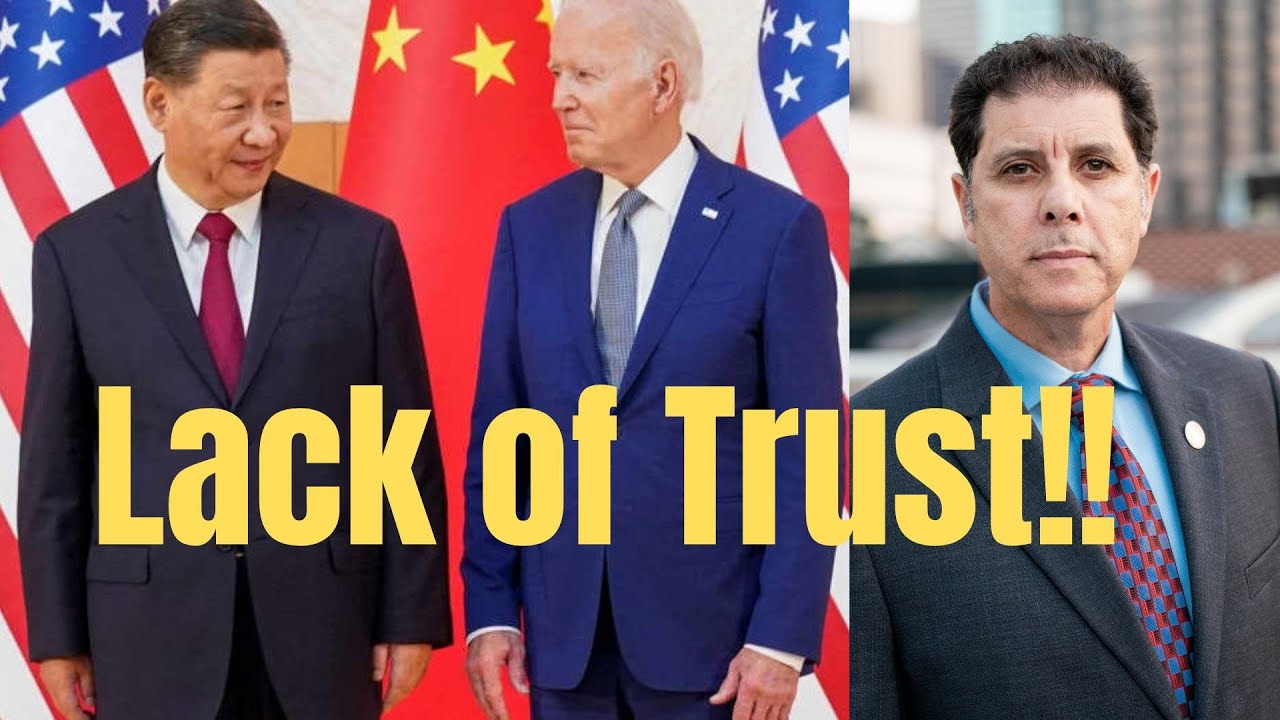
David Oualaalou breaks down the November 2022 Biden-Xi summit in Bali, calling it a photo-op with no real results. The core tensions: Taiwan and semiconductor exports. He questions whether U.S. competition with China could tip into conflict, and whether a 2024 Republican victory would shift American hostility toward Beijing.
Chapters
Hello everyone and welcome to Geopolitical Trends. My name is David Oualaalou. So good to be with you as always. President Biden and President Xi met yesterday. Was that meeting just a photo op or was it something of substance? In this video, I am going to provide you some insight as to how I personally evaluate or assess what that meeting was all about. But before I'll do that, please subscribe if you have not done so, and of course hit that subscribe— that notification button so you will be notified every time I upload a video. I also want to take this opportunity to give a shout out to two of my viewers. One of them is Bill, and the second person is a Secret Fountain of Youth. Thank you so much for your Super Sticker. I appreciate it and it means a lot. So let's dive in into the meeting between President Xi and President Biden. Well, of course, it took place yesterday in Bali. This was a day before the beginning of the G20 summit. So there is a lot of— some analysts are saying, you know, don't expect much from the meeting. I was one of those saying this. Not that the meeting now it took— it's over, but it was evident given the circumstances, given what's going on, given the tensions, economic that is, between the United States and China. And this is what I'm gonna just provide you some insights into how I see it. So the two leaders, of course, spoke for about 3 hours in Bali. In Indonesia, that is. And then they covered like a host of a range of issues. I had a chance to read the transcript issued by the White House, and of course the language of it is a little bit, uh, shall we say, uh, not, uh, straightforward, if I may use the term. So for example, and I'll give you as an example here, President Biden Uh, like the quote he said, and I quote here, the US— let me get the quote correctly here— the US will continue to compete vigorously with the PRC, including by investing in sources of strength at home and aligning efforts with allies and partners around the world. End of quote. Well, you can just see what the meaning of something like this You know, especially given that the competition that the US will have to embark on with China. Yeah, because China is moving forward. You all know what happened with the chips that now it's been some, uh, the United States imposed sanctions on that. So, but here is the question that you need to ask, because those are common questions we need to ask. Will this competition sort of veer into conflict? Could it create a conflict moving forward? There are those who said possibly, others said no, not likely. But this is where I say, like I said last time, uh, that you're gonna have to be looking for the trends in the next 5 years as to what's gonna be happening between US and China relations. Given that now with the outcome of what just happened in China by having President Xi granted third term, but also in the United States by having now Democrats secure the control of the Senate. So those elements will play a role into defining what kind of relationship should we expect moving forward. So the US and China, in my opinion, will have truly to manage this competition responsibly moving forward. Why? It's because it will benefit both countries, but it will benefit the world for that matter. I'm sure you just saw the video that I released today about the possibility of India and China displacing the US as an economic power. It is the possib— it's not the possibility for that, the trends are headed that way. So usually people in Washington, politicians that is, do not like to hear the truth. And that's unfortunate. So, but here is the thing. They are, you know, despite what you're gonna be reading about in the newspapers, if you read the newspapers or online or whatever that is, you know, there are only two key issues that you're gonna— that mattered during those conversations. And by the way, the White House said that they will share the briefing notes with Taiwan. Which breaks protocol because usually when there is a meeting between two heads of states, this kind of talks or the talking points stays internally. And the US, for the US doing this, I don't know who's advising the president on this matter by saying, well, sure, you can share the notes with Taiwan. No, no, no, no, that's breaking protocol. China already made it clear That would not be a wise thing to do, and rightly so. Taiwan shouldn't know what the conversation was all about. That's plain and simple. But also, this gives you an idea about the two main issues, and I'm gonna focus on those. The one— first one is Taiwan, and second one is technology. Those are the key, because here's the thing: during the meeting itself, Biden, President Biden and President Xi literally did not sort of resolve any key issues, like, for example, the tariffs that the United States imposed on China, the trade issues, you know. And this is why I'm coming to the conclusion that the meeting was of no substance. It was just a photo op. The rest of the world was looking at because of G20 summits, of course. But here it is, President Xi and President Biden meeting, but it didn't result in anything whatsoever. So because the disagreement between US and China persist, we're still having the issues of Taiwan and we're still having the issues of trade. Simple as it is. And you all remember only last month, 3 weeks ago or so, the United States imposed a dramatic export ban on certain advanced semiconductors technology. You know, this is considered as trade sanctions, basically, you know, and this basically, it's aimed at one thing and one thing only, is to hobble critical technology sectors like the space industry, like the military modernizations, like artificial intelligence and so, and so forth. And those are key elements or sectors that is in the economy in China that is of great importance. So, but again, if the both leaders didn't converse over these issues, then what's the point? You know, so to me, that's how I see it. On the issue of Taiwan, I found it very interesting that the president did say during the meeting that US recognized the One China policy, you know. But that's what he said. But in practice is different. You all remember a couple months ago how many US lawmakers went to Taiwan. I remember mentioning last time about the Taiwan Act, which was passed in Congress about selling weapons to Taiwan. So Taiwan issue will remain for the foreseeable future as the, uh, the key point of tensions between the US and China. Because we all know what the red line is for China. So why are we playing dumb with that? And why are we provoking China for that? You know, Taiwan's not gonna declare independence. Do you know what the outcome is going to be? Do you know what the consequences are? You know, there are two red lines, two red lines that China will not waver on. One is if Taiwan declares independence, which we know it's a no-no. And second one, if the US starts sending missile systems to be placed on Taiwan territory, because those are not for Taiwan to use. Those are for the US to use just in case a conflict breaks out. Those are the two red lines that China will not waver from. I believe, and this is my personal opinion, that China will embark on a military venture to just sort of put an end to this. This is where I see it going. So, but I found very interesting a comment from the representative of the Foreign Ministry, a spokesperson who accompanied President Xi during his meeting with President Biden. And because he was— I saw it in a tweet, and what he said was, and I quote here, let me get the quote: 'The world is big enough for the two countries to develop themselves and prosper together.' End of quote. Makes perfect sense. This competition and conflict is not gonna result— is not gonna bode well for anybody, you know. We all share one world, you know what I mean? How about that concept of live and let live? You know, it's kind of that era. Yes, the world is changing and sort of the West needs to change with it, you know. And this is why I'm saying Taiwan will remain that issue. This is why even President Biden said, uh, he stated that there is no imminent attempt on part of China to invade Taiwan, end of quote. You know, well, he said this to basically to— this is just for media consumption. Yeah, it's a different conversation behind closed doors in Washington. I tell you this based on experience as one who worked in Washington. So, but what you give the president credit for is that he, President Biden, that is, that that he declared the possession, that is, as US still confirmed US possession as to One China policy. So you give him some sort of a credit for that one because that's very, very important to understand. And bears, here is the thing. Last year, and I remember this because I was following on it, last year the Chinese Foreign Minister, Mr. Wang Yi, you know, put out 3 core demands, as they called them back then, the bottom lines, you know, that China wanted the United States to agree to in order for the relationship sort of to improve or move forward. So one is to not get involved in the way of China's development. 2 is to respect China's claim over places like Taiwan. And 3 is to respect Beijing's Communist Party rule. You know, those are basic demands. You know, whether the United States will sort of agree to that, well, that was almost a year ago. So you can just see, obviously the US didn't. Otherwise, why are we keeping provoking Taiwan? Oh, or China, that is. Using Taiwan, because Taiwan is being used into this contest. So this is why I am coming to the conclusion that the meeting was nothing but a photo op, no more, no less. It had no substance whatsoever. So I just wanted to share this with you before you start reading headlines online or paper or magazine, whatever that is. Well, the meeting was this. No, no, it had nothing of substance to it. To it. So, so here's a question for you for today: should China worry if Republicans win the presidency in 2024 that the US will take an even more bluntly hostile position against it? Let me repeat this: should China worry if Republicans win the presidency in the United States in 2024 that the United States will take an even more bluntly hostile position against China. Make sure to let me know your thoughts, and I would love to read your comments. As always, remember, geopolitics impacts your daily life in more ways than one. Till next time, guys, bye-bye.
More from David


Beyond the Single Actor: Why the Gulf Isn't Choosing Between the US and China


Iran, Iraq's Militias, and the Houthis Are Coordinating! This Changes Everything




Who Controls the Next Decade's Resources? Latin America and Africa's Geopolitical Crossroads

The Chokepoint Trap: How Washington's Stupidity Triggered a Cascade That Now Controls the World

Trump Spooked as IRGC Unveiled dual-use SLV, Deployed Ghadir Mini-Subs & Hinted at Tactical Nukes!
