Trump: $20B to Argentina while America Crumbles! Geopolitical Trends
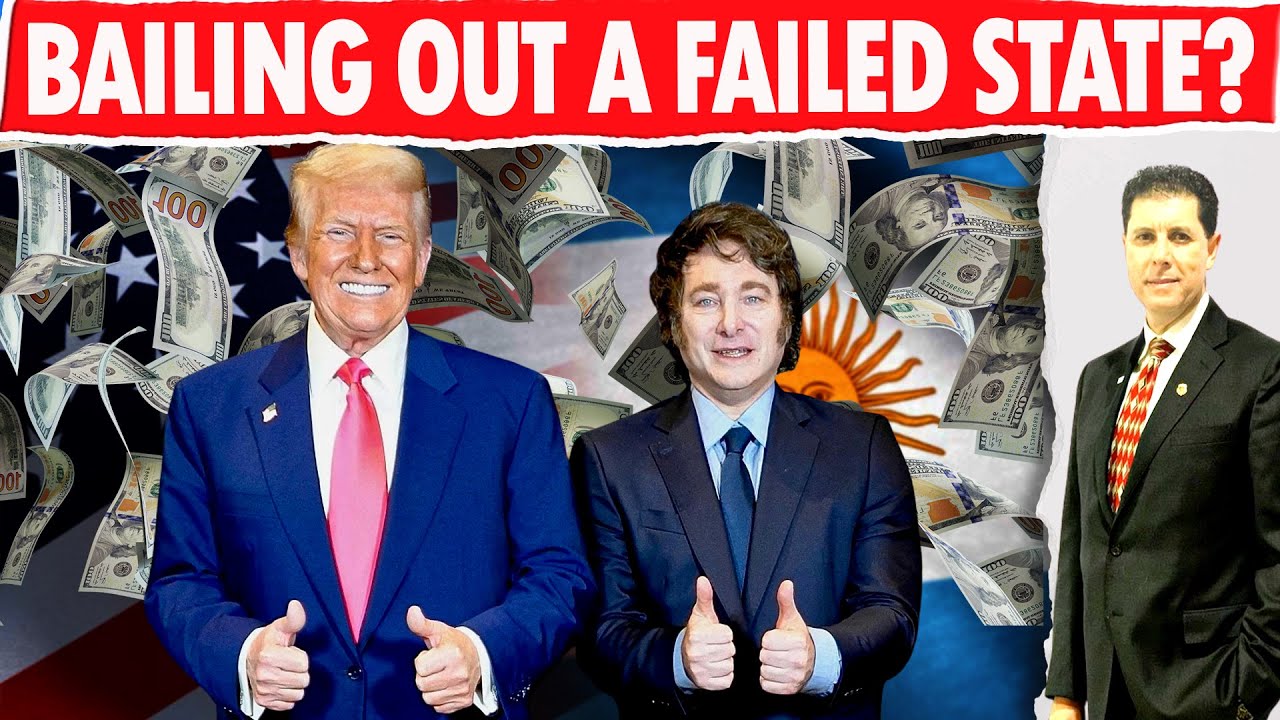
This content was created by David Oualaalou. This content was uploaded by David Oualaalou. This is a YouTube livestream titled "Trump: $20B to Argentina while America Crumbles! Geopolitical Trends" (published October 1, 2025) from the Geopolitical Trends channel. The video is a single-speaker political commentary/live analysis in which the host addresses a proposed US $20 billion support package for Argentina, critiques US foreign policy (with strong criticism of Donald Trump, Treasury officials, and Javier Milei), and situates the bailout in broader themes—Argentina's geography and history, IMF involvement, US–China competition in Latin America, impacts on US farmers, and related topics such as AI censorship. The stream includes audience chat interactions and the host reads an excerpt from his book on US interventions in Latin America.
Chapters
Hello everybody and welcome to Geopolitical Trends, where truth matters. Excited to be with you on this October 1st. Oh my gosh, where time goes. Uh, have an interesting topic for you. It's what's going on with the US preparing a $20 billion bailout for Argentina. I mean, just take a step back and think about it, especially for my American audience. You all know what it means. We're going to be bailing out, uh, you know, a dysfunctional government while at the same time the US is crumbling economically and otherwise, socially and so forth. So this is what I'm going to be addressing for you in this live stream. I'll provide you my own analysis about what's really also at the heart of it. But before I do this, let me say hi quickly to our wonderful community. Lian, good to see you. Azhar Idris, I haven't seen you for a while. Hope all is well. Good to see you. JJ, good to see you. It's called money laundering. That is correct, that's part of it. Willie Holman, as always, truth seeker. Good to see you, Bobby. Hello to you as well. Uh, if, if God don't, Carlyon, good to see you. Salaam to you as well. Athene Wu, here you are. And Army with Harmony, good to see you. Very, very excited. Uh, by the way guys, I want to just some housekeeping items here, uh I am working on, uh, two more stories. I know one was from what I mentioned earlier, but the recent one that I really needed to— I've been thinking last night about it, and I got an email, uh, from an avid supporter, uh, regarding what's going on with Donald Trump plan for Gaza. Yeah, if you believe that Donald Trump is for peace, you are mistaken. So So I've been thinking about it, and most likely we'll do this for you before, uh, October 5th, because I will be off the air for a while. I have to leave the country, and you most likely— I might do live stream for you from whatever location I'm gonna end up at. Nothing sure yet, but I will— you will, you will know, you will know, and I'll communicate with you. So that's one of the topics I will be addressing for you between now and then. I'm also working on the second topic regarding Iran. Very, very interesting developments. So what I'm gonna do in this live stream, like always, I'm gonna be provide you the first part of the analysis. I'll do geography and history because you need to know about the history of Argentina, which is a good way. I, I think I'm, I'm assuming the community enjoys listening to the history and also learning about geography. It's very, very important. And that's how I've always felt about doing the conversation with you here. Then I'll move on into the second part of my analysis as to why and what's really at the heart of this move by the United States. And eventually I'll see at the end if there is any question from you. I will share with you an excerpt from my book in which I addressed about Latin America and the US dark secrets in Latin America back in the '70s. So I'll be sharing an excerpt with you, but I'm gonna do headlines for you. I have about 2 or 3, I think 2. So we start with the— once again and again, this is why I'm gonna be doing the topic for you, because I feel you guys need to know what is going on with Donald Trump's plan. Now, Trump plans, let me just say it straightforward, It's nothing but a new colonialism in Gaza, straightforward. There is no ifs and buts. What the shame— here is where the shame to me, where the most of the shame of them all. Shame on the Arab leaders who sat down with Donald Trump during the UN Assembly General Summits or meeting, whatever it was. Remember, there were some Arabs who sat down with Donald Trump, they are agreeing to it, except Qatar saying, oh, we need to read more about this particular plan. But deep down, they're okay with it. That's, that's— they are as corrupted as it gets. But suffice it to say for now that the US-Israeli plan, because Netanyahu is not considering any peace whatsoever— I had a conversation yesterday with a good friend of mine that happens to be Jewish And he's of the view that, you know, we don't care for what Netanyahu thinks or wants because he's going against what really the Jewish people want. And Jewish people don't want this chaos that is going on. So this US-Israeli plan for Gaza, it's nothing but a neocolonialism. And think about who the US wanted to appoint to manage that. None other than the criminal Tony Blair. So So to me, I look at it as one of the analysts from Britain mentioned it, colonial deception, because that's what it is. That's what it amounts to, is the continuation of the Palestinian suffering under new guys. Simple as that. And this is why I'm gonna do, uh, this for you in more detail to provide you, uh, uh, sort of a better, uh, understanding, if you will. And I'll address the history part of it as well. Second one has to do with AI in America. You know, you know, I'm laughing. I'm laughing because even AI itself here in the US— I'm talking about the US— is already structured, you know, or, or programmed— not structured, programmed— in a way to avoid the truth. So my reference is to this particular aspect of why Google is preventing AI from answering some fundamental questions. One of them has to do with Donald Trump's mental health, you know. So Google has banned artificial intelligence now, so any enhanced research results for this question specifically about Donald Trump's mental health. There are articles out there mentioning about dementia taking hold of the guy's brain. But again, I am not qualified to assess, or I don't— you know, I read. But to me, when you start having so-called AI limiting the answers— so because here is what happened when you put the question, you know, Does Donald Trump display signs of dementia, or does Donald Trump have dementia? You know, instead of displaying the answer, AI answer is usually— which is the usual search engine, uh, what it's doing is displaying 10, about 10 links related to the topic, not answering the question, it's just related to the topic. So, so the message that appears indicates that AI mode is not available for this question, and that it tells you right there where the story is. So, so the whole AI— this is why I argued a few weeks ago that who's going to develop the best AI model, mainly between the US and China. China is already taking a sort of strides in this domain. This is why the rest of the world is moving towards the AI models in China, not the US. In addition to having the US system, the AI is closed, but China is not. This is where the difference is, and you can— this is an example. So anyway, just wanted to share this with you as a headline. So So let's move on to our conversation today about, uh, about Donald Trump preparing, uh, you know, what a, what a, what a joke, what a joke, you know. And by the way, if you go back on my channel here, go back to December 2023 and, and, and January or February 2024, I did two videos regarding Javier Milei And back then I argued this guy is going to drag Argentina even down, even further into more economic chaos. And here we are. And now Donald Trump wants to give $20 billion out of our tax dollars. I will have no problem with spending the money here at home. You look at again, I'll give example because it's worth it. Look where China's spending its money, you know, and we're gonna give $20 billion to, uh, to a lunatic country. That's what it is. So, so the question becomes, it's, what is wrong with this picture? Everything possible. As the US now plans to extend this $20 billion swipe line to Argentina and is ready to buy the country's born bonds, you know. Basically, we are buying the elections in Argentina because we wanted to prevent certain outcomes, and I'll get into that as I move forward. And their argument, meaning the Donald Trump administration's argument, is that, oh, we need to provide much-needed financial support for Javier Milei as he tried to regain investors' confidence. And of course, because what happened to the peso— went down completely. And of course, there is no deals as far as the, the terms of the deal. Americans, it's our tax dollars, and we don't even know how it's going to be spent. You know, system is corrupted beyond belief. So to my American viewers, you know, let this be a lesson, another lesson. It's almost like Some of us Americans have been brainwashed. So why will I even go and spend $20 billion to, to bail out another country when the country needs money here? So, and here is what, uh, uh, uh, Bessant, the Treasury Secretary— another corrupted individual anyway— he said, and I quote, I think the market is looking in the rearview mirror and looking at decades, about a century of terrible Argentina mismanagement. Oh no, I will care less because it was Argentina that dug itself in the hole by sort of borrowing money from the IMF. I was aware of the case of 1986 when Argentina went ahead and get a bailout from IMF. What do you think IMF is going to do? IMF put some restrictions on the economy in Argentina, including the austerity measures, which by the way, the idiot Milei, that's what he ran on. Oh, I'm going to tighten the economy. And he went ahead and cut down into the pension of retirees. And what do you expect? The country is not going to move forward that way. And this is exactly where the problem of Argentina is. So, so I'm gonna do geography, I'm gonna do history, then I'll continue my conversation about the, uh, uh, what's going on with Argentina. So let me share the map with you, and I give credit to World Atlas as always. There is the map here, let me make it bigger for you. So Argentina, very, very interesting a country as far as its location. So Argentina is considered one of the largest, uh, uh, country occupying the southern part of South America. So it's considered a large country for the, for, uh, the occupation of the, of the landmass. That is, it is positioned in the western and southern hemispheres of the Earth. Argentina shares its borders with 5 countries. First one is with Chile and the Andes mountain range to the west, with Bolivia to the northwest, with Paraguay to the north, with Brazil to the northeast, and with the Uruguay to the east. I remember when I traveled to Bolivia, I when I was in the government. So I had to go to La Paz, and, and I was asking the locals as far as, you know, how things are with Argentina. It's like, it's not good, it doesn't look good. So Argentina is also bounded by the South Atlantic Ocean to the east and the Drake Passage to the south. So this is why it's important to understand the geography of Argentina, to understand it. Because it'll give you a better perspective into understanding how this geography impacts its political, uh, decisions moving forward. Now, when it comes down to history, the history of Argentina— I will be sharing some pictures. If I recall, I have one from— this is Juan Perón, and I'll talk about him as I move forward into the history. Now, one thing you need to— pardon me— one thing you need to understand about the, the history of Argentina, and it's disclosed in the record, so, is that it include sort of the indigenous cultures that exist back then, which followed, by the way, the Spanish colonialism, which started— does anybody know which, which century the Spanish colonialism started in Argentina? Or Argentina, that is Latin America writ large. Let me see if any of you familiar with the history of Argentina. Uh, which century does the Spanish colonialism— oh, Alistair Loken, you got it, is the 16th century. That is indeed Indeed, in the '16, Taiwan still '18, comes later the British, but for the, the first one for the followed by Spanish colonialism, which started in the '16. So then comes the formation of the Viceroyalty of the Río de la Plata, the Viceroyalty of the, of the La Plata, which was in 1776. One thing you need to understand about the, the viceroyalty, uh, what is it? It's, it's the territory, the office, or the term of advisory. Viceroy is a representative of a monarch or ruling a territory or a province on their behalf, on behalf of the monarch. So, and in the context of the Spanish Empire back then, because you gotta remember how far the Spanish Empire was expanded, extended around the world, the, the viceroyalty was a vast integrated territory ruled by a viceroy. Viceroy is the representatives who exercised extensive power and was considered direct representatives of the Spanish crown. This is one thing you need to understand about these particular aspects of the, uh, viceroyalties. So now, independence was declared in 1816 for Argentina, leading to a period— or Argentina, that is— leading to a period of civil wars between centralists and Federalists. And that was before a unified Argentina's Republic, which was established in 1862. Remember, it was the independence of 1816, but the unified Argentina took place— a Republic, because that was the name that was given, the Republic, La República de Argentina, Argentina's Republic. It was in 1862. And in the early 20th century, it saw some sort of an economic growth, and this one was driven by European immigration. Because remember, even members of the Nazis fled to Argentina. It's well known, it's not a secret. It's— they were members of the Nazis that have fled— to Buenos Aires. And in the late 20th century, it was, first of all, the European immigration that has sort of helped with the economic growth. It was only one problem, is that the Great Depression that took place and the coups that happened frequently, not only in Argentina, but in other Latin American countries. And these coups led to the rise of none other than Juan Perón. And let me share the picture with you. Juan Perón, this is a picture of him taken back in 1954. I looked at it in the record for historical record and his populist movement. And in the late 20th century, this has to change for Argentina. Was marked by a period of military dictatorships and the human rights abuses of the Dirty War. I will be talking about the Dirty War in reference to the Falklands War between the UK and Argentina. So, and that one of course later on followed by so-called, uh, a return to democracy after the Falklands War. But it behooves us to understand at least how Argentina used to be prior to 1810. Why is that? Because that is the pre-Columbian and colonial eras. Those are very important eras in the history of Argentina. This is where the indigenous people came in before the Europeans arrived. You know, Argentina was inhabited by various indigenous groups that including the nomadic hunter-gatherer and the sedentary agricultural societies. And I'm not going to get into the depth of certain— because there are so many types of indigenous groups, uh, just because I want to give— keep this brief to you. Then comes the Spanish exploration and colonialization, and the Spanish explorer reached the Rio de la Plata back in the early 16th century, as we mentioned earlier. And the first attempt, the first attempt to establish Buenos Aires was back in 1536. That's when there was the first time, but permanent settlement was found till later on, on 1580. So, and that's again where this Viceroyalty of the Rio de la Plata came in. So, like I mentioned earlier. We move to the second era of the history of Argentina. That puts us between 1810 and 1880. This is where the nation building and the formation of modern Argentina started to take place. And this started with the independence movement. You go back to the May Revolution of 1810. That's when it happens. And where it happened? It happened in Buenos Aires. So, and that in itself, this particular revolution, this independence movement and this revolution started what was known in the historical record as the independence process, and that culminating into the Declaration of Independence on July 9th, 1816. 16. So remember, there was still the Spanish influence in that part of, uh, the world. And that's where you had that struggle between federalists and centralists. It's no different what we had in during the formation of the United States. And I used to teach the course about the U.S. government structure when we had the federalists and anti-federalists, which is in a simple term are nothing but a reflection of today's party, Republicans and Democrats, two parties that, you know, not good for America anyway. So, but we all know the system was set up by design to prevent any third party from even emerging in America. Argentina, Argentina experienced this struggle between the federalists and the centralists. And after the independence, Argentina was torn by the conflict, internal, that is. And the conflicts were between those who favored a strong central government. It's no different than what we have. Those are the centralists. And those who supported provincial authorities, those represented the federalists. Same setup we had here during the beginning of the United States. Then come, uh, Juan Manuel de Rosas. Now, he was a powerful governor and strong man. Rosas dominated politics in the mid-19th century in Argentina, leading to conflicts before his rule ended in 1852. That's when his rule ended. And that, after that became the beginning of Argentina's Republic, República, or the Argentine Republic. So, and this is where the federal continuation was established in 1852, because that was during the same time where the conflict started. So, and the unification of Argentina's Republic was formed in 1861. And their president Bartolomé Mitre. I was back then. This leads us to the era from 1800 all the way to today, or present time. And this, in the historical record, was— and I'm going to share the links with you later on for you to read all the details— was marked under what's known as modern Argentina. So this one has to do also with the growth and the immigration, because remember A lot of Europeans have migrated, or immigrated rather, to Argentina. So 1880 marked a period of relative, uh, stability inside the country. However, this era saw a rapid economic growth fueled by liberal policies and mass European immigration, primarily from two countries Spain and Italy. So once again, the reason I'm sharing this with you, to highlight to you that when there is stability socially and otherwise, economic growth follows. It's exactly what Argentina— by the way, I, uh, when I was in Washington, I used to, uh, there were some elderly people I worked with, they've been in the government forever, and some of them were stationed in Argentina back in the day. I asked them I said, how was Argentina back then? He said, yeah, it used to be like Paris. Buenos Aires used to be like Paris of Latin America. So it's same apply to Iran, by the way, how we used to be back then. So then come Juan Perón, you know, this guy here. This is known in history as Peronism. Juan Perón rose to power in 1940. And during his tenure, he implemented policies that benefited the working class and established a strong state rule. And this period was known inside Argentina as Peronism. If you mention Peronism in Argentina, they will know what you are talking about. What came after him is the military rule— and what's so now— what's the so-called the Dirty War. During this era, Argentina experienced some sort of several military coups. And I'm going to share at the end of this livestream an excerpt from my book highlighting some of these aspects in that part of the world, during which now thousands— because what happened during this era of coups and so forth, it was a period of extreme violence. That took place, and it was from 1976 all the way to 1983. What does it mark? It marks also the involvement of the United States in that part of the world, the whole Latin America. Because I recall, for example, in the '80s, I recall when money was funneled from Iran into the Sandinistas when Reagan was in, in power, because Reagan wanted to fight the communist Sandinistas, so we got a deal with Iran for selling them weapons in return for that money. That money didn't come to the US, it went directly in support of the Sandinistas. So the violence, the extreme violence that existed at that time in Argentina wasn't limited just to Argentina, it was in other countries— Colombia, Venezuela, Bolivia, and what have you. So all that era And it also marked because the dirty work, the dirty war rather, marked also the thousands of people who disappeared. It was the disappearance of people during this era. And of course, it was a very, very, very tumultuous time for Argentinians. And to those who are familiar with the history, you know what I'm referring to here. So Then come the era of so-called return to democracy and economic challenge. However, the defeat of the Falklands in 19— does anybody know what year the war started between the UK and Argentina, the Falklands? Let me just see. Once again, this is just for knowledge, no more, no less. Just like you to be part of the conversation. What year did the war between Argentina And the UK started over the Falkland Islands. Uh, Matt Becky, you went too far a little bit because the defeat— yeah, 1982. Soja, you're absolutely correct. Ontago, you were right, 1982, you're absolutely correct. That's when it started, the Falkland War, which led to the sort of the fall of the military regime, and that's where the system has changed. And by the way, let me just, uh, share— and I'm going to share a link with you here regarding the, uh, the Falkland, uh, uh, war. Let me copy the link and put it in the chat box for you, for those who wants to read up a little bit more on this. I thought I had— yeah, I had a picture. By the way, this is part of the, uh, historical record, the Black, uh, historic record of the Spanish, uh, colonialism in Argentina. And do you see the role of a priest here? Once again, because one of the mechanisms by which Spanish were able to push through is through religion as well. Because if you recall, uh, throughout history at that time, there was this strong conflicts between France, Italy, and Spain, because those were powerful at that time. And one of the rules had to do with the religious rule. The Pope had so much say into the political dynamics in France and in the UK, you know, and in Spain. So Argentina didn't escape that either. This is why Catholicism, it has a strong presence in Latin America. So for you to understand the war of 1982, and of course that's, as I said, known in the Argentinian, or Argentinian history as the Dirty War. So, and the territorial disputes between Argentina and Britain over the Falklands led to the Falklands War in 1982. Argentina was defeated. So, and of course, that's when Margaret Thatcher sort of, with support from Reagan at the time, they said, we will fight the Argentinians. And so I remember her speech. At that time. So, and thousands of Argentinians were killed into that, uh, war. So, and after that, he witnessed the first female— this is Cristina, is Cristina, uh, uh, Kirchner. Uh, this is the first female president in Argentina in 2007. She had some dirty, dirty stuff, corruption as always. Some Argentinians voted for her and support, but again, that's their country. They can decide whatever they want. So, all right, liking this video so far? Don't just be a watcher, go ahead and hit the like, share, and subscribe button, and don't forget to tap the bell so you will not miss any of my videos or live streams. This way you will be supporting the channel that stands for the truth and objective reporting. The choice is yours. Thanks for your support. Indeed, thank you for your support. So, so let's get into our second part of the analysis here. So, Malay, Jafir Malay, it's, it's, it's— I, I don't— when he was running for office, you know, I read up on him, his background as an economist and so forth. But I see this is not going to work for Argentina back then. So, and again, I'm— I wasn't just, uh, you know, I based it on a historical record. That is exactly where I'm gonna try to locate, uh, Argentina. I'm gonna try to locate the video for you, uh, if I can share it, uh, on the screen. Or yeah, I have one in May 2023 and one in February 22nd. So, so let me get the link to that and I'll share it with you for those who you might not have seen it, but that was back then. And you'll see what I argued back then is exactly what is going on, uh, right now with Argentina. So, uh, now Jaffer Meley, Jaffer Meley we were promoting him as a free market reformer. That's why, because remember, the push for his elections was done by the United States for political reasons. And of course, now he's facing some serious mounting financial pressure. And this didn't happen yesterday or the day before. This has been going on now for 3 weeks. So I didn't want to address it earlier on because, again, you know me, guys, I don't rush into addressing stuff till I gather my own facts about the topic. And this is where you start to have— his party, by the way, lost a key Buenos Aires province or provincial elections by a landslide. That's a clear and loud message to his party, which was some sort of a bad, bad indication or signal or omen, whatever you want to call it. Ahead of the congressional elections. This is where this whole issue— and Trump is trying to push that narrative, oh, we want just to support his election. Why? Why will send our $20 billion for when we can fix our own crumbling economy right here at home? You know, to the American administration, Trump administration, he's like, wait, the defeat of Mali will create more problems. No, it won't. It creates problems for them, and that's their country. You know, does anybody come over here and help us out with the issues we have? Because we have a corrupted government that is incapable and incompetent of coming up with really structural economic policies that will benefit the average American citizen. And I always give that idea, that analogy of the elderly, an elderly person standing in his or her kitchen, okay, holding, holding, uh, medication on one hand and opening the fridge with the other hand, you know. And he or she asking him or herself, do I buy medication or do I buy dinner? There is no food in the fridge. So an American senior citizen shouldn't be in that position. Because, you know, you think about it, that could be your mom, that could be your dad, your grandpa, your grandma, your aunt, your cousin, or whomever, you know. And yet we call ourselves the richest country, and we're turning around and sending $20 billion out of tax dollars. Because where that money is going to come from? It's the taxpayers that's going to bail them out. Why? And I'm sort of struggling with understanding the logic of Donald Trump doing this. So, and this Donald Trump arguing of the fear that Milei might lose the elections. So, and this way he will not be able to sustain his friendly reform agenda. Well, his friendly reform agenda is not working for Argentinians to begin with because the inflation is so high in Argentina and the currency is not stable. This is part of the problem. And when you have, uh, what's his name, Bess, the sec— Treasury Secretary, you know, yes, he's a millionaire, billionaire, whatever that is, you know, the guy is like a lap dog for Donald Trump, you know. Of course, that's what Donald Trump wants to surround himself with, you know. Those are not qualified individuals. When you cannot challenge the leader, then you shouldn't call yourself you know, qualified because you know deep down you are going against the truth. So when Bassin saying, oh, this bailout is just nothing but a bridge to the elections, once again, what this has to do with us? What this has to do with the welfare of an average American citizen who is now struggling economically? People here in America— let me share this with you— I know some, not all of course, I know some, they are struggling to have enough money by the end of the month. Some of their essential bills are not paid. They carry on till the next month. So why should I support sending my tax dollars to Argentina. And this is, again, you know, doesn't make sense to me. We're gonna support in Argentina while America crumbles economically and otherwise. It was a great article by, uh, Joy, uh, Windermere, uh, really, it's asking the key question: why Trump wants to help Argentina Despite America First agenda. Very, very great article, and I read it. It's, it's spot on. So because the idea of us supporting Milei, a guy whose radical economic ideas further drag Argentina into the hole. So, and by the way, as I mentioned earlier, the IMF loan that Argentina got in 1986 has not been paid yet. So, so, but all this has nothing to do with Argentina, has nothing to do with us. We care about Argentina. This one has to do with China because the US want to challenge China, given what's going on between Argentina and China, or what's going on with China in Latin America writ large. Yeah, between Peru, Venezuela, and Brazil, and Bolivia to a degree. So, and this is where one of the issues why we wanted to do this. So, so when you think about Argentina's now central bank temporarily lifting about 26% of the export tax of the soybeans because now the farmers in America are pissed at Trump because of what the tariff end up costing. Do you guys know how many farms are going bankrupt here in America, especially in the Midwest? Of course they're not going to disclose. They are not going to disclose the truth. So, so this is why this so-called assistance or bailout for Argentina has not gone over well with the farmers in America's heartland, because those farmers in the heartland have been railing from Trump's tariffs sort of fight with the Chinese, because China used to be a big market for our farmers to send the soy. China said thanks but no thanks, we'll get it somewhere else. So, and that's why you have representatives in Congress now, you know, asking the same question I'm asking, you know, why are we bailing out Argentina while they, meaning Argentina, is taking the soybean produces and sending it to other countries? So it just doesn't make any sense whatsoever. But deep down, it highlights to you the strategic importance of Latin America. I'm not going to say just Argentina. And why is this all of a sudden? Is because the presence of China. This is exactly what is going on with this. Let me, let me share the link with you, uh, if you want to take a look at it later on. You can read it when you have time. And that is part of this problem. So when, when Bazin's saying, oh, we're gonna just issue a swap line, basically what we want to do to Argentina, we wanted to keep it down. We won't allow any economic overture of Argentina with other countries, mainly China. That is what's at the bottom of it. My, my beef with all this is Why use my tax dollars for? Yeah, you want to do this, Trump, go ahead and use your own money. Why use my tax dollars for? And this is exactly where part of the problem. So, so when, when Donald Trump is saying, well, we're going to support Malay for the elections— no, no, no, no, no, it's nonsense. It's nonsense. Because now the government, US government, or Donald Trump's government, that is, they are arguing Here is what we are thinking about the strategic stability that include some key aspects. One of them has to do with preventing an economic crisis. Why? Because Argentina's economy is unstable and now you have a higher inflation and the pesos is going down. That's like a recipe for disasters to come anyway. So this is why one of the elements of this so-called reason why we want to do it. Second one is to counter the rivals of the United States in Latin America. They didn't want to disclose the name China, but that's what they reference to. Who else is in Latin America creating infrastructure, building infrastructure, helping the economies, improving the livelihood of some Latin American countries? There's only one country, China. And this is why they're arguing, the US government arguing that this move is a part of a broader strategy to solidify US influence in Latin America to counter the rising presence of Russia and China. No, that's what's at the heart of it. But again, why do you use my tax dollar for? And the third element is to enable investments. Whose investments? Argentinians? No, it's the Americans, because that's exactly where this part of this IMF loans and all this, you know, who's benefiting from it? It's not the local country or the local citizens, it's us. This is why when you think about Africa pushing against IMF, because IMF reached out to African countries, we'd be happy to help you and bail you out and so So, and they're saying, no thanks, we're not interested. And this is why the details of the, of the deal has not been disclosed yet, because they will leave room for maneuvering if depending on how the reaction of the Americans will be. But again, most Americans are oblivious to what's going on. They're not going to pay attention to this stuff. When you consider the criticism and the controversy of this particular approach to using our tax dollars to bail out another country while ours is crumbling, going down before our own eyes. So, and that becomes the issue to those who are against this particular deal, the political motives aspects of it. So they are arguing that this aid is politically motivated, and rightly so. Why? To prop up now the US ally, because Haftar is an ally of Trump. So effectively using taxpayers' money, this is again where the problem is. Yeah, if the government, the US government wants to, they can do it somewhere else or through some other means. So And once again, one of the key aspects to this, which the media here is not disclosing, is the impact on the US farmers. Big time, big time. I'm gonna share a link again to show you where you get a chance— if you get a chance to read it, you'll see, uh, disclosing with charts and all that. And that's exactly where part of this problem is. So I'm gonna share my clip— my, uh, sorry, my, uh, excerpt from my book then I'll share with you and I'll conclude with this one here. So here is what I wrote when I did my— it was in a Russia book, when I did the Russia book because I had to address Latin America. So what I wrote back then is that in Latin America, how could we forget the images broadcast on CNN, BBC, Al Jazeera of the failed coup orchestrated by Juan Guaidó— whom the Trump administration vehemently supports. It is mind-boggling to think about the US support of Guaidó as the legitimate president of Venezuela without the latter winning legitimate elections, let alone a presidential one. Talk about contradictions. While addressing the US involvement in Venezuela,— and Latin America for that matter, it is a fascinating topic. Let history be our guide as to what took place in the 1950s through the 1980s when the United States engaged in a policy of regime change that resulted in the rise of dictators of all sorts. The United States did many things in Latin America. At the same time, it has bloodstained, it has bloodstained record of supporting coups and dictators across the Latin American region. Somoza in Nicaragua, Pinochet in Chile, Stroessner in Paraguay, Batista in Cuba, Death Squad in Honduras, which is an armed group that conducts extrajudicial killing or forced disappearances of persons for the purposes of political repression, assassinations, torture, genocide, ethnic cleansing, or revolutionary terror. And of course, genocide military dictators in Guatemala. For now, suffice it to state that the turmoil in Venezuela— remember, I wrote this back then and even today. The turmoil in Venezuela has two specific objectives. One is geopolitical, suggesting how Russia can intervene anywhere in the world, including in the Western Hemisphere. Two is that Russians perceive Putin intervention in Venezuela as a sign of strength, thus sending a signal about restoring USSR glorious days back in Latin America. As of this writing, Maduro's government announced that China and Cuba will send about 933 tons of health products to Venezuela. As a matter of fact, China recently sent 71 tons of medical aid to Venezuela, a clear sign of Beijing's support of Maduro and a rebuke to Washington. Interestingly, not only Russia and China but also Turkey, Cuba, and Venezuela are throwing their weight behind Maduro. It indicates the shifting balance of power. However, Russia's involvement is of great interest to us in this war. Moscow's support for Caracas is not limited to speeches delivered by Putin but is also manifested through actions such as sending troops and military hardware. This is what I argued back then. And again, takes us back to the beginning of this livestream when we asked the question, what's in it for us? Why are we billing our tax dollars to support a failed state? To me, Argentina is a failed state, not in the terms the likes of Libya, the likes of some other entities, Sudan, or Somalia, but even those countries now they start to push towards some sort of standing on their feet. Then my question is, you are prioritizing overseas over domestic issues? And by the way, just to let you know, Mr. Trump is refusing, his government is refusing to provide any assistance to New York City if they elected the guy, Mondani, you know. Because he's not supporting Israel. But beside the point, I mean, to me, both Democrats and Republicans, two faces of the same coin. You know, you look at the last elections when Harris was like running her elections like a celebrity. Wait a minute, you're running to be in charge of a country, the livelihood and the responsibility that comes on that. You don't run a campaign like a celebrity. So what did American left with? They were left with a demagogue, with a nationalist, because Trump, you know, come on, you know. That's why I'm saying two faces of the same coin, and that's where usually the history will always remember. This is an old picture from the presence of the Spaniards and the British as well. Anyway, that's That's all I have for you for today. Let me say thank you to Rafael. John Adams said, and I quote, America is a government of laws and not of men. What is going on? Explain to me, Prof, how can Trump do all these things? Uh, the only answer I have, Rafael, is the system is corrupted beyond belief and Trump is taking advantage of it. Trump is enriching his family beyond belief. I heard that he just made serious money regarding the crypto. This is why you see in Trump's coin, Trump credit card— remember I shared that? So when John Adams said this, that was in a different time. And even the Founding Fathers themselves were also thinking in terms of their interests, because if you look at how the elections in the Senate after the founding of the United States, how it used to be conducted. Yes, there were some elections to a degree, but it wasn't much. It was through who's supporting, through the elite of society. And back then, during the formulation, or formation rather, of the United States, there were only three categories: farm owners, landowners, and bankers. Is no different than what it is today when you think about the big industrial, uh, big corporations, when you think about lobbyists, and when you think about, uh, Wall Street. So what is today is no different than what it was back then except in a different time and a different setting. So, so yeah, what John Adams said was right. The laws now are really selective here in the US. This is what I'm saying. Last time I had a conversation with someone who is in the know, and the question that is now— there's a conversation going on quietly inside the United States about the system in itself. Is the system a complete failure? That is exactly where we are. And, and, uh, till Americans educate themselves about these issues, nothing's gonna change. So, so once again, thank you very much, Rafael. Truly appreciate your continued support for the channel. And so for those who wanted to support the channel, here is the link. I'm going to share the link with you once again. This is if you want to buy me coffee in support of the channel. So I would be very grateful to you. As I mentioned at the beginning, I might do another topic for you before the 5th, and I will be out for a few days. And if I get a chance to communicate with you via live stream, I will do it if the circumstances permits for that. So once again, appreciate you, appreciate the civil discourse in the chat box. Thank you for keeping it civil, and, and that's what our community is all about. So, and I'm very, very grateful to you as part of the community because I'm part of it too. All of us, you know, this is not my community, is ours. Is ours. So, so I'm very, very grateful to you for your kind support and keeping it, keeping it real, keeping it real. So this is how we're gonna move forward into spreading the knowledge. So that was the whole reason for why I did this channel. I have a— I have, I have other things to do, but to me, as also, this became a priority, and that's my responsibility. YouTube. Anyway, I hope you all enjoyed it, and I look forward to seeing you next time. As always, remember, geopolitics impact your daily life in more ways than one. Till next time, bye-bye.
More from David


Beyond the Single Actor: Why the Gulf Isn't Choosing Between the US and China


Iran, Iraq's Militias, and the Houthis Are Coordinating! This Changes Everything




Who Controls the Next Decade's Resources? Latin America and Africa's Geopolitical Crossroads

The Chokepoint Trap: How Washington's Stupidity Triggered a Cascade That Now Controls the World

Trump Spooked as IRGC Unveiled dual-use SLV, Deployed Ghadir Mini-Subs & Hinted at Tactical Nukes!
