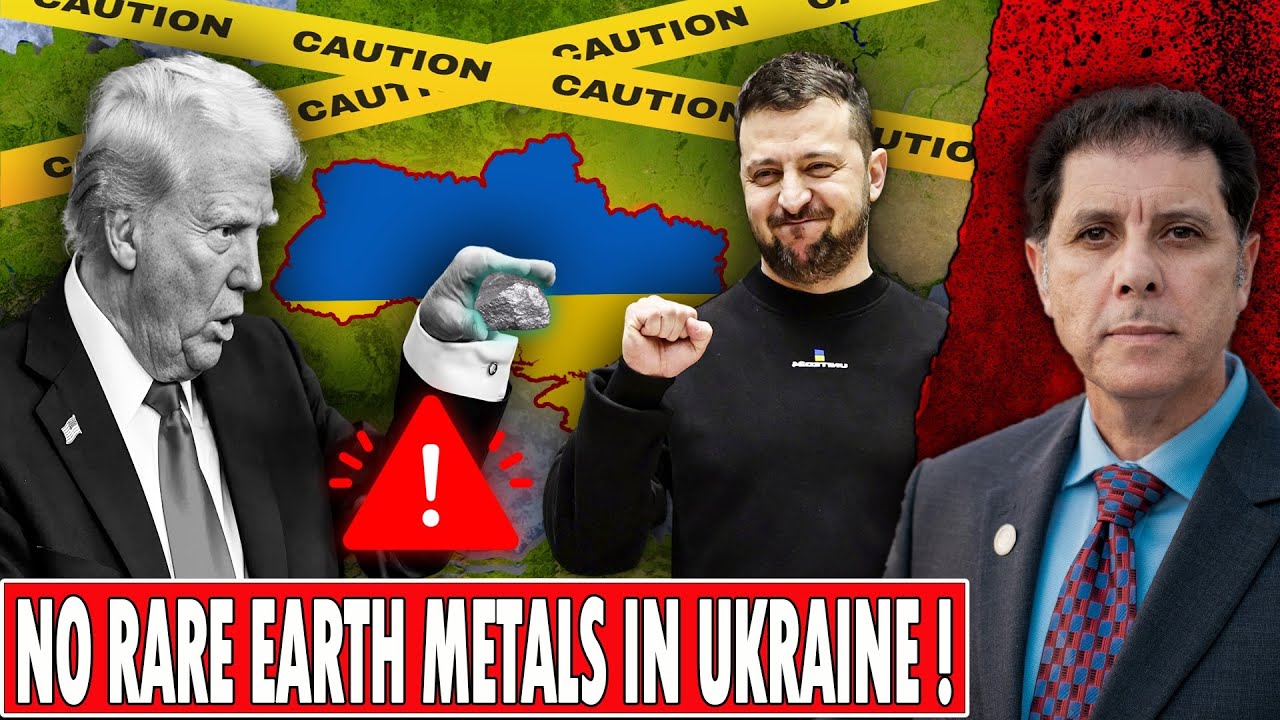
The video provides a geopolitical analysis of recent developments surrounding rare earth elements and critical minerals, focusing on a February 2025 framework agreement between the United States and Ukraine that grants the U.S. access to Ukraine’s antimony and other resources. The deal splits revenue 50‑50 but omits any U.S. security guarantees for Ukraine, which remains in conflict with Russia. In response, Russian President Vladimir Putin offered a joint U.S.–Russia exploration venture, claiming Russia’s deposits exceed Ukraine’s and proposing up to $15 billion in investments, even in territories Russia has seized from Ukraine. The presenter highlights a looming national‑security crisis: China and Russia together control virtually all global antimony production, a metal essential for ammunition, missile guidance, and nuclear weapons. After China banned antimony exports in late 2024, prices surged to $50,000 per ton and U.S. military reserves cover only about 17 days of combat. The analysis discusses the strategic dilemma for the U.S. between aligning with Ukraine (with corruption and security risks) and cooperating with Russia (ethical and geopolitical concerns). The video then shifts to a sponsor pitch for Military Metal Corp (ticker MILIF), a Canadian explorer with projects in Slovakia (Trohaiova antimony‑gold deposit), Nova Scotia (West Gore antimony), and Nevada. The presenter argues these brownfield projects can quickly supply Western‑controlled antimony, aligning investor profit with national‑security needs, and cites U.S. DoD funding for antimony projects, the EU’s Critical Raw Material Act, and NATO’s expanding munition production as supporting factors. The video concludes that securing antimony is a hidden national‑security emergency and that backing Military Metal Corp offers both financial upside and a strategic solution.
Chapters
Has a deal between the United States and Ukraine over rare earth minerals been reached? Why is this important for the United States? In a significant geopolitical development, the United States and Ukraine have reached a framework agreement granting the US access to Ukraine's vast reserves of rare earth elements and critical minerals. This accord, however, notably omits any security guarantees for Ukraine, a nation embroiled in a prolonged conflict with Russia. Complicating the scenario, Russian President Vladimir Putin has extended an offer to the United States for joint exploration of Russia's own rare earth deposits, asserting that Russia's resources surpass those of Ukraine. This intricate interplay of agreements and offers underscores the strategic importance of rare earth elements in global geopolitics, national security, and the military industry. A big thank you to our sponsor Military Metal Corp for sponsoring this video, and I will say more about it later on. The US-Ukraine framework agreements On February 26, 2025, the United States and Ukraine formalized a framework agreement focused on the joint development of Ukraine's natural resources, including rare earth elements, critical minerals, oil, and gas. Of interest in these discussions is antimony, a critical element for military industry. This partnership is poised to be economically significant, with potential valuation reaching up to $500 billion. The terms stipulate a 50-50 revenue split between the two nations, a revision from the initial U.S. proposal seeking full control over Ukraine's resource-related income. Despite Ukraine's ongoing conflict with Russia, the agreement conspicuously lacks US security guarantees. What about Russia's counterproposal? In a strategic maneuver coinciding with the third anniversary of Russia's military operations in Ukraine, President Putin has proposed a collaborative venture with the United States to explore Russia's extensive rare earth metal deposits. Emphasizing that Russia's resources are significantly more than those of Ukraine. Putin's offer appears designed to sway the United States' interests away from Ukraine. This proposal includes potential joint projects in rare earth exploration and aluminum supply, with suggested investments of up to $15 billion in Russia's hydroelectric and aluminum production sectors. Notably, Putin indicated that these projects could extend to deposits located in Russia's newly acquired territories of Ukraine, adding a layer of geopolitical complexity to the offer. Yet, there is the national security crisis no one is talking about. Herein the fact: China and Russia controls nearly 100% of the world's antimony supply, a metal the United States, or any other country for that matter, cannot go to war without. Why, you may ask? The answer is simple: no antimony, no bullets, no missiles, no military electronics. This metal is essential for ammunition, armor-piercing rounds, missile guidance systems, and nuclear weapons. Yet the United States produces almost none of it. For decades, the West has relied on China as the dominant supplier, ignoring the growing risk. Now the crisis has arrived. China just banned antimony exports, sending prices to a record $50,000 per ton. The Pentagon is scrambling to secure alternative sources. But the reality is stark. The US military has only 17 days' worth of reserves. Without a secure supply, America's defense systems are vulnerable. Geopolitical Implications. The dueling offers from Ukraine and Russia place the United States in a delicate position. Requiring strategic assessments of alliances, resource security, and geopolitical influence. Engaging with Ukraine comes with liabilities—corrupted government, fragmented security, and ongoing tensions with its nuclear neighbor. While Russia's proposal, though economically enticing, presents ethical and strategic dilemmas. Especially concerning collaboration in newly acquired regions. These developments underscore the critical role of rare earth elements, including antimony, in international security and the military industry, as they are essential components in advanced defense systems, including missile guidance and control mechanisms. This leads me to talk about today's sponsor, Military Metal Corp. As geopolitical tensions rise and global supply chain fractures, companies like Military Metal Corp, US stock ticker MILIF, are emerging as a vital player in addressing this crisis, offering investors a unique opportunity to back a solution to a pressing National Security Challenge. Antimony's role in warfare is not new. It was dubbed the secret metal that helped win World War II for its use in hardening alloys and enhancing munitions during the Allied efforts. Today, its importance has only grown with applications in night vision goggles, infrared sensors, and advanced battery technology. The US military relies heavily on this resource, yet it has outsourced its supply for decades, with China commanding roughly 50% of global production. This dependency was manageable until it wasn't. In December 2024, China imposed stringent export restrictions on antimony, slashing global availability and sending prices soaring to over $50,000 per ton. This wasn't just a market shock; it was a strategic move, amplifying a vulnerability that Russia, another key producer, could further exploit amidst its ongoing tensions with the West. The fallout for the Pentagon is dire. With no significant domestic antimoney production, the US military faces a scramble to secure alternatives as stockpiles dwindle. A Carnegie Endowment report warns that in a large-scale conflict, the United States could face shortfalls in 69 critical minerals, with current reserves covering only 40% of needs in a 1-year war scenario. Antimony's absence could cripple the production of artillery shells, vital in conflicts like Ukraine, leaving America's defense systems at risk. This isn't speculation. It's a stark reality unfolding now, as NATO defense spending surges past $1.5 trillion annually, driven by heightened global threats. Enter today's sponsor, Military Metal Corp, a Canadian exploration company stepping boldly into this breach. Unlike traditional miners chasing gold or lithium, Military Metals is laser-focused on securing Western-controlled antimony sources, positioning itself as a publicly traded lifeline for national security. Its flagship project, the Trohaiova antimony-gold property in Slovakia within the European Union, is a game-changer. Previously explored during the Soviet era,, a project was earmarked to become a mine that was never built as the Cold War ended in 1992. The brownfield site boasts a historical resource of approximately 2,500,000 tons of ore grading 2.5% antimony and 0.6% GPT gold. Based on extensive drilling and underground data. Located in a NATO-aligned nation, Trohaiova offers Europe a chance to reduce reliance on adversarial suppliers with military metal, aiming to fast-track it into production. The recently adopted Critical Raw Material Act in the European Union allows this project to be fast-tracked. Closer to home, the company's West Gore Antimony Project in Nova Scotia, Canada, adds another layer of promise. Once Canada's largest antimony producer during World War I, West Gore is a historic site with untapped potential. Surface piles of ore from past operations remain, offering a rare quick-to-market opportunity, a critical advantage in a crisis where time is of the essence. The company's CEO, Scott Eldridge, emphasized this strategic vision in a Small Cap Investor interview, stating, and I quote, "We are addressing the critical need for antimoney in defense, creating real solutions for secure supply chains. With antimoney prices up 228% in 2024 alone, the economics align with the urgency. The United States government recognizes this imperative. The Department of Defense's $1.83 billion investments in Perpetua Resources Antimony project signals a broader push to bolster domestic supplies. Perpetua, valued at $700 million with 90,000 tons of antimony, mirrors Military Metals' potential. Yet, Military Metals, with a market cap of just $25 million and a historical resource of 60,998 tons at Trohaiova alone, appears significantly undervalued. Its in situ value exceeds $3 billion at current prices, a disparity that savvy investors might see as a ground-floor opportunity in a sector poised for explosive growth. The stakes couldn't be higher. China's exports ban, coupled with Russia's unpredictable role, underscores the fragility of relying on foreign powers for a mineral so vital to national defense. OilPrice.com notes that antimony's scarcity could spark a new resource war with Western militaries racing to secure supplies aimed— escalating conflicts. Military Metals isn't just a mining company. It's a strategic asset, diversifying its portfolio across Slovakia, Nova Scotia, and Nevada to mitigate risk and maximize impact. Its brownfield approach Leveraging existing infrastructure slashes development timelines compared to greenfield projects, offering a faster path to production. For investors, the value proposition is clear. Military Metals aligns profit potential with geopolitical necessity, a rare dual mandate As NATO ramps up munition production—think about, for example, 2 million artillery shells by 2025 per the EU—and this initiative, Antimony demands will only climb. The company's projects, backed by historical data and modern exploration, position it to capitalize on this surge. Moreover, potential government funding like Canada's $3.8 billion critical minerals strategy could further accelerate its growth, reducing financial risk for shareholders. In conclusion, the anti-money supply crisis is a national security emergency hidden in plain sight. As China and Russia tighten their grip, the United States and its allies must act swiftly to secure alternatives. Military Metal Corp offers a compelling solution and a compelling investment. By supporting this company, investors aren't just chasing returns; they are backing a mission to safeguard America's defense capabilities. In a world on the edge, that's a stake worth owning. As always, Do your due diligence research, and like with any investments, there are no guarantees and there are always risks. Thank you.