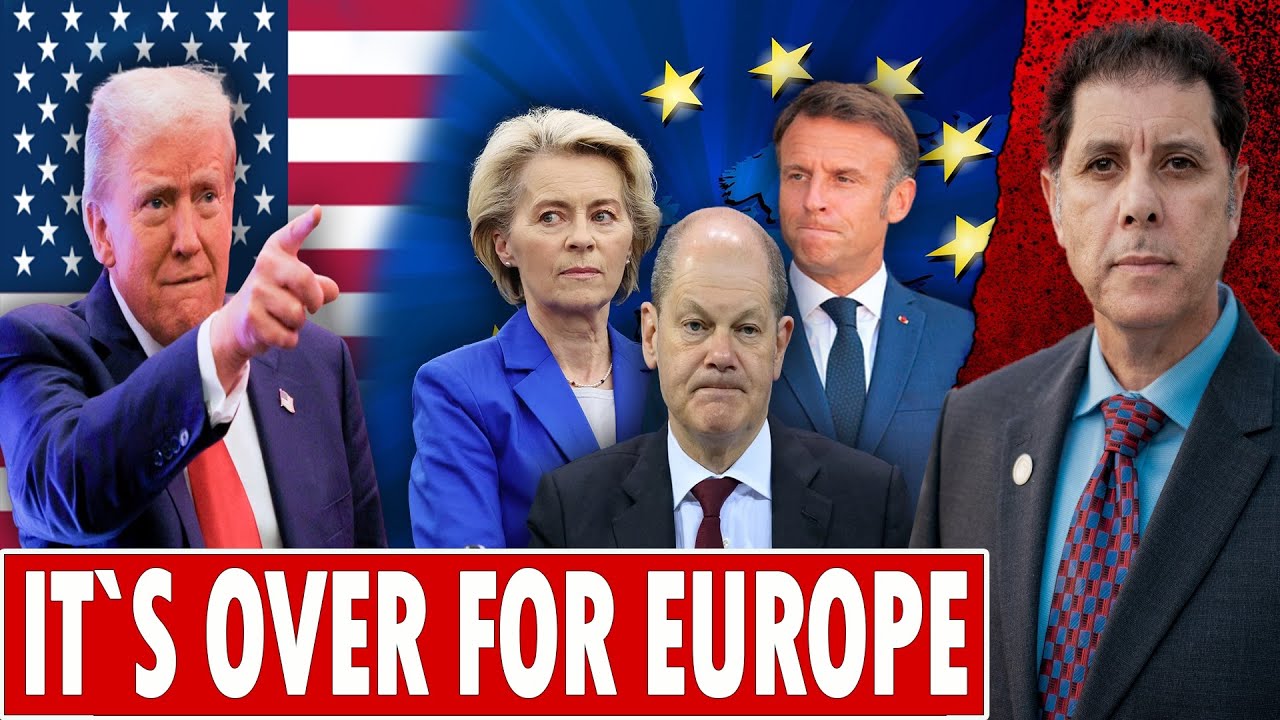
In this February 14 2025 livestream, the host of the Geopolitical Trends channel delivers a polemic analysis of the deteriorating U.S.–Europe relationship under former President Donald Trump. He argues that Europe is “exposed” and institutionally weak, and that Trump’s blunt criticism of European leaders (including at the Munich Security Conference) is a deliberate attempt to force Europe to shoulder its own defense costs and stop relying on U.S. subsidies. The host critiques two recent opinion pieces (by a writer identified as “Didi” and by George Friedman), disputes their claims about U.S. responsibility for the Ukraine war, and emphasizes that the U.S. has already spent over $300 billion on Ukraine while Europe contributes far less. He questions whether NATO and the broader transatlantic alliance are headed for collapse, raises the prospect of the U.S. withdrawing from NATO, and speculates on the strategic role of China in any future peace talks between the U.S. and Russia. Throughout, he engages the live chat, asks viewers to vote on whether transatlantic relations are ending, and repeatedly stresses that his analysis is “unfiltered” and not influenced by mainstream media or government sponsors. The stream interleaves clips from Trump, Pete Hegseth, JD Vance, Kaja Kallas, and other officials, while the host repeatedly labels European leaders as “weak,” “subservient,” or “clowns,” and frames Trump’s stance as a necessary, if harsh, reality check for Europe.
Chapters
All right, hello everybody and welcome to Geopolitical Trends, where truth matters. Excited to be with you on this, uh, February 14th, Valentine's Day. So to me, just another day. If you're gonna buy chocolate for your wife, you don't wait for Valentine's Day to do it, or buy flowers or what have you. You do that on every other day. So, and, and just by the way, guys, do you know the tradition of the Valentine, how far back it goes? So, so it goes back to the Roman time. So anyway, just something I read. Uh, very, very excited, and I mean it when I say this, because of the nature of the topic I'm going to be addressing for you today, the analysis that I provide, uh, given that I wrote extensively also on this part of the world that has to do with Europe, you know, where things now is gonna be. Europe is exposed. Exposed for what? For its weakness. And really, Trump doesn't mince words. I give a guy credit. I am very critical of Trump, and I'll say it to his face if I have an opportunity, but you give credit where credit is due. He's like sort of sticking it to the Europeans. Why? Because they are too weak. And that is the reason why you are hearing the statements now coming out of not only the president but also his Secretary of Defense, his vice president, his Secretary of State, and so forth. All of them aiming at, you know, exposing Europe for more weakness, because that's, that's all it is. So before I'll do this, I want to say hi to our wonderful community. Yan Hakor, good to see you. Hanging G, good to see you, and good evening to you as well. Truth Seeker, good to see you. Phil, as always. Taiwan Steel Army with Harmony, as always. And who is he? Oh, Work 2, Gita Hun, good to see you. And Marco W, good to see you as always. All right guys, uh, by the way, FYI, remember to join me tomorrow. I'm gonna put the link for you in the description I'm sorry, in the chat box. Uh, I have a lot of moving parts, so I better keep it together here. So, uh, for my interview tomorrow with Professor Anna Malindog, so it's going to be at 8 AM my time, which will be nighttime overseas in Asia, and about, uh, 4 PM if I'm not mistaken, or 3 PM in Europe. So anyway, here's the link on the chat box. And you guys can check it out later on. So, uh, now let's ask the key questions regarding this particular aspect of Europe now waking up to the reality. Trump is no Biden, which, by the way, I am in— you know, I'm gonna ask you a question. Do you guys— should— do you, in your opinion, do you believe should Biden be investigated? Yeah, it's just question, especially for my American viewers, uh, Biden and his former Secretary of State, uh, uh, Tony Blinken, and Secretary of Defense, and the National Security Advisor, former one that is. So anyway, let's ask the questions here. Is Europe cracking? When I say cracking, what am I referring to here? I am referring to the political structure that has hold the entity together. So, and when I say also cracking, I am also referring to NATO, because anytime— if you notice, anytime the EU moves in one direction, NATO goes the same direction in support of each other. Why? Because both of them are fear— are fearing, or they fear if there are cracks within society inside the European continent. And this is exactly what the vice president, uh, uh, uh, uh, Vance, just said. He lashed out at the Europeans at the Munich, uh, summit, which was— it's held on today. He gave a speech, and I have a clip I'm going to play it for you later on. So, second question: despite all this, will Europe stand on its feet? I've been always asking this question, you know, and it's, it's legitimate questions to ask. I've been asking it for years. And I never get the sense that Europe will ever be able to stand on its feet.
Why?
It's too weak institutionally, is too weak. Again, and could this provide an opportunity? I don't know. And I just wanted to ask, third question, does Europe's survival depends on the US? That's why I put that on the thumbnail. It is for a reason. That's my message there to those who knows the ins and outs of the transatlantic relations will be able to understand this one. And the last question is, is the, is the transatlantic relations era coming to an end? Because those are legitimate questions that we're going to have to sort of consider some. So as I said, uh, earlier, uh, uh, It appears that what Trump is saying to the Europeans, it's like, get over it, we're gonna move forward because you have to follow the orders we issue to you. Another word, we are the masters, you are the servant. So, and I had a chance to read some articles, and I'm gonna address two in this particular, uh, analysis here. I will react to them as I provide my own analysis. I disagree with the, uh, both authors on a certain aspect. There are other points that they were spot on. So, and I'm gonna address all this one here as I move forward. Before I'll do this, please make sure to subscribe to the channel because what you are hearing here, this analysis, and of course, uh, what you are learning here, you're not gonna find it anywhere else because What I share with you is unique to this channel, and I'm not bragging about it. I know what I'm talking about. So I would greatly appreciate if you could subscribe, and, and, uh, so just the videos or the content that I have reach out many, many other people around the world so they can have an opportunity like you to hear the truth. So here is the link in the chat box for those who just joined us here for the first time. Oh, I saw a super sticker already. Fred Ball, I thank you enough, uh, I can't thank you enough rather for your super sticker. You wrote, it's funny how EU is crying about basic diplomacy for peace. Also look at the words of Gaia Kalas, and I'm going to share a clip about that. Gaia Kalas, she's the foreign policy representative for the EU. Please, what a joke. You are right, you are right, Fred. These globalists, like, like von der Leyen, the liar I call her, trying to push the agenda. Absolutely spot on, and thank you so much, Fred. Truly appreciate your kind support. So, uh, all right, let me move on here with my own analysis here. So, so as I said, I had a chance to read, uh, some articles, and I came across one by, uh, an individual by the name of Didi. UNESCO DD. UNESCO DD. I wrote an article here. So, and of course I have to push back against some of the assertions. For example, Trump and the supremacist mentality. Well, you have to understand how you use the term. A supremacist mentality does not fit in within this context. If we are to talk about the language being condescending, tone for the Europeans? Well, because they deserve it. So, and also it's because, uh, when the author saying, well, he's, he's criticizing the European, well, rightly so, because we are the one. As an American, I am wondering about why am I sending my tax dollars to support European Defense Alliance when they can defend their own, their own, they can establish their own defense establishment. So, and actually, I have to disagree with the author regarding this one, that, uh, uh, uh, it's not about condescending, it's because it's, it's the truth. As far as the survival of Europe from a military perspective depends on the US because they allowed it. They could have got together and established their own security apparatus. So why? Because why should we be footing the bill for it? And this is what exactly what the current Secretary of Defense just stated. He was like, now the, the categorizing him as a, his speech as a betrayal to the Atlantic, transatlantic relation. He said, no, it is not because he stated the fact that Ukraine, there is no chance for it to be in NATO, period. And Europe needs to push or put more into its own defense. Simple as that. So, so, and this is where I, I, I disagree with the author that are saying that America is really seeking to subjugate its allies in the West. We subjugate them only if they allow it. Well, Europeans allow that. So simple as that. If we look at, if we are to look at the, uh, beginning of the conflict, you know, how it all started. It's because we allowed it. Simple, simple as that. Europeans allowed it. So I had a chance to read, uh, just brief synopsis of an interview by the Geopolitical Future, and I think its author, if I'm not forgetting his name, Friedman, something like that. But anyway, here is what it says: the war has been a failure. And I quote here, Mr.— yeah, his name is George George Friedman. Well, I couldn't dis— I disagree with what he's saying. That's bunch of nonsense. This is where you see the academic manipulation. It's worded nicely academically, but the truth has nothing to do with the reality on the ground. Here is what he stated, and I quote: The war has been— meaning the Russian-Ukraine war— the war has been a failure. Moscow has taken only about 20% of Ukraine territory. Thus failing to rebuild, to rebuild a decisive buffer. It has weakened the Russian economy and it imperiled the regime by sparking unrest and coup attempts, which Moscow successfully suppressed. Russia has done what it does best: it has failed but survived. It must now devise a strategy for the future that is more than just survival. What a bunch of baloney! Because first of all, if this author was honest enough, he would have had the courage to come forward and state it, academically speaking, that it was the US that planned the conflict to begin with, which was hatched back in 2007. I was in Washington, DC. I was aware of those dynamics as they were moving forward. And it became clear in 2014 when that decision was made by the State Department to allocate $5 million in push for the regime change in Ukraine, because you all know who voted in Ukraine back then. This is what's at the heart of it, what the author has failed miserably to address. And this is why you can't trust— you can't trust what's coming out of certain entities here in the US. You know, this is straightforward. That's what I said, guys, and I am not bragging about this channel or my other channel is because I provide you unfiltered information. You know, I am not beholden to anyone. I don't have a sponsor from Washington that can fund this. I don't have that stuff, and I would not allow it. I mean, I'm, I'm— I will, I will welcome the, the support, but if they start dictating the terms, I'll say it's been nice meeting you. Simple as that. So, and this is why, to go back to my original analysis here,, for the author Didi, where— why I disagree with him about certain aspects of it. So now the way you look at it is that tensions between Europe and Trump, of course, is going to escalate. They knew that when he announced he was running for office. They should have expected that. But also because they are concerned that now he's going to put them to test. He's gonna put them to task as far as funding for their own defense. So once again, do I agree with Mr. Trump on everything? Hell no. I am very critical of him. I look at his policies in West Asia, or Middle East, that is. I look at his policies now in Gaza. I look at certain aspects of this war on tariffs that has no idea how much is going to harm the American people. But on the other hand, I got to give credit where credit is due because of what he's asking the Europeans to do is to be responsible financially for taking some of the consideration financially. Why should us, an American citizen, be footing the bill for the Europeans? Simple as that. So I, I have no, no issue with that. Now the idea that, uh, the author saying what Trump, uh, uh, Trumpism America First. Yeah, it's a slogan, it's a push, is, uh, for domestic consumption. But the idea that, uh, Trumpism is based on the idea— this is what the author wrote, and I quote— Trumpism is based on the idea that America should put its own interest above all else, even at the expense of its traditional allies. Well, hold on a second, Mr.
Author.
Wouldn't it be the right thing to do for any country to put its national and strategic interest first before anyone else. So what makes this case different? And this is where I kind of, uh, uh, sort of challenge the author on these aspects, that the arguments that is presented is not well balanced. You're pushing only on one direction, but you are forgetting the other. That just doesn't make, make sense of this. And because Mr. Trump is saying that NATO is exploiting America, for that matter, as far as the funding. You all know who funds NATO. You know, the other countries put in 1.5 to 1.6% of their defense spending. Some of them increased it to 2%. What is that in comparison to what we are putting? Yeah, to me it's, it's common sense why it has to do. And I am even moving as far as saying maybe Mr. Trump should do what he did when he withdrew the US from the World Health Organization, he should withdraw the US from NATO altogether. All it takes is an executive order. Yeah, things can be changed in the next 4 years after he leaves office. The next president could put it back, but it's just the idea. This is what I'm saying, Mr. Trump, you know, I, I'm critical of Trump. I don't shy away from saying it, for the record. But the idea that if he really wanted to go that direction, then you do it this way. Go ahead and withdraw the US from NATO altogether. And I'm gonna get into that as I move forward into this one here. So, so we start to think about— and I have some pictures that I need to share with you as I address these aspects of it. So when you can— when you think about Europe, you know, thinking Europeans, well, of course, who matters in Europe? You know, you got Britain, matter in a sense of within Europe, because UK doesn't matter on the global stage anymore. You all know, especially for my viewers who live in England, please share with the community if the poverty is not on the rise in the UK. You know how the inflation in UK, how the economic conditions is going down, and it's no different than Paris. Yesterday I just had talked with a cousin of mine just returned from Paris and told me like, Paris is gone. Paris, we used to— I used to know it when I was a kid. It's gone, you know. And I am planning on making a stop there soon, and I will report to you guys even in a short video or whatever, because I will be there on the ground, and I know where to go in Paris. I know the corners in Paris. My family lives in Paris. So, so all those countries that matter, at least in Europe France, UK, Germany, Italy to a degree, Spain, give or take. That's all. Because the idea that what Mr. Trump now is trying to do is trying to sort of tell the Europeans, you know, that era of what you had with Biden is over. So, and rightly so. So, and this is what I'm saying, The transatlantic relations, it's gonna come— is it coming to an end? What do you guys think? Just quick question for you: is the transatlantic relations coming to an end? Meaning the relations between Washington and Europe. Just please answer in chat box yes or no, and I'll, I'll, I'll check your answer here. So, and there's very, very important to understand Why is this important? It is important because this is part of what geopolitics is all about. While all this happening, Russia, like I argued in my, uh, in my Russia book, it will be just matter of time before Russia plays its strategic game the right way. This is one of those opportunities, I believe, in my opinion. That Russia is going to benefit mainly from this. And this is now what's getting the Europeans so pissed off.
Why?
Because Mr. Trump decided to move forward with peace talks with the Russian president without the presence of Europe or Zelensky, comedian Zelensky himself. So that is very, very interesting dynamic. So So take a listen at what the, uh, I call her the idiot. She's not even qualified for the position. I have nothing against women, but she is clueless. Uh, this is, uh, what's her name? Kaas. So take a listen, please, and give me a heads up, uh, give me a thumbs up, please, on the sound. I want to make sure, uh, you can hear what she is saying. Here that any deal behind our backs will not work. Any agreement will need also Ukraine and Europe being part of it. And, and this is clear that appeasement also always, always fails. She— yeah, yeah, she is clueless. This is the same person who said only a week and a half ago, oh, we need to defeat Russia so we can carve out Russia. That just shows me the ignorance of the highest order, not understanding the history of the Russian Empire, not understanding that no empire was able to defeat the Russians. You know, you know, ask the latest in World War II when the Nazi Germany want to go and invade and they couldn't. So this is, to me, it's not a laughing matter, stupidity of the highest order. And this is why I have to sort of push back against certain arguments from the author, uh, who are arguing that, for example, the future of transatlantic relations. And I quote, Trump's policies appear to be based on a national— nationalist philosophy that puts America's interests above all else, even at the expense of its traditional allies. But the question remains: does America really benefit from weakening its allies in Europe, or will this policy lead to further divisions and weaken— and weakness in the West, strengthening the influence of rival powers such as Russia and China? You know what, to me, end of quote, to me that's just, uh, this is like a deceiving one. Here is why. It's because, interesting enough, that the author had to mention Russia and China for one reason and one reason only. And you know what that reason is, in my opinion? Because you always have to portray an enemy, whether it's real or perceived. Simple as that. We did it with the Soviet Union. Later on, a Russian Federation became— now we are shifting that to China as we speak. So, and this is why I just wanted to react to that, because sometimes I kind of, uh, uh, to me, here is the, here is the, here is the, the fact. The fact is this, that Western hegemony is on its last leg of its dominance. This is what this division and all this showed and exposed. That's what's at the heart. So when you have clowns like, uh, Olaf Scholz and Macron talking about the, the strength of the European— what strength? Olaf Scholz now is, is pissed that he's not even been consulted. And why should he? You know, why should any European for that matter? We the one who dictate the terms, not, not the, the idiot liar or so. They, we, they had their way. Europeans had their way with weak Biden because Biden was weak, very, very, very weak. This, this with Trump is slightly different. And you have the idea that even Elon Musk now supporting certain groups inside Europe like the AfD, which if he ends up winning the chancellor in Germany, you're going to see an upside-down turn regarding policies of Germany. So, uh, Europeans— this Stammerer of, of UK— they are so, so, so inept, so incompetent And again, I am not saying this to, uh, uh, downgrade. I'm pointing the facts here that Europeans are good at talking. It almost reminds me like Arabs, leaders that is, not the people. So they tend to talk too much. It's in action that you find out. So, and this is where the challenge, uh, uh, uh, moving forward, how I see it, Europeans now are pissed. Well, get over it, suck it up. Peace or not, the peace talk regarding Ukraine is going to take place between Russia and the United States. There is no need for Europe to be sitting at the table. There is no need for Ukraine to be sitting at the table. It's because if Europeans or Ukraine think they're gonna go back to pre-2014 borders, they are mistaken. I, I just don't, I just don't see that, that happens. Uh, let's move on into talking about Europe here. Let me share something with you here quickly, and I want, want to play a clip for you. Uh, let me open it up here first. All right, let me share this with you guys and just want you to take a listen, please. Oh, everybody can get it now. I don't know what it is. All right, let me see this one here. All right, I'm not going to play this one because it's not coming up here. So now let's talk about our European, uh, about NATO Summit that just took place. It's because the conversation or regarding the outcome of it, uh, it, it just, uh, actually, I got it, I got it. You know, pardon me here, guys, because I just have too many open screens that I have to navigate through to ensure the accurate one. So take a listen here, please.
Donald Trump's recent call with Russian President Vladimir Putin has shocked Kyiv and its European allies. They fear the White House might make a deal to end the war between Russia and Ukraine without them after Trump announced Kyiv won't get all of its land back or join NATO.
Any quick fix is a dirty deal.
This is European foreign policy chief Kaja Kallas.
It is clear that— So you already listened to this idiot, so we don't need to spend more time listening to that. But the point now, is that the idea, the idea that, uh, NATO now— because European now are sort of wanting to, uh, uh, uh, have a seat at the table after President Trump called President Putin. I don't think so. I don't think so. Like I said earlier, I think both leaders, the Russians and the Americans, going to work out a deal the way I see it. Even China China now is encouraging, even though China is not invited to the seat, to the table. Uh, I mean, for me personally as a geopolitical analyst, I would say have Chinese sitting there as well, even though Chinese have no stakes into that inside Europe. But with their global status, it makes more sense because again, I am referring to history here, back to the 1970s in the last century. You know, had the Soviet Union, uh, the Chinese and the Americans sat together, the direction of the global order would have taken a different trajectory altogether. So, and that is my question to you guys: do you think, do you think the Chinese should, uh, uh, have a seat at the table with the Russians and the Americans regarding the Ukraine-Russia conflict? So Let me just see your answer. If you could just play yes or no, that's easier for me to see that. So I just want to— do you think, in your opinion, China will make more sense to have China, uh, uh, have a seat at the table, at the table, uh, for the negotiation, the peace negotiations, uh, uh, that the US and the Russians will be negotiating? Uh, Sam, can you know, you say no. Uh, Flat Earth, you say nothing to do with China. Okay, Marcian Dossier, you say yes. Leon C, you say yes. Hanging G, you say yes. YT, you say yes. Okay, let me— John Smith. From New Zealand, you say yes. Macian Dorcier— I'm sorry, just me, you say, uh, Alvino, you say no. Well, okay guys, to those who say no, I need you to understand one thing. I respect your opinion, of course, but I need you to understand what I'm referring to here. Yes, I agree with you that China has no stakes when, when it comes down to what's going on inside Europe. Yeah, what I'm talking about I am talking about China's role on the global stage, because here is what I see coming. Here is what I see coming that maybe President Trump didn't think of or think about, is that Europe, Europe could switch to dealing with China economically and forego the US just to get back at Mr. Trump. That's the only way I see them doing that one. As a matter of fact, there is now a talk between the EU and Canada. You all know we're gonna impose tariffs on Canada, and we will be imposing tariffs on Europe. Well, guess what? Canada and, and Europe are already in talks about, uh, first of all, hitting back at the US, but strengthening the bilateral economic Could Europe do the same with, with China? Because Europe had to take its lead from the United States. Not on this one, maybe. So that is my point, uh, uh, uh, uh, that is my point as to why I asked that question. But I see you, your logical argument for why not. So, uh, while I'm thinking about it, somebody— Rample 01, you said, did I hear the speech by Vance at the Munich summit. Yes, I did. So, and I'm going to be playing some clips for you. So, so now the Europeans scrambling for having a seat at the table, it's not going to bode well for them. Why? Because Mr. Trump's going to be dealing directly with Mr. Putin. So why, why European opinion will matter? It will not. Because we dictate the term. You know, you think about NATO, for example. You know, uh, even it was reported by Reuters, which— speaking of Reuters, by the way, did you guys know that Reuters, Thomson Reuters, was receiving $9 million from USAID? Yeah, because Reuters has a contract with the Department of Defense. News agency. So, and why, why this contract was awarded? Because they were, they were tasked— meaning Routers, Thomson Reuters, that is— were tasked with developing automated defenses against social engineering attacks. Yeah, so even Routers— and I have the link that I'm gonna share with you guys. Uh, let me put it for you in the, uh, in the chat box, and you can read it later on if you decide to. This is what I spend time on, guys, researching stuff for you, because I want you to have the information that is not elsewhere. Yes, you can find it if you know where to look for it, but, but in any event, so now here is what Mr. Trump said, and I quote, this is regarding why he wants to move forward. He said, and I quote, 'I think they have to make peace,' meaning Ukraine, 'that people are being killed, and I think they have to make peace,' Trump said as he pushed both sides, meaning Ukraine and Russia, to start talks at the end of 3-year war. But it's the US that's going to have the talk, not Ukraine, you know. Later along, Mr. Trump said, and I quote, The US has spent over $300 billion that we sent to Ukraine, and Europe has spent $1 billion, which has never been disclosed. The previous administration said only over $150 billion, $170 billion was spent. Mr. Trump is saying, well, I'll take his word because he has access now, over $300 billion. So why are we taking our money and sending it to corrupted, uh, Ukraine? And why the Europeans don't put their own $300 billion, counting on us to do it? You know, every citizen does not understand this dynamics. So, and this now highlight to you the tensions that exist between Trump and Europe. You know, even the German defense minister— and I have a picture of him, uh, with the, uh, our defense secretary right here. The guy on the right, uh, his name is, uh, uh, Geert van den Wingerd. Sorry if I mispronounced his name. Anyway, uh, the defense minister Boris Pistorius said, and I quote, it was regrettable that Washington has made concessions to Russia before peace talks had even started. No, they didn't. We did not. We did not. I can't stress enough, guys, This is what the media does— wanted to manipulate you into thinking we already gave concessions to the Russians. We did not. You know, it's the same argument I will make about what the, uh, warmonger John Bolton said. And I have the, uh, interview here. I'm going to share with you the clip. Take a listen, please. Of course, he had to do it in none other than CNN. Who listens to CNN anymore? I mean, come on. Yeah, take a listen here, guys. Previously said that you believe Putin sees Trump as what you described as an easy mark. You were there for their first meeting in Helsinki.
What are your expectations for this one? Well, I don't have any expectations anymore. I think we know exactly what's going to happen. President Trump has effectively surrendered to Putin. Before the negotiations have even begun. The positions that Defense Secretary Hegseth announced in Brussels, which I'm sure I'd be stunned if Trump didn't convey them directly to Putin in their phone call, constitute the terms of a settlement that could have been written in the Kremlin. Maybe they were written in the Kremlin and got out in propaganda channels. But it's a complete reversal of the U.S. and NATO position on a number of issues. For example, up until today, The official American position was that Ukraine should be returned to full sovereignty and territorial integrity. That's gone. The question of NATO membership, as far back as 2008, had been that ultimately Ukraine would become a NATO member. That doesn't look like that's around anymore either. Putin has scored a whole series of victories today. It's hard to encompass them all, but I think one—
Yeah, and that's what I call the surroux diplomacy. On part of the Russians. You know, this is the same guy that said, oh, Iraq had the weapons of mass destruction. This is the same guy, Bolton, who's been advocating for war against Iran. Why should I take his word for that? And, and if, if you know the background of this guy, warmonger, he is the likes of Marco Rubio. I won't, I won't hold back on this one here. And this is what I need you to understand. What the media is going to be saying, it's like what this German, uh, defense minister, uh, Boris Pistorius, saying, oh, it's regrettable that Washington had made concessions to Russia before peace talks had even started, end of quote. No, like I said, there is not. No, because here is the, the problem for the Europeans is that they are not going to be party to the negotiations, the peace negotiations, and that they didn't like it because it exposed how weak they are and how subservient they are to the Americans. Simple as that. Because all the narratives that is coming out of certain capitals in Europe, uh, except for UK— UK, because UK will have to toe the line with what the US dictates, so the UK will not go out. And, and if you notice, It doesn't come from the UK, it comes always from France, uh, Germany, Italy to a degree, Sweden now. Even Sweden, yeah, even Sweden. The Swedish defense minister, uh, he's saying that European nations provide 60% of the military support to Kiev. Nonsense. And they must be involved in the negotiations. No, because Sweden shot itself in the foot when it joined NATO. Because what I'm going to share with you, I'll share with you the history of Sweden back in World War II. What did Sweden do at that time? It was neutral, you know. They, they, they didn't side with the Nazi Germany, they didn't side with the Allies, they stay neutral. They were dealing with both, business as usual. And Sweden had lived in peace with the Soviet Union and later on with the Russian Federation with no issues, till they shot themselves in the foot by joining NATO. Same thing with Helsinki. So when you start to think in these terms, uh, who's going to be talking? It's going to be talking the ones that we just can press them one direction or another. So even Olaf Scholz himself— Olaf Scholz now expressed his concern that Trump could force Ukraine into a bad peace deal. That would leave it facing the emboldened— in quote— the emboldened Russia. I mean, just— I mean, are you gonna take, uh, uh, this idiot at, at face value for what he says? I mean, literally, you know, literally, are you gonna take him for what— I mean, the guy is as clown as he gets. Now, now, even the, the, the Secretary, or the NATO Secretary General Mark Rutte, who was, by the way, ousted by his government in Netherlands. And you all know the reason why he became in that position. How did he become in that position? Because we told him, if you pressure your ASML company in Netherlands not to sell the, uh, the equipments for microchips, very, very tiny one, to Chinese then we can see what we can reward you with. And that's what exactly happened. I was aware of his visit to Washington before he left his office, because the moment he went back, it was like some sort of an assurances. And later on, actually, who was after that position for the NATO Secretary? There were two people. It was the idiot Boris Johnson, you all remember him, and it was this liar Ursula, she was hoping to get the position. But one thing you need to understand, we the one who decide who NATO Secretary is going to be, and it's always a European. But as far as the commanding officer for NATO is always a 4-star US general. So, so, and even this guy Mark Rutte now found himself in the corner. Why is this? Because if you go back to 2022 or '23, somewhere around that time, when he met with Zelensky, he told him— meaning Mark Roth told comedian Zelensky that we have your back, you know. Then later on he said, oh, we don't have to worry if ever Trump comes to power. Well, here you are now, you're dealing with it. You are dealing with it. And this is where This, this is where the idea of NATO as it's going to move forward, and it's expressed through the statements of the Secretary of Defense. Take a listen here, guys. Article 5 then for the NATO peacekeeping forces that could potentially be deployed, like, how does that deter President Putin?
Well, I would say—
I want to be clear about something as it pertains to NATO membership not being a realistic outcome for negotiations. That's something that was stated as part of my remarks here, as part of the coordination with how we're executing these ongoing negotiations, which are led by President Trump. All of that said, these negotiations are led by President Trump. Everything is on the table. In his conversations with Vladimir Putin and Zelensky. Uh, what he decides to allow or not allow is at the purview of the leader of the free world, of President Trump. So I'm not going to stand at this podium and—
uh, funny enough that he's using the term leader of the free world. You all remember that statement, and I did elaborate on this few months ago. That's one of the selling points we have to convey we are the dominant power.
Declare what President Trump will do or won't do, what will be in or what will be out, what concessions will be made or what concessions are not made. I can look, as our team has, of what's realistic, likely on an outcome. I think realism is an important part of the conversation that hasn't existed enough inside conversations amongst friends. But simply pointing out realism, like the borders won't be rolled back to what everybody would like them to be in 2014, is not a concession to Vladimir Putin. It's a recognition of the hard power realities on the ground after a lot of investment and sacrifice, first by the Ukrainians and then by allies, and then a realization that a negotiated peace is gonna be some sort of demarcation that neither, neither side wants. But it's not my job as the Secretary of Defense to define the parameters of the President of the United States as he leads some of the most complex and consequential negotiations in the world.
All right, I just want you to hear that the idea that even for Secretary of Defense he had to walk a tightrope, because the argument is he has to make sure he doesn't deviate from the big message that Trump is sending, which is what? Is what he told Zelensky. You have to do what you have to do. Meaning what? Meaning you have to accept the reality. First of all, the, that the people do not want Zelensky anymore because he's a dictator. You know, he forbade the elections, and, and as a matter of fact, there was no elections. That's what he did. So where is this democracy that Europeans are calling about? Second thing is that there will be no going back to what it was before 2014 as far as borders. In other words, uh, Russia is not going to give up the 4 locations they took over— the Donbas, the Duhansk, uh, and, and the 2 others, I couldn't remember the name there. So that's the eastern border of Ukraine nowadays, under part. But what you need to understand, and the media here is not disclosing openly, is that what started part of the problem is that in Kursk, for example, the locals were asking the Russians to come over and help defend them against the Ukrainians who were killing their children through landmines and so forth. So, and why the Europeans are not disclosing all this? So this is what I'm saying, the double standards of Europe. And that leads me to talk about what, uh, JD Vance told the Europeans, uh, during his speech at the Munich Security Conference. So, so take a listen here, guys. Very, very interesting because basically he lashed out at the European, and rightly so. Not that we don't have the same problems as far as censorship and all that. You're all familiar with this. So, so take a listen here, guys.
European friends must play a bigger role in the future of this continent. We don't think— you hear this term burden sharing, but we think it's an important part of being in a shared alliance together that the European step up while America focuses on areas of the world that are in great danger. But let me also ask you, how will you even begin to think through the kinds of budgeting questions if we don't know what it is that we are defending in the first place? I've heard a lot already in my conversations, and I've had many, many great conversations with many people gathered here in this room. I've heard a lot about what you need to defend yourselves from. And of course, that's important. But what has seemed a little bit less clear to me, and certainly I think to many of the citizens of Europe, is what exactly it is that you're defending yourselves for. What is the positive vision that animates this shared security compact that we all believe is so important? And I believe deeply that there is no security if you are afraid of the voices the opinions, and the conscience that guide your very own people. Europe faces many challenges, but the crisis this continent faces right now, the crisis I believe we all face together, is one of our own making.
All right, that's the key word— of our own making— meaning that the Europeans allow themselves to follow the US blindly the policies of the incompetent previous president, former President Biden, which by the way, I still believe he needs to be investigated. And again, all other cronies, because no exception to that. But the Europeans allow themselves to follow those policies because they said, well, the US is telling us to do this, we can count on Americans and all that stuff. Of course, we wanted to sink them down. But even with JD Vance, the speech, you need to read between the lines as to what he's also referring to other challenges. This is in reference to the Asia Pacific, because as we speak, and mark my word, you're going to be seeing some, how shall I put it, posturing that's going to be exposed through military movements in Asia. Especially in South China Sea, very, very soon. Remember the first trip of the Secretary of Defense? Where did he go? He went to Poland. Okay, that's to reassure certain aspects in Europe, but the aim is to calm down the theater in Europe and focus on Far East, because that is what the overall objective into all this. Then comes the idea, and I'm gonna— I'm sorry, and I'm gonna close with this one here— is the idea of neutrality. Is there any neutral country still left in Europe? Can anybody tell me, is there any neutral country that is still live, that, that still exists in Europe? Let me see if you can type in, in the chat box. Uh, Rampran Sawan, yes, I see your point. Ireland, that is correct. Liechtenstein, yeah, you don't hear much about it. I remember I used to have a student from Liechtenstein. Yeah, actually, Hangin' G, I'm going to show you. No neutrals left. And that is the right answer. Same with the empires. Empires, you are right too, they're not. Because you think about, we all hear about, uh, we all hear about, uh, uh, Switzerland, right? You'll be misled if you think that Switzerland is neutral. It's— you'll be mistaken. Neutral on paper. Did you know that it was Switzerland also that went ahead and sanctioned Russia right on December 2023? Okay, on December, uh, uh, I'm, I'm sorry, December 2024 also they added another, uh, uh, sanctions. And it's— and I have the link, I'm going to share it with you. Their Federal Department of Economic Affairs and Education in its capacity as the competent body of— for sanctions, has expanded its list of sanctions against Russia and Belarus. Switzerland is thus adopting the additional sanctions decided by the EU. And, and under these sanctions, then I read through all this, it was about 54 people in Russia that were sanctioned and 30 companies there were sanctions. So if you are to say we are a neutral nation— well, neutral in the sense that you don't get involved in wars, but you still get involved in aspects of sanctions— then what is that neutrality? There is no neutrality, and it doesn't exist. Now, for those who mention Hungary and Ireland, and I agree with you on that aspect, there are certain aspects of— like, for example, Hungary has been pushing back for peace against European Union's wish, to the point that Ursula von der Leyen wanted to choke the Hung— Hungarian economy.
Why?
Because they didn't want to allow, uh, the immigration. They didn't want to follow what the European Union is doing, and because that's their stand. That does not qualify them as neutral. No, it does not. So this is, uh— oh, Army with Harmony, thank you very much. If all together Why is the Red Sea closed? Yeah, well, because the Houthis won't allow— as a matter of fact, the Houthis now saying they will continue their, uh, uh, offensive operations. And I'm going to do a video for you guys next week. So, so thank you very much, Army with Harmony, appreciate it. So my point, I just want to close with this one: the idea of neutrality, it doesn't exist anymore. You know, look, like I example I gave you about Sweden in World War II. But look where Sweden is today, you know. And, and the, uh, uh, for, for Switzerland, don't, don't fall into that trap that is neutral. It is not. I mean, look, for few years ago, the government in Switzerland turned over the names of the bank holders in Switzerland, turned them over to the IRS here in the United States. So that's where you have to understand, uh, the, the reason I wanted to do this video for you guys, because you're gonna be hearing a lot of media saying things that it's gonna— they're gonna try to manipulate the narrative. This is why I reacted the way I reacted to the, the two articles, uh, by the individuals who wrote those articles. There are some valid arguments, I'm not saying otherwise, But other stuff I had to push back against because I can just see the deviation for why, uh, certain things go, go certain ways. It's like the same arguments for, uh, uh, why the, uh, uh, those who say what the Russian-US negotiations gonna open the next phase of restructuring the world. Not necessarily, not necessarily, because those who argue this point are missing the key component, and the key component is China. No matter how you look at it now, there is no way you will ignore the role of China on global stage, no matter how you look at it. And I'll challenge whomever, whomever, because the way I read it, when I look at the geopolitical map of the world, I only see 3 countries that matter. And these three countries will have to decide how they want the, the world to move forward. That's the only way I see it. And, and this is not, uh, uh, sort of new to me because that's what I argued in my book. And if you allow me to share this with you, and I'll close it with this one here. So, so here is what I disclosed in my, uh, in my Russia book because I was addressing European issues. So here's what I wrote: after the fall of the Union of the Soviet Socialist Republic, hereinafter referred to as USSR, in 1991, many in the United States and Europe claimed that the Cold War ended and that the capitalist system has triumphed. For much of the post-Cold War era, The assumption among Washington elite circles and Europe was that the Russian Federation no longer had the power it once did. That thinking among Washington elites persists even today. However, the thinking in the West that Russia will be unable to re-emerge has proven ill-conceived. And let us be realistic. Europe is similarly weak and more divided than ever. I do not see how it could even move forward or replace the US. So the other aspect that I addressed into this was, was the Soviet Union really the monster that Washington leadership portrayed? Not physically, not even if seen as a conventional fighting power. The Soviet Union posed its threat through the presence of its rival nuclear apparatus. Furthermore, that nuclear apparatus lay in the hands of Soviet leaders who espoused an ideology contrary to the capitalist principles on which America has built its so-called democracy. Thus, the Soviet Union, an ideologue opposed to capitalism, and armed with nuclear weapons posed a threat to the global economic order of which the United States has served as primary architect and guardian. That order, of course, went beyond US borders, incorporating other nations and their major industries, financial institutions, and infrastructures. The American public responded negatively to providing large sums of money to rebuild Europe. Yet the Truman administration played politics with the American people's sentiment when it presented the need for this so-called Marshall Plan not as a rehabilitation project but as a response to an emerging grave threat from the Soviet Union. That's my point. So American leaders, if they can manipulate the masses— and this is where my fellow American citizens here have no idea what is going on. So, and, uh, uh, and this is why, again, when the West start to— even back after 1991, uh, start to say the Cold War has ended— no, Cold War has never ended. The West needs to sort of reconsider its claim that it won the Cold War. It never did, because it's evidence to the contrary. So, and this is why when Russia took over Crimea, well, guess what? The world should not be pretending otherwise, because as a geopolitical analyst, I strongly believe I strongly believe that when Russia took over annexation, uh, when, when Russia took over, uh, Crimea, it became now, represented the new Iron Curtain. Yeah, except that this time around, that line of, uh, that line is drawn in Eastern Europe rather than its center. So from a military perspective if you are to think about it from a military perspective, because this line that the Russians draw now is where political discourse and conversation with the West end and military confrontation begins. So, so are we talking about Russian comeback? I argued back then, absolutely. We have learned nothing from history. So you do not humiliate your enemy You do not underestimate your opponent, and you certainly do not rub your enemy's nose in the dirt during victory elections or celebrations. And this is exactly what the former CIA director and Secretary of Defense Robert Gates stated. Yeah, and here is the funny things of them all, guys, and I'm going to conclude with this. Did you know that the Russian president invited Putin— I'm sorry, the Russian president Vladimir Putin invited Donald Trump to attend the May parade. You all know what May parade in Russia is all about. So, so can you imagine the three leaders, the Russians, the Chinese, and the Americans are there together? That, that will be a nail on a coffin for the Europeans because Europe is so weak, and I don't see how they're going to change. I I've, since I was a kid, and I, I was raised in a setting, in an environment where there were some diplomats in the family, there were some high-ranking people and so forth. So I was aware of that environment. Since I was a kid, I've been hearing about, oh, Europe needs to take a stand, Europe needs to build its own security apparatus, you need to take, you, Europe need to stop depending on Americans. Nothing ever changed. So, and I don't see it changing anytime soon. It will change once you get rid of the knuckleheads that exist right now and you have a new leadership, young ones from a different political thinking altogether. So, so once again, I want to say thank you to Fred, Fred Ball. I truly appreciate you. I want to say thank you to KL Super for your Super Sticker. Truly appreciate you, KL. Rafael Legon, as always, man, I truly appreciate you. You wrote, remember I said all three will be at the meeting, Putin, Trump, and Xi. China is the big boss. Putin is comfortable being the junkyard dog because the dynamics have changed. Of course, where China is today compared to what the Soviet Union was back then, it's no comparison. It's different. So I see your point for that one. Thank you so much for your Super Sticker. And Army with the Harmony, once again, truly appreciate you, uh, for your support. So once again, guys, if, uh, just remember to support the channel should you decide to do so. This is for my Asia trip. I am gonna be planning on heading out there towards August-September time frame. I will provide you the detail as far as the time frame, but but not the locations. There will be, I think, 1, 2, 3, 4, even 5 locations I have in mind. Depends on the funding. We'll see, uh, if I have the funding for it, I'll go. If I don't, I won't. Simple as that. And I will let you know. So, but thank you very much for your support. Should you decide to, uh, support the, the trip, that's the, that's the, uh, the link, uh, where you can donate for that one. So remember to join me tomorrow at 8:00 AM for my conversation with Professor Anna Malindog. And as always, appreciate you, uh, being here. Enjoy your Valentine's Day if you celebrate that, and I look forward to seeing you tomorrow. As always, remember, geopolitics impacts your daily life in more ways than one. Till next time, guys. Bye-bye.
More from David


Beyond the Single Actor: Why the Gulf Isn't Choosing Between the US and China


Iran, Iraq's Militias, and the Houthis Are Coordinating! This Changes Everything




Who Controls the Next Decade's Resources? Latin America and Africa's Geopolitical Crossroads

The Chokepoint Trap: How Washington's Stupidity Triggered a Cascade That Now Controls the World

Trump Spooked as IRGC Unveiled dual-use SLV, Deployed Ghadir Mini-Subs & Hinted at Tactical Nukes!
